On Feb. 21, a Los Angeles federal judge ruled that the son of a local Jewish same-sex couple previously denied U.S. citizenship will now be recognized as a U.S. citizen since birth.
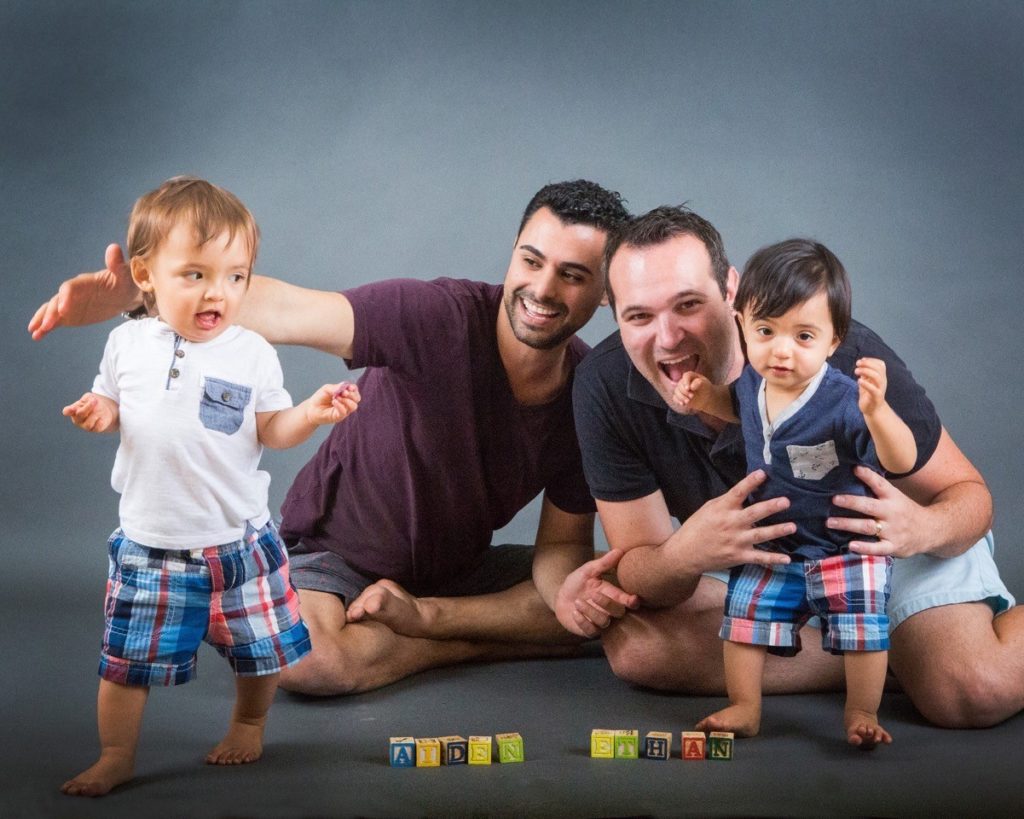
Brentwood couple Andrew and Elad Dvash-Banks filed a lawsuit against the State Department in January 2018 after one of their then year-old twin boys, Aiden, was given U.S. citizenship but the- other, Ethan, was not.
In his ruling, Judge John F Walter said the U.S. had no grounds to deny citizenship to Ethan, and that the State Department statute does not contain language “requiring a ‘blood relationship between the person and the father’ in order for citizenship to be acquired at birth.”
Los Angeles-born Andrew and Tel Aviv-born Elad, who works as IKAR’s development director, spoke with the Journal four days after the ruling.
“It’s been a really, really busy but an amazing last few days. We’re really, really thrilled with the news,” Andrew said.
And while the boys are only two-and-a-half and unable to fully grasp the magnitude of the decision, “We showed them the newspaper articles,” Elad said, “and Ethan saw his photo and said, ‘Ethan! Ethan!’
Despite their exuberance at the decision, the couple is still coming to terms with the toll their fight has taken on their entire family.
“It has been two sleepless years,” Elad said. “It was on our mind every single day. People can’t really understand what it is to live with the concern that you have twin boys and they’re treated differently. Though the decision that was made right now says Ethan was always a U.S. citizen since birth, no one can give us back these two years of worry or stress or sleepless nights.”
And on a practical level, Ethan’s undocumented status has not allowed the family to travel to Israel and visit Elad’s family, especially the boys’ great-grandparents, who are too old to travel to the States. Now, however, the couple has booked their tickets. “We’re going in August,” Elad said.
The couple’s saga began when Andrew and Elad decided to marry in 2010. They had hoped to do so in the U.S., but the Defense of Marriage Act was still in existence, so the couple moved to Toronto, where Andrew also has citizenship and gay marriage was legal.
The couple married in 2011 and knew they wanted a family. After finding a surrogate, they used sperm from both men, and the Dvash-Bankses were thrilled when their sons, Aidan and Ethan, were born. Aidan is Andrew’s biological son and Ethan is Elad’s biological son.
When same-sex marriage was finally legalized in the United States in 2015, the couple planned to move back to Los Angeles, with Andrew sponsoring Elad’s green card. They returned in August 2017 to Los Angeles.
However, immigration authorities demanded DNA testing for the twins, and determined that because Aidan was the only child biologically related to Andrew, he alone would be granted U.S. citizenship.
Andrew and Elad were shocked when they were asked to perform a DNA test on their children. They wondered if they had been a straight couple — an American husband and an Israeli wife — would they ever have been asked to perform a DNA test or questioned if they had used a surrogate?
While both men said they were hopeful and confident that the law was on their side and that Ethan would eventually be granted citizenship, “Of course, you worry,” Andrew said. “This is my child’s life. I never want to take that for granted or mess around with that.”
“I also felt pretty confident the decision would be in our favor,” Elad said, “just because the law is very clear. It’s so simple. The law doesn’t require a biological connection. But, like Andrew, I was concerned. What if something else happened in the meantime?”
The Dvash-Bankses also hope that their victory will help others.
“I really hope that other families don’t have to go through what we went through and that any child born abroad to an American citizen parent will be treated equally regardless whether they’re born from a man and a woman or two men or two women,” Andrew said.
Elad added, “We hope this decision is another step in the right direction to make sure all the policies of the different agencies and the government as a whole are equal and are fair to the LGBTQ community and that parentage is not assumed to be a man and woman only.”
The couple also plans on ensuring that their boys know their story. “We are always going to talk to them about this situation and this moment,” Andrew said. “We don’t want to keep anything from our children. We want to always stay honest with them. I really hope that our children see the love we have for them and we will always fight for their safety and security.”
In addition, Andrew and Elad have been writing to the boys since they were born. “We write emails to them all the time,” Elad said. “We established e-mail addresses for them both, and when they are old enough – maybe after their bar mitzvahs — we will give them the password and they will be able to see all the emails we’ve written to them through the years.”
The Dvash-Bankses are looking forward to being able to celebrate with their local community — IKAR — which will host a celebration for the family this Shabbat.
“The IKAR community has been so supportive,” Elad said. “There is no better community in Jewish LA to be part of at this moment. It’s one of the most progressive, social justice, supportive organizations out there and just to be an employee of such an organization and to work with Rabbi [Sharon] Brous who is a fighter for social justice and LGBT rights, is an honor.”
Beyond that, the Dvash-Bankses are just hoping to move on with their lives.
“All we’ve ever wanted is to be a happy, healthy family,” Elad said. “And not always in the public eye. We hope this [ordeal] is something we’ll be able to teach [the boys]: how to fight for yourself and fight for what’s right and stay a good person.”