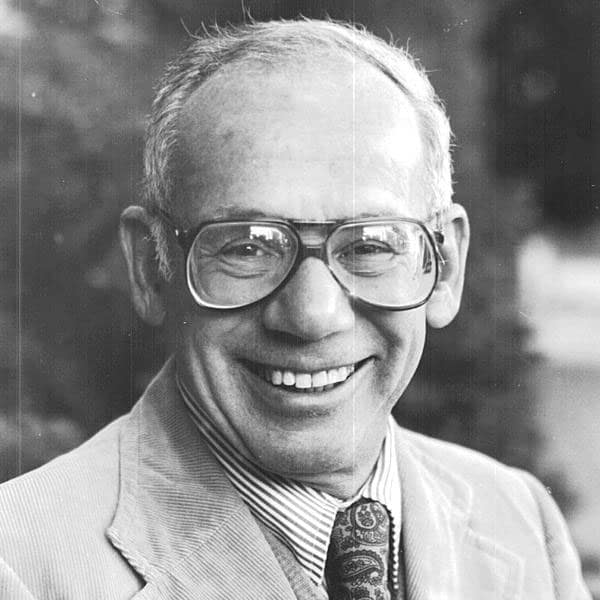
When David J. Gross, a winner of this year’s Nobel Prize in physics, was asked whether he was Jewish, he told a reporter, “What do you think? Of course!”
The same affirmative answer applied to five out of six 2004 science Nobel Laureates. Two are Israelis, three are Americans — all from Southern California universities — and two of these Americans have close ties to Israel.
The Israeli winners, Avram Hershko and Aaron Ciechanover of the Technion in Haifa, shared the $1.35 million prize in chemistry with Irwin A. Rose, professor emeritus at UC Irvine.
They were recognized for their research on the regulatory process taking place inside human cells, a discovery leading to the development of drugs against cancer and degenerative diseases.
“The practical applications are too numerous to mention,” said Rose, generally addressed as Ernie, who was quick to give major credit for the prize-winning work to Hershko.
In the typical research collaboration between professors and their graduate students, Rose became Hershko’s doctoral thesis adviser when he spent part of his 1972 sabbatical year at Israel’s Hadassah Medical Center.
“I took my wife, four children and mother-in-law and we settled in Jerusalem,” he said.
Ciechanover, in turn, became Hershko’s graduate student and over the next 19 years, the two Israelis spent the summers at Rose’s lab at the Fox Chase Cancer Center in Philadelphia.
Ciechanover is director of the David and Janet Polak Center for Cancr Research and Vascular Biology, a project of the Southern California chapter of the American Technion Society.
The two Technion researchers are the first Israelis to receive Nobel Prizes in a scientific discipline and their work has been supported for many years by the New York-based Israel Cancer Research Fund.
Jubilant Israelis liked the Nobel award to the Olympic gold medal won by Israeli windsurfer Gal Friedman. The prize was also seen as a telling answer to some European academicians who have called for a boycott of Israeli scholars.
Rose was born in Brooklyn, attended Hebrew school, but became a “confirmed secularist” at age 10. Now 78, he and his wife live in Leisure World in Orange County, are active in the retirement community’s Concerned Citizens group and express their Jewish identity mainly through their ties with Israel, he said.
For the Nobel prize in physics, Gross, director of the Kavli Institute for Theoretical Physics at UC Santa Barbara, shared the award with professor H. David Politzer of Caltech and professor Frank Wilczek of the Massachusetts Institute of Technology.
The Nobel Foundation recognized their development of quantum chromodynamics, the study of the mysterious “strong force” that holds the nuclei of the atom together, even as the protein’s electrical charges try to blow them apart.
The development is seen by many scientists as a major step toward a “Theory of Everything” — a single set of equations to explain all phenomena from the force holding atoms together to the gravitational fields that hold planets in orbit.
Colleagues confirmed that Politzer is Jewish, but he did not respond to an interview request, and former Los Angeles Times science editor Irving Bengelsdorf described the Caltech physicist as unusually shy and sensitive.
Politzer affirmed this description by refusing to attend a press conference in his honor, despite the pleading of Caltech President David Baltimore.
Gross, who previously taught at Princeton, was more outgoing. As a teenager and young man, he lived for eight years in Israel, while his father served as economic adviser to the government and founded the business administration school at the Hebrew University.
The younger Gross received his bachelor’s and master’s degrees at the Hebrew University.
“For one day, until Hershko’s and Ciechanover’s award was announced, I was considered the first ‘Israeli’ scientist to have won a Nobel Prize,” Gross said.
For five years, he directed the Jerusalem Winter School at the Hebrew University’s Institute for Advanced Studies and will be back in Israel in April to participate in a symposium on Albert Einstein.
The figure for the total number of Jewish Nobelists varies slightly, depending on the strictness of the “Who’s a Jew?” definition. But the figure cited most frequently is 161, or 22 percent of Nobel Prizes in all categories awarded between 1901-2003. With the 2004 additions, the total apparently stands at 166.