“Do Jewish people still practice sacrifices?”
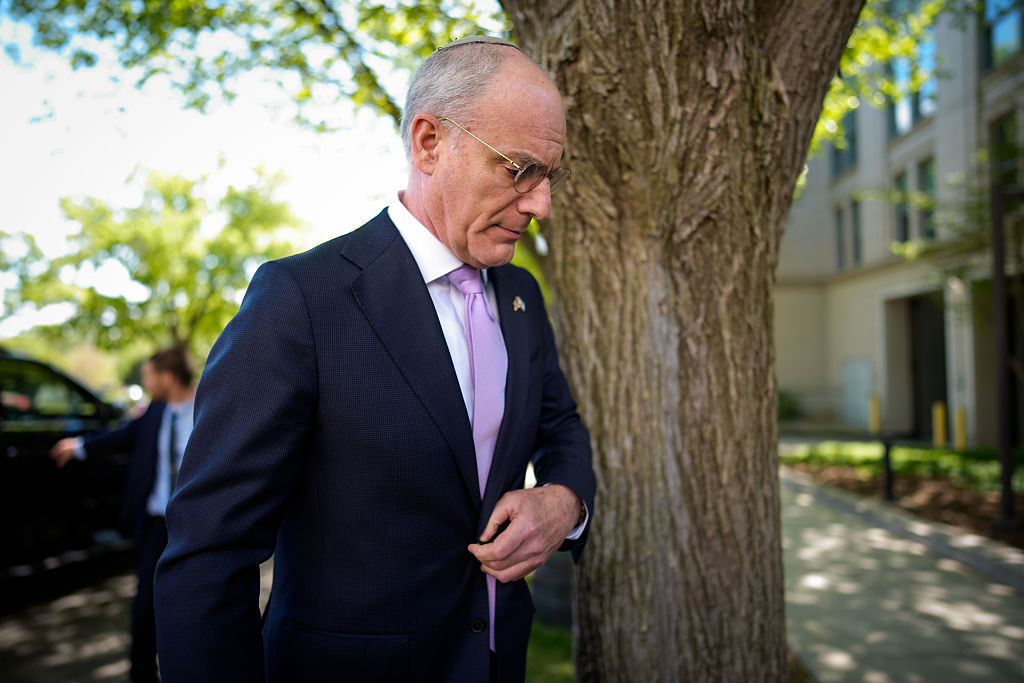
This was among the questions asked recently by a group of Mormon missionaries, 50 students who came to Palos Verdes’ Church of Jesus Christ of Latter-day Saints to hear a lecture by Rabbi Isaac Jeret of Congregation Ner Tamid, located right next door to the church.
Jeret was one of three rabbis to address the Mormon missionary groups in an attempt to build further understanding between the two religious groups.
Jeret explained that no, Jews no longer practice sacrificial rites. He also answered questions, including, “Which tribe are the Jews descended from?” “Who was the last Jewish prophet?” and “Are Jews planning on building [a] third temple?”
These questions, which followed a 45-minute lecture by Jeret explaining the essentials of Judaism, showed the missionaries’ familiarity with the Jews of the Torah — the Old Testament — but they also revealed their lack of knowledge about modern Jews and Jewish practices.
“What they know of Judaism is very biblical,” Jeret said in an interview following the Q-and-A session. “They know what Judaism was 2,500 years ago.”
“In such a culturally and religiously diverse city, I felt a need for missionaries to develop a great appreciation of and sensitivity to other faiths,” said Mark Paredes, former director of Jewish Relations for the Mormon Church of Southern California. Because Parades had already built ties to the Jewish community, he started the training with Judaism. He invited Jeret, Rabbi David Wolpe of Sinai Temple and Rabbi David Woznica of Stephen S. Wise Temple to speak to different groups of young missionaries at their “Zone” (regional) conference. (The men, the majority, were ages 19 to 21, and the females aged 21 to 23 — the preferred ages for the two-year voluntary missionary service that some 60 percent of Mormons undertake.)
“They would do well to take Rabbi Wolpe’s advice to learn as much as they can from other faith traditions,” Paredes said.
The rabbis explained their goal was to create understanding, and they were wary of proselytizing.
Amy Klein has written about Mormon missionaires before. Check out this piece about a lunch meeting she had with some LDS missionaries
“I want to be clear,” Jeret told the students. “I’m not here to help you missionize. If you really want to build a bridge between the Mormon and the Jewish communities, understand who we are and how vital and important and precious the Jews are to the Jewish people,” he said. “Understand a little bit more of the beauty of our heritage.”
In describing two basic tenets of Judaism — that the messiah has not yet come and that a belief in more than one God is wrong — Jeret attempted to show that Jews and Mormons share the notion of monotheism but are distinct in their understanding of the Messiah.
There are also other differences, many subtler: “You can approach a Jew and ask them what they believe, and they say, ‘I don’t believe in God,’ and they’re still Jewish,” Jeret explained. “That sounds ridiculous to many Christians,” he acknowledged to nodding heads.
He also advised the group to learn about Jewish holidays and time schedules, such as Shabbat, so they will not offend Jewish people.
Jeret ended on a note of collaboration: “The Mormon faith is the fastest-growing faith in the world, and you have the opportunity to stand up and join with Jewish people for the state of Israel,” he concluded. “Every one of you can be part of it.”
After the session, Jeret said he believes his lecture will dissuade these Mormons from proselytizing to Jews.
“You can’t make a case why Jews should convert,” he said. “My message is that there’s nothing comparable about Mormon faith and Jewish faith.”
He called proselytizing of Jews “futile,” and noted that he believes his lecture provided nothing “they can take to use to a constructive end.”
But that was not necessarily the message the missionary students took away from the lecture.
“He focused on the Jewish people and how family oriented the Jewish population is,” said Sister (Bethany) Olsen, 23. “I didn’t realize how strong the Jewish family is.”
She also said she hadn’t realized how broad the spectrum of modern-day Judaism is. But the talk didn’t dissuade her from wanting to reach out to talk to Jews.
“We knock on doors all day, and people say, ‘I’m sorry, I’m Jewish’…. Jews have an easier excuse to close doors,” she said, noting their purpose isn’t to convert, but to understand more. “Sure, if they happen to be interested in converting, I wouldn’t be disappointed.”
Spencer Blackburn, president of the California Los Angeles Mission, said the “aggressive” missionaries need to learn about other faiths.
“We don’t know how to be sensitive,” he said. “People say, ‘I’m Jewish.’ What does that mean?”
Blackburn said people might simply ask questions, have a dialogue and then leave.
Many of the missionary students said their purpose is to spread the message of God and begin a dialogue about faith.
“I love taking the message,” said Elder (Matt) Stapelton, 21. “I wasn’t going into this to learn tactics of conversion into a Jewish home,” he said. “Sometimes I want them to tell me about their faith. People always think we’re going to convert them — I just want to understand where they are coming from.”