After 25 years of discussion, prayers, lobbying, false starts, delays and setbacks, the “walls” are finally going up in Encino and Tarzana — and the community of Orthodox Jews living there couldn’t be happier.
With state and city permits in place, the West Valley Eruv will be blessed and officially launched Dec. 16 at a 6:30 p.m. ceremony at the Eretz Cultural Center in Tarzana. The establishment of the eruv — a halachic perimeter that transforms a public area into a private domain for Shabbat — will help unite the community and allow it to grow, say the advocates who have spent the last three years raising support for the project.
“It’s a miracle that it’s happening,” said Rosana Miller, secretary and treasurer of the West Valley Eruv Society. “I went into this process with a good feeling. I saw it was going to happen. When? I don’t know. How much? I don’t know. But I was positive it was going to happen.”
An eruv defines a specific area by use of a fence, string or wire and allows observant Jews to carry items within its boundaries on Shabbat, in accordance with Jewish law. This includes synagogue-goers carrying books and prayer shawls, as well as parents wheeling strollers. Residents of communities within an eruv say that the structure opens up the community for greater social interaction.
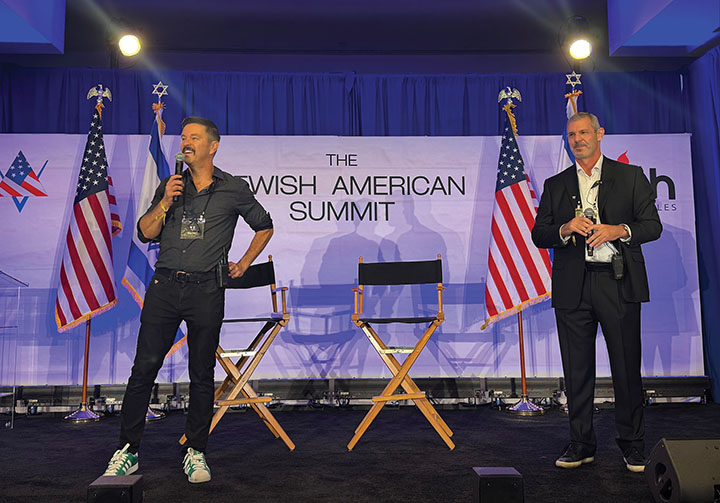
 From left: Rabbi Eliezer Eidlitz, City Councilman Paul Koretz and Rabbi Dovid Horowitz.
“We noticed a lot of women here in the area cannot come to synagogue because the kids cannot come with carriages. Old men cannot come with a wheelchair or a walker,” said Miller of Encino. “It’s not a community if the husband can pray and the kids have to stay home. We have a lot of women complaining it’s like prison in the house.”
“You work all week and you want to go out and have a social life at the synagogue with your friends and your community,” added Rabbi Meyer May, executive director of the Simon Wiesenthal Center. “With an eruv, an Orthodox community creates the wherewithal for mothers and young families to be released from the prison of a Shabbos home.”
The first phase of the West Valley Eruv will cover a stretch of Ventura Boulevard that extends west from the intersection of the 405 and 101 freeways to White Oak Avenue. Then it will snake south around the El Caballero Country Club, wind its way back north via power lines near Wilbur Avenue, banking west to Tampa Avenue and north to Victory Boulevard before zigzagging east along the Los Angeles River and eventually meeting up again with the 101.
The total cost of the project is approximately $300,000, according to Rabbi Eliezer Eidlitz of the Kosher Information Bureau in Valley Village. Existing structures such as freeway off-ramps, sound walls and fences can serve as parts of the eruv, as can fishing wire strung between utility poles.
Subsequent phases of the eruv are expected to expand the territory to encompass areas south of Ventura Boulevard, according to Rabbi Dovid Horowitz of Makor HaChaim, which falls within the area of the first phase’s 15 square miles.
There already are existing eruvs in the city. The Los Angeles Community Eruv encompasses 80 square miles of communities including Hancock Park, West Hollywood, Beverly Hills, Westwood and the Pico-Robertson area. The Valley Eruv — established in 1983 — is bounded by five freeways and covers a 27-square mile swath of the East Valley, including Sherman Oaks, Studio City, Van Nuys and North Hollywood areas.
Community leaders say that interest in an eruv to serve the West Valley — particularly the Encino and Tarzana regions — has been growing steadily since the early 1990s. Different organizers have tried to raise funds and rally the community behind the project without success. When Miller and her husband, Alon, volunteered to spearhead the effort, they said that many had given up hope that it would ever come to fruition.
The Millers gained the support of 5th District Los Angeles City Councilman Paul Koretz and 30th District Rep. Brad Sherman. Joseph Bernstein of Rosenheim of Associates was hired as a consultant to help secure permits from seven agencies ranging from the City of Los Angeles Department of Public Works to the U.S. Army Corps of Engineers. The Wiesenthal Center’s May, who had extensive lobbying experience in Sacramento, was called in to help secure final permitting approval from the California Department of Transportation.
Once the eruv has been launched, a rabbi must check every segment of the structure on a weekly basis before Shabbat to make sure that all of the boundary elements are intact. Eidlitz has been consulting on the project for more than five years and has been overseeing the eruv’s spiritual requirements, just as he does with the East Valley eruv.
Eidlitz emphasized that the community will need to continue to support the development and maintenance of the West Valley eruv once it is launched, just as they have done to bring it about.
“I’m inspired by Mrs. Miller. She was a one-person machine of putting their money and desire into this project and moving forward no matter what happened,” he said. “That is a strong message of what each of us can do.”
The community is invited to the launch of the West Valley Eruv, Dec. 16 at 6:30 p.m. at the Eretz Cultural Center, 6170 Wilbur Ave., Tarzana. Rabbi Moshe Heinemann of the Agudath Israel in Baltimore will preside.