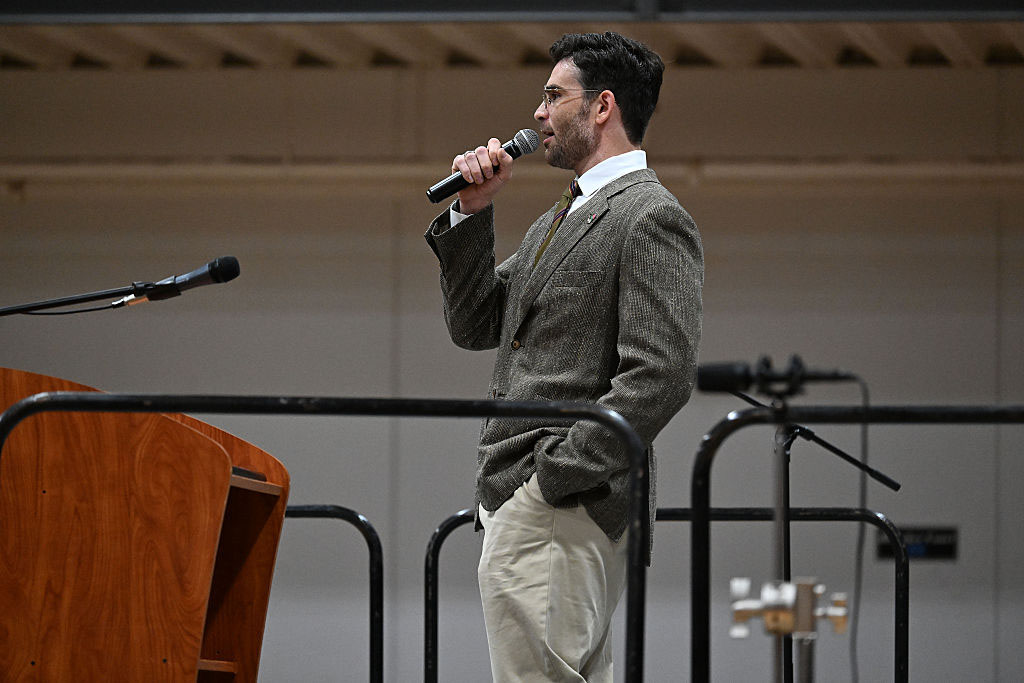
In an elegant limestone building in a Jerusalem neighborhood that before 1948 was home to the city’s Palestinian elite, a group of Jewish and Arab Israeli academics recently tried to untangle one of Israel’s most complex and charged questions: the status of its Arab minority.
“The discussion here is so important because we are trying to see if this is a zero-sum game or if it’s possible to find the way to coexistence,” said Anita Shapira, the Israeli historian and former dean of Tel Aviv University who presided over the symposium on the topic organized by the Israel Democracy Institute.
As Israel celebrates 63 years of independence this week, relations between its Arab and Jewish citizens are marked by a palpable and growing sense of alienation. As often occurs on Yom Ha’atzmaut, the marking of Israel’s Independence Day served to highlight the divisions between Israel’s Jews and Arabs.
Just a few weeks ago, the Knesset passed a new law that mandates fines for state-funded groups that question the country’s status as a Jewish and democratic state. Critics say the so-called Nakba law—aimed at outlawing marking Yom Ha’atzmaut as the Arab Day of Catastrophe, or Nakba—limits the right to freedom of expression and is an attack on the country’s Arab minority.
That and other recent Knesset measures—from a bill attempting to cancel Arabic’s status as an official language in Israel to proposals for a mandatory loyalty oath—have sharpened feelings of disenfranchisement among many Arab citizens of Israel.
“I have no problem with your religion, but I also want you to acknowledge my history,” said Aziz Haider, a Hebrew University sociologist, during one of several heated exchanges at the symposium. “There is a State of Israel and Israel’s establishment is the result of our Nakba.”
Nakba is how Palestinians commonly refer to the events of 1948, which led to Israeli statehood but also to Palestinian dispossession.
“Israel, instead of going toward reconciliation, is headed towards confrontation,” Haider said.
How to reconcile an Arab minority in a state that defines itself as both Jewish and democratic remains one of Israel’s greatest challenges.
On the one hand, Israel’s Arab citizens, who number about 1.6 million in a country of 7.7 million, are more “Israeli” than ever before. They are fluent in Hebrew, are intimately familiar with Israeli culture and are present in relatively large numbers as students in Israeli universities. In recent years, the government has begun to address the imbalance in allocating resources among its Jewish and Arab citizens.
On the other hand, that imbalance still exists, Arabs still rank among Israel’s poorest citizens and they live largely apart from Jews.
In recent years, Israeli Arabs also have embraced a more assertive political voice, expressing solidarity with their Palestinian counterparts in the West Bank and Gaza, and growing more vocal in their criticism of the Israeli government.
Arab Israelis say they feel more threatened in Israel—the current Israeli foreign minister, Avigdor Lieberman, advocates transferring some Arab Israeli towns to a future Palestinian state in the event of a peace deal, and wants Arabs to be required to take a loyalty oath to the Jewish state—while Jews say they feel more threatened by radicalized Arabs.
“There is a psychological problem for both the Jews and the Arabs,” Shapira said. “The Jews today still feel as if their majority status is under attack.
“On the Arab side, the Arabs are not used to being a minority, and they demand every now and then rights that belong not only to the Arabs as individuals but also want collective rights. This causes a clash.”
At the symposium last month, Professor Yedidia Stern, who teaches law at Bar-Ilan University, cited a recent poll finding that the majority of Israeli Jews are against any notion of universal rights for minorities.
Meanwhile, political discourse among Israeli Arabs in recent years has focused on stripping Israel of its Jewish symbols in the name of democracy and minority rights, including changing the flag and national anthem.
“For Jewish Israelis, the situation seems very pessimistic, like we are on a collision course,” Oded Haklai, a political science professor at Queen’s University in Canada, said at the symposium. “But if one looks comparatively, it can be seen that the behavior of Arabs in Israel show they have accepted the rules of the game of democracy as the only game in town. Political violence, for example, is very rare, and that is something we take for granted.”
As Israelis prepared to celebrate Independence Day, Issa E. Boursheh, an Arab graduate student at Tel Aviv University, published a personal plea for mutual understanding in an Op-Ed in The Jerusalem Post on Monday.
“While Jewish Israelis are honoring their heroes, Palestinian-Israelis have the right to honor theirs,” he wrote. “The Israeli and Palestinian narrative may never agree, but I trust that in the long term, with proper steps taken now, we will be able to reach a point of understanding. We might never celebrate Independence/Nakba together, but we may be able to have sympathy toward a hope that is not lost—to be free people in our land.”