
To read more articles from The Media Line, click here.
(The Media Line) Daily bombings were ringing in the ears of Menachem Lichtsteyn and his wife, who for many years have been among the caregivers for dozens of Ukrainian children. For many of these children, the only home they have ever known is Ukraine’s Alumim orphanage.
After leaving the city with only what they could carry, Lichtsteyn says, his wife handed a game that was almost left behind to one of the children who then broke out in tears. It was at that moment that he realized he was probably leaving home for good.
On Sunday afternoon, two planes arrived in Israel carrying around 80 children from the Alumim Jewish orphanage in Zhytomyr, a city located in the northern part of Ukraine that has been mostly destroyed by the Russian military since it invaded the country late last month.
Menachem Lichtsteyn, who arrived in Israel with the children, told The Media Line that the reason their hometown was subject to such heavy bombardment is because it is located very close to a Ukrainian military camp, making it a target for the Russian army.
The bombing attacks on Zhytomyr began on February 24, the first day of the Russian invasion of Ukraine.
Lichtsteyn said they realized that the children would need to be evacuated on that day, when the bombing attacks woke them up at 5:30 a.m.
“We woke up from explosions, there were four rockets, and all the children woke up very scared and in panic,” he said. “We even have one girl that was also in Donetsk when the war started there eight years ago, and it transported her right back to the trauma that she lived almost a decade ago.”
Irena Kapakova, an English teacher at the school, who came along with her own five children, including a newborn, told The Media Line that she also remembers that first bombardment.
“It started with two explosions at 5:30 a.m. I woke up because of them, but I didn’t understand what it was. And after that I read in the news that the war started. I was very frightened because of my children,” Kapakova said.
“I thought it was going to last maybe one or two days, but after they started bombing more places, I understood that I must flee,” she added.
The community’s rabbi, Shlomo Vilelem, began organizing the evacuation of the orphanage and the Jewish community as soon as he realized that it was not safe for them to stay in Zhytomyr.
Vilelem, Lichtsteyn explained, has been a rabbi in the city for the past 28 years and was Alumim’s founder.
“He has dedicated his life to the city, and now he is all the time helping to get people out of Zhytomyr,” Lichtsteyn added.
“It is very difficult to go with a baby to a bomb shelter 10 times a day during the day and night,” Kapakova said. That is why she decided to go to western Ukraine and then abroad.
She also is grateful to Vilelem. “Everything is thanks to our rabbi, who organized everything for all Jewish people in Zhytomyr to go to western Ukraine, then to Romania, and then to Israel,” she said.
Their journey to Israel was very complicated. First the children of the orphanage, the staff and their families were evacuated from Zhytomyr, and headed to Chernivtsi, a city in southwest Ukraine, where the children were finally able to rest and play.
“Generally, is a seven-hour drive, but this time it took 15 hours because the whole way was packed with people who wanted to run away,” Lichtsteyn said.
“One or two days after our arrival, the sirens started there as well. So again, at 1 a.m., we needed to take all of the children to the bomb shelter,” he said.
“We were about an hour in the bomb shelter, and when we came out, I overheard some children, 9-10 years old, talking and agreeing among them that they won’t tell their family members tomorrow morning what happened, so they would not worry,” Lichtsteyn said.
The children and their caregivers then found themselves on the run again and crossed Ukraine’s border with Romania, where they were received by the Israeli diplomats of that country and welcomed by members of the Jewish community.
“The Romanian people were very hospitable. They bought me this stroller for the baby,” Kapakova said.
Finally, after many days of traveling, they arrived in Israel on Sunday. They are being hosted in Nes Harim Field and Forest Education Center, a complex in the Judean foothills, west of Jerusalem, which is owned by Keren Kayemeth LeIsrael-Jewish National Fund (KKL-JNF).
Gili Maimon, director of the Nes Harim Center, told The Media Line they found out that they would be hosting the group just 48 hours before their arrival. However, she noted that many people donated time and money to get the complex ready to receive the refugees on time.
A 7-year-old boy who arrived with the group told The Media Line that he is happy that Israel’s weather is not as cold as Ukraine, and that he was excited to fly on an airplane for the first time. However, he also said that during the trip he thought a lot about his grandmother, who he really misses.
Lichtsteyn explained that some of the children who lived in the orphanage do have contact with members of their families but still cannot be cared for by them for a variety of reasons.
He pointed out that now the goal is to keep the children’s routine as normal as possible and to make sure that they have everything that they need, physically and emotionally.
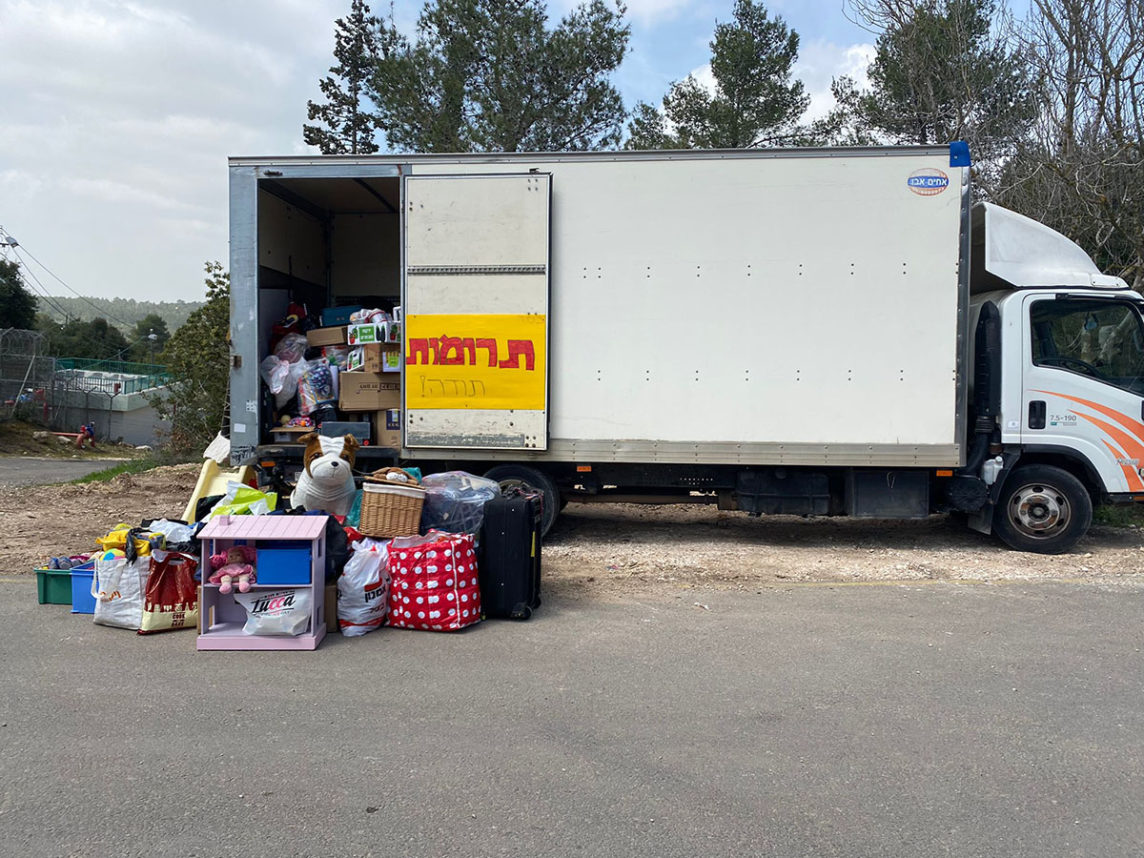
Since their arrival at Nes Harim, trucks filled with donations of clothing, shoes, toys, diapers, games and food have arrived from all over the country and volunteers have come along to help organize the gifts.
Lichtsteyn says that he has received a lot of support as well from people all over Israel who have offered their help. Some Israelis said they are interested in adopting the children, though Lichtsteyn says this is not currently feasible, but could happen in the future.
As for now, the refugees are expected to stay in Israel for a month, and there are no defined plans for after that. Maimon says it depends on developments of the war in Ukraine.
The future is still uncertain for the refugees, who are living from day to day.

“I don’t know what to do now, I don’t have any plans because in Ukraine I have an apartment, there is the school of my children, my job and currently I don’t know anything about my future,” Kapakova said.
The refugees that have arrived in Israel are worried about their loved ones who remain in Ukraine.
“Three days ago, my parents and my brother were very close to Kyiv, and they were without electricity, water or any way to connect. I couldn’t reach them. And they finally fled to western Ukraine because their city was also under fire,” Kapakova said.
Lichtsteyn explains that every man between the ages of 18-60 with no more than three children is being drafted upon arrival to the border.
Because of that, many men either stayed in their hometown or drafted to the army while their families fled.