fbpx

August 26, 2026

Israel Has No Shortage of Biomedical Startups, but Where Are the Global Companies?

Israel has exceptional biomedical researchers, outstanding universities and hospitals and a remarkable ability to turn scientific discoveries into startups.

But consider a simple question: where are the globally leading Israeli biotech-pharmaceutical companies that have emerged from all this research, talent and investment?

Most of us could probably name one: Teva.

Teva deserves enormous credit. It built an extraordinary global pharmaceutical business, historically rooted in generics, while increasingly developing innovative medicines. Its evolution is an important Israeli success story. But it remains a strikingly limited list.

This is not a question about prestige. It is an economic question and a national interest.

A globally successful biotech-pharmaceutical company can create decades of high-value employment, exports, intellectual property, expertise, tax revenues and further investment. It can turn scientific knowledge into a long-term economic asset for Israel.

And that value can continue to compound. An enduring global company can build development capabilities, train the next generation of leaders, create new medicines and reinvest its expertise and capital into the same ecosystem that produced it. Over time, the accumulated capabilities of such companies can themselves become an important economic asset.

So why has Israel not built more of them?

Perhaps the problem is not Israel’s inability to create biomedical innovation. It may lie in what the system has learned to reward.

Israel has excelled at creating biomedical startups around promising scientific discoveries, attracting investment and advancing assets toward licensing or acquisition. These are legitimate outcomes. But they are different from building companies that compound value for decades.

In biotechnology, that distinction is particularly important. Developing a medicine is a long and uncertain process, and much of the capability required to succeed is accumulated only through repeated experience taking drugs through clinical development, regulatory review, manufacturing and commercialization, and then using that experience to build the next generation of medicines. When companies are repeatedly sold before those capabilities mature locally, part of that institutional knowledge is built elsewhere.

Building a global biotech-pharmaceutical company requires something that cannot be created in a financing round: accumulated development experience, experienced leadership, patient capital and the organizational capability to turn one successful product into the next.

This may be Israel’s blind spot. The system is exceptionally good at creating biomedical startups but not equally optimized for turning the strongest of them into enduring global companies.

If capturing more of the economic value of Israeli biomedical science is a national interest, then long-term company building should become an explicit objective of the system.

That means supporting companies through the long development journey, building deeper pharmaceutical expertise in Israel and creating incentives that reward building an enduring global business rather than optimizing for the next financing round, licensing agreement or acquisition.

It also means asking a different question when an Israeli biotech company begins to succeed. The objective should not automatically be how quickly that success can be monetized, but whether some of those companies have the science, leadership and financing required to become the foundations of much larger businesses headquartered in Israel.

This is not about preventing acquisitions or licensing. They are essential to biomedical innovation. It is about ensuring that building a global company is a realistic and rewarded alternative.

Israel has excelled at creating biomedical startups.

The next challenge is to turn that scientific strength into enduring global companies and capture the long-term economic value they can create for Israel. 


Professor David Adler is Chief Scientific & Medical Officer of the PATHORA Institute of Pathology & Tissue Medicine. He is a senior pharmaceutical leader in oncology drug development and translational medicine with over 15 years of experience, including a decade in senior leadership at Bayer AG’s Global Oncology Clinical Development organization. He holds academic appointments at the Hebrew University of Jerusalem, Ben-Gurion University of the Negev, and the University of Bonn.

Israel Has No Shortage of Biomedical Startups, but Where Are the Global Companies? Read More »

The Legacy of Everyday Love

Some of the most important lessons in life are never taught in a classroom. They are not written in books or delivered in speeches. They are lived quietly, day after day, in ordinary moments that become extraordinary over time.

For more than 20 years, I’ve worked in clinical research. Throughout my career, I have had the privilege of working alongside remarkable physicians, nurses, research coordinators, patients and families. Every person has taught me something about compassion, resilience, courage and hope.

But long before my career began, I had my very first teacher. My mother. Her story began long before mine.

She was born to two remarkable parents whose childhoods were forever shaped by World War II. My grandmother spent part of her childhood living under Nazi occupation as bombs fell around her. My grandfather’s hometown was also occupied by Nazi forces. They endured hardships that no child should ever experience, yet they never allowed those experiences to define them. Instead, they built a life rooted in resilience, gratitude and family.

After the war, my grandmother returned to Odesa, Ukraine — the beautiful city on the Black Sea often called the Pearl of the Black Sea. There, she met my grandfather. Three days later, he asked her to marry him.

Together, they built a home filled with warmth, laughter and unwavering love. That was the home in which my mother was raised. She inherited their resilience, but she expressed it in her own quiet way.

It was in the meals she prepared every single day. It was in the way she always made sure everyone had enough. It was in the birthday tables she thoughtfully created, paying attention to every detail so our celebrations felt special. It was in the way she welcomed family and friends into our home, making everyone feel seen, comfortable and loved.

Every meal around our family table was a lesson in human connection.

Today, I work in an industry driven by science, regulations, timelines and data. Clinical research demands precision, discipline and accountability. Those things matter deeply because every protocol, every data point and every decision ultimately affects patients waiting for better treatments.

But behind every clinical trial is a human being.

Over the years, I have learned that technical expertise alone is not enough. I often think those lessons began at home.

My mother showed me that caring for people is not measured by titles or recognition. It is measured by consistency — by showing up every day, making people feel welcome, and creating a place where they know they belong.

Those same values have followed me throughout my career.

When I was a study coordinator early in my career, I learned just how much the smallest gestures can matter.

I remember a patient who came to her appointment and during the informed consent process, I met her daughter only once while we were reviewing the study with the principal investigator. Whenever I stopped by to see how she was doing during her infusions, I would greet them by name and ask how they were doing.

One day, she thanked me — not for anything related to her experience in the clinical trial — but simply for asking about her daughter.

I was genuinely surprised. To me, it seemed like such a small thing. I had only met her daughter once.

To her, however, it meant something entirely different. It meant that someone saw her as more than a patient. Someone remembered the people she loved most.

That moment has stayed with me ever since.

It reminded me that while we often focus on protocols, timelines and data, patients remember something entirely different. They remember kindness. They remember feeling seen. They remember the people who took a few extra moments to make a difficult journey feel a little less lonely.

Throughout my career, I have met extraordinary people. Some of the strongest individuals I have ever known are not the loudest voices in the room. They are the nurses who comfort frightened patients. The research coordinators who stay late because someone needs help. The physicians who patiently answer one more question. The families who continue hoping despite unimaginable uncertainty.

Strength often looks quiet. Perhaps that is why my mother’s example stayed with me, as she never sought recognition. She simply lived her values.

The greatest legacy we leave behind is measured by the lives we touch.

A meal prepared with love.

A welcoming home. A thoughtful conversation. Remembering someone’s name. A birthday table arranged with care. A family that always knew they came first.

These moments may seem ordinary, but they become unforgettable.

My mother taught that generosity is found in everyday moments and that love is demonstrated through the quiet, consistent ways we care for one another.

We may not remember every conversation or every accomplishment, but we remember how people made us feel. In the end, it is those ordinary acts of kindness that stay with us the longest.


Regina Portnoy is a clinical research professional and published author.

The Legacy of Everyday Love Read More »

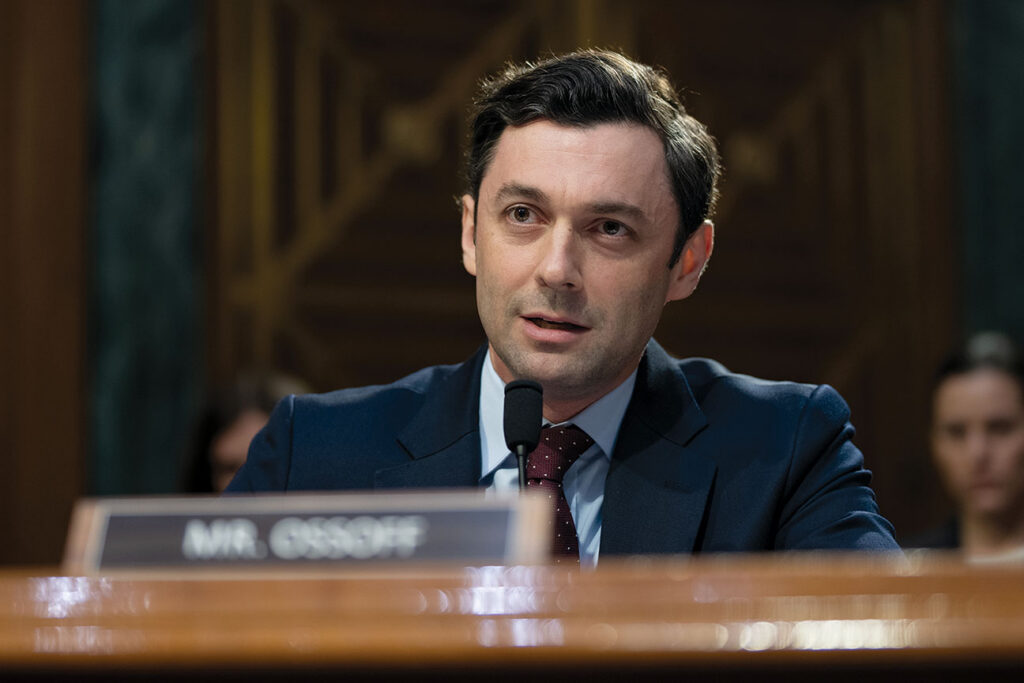
Could Jon Ossoff Become the First Jewish President?

It is possible that a record four Jewish candidates will be on a debate stage, vying to become the Democratic nominee for the 2028 presidential election.

Illinois governor J.B. Pritzker has lost weight, but his wallet hasn’t. He is a billionaire, which might not be so attractive to Democrats. Rahm Emanuel, former Chicago mayor and chief of staff to President Barack Obama, has the smarts and the know-how, but voters may see him as too Jewish.

The same of true of Pennsylvania Governor Josh Shapiro, who is a great speaker and has taken President Trump to task in his speeches. He’s also down-to-earth enough to appear on a sports podcast to talk about the Phillies and the Eagles, and has a sense of humor. He was once a volunteer for the IDF, which means he never fought anywhere with a gun, but the usual Israel-haters will falsely claim he “served in the IDF” to try to make sure he can’t be the nominee.

Currently, the political pundit class sees California Governor Gavin Newsom, New York Congresswoman Alexandria Ocasio-Cortez or possibly former Vice President Kamala Harris, if she could sell a run as a comeback story, as the likely nominee. 

But many are looking at Georgia Senator Jon Ossoff. On Kalshi, he is currently second, at 18%, compared to AOC at 21%. Of course, betting markets can be wrong. But Ossoff has shown an ability to raise money and he’s not afraid to take a shot against Trump. 

Newsom is handsome. He isn’t afraid to debate, having done well on Fox News against Governor Ron DeSantis (R-Fla.) in November 2023. If it means getting a Democrat in the White House, criticism over him eating at The French Laundry during the COVID lockdown, the high-speed rail project and the Palisades Fire could be downplayed. When it comes to looking and sounding slick and smooth, you won’t get better than Newsom. 

AOC is riding the energy of the Democratic Socialists of America, and the announcement that she is freezing her eggs (which is her right and has received too much criticism) is seen by some as likely signal for a presidential run. She will have to overcome her lack of knowledge on foreign policy. But she can get up to speed in a year.

On CNN in July, the host of “The Story Is With Elex Michaelson” said Ossoff “may not read as Jewish” as Shapiro. Political commentator Eric Messersmith spoke about the elephant in the room. “But on the Jewish thing, because he is Jewish, he might be the Democrat that could thread the needle,” he said. “Because even though he’s Jewish, he’s been very critical of the Israeli government, very critical of Benjamin Netanyahu … He has credibility on this issue …”

Michaelson added that “as a Jew, some people read a little more Jewish than other people, and Jon Ossoff may not read as Jewish as Josh Shapiro does, for whatever that’s worth.” Michaelson later apologized on social media, but the gist of what he said was correct, if he’s speaking about someone viewed as pro-Israel. Shapiro is also a very Jewish-sounding name, while Ossoff is not.

Ossoff was also discussed on a recent episode of “Real Time with Bill Maher.” The Georgia senator had said the president “wants to build his ballroom and travel with Natalie on their apparently defenseless flying palace gifted by the Emir of Qatar,” referring to Natalie Harp, an aide to Trump. In response, Trump called Ossoff “Pee-Wee Herman.”

Dana Bash of CNN, who is Jewish and has covered antisemitism, was Maher’s guest. “What do you think of this new star, Jon Ossoff?” Maher asked. “He’s kind of Obama-esque when he speaks … The problem is he’s Jewish. I know we don’t want to talk about that, but we need to talk about that because that is the situation in the Democratic Party. They think Gaza is a genocide. It is not. There’s an actual meaning to the word ‘genocide.’ It doesn’t come close. But as long as you tag that name, genocide, of course, what kind of normal person would not hate someone who’s responsible for a genocide? And they’ve all just signed onto this because they’re just big on buzzwords and lawn signs and bumper stickers, that’s as deep as they go.”

“And likes on their social media,” Bash added.

Bash said she’d asked Shapiro if he thought a Jewish politician could win a Democratic primary in this environment, but didn’t reveal his answer. 

Ossoff has not claimed Israel has committed a genocide. Michael Morris, publisher of The Atlanta Jewish Times, wrote an open letter to Ossoff claiming the senator threw Jews and Israel “under the bus” with votes blocking weapons and munitions sales to Israel in 2024 and 2025.

But in an op-ed in The Jerusalem Post, Ted Jonas defended the Georgia senator, writing that Ossoff has “always been a proud supporter of Israel.” Ossoff described the war against Iran as “another reckless war.”

Ossoff is a more energetic orator than Newsom. According to Newsweek, Ossoff has a war chest of more than $80 million for his run against Republican Mike Collins, a race that is currently rated a toss-up.

Many would still put their money on Newsom because he looks like he came out of central casting. 

And he’s not a Jew.

Could Jon Ossoff Become the First Jewish President? Read More »

Intermarriage and the Conservative Movement – A Different Approach

Last week, Rabbi Bradley Shavit Artson argued in the Jewish Journal that Conservative clergy in the United States should officiate at interfaith weddings. I would like to respectfully disagree with his thesis.

I am writing this article as a Posek (halakhic authority) of the Conservative/Masorti movement for the past 45 years. During these years, I have taught Jewish law to many hundreds of rabbinical students from the Schechter Rabbinical Seminary, JTS, Ziegler and the Seminario Rabìnico. In 1985, I was one of the founders of the Va’ad Halakhah (Law Committee) of the Rabbinical Assembly of Israel and I served as its Chair for almost 20 years. I have published 16 volumes of my own responsa and edited an additional eight volumes of responsa written by other Conservative rabbis. In addition to publishing over 200 of my responsa, I have written some 800 unpublished responsa.

I would like to address three major issues raised by Rabbi Artson: What does Jewish law have to say about intermarriage? What will happen to the Conservative/Masorti Movement if the Rabbinical Assembly (R.A.) decides to change its Standard of Rabbinic Practice which prohibits officiation at an intermarriage? What can we do to stem the tide of intermarriage?

 What does Jewish law have to say about intermarriage?

Rabbi Artson refers to the prohibition of intermarriage as a “policy.” He also calls it “nostalgia” and “a personal preference.” The reality is that ntermarriage has been forbidden since the days of the Torah.

Abraham made his servant swear to him that he would take a wife for Isaac from among Abraham’s own relatives and not from the daughters of Canaan (Genesis 24).  Rebecca and Isaac saw to it that Jacob did likewise (ibid., 27:46-28:5). The Torah records the great displeasure of Rebecca and Isaac when Esau marries Hittite women (ibid., 26:34-35) – so great that Esau takes an additional wife from Ishmael’s daughters to placate his parents (ibid., 28:6-9).    

Later, the Torah explicitly prohibits intermarriage (Exodus 34: 15-16; Deut. 7:1-4; cf. Joshua 23:12). While these verses only prohibit intermarriage with the Seven Nations, the First Book of Kings (chapter 11) condemns King Solomon for marrying Egyptian, Moabite, Ammonite, Edomite, Phoenician and Hittite women who led him to worship idols, which caused God to punish him by splitting his kingdom after his death. Indeed, Nehemiah (13:26) emphasizes the sin of Solomon whose “foreign wives caused even him to sin.” 

Furthermore, Second Temple sources beginning in the fifth century BCE forbid all forms of intermarriage (Ezra 9:1-2; 10:11-12; Nehemiah 13:23-27; Malachi 2:11-12; Philo, The Special Laws III:29; Josephus, Antiquities 8:190-196). 

According to the Talmud (Avodah Zarah 36b), the Sages maintained that Deut. 7:3 applies only to the Seven Nations while other forms of intermarriage are rabbinic prohibitions, but Rabbi Shimon bar Yochai ruled that all forms of intermarriage are forbidden by the Torah. Rabbi Moses of Coucy (13th century; Sefer Mitzvot Gadol, Lo Ta’aseh 112); Rabbi Yaakov ben Asher (died 1240; Tur Even Ha’ezer 16) and apparently Rabbi Moses Isserles (the Rema, Shulhan Arukh Even Ha’ezer, ibid.) ruled according to the Sages. On the other hand, Maimonides (Sefer Hamitzvot, Lo Ta’aseh 52; Issurei Biah 12:1-2), Sefer Hahinukh (No. 427) and Rabbi Yosef Karo (Even Ha’ezer ibid.) ruled according to Rabbi Shimon bar Yohai. Yet even those who say that the general prohibition is rabbinic, ascribe it to the days of the Maccabees (Avodah Zarah, ibid.) ca. 170 BCE or to Bet Shammai (Shabbat 17b) in the first century CE. 

Thus, from the Talmudic point of view, all forms of intermarriage have been forbidden either Biblically or Rabbinically for the past 2,000-3,200 years, while according to the Bible itself, all forms of intermarriage have been forbidden since the days of Abraham some 3,800 years ago.

Therefore, a rabbi who officiates at an intermarriage ceremony is going against the prohibition of lifnei iver, “putting a stumbling block before the blind” (Leviticus 19:14), which includes telling a Jew that something is permitted when it’s forbidden or helping him/her transgress Jewish law. He/she is also transgressing the obligation of afroshei mei’isura, of preventing a fellow Jew from committing a transgression. 

What will happen to the Conservative/Masorti Movement if the R.A. decides to change its Standard of Rabbinic Practice?

I believe this would be a historic mistake.

While I understand and sympathize with the issues confronting Conservative rabbis and synagogues in the United States concerning intermarriage, allowing Conservative rabbis to officiate at intermarriages will not solve that problem. But it will announce the end of the Conservative Movement as a Halakhic movement, and it will make us synonymous with the Reform and Reconstructionist Movements. 

In most cases, performing an intermarriage does not bring the couple closer to Judaism and to raising their children as Jews. 

It will also create a schism between the minority of R.A. members who favor this move and the majority who are against changing this standard. Included in the latter are 95-100% of rabbis who live in Canada, Israel, Europe and South America who will feel disenfranchised by the R.A. and the Movement. Indeed, many hundreds of rabbis will be forced to resign from the R.A., which would be a tragedy for them, the R.A. and the Conservative/Masorti Movement. (This latter paragraph is based on my correspondence with hundreds of rabbis on this topic.)

Rabbis who are opposed to intermarriage will not be able to find pulpits. This is what happened in the Reform movement.

Finally, the phenomenal growth of Chabad and Hadar prove that movements and synagogues can grow and prosper while sticking to their halakhic principles. The farther we move away from Jewish law, the fewer members we will have. Those who want liberal Judaism without halakhic standards will go to Reform and Reconstructionist synagogues, while those who want modern yet halakhic Judaism will move to modern Orthodox or Chabad or Hadar synagogues. If you try to please everyone, you end up pleasing no one.  A movement which has no principles will, in the long run, disappear.

What can we do to stem the tide of intermarriage?

Education: The main way to deal with intermarriage is by providing serious Jewish education in Day Schools, Camp Ramah and USY. Dealing with intermarriage after the fact is akin to closing the stable door after the horse has bolted. Without strong Jewish education, we have no future.

Conversion both before and after an intermarriage: As I have shown in my articles and responsa, the classic Talmudic approach is very welcoming to converts and the Conservative movement has followed in that classical tradition. We must make every effort to convert the non-Jewish spouse and the children. 

But, you may say, many young people today do not wish to convert because they have no interest in any religion or for other reasons. This is true, but we cannot make them Jewish by magic. They are adults. If they decide not to convert, we should make them feel welcome in our synagogues without compromising Jewish law. 

In summary, as Prof. Jack Wertheimer, the leading sociologist of American Jewry, wrote in his very important article about intermarriage (eJP, March 15, 2022), we do not need “a new narrative.” 

Endogamy has preserved the Jewish people for some 3,800 years. If we endorse intermarriages, not only will we destroy the Conservative movement, but the Jewish people itself will disappear.


Rabbi Prof. David Golinkin serves as a Professor of Talmud and Jewish Law at the Schechter Institute in Jerusalem. He has published forty books related to responsa and Jewish law. The opinions expressed here are his own. 

Intermarriage and the Conservative Movement – A Different Approach Read More »

Why I Don’t Care About Antisemitism

I don’t care about antisemitism.

That does not mean I don’t care about Jews. I am shomer Shabbat, attend a community minyan daily, have three Jewish grandsons (so far …), and a brother whom I helped bring to traditional Jewish practice who lives in Jerusalem and learns in kollel.

I care a lot about Jews.

What I am tired of is Jewish political and communal organizations making the fight against antisemitism such a focal point of American Jewish life.

We have organizations fighting antisemitism, conferences about antisemitism, committees studying antisemitism, webinars teaching us about antisemitism and politicians condemning antisemitism. Then, after something actually happens, the police increase patrols in Jewish neighborhoods, statements are issued, everybody promises that hate has no home here, and we wait for the next incident.

And yet antisemitism seems to be doing just fine.

Maybe we are fighting the wrong battle.

I don’t expect antisemites to be polite to me. I don’t particularly care whether they like me. And I certainly don’t think the Jewish community should measure its success by whether a university administrator, politician or activist issues the appropriate statement after Jews are treated badly.

My concern is whether Jews are safe, whether Jewish institutions are strong, whether our children and grandchildren remain Jewish and whether we are spending our limited resources intelligently.

Those are different objectives.

UCLA Is a Good Example

Jewish organizations understandably celebrated the settlement of Frankel v. Regents of the University of California in July 2025. The settlement totaled more than $6 million. The individual plaintiffs received $50,000 each, while millions went toward attorneys’ fees, charitable contributions benefiting organizations supporting UCLA’s Jewish community and UCLA’s own Initiative to Combat Antisemitism.

I don’t begrudge the lawyers their fees, and I hope every dollar going to Jewish organizations accomplishes something useful. But when I looked at those numbers, my reaction was different from much of what I was reading in the Jewish community.

Why are we spending this much money and energy trying to convince UCLA to be a place Jewish students should want to attend?

Maybe they shouldn’t.

UCLA has had controversies involving Israel, Jewish students, speakers and campus politics for decades. The recent problems did not suddenly materialize after Oct. 7, 2023. At some point, Jewish parents need to stop asking what UCLA is going to do about antisemitism and ask a much simpler question: Would I send my kid there?

If the answer is no, don’t.

There are plenty of excellent universities in America.

Jews constitute only a small percentage of the American population. We have been remarkably successful in this country, but we are still a tiny minority. That means we need to pick our fights. We don’t have the resources to fight everybody everywhere about everything, and I’m not convinced that getting UCLA to spend money making itself temporarily more hospitable to Jewish students constitutes a major Jewish victory.

Sometimes the smarter strategy is refusing to play on somebody else’s battlefield.

If a university needs to be sued before it protects the rights of Jewish students, perhaps the answer isn’t another Jewish task force working with that university. Perhaps the answer is fewer Jewish students applying there, fewer Jewish parents paying tuition and fewer Jewish alumni writing checks.

That would get my attention if I were running a university.

Somewhere along the way, however, American Jewish organizations became extraordinarily invested in being accepted by institutions that don’t always seem particularly invested in accepting us. I don’t understand that strategy.

I don’t need UCLA to like Jews. I don’t need every professor to support Israel. I don’t need every student organization to approve of Zionism. I don’t even need people to refrain from saying stupid or offensive things about Jews.

It’s a free country. People are allowed to dislike us.

What I do care about is what happens when that hostility turns into discrimination, intimidation or violence. And when an institution repeatedly demonstrates that it won’t protect Jews unless forced to do so, I think Jews should be much more willing to take our children, our money and our support somewhere else.

That isn’t surrender. It’s common sense.

I would rather spend $1 million building something Jewish than spend $1 million convincing people who dislike Jews to dislike us a little less.

Antisemitism Is Not Judaism

There is another reason I am bothered by the Jewish obsession with antisemitism: It allows our enemies to occupy far too much space in our Jewish lives.

Judaism isn’t about antisemitism.

My Jewish life isn’t organized around people who hate me. It is organized around Shabbat, Torah, minyan, family, community, Israel and our relationship with our Creator.

When I sit at the Shabbat table with my grandchildren, I don’t want their Judaism to be about Hitler, Hamas, campus protesters or whichever politician said something offensive this week. I want them to know why being Jewish is worth the trouble.

I think that is a much more important Jewish project.

So, yes, I don’t care about antisemitism — at least not in the way our communal institutions seem to want me to.

Obviously I care when Jews are attacked. I care when Jewish students are threatened. I care when synagogues require armed guards and Jewish children need security outside their schools.

But antisemitism is not going away. History should have cured us of the fantasy that one more educational program, conference, task force or carefully worded statement is finally going to fix it.

I would rather see Jewish organizations spend more of their energy asking different questions. How do we get more Jews into synagogues? How do we make Jewish education affordable? How do we strengthen our connection to Israel? How do we build communities that young Jewish families actually want to join?

And, most important to me: How do we make sure our grandchildren remain Jewish?

Those questions interest me.

Whether somebody at UCLA likes me doesn’t.

We don’t need everybody to love us. We need to build a Jewish community strong enough to survive the people who don’t. 


Bill Gross is a Los Angeles businessman, husband, father and grandfather of, objectively speaking, the three cutest boys in the world.

Why I Don’t Care About Antisemitism Read More »

America’s First, Remarkable Flag, a Reminder of Biblical Faith

In a historical irony few Americans are aware of, the colonies’ first collective flag prominently displayed the very symbol of the empire from which the Revolutionaries would soon declare their independence. 

By the close of 1775, the Second Continental Congress had already assumed many of the functions of a national government. It had authorized a Continental Army, established a navy and created the Marine Corps that November. Those institutions required a banner that represented the united colonies rather than the patchwork of individual colonial flags then in use, including Massachusetts’ Taunton Flag (designed by the Sons of Liberty) and New York’s George Rex Flag, raised on a “liberty pole” in 1774. 

What became known as the Continental Union Flag was born — featuring thirteen stripes, with, surprisingly, the Union Jack in one top corner. The new standard distinguished American forces from the various British military and naval ensigns while still reflecting the colonists’ complicated relationship with the Crown. During the Revolutionary era it was referred to by many names, including the Continental Colors, Congress Flag, First Navy Ensign or Cambridge Flag. 

The identity of its designer remains unknown. One longstanding tradition attributes its construction to Margaret Manny, a milliner based in Philadelphia. Some historians have also suggested that the flag’s creation was remarkably practical: by sewing six white stripes onto existing British Red Ensigns, the colonies could quickly produce a distinctive national banner while conserving scarce wartime resources.

The retention of the Union Jack reflected the belief of many of the colonists that reconciliation would prevent the need for full-scale Revolution. After all, their quarrel was with Parliament’s policies and what they regarded as violations of their constitutional rights as Englishmen, not necessarily with the institution of monarchy itself.

The first documented raising of the flag occurred on Dec. 3, 1775, when it was hoisted at the commissioning of Admiral Esek Hopkins’ USS Alfred on the western shore of the Delaware River at Philadelphia. The flag subsequently became closely associated with George Washington’s army outside Boston. Tradition holds that it was raised at Prospect Hill on New Year’s Day 1776 as the Continental Army besieged British forces occupying the city. 

Only months after the flag first appeared, however, Thomas Paine’s “Common Sense” transformed public opinion by arguing that complete independence was both necessary and morally justified. The Declaration of Independence followed on July 4, 1776, fundamentally changing the meaning of the Revolution. 

A flag that still incorporated Britain’s national symbol no longer reflected the new political reality. On June 14, 1777, Congress adopted the Stars and Stripes, replacing the Union Jack with thirteen stars representing a new constellation of sovereign states. That date is now commemorated as “Flag Day.”

This gradual progression evokes the sequence of the Exodus story. The Torah depicts redemption as a process rather than a single event. The Israelites did not leave Egypt one day and become a covenantal nation the next. More than once they longed for the comfort food of their former captors. Remnants of the oppressive empire in whose culture the Israelites had been steeped took time to be removed.  Political and spiritual maturity required trials and tribulations to manifest on the way to the Promised Land. Revolutions in the Bible, the late British chief rabbi Lord Jonathan Sacks observed, “go with the grain of human nature, recognising that it takes time for people to change.”

The Continental Union Flag therefore deserves to be remembered as a window into the political process of independence, as in the time of biblical Israel. The banner embodies the uncertainty, debate and gradual emergence of the American liberation movement, the wanderings that helped form those whom Abraham Lincoln would later label “God’s almost chosen people.”


Rabbi Dr. Stuart Halpern is Senior Adviser to the Provost of Yeshiva University and Deputy Director of Y.U.’s Straus Center for Torah and Western Thought. His books include the newly released “Jewish Roots of American Liberty,” “The Promise of Liberty: A Passover Haggada,” “Esther in America,” “Gleanings: Reflections on Ruth” and “Proclaim Liberty Throughout the Land: The Hebrew Bible in the United States.” 

America’s First, Remarkable Flag, a Reminder of Biblical Faith Read More »

I’m So (Sorta) Sorry

With the approach of the High Holy Days, it’s a good time to prepare ourselves to ask for forgiveness for our failings over the past year.

But offering apologies isn’t limited to a particular season.  In fact, it seems that each day we hear expressions of remorse from celebrities, politicians, and others.  

Are they sincere?

The classic case of a “nonapology” apology is when the allegedly contrite offender says something to the effect of “I’m so sorry that you’re upset.”  Note that the speaker doesn’t actually acknowledge doing anything wrong.  Instead, this may be a devious way to accuse an aggrieved party of being too sensitive, while absolving oneself of any guilt.

How else can you tell if an apology is less than heartfelt?  

If a person uses the passive voice, be on your guard.  A favorite line from Richard Nixon and his defenders regarding Watergate was that “mistakes were made.”  Really?  By you?  Ronald Reagan used that phrase several times when referring to the Iran-Contra affair, as did Bill Clinton when questioned about a campaign fundraising impropriety.

And the refusal to offer a genuine apology can change history.

Hillary Clinton may have cost herself the presidency when she said that “You could put half of Trump’s supporters into what I call the basket of deplorables.  Right? They’re racist, sexist, homophobic, xenophobic, Islamophobic – you name it.”  In the face of intense criticism, Clinton said that she regretted saying “half.”  While she eventually conceded that using the word “deplorable” presented a “political gift” for Trump, as far as I know, she has yet to apologize to the tens of millions of Americans she ridiculed.

But the king of the “Never Apologize Movement” has to be President Trump.  That isn’t terribly surprising given that an important mentor of his was none other than Roy Cohn, chief counsel for Senator Joseph McCarthy (R-Wis.)during the “red scare,” and one of the most notorious figures in U.S. history. Cohn lived by the motto “Never admit you are wrong” — a lesson our president apparently has taken to heart.

Does a genuine apology ever make a difference?  It seems so.

John Galliano was fired as creative director of Dior for his well-documented 2010 antisemitic rant at a French café.  His redemption will be complete next year when he is honored with a retrospective at the Metropolitan Museum of Art.  The backlash to that announcement has been substantial, but it is worth noting that the ADL has vouched for the sincerity of Galliano’s apology, adding that he has met with Jewish leaders, educated himself in the history of bigotry and visited Auschwitz.  That’s good enough for me.

Some have criticized Anthony Fauci for refusing to apologize for anything he did during the COVID years or wrote in his recently released pandemic-era diary.  Of course, he is undoubtedly following the advice of his lawyers.

That makes the words of John Jenkins, former president of the University of Notre Dame, seem even more remarkable.  Back in 2010, despite strong winds, a 20-year-old undergraduate was inexplicably ordered to film a football practice from a perch high above the field.  The tower collapsed, and the student died.  Father Jenkins put out this message:  “Declan Sullivan was entrusted to our care, and we failed to keep him safe.  We at Notre Dame – and ultimately I, as President — are responsible.”  The university’s lawyers likely cringed, but Father Jenkins proved that he is a true mensch.

Finally, when I think about real contrition and why it matters, I reread the High Holy Day message that Rabbi Steven Stark Lowenstein from Am Shalom in Glencoe, Illinois sends to his congregants:  “If I have offended you in any way this past year, I ask for your forgiveness.  Remember the pages are still blank, the book is still open.  The pen is in your hand.  May the final seal be a good one.” 

Here’s a suggestion for those who intend to ask for God’s mercy during the Kol Nidre service at the start of Yom Kippur:  Don’t say, “God, mistakes were made and I am so sorry that you’re upset.”  

God is much too clever to fall for that ruse.


Morton Schapiro served for more than 22 years as President of Northwestern University and Williams College.  He taught almost 7,000 undergraduates over his 40 plus years as an economics professor.

I’m So (Sorta) Sorry Read More »

What the Return of Yehuda Katz Says About Israel’s Covenant With Its People

I arrived in Israel for a gap year in August 1982. Looking back, I can hardly imagine a more consequential moment to begin my journey. Just two months earlier, Israel had launched Operation Peace for Galilee, the First Lebanon War. The war was still unfolding. Casualty lists were appearing in newspapers. Families were waiting for their sons to return home. The entire country seemed suspended between determination and grief.

One battle in particular cast a long shadow over the nation. In June 1982, an IDF armored force entered a narrow valley near Sultan Yaacoub in Southern Lebanon and was caught in a deadly Syrian ambush. Twenty-one Israeli soldiers were killed. Dozens more were wounded. Three soldiers were listed as missing in action: Zachary Baumel, Zvi Feldman, and Yehuda Katz.

At the time, I knew little about any of them. Yet one name quickly became familiar. Yehuda Katz had studied at Yeshivat Kerem B’Yavneh, the yeshiva where I was spending my gap year. I never met him. But I encountered his presence every day. Everyone who had known Yehuda spoke about him in the same terms. He was the best and the brightest. Brilliant without arrogance. Accomplished without pretension. Kind, humble, and deeply loved. When people described him, they did not sound like they were reciting a eulogy. They sounded like they were talking about a friend who had just stepped out for a moment and would be back soon.

His room in the dormitory remained untouched.

It stayed that way throughout the two years I studied there. Perhaps it remained unchanged for years afterward. No one wanted to be the person who packed away his books, emptied his closet, or erased the traces of his life. Officially, he was missing. Unofficially, everyone knew that the chances of his return were virtually non-existent.

And yet the room remained. Maybe it was hope. Maybe it was denial. Maybe it was faith.

To me, there was something holy about that room. It stood as a quiet declaration that a Jewish life cannot simply be written off. Even when logic says otherwise. Even when decades pass. Even when all evidence points in one direction.

The years rolled by. In 2019, the remains of Zachary Baumel were recovered and brought home to Israel. Last year, Zvi Feldman was finally returned as well. But Yehuda Katz remained missing. Then, last week, came the announcement. After forty-four years, Israeli intelligence and security services had succeeded in locating Katz’s remains and bringing him home. The details, unsurprisingly, remain largely classified. The operation reportedly relied on years of intelligence gathering and extraordinary persistence. What matters is that the mission succeeded. After more than four decades, Yehuda Katz returned to Israel. He was laid to rest on Friday on the Mount of Olives in Jerusalem. More than a thousand people attended his funeral.

The remarkable thing is that none of us were surprised. Not because we expected success after so many years. We did not. We were unsurprised because, in a deeper sense, it was always understood that Yehuda would someday come home.

Israel is a country that reveres life. We fight for the living. We rescue the wounded. We search for the missing. We bring home the hostages. And we do not abandon the dead. Our enemies often misunderstand this. They see it as vulnerability, and they imagine that our determination to recover every hostage and every soldier—dead or alive—can be exploited. Hamas certainly drew that conclusion when it turned human lives into bargaining chips.

Israel is a country that reveres life. We fight for the living. We rescue the wounded. We search for the missing. We bring home the hostages. And we do not abandon the dead.

They are wrong. This is not a weakness. It is one of Israel’s greatest strengths.

Most nations honor their fallen, but Israel does something more. We make a covenant with them. We promise that if you stand in defense of the Jewish people, the Jewish people will never forget you. Not after a year. Not after a decade. Not after forty-four years.

That promise is incredibly expensive. It requires patience, resources, and extraordinary effort. It sometimes defies military logic and political logic. But it is the reason Israeli parents like myself continue sending their children to defend this country. It is the reason Israeli soldiers continue charging forward under fire. They know that the nation stands behind them, in life and beyond life.

For forty-four years, Yehuda Katz’s room stood as a testimony to that promise. Last week, the promise was fulfilled.


Ari Sacher is a senior policy advisor at the U.S.-Israel Education Association and a veteran Israeli rocket scientist who worked on the development of the Iron Dome missile defense system.

What the Return of Yehuda Katz Says About Israel’s Covenant With Its People Read More »

Off the Hook

I downloaded a fitness app. When filling out the questionnaire, they asked, “What kind of shape are you in?” I’m in the kind of shape such that no woman I know, except my wife, would go on a romantic vacation with me alone. And if they did, they would come home early.

“When was the last time you were in great shape?”  Sixty-six years ago. When I turned 7, I was as trim as a Blue Jay and as fast as a Central Park squirrel. Just like a squirrel, I could eat nuts day and night and never gain an ounce. Now, if I eat one nut, my pants need tailoring. I wonder if, like people, squirrels can be allergic to nuts. Has anyone ever seen a squirrel in anaphylactic shock?  Someone needs to write the squirrel diet handbook called “How to Hide Your Nuts.”

At 7 years old, there was no shape other than great shape. I ran to school; I ran home from school. I climbed stairs; I jumped downstairs. I leaped over fire hydrants. I could play all day on an eyedropper of water and a Good Humor vanilla ice cream bar.  My parents never had to tell me I should run around more. In fact, it was quite the opposite. What I heard was, “When are you going to stop running around and just stay still for one minute?” I do miss that little Mark.

One of my greatest tests of strength was in gym class, climbing 20 feet up the rope without using my feet to grab onto it. I was half chimpanzee. I was a James Sprague, the reigning Fittest Man on Earth. James can back squat 475 pounds. These days, I am so stiff that I can’t front squat a pair of socks without needing a heating pad.

Without noticing it, my body has gone from a shiny new Audi to a dented rent-a-wreck. I went from “Let me get it” to “Just give me two minutes to catch my breath.”

The first time I remember being out of breath was August 9, 1971. I ate some bad fish. An hour later, I ran two miles like a Kenyan marathoner trying to make it home to the bathroom before experiencing a Hiroshima-type blast. Touchdown with less than half a second to spare.

Because my computer knows I’m looking to get into better shape, my algorithm sends me male enhancement ads and new “Tai Chi Walking and Chair” emails every hour. Every man in these ads has a perfectly chiseled six-pack. The only six-pack I ever had was when I carried one home from 7-Eleven.

Jewish men are not especially known for their six-packs. We tend not to look like Michael B. Jordan, and more like Jonah Hill. If I were to go shirtless and look into my full-length mirror, I wouldn’t see a six-pack.  I’d see an “I need to pack it up” pack. 

The next app question was, “What kind of shape do I want to be in?” At a certain age, and I’m there now, most of us give up wanting anything but good health for our families, friends and ourselves. And to finally be happy with who we are.  Of course, I want to look good to my wife, kids and friends and when I’m on stage, to my audience.

For decades, my friend Cindy had so much invested in staying thin that she got sucked into a negative void. She recently told me she doesn’t want to live like that anymore. She seems finally happy letting go of the idea that she must be perfect. 

I’ve gained back 10 of the 50 pounds I lost. It’s brought up guilt, shame and fear. People were always telling me how proud they were of me for losing the weight. Now I think I’ve let them down.

Here’s my pep talk to myself:

“Mark, you let nobody down, including yourself. What you did was get sloppy with your food. Now you need to get back on track and stop kicking your own behind. Be kind. You’re a human being with a human struggle. Let yourself off the hook.” 


Mark Schiff is a comedian, actor and writer and hosts, along with Danny Lobell, the “We Think It’s Funny” podcast. His new book is “Why Not? Lessons on Comedy, Courage and Chutzpah.”

Off the Hook Read More »