fbpx

April 24, 2026

Longtime Philanthropy Leader Joins AJU, Weekend Retreat Gathers NLP Cohort

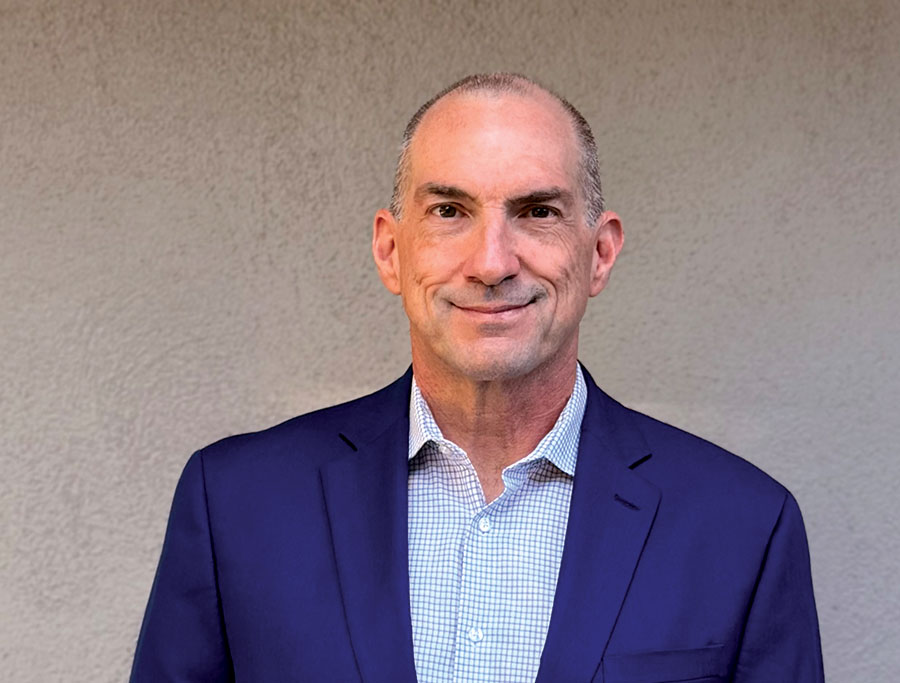
American Jewish University (AJU) announced the appointment of Mitch Hamerman as vice president and chief advancement officer, effective May 11. A respected leader in Jewish philanthropy and nonprofit strategy, Hamerman will lead AJU’s advancement efforts at a pivotal moment for the university and the broader Jewish community. With nearly 25 years of experience, he has helped generate more than $1 billion in philanthropic support for major institutions across Los Angeles, building deep relationships with donors, foundations and community leaders.

He joins AJU from Los Angeles Jewish Health, where he served as vice president of development. Previously, he spent more than two decades at Jewish Federation Los Angeles, ultimately serving as senior vice president of development. In that role, he partnered closely with AJU President Jay Sanderson to shape and execute large-scale fundraising initiatives.

“Mitch is the right leader for this moment,” Sanderson said. “He understands that the future of Jewish life depends on bold vision, strong relationships and sustained investment. Mitch brings all three. His leadership will help fuel AJU’s growth and expand our impact in meaningful and lasting ways. We’re excited to welcome him to our team.”

Throughout his career, Hamerman has focused on building long-term partnerships with philanthropists, foundations and institutional partners, enabling organizations to expand their impact through sustained philanthropic support.

“Development professionals aren’t in the fundraising business—they’re in the relationship business,” Hamerman said. “When relationships are authentic and mission-driven, philanthropy follows. AJU is doing essential work to shape the Jewish future, and I’m excited to help deepen that impact and bring more people into that story.”

In his new role, Hamerman will lead AJU’s advancement strategy, with a focus on strengthening donor engagement, expanding philanthropic support and reconnecting with the university’s alumni network. He will collaborate closely with university leadership and lay partners to enhance fundraising efforts and support AJU’s evolving vision and programmatic growth.

Hamerman began his career in account management at global advertising agencies, where he worked with major consumer product and retail clients to drive revenue growth and brand awareness—experience that continues to inform his approach to growth, engagement and strategic positioning.


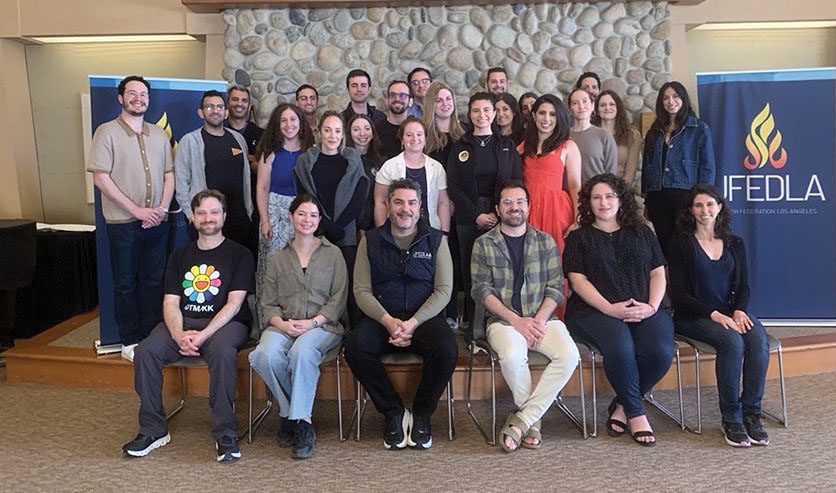
LA Federation CEO and President Rabbi Noah Farkas (front row, middle) joins the latest cohort of the Federation’s New Leaders Project for a discussion on L.A. Jewish community priorities. Courtesy of Jewish Federation Los Angeles

A recent Shabbat retreat at AJU’s Brandeis-Bardin Campus in Simi Valley marked the kickoff of the latest cohort of Jewish Federation Los Angeles’ Rautenberg New Leaders Project (NLP).
The cohort, comprised of 25 civic-minded professionals ages 27-40, connected in a beautiful setting, discussed challenges facing the Jewish community and this city, and learned how the L.A. Federation partners with civic and government leaders to find solutions.

With insightful speakers including former LA City Controller Ron Galperin; LA Federation President and CEO Rabbi Noah Farkas; Theatre Dybbuk Artistic Director Aaron Henne; and NLP alumni, participants strengthened their leadership skills and developed strategies for change.

“We look forward to seeing how this dynamic group drives action in the years ahead!” a Federation leader said.

NLP, founded more than 30 years ago, provides opportunities and training to elevate the next class of outstanding Jewish civic leaders in Los Angeles. The ten-month program involves weekend-long treats, specialized seminars and in-depth discussions.

Longtime Philanthropy Leader Joins AJU, Weekend Retreat Gathers NLP Cohort Read More »

Rabbis of LA | A Man of Inclusive Compassion

As Rabbi Bradley Shavit Artson takes his place as American Jewish University’s Mordechai Kaplan Distinguished Scholar it should be noted that for 40 years, he has been at the forefront of changes in the Jewish world.

Artson, who has been dean of AJU’s Ziegler Rabbinical School for 25 years, proudly pointed out that “we have helped almost 300 people become rabbis across North America, Israel and Uganda. The key word for him is “people.” When he attended rabbinical school in the 1980s, it was men only. “They weren’t knowingly admitting LGBT people,” he said.

As a rabbinical student, Artson wrote a paper in favor of ordaining gays and lesbians. “Officially, it was quite unpopular,” he said, “but under the surface very popular” across the non-Orthodox world. “It was on the Reservation Desk at the Jewish Theological Seminary library, at Hebrew Union College’s library and UC’s library. They couldn’t keep it in stock. They kept having to copy it because people kept coming/going back for more and more.” He’s proud there’s a much broader range of people studying for the rabbinate today. “We have students in the school who came out the day the Law Committee authorized it. That was a very exciting moment 15, 20 years ago. I was amazed by that.”

More recently, he was at services as a congregant when one of his rabbinical students came up to him. He wanted to introduce Artson to his then-boyfriend. “I stopped him, and I said ‘I am happy you are doing that, and I just want to point out what a historic miracle this is, that you come up to your rabbinic school dean and your full expectation is that I am going to be excited for you – and that is going to be my whole response. I just want us to notice that things do change.’

That is Rabbi Artson’s message in a nutshell: “I want to say that things do change. We can’t be passive. We can’t wait for them to change. But people do learn, and things can get better.”

The reason for this, he said, was simple: “American culture was ready for change. That took a long evolution. It wasn’t something that just happened overnight. For sure I met resistance.”

People would yell at him in rabbinical school. “I would have strangers come up to me in the cafeteria and shriek at me. But over time, younger people were just at home with the change.” He has seen the same issue with trans students. “They are at home,” Rabbi Artson said. “Once you realize you don’t have to be afraid of something, once you get to know actual people, you see they are wonderful in their own ways. Things you didn’t think could be sources of learning, actually are.”

The happily married father of two and grandfather of one knows people fear change. He mentioned the classic case of a rabbi who was told “we want you to bring change.” Sure, the rabbi responded, “we’ll move Friday night services.” No, said the congregants. We don’t want that. OK, we’ll do more Hebrew. No, said the congregants, we don’t want that. More English? We don’t want that. Change the melodies? We don’t want that. But we want change.

“We are all afraid of change,” Rabbi Artson said. “Once you grow accustomed to it, you forget why it was a problem in the first place.”

The reason he took on this battle was very close to home. “I had some loved ones who came out to me when I was just starting rabbinical school at JTS in New York in 1983,” he said. “I always have felt God as a loving presence. I have always felt God was passionate about justice and human dignity. And so I always have believed that any Jewish law that seems to violate human dignity and justice, we are just reading it wrong.

“I brought that to rabbinical school. And that was a burning question because of the loved one in my family.” He wrote a 40-page paper, making legal and halachic arguments for gay marriage. When the paper was returned, he started flipping through the pages, and there were no marks. “Page after page. I got to the last page, and he said ‘Wrong A.’ He thought I was wrong in my argument. He thought it was a brilliant argument. It stunned me.”

The most crucial portion of his work was 11 words: “I never have been afraid of thinking differently from other people.” He was raised that way. “My mother, especially, always has been a beacon of light to me,” he said. “My Mom is one of the bravest and most loving people I ever have known. And so the two things I never doubted were that I was worthy and lovable, and that I had as much right to an opinion as anybody.”

How many 66-year-old men speak this way? “To this day, my mother, formerly a psychotherapist in San Francisco, still lives there, and, thank God, is very much alive, and still an inspiration.”

His family has been “absolutely” supportive of his views. “My mother had a hard time with my believing in God. That I talked to God and that I think God answers me, for my mother would be no different than thinking I was talking to Mickey Mouse, and he answered me.”

Fast Takes with Rabbi Artson

Jewish Journal: What is your proudest achievement?

Rabbi Artson: Three. Being married to Elana. Being the father of Jacob and Shira. And I am now a Zayde. I have the best einekl (grandson) in the world.

JJ: Your favorite Shabbat moment?

RA: I am one of the richest people in Los Angeles because almost every Friday night I have around the table, my wife, my son, my daughter, my son-in-law and my grandson. When I look around the table, I feel the blessings overflowing.

JJ: Your next career goal?

RA: This is my last great adventure.

Rabbis of LA | A Man of Inclusive Compassion Read More »

The Point of Pointless Hatred

In the final days of the Second Temple, three factions of Jews battled each other inside Jerusalem, while the Roman troops camped comfortably outside. The carnage was indiscriminate, and every pedestrian was a target. Josephus describes the scene with shock and horror:

“The stones launched by the engines reached as far as the altar and fell upon the kohanim and those offering sacrifices. Many who had come from the ends of the earth to this celebrated and holy place, (revered by the entire world,) fell dead alongside their own sacrifices; their blood flowed down to the altar, which was revered by the Greeks and all other Gentiles. The corpses of the townspeople and of foreigners, kohanim and laymen were mixed together, and in every corner of the Temple Courts the blood of the slain gathered into pools.”

Josephus then exclaims:

“Woe, wretched city! ….You could no longer be a dwelling for God, nor remain part of His inheritance, after you had become a burial place for your own sons and your temple had been turned into a graveyard.”

Internal divisions had defeated the Jews even before the Romans invaded. The Talmud says that the sin of sinat chinam, pointless hatred, brought about the destruction of the Temple. This is doubly true. The sin itself is of divine consequence; a temple filled with the blood of innocents will be visited by God’s punishment. But the practical implications are dire as well. The type of infighting Josephus describes is a military and political failure, full stop; a nation so divided has no future whatsoever.

Hatred is an unfortunate Jewish tradition. Joseph was nearly murdered by his brothers. The first Jewish state in Israel divided into two kingdoms after King Solomon’s death. And there have been so many communal battles, between Karaites and Rabbanites, Chasidim and Mitnagdim, Orthodox and Reform. All too often, these disputes devolved into episodes of violence.

Why can’t Jews just get along?

Parshat Kedoshim includes the most famous of commandments: “Love your neighbor as yourself.” But, as Rabbi David Zvi Hoffmann points out, it is a mistake to read this oft-quoted commandment in a vacuum. It is one of a group of five commandments. The commandment to love your neighbor follows commandments against hatred, to communicate your concerns when in conflict, to avoid embarrassing others, and not to  take vengeance or bear a grudge.

One must first set the stage to make love possible. That begins with avoiding hatred. And one must never underestimate hatred.

We assume people do what’s best for them. In negotiations, we offer incentives to the opposing party with this assumption in mind. We believe all conflicts can be resolved if the settlement satisfies everyone’s self-interest.

These assumptions ignore the power of hatred. In 1932, Sigmund Freud and Albert Einstein exchanged letters discussing the possibility of world peace. Einstein naively assumed Freud might have a way to teach the world to be peaceful and overcome the long-standing human tendency towards hatred. Freud was less hopeful. He responded to Einstein: “You surmise that man has in him an active instinct for hatred and destruction… [I] entirely agree with you. I believe in the existence of this instinct.”

Hatred is an ever-present instinct, and like its opposite, love, it can blossom into a full-blown passion. Suicide bombers are content to destroy themselves if they can murder others. We might imagine this example is some sort of bizarre outlier, the product of fanatical ideology. But divorce lawyers can tell you stories of people who have harmed themselves in order to ‌harm their ex-spouse. And there are many other such examples of hatred getting the better of people in business, relationships, and diplomacy.

Rabbi Ahron Soloveichik once remarked in a lecture that hatred may even be a more powerful passion than love. He noted that in the famous story of Solomon and the two mothers, the “fake” mother was willing to cut the baby in half. Rabbi Soloveichik wondered: how could she want to do this? This woman had just taken the baby, hoping to raise it as her own son. If she had that much love for the baby the day before, why would she want it killed now?

The answer, Rabbi Soloveichik explained, is that even though the woman wanted to adopt the baby, her envy of the other woman was more powerful than her love for the baby.

Yes, hatred is that strong.

When the Talmud refers to “pointless hatred,” it is referring to a passionate hatred that ignores all self-interest.

Pointless hatred has become a tragic Jewish tradition; all too often we are drawn into absurd, self-destructive, internecine struggles like the one Josephus describes.

Yet despite their absurdity, these battles conform to their own logic. Freud used the phrase “the narcissism of small differences” to describe how groups with a great deal of similarity would often be caught up in constant feuds. That is because those who are most similar to us upset us the most, with minor differences stirring bitter criticism and jealousy. Differences within our own community are far more threatening than those of total strangers; they challenge our own identity.

That is why from the Book of Genesis onward, Jews fight. Because they are so close to us, other Jews have the capacity to make us particularly upset.

The point of pointless hatred is to protect our identity; seeing people who deviate from our expectations exposes our own worries. The challenge makes us feel fragile and alone.

And very quickly, this fury becomes a passion of its own, feeding on anger-induced adrenaline.  All too soon, it metastasizes into pointless hatred.

Josephus’s depictions of the end of the Second Temple seem remote; but sadly, those passions continue to stir today. Social media incentivizes “pointless hatred.” Followers are more likely to respond to an angry post; that’s not just the algorithm, it’s human nature.

Before the October 7th war, there was a lot of pointless hatred; so much so, that one of Sinwar’s motivations in starting the war was to take advantage of the divisions in Israeli society. Sadly, this hatred is bubbling up to the surface once again, both in Israel and the United States. Jews attack ‌Jews and become social media celebrities in return.

We must do several things in response. As the Torah explains, we must refuse to hate, we must communicate about tough issues, we must treat others with civility, and must put aside grudges. And we must learn how to love.

Rabbi Abraham Isaac Kook said that “if the Temple was destroyed because of “unnecessary hatred” it will be rebuilt because of “unnecessary love.” This seems almost too cute to take seriously, which is why it is easy to gloss over it and treat it as some sentimental words.

In actuality, the idea is quite profound. It teaches us that the only way to overcome the passion for hatred is to cultivate an opposite passion, a passion for love.

On Tuesday night, our synagogue, Kehilath Jeshurun, along with Central Synagogue, Park Avenue Synagogue and the 92nd Street Y. held our annual celebration of Yom Haatzmaut, Israel’s independence Day, together. It was the sixth time that these  Orthodox, Conservative and Reform synagogues had stood together in solidarity with our brothers and sisters in Israel. The rabbis and cantors stood on stage together, because we knew that far more unites us than divides us. We were one community and one family.

Afterwards, a couple that had driven in from New Jersey told me they came specifically because it was an evening of unity. They lamented that there are very few events like this one.

And they were right. It is time for us to develop a passion for other Jews.

If there were ever a time for pointless love, it is now.


Rabbi Chaim Steinmetz is the Senior Rabbi of Congregation Kehilath Jeshurun in New York.

The Point of Pointless Hatred Read More »