
The Ethics of Fearlessness in an Age of Jewish Erasure
There’s a well-known poem about fear by Joy Harjo called “I Give You Back.” I heard it read aloud once and it was a haunting and emotional experience that has never left me. Harjo, the first Native American to become a U.S. Poet Laureate, taps into a long legacy of the suffering of indigenous people when she writes: “I release you, my beautiful and terrible fear. / I release you. / You were my beloved and hated twin, but now, I don’t know you as myself. … / You are not my blood anymore.”
There is something magical and hypnotic about the idea of releasing fear. Perhaps it’s a therapeutic necessity to do so, to release that which holds us hostage. But it’s also not that simple, and the question of whether there is value to fear—or whether it is always useless—is one to consider.
Native American and Jewish communities share much when it comes to histories of violence and persecution, and for that reason Harjo’s work has always spoken to me. For Jews, the violence is cyclical. It comes and it goes across centuries. We have had nearly a century of progress and success, acceptance and appreciation, especially in the U.S. But the golden age has crept to a close over the past two years, and now we are in a different era—one in which fear, once again, plays a significant role.
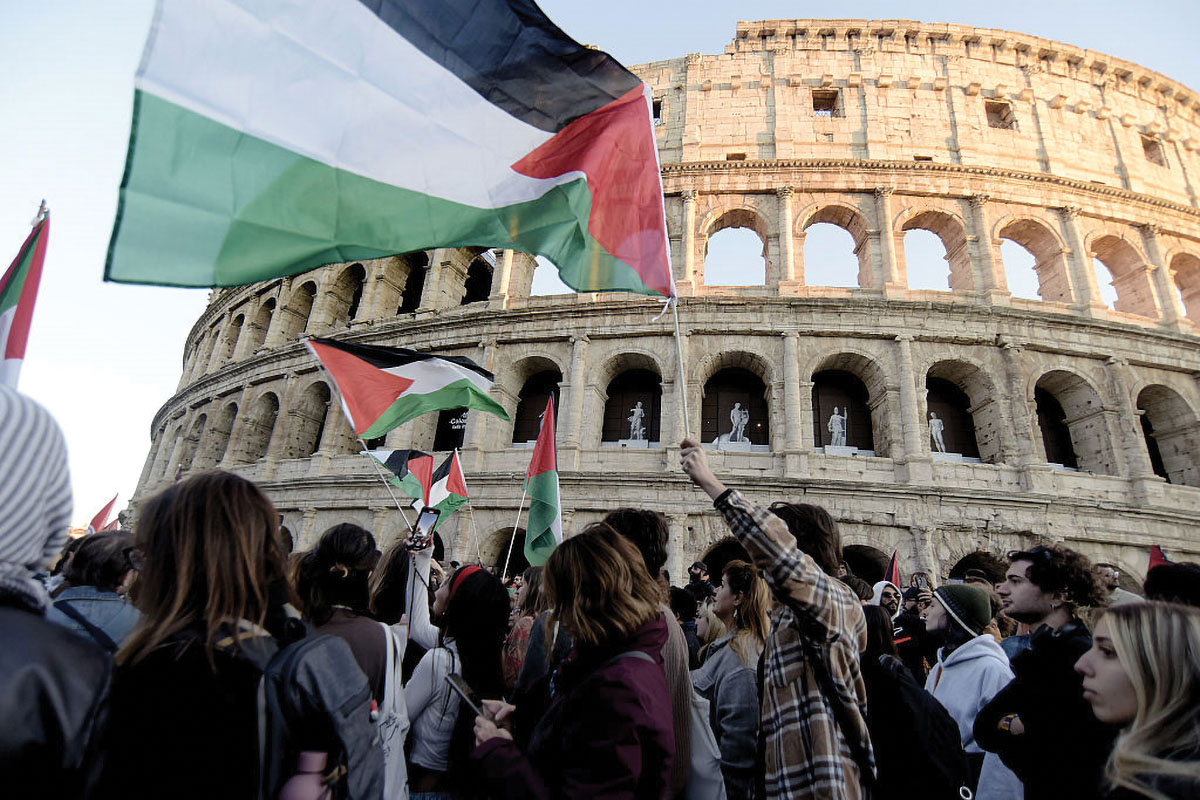
I’ve written in the Journal and elsewhere about what it has been like for Jews in Italy, where I live, since Oct. 7, 2023. Previously, it was as if we lived in a bubble, shielded from the antisemitism that has plagued other European countries so viciously. The bubble is gone now, the protection so deflated and useless that one wonders whether it ever existed at all. The pervasive anti-Jewish graffiti throughout the country; the shouts of “Free Palestine,” “Zionism is fascism,” and even “Jews go home” that echo throughout the streets on a weekly basis; the accusations and blood libels that have become fact rather than fantasy and show up even in classrooms and on playgrounds: It’s the new normal.
It’s unsettling. And it makes many of us feel afraid.
I was blessed to have a father who taught me to be fearless, who showed me what it looked like to live a life unburdened by fear, to refuse it in all of its manifestations. I’ve always rejected fear, not the idea or reality of it but the sensation of it. When we experience fear, the mind and the body adapt to that immediate threat. The body becomes tense and the mind unable to function at capacity because it is devoting all of its resources to the most immediate need: the need to avoid pain and violence. Fear is the signal to the body and the mind that everything else must be put aside so that we can survive.
But to live a life in which fear is our constant companion, is not to live a life at all.
As antisemitism and anti-Zionism have heated up in Italy, I’ve remained fearless. When it was suggested that I not wear a Star-of-David in certain neighborhoods because it might not be safe, I chose to wear an even bigger one. I see this same trait in my almost 13-year-old son. At his international school, he has been told to “go back to the concentration camps,” he has been referred to as “you Jew,” and he has been accused of killing “millions of babies,” among other things. His response was to start wearing a kippah to school every day. His response was to bring an Israeli flag to school on international day. His response was to be more Jewish rather than less Jewish.
As antisemitism and anti-Zionism have heated up in Italy, I’ve remained fearless. When it was suggested that I not wear a Star-of-David in certain neighborhoods because it might not be safe, I chose to wear an even bigger one.
I’ve been proud of this fearlessness and I’ve called for others to embrace it. But last weekend something shifted. I woke up to distant screams of “Palestina libera,” the familiar abrasive and often shrill throatiness echoing across the river through a bullhorn, and knew there was another protest. I was ready. I had prepared two giant Israeli flags to hang from my terrace that overlooks a street on which protesters often march. I ran as fast as I could and draped one of the flags near the railing, mindful of the fact that there was a very good chance this was the only visible Israeli flag in the city. I stood back, proud.
But then I felt something new: fear. I was suddenly scared in a way I hadn’t been and I felt it throughout my body. My terrace is on the second level of the building. Anyone who wants to could reasonably access it. Violence isn’t something we’ve had to worry about in Florence, until recently: a woman wearing a Star-of-David was assaulted by an Arab man on a tram; a father and son wearing kippot were attacked at a gas station; extremely violent altercations between protesters and law enforcement have been the norm at recent protests.
The protesters didn’t end up going down the street on my side of the river, so they didn’t see the flag. But I couldn’t shake the anger I experienced at the depth of what felt like existential fear once I unfurled the flag, wondering if I was putting myself or my family in danger simply by hanging an Israeli flag. I was angry that I felt fearful.
There’s nothing fundamentally wrong with feeling fear. French philosopher Maurice Blanchot writes: “Fear is your only master. If you believe that you no longer fear anything, reading is useless.” Fear isn’t necessarily something we have to overcome; it’s a necessary condition, part of who we are. Fear can be a reaction to a concrete threat, but it can also be existential, again part of the human condition. For Blanchot, we have to find ways to confront existential fear or dread. It’s how we can resist complacency.
For Danish philosopher and theologian Søren Kierkegaard, fear begins as a response to something in the world that threatens or endangers us, but the concrete fear points to something much deeper, which he refers to as anxiety, dread, or angst. Anxiety is fear without an object. Kierkegaard gives us an example: Standing on the edge of a cliff, one fears falling, but one also perceives the possibility of jumping. That second feeling is anxiety, not ordinary fear. Fear is empirical; anxiety is ontological. Fear disappears when the threat or danger has passed, but anxiety carries on even after.
Interestingly, Kierkegaard believes this fear (anxiety) remains because we are free, we have the possibility to choose, we are responsible, and we are finite. In other words, it’s a precondition for selfhood—it’s how we face our freedom, our possibility, and the limits of both.
We can perhaps avoid fear, but we cannot avoid anxiety. However, we don’t need to get rid of it; we need to pass through it. But what’s on the other side? In this case, authentic selfhood, humility before God, spiritual awakening, freedom realized rather than feared. Anxiety can be terrifying, but it is also redemptive. It teaches us something about ourselves and who we must be.
I found myself returning to these philosophical reflections on fear and anxiety as I contemplated my own situation. I wondered what, really, it was that I was experiencing. Was it fear in the face of a specific threat or was it anxiety, a kind of fear without an object? I realized that it was the latter—that the “fear” I was feeling was deeper and more profound than being scared because an angry protester was climbing up to my terrace (that has not yet happened). It was the moment where I felt most profoundly the vulnerability of being Jewish in a hostile world and realizing that I really do have a choice, and that my selfhood and my humility before God are both caught up in how that choice takes shape.
Within this kind of deep fear that lacks a specific object is the opening of possibility.
In recognizing the anxiety beneath my fear, I realized that vulnerability is not a sign of weakness but a reminder of what it means to be human—and what it means to be Jewish—and that moving forward requires carrying that knowledge with intention rather than hiding from it. Fear and anxiety aren’t conditions to be conquered but passages we must walk through. That morning, I understood that my anxiety wasn’t a weakness; it was an invitation to responsibility, to selfhood, and to clarity about who I am and what I stand for.
In recognizing the anxiety beneath my fear, I realized that vulnerability is not a sign of weakness but a reminder of what it means to be human
My anxiety was not only my own; it was connected to centuries of Jewish vulnerability and the relentless struggle between fear and fearlessness. To hang the flag wasn’t just an expression of identity but an act of insisting on a place within a world that sometimes, especially now, prefers our invisibility. Passing through this kind of profound fear can also be a form of resistance if we face the opportunity to choose contained in that fear.
I choose visibility over erasure. I choose responsibility over silence. And I choose presence over fear.
On the terrace that morning, fear gave way to something quieter and deeper: the awareness of that possibility. Anxiety opened a space not just of danger but also of choice. And in that space, I began, if imperfectly, to decide who I want to be.
Monica Osborne is a former professor of literature and Jewish studies. She is Editor at Large at The Jewish Journal and is author of “The Midrashic Impulse.” X @DrMonicaOsborne
The Ethics of Fearlessness in an Age of Jewish Erasure Read More »

