fbpx

September 24, 2025

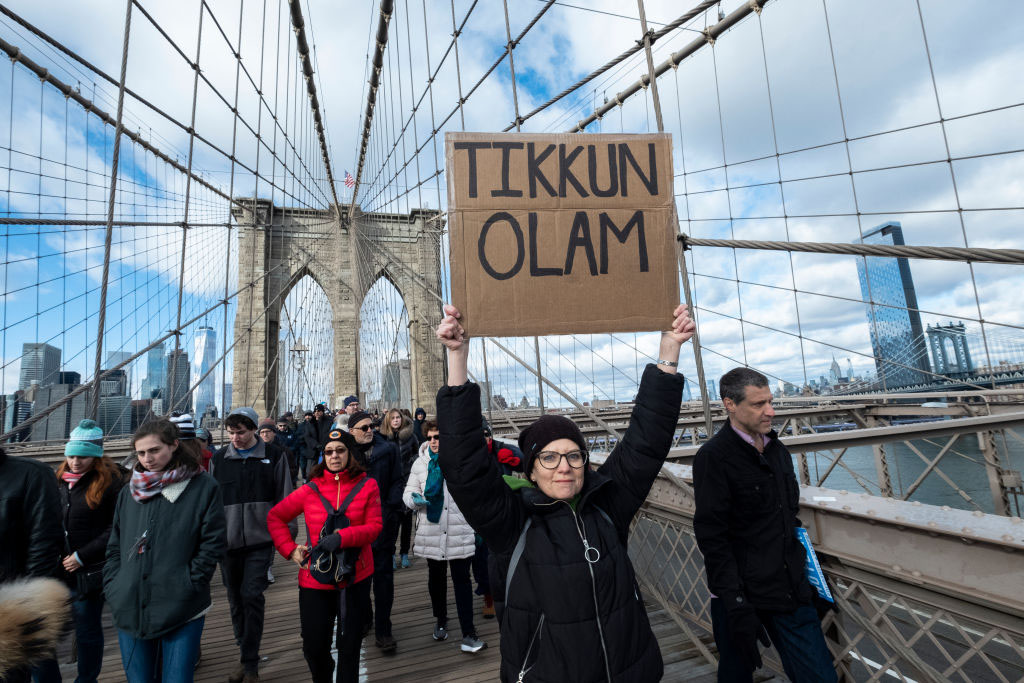
Did Tikkun Olam Shrink Judaism?

Compared to feeding the hungry or saving the planet, how important can it be to light Shabbat candles?

That question has been on my mind as I’ve considered the unique power of tikkun olam, the Jewish movement to “repair the world.” For many years now, this universal ideal has been a driving force throughout the liberal wing of American Jewry. How could it not be? What can be more meaningful than to repair a broken world?

Few people, however, seem to have considered this question: Did the universality of tikkun olam end up overpowering the particularity of Judaism?

The easy rebuttal has always been that there’s no difference between the two: fighting to repair the world is Judaism. In this view, everything socially worthy– helping the marginalized, assisting the homeless, climate change, social justice, defending democracy, etc.—can be put under “Jewish values.”

Thus, tikkun olam offered American Jewry an irresistible proposition: take whatever good you’re doing for the world and call it Jewish.

Why is this irresistible? Because it’s seamless. It fits where you’re already at. You can “live Jewish” without going too far out of your way. Indeed, if the goal was to cast as wide a net as possible to attract Jews, fixing a broken world sounds a lot more attractive than, say, studying Talmud.

Tikkun olam was never intended as a replacement for Jewish tradition. “It’s not either/or” was and remains the classic mantra to convey that the two are interconnected.

But there’s theory and there’s human nature. Humans tend to like the clarity of either/or, especially when one of the choices is so appealing.

And let’s face it– compared to the headiness of changing the world, Jewish tradition can look rather…ordinary. Who needs to observe the restrictions of Shabbat when you could do something that feels so much more meaningful, like, say, volunteering at a soup kitchen?

In other words, when the drama of fixing a broken world becomes more captivating than the routine of traditional Judaism, people do tend to go for either/or.

There are, of course, notable exceptions. Two that come to mind are the IKAR community in Los Angeles and Tevel b’Tzedek in Israel, groups that have successfully married Jewish learning and Jewish tradition with the universal ideals of social justice.

That’s not an easy marriage to pull off.

In too many cases, tikkun olam has become the main course of the Jewish menu. But inevitably, a Jewish menu that downplays Jewish rituals leads to a diluted Judaism. And a diluted Judaism based on universalism doesn’t build a unique Jewish identity– it builds a universal one.

That is the unintended paradox of tikkun olam: In its zeal to make Judaism look big and important, it ended up making it look small and secondary.

We shouldn’t be surprised, then, that in the latest Pew survey, about a quarter of adults who were raised Jewish no longer identify as Jewish.

We’ve already started to see a backlash. More and more Jewish leaders are realizing that being a “universal Jew” is not enough to nurture a strong Jewish identity and sustain a thriving Jewish future. Many in Reform Jewry are bringing back Jewish rituals.

The toughest challenge to this backlash is Israel, which has come under assault in liberal quarters post Oct. 7. Can liberal Jews separate their distaste for Israel’s politics and policies from the moving Jewish ideals of the Zionist movement? Can their reflex to “repair the world” be brought constructively to the Jewish state? In too many cases, the answer has been no.

But that’s no reason to give up. The inherent idea of marrying tikkun olam with the Jewish tradition must prevail if we wish to secure a strong Jewish future.

In that spirit, for spiritual leaders who share my concern, I offer a brief message they might want to share with their flock:

“Judaism, my friends, is more than a universal idea, even one as powerful as repairing the world.

“Judaism is the unique tradition that has sustained us for thousands of years. Judaism is Jewish rituals, the Jewish story, Jewish peoplehood.

“Repairing the world is essential, but that alone won’t instill a Jewish identity.

“If we want to nurture a thriving Jewish future, we must find meaning in what is uniquely ours– our people, our story, our rituals.

“There is no better place to start than the ritual of lighting Shabbat candles this Friday night and sharing a Shabbat meal with your loved ones.

“For our people, repairing the world also means reclaiming our tradition.

“Shabbat shalom.”

Did Tikkun Olam Shrink Judaism? Read More »

Ten Secrets to Academic Success | Fighting Educational Malpractice Personally: What Do I Do with a Politicized Prof – or Teacher

Others in the series:

#1: Remember Why You’re Going to College

#2: Give Yourself the College Orientation You Deserve

#3: Great Debates About Great Books Yield Deep Knowledge, Sharp Minds and Constructive Citizens

#4 Make for Yourself a Teacher – Acquire a Friend

#5 Turn It Off! Managing Social Media, Middle East Minefields, and Political Difference


As I travel, speaking to students, hearing about their teachers, I often feel like an alien. I’m not naïve. In my day, we had plenty of arrogant professors who built themselves up by belittling undergrads. More frequently, we encountered scholarly misfits, forced to teach despite having left any people skills they might have once had on some dusty shelf deep in the archives.  Nevertheless, they were anomalies. They weren’t part of an institutionalized agenda to subvert the consensus position which celebrated classrooms as hothouses encouraging thoughtful, open-minded, liberal and critical inquiry.

By contrast, today, even after the Trumpian backlash, many professors still champion a mass, determined attempt to reduce the sacred educational podium to a political platform. Thousands of colleagues from most leading universities signed one anti-Israel petition, “Palestine and Praxis,” insisting “that the critical theory we generate in our literature and in our classrooms must be backed in deed.” 

In 2018, Altheria Caldera, Ph.D., then an assistant professor at Texas A&M University-Commerce, published “Woke Pedagogy: A Framework for Teaching and Learning” in the journal Diversity, Social Justice & the Educational Leader.  Characteristically preferring advocacy to analysis, demanding that “teachers exhibit activist care,” Caldera asserted: “The sociopolitical context of schooling demands that teachers acknowledge the ways their students’ and their own experiences are shaped by the intersections of racism, classism, sexism, heterosexism, and other discriminatory factors …” 

Denouncing “colorblind pedagogy” – I call it “treating each student equally, respectfully, as an individual” — Caldera instead endorsed “Woke pedagogy … grounded in Black ideology,” which “like critical multicultural education, is defined by teaching practices that integrate critiques of contemporary justice-related issues with academic content in a learning environment that encourages introspection, interrogation, and insurgence.”

By the time a brutal Minneapolis police officer killed George Floyd in May, 2020, waves of woke alumni were imposing their doctrines in the media, in corporations and, most disturbingly, from “Woke kindergarten” to “Woke U.” They spread the “woke” language of microaggressions, macroaggressions, triggering, intersectionality, anti-colonialism and white privilege. 

Rather than fine-tuning America’s meritocracy, democratizing that process, grievance groups competed for goodies. This intellectual corruption intensified the victimology Olympics, squabbling over which groups suffered most and deserve the greatest payoff. This results-oriented “equity,” fueled by a politics of vengeance, trumped the traditional liberal-democraticcommitment to seeking equality opportunity and an ever-fairer process.

Meanwhile, all too often in “red America,” teachers ban books, impose their partisan agendas and fight the elites’ heavy-handed left hand with a heavy-handed right hand of their own.

If there’s medical malpractice and legal malpractice, this is educational malpractice. Expose the con: “academic freedom” doesn’t free teachers to bully students into parroting every political position the classroom authority takes. Universities must start scrutinizing what’s happening in the classroom and redefine educational protocols. If students don’t feel free to ask, challenge, express themselves and come to conclusions their teachers may reject politically, the teachers are failing; the classroom needs fixing. When the orthodoxy is imposed intentionally, the malpractice is “premeditated.”

If students don’t feel free to ask, challenge, express themselves and come to conclusions their teachers may reject politically, the teachers are failing; the classroom needs fixing. 

So what’s a thoughtful student to do? What happens when you’re paying $96,078 for tuition room and board, and – true story – your professor spells U.S.A. “u*s*a” and Israel “isr*el” treating these democracies’ names as curse words, not worthy of capitalization? What happens when you’re attending medical school and you must take a full course – not one lecture, which would be reasonable – called “Decolonizing Anatomy?” 

The advice I give students may surprise many – and I’m happy to be corrected, or at least trigger a robust debate. My first answer is: “feel free to do nothing at all. Remember, your main job is to be a student. Play the game, get the grade you can.” That answer shows that my job as a professor – and an activist – is not to guilt students. I do, however, want to reassure them that they have options, while inviting them to clarify who they are and what their goals are.

I add two thoughts.

First, I say, “at the end of the day, you must pass the mirror test. You want to look into the mirror and like what you see. So feel free to flow with your prof – or feel free to take a stand – but do it for you, not for me or anyone else.”

Then, I offer a constructive middle path. “Here’s another strategy,” I say. “Take the course. Don’t rock the boat. Get that A. But, whenever the prof goes wacko partisan or anti-Israel, during the semester, document it.” I add advice I hate adding: “and if it’s anti-Zionist, see if you can get a non-Jewish student to confirm that too.

“When the semester ends, and grades are in, do what these fanatics often don’t do with us. Be a mensch. Give the professor the benefit of the doubt. Visit during office hours, and respectfully share your detailed concerns. In short, model the kind of constructive ‘I-thou’ relationship you seek. Then, if the teacher shuts you down or denies it, you can always go to the administration, ombudspeople, the press. But, first, honor the sacredness of the teacher-student interaction.”

There’s a beautiful Jewish concept called “Milchemet HaTorah” – the Torah war. It can refer to wars the Torah justifies – especially wars of self-defense like Israel’s war today – but that’s a gratuitous jab at our hypercritics, I confess. The phrase also refers to the purer, back-and-forth between two students, or a teacher and a student, debating what the Torah means, and teaches. 

That acknowledgment of doubt, that invitation to argue, is sublime. There’s a Jewish tradition that when such arguments erupt, God descends – just to listen in and delight, not opine.

The Harvard University I attended was indeed “godless Harvard” as many critics loved calling it. But in most classrooms, among most scholars, there was that kind of apolitical, open-minded, liberal, purity a godliness. That transcendent classroom given isn’t for Donald Trump to restore to defeat the left – that’s an ideal approach for every educator to restore, to sharpen our minds and lift up our souls.


Gil Troy, a senior fellow in Zionist thought at the Jewish People Policy Institute, is an American presidential historian. Last year he published, “To Resist the Academic Intifada: Letters to My Students on Defending the Zionist Dream” and “The Essential Guide to October 7th and its Aftermath.” His latest, “The Essential Guide to Zionism, Anti-Zionism, Antisemitism and Jew-hatred” was just published and can be downloaded on the JPPI Website. 


Ten Secrets to Academic Success | Fighting Educational Malpractice Personally: What Do I Do with a Politicized Prof – or Teacher Read More »

On 5786, A Protocol for Action in This New Year

In this season of our renewal, where should we turn? In this moment we are operating in the betweens, those uncertain spaces where we find ourselves bereft of clear choices and future directions. 

As we enter 5786, this New Year we each are struggling with the many challenges before us. How ought we to engage with Israel? Can we reclaim the Zionism that we had once embraced? In what ways can and should we respond to the anti-Jewish rhetoric and anti-Semitic actions being directed against us? What will be the future of this democracy and do we as Jews have a place in this changing society?

Returning to the work at hand, we need to confront the major elements of both the Israel story and our own American Jewish experience. Acknowledging that these elements are bound together, informing our identities and defining our destiny. 

As we face the future, we need to remind ourselves not only about the pace of change but also the scope and depth of the transformational process around us. What will we require moving forward? I have had occasion to write about the underlying factors creating this new point in time. As a society, and more directly, as an ethnic community, there will be essential structural and policy components requiring our attention and action.

Where do we begin? In an environment of discord and disunity, it is imperative to start by initially turning inward. Being grounded in our own reality and clear about our sense of self will allow us to affirm our identity and advance our priorities. 

We need to confront the deep and real divisions that today separate us. Where once we defined ourselves as part of a collective and shared voice, today we acknowledge that we are living amidst divided communities and disparate expressions. When dealing with isolation, loss and disconnection, Judaism itself offers us an extraordinary set of texts and resources designed to provide both an anchor and a direction forward. Yet, we must take up the significant and essential tasks before us.

The Primacy of Community:

At a time of extreme isolation and uncertainty, we must reclaim the added value of community. In so many ways, the sanctity of the collective is where we find comfort and support. We must move from the noise and the anger of the public square into the quiet of our communal sanctuary, drawing solace, hope and vision from within our own circle of unity.

The Centrality of Leadership:

We come to this moment feeling a sense of loss — as a society we are experiencing a series of cultural and policy disruptions. The transformative changes abound all about us, as values, principles and practices are being reconfigured. What will be required is a serious investment in exploring new models of leadership and governance in an age where many folks have lost confidence in and belief about the ability of organizations or governments to solve problems and bring peoples together. 

Resetting a Climate of Civility and Respect:

As a society we must find some common threads, allowing us to engage with one another.  Absent such lines of discourse, we as a nation will cease to exist. The search for the common ground must drive this quest for some measure of wholeness. As Jews we know only too well the failed outcomes when we find ourselves divided and in discord. Drawing upon our own story, we must model a framework of connection and engagement.

Reimaging our Democracy:

Judaism must be seen as a natural and essential counterweight to authoritarian behavior. Jews have encountered authoritarian rulers over the course of their long history, developing mechanisms providing them with the means to protect and manage their communities. In dark and uncertain times, Jews always returned to their tradition, finding a sense of solace and connectivity. Jewish texts offer profound messages of consolation and hope from the Tanakh to later rabbinic and mystical writings. These texts address themes of suffering, national tragedy, personal grief and the promise of redemption and renewal. 

“Brokenism” has become the unifying idea, as citizens search for those shared values that once defined their belief in community and provided social cohesion.

Joining with others, we have a unique opportunity to reenvision our national story. Drawing upon our rich history, reclaiming our civic values, and capturing our collective aspirations and dreams, this then becomes the moment in consort with others to construct the new American platform.

Rethinking the Diaspora-Israel Relationship:

As Israel and we move beyond Gaza, will we be able to undo the images and pain of this conflict? What will be required of Israelis and of Diaspora Jewry will be nothing short of a fundamental remake. It will begin with a remake of Zionism and how we both understand and relate to what it may represent in a post-Gaza environment. Yet, well beyond Zionist ideology, what will be the defining characteristics of the Jewish state moving forward? Will we experience a radicalized Zionist nationalism or are we likely to see the reaffirmation of a democratic, Jewish Israel?

Rebuilding the “Case” for Israel:

In the aftermath of these difficult two years, much will need to be repaired. We will be tasked with advancing a possibly different Israel storyline as we move to rebuild partnerships and connections with potential allies and seek new ones as well.

Reframing the American Jewish Agenda:

This is not a time to surrender our broader civic concerns. Our collective interests begin with the healing and embracing of America democracy, even as we continue to advocate for our particular policy interests. This is a time where we need to project how our agenda also enhances the broader political space.   

All of this and more sit before us as opportunities and tasks awaiting our attention and action. In this New Year, we will find ourselves called upon to carry forward the responsibilities of leadership, the obligations of community building, the requirements of advancing Jewish civic interests. There is no space here for delay — the welfare of our community is dependent upon our mutual action and the demands of our society require our hearts and hands to be present in rekindling the American democratic framework. 


Steven Windmueller, Ph.D. is an Emeritus Professor of Jewish Communal Studies at HUC-JIR, Los Angeles. His writings can be found on his website, www.thewindreport.com

On 5786, A Protocol for Action in This New Year Read More »

When Words Break: Rebuilding a Shared Jewish Lexicon

In the aftermath of October 7, language itself began to falter. At first, many of us lacked adequate words to describe the horror of the events or the intensity of our responses to them. Terms that once offered comfort or cohesion suddenly felt fragile, divisive, or even dangerous. Words like hostage,” “genocide” and “betrayal” began to fracture under the pressure of new pairings and contested meanings, while familiar phrases such as “solidarity,” “safety” or “never again” no longer carried shared resonance. Instead, they became contested terrain, provoking confusion, trauma or defensiveness depending on who invoked them and in what context.

This rupture in language is not confined to the realm of political debate; it reverberates across classrooms, congregations, camps and family tables. For Jewish educators, clergy and communal leaders—those tasked with fostering meaning, coherence and resilience in the midst of collective trauma and global polarization—the breakdown of shared vocabulary poses a profound challenge. Conversations that once might have served as sources of connection or moral clarity now risk deepening fractures. Yet silence, while often perceived as the safer choice, carries its own cost: It can erode trust, perpetuate isolation, and leave communities without the frameworks they very much need to navigate this moment.

In the face of this unraveling, many educators began to ask: When our common vocabulary no longer holds, what possibilities—and responsibilities—emerge for those tasked with teaching, guiding and shaping meaning?

In response, over the past year, our organization convened hundreds of educators and community professionals across the United States and Israel, inviting them to identify the words that no longer served them—terms that had become charged, emptied, painful or unsafe—and to articulate the new shared language they were reaching for. One of the early inspirations for this work was Rabbi Angela Buchdahl’s Oct. 13 sermon at Central Synagogue in Manhattan, delivered just days after the attack. “There are no words,” she said—naming both the collapse of language in the face of horror and the danger of silence. Her framing helped crystallize a core question that would guide our inquiry: When language breaks, what might help rebuild it?

The responses were both sobering and illuminating. Again and again, participants testified to a profound instability: Language itself no longer felt like a trustworthy vessel. Yet, embedded in their reflections was also a measure of hope: that with care, honesty and sustained reflection, words might once again become capacious enough to bear meaning, connection and even renewal.

From this expanding body of responses, five core insights have emerged—offering educators, leaders, and all who engage in Jewish life new ways to consider how we might speak, and how we might listen with greater clarity, nuance and compassion.

  1. Fractured Semantics: When Words Stop Holding Shared Meaning

Language is inherently social, but in polarized times, meanings fracture. A single word can now mean radically different things to different people. For example, in our survey, the word “Zionism” often appeared simultaneously as a source of pride and as a trigger for division. “Peace” and “justice” were also cited repeatedly as words that once felt aspirational and grounding, but now felt politicized or co-opted.

Educators reported feeling hesitant to use terms they had relied on for years. Even foundational concepts like “Jewish values” were called into question—not because the values changed, but because the words used to describe them no longer felt shared.

The takeaway: We can no longer assume common definitions. As educators and leaders, we must cultivate the discipline of semantic humility—slowing down to ask not only “What does this word mean to me?” but also “What does it mean to the person before me, and what histories and experiences shape their hearing of it?”

  1. Linguistic Rupture: When Trauma Overwhelms Language

Words can serve as tools for healing, but under the weight of trauma they often collapse. In the aftermath of Oct. 7, familiar terms such as “safe,” “home,” and “normal” surfaced not as sources of comfort but as painful reminders of what had been lost. In our Israeli sessions, the phrase “Simchat Torah” appeared again and again—not as the name of a Jewish holiday, but as a symbol of devastation, permanently reframed by the events that happened on that day in 2023.

Jewish tradition both illuminates and complicates this reality. We are a people who name our collective ruptures by date—Tisha B’Av, 17 Tammuz, and now, inevitably, October 7. Yet unlike those historical tragedies, this one is still unfolding. Educators are being asked to respond in real time, to give words to grief even as its contours remain unfinished.

The takeaway: Trauma demands linguistic patience. In moments when words collapse, our task is not to supply ready-made scripts but to hold space for silence, presence, and the slow work of meaning-making. Words will return, but only if we honor the time it takes for language to become trustworthy again.

  1. Polarized Language: When Words Turn Into Fault Lines

The most emotionally charged words in our data—”genocide,” “colonizer,” “resistance”—came up frequently in North American settings, especially on college campuses. For some participants, these words were invoked to name Jewish suffering; for others, they appeared primarily in accusations against Israel. In both cases, the terms functioned less as descriptors and more as weapons, sparking confrontation and defensiveness.

Yet, the fracture extends beyond overtly political vocabulary. Words like “ally,” “activist” and “dialogue”—once embraced as markers of inclusion and shared purpose —now trigger suspicion, mistrust or even hostility. The same word that signals solidarity to one audience can now feel like betrayal to another. This collapse of shared language reflects a deeper fragmentation: the erosion of shared moral and ethical frameworks. These fractures are not limited to public discourse—they’re playing out around family tables, too. Across North America, we heard stories where conversations about Israel and Gaza led to pain, silence and estrangement within families.

Words are never neutral; they arrive carrying histories, affiliations, and wounds.

The takeaway: Polarization demands stewardship of language. Words are never neutral; they arrive carrying histories, affiliations, and wounds. Educators and leaders must take responsibility for how language is used—acknowledging its multiple meanings, surfacing its risks, and creating conditions where even contested terms can be engaged without collapsing the conversation itself. The same practices that can sustain classrooms and communities—slowing down, asking with curiosity, listening for nuance—can also help families begin to reopen channels of empathy and rebuild trust across divides.

  1. The Weight of Silence: When Not Speaking Becomes Its Own Message

Faced with these complexities, many educators described retreating into silence. When the risk of being misunderstood feels high, when every word can be scrutinized or weaponized, staying quiet often feels like the safest refuge.

Yet silence is never neutral. It can signal distance, abandonment or fear. One educator in our survey shared the difficulty of not knowing how to talk about the hostages taken to Gaza on Oct. 7 in an interfaith setting, worried any comment would be judged as political. Another avoided discussing Israel at all in her classroom, despite students’ clear need to process. In both cases, the absence of words created a vacuum where trust, connection and meaning could have been built.

The takeaway: Silence may feel like protection, but in reality it holds us back. It can fracture relationships, erode trust and leave meaning unspoken. What this moment demands is communicative courage: the willingness to risk imperfect words, spoken with honesty and humility, so that connection and trust can grow where silence would otherwise prevail.

  1. Responsibility: We All Have a Role in Naming This Moment

In times of rupture, the words we choose (or avoid) shape not only what gets said, but also who feels seen, heard and held. When educators, rabbis and communal professionals name the words that feel broken and reach for language that better reflects this moment, they’re not merely facilitating dialogue—they’re helping rebuild the moral fabric of our communities.

This responsibility isn’t about finding the “right” words. It’s about showing up with humility, curiosity and care— recognizing that a single word can carry different meanings for different people, shaped by history, identity and lived experience. Notably, the terms that surfaced most powerfully in our sessions—“grief,” “holding,” “presence”—didn’t resolve tension or offer certainty. Instead, they emphasized depth over performance, meaning over messaging.

The takeaway: Rebuilding a lexicon requires communal responsibility. Language is not only descriptive; it actively shapes our relationships. The task before us is to choose words that open rather than close, that invite rather than exclude, and that help reweave trust across fractured communities. This is not work for educators alone, but a shared obligation we must carry together as a people.

What Comes Next Is Ours to Name

A new lexicon doesn’t mean abandoning the old one. It means acknowledging the rupture—and still choosing to speak. It means holding the tension between the language we inherited and the language we now need. Some words will remain. Others must be reimagined. Still others have yet to be found.

In See Under: Love, Israeli novelist David Grossman writes of a child who creates an imaginary encyclopedia to make sense of the Holocaust—because no one around him could speak the words. We are in a similar moment. And like that child, we are not starting from scratch. We are starting from silence, from rupture, and from the fragments of meaning we still carry.

This emerging lexicon is not just a tool for educators. It’s a collective act of responsibility—an expression of Jewish peoplehood, resilience, and care. It’s an invitation to each of us, wherever we sit in the community, to name what feels broken, to notice what still holds, and to begin reaching for words that can carry us forward.

We know this is not simple work. Language lives in the hearts, histories and identities of those who use it, and the same word can hold entirely different meanings for different people. Building a shared lexicon will take time, patience, and humility. But even beginning the work, together, is a step toward rebuilding trust and deepening connection.

If you’re wondering where to begin, maybe start here: What words feel broken for you? Which ones are you clinging to? And what new words might help you teach, lead, or love in this moment?


Shuki Taylor is Founder & CEO of M²: The Institute for Experiential Jewish Education (M²), and Shlomit Naim Naor is Program Director at M².

When Words Break: Rebuilding a Shared Jewish Lexicon Read More »

Rosner’s Domain | Tell Me More About the State You Just Recognized …

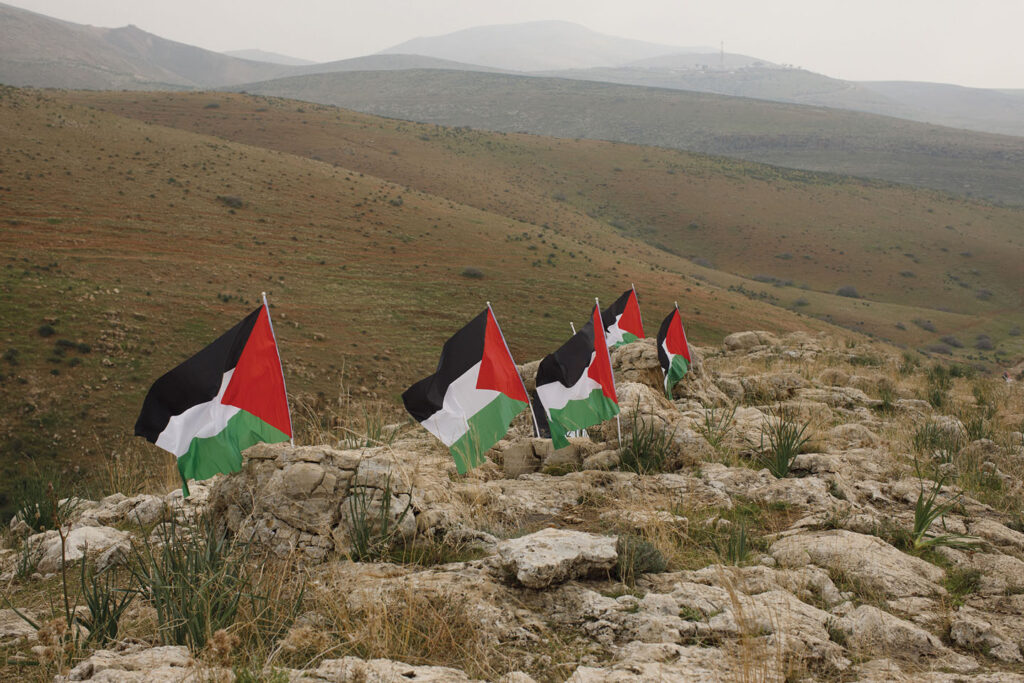
Canada recognized a Palestinian State. The U.K. did. And France. And Australia. What are they trying to do? Assuming they aren’t all dumb, or hateful, assuming there’s a rationale we fail to grasp – what could it be?

Maybe it’s punishment. Israel doesn’t listen to their advice, doesn’t follow their recommendations, doesn’t respect their sensitivities. They punish Israel by recognizing a nonexistent state. It is retribution because Israel had been annoying. If that’s the case, they don’t even have to truly believe in a Palestinian state as an implementable objective. They use the Palestinians as a tool to hammer Israel – or Prime Minister Netanyahu and his government. The Palestinians are pawns in a diplomatic game they play. They could similarly become the pawns when Israel decides on its measures of retribution. There’s very little the Palestinians can gain from this international move. There’s a lot they can lose. Of course, Israel can also lose. A battle with half the world – even when one has the backing of the U.S. – is not a recipe for success.  

There’s very little the Palestinians can gain from this international move. There’s a lot they can lose. Of course, Israel can also lose. A battle with half the world – even when one has the backing of the U.S. – is not a recipe for success. 

What else can the trend of recognition be? It could be an internal political ploy. Leaders use both Israel and the Palestinians as pawns to gain popularity in their own countries. Does it help Israelis? Does it help Palestinians? Macron and Starmer don’t necessarily care. We – Israelis – berate them for doing a foolish thing. But it is not necessarily foolish from their perspective if the goal is political gain. We could say they are cynical, we could say they are hypocrites, we could say they are immoral – but foolish? Only if the polls in their own countries prove their moves to be politically harmful.  

Now let’s consider the most gracious option. Let’s consider the possibility that they truly want a Palestinian state to emerge from this process of symbolic gestures. If that’s the case, two follow-up questions must be asked. One: do such symbolic gestures increase (or decrease) the likelihood of a Palestinian state. Two: why would Australia and the U.K. take steps that (they believe) make a Palestinian state more likely?

Let’s begin by tackling the first question. It begins with the following assumption: Israel doesn’t let a Palestinian state emerge and putting pressure on Israel to allow it to emerge is the vital step towards Palestinian statehood. Is it true? Well, that depends on the answers to more questions. For example: Would Israel accept a heavily militarized Palestinian state on its border? The answer is “of course not.” Surely, not before such an entity is guaranteed to be a peaceful neighbor. So yes – if a Palestinian state means a Palestinian military on Israel’s border, Israel is indeed an obstacle. 

Do Australia and Canada call for such a state? That’s a question for which we have no answer. They recognize a state but have no plan for a state. They act as if a “state” is a clearly defined goal, or entity – when it is not. In fact, more than a disagreement about the headline “state,” the Israeli-Palestinian conflict is about the details of whatever you call what comes next. It is a disagreement about borders, security, refugees, incitement, settlements, holy places, recognition and so on. Does France have a plan for resolving these issues beyond a recognition of a “state”? If they do have a plan, I’ve yet to see it. The Brits, Australians, Canadians and the rest are no better. In a similar vein they can recognize a “world peace,” or a “global cooling,” or a “cure to cancer.” Details to follow. 

Then, there’s the nagging other question. Why a Palestinian state? One assumes that in recognizing such a state, the leaders of these great Western countries strive to achieve something. They did not recognize a Kurd state, or a Druze state, or the state of the Basques (in Spain), or a state of the Québécois (in Canada) or an independent Tibet. That’s because countries do not recognize other states unless they believe there’s more good than harm in doing so. If they assume that a recognition of a “state” – say, Taiwan – is likely to bring about more dificulty, more bloodshed, you’d expect them to take the cautious route. But in this case they don’t. They aim to achieve a goal without having the ability to guarantee that achieving it is going to be beneficial to anyone. 

You think the lives of Palestinians are going to be better than today within a Palestinian state? Look at Gaza, look at Syria, look at Yemen and think again. Maybe – maybe not. You think the lives of Israelis are going to be better than today if there’s a Palestinian state? Well, the obvious answer is “that’s unlikely.” Maybe the lives of Brits, Canadians, Australians, French are going to be better than today if there’s a Palestinian state? If that’s the case, show me how. 

Something I wrote in Hebrew

Israel’s PM “super-Sparta” speech was highly controversial. But some things the PM said are becoming a consensus:

Netanyahu was right to argue that the war taught Israel an important lesson when it comes to munitions production, stockpiles and management. During prolonged periods of war, stockpile considerations dictated military and political moves. It was sometimes impossible to attack in one place, because that would leave a munitions’ shortage somewhere else. It was impossible to act against the will of the Americans, because that would also have created a munitions shortage. So yes, Israel will have to strengthen autarkic elements when it comes to its ability to arm itself. 

A week’s numbers

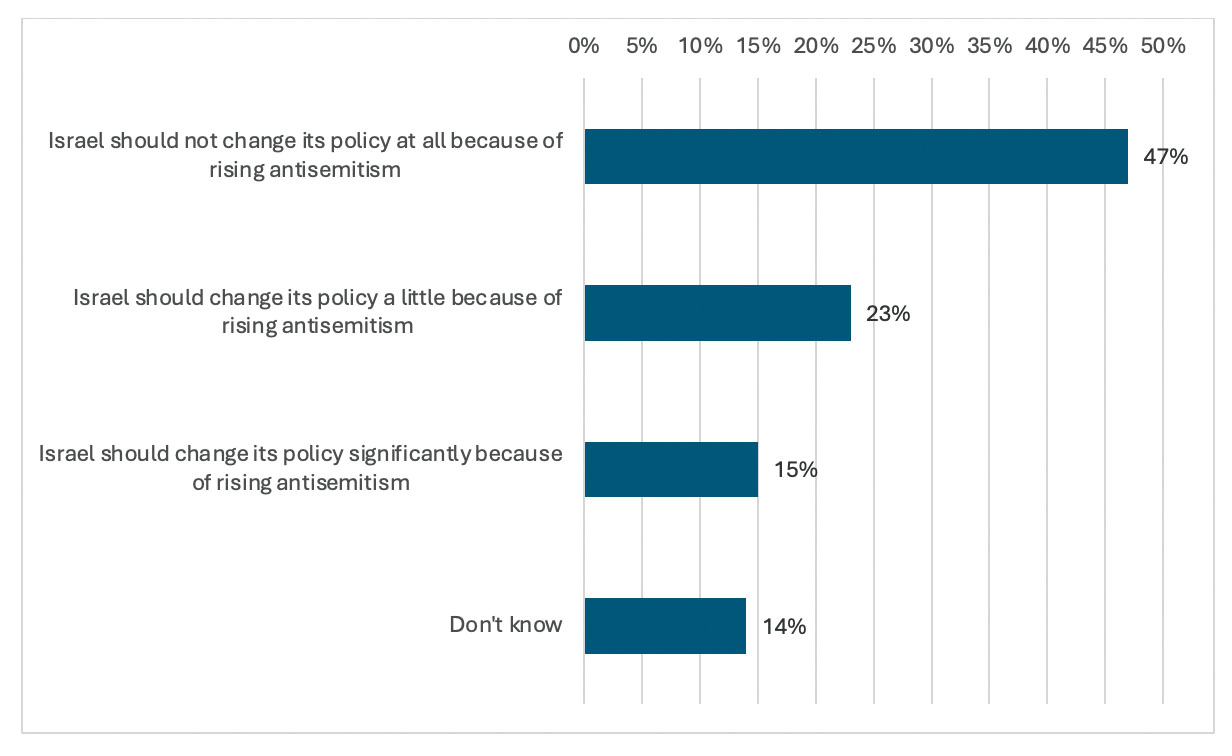
We asked: When you think about the rise of antisemitism in the world, which of the following options is closest to your position? Israelis had an answer (JPPI September 2025).


A reader’s response

Adam Frank asks: “Did you read the Economist report on Israel’s dwindling support in the U.S.?” My response: I did. The follow-up question is this: Can Israel do something to improve its standing without dangerously compromising on its security? I think it can – but it’s not as simple as people might think. 


Shmuel Rosner is senior political editor. For more analysis of Israeli and international politics, visit Rosner’s Domain at jewishjournal.com/rosnersdomain.

Rosner’s Domain | Tell Me More About the State You Just Recognized … Read More »