fbpx

June 19, 2025

By the Thames, There We Sat Down, Yea, We Wept, When We Remembered Babylon

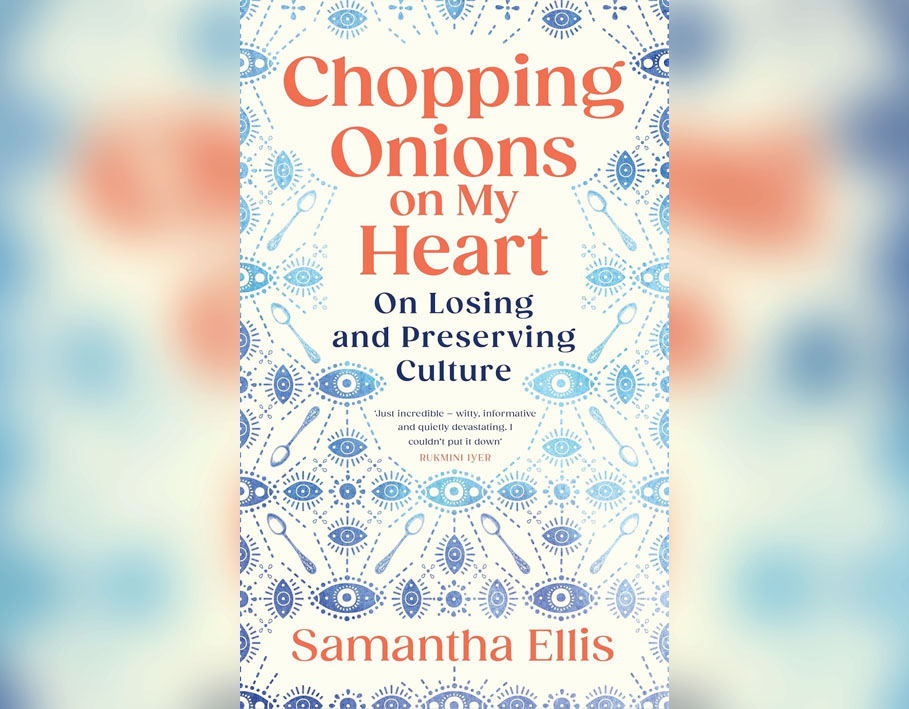
A lachrymose river runs, like the Tigris, through Samantha Ellis’s new book “Chopping Onions on My Heart: On Losing and Preserving Culture.” In almost every chapter, Ellis mourns the loss of yet another aspect of Iraqi Jewish culture, chief among them, the Judeo-Iraqi Arabic language, but also the nabug fruit, and the ability to fit in. Ellis, a playwright and the daughter of Iraqi Jews who migrated to Britain (her father via Israel), is determined, as the subtitle indicates, to hold on to and share with readers that colorful world that her parents left behind. And, as I read the book, I saw why. It’s impossible to finish this memoir and not come away with a desire to claim as your own fantastic and near-forgotten expressions such as “Yethrem basal all ras efadi!” (you’re chopping onions on my heart!), like the English “you’re rubbing salt on the wound” and “ashteedek” (long live your hands), a beautiful compliment to a chef. You might even sign up for a class at the Oxford School of Rare Jewish Languages, as Ellis has, or tune into the latest episode of the podcast “Heritage Words” hosted by Hebrew Union College professor Sarah Bunin Benor.

Two years ago, writing about an exhibit at the Jewish Museum in New York, Sasha Goldstein-Sabbah, a scholar of Baghdadi Jewish history, declared: “The Sassoon family is having a moment.” Indeed, it’s not only the “Rothschilds of the East,” but Iraqi Jews more generally who are having their little-known history coming to light. Certainly, this is true in Britain, where much of it has been emerging from a deeply personal perspective. Ellis’s memoir joins a choir of voices of second- and 1.5-generation Iraqi Jewish Brits. In the last five years, we’ve been treated not only to Joseph Sassoon’s family history, but also to Carol Isaacs’s “The Wolf of Baghdad,” a stunning graphic novel with a stripped-down palette, all twilight and dawn, liminal temporalities to go with the ghostly figures, a book non-chronological like memory itself; Avi Shlaim’s anti-Zionist polemic-cum-memoir, “Three Worlds,” a story of a man who never forgave the Zionist state for downgrading his high-status people long, long after he left it, moved to England, and rose to prominence as a historian at Oxford; and now Ellis’s memoir, a mix of historical research, insightful reflections on all matter from antisemitism to parenting, and recipes.

Ellis begins with the fear that her “milk language” is at risk of extinction. But in order for us to care about the language, we must first know who spoke it. So, Ellis offers us a history of the Jews of Iraq—Jews who were there long before the Arabs, who wept by the rivers of Babylon, remembering Zion after they had been exiled from the Kingdom of Judah in 597 CE. They were Jews who chose to stay when offered the chance to return from the diaspora, Jews who slept on the roof, listened to Salima Murad, ate amba (Ellis recycles the myth that it was a Sassoon who invented it), went to the Alliance Israëlite Universelle schools and, a decade after the Farhud, all but disappeared (but not Ellis’s mother, who left almost two decades later, which makes her stories some of the most recent in Iraqi Jewish history). We follow Ellis to the British Museum, where she studies artefacts, like a kohl stick, reminiscent of the kohl pots her mother brought with her to England; the Cyrus Cylinder, a kind of human rights proclamation that curiously is housed in the Iran section of the museum; and the magic bowls made by Jewish women. Each object, memory and fact comes with its own set of questions and ruminations.

Each object, memory and fact comes with its own set of questions and ruminations.

Throughout the memoir, Ellis struggles to embrace what is clear to the reader: that she is, not despite, but because of her heritage, a modern woman in multicultural Britain. She writes about “homesickness—for a place I’d never been” and feeling “alien.” When she eats the nabug fruit for the first time, she thinks she is returning “where I belonged. Where I made sense.” Is it where she belongs? When Isaacs imagined returning to the Iraq of her parents’ time in “The Wolf of Baghdad,” she draped her ghostly figure in an abaya. She understood her contemporary Jewish, modern self had no place there. But Ellis gets trapped in nostalgia—for a place she hasn’t visited and can’t visit, for a place she can’t fully capture, for all the research in the world. There is pathos and humor in this failure. When she learns Judeo-Arabic at the Oxford School, she excitedly greets her mother with “s’bakh el heir” (morning of wellness), but her mother responds, “We didn’t use those words … We just said hello.”

At one point, Ellis relates that she’s worried she would always miss things “writing in a language that wasn’t fully mine.” I startled and not only because she’s London-born, and English, as she says, was “the language I grew up in, the language of all my friendships and relationships, the language of my child,” but also because her prose is so truly masterful. Not a minute earlier, I had inserted a series of checkmarks on the margin of the page, loving the way she discussed Sami Michael’s “Victoria,” that scene where illiterate Victoria and her girl cousins discover a message on a paper airplane and ask the rabbi what it says, and Michael renders the message (comparing rabbis to prostitutes) in Judeo-Iraqi Arabic, using the Hebrew alphabet. “This is how my language exists on the page now,” Ellis writes, “as a snippet of scurrilousness written on paper folded into an aeroplane and flown onto a roof, found by a people who can’t read it, translated by someone who is outraged about it, and printed in a book in such a way that not everyone can fully access it.”

There are moments when Ellis decides to release her tight hold on the idea of authenticity, to accept that she is (as all of us are) a product of different cultures and heritages, of yesterday and of today. These moments seem fleeting, but they impart a message, one not of loss, but of gain, not of the lachrymose, but of the joyful. What we gain through Ellis, as well as Isaacs and others of her generation, is a new body of Anglo-Iraqi Jewish literature.


Karen Skinazi, Ph.D. is Associate Professor of Literature and Culture and the director of Liberal Arts at the University of Bristol (UK) and the author of “Women of Valor: Orthodox Jewish Troll Fighters, Crime Writers, and Rock Stars in Contemporary Literature and Culture.”

By the Thames, There We Sat Down, Yea, We Wept, When We Remembered Babylon Read More »

Unutterable Art: Jewish-Russian Poets Gain New Lives in English

There are only 110,000 Jews left in the post-Soviet states, the majority in Russia and a significant minority in Ukraine—two Jewish communities now living on opposite shores of a bloody war. Spaces of the former Russian Empire are not likely to produce another national poet of Jewish origin. At the same time, Israel, North America and Germany have gained large Russophone Jewish communities, whose members are writing in English, Hebrew and German, translating into those languages, and shaping their countries’ literary canons.

It’s a thrill to celebrate the publication of two first English-language poetry collections by major figures of Jewish-Russian literature, Ilya Ehrenburg (1891-1967) and Semyon Lipkin (1911-2003). Both the Kyiv-born and Moscow-raised Ehrenburg and the Odessa-born and raised Lipkin originated from what is now Ukraine and made the Russian language their home. These English-language versions of Ehrenburg’s poetry (passionately transposed by the Russian-American poet Anna Krushelnitskaya and published by Smokestack Books) and of Lipkin’s poetry (lovingly curated by the late Jewish-British poet Yvonne Green and published by Hendon Press) come at a challenging time. A judgment of literary work is particularly complicated when Russia’s bombs and missiles are falling on Ukraine and, as a backlash, when streets named after Russophone authors, some of them Jews, are being renamed or unrenamed in Ukrainian cities.

Joshua Rubenstein, Ehrenburg’s biographer whose introduction adorns the new volume, offers this assessment: “[Ehrenburg] managed to survive Stalin, but in spite of his official conformity there was always a feeling about Ehrenburg that he was different.” Fiction writer, journalist, poet and memoirist, Ehrenburg possessed a peerless talent for articulating the vibes of history. Even before World War 2, Ehrenburg had been well known outside the USSR, especially to left-leaning intellectuals. In a letter to Walter Benjamin, dated Nov. 27, 1937, Theodor Adorno drew on Ehrenburg’s novel “The Extraordinary Adventures of Julio Jurenito and His Disciples” (1922) to describe the position of the intellectuals exiled from Nazi Germany: “Dear Walter, … In all seriousness, I can hardly imagine our relationship to Europe as other than that of Ehrenburg’s travel company rummaging its way through her devastated cities.” Ehrenburg’s wartime journalism made him one of the most famous Soviets abroad. He was a principal cultivator of popular hatred against the German invaders, which he famously summed up in his article “Kill!” published on Jul. 24, 1942 as the panzers pushed ahead toward the Caucasus and Stalingrad, and also in a poem of the same title, included in the volume: “Like life—don’t eat, don’t drink, keep still,/ No breath, no word, except for—kill!” Legend has it that only two sections of army newspapers were exempt from being rolled into cigarettes: Stalin’s portraits and Ehrenburg’s articles. Soon after Stalin’s death, Ehrenburg wrote the novel “The Thaw” (1954), which lent its title to palliative de-Stalinization. Ehrenburg was never a dissident, yet his funeral in Moscow amounted, in the account of my late father, the writer David Shrayer-Petrov, to a demonstration of dissent.

Ehrenburg often treated poems as public diaries or lyrical sketchbooks. His early Jewish-themed poetry brings to mind the words of the philosopher Morris Feitelzohn in Isaac Bashevis Singer’s “Shosha” (1974): “I love Jews even though I cannot stand them.” Footlights of history—Spain, the Molotov-Ribbentrop pact, the darkest years for Soviet Jewry, and the Thaw—easily annotate both Ehrenburg’s poetic silences and revivals. According to Boris Frezinsky, Ehrenburg’s leading commentator, Ehrenburg wrote about 800 poems, of which about 240 were written after 1938. Without Ehrenburg’s war and Shoah poems, we mostly have thousands of lines of average-quality verse. With them we have moments of supreme clarity, such as a untitled octave, written in 1943 after Ehrenburg’s visit to the front. In a literal translation: “There was the hour—the soul grew feeble./ I saw the orchards of Glukhov./ And on the apple trees cut down by the enemy/ [there were] now the posthumous fruits./ The leaves trembled. It was empty [all around]./ We stood a while and then left./ Forgive us, o great art,/ We haven’t protected you, either.”

This short poem about violence, war, and the Shoah reveals layers of Jewish history. Located in the Sumy province of Ukraine, the town Glukhov (Hlukhiv) had been an important center of Jewish life. In 1904, one third of its population was Jewish. Jews of Hlukhiv had experienced Civil War pogroms and Soviet de-Judaization; the community was nearly wiped out during the Shoah. In 1989, there were 143 Jews out of Hlukhiv’s population of almost 30,000 people. During the ongoing Russian-Ukrainian war, Russian shelling damaged the town’s Jewish cemetery. When one revisits Ehrenburg’s poetry today, one sees that for him, a crisis of civilization was felt most acutely as a crisis of art and measured most precisely on the scales of Jewish history. The outward simplicity of diction and the intimate colloquialisms make Ehrenburg’s poetry difficult to translate without formal losses or semantic excesses.

The outward simplicity of diction and the intimate colloquialisms make Ehrenburg’s poetry difficult to translate without formal losses or semantic excesses.

Anna Krushelnitskaya, a U.S.-based bilingual poet and translator originally from Russia, selected forty-two poems by Ehrenburg for the new volume, one third of them from the earlier work, and two thirds from 1939-1966. The volume’s title, “Babi Yar and Other Poems,” is a bit misleading. The first published poem about the murder of Jews of Kyiv in September 1941 was the long docupoem “Babi Yar” by Lev Ozerov, which appeared in Moscow in 1946. Western readers still think of the succès de scandale of Evgeny Evtushenko’s 1961 poem of the same title, which Dmitri Shostakovich set to music. Composed in 1944, Ehrenburg’s own poem about Babi Yar (Babyn Yar in Ukrainian) was first published in 1945 in a cycle of six untitled poems. A modified version, titled “Babi Yar,” did not appear until 1953. While the word “Jew” did not figure in the poem, the line “And every yar is now my home” spoke to a national Soviet audience about the murder of Jews not just outside Kyiv in the autumn of 1941 but also in countless ravines and anti-tank diches across the occupied Soviet territories. Ehrenburg subsequently toned down his poignantly Judaic line “I speak for the dead. Let’s rise”; in Krushelnitskya’s translation, based not on the 1945 but on the 1953 version, the line reads as “We’ll rise; we’ll strain with all our might.”

Krushelnitskaya’s approach privileges prosody over diction. Many of Ehrenburg’s individual lines in Krushelnitskaya’s translation live and breathe poetry: “by the shallow creek where bulrush weaves” (“If you press your ear down to the ground”); “And the roused monastery/Plays its full carillon” (“Devichye Pole”); “The Kremlin’s pauper porphyry” (“Spring pushed around her snowfalls”). In seeking to capture Ehrenburg’s versification, Krushelnitskaya adds as much as twenty-five percent of extraneous material. “I’ll tell you of bygone childhood, of mama,/ and of mama’s black shawl,/ Of the dining room with a cupboard, with a big clock,/ And of a white puppy,” reads a word for word translation of the opening of Ehrenburg’s 1912 poem. In the new volume, the opening stanza reads:

I’ll talk of past childhood, of Mamma; I’ll talk

Of the black shawl my Mamma wore up,

Of our dining-room hutch, of our grandfather clock,

Of our little white pup.

What is the right balance of formal transposition and interpretation in translation? In “The Bullfight” (1939), an allegory of the Spanish Civil War, on which Ehrenburg reported from Republican strongholds, his voice is sparse and brittle. In a literal translation: “The ecstatic screams of the gawkers/ Met the burly bull./ In his eyes, big and wild,/ There was a deep longing./ Darts of offense trembled./ For a while he had been waiting for the enemy,/ [He] ran at bright loose garments/ And thrust his horns into emptiness.” Krushelnitsky’s inspired translation preserves the iambic tetrameter and even some of the non-masculine rhymes (which is not easy):

The burly bull came out surrounded

By crowds excited, cheering, raucous.

His big wild eyes looked out, confounded

And deeply sad, upon the gawkers.

The darts of hurt stung sharp like nettles.

He gave the foe a patient stare,

Ran charging at the bright muletas

And thrust his horns into this air.

Muleta, a great restoration of the name of a matador’s cape, comes at a cost. How can “darts of hurt” sting “like nettles”? (A rhyme is needed for muletas?)

Rhyming has a way of forcing the translator to make unwitting choices. In the finale of the volume’s title poem, Ehrenburg speaks of the murdered Soviet Jews as a collective we—voice, bones, and living memory. Literally: “We’ll strain ourselves and rise,/ We’ll rattle our bones [and go]—there,/ Where breathing bread and perfume/ [Are] the still alive cities./ Blow out the lights. Lower the flags./ We’ve come to you. Not we—ravines [yar in Russian means ‘ravine’ or ‘gully’].” In Krushelnitskaya’s version:

We’ll rise; we’ll strain with all our might;

We’ll rattle with our bones, exhumed,

Toward the live cities filled with light,

With bread and sharp cologne perfumed.

Half-staff your flags. Blow out your stars.

We come to you—us gullies, yars.

In this translation, Ehrenburg’s Shoah poem gains the quality of an oratory, and yet it would be difficult to sing the last line in English.

In 1950, while in Stockholm as a Soviet peace crusader, Ehrenburg met the left-wing activist Liselotte Mehr, a Jewish woman half his age who was married to Hjalmar Leo Mehr, Swedish Social Democrat politician of Jewish-Russian origin. Liselotte Mehr became Ehrenburg’s last love, and by some accounts, Ehrenburg’s willingness to carry out official Soviet missions masked a desire to see her. In 1965 Ehrenburg, who had two years left to live, penned the poem “Last Love”:

There are no seasons for the heart:

It’s tossed by winds that fate will summon.

Tyutchev’s was pierced by a strange dart

In his old age—a love uncommon […].

Like a costume, Ehrenburg tried on the destiny of Fyodor Tyutchev, one of Russia’s greatest mid-19th-century lyrical poets, whose love for and extramarital relationship with Elena Denisyeva, a much younger women and a writer in her own right, resulted in the composition of one of the most profound pages of Russian love poetry. Soon after coming to America with a Jewish wife and son in 1940, Vladimir Nabokov would translate Tyutchev’s great lyric with elegance, precision, and metrical nuance:

Blue shade takes half the world away:
through western clouds alone some light is slanted.
O tarry, O tarry, declining day,
enchantment, let me stay enchanted.

While among the most accomplished ones in the volume, Krushelnitskaya’s translation recognizes the performative rather than imitative nature of translation. Here we have ageing Ehrenburg playing at ageing Tyutchev, and Krushelnitsky in turn playing at Nabokov performing Tyutchev in English. An assessment of how much of Ehrenburg’s own voice survives, and how much of Krushelnitskaya’s materializes instead, will depend on both the readers’ familiarity with the Soviet and Jewish contents and their vision of modern Anglo-American verse aesthetic.

Reading the poetry of Ilya Ehrenburg and Semyon Lipkin today, in English translation, helps understand the historical and cultural baggage ex-Soviet Jews brought to Israel, North America and Germany. Growing up, Ehrenburg and Lipkin had drastically different exposures to Jewish culture and Judaism. Ehrenburg was raised in an acculturated milieu and without Jewish observance. As a young author, he had made the international Parisian avant-garde his domicile, and he never really parted with it, even during the Stalinist period. During bouts of insomnia in wartime Moscow, when Ehrenburg wasn’t writing his searing articles against the German invaders, Ehrenburg translated French poets. And he was, of course, an official Jew who enjoyed Stalin’s favor. Ehrenburg strove to speak not in code but directly, to power and Sovietness, despising the proverbial desk drawer and managing to steer into print the greatest number of Shoah-related works. Even though Ehrenburg had no traditional Jewish upbringing (or, perhaps, because of it), he regarded Jewishness as an existential condition and, especially after the Shoah, as an essential category of being.

Reading the poetry of Ilya Ehrenburg and Semyon Lipkin today, in English translation, helps understand the historical and cultural baggage ex-Soviet Jews brought to Israel, North America and Germany.

With Ehrenburg’s younger contemporary Lipkin, things could not have been more different. As a child he observed Hayyim Nahman Bialik in the courtyard of Odessa’s Great Synagogue and remembered, rightly or wrongly, Bialik telling his father, in Yiddish, that a “poet must be a salesman.” Until his latter days in post-Soviet Moscow, Lipkin continued to observe Jewish holidays in the privacy of his home. His translations from the Yiddish included works by Perets Markish, Itsik Fefer and Shmuel Halkin. Having forgotten the alphabet but not the language, Lipkin relied on phonetic transcriptions of the Yiddish originals. Jewishness, for Lipkin, was something of an accident of birth—not to be obfuscated or abnegated, and not to be touted with pride. And yet both Ehrenburg, who died three years after Khrushchev’s deposal, and for Lipkin, who outlived the USSR and witnessed the great exodus of Soviet Jewry, writing both Russianly and Jewishly remained a lifelong imperative. So more the reason to regard them as facets of a disappearing civilization now increasingly preserved in translation.

Poet, translator, novelist and memoirist Semyon Lipkin moved from Odessa to Moscow in 1929, a protégé of the resplendent Odessan poet Eduard Bagritsky. Lipkin had a difficult time placing original poetry and turned to literary translation. In his prolific career, he translated and adapted poets and heroic epics of ethnic regions in Central Asia, the Volga basin, the Caucasus, and the Far East. While he enjoyed a sterling career as a literary translator, his first full collection of poems only appeared in 1967. Lipkin was a military journalist during World War 2 and fought at Stalingrad. He showed great civil courage when he safeguarded a copy of his friend Vasily Grossman’s “Life and Fate” following the novel’s arrest by the KGB in 1961. In 1980, he and his second wife, the poet Inna Lisnyanskaya, resigned from Union of Soviet Writers to protest the expulsion of two fellow contributors to the “Metropol” collective (1979). He was temporarily blacklisted in the USSR, but his books appeared in Russian in the United States. “Freedom” (or “Will,” 1981), a retrospective of Lipkin’s poetry, was edited by Joseph Brodsky. Donald Rayfield, Chekhov’s British biographer, writes in his preface to the new volume that “Lipkin … and his wife Inna Lisnyanskaya … formed one of the most extraordinary couples in the history of Russian literature,” inviting a comparison with Osip and Nadezhda Mandelstam.

The volume features a number of Lipkin’s Jewish and Judaic poems, notably “Ashes,” “The Compound at Vilnius,” “Moses,” and “Odes[s]a’s Synagogue.” Lipkin resorted to Christian imagery in memorializing victims of Nazism and Stalinism. Discussing what defines a Jewish writer in Russia, Lipkin told me in 2000 when I visited him and his wife in Peredelkino outside Moscow: “Not for a single moment have I felt myself to be not Jewish. But I love Christ … consider him the greatest Jewish prophet.” Decades of translating the poetry and epics of different ethnic groups, including such victims of Stalinist collective punishment of nations as Crimean Tartars, Kalmyks and Chechens, made Lipkin exceptionally attuned to the persecution of smaller nations. At the same time, Lipkin’s writings about the Jews display an obsession with demonstrating that Jews are just as capable of wrongdoing as are non-Jews—as though the truism requires proof.

Traditionalists admire Lipkin’s verse, composed in the classical vein but occasionally betraying the modernist winds of his youth. He was hailed in post-Soviet Russia as a minor classic and an emblem of Jewish artists who had not emigrated and, Russian by culture as they were, have preserved a Jewish spirit. “I cannot part with [the Jewish theme],” Lipkin told me in 2000.

In the 1970s, Jewish motifs resurged in Lipkin’s lyrics. That Lipkin was writing Judaic religious poetry in Moscow in the late Soviet period is in itself remarkable. In several Jewish poems Lipkin steered past the censors, he resorted to allegory and Aesopian language. Perhaps most famously, a play on words and historical associations engendered his poem “Khaim” (1973), built around the coincidence of Khaím, the name of an actual river and a mountain pass in Eastern Siberia, and the Jewish name Kháim (Hayim, life in Hebrew). Lipkin resorted to coded messages in order to fool the Soviet authorities. He embodied the method of writing and reading between the lines, as recently catalogued in Marat Grinberg’s book “The Soviet Jewish Bookshelf.” While a superior master of verse as compared to Ehrenburg, in many of his poems, including his biblical verse, Lipkin may come across as cerebral. Lipkin’s best poems possess exuberant descriptions while radiating a Homeric simplicity of tone.

The cover of the Lipkin volume claims that the poems were “selected by Alexander Solzhenitsyn.” This is an innocent marketing ploy. In 1998 the Moscow monthly publication Novyi Mir ran Solzhenitsyn’s essay “Four Contemporary Poets” (1995). Solzhenitsyn’s essay belongs to one of the orbits of his book “Two Hundred Years Together,” in which he laid historical blame on the Jews while seeking to prove that he was not an antisemite. For Solzhenitsyn, Lipkin embodied the good Jew, whose heart ached for Russia and her Orthodox Christian destiny. The fifty-three poems Solzhenitsyn quoted from in his essay were the ones chosen for the new volume.

Yvonne Green worked from philological translations prepared by the Israel-based translator Sergei Makarov, who is married to Lipkin’s stepdaughter Elena Makarova, a Shoah cultural historian. Green formulated her method as follows: “by audio taping Russian friends reading [Lipkin’s poems] and using literal translations obtained word for word, line for line … I began my search to understand Lipkin’s poems and bring them to an English reader.” Relying on interlinear translations may lead one astray, as in Lipkin’s poem “Solikamsk in August” (1962), where the poet envisions a visit to a labor camp town in the Urals. In Green’s version: “To the right, the opera house, tribunal, reprisals.” In Lipkin’s original, the word “oper” appears, a colloquial abbreviation of oberupolnomochennyi, a Soviet law enforcement officer with special privileges. Something like “domain of the police detective” might have captured Lipkin’s intonation, ironic but not absurdist.

Where Anna Krushelnitskaya adds to and ferments Ehrenburg, Green pares down and distills Lipkin. A case in point is the long poem “The Technical Lieutenant-Quartermaster” (1961-1963), which Lipkin regarded as his “main” poetical work. Through the eyes of a young Jewish lieutenant, the poem depicts some of the worst World War 2 fighting in the south of Russia. Green is both at her finest and her weakest as a poet writing on the stumps of Lipkin’s verse. Consider a literal rendition of Lipkin’s Rabelaisian Russian: “Adyghean fermented baked milk and cheeses./ Dried fruit in woven baskets with two handles, in flagons, wine/ Of the local pressing—cheap, roguish,/ And a little turbid, the color of a Cossack saber./ On the zinc top tables—gleaming salt pork./ And goose giblets, and watermelons/ The women [of the house] had canned back in winter for the spring,/ Our first wartime spring.” And now Green’s version:

Baked milk and cheese from the Caucasus,

To reach into bins of dried fruit,

To choose bottles of cheap, mischievous, cloudy

Local wine, as red as the blood on the blade

Of a Cossack’s shashka.

Zinc-topped tables heave with glowing lard, giblets,

And preserved watermelons the housewives

Soaked in salt water for this, the first spring of the war.

Displacing meaning to endnotes, Green parades a museumist habit of not translating items of local use and deliberate names. In “Autumn at Sea,” old men in Odessa play dominos, in Russian zabivayut kozla, literally “slaughter a billy goat”; in Green’s translation, they “score goat.” Score goat?

In Green’s approach, prosody is disregarded; whole stanzas are moved around. This works with some of the shorter poems; it works less well with longer narrative poems. In Green’s version of “The Taiga,” one of Lipkin’s poems about the Gulag, raw beauty shines through:

… How long is it since felling’s plague

Raged in the forest, since axe blows

Seemed wiser than sacred language,

Trees fell like Jews, and every ditch became a Babi Yar?

Obscured is Lipkin’s original line of iambic tetrameter with a masculine ending, which literally means “And each ditch—like Babi Yar.” The line is directly in conversation with a line from Ehrenburg’s poem about Babi Yar.

Lipkin’s verse demands inventiveness from translators. His poem “Soyuz” (“Conjunction” or “Union”) is titled “And” in the English-language volume. Lipkin was in fact taken with the fact that in Chinese one character and in Russian one letter captures the name of an entire people, the Yi (or Nuosyu) in southern China. When published in the USSR, the poem was immediately attacked for its coded admiration for Israel (“Yi,” as in Yisroel), which after 1967 was openly vilified by Soviet anti-Zionist propaganda. “And” with an endnote doesn’t cut it, but what would actually do justice to Lipkin’s design?

One of the greatest challenges of literary translation is rendering imperfection. This is even more the case when one translates Jewish-Russian poets into English—going from a culturally conservative tradition to a formally liberal one while also negotiating hybridity and otherness. Translators pay doubly the price for the choices they make: the original’s flaws and the translation’s infelicities. But they also collect doubly the recompense.

One of the greatest challenges of literary translation is rendering imperfection.

In 1945, Ilya Ehrenburg “beg[ged] not for myself—for them”—begged the censors, and ultimately the country’s tyrant who as a young man had dabbled in Georgian poetry, to allow “nemnogo smutnogo iskusstva.” What is literally “a little bit of vague art,” in Krushelnitskaya’s version it becomes “some unutterable art.” In 1984, Lipkin spoke directly of his legacy, in a stanza Green rendered as:

If only four of the lines

I write in my old age

Could become prayers

In our horrible world.

If getting “unutterable art” and “prayers” across the boundaries of time and language should be deemed the translator’s principal task, both Ivonne Green and Anna Krushelnitskaya have succeeded.


Maxim D. Shrayer is Professor of Russian, English, and Jewish Studies at Boston College and the author of thirty books in English and Russian. A former refusenik, he was born in Moscow and emigrated in 1987. His recent books include “A Russian Immigrant: Three Novellas” and “Immigrant Baggage,” a memoir. His new bilingual collection of poetry, “Parallel’noe pis’mo/Parallel Letters,” was published in March 2025. Shrayer’s works have been translated into thirteen languages.

Unutterable Art: Jewish-Russian Poets Gain New Lives in English Read More »

Unpacking the Rapid Growth and Weaponizing of Antisemitism

Recent events in Washington, D.C. and Colorado point to the continued rise and challenges of antisemitism in the U.S.  It is apparent that hate crimes against Jews have no boundaries, no logic and no end. The increase and the random but persistent nature of this hate makes vigilance and dialogue around antisemitism more urgent than ever. Yet paradoxically, as it is on the rise, accusations of antisemitism are increasingly being used not as tools for justice and resolution, but as weapons of political convenience. No matter your political or cultural background there continues to be an ongoing distortion and muddying of the waters of public discourse around what constitutes antisemitism—making it harder to fight genuine antisemitism when it arises.

And the horror that recently played out in Washington, D.C. and Boulder only exacerbates the level of division and animus on both sides of this issue. To be clear, antisemitism is real, dangerous and deeply rooted in centuries of prejudice and violence. From white supremacist marches where people chant “Jews will not replace us” to recent attacks, the threat is palpable. But the issue becomes more complex—and more troubling—when the label of antisemitism is deployed to silence political opponents, particularly around contentious issues like the Israeli Palestinian conflict.

Unfortunately, the accusation of antisemitism has become a powerful rhetorical tool in public discourse. While vigilance against genuine antisemitism is crucial given the long and painful history of prejudice against Jewish communities, there is a growing concern among scholars, activists and Jews themselves that the charge is increasingly being weaponized—particularly by special interest groups—to stifle criticism, silence political opponents, and advance unrelated ideological agendas.

Historically, antisemitism referred to discrimination, hostility or violence against Jewish people based on their religious, ethnic or cultural identity. It is a term with deep roots in tragedy, most notably the Holocaust, and has rightly triggered societal vigilance. But in the last decade, the definition of antisemitism has become more elastic, particularly as it relates to discourse about Israel and Zionism.

The International Holocaust Remembrance Alliance (IHRA) definition of antisemitism, for example, includes certain criticisms of the state of Israel as potentially antisemitic. While this definition has gained acceptance with at least 30 countries and many institutions within the global community, there have been concerns raised about this broad definition by a number of organizations and interest groups around the world. As an example, in 2023 Human Rights Watch and over 100 global organizations raised concerns about the broadening of the definition that includes for many what they perceive as merely free speech and commentary about their position on how the State of Israel has handled the Palestinian conflict.

The weaponization of antisemitism accusations is most visible when discussing criticism of Israeli government policies—especially regarding the ongoing Palestinian conflict, where criticisms are often quickly labeled as antisemitic. In some cases they can cross over into the territory of antisemitism; but in other cases they do not, and characterizing them as antisemitic attacks is detrimental to the fight against real antisemitism. This tactic, deployed by organizations and a number of very important cultural and research institutions, has had a chilling effect on public debate. University professors, conservative and liberal activists and even Jewish critics of Israel have found themselves accused of bigotry for voicing dissenting views.

This approach does not just affect those on the political left. It also serves to shield policies from scrutiny, particularly in the context of U.S. foreign aid, military alliances and broader geopolitical strategy. By redefining antisemitism to include a wide range of criticisms of Israel, these groups create a climate where meaningful debate is stifled, and the line between legitimate discourse and hate speech is blurred.

Groups on both sides of the spectrum have engaged in this campaign to redefine antisemitism.  Liberal and progressive groups have created their own litmus tests, focused on how there is no support for Israel that can be tolerated. For groups like IfNotNow, the narrative is that there is a binary choice: You are either against Israel and their efforts to protect their lands and people or you are part of the forced genocide of the Palestinian people. Even pro-Jewish groups that have for decades supported every liberal or progressive movement are now sidelined by the extreme left. And then there are several conservative organizations that have made weaponizing antisemitism a cornerstone of their political strategy. The Republican Jewish Coalition, for example, has frequently accused political opponents—especially progressive Democrats—of antisemitism for statements critical of Israel or supportive of Palestinian rights. Media outlets then amplify these accusations on both sides, creating a feedback loop that pressures institutions and individuals to self-censor.

Liberal and progressive groups have created their own litmus tests, focused on how there is no support for Israel that can be tolerated.

Ironically, the weaponization of antisemitism can undermine the fight against real antisemitism. When the term is used too broadly or cynically, it loses its moral force. Many Jewish organizations, from the center right like AIPAC to the center left such as Jewish Voice for Peace, have spoken out against this trend, arguing that conflating every instance of anti-Zionism with antisemitism silences a real discussion about the growing global threat of antisemitism and silences any critics or supporters of Israeli policy while distracting from actual threats—like white nationalist violence, synagogue attacks, and the spread of neo-Nazi ideology.

Furthermore, this dynamic can create divisions within Jewish communities themselves, pitting those who support the Israeli government uncritically against those who advocate for human rights and social justice alongside support for Israel. It can also alienate potential allies in the struggle against genuine antisemitism, including activists within communities of color and the broader progressive movement.

The rising tide of antisemitism, both in the U.S. and abroad, is real and alarming. From deadly attacks in Washington, D.C. and Poway to online hate campaigns, Jewish communities face genuine threats. But using antisemitism as a political weapon dilutes the term and makes it harder to confront the true dangers.

Interest groups, by broadening the definition of antisemitism to include nearly any criticism of Israel or its policies, risk turning a grave moral issue into a partisan cudgel. This not only distorts public debate but also undermines solidarity in the fight against bigotry in all its forms.

As society continues to grapple with antisemitism’s persistence, it is vital to distinguish between legitimate criticism and hate, between passionate debate and prejudice. Only then can the fight against antisemitism remain credible, and effective, for everyone. 


Seth Jacobson is nationally recognized public affairs consultant, the Founder of JCI and a regular lecturer at UCLA, USC and Pepperdine University.

Unpacking the Rapid Growth and Weaponizing of Antisemitism Read More »

A World Without Jews

Since the dawn of the Christian era, and many would argue well before that, a large part of the Western World determined that Judaism and Jews embodied irredeemable evil. This from the people who gave them the values that constitute the foundation of religious belief in Western civilization. Values like “Love your neighbor as yourself “ and “Be kind to the neighbor in your midst.”

Let us put aside any argument for the benefit of Jews for society, which Jew-haters would never acknowledge anyway. Not the Nobel Prizes—Jews were awarded 216 as of 2023, 22% of the total—not the wealth creation and philanthropy, not the professional services like doctors and medical research.

Instead, let us imagine the Jew-haters’ dream fulfilled: a world without Jews.

First, there would be tears from some. After all, as Dara Horn pointed out, the world likes dead Jews. Then, what? Does anyone believe that the Middle East would become an oasis of peace and tranquility? That the Sunni would lie down with the Shia, with apologies to Isaiah? That prosperity, human rights and respect for women would blossom? That Iran would cease its attempt to impose itself on the entire Muslim world? Or would the absence of Jews in Israel only yield yet another dysfunctional, corrupt dictatorship and more rivalries?

Widen the scope of this exercise of the imagination and consider Europe, which actually did murder most of its Jews, leaving a remnant that is under constant assault. If the tiny number of Jews was no longer there, how exactly would Europe’s problems with Russian aggression, economic challenges, and the evisceration of NATO by the U.S. be resolved?

The world today is becoming another battleground as America becomes isolationist, and Pax Americana disappears. After the Second World War, America helped stabilize the nations of the world and another world war has been averted for 80 years. Now, Iran, China, Russia and North Korea constitute an alternative to American hegemony. The one and only state standing in the way of their ascendency is Israel. If the Jewish state did not exist—and Iran is working feverishly to accomplish that goal—then there would be no bulwark against an inevitable conflict between the West and its determined enemies. In this case, the loss of the Jewish state would not result in an improvement in the world, as Jew-haters would have it, or even a return to the status quo. It would herald a serious deterioration of global stability. This is one case where the absence of Jews would have a catastrophic negative effect.

Again, widening our horizon, it needs to be pointed out that Africa is ablaze with conflicts. Does anyone know or care? There are over 30 raging conflicts in Ethiopia, Mozambique, Somalia, Burkina Faso and Congo to name a few. There has been a Sudanese civil war since 2023. Tens of thousands have died, countless numbers have been dislocated, misery reigns. Where are the campus protests? Where are the world’s newspapers and TV cameras? What sordid, perverted Jew-hating media focuses most of its resources on Israel and neglects an entire continent in turmoil? Would a single one of these wars end if there were no Jews, no Israel?

Judaism is a test that the world fails. The test has three components: historical, material and moral.

History does teach for those who want to learn. One of the lessons is that there is no such entity as a permanent empire. Every empire collapses and disappears. All conflict, where one country or group attempts to overtake another, is folly and absurd in the eyes of history. The empires of the past that defeated ancient Israel are all gone and the current attempt to destroy Israel would yield the exact same result. Attempting to destroy Israel today would be the beginning of the destruction of the destroyer.

The material failure is blindness to the unique importance of Judaism to the world. Paul Johnson, a Catholic historian, writes that the Jews were the first to “create sequential, substantial and interpretive history” and ancient Jewish literature is “the verbal presentation of the human personality in all its range and complexity.” Thomas Cahill is another Catholic, whose book “The Gifts of the Jews” enumerates the many ways that the Jews have contributed to civilization over the course of thousands of years.

The material failure is blindness to the unique importance of Judaism to the world.

Finally, the moral failure. Rabbi Jonathan Sacks addresses the issue of “the dignity of difference,” which is the basis for religious pluralism in the West. Jews introduced morality as we know it today. Sacks analyzes the biblical verses before and after the Flood. Before the Flood, the Torah teaches that men and women are created in the image of God, but after the Flood there is a dramatic shift: “Genesis 1 tells me that I am in the image of God. Genesis 9 tells me that the other person is in the image of God … After the Flood, God taught Noach and through him all humanity, that we should think, not of ourselves but of the human other as in the image of God.” This is what Rabbi Sacks calls the greatest religious challenge, and it is what I refer to as the third failure of the world regarding Judaism.

These three failures—historical, material and moral—guarantee Jew-hatred, conflict and endless suffering for all. To paraphrase the German theologian and opponent of Nazism, Martin Niemoller, after they come for the Jews, they come for those who think they are safe. However, Jew-hatred is the symptom of a decadent society. No one is safe in a country consumed with Jew-hatred.

A world without Jews would constitute the end of the dream of people accepting one another, the loss of all hope for peace in the world.


Dr. Paul Socken is Distinguished Professor Emeritus and founder of the Jewish Studies program at the University of Waterloo.

A World Without Jews Read More »

How to Be a Brave Jew

“Aren’t you afraid? Why make yourself a target?” my dear Israeli friend asked me as we walked together the morning after the antisemitic attack in Boulder, Colorado. Just prior, two young Israeli embassy employees had been murdered outside the Capital Jewish Museum in Washington, D.C.

She was questioning my decision to be so public about my Jewish identity, why I write for the Jewish Journal, why I proudly post about being a Jew and a Zionist on LinkedIn.

“In Israel we were always a target,” she said. “At least here in the U.S., for now, you can still hide and be safe.”

Her words haunted me. I don’t want to hide. But it no longer feels irrational to think that Jews are being hunted. The fear we feel in our bodies, our synagogues, our children’s schools, it’s real.

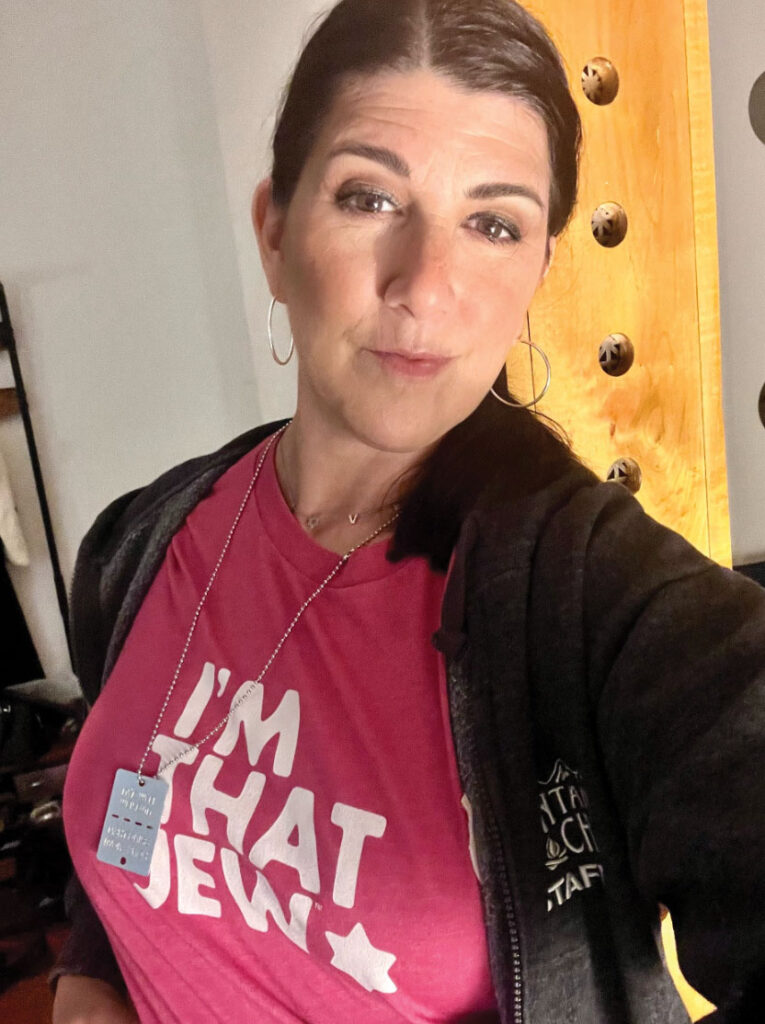
Still, I refuse to hide. Externally, I wear my “I’m That Jew” t-shirt when I walk my dog, but internally, I’m struggling.

To better understand what it means to be a brave Jew today, I spoke with three people I trust deeply: Reut Schwartz-Hebron, a neuroscientist and trauma expert; Dr. Elisha Goldstein, a mindfulness author and emotional health leader; and Rabbi Simcha Weiser, a scholar and educator who brings Jewish wisdom into everyday life.

Reut Schwartz-Hebron: Between Real Danger and Anticipated Fear

“I grew up on a little moshav on the border of Jordan,” Reut told me. “Before the age of five, we had constant alarms. We went into bomb shelters all the time. Sirens wailing. A concrete room. My father with a gun. That was normal.”

She spoke calmly, but with intensity. “In my teen years, during the Intifada, it was suicide bombers. They went on buses with explosives packed with nails. It was horrific.”

After moving to the U.S., Reut hoped for peace. Then 9/11 happened. Her son was born soon after. “I developed OCD. I would check the locks twenty times a day. I was holding my baby and dreaming that someone would shoot him in my arms.”

Her professional and personal life led her to study trauma and the brain. 

“We need to distinguish between real threat and what I call anticipatory threat,” she explained. “Your amygdala handles real-time danger: fight, flight, freeze. But the BNST, the bed nucleus of the stria terminalis, anticipates future threats based on past experiences.”

She said, “When we treat the anticipatory zone like it’s the real threat, we intensify the anxiety. We become hypervigilant. That actually makes us less prepared, not more.”

Instead, Reut teaches people to pause and ask: “Am I under threat right now, in this very moment?” She emphasized, “We have to actively recognize the difference. Otherwise, we live as though we’re in constant danger.”

What helped her heal? “Imagery,” she said. “I would picture my family years from now, at a Passover table, safe. Just safe. I had to teach my nervous system that the future could be good.”

Reut’s father, a senior commander in the IDF, once told her, “You either die once, or you die a million times. That’s up to you.” She added, “This anticipatory threat, that’s the dying a million times. But we can manage that.”

Dr. Elisha Goldstein: Emotional Regulation in a Time of Fear

Dr. Elisha Goldstein echoed many of Reut’s insights through the lens of mindfulness. “Every time there’s an antisemitic attack, a surge of emotions rises: anxiety, fear, disgust, even the urge to hide or lash out.”

He said, “There’s not a one-size-fits-all response. Some Jews want to wear their Magen David proudly. Others want to avoid the conversation entirely. Both are valid.”

His four-step self-regulation method is simple but powerful:

1. Recognize the feeling. “That’s the first step in any healing process,” he said. “You can’t change what you can’t see.”

2. Release the emotion from the body. “Stretch. Breathe. Shake it out. Talk to someone. Journal. Let it move.”

3. Refocus your brain. “Instead of asking, ‘Why am I not safe?’, ask, ‘What do I need right now?’ That prompts your natural intelligence.”

4. Renew the moment. “Take a beat. Let your body feel the calm. Let it sink in. That’s how we consolidate positive body memory.”

He explained, “When our emotions are high, our thoughts feel more true. That’s dangerous. We need to create space between stimulus and response.”

And perhaps most critically, he reminded me: “You shouldn’t feel bad about how you feel. Name it. Be curious. That’s emotional health.”

Rabbi Simcha Weiser: Jewish Knowledge is Jewish Courage

Rabbi Weiser came at the question of fear with a spiritual and historical lens.

“When a person feels threatened,” he said, “they want to understand where the threat is coming from. But for many American Jews who don’t have a strong connection to their Jewish identity, the hatred feels completely random.”

He continued, “I’ve seen Jews ask, ‘What am I doing wrong?’ That’s heartbreaking. We saw that in Germany: Jews who thought, ‘If I just blend in more, I’ll be safe.’ It didn’t work.”

He told the story of a photo he once saw at the Holocaust Museum. A Seder in Berlin. Jews who knew they would die. “But they chose to hold a Passover Seder anyway. That, to me, is courage.”

“We can’t understand antisemitism,” he said. “It’s a mystery. But we can understand Judaism. That gives us something to stand for.”

He called on all Jews to deepen their learning. “The more we study, the more anchored we become. We stop quaking. We start standing. And when we know what we stand for, we can defend it.”

My Own Journey

I grew up Reform with very little Jewish learning. During COVID, I felt spiritually adrift. That’s when I found Partners in Torah and I started studying Jewish wisdom weekly with Jessica Weiss, a fellow working mom and immigration attorney. Just 30 minutes each week changed everything.

I found meaning. I found grounding. And I found hope.

My first article for the Jewish Journal was about that moment. Now, years later, I still believe it. Studying Torah gave me the strength to face uncertainty.

We need all the tools: the neuroscience of Reut, the emotional awareness of Elisha, the rooted wisdom of Rabbi Weiser.

Being brave doesn’t mean we are not afraid. It means we keep showing up: at synagogue, on social media, at the Shabbat table, in the face of the world’s confusion and hate.

As Rabbi Weiser said, “We are defending something very precious for the world. That is Judaism.”

And that is why I will not hide.

I am a Jew.

Proudly. Publicly. Bravely.


Audrey Jacobs is a Jewish communal leader, strategic advisor, and TEDx curator, and the mother of three grown sons.

How to Be a Brave Jew Read More »

If You Want Peace, Prepare for War

Let’s be honest: Peace comes at a price.

Not with speeches or wishful thinking, but with courage, clarity, and sometimes even pain. In a world where pacifism is often confused with weakness, it’s important to remember that peace doesn’t just happen—it’s built, and often in the heart of the storm.

Today, the Middle East is once again on fire. Borders are shifting, alliances are changing, rhetoric is growing sharper. And in the middle of all this noise, we must keep our eyes open and our minds steady.

As Sunnis, it only makes sense that we should feel closer to Israel than to the Islamic Republic of Iran. That may sound shocking to some, but it’s a truth we need to face. While the Israeli state remains within its territorial bounds, Tehran operates from the shadows, infiltrating, manipulating and imposing its Shiite vision across the region.

Iran is no longer preaching; it’s acting. It finances militias, fuels division, and fans the flames of conflict from Gaza to Beirut, from Sanaa to Damascus. The method is always the same: weaken states from within to dominate them from without—all under the guise of resistance and justice, which no one buys anymore.

Worse still, Iran has no issue working with radical Sunni groups when it serves its own ends. Ideology takes a back seat to ambition. Hypocrisy is the only constant. Behind its eternal anti-Israel slogans lies a much colder goal: to rise as an untouchable power on the ashes of Arab sovereignties.

In Morocco, we were never fooled. Back in 2009, we cut diplomatic ties with Tehran over an unacceptable campaign of Shiite proselytism. Then in 2018, the truth became undeniable: Iran, through Hezbollah, was providing military support to the Polisario Front. In other words, a foreign regime was actively undermining our territorial integrity.

That’s not interference; that’s aggression.

And while Iran keeps chanting revolutionary slogans, peoples are falling apart. Yemen is in ruins, Syria bled dry, Lebanon paralyzed, Iraq in pieces. Even the Palestinians, whom Tehran claims to defend, have become pawns in a game that was never theirs.

So no, I’m not outraged by Israel’s decision to go to war against Iran, and I am not here for symbolic outrage. I deal in facts, consequences and reality, and after years of indirect assaults, Israel has simply chosen to name the enemy and confront it.

Because yes, Iran has tried to reach us too.

It has worked to erode our foundations, to spread its influence through political actors cloaked in religion. The PJD, and Al Adl Wal Ihssane, in varying degrees, have followed the logic of transnational political Islam, an ideology that ignores borders, denies national allegiance, and answers to faraway centers of power. So this is no longer about parties; it’s about a system, a network, a global threat.

And when Israel strikes Iran, it doesn’t just retaliate. It exposes a paper giant, it reveals the cracks, the bluff, and a regime that crumbles when faced head-on.

I send a heartfelt thought to the Moroccan Jewish community in Israel. They carry within them a deep and quiet bond between our shared history and what lies ahead. They are a living testimony to a connection that no regime, no ideology can erase. Their loyalty to Morocco, even from afar, calls on us to stand tall, consistent and dignified.

So, yes: To hell with the Iranian regime that lies, divides and destabilizes;  and yes to peace, real peace, earned and protected. God knows how much the world needs it.

Note: Morocco is a country that champions peace and the values of coexistence. The Islamist movement does not represent the State, nor the people, and in fact, it was sanctioned by the Moroccan electorate during the 2021 elections, where it was relegated to where it truly belongs: the bottom of the political scene. Its popularity has been in freefall for years, and as such, its press releases are nothing more than personal exercises, empty of substance, devoid of legitimacy, and entirely inconsequential.


Dr. Loubna El Joud is a Moroccan activist and a professor of Language and Communication. She’s a member of MENA2050, A Middle Eastern and Northern African organization dedicated to promoting regional development and cooperation.

If You Want Peace, Prepare for War Read More »

Artist Kimberly Brooks on Finding Her Way Back to Her Jewish Roots

Kimberly Brooks made quite a name for herself in the art world. Her collection of work, from realistic portraits to abstract landscapes and architecture, had been displayed at the Tokyo Metropolitan Museum of Art, the Whitney Museum of American Art in New York, and the Roosevelt Library in Texas, as well as locally at LACMA, Mash Gallery, and California Institute of the Arts. 

Now, after a few key events over the past decade, the New York City native turned Angeleno is focusing on capturing her Jewish roots in her new pieces and exploring her culture and religion.

“When our son and daughter were approaching the age of becoming bar and bat mitzvah, it very much felt like my actions were rote, like, ‘I had this bat mitzvah, and you will too,’” she said. “My father, Leonard Shlain, was this famous surgeon and author who wrote ‘Alphabet Versus the Goddess.’ After he passed away, I was going through his papers and organizing his books and I found an amazing book on his shelf called ‘Jews, God and History,’ by Max Dimont.  It was this brilliant, riveting, and metaphorical march through the history of religion and Jews. I couldn’t believe it.  I thought to myself, ‘How come I didn’t know any of this?’”

Brooks grew up learning about Israel; her parents were “very Zionist,” she said. “Being Jewish meant being Zionist.” Her grandfather had been a pilot in World War II and flew weapons to Israel during the War of Independence. 

While she went to a Reform Jewish Hebrew school and synagogue – and enjoyed learning Hebrew and helping kids prepare for their bar and bat mitzvahs – she was not deeply engaged with her Judaism beyond that. What she focused on was her love of literature and art. 

“I was always the kid who was drawing everything,” she said. “I’d say to someone, ‘Sit for me. I want to draw your portrait.”

Once she graduated valedictorian from UC Berkeley with a B.A. in literature, Brooks became a speechwriter for Walter Landor, a German Jew who escaped and started one of the biggest design firms in the world.

“I believe designers and painters are cousins,” she said. “You’re still dealing with the issues of composition, impact, message, and feeling. It’s extremely similar. Being in that world nurtured the part of me that was an artist.”

Brooks would draw and paint as a hobby, but when she had her daughter Claire, that’s when she decided to take her art career more seriously.

“I was doing a sunset horseback ride at Griffith Park, and it was absolutely magical with the horses galloping on the way back in the dark,” she said. “There was a full moon. The moon said to me, ‘What are you waiting for?’”

She promptly enrolled in painting classes at Otis College of Art & Design and pursued her passion for art while raising her children. She saw that they went hand in hand. 

“Motherhood is so important and integral to being an artist,” Brooks said. “When I first started showing work, there was this cerebral consideration about motherhood. My work was directly related to having a little girl follow me around the house. This is when I created the series ‘Mom’s Friends.’”

“Mom’s Friends” was one of Brooks’ early solo exhibitions which featured realistic portraits inspired by Polaroid photos from the 1970s of her mom and her mom’s friends. It explored the explosion of feminism during that time and recreated Brooks’ utopian childhood, right before their lives began to fall apart.

“Sophia Loren of Mill Valley” from the Mom’s Friends exhibit by Kimberly Brooks

“Every parent around me — in Marin County where I grew up — got divorced within the same two-year period,” she said. They even made a movie about it, called ‘Serial.’ “Being a child of divorce was maybe one of the most painful things I ever experienced.” 

She believed that Judaism was at odds with feminism, but when she sat down to actually study it, she found the opposite to be true.

“I have a new understanding of Judaism as a quite feminist religion,” Brooks said. “Reading the Torah while learning about the history of the Jewish people and their role in it made me reframe what it meant to be a woman and feminist and mother.”

Following her son’s and daughter’s bar and bat mitzvahs, Brooks then went to Israel with them in 2017. Though she’d gone before, it was for a brief visit. This time, she saw the beauty of the country and was fascinated with its history and architecture. Her paintings began to reflect her spiritual awakening; she created an oil, gold and silver piece on linen, calling it “Jerusalem,” which looks like a doorway into an ancient world, and paintings with frames inside of them capturing different stories from the Torah, like Sarah’s abduction.

“Jerusalem” by Kimberly Brooks

“My work is based on ancient texts,” she said. “I wouldn’t say I am a highly religious person, but I do keep Shabbat now, and I’m very proud to be a Jew.” 

Brooks kept painting, and she put out her first book during the pandemic, “The New Oil Painting.” When she went to promote it on an app called Clubhouse, she uncovered a “beehive of antisemitism on it that was underground,” she said. “I never knew it was there.”  

Then, when Hamas and Palestinian Islamic Jihad (PIJ) launched rockets into Israel in May of 2021, Brooks saw the bias against Israel in the media.

“Hamas started firing rockets into Israel, and CNN only said that Israel was shooting missiles into Gaza without saying why they were doing it,” she said. “I thought it was awfully unfair.”

Antisemitism and misinformation about Israel and the Jewish people were popping up everywhere, and Brooks wanted to protect her kids as they were going off to college. After Oct. 7, she teamed up with Emily Schrader, an Israeli American journalist, and Blake Flayton, another American writer who moved to Israel, to write “10 Things Every Jew Should Know Before They Go to College: An Illustrated Guide.” Both wrote about their personal experiences with antisemitism in college, as well as facts that Jewish students need to know. Brooks provided the illustrations. 

“We knew we had to get this information out,” she said. “We were sending young students into a sawmill of misinformation.”

Along with beginning to keep Shabbat, Brooks joined WIZO, where she interviewed pro-Israel voices like Schrader and Eve Barlow. 

She is continuing to create work with Jewish themes, even though she is up against antisemitism in the art world as well. 

“The art world is convulsing just like every other section of society,” she said. “I believe in my heart that sunlight and oxygen on the problem will have an impact.”

In discovering herself, and tapping into her Judaism, Brooks had discovered her life’s goal.

“My Hebrew name is Keren, which means rays of light,” she said. “That’s the impact I want to have in this world. I want to shed light.”

Artist Kimberly Brooks on Finding Her Way Back to Her Jewish Roots Read More »

Ice Cream with a Bomb Shelter on Top

One of the best things in life is to have the privilege of taking one’s grandchildren out for ice cream. Even during a war.  Perhaps especially during a war.  

This week, my daughter and son-in-law brought my four grandsons for a visit, partly as a fun outing and partly as a respite for themselves. Since the war erupted with Iran, all school and preschool programs have been canceled, leaving parents of young children to figure out how to juggle keeping all the kids occupied without pulling their own hair out and keeping them safe and close to home for the eventuality of having to take cover in the bomb shelter sometimes two to three times a day. 

My kids have taken to putting their boys to sleep in the spare room that doubles as the bomb shelter, to avoid having to move them all in 90 seconds, and risking their waking up due to being moved and the jarring sound of the siren. 

Moving little children to the bomb shelter is all the more complicated in families where one of the spouses had been called up for reserves, something that’s much more common in the past week, even more so than the recent previous, major call-up of reservists. Imagine being a young mother with three to four kids under seven home alone, not only having to move the kids into the shelter one by one, but also having to get them back to sleep after.  

Or during the day when they are awake, as happened again yesterday (and at night) and having to occupy and comfort them for at least 10-15 minutes, but sometimes over an hour.  

Whether one or two parents with little kids, or empty nesters like ourselves, we are all operating bleary-eyed from repeated nights’ sleep being interrupted.  Last night the “blessing” was that it was at 4:20. The day before it was at 2:30.  Sometimes one is able to get back to sleep. Sometimes (like me in all cases), not.  Good thing I am not operating heavy machinery. 

With grandson number four napping, and me more than a little envious, it was prime time to take the three older boys for ice cream, giving my daughter and son-in-law a few minutes of quiet. Bleary-eyed or not, it’s always a pleasure to take the kids out and spend some time with them. Also parenting never ends and letting your own kids in their 30s have a break is meaningful and important. 

On the way out, my daughter said something I not only had never heard, but never could have imagined.  In my life, I never would have put these words together in the same sentence.  “Make sure you know where the bomb shelter is at the ice cream shop when you’re out with the boys,” the mama-hen responsibly reminded.  

Nope. I’d never have thought of it. But we’re at war. Iran is firing ballistic missiles with massive warheads directly at our towns and cities.  All the casualties in Israel have been civilians.  Yet while at war there’s never a better time for ice cream, with whipped cream and sprinkles, and a bomb shelter on top. 

Also, for the first time, there was abundant signage in and around the strip-mall next to our house identifying where all the bomb shelters were. Just in case.  As much as I’d never thought of putting “ice cream” and “bomb shelter” in the same sentence, I never would have thought that whoever planned the architecture would put a bomb shelter right there in the ice cream shop.  But there it is, behind the bright pink walls and shelves of toppings.  Just in case. 

On the way home, my first-grade grandson told me about all the different ice cream flavors they have at home.  It’s a good parenting strategy to have ice cream to pull out even under missile attacks, maybe especially so.  While I joined them with a scoop of yummy pistachio today, I’m really feeling that I need something more along the rum raisin or bourbon-caramel swirl. Maybe a double. 

The grandchildren just left. I didn’t say it. but while I never want to see them go, I was silently praying that they would hurry up and leave.  While they were here, reports came out that Israel had another significant and apparently successful strike against another Iranian military target.  Not that the Islamic regime that has indoctrinated two generations with chants of “Death to America” and “Death to Israel” ever need an excuse, but it’s likely that again later today, their ballistic missiles will light up the sky here, sending almost all Israelis to the bomb shelters, whether at home or in an ice cream store. Again. 

While I didn’t want the kids to leave, I did want them at home, in the safety, familiarity, and comfort of their own bomb shelter.   

The reality could not be more vivid: Israel issues evacuation warnings to Iranians living near various military sites to prevent the loss of civilian life, while the Iranians deliberately fire dozens or hundreds of missiles at a time, targeting homes like where my grandchildren live.  

This has become their — and all of our — norm. The reality could not be more vivid: Israel issues evacuation warnings to Iranians living near various military sites to prevent the loss of civilian life, while the Iranians deliberately fire dozens or hundreds of missiles at a time, targeting homes like where my grandchildren live.  Iranians are given ample notice to flee in advance of a military strike, and indeed we have seen massive traffic jams with them doing just that. On our side, the evacuation is wanting my grandchildren to leave early enough that they will be in the comfort of their own bomb shelter when the jihadi missiles target us all. 

The Genesis 123 Foundation is sponsoring a series of personal candid briefings including Q&As, sharing perspectives on life in Israel during this war, discussing current events but from a perspective of what’s going on behind the headlines. For a full list you can connect at www.Genesis123.co, or register here for the one scheduled for Saturday June 21. 


Jonathan Feldstein is president of the Genesis 123 Foundation (www,genesis123.co) whose mission is to build bridges between Jews and Christians and Christians with Israel. He was born and educated in the U.S. and immigrated to Israel in 2004. He is married and the father of six, and grandfather of four (so far).

Ice Cream with a Bomb Shelter on Top Read More »

Father’s Day Under Missile Strikes

Growing up, Father’s Day had a special energy. We woke up early, got breakfast together, wrapped a present or two and placed streamers and posters around the house. Then, we quietly walked into our parents’ room around 8:00 a.m. to “surprise” our dad. 

When my wife got pregnant, I imagined one day experiencing the same excitement I saw on my dad’s face all those years—a smile filled with gratitude for having a healthy and happy family. 

Waking up on Father’s Day 2025, my second since becoming a parent, I had hoped to continue those traditions — except instead, I woke up at 2:18 a.m. to my phone blaring a red alert. It warned us to “stay next to a protected space in your area” since my location was likely to be bombed by ballistic missiles in the coming minutes. 

I needed to make a decision. Our apartment does not contain a bomb shelter. We have one for the entire building floor just outside our apartment. This means I could preemptively wake up my 22-month-old son and wife to move us all to safety, or let them sleep in hopes of the missile skipping past Tel Aviv. 

The answer should have been simple: move your family to safety. Yet, this was night three of constant bombardment. We were all exhausted. Waking my son up when he could be sleeping meant further exhaustion for him — not a great recipe for having a happy or healthy toddler. So I decided to let them rest, knowing that if a rocket gets close, the red alert system will warn me.

Then it happened. At 2:30 a.m., the red alert went off: “In the next few minutes, alerts are expected in your area. You need to find a better location that will provide the best protection.” This heightened my senses, and I prepared for the situation, but did not wake my son — he was so tired. We spent the previous night in and out of the bomb shelter.

The siren blared. 2:36 a.m.: “Rocket and missile fire in your area, time of arrival to the protected room — one-and-a-half minutes.” I got my wife, who by now was awake from multiple pre-warnings. She grabbed a bottle of milk and opened our apartment door. I grabbed my son from his crib, covered his eyes so the light did not wake him, and walked carefully to the bomb shelter.

We spent over 40 minutes in the bomb shelter as ballistic missiles rained down across the country, creating immense damage in civilian areas, injuring and killing civilians, including children and the elderly. Lying in my arms for those 40 minutes, my son eventually woke up. He is startled, not recognizing his surroundings, but thankfully is easily soothed. This has become routine. My son is 22 months old, to be exact, 680 days old. Disturbingly, yet unsurprisingly, he remains relatively calm in the bomb shelter. Why? Because 619 days out of the 680 days of his life, we have been at war. For 91% of his life, he has lived in a war zone where civilians are targeted, where tomorrow is not guaranteed. 

He is resilient, more than he can understand now, more than he will likely ever understand.

He woke up smiling on Sunday morning, and I hugged him tight, knowing it was a privilege. The overnight barbaric missile strike from Iran left many casualties. I am sure many fathers woke up to the news that their children had been killed or hurt, and many children woke up to the same news about their fathers. They didn’t get to smile at each other on this Father’s Day morning. 

I understand now why my dad was always so grateful to see a smile on our faces. Health and happiness should never be taken for granted. That’s why my Father’s Day present –  my son’s smile and laughter – is everything I could have asked for and more.


Kyle Blank is the Executive Director of IsraelFriends.org, a global network that solves real-world problems for those defending the Jewish state. He and his family live in Tel Aviv. 

Father’s Day Under Missile Strikes Read More »

Vegan Barbecue Off the Grill

Great barbecue is all about texture and depth of flavor. It does not need to involve meat, chicken or fish to be delicious. It doesn’t even have to be made on a grill!

For many years vegan, kosher sushi chef Marisa Baggett competed in Memphis’ kosher barbecue competition with her award-winning team, Adam’s Ribs. “This tofu is a tribute to Memphis-style barbecue, but with a twist,” Baggett told The Journal. “Instead of being served with a tomato-forward sauce, it’s paired with a sweet soy glaze inspired by the Japanese flavors I’ve come to love.”

Baggett’s flavors work beautifully when going for the full Memphis experience: piled high on a bun, drizzled with sauce, and topped with your favorite coleslaw. “Oven-roasting makes this easy to prepare at home, but for an extra hit of smoky flavor, you can finish it on the grill,” she said. “Just be sure to place it on a sheet of aluminum foil so the shaved tofu doesn’t slip through the grates.”

BBQ Tofu with Sweet Soy Sauce Recipe

Serves 3

Vegan

For the Barbecue Tofu:

1 (14 oz) block extra firm tofu (No need to press!)

1 tsp smoked paprika

½ tsp garlic powder

½ tsp onion powder

¼ tsp ground mustard powder

¼ tsp brown sugar

¼ tsp cayenne pepper

½ tsp toasted sesame seeds

¼ tsp black pepper

¼ tsp salt

2 tsp soy sauce 

2 tsp rice vinegar


For the Sweet Soy Barbecue Sauce:

¼ cup low-sodium soy sauce 

2 Tbsp rice vinegar

3 Tbsp brown sugar

2 Tbsp ketchup

1 tsp freshly grated ginger

1 small garlic clove, grated

½ tsp sesame oil

Shave or cut the tofu: Use a vegetable peeler to shave the extra firm tofu into thin, meat-like slices. Or use a knife to make thin slices. It’s OK if some of it breaks into small pieces and that some are slightly uneven.

Season the tofu: Place the shaved tofu in a single layer on a parchment-lined baking sheet. Drizzle with soy sauce and rice vinegar and toss gently. This will help the dry rub stick. In a separate small bowl, mix together the smoked paprika, garlic powder, onion powder, ground mustard powder, brown sugar, cayenne, sesame seeds, black pepper and salt. Sprinkle the dry rub over the tofu.

Bake: Bake at 400°F for 20 minutes, flipping halfway through. The edges should start to crisp and darken slightly.

Make the barbecue sauce: While the tofu bakes, combine the soy sauce, rice vinegar, brown sugar, ketchup, ginger, garlic and sesame oil in a small saucepan. Bring to a simmer over medium heat and cook for 3–4 minutes, until slightly thickened. Set aside. 

Serve: Serve the tofu hot with the sauce on the side or drizzle it over the top. It’s great on a toasted bun with coleslaw. 


One of the things Rabbi Dr. Jo David really missed as a vegan was barbecue meat, especially brisket. “I recently came across Chunk brand meats in the frozen food section of my local health food store,” David, who writes poetry and nonfiction, as well as Regency romance novels, told The Journal. Chunk, which specializes in high-protein, plant-based meat products, delivers a very beefy taste and texture.

While David generally prefers a whole food vegan diet — she also uses jackfruit as a meat substitute — once in a while she enjoys something different. “I bought the Chunk pulled product a couple of months ago and created this vegan barbecue brisket recipe,” she said. “My husband and I really enjoyed it; I think it’s good enough to fool meat eaters.”

The recipe below can be made with jackfruit or Chunk pulled products.

Rabbi Jo’s Vegan BBQ Brisket 2 Ways

1 14 oz can of jackfruit – I suggest organic, if you can find it (not sweet), drained and mashed with a fork until it has the consistency of pulled beef (shreds.)

Or

1 package Chunk pulled plant-based meat, defrosted

1 Tbsp of olive oil if using plant based pulled meat

1-2 cups of tomato-based sauce pasta sauce; tomato, tomato and basil or marinara

1 cup of your favorite vegan barbeque sauce (I like sugar-free)

1-2 cups of water

1 tsp smoked paprika (or more to taste), optional

1 tsp garlic powder (or more to taste), optional

Salt and pepper to taste, if desired

This recipe makes 2-3 servings of Vegan BBQ Brisket. For that quantity, a large non-stick skillet is fine. If you wish to double the recipe, use the skillet to crisp the pulled meat, one package at a time, and then transfer into a pot. It’s not necessary to crisp the jackfruit, so just assemble that and cook in a pot.


For The Chunk pulled Meat version:

Heat a non-stick skillet with a small amount of olive oil. When the oil is hot, lower the heat and add the defrosted meat to the pan. With a fork or a spoon, separate the strands. Cook for about 5 minutes without stirring, adjusting the heat as necessary. After 5 minutes, check to see if the bottom of the meat is getting brown and crispy. If so, stir the shreds so that the un-browned part of the meat is on the bottom. Then cook for another 3-4 minutes until all the shreds are crispy around the edges. If using only 1 package of the pulled meat, continue with the recipe, adding the ingredients to the skillet. If using two or more packages of meat, brown one package at a time and then add to a large pot to continue the recipe.


For the Jackfruit version

Note: If using 1 can of Jackfruit, use a skillet. If using more than 1 can, use a large pot.

Put the jackfruit in the skillet or pot. Heat the jackfruit for a couple of minutes until it is warm. Stir occasionally, so that it doesn’t stick to the bottom of the pan.

For both versions

Once the shreds are prepared, add 1 cup of the pasta sauce and ½ cup of barbeque sauce to the pan or pot. Combine with the shreds.

Add some water slowly to create a cooking liquid.

Taste the cooking broth.

Remember, everyone has a different idea about what barbecue should taste like and how dry or moist it should be. According to your preference, add more pasta sauce, more barbecue sauce and/or more water. Continue doing this, adding small amounts, until you achieve the desired consistency.

If you wish, add some smoked paprika and/or garlic powder, salt and pepper. 

Bring to a simmer, cover and cook for a couple of minutes until all the flavors have blended and the shreds have absorbed some of the sauce.

Serve as a barbecue Sloppy Joe on a vegan burger bun or on a plate with side dishes of your choice.

Suggestion: Like many stewed dishes, this tastes even better the next day. Make it a day in advance and refrigerate it, if you like.

Vegan Barbecue Off the Grill Read More »