fbpx

May 21, 2025

Jewish Groups React to Two Israeli DC Embassy Staffers Killed by Suspect Who Shouted “Free Palestine”

Many Jewish groups issued statements on May 21 condemning the killing of two Israeli Embassy staff members in front of the Capital Jewish Museum in Washington, D.C.

According to media reports, the two staffers were shot and killed in front of the museum and were leaving an American Jewish Committee (AJC) event. The two victims were a couple and were about to engaged.

Fox News reporter Bill Melugin posted on X that the suspect has been identified as Elias Rodriguez, 30, and that Rodriguez allegedly shouted “Free Palestine” while in custody.

Jewish Insider spoke to a witness, Paige Siegel, who said that the suspect entered the museum and shouted, “I did it, I did it. Free Palestine. I did for Gaza.” Siegel also told the outlet that the suspect subsequently opened his backpack and brought out a red keffiyeh. She then looked at security footage of the shooter and confirmed that it was the same person.

Amanda Rothschild, a national security professional, posted on X that she was at the AJC event and that it “was for young Jewish professionals working in foreign policy. The panel was on multi faith efforts to address the humanitarian situation in Israel & Gaza. The people who lost their lives tonight were young people dedicated to service & alleviating human suffering.”

AJC CEO Ted Deutch said in a statement that the Jewish group “can confirm that we hosted an event at the Capital Jewish Museum in Washington, D.C. this evening. We are devastated that an unspeakable act of violence took place outside the venue. At this moment, as we await more information from the police about exactly what transpired, our attention and our hearts are solely with those who were harmed and their families.”

“This shooting strikes a nerve because it comes after an unrelenting, ongoing campaign of hate and harassment targeting the Jewish community simply because of who we are and what we believe.” Jonathan Greenblatt

Anti-Defamation League CEO Jonathan Greenblatt posted to X, “We still are confirming details of this heinous crime, but this shooting strikes a nerve because it comes after an unrelenting, ongoing campaign of hate and harassment targeting the Jewish community simply because of who we are and what we believe. Our hearts break for the families of those who were murdered even as our will hardens in the face of those who threaten us. What they fail to grasp is that we will not be intimidated.”

Simon Wiesenthal Center CEO Jim Berk said in a statement that the shooting was “a targeted assault on Israeli diplomats and the Jewish community in the very heart of the nation’s capital, and it must be recognized for what it is: a depraved act of antisemitic terrorism. This horrific act is the result of months of silence, excuse-making and moral cowardice in the face of escalating antisemitism. When Israel is demonized as evil, when Jews are targeted under the guise of ‘anti-Zionism,’ it emboldens hate and incites violence. Jew-hatred is not a political position.” He added that “this is the outcome when antisemitic hate is normalized on our campuses, in our streets, and online. When leaders fail to call it what it is, hate festers, metastasizes, and erupts in bloodshed. This can no longer be tolerated, and our political and religious leaders, as well as each and every one of us, must lead by example and condemn this act without qualification. We extend our deepest condolences to the victims’ families, to the Israeli diplomatic community, and to the Jewish community of Washington, D.C.”

The Conference of Presidents of Major Jewish American Organizations posted to X, “Heartbroken and outraged by the apparent targeted murder of Jews gathered in Washington, DC to celebrate Jewish American Heritage Month at the Capitol Jewish Museum. A moment of pride turned to horror. We mourn the victims, demand justice, and urge vigilance.”


Lawfare Project Senior Counsel Gerard Filitti posted on X that “this is more than a hate crime. This is terrorism. Tonight’s attack shows that terrorist sycophants have crossed the Rubicon. We are well past “free speech” and well into the territory of a transnational criminal conspiracy — one whose stated goal is not just the eradication of the Jewish people in Israel, but the radicalization and dismantling of Western society itself.” He contended that “Free Palestine” is now “code for ‘death to the Jews’ and ‘death to America.’

“President Trump must take decisive action and activate the National Guard — to protect Americans and foreigners alike from the escalating threat of ideological violence, and from a braying mob that openly praises, and in some cases identifies as members of, designated Foreign Terrorist Organizations,” wrote Filitti. “Enough is enough.”

Republican Jewish Coalition CEO Matt Brooks said in a statement that “those responsible for this heinous attack must be prosecuted to the fullest extent of the law, and we have full confidence in the Trump administration to deliver swift and righteous justice” and that the shooting is “a blaring warning to all Americans, across the political spectrum, that the world’s oldest hatred continues to plague our society, and we must stand together to confront it wherever and whenever it appears.”

Democratic Majority for Israel posted to X, “We’re horrified and sickened by the senseless violence tonight near the Capital Jewish Museum in what looks to be a targeted antisemitic attack. Our hearts are with the Israeli Embassy staff, the victims and their loved ones. We pray for a speedy recovery for those injured. Jews must be able to gather safely around the world.”

J Street posted to X, “We are horrified by the shooting this evening outside of an American Jewish Committee event for young professionals at the Capital Jewish Museum in DC that took the lives of two Israeli Embassy staff. We are keeping the victims of this attack and their families in our hearts. Antisemitism is a deadly scourge that has no place in our society and must be unequivocally condemned.”

UPDATE: The victims have been identified as Yaron Lischinsky and Sarah Milgrim.

Jewish Groups React to Two Israeli DC Embassy Staffers Killed by Suspect Who Shouted “Free Palestine” Read More »

Two Israeli Embassy Staffers Shot Dead Outside Capital Jewish Museum in DC

Two Israeli embassy staffers were shot and killed on Wednesday evening outside the Capital Jewish Museum in Washington, D.C., according to Kristi Noem, U.S. Secretary of Homeland Security.

“We are actively investigating and working to get more information to share. Please pray for the families of the victims,” Noem wrote on X. “We will bring this depraved perpetrator to justice.”

The shooting reportedly occurred around 9:15 p.m. near the intersection of 3rd and F streets NW, in front of the museum, and just behind the FBI’s Washington Field Office and the U.S. Attorney’s Office.

U.S. embassy spokesperson Tal Naim Cohen wrote on X that the victims—a man and a woman—were shot “at close range.”

“We have full faith in law-enforcement authorities on both the local and federal levels to apprehend the shooter and protect Israel’s representatives and Jewish communities throughout the United States,” said Cohen.

Police are questioning Elias Rodriguez, 30, of Chicago, who is believed to have acted alone. Following the shooting, Rodriguez reportedly entered the museum, where he was detained.

D.C. Police Chief Pamela Smith said during a Wednesday night press conference that the suspect chanted, “Free, free Palestine” as he was taken into custody.

Israeli Ambassador to the U.S. Yechiel Leiter revealed that the victims were a couple who were about to be engaged. The man had recently purchased an engagement ring and planned to propose next week in Jerusalem.

Ted Deutch, CEO of the American Jewish Committee, told ABC News that his organization was hosting an event at the museum that evening.

“We are devastated that an unspeakable act of violence took place outside the venue,” Deutch said. “At this moment, as we await more information from the police about exactly what transpired, our attention and our hearts are solely with those who were harmed and their families.”

Danny Danon, Israeli Ambassador to the United Nations, condemned the incident as a “depraved act of antisemitic terrorism.”

“Harming the Jewish community is crossing a red line,” Danon wrote on X. “We are confident that U.S. authorities will take strong action against those responsible for this criminal act. Israel will continue to act resolutely to protect its citizens and representatives everywhere in the world.”

The FBI’s Joint Terrorism Task Force was involved in probing the attack, according to local media reports.

U.S. President Donald Trump extended condolences to the victims. “These horrible D.C. killings, based obviously on antisemitism, must end, NOW!” he wrote on Truth Social. “Hatred and radicalism have no place in the USA. Condolences to the families of the victims. So sad that such things as this can happen! God Bless You ALL!”

U.S. Attorney General Pam Bondi visited the scene and said she was “praying for the victims of this violence as we work to learn more.”

Israeli Foreign Minister Gideon Sa’ar condemned the attack, expressing outrage and emphasizing that representatives of the Jewish state are under constant threat.

“Horrified by this morning’s terrorist attack, in which two of our embassy staff in Washington, D.C., were murdered. Israeli representatives around the world are constantly exposed to heightened risk, especially in these times,” he said. “We are in close contact with American authorities. Israel will not surrender to terror.”

Israeli President Isaac Herzog stated: “I am devastated by the scenes in Washington, D.C. This is a despicable act of hatred, of antisemitism, which has claimed the lives of two young employees of the Israeli embassy.

“Our hearts are with the loved ones of those murdered and our immediate prayers are with the injured,” he continued. “I send my full support to the ambassador and all the embassy staff. We stand with the Jewish community in D.C. and across the U.S.”

He added that “America and Israel will stand united in defense of our people and our shared values. Terror and hate will not break us.”

Two Israeli Embassy Staffers Shot Dead Outside Capital Jewish Museum in DC Read More »

The Jewish Scholars Emboldening the Academic Assault on Zionism

Amid calls of “ceasefire” and an end to the “occupation,” encampment demonstrators at the University of Pennsylvania last April waved the flag of the Popular Front for the Liberation of Palestine (PFLP) while chanting “Al Qassam, make us proud,” invoking Hamas’s military wing and its mission to destroy Israel. That night, a rabbi and a student attempting to pass through the encampment were physically harassed.

Just hours before, two prominent Israeli genocide scholars, Brown University Professor Omer Bartov and Stockton University Professor Raz Segal, lectured at that same encampment about the weaponization of antisemitism. That May, Bartov defended the demonstrators, stating, “There’s nothing threatening about opposing occupation or oppression.” Such rationalizations have been voiced within academic circles.

In an October 2024 Al Jazeera documentary entitled “How Israel Won the West,” five Jewish scholars—among them Segal and Bartov—denounce Israel as genocidal, racist and settler-colonialist with a tone of certainty. American complicity in this presumed evil is treated as a foregone conclusion.

How do Jewish and Israeli scholars—and students—find themselves at anti-Israel protests or aligned with anti-Zionist groups? The answer lies at the intersection of academic theorization, identity crisis, and the pressure to undergo a modern-day conversion.

Embedded within the surge of anti-Zionist activism on university campuses lies a broader intellectual reckoning with Jewish identity in the modern era—one that seeks to divorce Judaism from the State of Israel. Increasingly common views aired today are refrains of Judaism ≠ Zionism and anti-Zionism ≠ antisemitism. In various humanities circles, this movement manifests through two evolving frameworks: non-Zionism and post-Zionism.

Simply put: Non-Zionism acknowledges that Jews may possess ties to the land of Israel but rejects the idea of a Jewish state. Post-Zionism, on the other hand, holds that the Zionist project concluded with the founding of Israel and that continued attachment to Zionism is obsolete. Combined, they promote the notion that the answer to what comes after Zionism may lie in what came before it.

These ideas are not new. Traces of non-Zionism are found in the biblical passage Jeremiah 29, when the prophet instructs the Israelites to “prosper” in the diaspora in the aftermath of the Babylonian exile, awaiting the divine hand to facilitate their return: God says, “Build houses and settle down; plant gardens and eat what they produce …When seventy years are completed for Babylon, I will come to you and fulfill my good promise to bring you back to this place. For I know the plans I have for you … plans to prosper you and not to harm you, plans to give you hope and a future.”

This view contrasts with Psalm 137, which laments the exile and demonstrates a deep yearning to return to Zion, for no tradition can be practiced in the diaspora: “By the rivers of Babylon, there we sat down, yea, we wept, when we remembered Zion … For there they that carried us away captive required of us a song; and they that wasted us required of us mirth, saying, Sing us one of the songs of Zion … How shall we sing God’s song in a strange land?”

Eastern European Bundists and other late-19th-century Jewish thinkers helped reintroduce non-Zionism, challenging the notion of a Jewish nation state as the solution to Jewish identity and security. Non-Zionism has been maintained by certain sects of Orthodox Jews who believe that political Zionism disrupted the Messiah’s task of returning them to Israel on a divine timeline. But history proved brutally unforgiving—first during the Holocaust, and more recently on Oct. 7—underscoring that the Jewish people have no option but to assert their sovereignty and harness their security.

While non-Zionism and post-Zionism are not inherently antisemitic, post-Zionism carries an eerily dystopian irony: Nearly eight decades after the founding of the Jewish nation-state, segments of the Jewish intellectual elite take particular delight in questioning—or even seeking to dismantle—its very essence and existence.

Jews today may indeed feel a strong connection to the diaspora. They may also call for a ceasefire in Gaza and criticize Israeli government policies. But those Jews partaking in anti-Israel protests or intellectual movements are not expressing merely diasporic connections or political critique.

Consider the February 2025 conference, “Non-Zionist Jewish Traditions,” hosted by Brown University’s Cogut Institute for the Humanities. Its stated goal was to explore the “changing relation to Zionism and the State of Israel” among Jewish communities around the world. Brown University student Maya Rackoff attended the conference. She noted, “the characterization of Zionism as inherently racist and genocidal went unchallenged,” as academics “attacked the founders of Zionism and their adherents as genocidal, Jewish supremacists.”

Panels at the conference included titles like “Disillusioned Zionists,” and the scholar lineup featured distinguished speakers with records of anti-Israel activism. Bartov, who organized the conference, has accused Israel of genocide and participated in anti-Israel protests. Israeli scholar Ariella Aïsha Azoulay serves on the advisory board of the Institute for the Critical Study of Zionism (ICSZ), an anti-Zionist organization that characterizes Israel and the United States as inherently oppressive, racist and settler-colonial. Other non-Jewish scholars also joined the conference, including Yale Law School’s Aslı Ü. Bâli, President of the pro-Boycott, Divestment, and Sanctions (BDS) movement Middle East Studies Association (MESA).

The saturation of these panels by representatives from explicitly anti-Zionist organizations unmasks the innocent intentions of “Non-Zionist Jewish Traditions.” It merely sets the stage for parading anti-Zionist ideology under the guise of scholarly exploration.

The Jewish scholars at the conference are aligned with what Brown University Chair of Palestinian Studies Beshara Doumani dubbed “Global Israel:” the “north star” of “rising global fascism.” These statements are upheld by Israeli scholars like Adi Ophir, who added that to truly “liberate” Jewish identity, one must first become an anti-Zionist. Shaul Magid of Harvard, a

former Orthodox rabbi, recently published “The Necessity of Exile,” positing that Jewish flourishing may require rejecting the idea of a Jewish nation-state.

This is what passes for academic discourse about Israel today. Impressionable students are influenced by credentialed authorities—several Jewish or Israeli—that the only way to be a moral Jew is to denounce Zionism. Furthermore, the progressive notion that if something is new, or new again, it is somehow good, contributes to the idea that there is a relationship between opposing Zionism, righteousness, and prestige. Thus, faculty and students join anti-Israel protests to feel as if they are displaying their knowledge and virtue.

These movements endorse a modern-day conversion. Believing that casting away Zionism will render them righteous, young Jews have embraced this identity makeover. But history offers sobering precedents. Jews who converted to Christianity seeking protection during the Spanish Inquisition, known as conversos, were not spared enmity for shedding their Judaism. Nor were the assimilationist Jews of the 19th century who believed similarly and faced the fate of the Holocaust. Relinquishing Zionism, a key pillar of Judaism, offers merely an illusion of moral clarity at the expense of historical amnesia.

The 2019 essay entitled “On Three Anti-Zionisms” by Hannah Arendt Center Associate Fellow Shany Mor offers critical insight into the dangers of framing a conference on non-Zionist Jewish traditions around voices—many of them Jewish—who are openly critical of Israel. Mor categorizes these three strands of anti-Zionism as Alpha, Beta and Gamma. “Alpha anti-Zionism” relates to non-Zionist Jewish traditions; “Beta anti-Zionism” characterizes much of the Arab Muslim world’s rejection of a Jewish state in the Middle East; “Gamma anti-Zionism” accepts the existence of Israel but views its very creation as inherently sinful, playing on the notion of “original sin” from Christian tradition, rendering all of its actions immoral.

While distinct, these three strands overlap. Alpha anti-Zionism—now dressed in academic garments sewn by Jewish traditions—provides an insidious cover for the destructive beta and gamma anti-Zionism.

What has unfolded during the past several years is not just a challenge to Zionism from the outside—it’s a corrosion from within. Consider Bartov, who paradoxically identifies as a “Zionist,” while advancing the naive idea that if “the Palestinian issue were resolved, antisemitism would diminish.” He argues that the founding of Israel, intended to safeguard Jews, has instead exacerbated antisemitism. These claims ignore centuries of antisemitism that long predate the State of Israel. Most concerningly, these ideas flirt with the logic of exile-promoting thinkers like Magid, who render Jewish statelessness preferable.

What has unfolded during the past several years is not just a challenge to Zionism from the outside—it’s a corrosion from within.

Institutions like ICSZ and MESA do more than promote scholarship on Israel and the Middle East; they explicitly support anti-Israel activism. Both organizations actively support students participating in illegal campus protests and encampments. When such actions invite disciplinary or legal scrutiny, MESA defends faculty and students engaged in antisemitic conduct under the broad banners of “human rights” and “academic freedom,” promoting Palestine Legal.

It is hardly surprising that individuals affiliated with these institutions, such as Ariella Azoulay, whose conference presentation “Ima, Why Didn’t You Love Me in Ladino” nostalgically mourns a lost Ladino past, support groups like JVP and the rule-defiant students, including those allegedly linked to Hamas operatives, like Mahmoud Khalil. While diasporic themes may be emotionally resonant, they presently serve as a political tool.

Many Jewish scholars believe that by critiquing Israel, they are working toward a more just and equitable future for Jews, Israelis and Palestinians. And when grounded in reality, constructive criticism of Israeli policy is valuable and necessary. But attaching romantic nostalgia to the diaspora while aligning with movements that vilify Israel undermines Jewish safety and Palestinian well-being. The academic normalization of anti-Zionism—especially when expressed by Jewish or Israeli scholars lending it a veneer of credibility—only emboldens the dangerous fiction that Judaism and Zionism are incongruent.

When strands of non-Zionism or post-Zionism surface within the broader debate over antisemitism and anti-Zionism, they must be identified and forcefully challenged. After all, Zionism is not severable from Judaism. And, today’s Jewish state is far from an abstract idea but a thriving democracy engaged in a life-or-death struggle against Hamas, a terrorist entity aptly described by British author Douglas Murray as a death cult.

In a climate increasingly shaped by anti-Israel academic discourse, faculty—particularly those Jewish and Israeli scholars who affirm Israel’s legitimacy, its moral clarity in Gaza despite the humanitarian tragedy, and the importance of Jewish-diaspora ties—must insert themselves in forums promoting non-Zionist ideas. The integrity of academic inquiry demands that these perspectives be part of the conversation.

This is not merely a debate about Israel or politics, but the manipulation of scholarship in service of ideology, a betrayal of the humanities, academia, and intellectual honesty. At stake is the right of the Jewish people to exist fully, to claim a national identity like any other. Judaism is not a buffet of symbols and memories to pick from; it is a lived tradition, a way of life—and Israel is its modern anchor.

Those Jewish and Israeli scholars glamorizing Jewish statelessness and powerlessness as virtuous do not serve a noble cause. Their efforts have proven reckless with dangerous implications. The brutal attacks on the Jewish state and its people reveal how deadly that illusion can become.


Sabrina Soffer is a recent graduate of the George Washington University. 

The Jewish Scholars Emboldening the Academic Assault on Zionism Read More »

Evian and the Jews

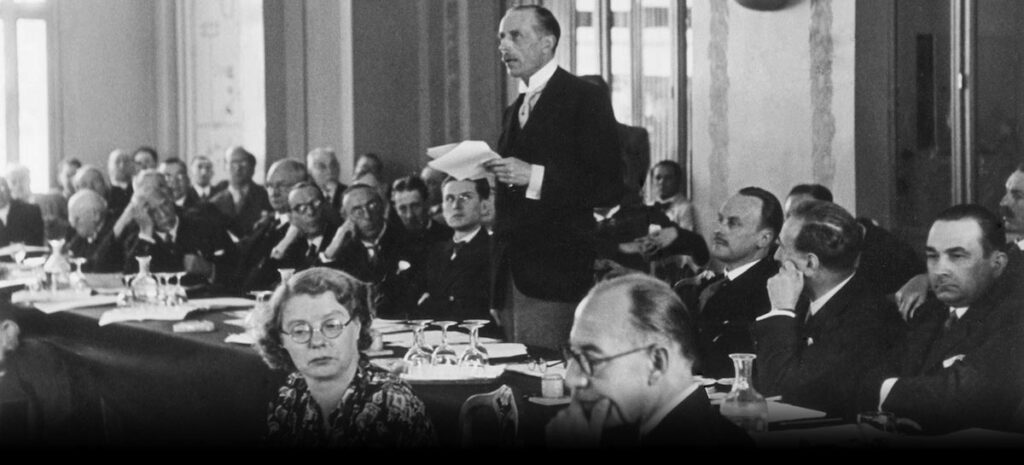
Everyone knows the Evian name for its French spa and spring water. Few know of its dark role in the murder of Europe’s Jews. The year was 1938 and war clouds were beginning to gather over Europe.

President Franklin Roosevelt convened an international conference beginning July 6, 1938 at Evian in order to deal with the crisis of Jewish persecution in Germany and Austria and the Jews who were frantically searching for refuge in other countries.

Of Germany’s original population of 600,000 Jews, about a quarter had already fled since Hitler took power five years before. Some were admitted to the U.S. and others to European countries like France, Belgium and Czechoslovakia where many were later caught by the Germans and murdered.

There was an opportunity to save the Jews of Europe when Hitler stated that he would let Jews leave “at the disposal of these countries, for all I care, even on luxury ships.” On July 6, 1938, representatives of 32 countries gathered, along with 39 private organizations and 200 reporters.

Roosevelt appointed a businessman, Myron Taylor, to lead the American team, rather than a diplomat, indicating a low level of commitment. In fact, his vice-president, John Garner, had told Roosevelt that Congress would prefer no immigration at all. The meeting lasted for nine days in the lavish resort and the result sealed the fate of the Jews of Europe.

Most countries, including Australia, Britain, America and France, had no interest in taking in Jews. The only exception was the Dominican Republic and their motive was most likely not altruistic. The President of the Dominican Republic, Rafael Trujillo, had just had his soldiers kill thousands of Haitians at the border and was likely trying to burnish his image.

Every country had an excuse. Central American countries said they did not want traders or intellectuals, by which they meant Jews. Australia said it had no racial problems and didn’t want to create any. Canadian Prime Minister Mackenzie King wrote in his diary that there was nothing to be gained “by creating an internal problem in an effort to meet an international one.” A poll in America in 1938 found that two-thirds of Americans believed that the persecution of German Jews was partly or entirely their own fault.

The Germans were delighted. Hitler’s government stated that it was “astounding that foreign countries criticized Germany for their treatment of the Jews, but none wanted to open the doors to the Jews.” They obviously considered it a green light to do whatever they wanted.

A few months later the Nazis, knowing no one would care, unleashed a pogrom that was later called “Kristallnacht,” which resulted in the murder of dozens of Jews and the destruction of synagogues and Jewish institutions. More than 230,000 German and Austrian Jews were later murdered by the Nazis. Just a few short years later, most Jews across the European continent were also murdered.

So, what is the upshot of this historic betrayal of the Jewish people by those in power all over the world who made the conscious choice to condemn countless Jews to certain death?

Rabbi Jonathan Sacks wrote that Evian made Israel a moral necessity because “that was the moment when Jews discovered that on all the surface of the earth, there was not one square inch they could call home.” Evian is a lesson for our times. The belief that the danger of earlier times has passed, and that Jews finally have a long-term home outside of Israel is little more than a desirable and seductive fantasy.

Evian is a lesson for our times.

In the ancient past, when Babylon conquered Judea, the Jews were enslaved and carried off, far from their homeland. After the Roman conquest, Jews were dispersed. Losing sovereignty and the Temples, on both occasions, was catastrophic, but the Holocaust was unique in history. It was an attempt not to enslave or disperse the Jews but to murder each and every one, an entire people. That is what genocide really means.

If that event did not elicit compassion then, before the Holocaust, and now, when the world condemns Israel for fighting for its existence, eighty years after the Holocaust, how can the case be made for Jews as safe and secure outside of their ancestral homeland where they can defend themselves?

If the world did not care then and doesn’t care now, when will they care?

Jews must awaken to a harsh truth: To remain in the Diaspora, whether for one generation or more, whether assimilated or observant, will require a concerted effort. America, Canada, and Europe can no longer be taken for granted as home for Jews even if we have lived in these places for generations.

Evian speaks to us today. We thought the battle was over. We were wrong. Boca Raton is not the Holy Land. We must realize and accept that we are not as safe as we thought we were since the end of World War II. No one came to our rescue then, and we cannot expect to be rescued now. And so we must decide: Do we leave or do we stay and stand up resolutely for our rights?


Professor Paul Socken is Distinguished Professor Emeritus and founder of the Jewish Studies program at the University of Waterloo.

Evian and the Jews Read More »

Living Jewish: Reforesting Hope in the Heart of Mexico

I came to Mexico to escape burnout. I wasn’t having a crisis of faith, but I needed my faith restored. I wanted to find extraordinary people doing extraordinary things — to be reminded that the world is still filled with hope, light, and beauty. My core identity is Jewish, and I see the world through the lens of Torah values. By an incredible series of fortunate events, I discovered two extraordinary Jews, deep in the heart of Mexico, who are Living Jewish — embodying Torah values not as belief, but as daily practice. This is their story.

Living Jewish Means Guardianship of the Earth

“God placed the human in the garden to work it and to guard it.” — Genesis 2:15  

The Torah’s first mandate was ecological: to become stewards.   

Just beyond the cobblestone streets of San Miguel de Allende — a jewel-toned city known for its art, architecture, and golden light — there’s a place that feels less like a farm and more like a living prayer. It’s a modern-day Gan Eden, a Garden of Eden.

Olive trees rustle beside pomegranate groves. Rainwater flows gently through stone-carved canals. Native plants thrive in carefully terraced soil. Chickens cluck, koi ripple and medicinal herbs line the garden beds.

This is the Tikkun Eco Center. And at the heart of it is a sacred partnership: a love story rooted in devotion to the Earth.

From the moment Ben Zion Ptashnik first met Victoria Collier 15 years ago, they felt an ancient knowing, a bond that transcended time. They have known each other not just in this life, but across many lifetimes.

They move through life in step. They pause for each other’s words. They finish each other’s thoughts. They gaze at one another not just with affection, but with purpose.

Together, they are doing what Torah commands: repairing the world. I was mesmerized, witnessing love and purpose intertwined.

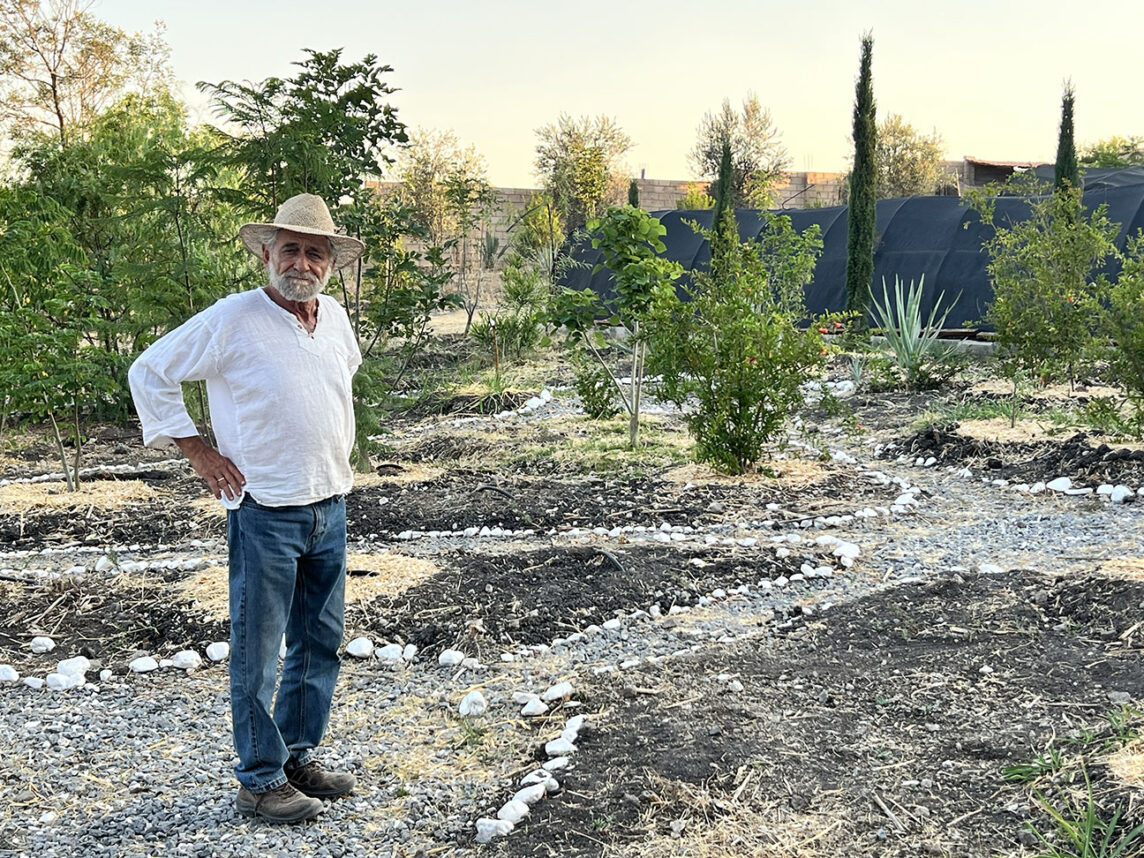
A visit to Tikkun fills the heart. Walk the land. See the trees. Sit in the quiet of the orchard with Ben and Victoria. You’ll understand why this place is more than a seven-acre food forest and regeneration project. It’s a blessing.

Ben Zion Ptashnik and Victoria Collier

More than anything, Ben Zion and Victoria are farmers of hope. Hope for a future free from hatred, greed, violence and exploitation — a future rooted in conservation and regeneration. 

Located on the semi-arid high plateau of central Mexico, in a small campesino village, Tikkun is fully off-grid. Solar panels and a wind turbine power the buildings and grounds, and drive irrigation pumps. Batteries power computers and lights at night. Rain is captured and stored using ancient methods — ponds, underground cisterns, swales and terraces. Rainwater is distributed with precision-gardens are nourished with Israeli invented drip irrigation. 

Water lilies and cat-tail roots filter the reservoirs, farm hands build a new tree nursery. Rainwater captured in fish ponds fertilizes the soil, and chickens feed on invasive grasshoppers. Everything works in sacred harmony. 

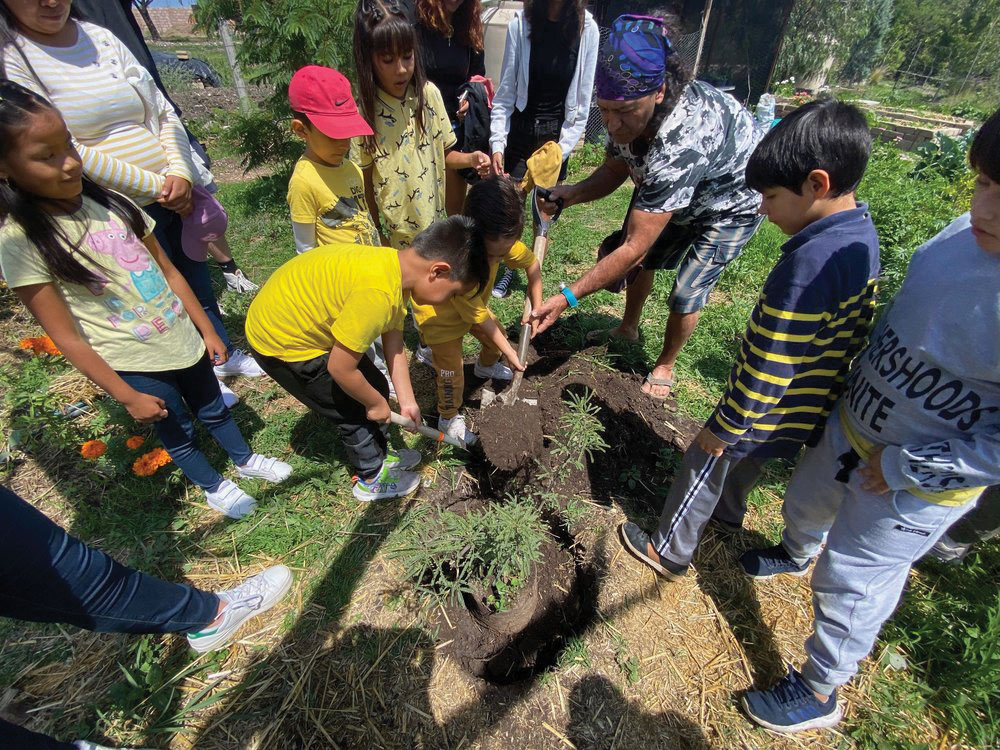
One can meditate in the “Tikkun Peace Forest,” dedicated after Oct. 7 to the children of Israel and Gaza. This small forest is designed in the shape of the Kabbalah Tree of Life mandala, with its 10 Sefirot. The forest contains dozens of indigenous ceremonial and medicinal trees and plants, mostly planted by visiting school children.

Ben Zion — the Israeli-born son of Holocaust survivors and a former Vermont State Senator — has spent his life building: legislative coalitions, international fair-trade companies, environmental campaigns, wind generators and solar systems across Mexico. Though self-taught in many areas, he has a deep academic background in political science, ecology and natural resource management. As a child growing up in Yafo, and later in Tel Aviv, he often visited cousins in kibbutzim. 

For his senior project at Goddard College, Vermont, he organized a conference for over 100 second-generation children of survivors. They came from all over the U.S. — from as far away as Atlanta, Philadelphia and from Boston, New York and Chicago. They spoke about their parents, antisemitism and the possibility of a return to fascism.

After selling Via Vermont, his import-export business, to a Fortune 500 company, Ben founded the Stopnitz Family Fund — named for his parents’ village in Poland, a town that lost 90% of its Jewish population in the Nazi camps — over 3,000 men, women and children. Initially focused on human rights and Holocaust education, the Fund eventually expanded to address democracy, civil rights, and the climate crisis — what Ben and Victoria call “a slow-moving holocaust or extinction for so many earth-species, and perhaps of humanity itself.” 

The Stopnitz Fund initially funded the Tikkun Center for Ecological Sustainability in 2008, after Ben decided to quit the Vermont Senate, and came to Mexico to pioneer solar and wind energy. 

From his father and grandfather, Ben-Zion inherited a legacy of service and moral courage. Ben speaks of his carpenter grandfather Ben-Zion, who disappeared in the Holocaust, a righteous man who ran around Stopnitz every Friday afternoon collecting zlotys to buy challah for the poor families and widows. And he reverently talks about his father Ezekiel’s life examples:

“My father searched for meaning in service,” Ben told me. 

After he found that most of his family had perished in the death camps, he smuggled into Israel and joined the Haganah. And he dedicated himself to his community of survivors, helping start and manage the Stopnitzer Society for survivors. Even in Buchenwald, during the depths of the Holocaust, my father and his two brothers — carpenters in the slave labor camps — built secret doors and bunkers in the workers’ barracks to hide sick inmates who couldn’t work, lest they be shot. In the Lodz Ghetto, he risked his life climbing through barbed wire at night to smuggle food from nearby farms.” 

“Our time on Earth must have consequences — that’s what he taught me. He believed in what Buddhists might call Karma. It’s not enough to survive or accumulate wealth. He always reminded me to be a mensch — that you can’t take it with you when you die.” 

Both Ben and Victoria believe that their mission as Jews, especially those who understand suffering — whose families were so brutally enslaved and murdered — is to honor the memory of those who died: to serve, to heal, to repair, and to leave the Earth spiritually and ecologically stronger than we found it — for generations to come.” 

Victoria, originally from Los Angeles, trained in permaculture and steeped in social justice, tends to the seed collection and library, the chickens, the horses and other rescued animals. She focuses on the garden beds, and human relationships.

A gifted artist, musician, and nonprofit leader, she believes that healing the Earth begins with reverence — for water, for soil, for soul. She found farming transcending when her parents decided to move to a farm in her teenage years, and she first grew her own garden.

“Every act of planting a seed or restoration of the earth is an act of love,” she says. “When a child plants a tree, it awakens something ancient — a memory that we belong to the Earth, not the other way around.”

 Victoria and Ben rarely quote Torah — but they live it. Through shmirat ha’adamah (guardianship of Earth), bal tashchit (prohibition against waste), and tikkun olam (repairing the world), not as slogans, but as practice. One plant, one person, one village at a time.

Living Jewish Means Restoring What Was Lost

San Miguel, in the State of Guanajuato, once blanketed in oak and encino forests, was scarred by colonial mining and smelting of silver, and aquifer depletion by agribusiness. Today, the northern Mexican desert creeps closer to San Miguel every year. Ben Zion and Victoria are building a barrier — not of walls, but of trees.

Their vision: a green belt around San Miguel de Allende. A living defense system of native trees, rainwater reservoirs and watershed restoration to reverse desertification. They focus on communities where economic sustainability is rapidly fading for local farm families.  

They’ve especially mapped out denuded forests in communal ejidos — collective farms born of Mexico’s land reform, very much like the Israeli moshav cooperatives — and partnered with local experts and campesinos to reforest where it’s most urgently needed. 

Their goal: rebuild indigenous abandoned reservoirs, propagate and plant 1 million trees, in 10 years. Not in theory — in water capturing projects, community reforestation and soil regeneration. Like pioneer kibbutzniks, in the Negev and in the Galil.

They know this cannot be an “expat-led” initiative. So they’ve built a local team of ecologists, educators, and organizers. What began with a shovel and a dream has become a scalable model for ecological restoration. One of the most powerful parts of their work is hosting schoolchildren and university students — hundreds of them — to visit, learn and plant trees. These moments ignite something lasting: wonder, responsibility, and a deep sense of belonging to the land. 

Living Jewish Means Creating a Culture of Repair and Feeding the Hungry

During the darkest days of COVID, when San Miguel and the U.S. were in lockdown, two nearby villages were cut off from food and income. Ben built irrigation systems and Victoria grew five acres of blue corn, beans, squash, tomatoes, greens, chilis, broccoli, and cilantro — and gave it all away. 

They met with village leaders to identify the most vulnerable — the elderly, single mothers, those without pensions. The elected “delegadas” made lists. No one in need was left behind. 

This is Torah in action:

“You shall open your hand to your neighbor, to your poor and to your needy in your land.” — Deuteronomy 15:11

As the crisis deepened, Victoria began helping families build home gardens. But the local well had begun to dry up, and water was being rationed.

So they used their savings — all of it — to rent an excavator and five trucks to restore the village’s 200-year-old abandoned rainwater reservoir. They redistributed rich silt soil to nearby farms, terraced the surrounding hills, and planted hundreds of trees with the community.

Six months later, the dam held 25 million liters of rainwater. Today, after 10 years of going dry every winter it holds water year-round. A new distribution system is underway to bring water directly to homes. And a second reservoir project in the ejido community of Los Torres is now being forested.

Tikkun is also creating jobs in rural communities. This spring Tikkun hired 10 ejidatarios to build stone-walled terraces, and a tree nursery in a rural ejido. Next they plan to help start a community garden at the primary school.  

Victoria speaks of a wedding tradition in India, where guests give trees to the new couple — symbols of life, rootedness, and responsibility. “That’s the culture we hope to see built here,” Victoria told me. “Where bringing a tree as a gift is sacred. Where restoration is a way of life.”

It reminded me of the old JNF pushke box from my childhood, where planting a tree in Israel marked births, losses, and celebrations. It isn’t just about trees. It’s about belonging.

Ben Zion and Victoria are building that same tradition — one that transcends borders but remains deeply grounded in Torah.

A New Chapter: Growing the Dream 

With over 3,000 trees and cacti already planted, and two reservoir restorations under their belt, Ben and Victoria’s dream is scaling up. Tikkun is now supported by a number of member-funders, small family funds, and a five-year foundation grant. The new funding from private foundations has enabled them to hire local experts, build new nurseries, fund watershed restoration, and launch a 10-year regional reforestation effort.

Their vision:

• One million indigenous plants and trees native to the Guanajuato region propagated and planted

• Dozens of restored local watersheds and reservoirs

• Sustainable employment for rural communities

• Development of sustainable regenerative agriculture 

• A transformed ecological future for Central Mexico

Not all at once. Not by one NGO like Tikkun, not one funder. But by a constellation of people who believe, as they do, that we can heal what’s been broken. That stewardship is sacred. That Living Jewish means showing up with purpose and doing good.

Come visit. Come plant. Come share and give. Living Jewish is not just about tradition — it is about embodying our values in the world. It is a vision of Tikkun Olam. It is about choosing to be part of the repair.

https://www.tikkunsanmiguel.mx/ 


Audrey Jacobs is a Jewish communal leader, strategic advisor, and TEDx curator, and the mother of three grown sons.

Living Jewish: Reforesting Hope in the Heart of Mexico Read More »

For-Profit Colleges Exploit Veterans’ GI Bill Benefits: An Overlooked Crisis in Addressing Veterans’ Needs in Los Angeles and Across the Country

In a significant move to address veteran homelessness, President Trump signed an executive order aimed at accelerating the development of housing for veterans in Los Angeles, where the overlapping crises of unaffordable housing, failed healthcare and homelessness have led to the conditions that have resulted in creating one of the largest populations of homeless veterans in the United States. The order emphasized the need for streamlining bureaucratic processes and reallocating resources to facilitate the construction of residences on VA property in West Los Angeles with the goal of housing up to 6,000 veterans by 2028. Veterans transitioning to civilian life face many challenges, from securing adequate housing to pursuing higher education. While the Trump administration has accurately emphasized the critical need for addressing housing shortages among veterans, one glaring issue remains largely ignored — the exploitation of veterans’ GI Bill benefits by for-profit colleges. This crisis not only leaves many struggling with insurmountable student loan debt but also undermines their ability to achieve financial stability and, in turn, secure affordable housing.

The GI Bill was created to offer educational opportunities to veterans, enabling them to build careers and achieve economic independence. Under the Post-9/11 GI Bill, veterans receive funding for tuition, housing allowances, and additional educational expenses, providing a lifeline as they return to civilian life. Yet, for-profit colleges have turned what should be a tool of empowerment into a vehicle for exploitation. These institutions target veterans aggressively, leveraging loopholes like the “90/10 Rule,” which allows GI Bill funds to bypass restrictions on federal funding quotas. The consequence is a predatory focus on veterans, lured by promises of flexible programs, career placement assistance, and accelerated degrees — many of which fail to deliver meaningful results.

Veterans who enroll in for-profit colleges often end up saddled with exorbitant tuition costs that exceed their GI Bill coverage. To make up the difference, they turn to federal or private loans, creating a debt burden that can take years — or decades — to pay off. 

Veterans who enroll in for-profit colleges often end up saddled with exorbitant tuition costs that exceed their GI Bill coverage. To make up the difference, they turn to federal or private loans, creating a debt burden that can take years — or decades — to pay off. This financial strain impacts more than just their educational journey; it directly affects their ability to afford stable housing and meet basic needs. This predicament is underscored in the story of David Boyer, a navy veteran who served on three aircraft carriers, who shared his experience of betrayal and debt in a recent interview with Jessica Dietzler, founder of the “Rad Futures” podcast. Boyer earned a degree in electronic engineering from ITT, a for-profit college, using his GI Bill benefits, only to find that prospective employers deemed his degree worthless. Unable to secure a job in his field, Boyer faced mounting loan payments and financial insecurity, a struggle that ultimately hindered his ability to find suitable housing. Today, Boyer has authored a petition called “Restore Veterans’ Futures” to shed light on the crisis of how veterans who have served both active and reserve duty, exited the military only to be steered by the Veterans Affairs (VA) office toward for-profit colleges that not only stole their GI benefits, but left them unemployable with useless degrees and excluded from the Borrowers Defense path toward student loan cancellation by means of holding accountable predatory and defunct colleges. 

Further compounding the predicament of veterans who have been defrauded of their GI benefits is the fact that student loans have been uniquely stripped of constitutional bankruptcy protections. In practice, this means that unlike other types of consumer debt, student loans cannot be discharged through bankruptcy proceedings. This makes it particularly challenging for veterans who are struggling to repay their student loans from predatory for-profit institutions, as they do not have the option to seek relief through bankruptcy despite the fraud they have been subjected to and the lack of gainful employment they continue to experience. 

The Trump administration’s efforts to address housing shortages for veterans must also account for the economic realities that drive homelessness and housing instability. Student loan debt from predatory for-profit colleges exacerbates these issues, and reintegration into civilian life. Without intervention, these intertwined crises will continue to deepen.

Advocacy groups and policymakers have long called for measures to curb the exploitation of GI Bill benefits. Closing the 90/10 loophole, enforcing stricter performance benchmarks for schools, and holding for-profit colleges accountable for their outcomes are critical steps. Additionally, initiatives that support veterans in making informed educational choices, such as the VA’s GI Bill Comparison Tool, can help reduce the risk of falling victim to predatory practices. However, these reforms must be coupled with broader efforts to ensure veterans have access to affordable housing. Financial relief programs that address both housing needs and educational debt could provide a more comprehensive solution, empowering veterans to focus on rebuilding their lives rather than grappling with the fallout of exploitation.

Veterans such as Boyer deserve more than hollow promises; they deserve real solutions that honor their service and sacrifice. Addressing housing shortages is undoubtedly vital, but it cannot be done in isolation from the broader financial challenges veterans face — including the burden of student loan debt incurred through exploitative for-profit colleges. The Trump administration has the opportunity to tackle these interconnected crises head-on, ensuring that veterans can transition to civilian life with dignity, stability and hope for the future. By prioritizing both housing and educational reform, the nation can uphold its commitment to those who have served—and empower them to thrive in the country they have defended.


Lisa Ansell is the Associate Director of the USC Casden Institute and Lecturer of Hebrew Language at Hebrew Union College-Jewish Institute of Religion Los Angeles.

For-Profit Colleges Exploit Veterans’ GI Bill Benefits: An Overlooked Crisis in Addressing Veterans’ Needs in Los Angeles and Across the Country Read More »

Hear Today, Gone Tomorrow: The Torah of Loud Music

In 1959, my late mother had her sweet 16 celebration. The party favor for the girls was personalized cigarettes. I wish I could ask my mother whether the cigarettes were personalized with her name or of each girl. Anyway, if anyone has a box of them in an attic somewhere – I would love to have it.

This apparently was not a unique gift. I don’t think I ever got to tell my mother, but I found in my research for my forthcoming book, “God Was Right: How Modern Social Science Proves the Torah is True,” that presidents from Kennedy onward handed out personalized cigarettes as a White House gift until President Reagan switched to jelly beans.

My mother and I often spoke of this story as an example of how one of the wonderful things about America is how quickly and profoundly it can change for the better. A practice that is standard in one generation can become unthinkable – even unthinkably funny – a generation later. We often spoke of what practices in our day would be equivalent to the personalized cigarettes of 1959. And we came up with one that definitely should be – if we, participants in society, make it so.

The story of what this is begins around ten or twelve years ago. Erica and I told Eli Beer that he is the most hard-traveling person we have ever known – he met with United Hatzalah donors and attended United Hatzalah events all around the world. We told him that he was too old to be making that many trips flying economy, especially as he always had work on the plane and needed to be fresh when he landed.

We told him that we were making what would be our first and only conditional contribution to United Hatzalah. We would make an additional annual contribution – to be used specifically for him to fly business class. He resisted mightily, on the grounds that he wanted every dollar possible to go to the organization. We thanked him for saving us the money. When he saw that we were completely serious, he relented.

It turned out to be a good investment. On one of his trips to or from Israel that year, a fellow passenger passed out – I think it was diabetic shock. Eli immediately commanded the situation, getting what he needed from the plane staff and saving the patient. When he sat back down hours later, a fellow passenger in business class asked him how he did that. He explained that he was the leader of the United Hatzalah, and a lifelong volunteer himself. She ended up contributing $2 million.

A few months later, Eli was again in business class – this time flying from Miami to New York. Nothing dramatic that time – just the usual for Eli: reviewing documents and dictating in Hebrew for the entire flight. The man next to him on that flight asked him what he was doing, and he explained. Eli’s fellow passenger offered him a ride from the airport to New York City – and a great friendship had started. The passenger was Joel Sandberg.

In March 2020, Eli got a very early and severe case of COVID. He was hospitalized in Miami and Joel, a physician with privileges at the hospital, arranged for and oversaw Eli’s care while he was intubated – twice. Just as Eli saved the life of the passenger on the Israel flight, Joel saved his in Miami.

If Joel had just saved Eli’s life – of course, dayenu– it would have been enough. But Joel and his wife Adele had also (well before then) become dear friends of Eli and Gitty, of Erica and me – and very generous supporters and involved board members of United Hatzalah. Joel and Adele have been friends and role models for Erica and me – as parents, as Jewish leaders, and (in so many ways) as people.

Why is all of this relevant? Because of one of the many things Adele taught us. Adele taught us that every exposure to loud noise – as defined as greater than 75-80 decibels – leads to hearing loss that can never be recovered. She has recently published a children’s book on the subject – part of her work to share this important and practical truth. Every study has confirmed that she is right. She told us to put an app on our phone that detects decibel levels. We did.

The app registers noises way above 75 dB – regularly 95-103 (which is extremely dangerous) – at the weddings and bar mitzvahs we attend, due to the music. This is not a uniquely Jewish phenomenon, of course. Our Evangelical friends said that the music in their church services and celebrations often get as loud. Concerts (indoor and outdoor) often register similarly.

This is unfortunate for a number of reasons. First, a test for whether music is any good might be whether anyone is tempted to blast it. Take any of the great singers of the past 75 years – Sinatra, Elvis, the Beatles, Simon & Garfunkel, Ella Fitzgerald, Pat Boone, Willie Nelson, Etta James, George Strait. The one thing that they all have in common is that no one would reasonably think to play their music at dangerous decibels. That is because music that is genuinely beautiful – music that inspires, evokes or uplifts – is not well experienced loudly.

So it is not like loud music is a (high) price we pay to enjoy celebrations. Not only is loud “music” really just bad sound – but it makes it sometimes impossible even to hear the person sitting next to you. It is ridiculous – even more, sad – for a milestone to be celebrated with pounding sounds that damage everyone’s hearing while making conversation impossible. And the foam earplugs that are sometimes made available don’t really solve anything (they probably reduce the noise by 10 dB) – and are best used as a signal that the event is too loud. The only safe and responsible thing to do at such a “celebration” is to leave it – which I routinely do, emailing Adele, “95 decibels at this wedding, I’m out again.”

This problem is especially the responsibility of Jews and Christians who love the Torah. In Deuteronomy 4:15, Moses tells us: “You shall guard yourselves very much.”

This is universally understood to be a commandment to take care of our health. We, as an American society, have done this exceptionally well with cigarettes – to the point where handing out personalized cigarettes at a Sweet Sixteen, a widely practiced custom in the lifetime of some readers of this column, is a historical curiosity.

We should do it again with loud music – so that our children and grandchildren ask us, ”Is it true that celebrations were so loud in the 20s that hosts actually handed out earplugs?”

Adults in school and synagogue communities should make it clear that they do not want their children exposed to music that has been irrefutably demonstrated to irreparably damage their hearing at “celebrations.” Rabbis should condition doing bar mitzvahs and weddings on the celebrations being at a maximum of 80 decibels.

There could – or at least should – be no principled opposition to this, especially (but not only) for people of faith. One who wants to follow the guidance of the Torah cannot reconcile the commandment to “guard yourself very much” with playing loud music at a religious celebration – or, perhaps, being around it at all. God gave us the gift – and what a gift it is – of hearing, and it is not ours to ruin so that we can listen to blaring sounds at the cost of human interaction.

How is the alternative? Wonderful. The best upbeat songs – I am thinking of “Stayin’ Alive” by the Bee Gees– can be fully experienced at around 80 dB. And for perhaps music’s best purpose – the cultivation of love? Just put on the Hoagy Carmichael classic “The Nearness of You.” The question is not whether this ineffably beautiful love song is better than anything played loudly – that’s obvious. It is whether the best version is by Willie Nelson, Johnny Hartman, Frank Sinatra or Ella Fitzgerald.


Mark Gerson is the co-founder/Chairman of United Hatzalah of Israel and author of the forthcoming book, “God Was Right: How Modern Social Science Proves the Torah is True.”

Hear Today, Gone Tomorrow: The Torah of Loud Music Read More »

Qatar’s Foreign Policy of Influence: Lavish Gifts, Shadow Diplomacy and Strategic Silence

Qatar, a tiny Gulf monarchy with a population smaller than many global cities, punches well above its weight on the world stage. With its staggering wealth derived from natural gas—the third-largest reserves on the planet—Qatar has used financial leverage as a cornerstone of its foreign policy. Indeed it may be said that Qatar’s principle means of foreign policy is bribery. Rather than relying on conventional military might or multilateral institutions, Doha’s preferred strategy is soft power with hard cash: donations, sponsorships, and high-level “gifts” that blur the line between diplomacy and patronage. This method has earned Qatar a network of influence across the Middle East, Europe, and even the United States.

But behind the gleaming towers of Doha and the generous endowments to universities lies a murkier dimension to Qatar’s foreign policy. It has long been accused of using its wealth to shield and promote actors aligned with Islamist ideologies, most notably Hamas, which is unequivocally labeled a terror organization by the U.S., EU, and many others. These efforts—whether via direct financial transfers or indirect legitimization—have placed Qatar at the center of complex regional geopolitics, prompting questions about how far money can go in laundering a nation’s global image.

Qatar’s foreign policy can be summarized in three words: money buys influence. Over the last two decades, Qatar has poured billions into strategic partnerships, infrastructure projects, media ventures, and institutions across the globe.

The most glaring example of Qatar’s soft power is Al Jazeera, the state-funded broadcaster launched in 1996 that is easily the most antisemitic major news source in the entire world. Billed as an independent voice in the Arab world, Al Jazeera echoes the foreign policy priorities of the Qatari government. In the wake of the Arab Spring, it was notably sympathetic to Islamist political parties, particularly those affiliated with the Muslim Brotherhood—a controversial movement that Qatar has long supported even as its Gulf neighbors, especially Saudi Arabia and the UAE, classify it as a terrorist group.

Qatar’s ties to Hamas have been widely scrutinized and well-documented. Since at least 2012, when Hamas political leader Khaled Meshaal relocated from Damascus to Doha, Qatar has played host to high-ranking Hamas officials, providing them with not only sanctuary but also political legitimacy.

This continues to this very day.

In 2014, Qatar pledged $1 billion in aid to Gaza following the war with Israel prompted by Hamas murdering three Israeli teenagers in the most gruesome manner and then showering thousands of rockets on Israeli cities. While Qatar claims these funds go toward humanitarian reconstruction and salaries for civil servants, the truth of course is that these funds are pivotal in propping  up Hamas’s governance of the Gaza Strip, thereby enabling the group to redirect other resources toward military capabilities and terrorism. Israel and even the United States have repeatedly accused Qatar of directly and indirectly financing terror, although Western diplomats have on balance never gone far enough in holding Qatar accountable for their malicious activities and influence.

As recently as the October 7th massacre of Israelis in 2023, Hamas leaders Ismail Haniyeh and others continued to operate freely from Doha. As a Jewish American I find it positively vomitous that our Air Force runs a base of some 10,000 American service men and women – the Al Udeid Air Base, a strategic hub for American forces in the Middle East –    from a country that funds a group that carried out the brutal October 7 mass murder  that killed over 1,200 Israelis and took hundreds hostage. Though Qatar cynically condemned the violence in generic terms, it has steadfastly resisted calls to expel Hamas leaders or fully sever ties, portraying itself as a “neutral mediator.”

But neutrality is nothing but a fig leaf for complicity. As my friend former U.S. Ambassador to Israel David Friedman stated in late 2023 that “Qatar is not a neutral party. It is the lifeline of Hamas.” Similarly, Republican lawmakers introduced legislation to force the U.S. to reconsider its military presence in Qatar id its terror-funding government does not curb its support for Hamas.

While Qatar has invested heavily in real estate, sports, and airlines across the West, some of its most strategic funding targets our leading universities and intellectual institutions. Since the early 2000s, Qatar has contributed at least $1.8 billion to American universities, making it the largest foreign donor to U.S. higher education. That this has been allowed to proceed unrestricted is a terrible stain on the very integrity and reputation of our Ivy League.

Much of this funding flows through the Qatar Foundation, a nonprofit established by the ruling Al Thani family. It hosts branches of elite U.S. universities such as Georgetown, Cornell, Northwestern, and Texas A&M at its sprawling “Education City” campus in Doha. Ostensibly aimed at exporting high-quality education to the Gulf, these partnerships have raised alarm bells about academic freedom, ideological influence, and compliance with U.S. laws on foreign disclosures.

Georgetown University, for instance, which houses a School of Foreign Service branch in Doha, has received hundreds of millions in Qatari funding. Does any impartial observer seriously doubt that such financial entanglements does not temper institutional criticism of Qatar’s human rights record or its geopolitical actions? There is also concern that academic environments might avoid critical inquiry into subjects like political Islam, Hamas, or the Muslim Brotherhood, in order to maintain Qatari patronage.

A 2019 Department of Education investigation found that American universities had failed to report billions in foreign gifts, with Qatar being one of the top unreported sources. The investigation suggested that foreign funding could create “undue foreign influence,” particularly when it comes from authoritarian regimes with defined ideological agendas.

Texas A&M, which operates a full engineering campus in Qatar, faced scrutiny from lawmakers over concerns that its research—some of which is defense-related—could be indirectly accessible to a foreign government with questionable alliances.

Qatar’s gifting strategy is not limited to education. In recent years, the country has lavished European officials with perks and financial incentives, culminating in the so-called “Qatargate” scandal of 2022. European Parliament members were accused of accepting large sums of money and luxury items from Qatari intermediaries in exchange for influencing legislation favorable to Qatar. Eva Kaili, a former vice president of the European Parliament, was among those arrested.

The incident raised broader questions about how Qatar uses money not just for soft diplomacy but for potentially corrupting democratic institutions. Even amid the scandal, Qatar’s influence was felt: no sweeping sanctions followed, and Doha retained its prominent voice in European energy talks after Russia’s invasion of Ukraine.

For now, Qatar’s strategy of influence via wealth appears to be paying off. Despite its support for actors like Hamas and its entanglement in European corruption scandals, Doha has largely avoided severe diplomatic repercussions. Astonishingly, it remains a key U.S. ally, hosts one of the largest American military bases abroad, and continues to maintain influence in global conversations about Gaza, energy security, and Middle East diplomacy.

But the winds may finally be shifting. Increasing scrutiny from U.S. lawmakers, criticism of President Trump’s plans to accept a $400 million aircraft from the Al-Thanis, and bipartisan calls to reassess military and educational ties, and the global backlash after Hamas’s 2023 attack on Israel have brought new attention to the costs of tolerating Qatar’s dual policy of Western partnership and Islamist alignment.

Qatar’s foreign policy is built on wealth—not just in how it sustains its influence, but in how it evades accountability. Lavish donations –  no, let’s call it what it is, bribes – to universities, cushy relationships with foreign officials, and a carefully crafted image of diplomatic neutrality mask a reality in which Doha has enabled extremist actors and undermined liberal institutions.

I have a personal stake in this matter as it was our organization, the World values Network, that led a national effort in 2017 and 2018 to expose Qatar’s alleged bribery of leading pro-Israel voices to cynically promote Qatar as an agent of peace in the Middle East. My reward? According to a New York Times investigation, I was at the top of a list of activists whose emails Qatari intelligence targeted for hacking.

If the international community in general and the United States in particular, wants to take the fight against terrorism and authoritarian influence seriously, it must start asking tougher questions—not just about where the money is going, but what it’s buying.


Rabbi Shmuley Boteach, “America’s Rabbi,” is the international best-selling author of the newly published guide to fighting back for Israel “The Israel Warrior,” “Holocaust Holiday,” and “Kosher Hate.” Follow him on Instagram and Twitter @RabbiShmuley. 

Qatar’s Foreign Policy of Influence: Lavish Gifts, Shadow Diplomacy and Strategic Silence Read More »

From the Bottom of the Barrel to the Top of the Mountain

Nearly a century ago, on June 8, 1924, George Mallory disappeared into the clouds high on Mount Everest. Straddling the border between Nepal and Tibet at the crest of the Himalayan mountain chain, Everest is considered the tallest mountain in the world at an estimated elevation of over 29,000 feet, roughly 5.5 miles tall. When Mallory and his climbing partner, Andrew Irvine, were last seen, they were less than a thousand feet from the summit. 

At that point in history, no one had yet reached the top of Sagarmatha, the mountain’s Tibetan name, which means “the Head of the Earth touching the Heaven.” When Mallory was asked by a reporter why he was attempting to climb Everest, he famously replied, “Because it’s there.” 

Over 3000 years earlier, the recently liberated Israelites approached the base of a much more hospitable mountain. No special equipment or experience was needed for the trek made by young and old alike. If a press conference had been held on the morning of the Revelation at Sinai, I imagine reporters would have had a similar question: Why? Why embark on this arduous journey? Why venture time, energy, resources, and your very lives for the Torah? 

The Talmud relates that on that day, 600,000 men as well as their wives and children stood b’takhteet hahar (Ex. 19:17), “in the bottom of the mount,” for God had overturned Sinai itself and suspended it above their heads like an upturned vat, signaling that if they did not accept the Torah, “there will be your burial” (Shabbat 88a). Thus, in response to any question about the nation’s motivation to take on such a challenging spiritual expedition, the Jews might simply have pointed up at the forbidding butte overhead and said: Because it’s there.

Since the Jewish people had already said naaseh v’nishma, “we will do and we will hear” (Ex. 24:7), and committed to accepting the Torah prior to arriving at Sinai, sages across the ages have expounded on the Talmud’s apparent contradiction of volition. Even if the threatened burial-by-barrel was meant to ensure the Jewish people would stand by their promise, it significantly weakens their “why.” No longer would they be choosing Torah because of a genuine desire for an elevated and everlasting relationship with the Almighty, but rather, their choice would be coerced by fear of death, essentially rendering it no choice at all. 

The Talmud’s striking tableau summons to mind a slightly altered version of Lord Alfred Tennyson’s poem “The Charge of the Light Brigade,” which portrays the noble yet ill-fated British assault against the Russian forces during the Crimean War:

Theirs not to make reply,

Theirs not to reason why,

Theirs but to do [or] die.

Into the valley of Death

Rode the six hundred.

According to the Talmudic sage Reish Lakish, while Israel stood stricken with awe, the earth itself trembled, for all the works of creation knew they were brought into existence only for the transmission of the Torah. If the Jews refused, the Sages say God pledged to return the world to chaos and emptiness (Shabbos 88a). Why?

In “Man’s Search for Meaning,” his personal account of the horrors of the Holocaust, Viktor Frankl observes that one who has a “why” can endure the most extreme suffering and even turn pain into purpose. Reflecting on Frankl’s assertion, Rabbi Lord Jonathan Sacks writes, “Jews were the first to find meaning in history. They discovered the why [and] that is why [they’ve been] able to bear almost any how.” Noting that Nietzsche’s most often quoted remark— “One who has a why to live for can bear almost any how”— appears to align with Frankl’s insight, Rabbi Sacks counters the 19th century German philosopher who announced the “death of God” by arguing that a world without God is “infinite nothing… empty space… a universe without a why. It may have beauty, grandeur, scale and scope— but not meaning.” When people turn away from faith, writes Rabbi Sacks, “what dies is not God, but man.”

From this vantage point, we might understand the suspended Sinai not as peril but pedagogy. Not as leverage, but a vital lesson. In holding the mountain overhead, God taught the Jewish people that a life without Torah is senseless, empty, nothing. A form of living death. But the offer, the assurance, of Torah is the most essential why. It is connection, meaning, and a life filled with purpose.

The values and principles of Torah are universally appealing. The Hebrew Bible’s emphasis on freedom, justice, charity, and moral responsibility has buttressed democracy and shaped Western civilization in countless ways. But, as the Maharal of Prague explains, God needed to teach the people that values, vision, and volunteerism are not enough. Covenant requires compelled commitment. 

The history of attempts to climb the highest mountain on earth began in the early 1920s, but the attempt to reach the apex of human flourishing by drawing heaven down to earth began with the bestowal of the Hebrew Bible millennia ago. Although Mallory perished during his expedition, and it remains unknown whether he died on the ascent toward or descent from the peak, there is nothing mysterious about the mass revelation at Sinai. The continuity of the nation founded at Sinai across epochs is evidence of its sacred mission. And while it is evident that we must continue climbing to reach the pinnacle of religious, moral, legal and political life, our steps are strengthened by the truth of Torah and the wisdom of our ancestors. We carry on our backs and in our hearts a legacy of lives committed to Jewish values. We are oxygenated and warmed by our communities and allies. And we remain tethered to our purpose, knowing that the cord between God and the Jewish people can never be severed.


Dr. Shaina Trapedo is an Assistant Professor of English at Stern College and a resident scholar at the Straus Center for Torah and Western Thought at Yeshiva University.

From the Bottom of the Barrel to the Top of the Mountain Read More »

America’s Founders and Israel’s City of Faith

As Jerusalem Day is commemorated this year beginning Sunday evening, May 25th, all Americans have reason to celebrate. While the occasion marks the reunification of Jerusalem by Israel during 1967’s Six Day War, it is, at its core, dedicated to both the historical and contemporary significance of the city. And Jerusalem’s eternal resonance as a symbol of covenantal community is something the American Founders well understood.

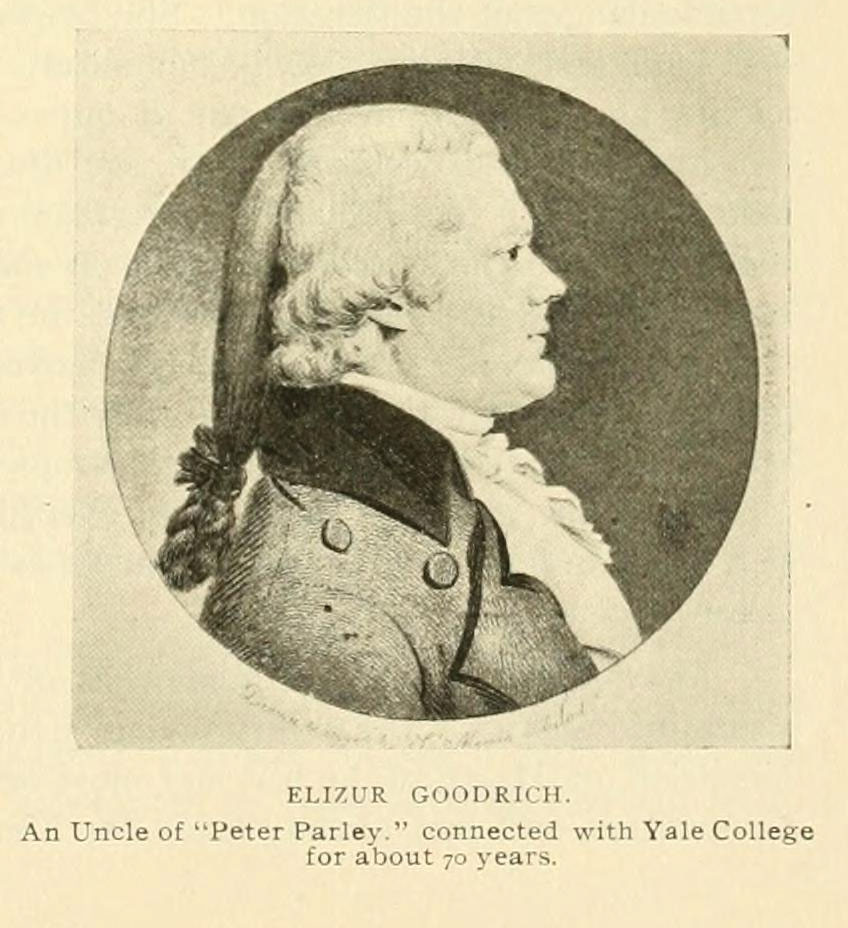
Roughly two weeks before the start of the Constitutional Convention in Philadelphia in 1787, in front of the General Assembly of the state of Connecticut, pastor Elizur Goodrich offered a comparison between the emerging nation and the ancient Israelite city in his speech “The Principles of Civil Union And Happiness Considered And Recommended.” 

He started by citing Psalm 122’s third verse, “Jerusalem is builded, as a city that is compact together.” The city, he emphasized, was federalized by faith. “It’s [sic] inhabitants were not a loose, disconnected people, but most strictly united, not only among themselves, but with all the tribes of Israel, into a holy nation and commonwealth, under … their king and their God.” Jerusalem housed the legal, political and religious authorities, a separation of powers that America would be wise to imitate. “Hence both by divine appointment, and the common consent of the nation, it was established as the local centre of communion in all the privileges of their civil and sacred constitution. There were the thrones of judgement, the thrones of the house of David, and the supreme courts of justice, and of the public administration [the Levites and Priests who served in the Temple].”

If the newborn America was to flourish like biblical Israel, it would be through a polity similarly composed through covenant and guided by righteousness. “[O]n the walls of our Jerusalem: Let not these walls be daubed with the untempered mortar of injustice, jealousy and discord; but may they be cemented by the uniting principles of justice, benevolence and public spirit,” he preached. 

If those who were forming the new nation maintained “a noble spirit of true patriotism, having no narrow and private interests at heart; but seeking the good of our Jerusalem, build it up on the great foundations of truth and righteousness. Then peace will be within our walls, and prosperity within our palaces.” In this way, he prayed, “the United States, may, after the model of Jerusalem, be ‘builded, as a city that is compact together.’”

George Washington shared Goodrich’s belief in Jerusalem as a model for America. In over 50 letters and speeches, both as a general and as America’s first president, Washington spoke of his aspiration that the country be a place wherein each individual should “sit under his vine and under his fig tree, and none shall make them afraid.” This image, a prophetic vision of a Messianic-era of the city sparkling with serenity and prosperity, is drawn from Micah 4:4. It also appears in 1 and 2 Kings, Zechariah, and in the apocryphal 1 Maccabees.

George Washington shared Goodrich’s belief in Jerusalem as a model for America. In over 50 letters and speeches, both as a general and as America’s first president, Washington spoke of his aspiration that the country be a place wherein each individual should “sit under his vine and under his fig tree, and none shall make them afraid.”  

As the historian Jon Meacham has noted, “The image of every man being free from fear, comforted by the shade of his own conscience, is vivid and enduring, and places the ideal and the reality of liberty and mutual understanding at the heart of the American tradition from the first year of the first presidency.”

American towns and cities named for Jerusalem can be found in Arkansas, Ohio, Maryland, Michigan, New York, Rhode Island and Virginia. The island of Saint Croix in the U.S. Virgin Islands even houses a small neighborhood called Jerusalem and Figtree Hill.

Though most Americans might not be aware of this history, Jerusalem Day provides an apt moment to teach it. After all, the Jewish people’s beloved city, miraculously rebuilt in our own era, stands everlasting as a source of inspiration for all those whose hearts possess faith in truth and righteousness, justice, liberty and public spirit. 


Rabbi Dr. Stuart Halpern is Senior Adviser to the Provost of Yeshiva University and Deputy Director of Y.U.’s Straus Center for Torah and Western Thought. His books include “The Promise of Liberty: A Passover Haggada,” which examines the Exodus story’s impact on the United States, “Esther in America,” “Gleanings: Reflections on Ruth” and “Proclaim Liberty Throughout the Land: The Hebrew Bible in the United States.”

America’s Founders and Israel’s City of Faith Read More »