fbpx

March 25, 2025

Antsy for a Deal

Donald Trump wants a Nobel Peace Prize. And he may have decided that Benjamin Netanyahu can make that happen for him.

Trump regards the Nobel Prize as the ultimate validation of his presidency. He believes that he deserves it, and he is fashioning his foreign policy agenda to allow him to make that case even more forcefully.

He also understands that Americans are tired of war. Even though our own young men and women are not fighting in either Ukraine or Gaza, growing numbers of U.S. voters are both skeptical of the relevance of these two conflicts to this country’s core interests and wary about the growing cost of supporting our allies given the brewing economic storms here. 

While Trump has been effective in stoking these concerns, he did not create them. But the combination of the short-term political gain and the enduring historical prestige has made Trump extremely motivated. He wants a peace deal – somewhere – and he wants it fast. The question is where he gets it.

The combination of the short-term political gain and the enduring historical prestige has made Trump extremely motivated. He wants a peace deal – somewhere – and he wants it fast. The question is where he gets it.

During the campaign, he promised to end the war between Russia and Ukraine on his first day in office. That ambitious goal has not been realized, and given the lack of cooperation he has received from both countries’ leaders, that peace still appears to be a more distant goal.

The additional challenge for Trump is that what seems to be his preferred path toward peace — which involves capitulating to Putin and giving the Russians all or most of what they want — is unlikely to help him achieve his personal goals. Abandoning a democratic ally in Ukraine is not the pathway to a Nobel Prize, nor is essentially leaving Europe to fend for itself as Putin ponders further expansion. 

Trump’s preferred path to Middle East peace is much clearer than in Eastern Europe, as evidenced by his repeated threats that there will be “hell to pay” for Hamas if they do not release the remaining hostages. But his long-time support for Israel creates a challenge for Trump in this fight too, as the terrorists have little incentive to trust him or his negotiators. Israel’s leaders march in lockstep with this American president only slightly more than they did for his predecessor: Benjamin Netanyahu’s domestic political challenges have made him unenthusiastic about accepting American-endorsed middle ground.

But Trump has an ace in his pocket here that Netanyahu lacks: the overwhelming support of Israeli voters. Trump’s favorability ratings in Israel have skyrocketed to off-the-charts highs, which makes his advisors much more confident about his ability to lean on Israel’s leaders. If he chose to deploy some portion of his political capital to pressure Netanyahu or his successor toward uncomfortable concessions to end the war, they would find that type of strong-armed persuasion very difficult to resist.

But simply ending the violence between Hamas and Israel will not be enough to get Trump to his goal. Many presidents in the past have been able to temporarily stop the fighting between Israel and Palestinian terrorists, only to watch the violence erupt again after a short respite. What Trump needs is a much bigger deal, something of the scope of the Camp David Accords between Menachem Begin and Anwar Sadat that fundamentally remade the Middle East almost half a century ago.

That requires normalizing relations between Israel and Saudi Arabia. Since the Saudis desire a Palestinian state as the price for their sign-off, Israel’s leaders will be facing immense Trumpian coercion to make undesirable concessions. Saudi Arabia may not insist on a formal flag-raising over Ramallah. There is evidence that they may settle for less concrete progress toward that goal, especially if Israel mounts an aerial military attack on Iran’s nuclear facilities. But there will need to be some movement, both rhetorical and substantive, toward a two-state solution for a broader treaty to be forged. That won’t be easy for Israel, but it might end up happening anyway.

Trump wants a Nobel Prize. He’s not going to get it in Ukraine. Hamas has little incentive to help him in Gaza. Israel’s leaders may have little choice.


Dan Schnur is the U.S. Politics Editor for the Jewish Journal. He teaches courses in politics, communications, and leadership at UC Berkeley, USC and Pepperdine. He hosts the monthly webinar “The Dan Schnur Political Report” for the Los Angeles World Affairs Council & Town Hall. Follow Dan’s work at www.danschnurpolitics.com.

Antsy for a Deal Read More »

Persian Halegh: The Charoset to End All Charosets

At the risk of offending half of our readers, the first time someone shared with me that they had “a lot of charoses,” I worried that they had a skin condition. 

I had never heard “charoset” pronounced that way. In fact, as soon as I typed the word for this week’s column, autocorrect requested to change it to “charoset.” As I do each time autocorrect attempts to change my title to “a weekly communist for the Jewish Journal of Greater Los Angeles,” I had to override the suggestion. According to my family, I may be a dictator, but I’m no communist. 

Modern Jewish vernacular uses words such as “charoset,” “challah,” “hamantaschen,” and “cholent” as if every Jew in the world knows their meaning and uses these words. I learned the word “charoset” years after coming to the United States. Until I was exposed to that word, I, and 100,000 other Iranian Jews, simply called this Passover staple the only name we had ever known for it: halegh.

Halegh is the indescribably flavorful and aromatic mixture that Iranian Jews prepare for the mortar-like, symbolic food that is eaten during the Passover seder. In my opinion, Persian Jewish halegh is the charoset to end all charosets.

Iranian Jews prepare enough Passover halegh to last beyond the seder, enjoying it all week with matzah, spread on fruit, or by itself. An apple and walnut-based charoset is delicious, but halegh, with its warm notes of cardamom and cloves, embodies the tastes of the Middle East. 

Before the Iranian revolution, my late grandmother made her famous Passover halegh with sweet wine. After the revolution, alcohol was banned in the Islamic Republic of Iran, per Islam’s prohibition, though Jews were allowed to make their own wine, to be consumed only one day a week on Shabbat. My mother was too reluctant to use wine in her halegh after the revolution, though the prohibition never stopped my father from trying to find a bottle of his beloved (illegal) Turkish liquor. One day, he was found in possession of alcohol and imprisoned, but that is a story for another column.

Back to the tale of halegh and charoset: Readers may be shocked to learn that many types of Persian halegh do not contain a single chopped apple. As a child, whenever I helped my mother prepare Passover halegh, I didn’t snack on apples, but on the glorious hazelnuts and walnuts on the kitchen counter. At the time, I didn’t know what kinds of Passover chores my American peers had to endure, but my mother forced me to de-scale several giant, dead trout and violently pound roughly 100 walnuts on the dining room table with a heavy walnut cracker. But my childhood Passover obligations are also part of a story for another column.

Whether on blogs or in the food section of The New York Times, stories that feature recipes follow professional standards (for example, ingredients should appear in the order they are added), and they offer exact measurements and easy-to-follow instructions. But ask anyone who has ever attempted to extract a delicious recipe from a Sephardic or Mizrahi woman, and they will attest that there is simply no point in trying to write down anything exact.

I am offering my mother’s famous halegh recipe to readers in two forms: the way she attempted to describe the recipe to me during a frustratingly comedic phone call last week, and the actual recipe that I deduced for myself.

Therefore, I am offering my mother’s famous halegh recipe to readers in two forms: the way she attempted to describe the recipe to me during a frustratingly comedic phone call last week, and the actual recipe that I deduced for myself. There’s no reason to only publish the sanitized, exact version; to know and love a Mizrahi or Sephardic mother is to know that she will never be able to give you her delectable recipes like a Westerner. In anticipation of this, I recorded the phone call with my mother, in which she attempted to share her halegh recipe. The following are her exact words, translated from Persian to English:

Flora’s Incredible Passover Halegh (As Told by Flora)

Yield: “I don’t know. Do I look like I have time to sit and measure how much halegh I have to make for 40 people?”

Ingredients:

Some walnuts.

About the same amount of hazelnuts as walnuts. 

Hazelnuts are excellent when toasted in the oven, but not for this recipe. Are you eating enough nuts? You need them for your brain. 

Dates. And raisins. Get the big, black kind of raisins. The small ones aren’t sweet. 

Pomegranate juice. 

Maybe no pomegranate juice, but a few spoons of pomegranate molasses. 

Either apple juice and pomegranate molasses, or pomegranate juice. But not both. 

You really need apple juice in this. Don’t use the fake kind. I don’t know why there’s so much fake fruit juice in America.

Wine.

Actually, no wine. My mother used to make it with wine. I don’t. It makes guests drunk. Forget it.

Put it all in the food processor. Turn it on two to three times.

Wait, I forgot the spices. I used to buy the spices separately, but now, I just buy them together in a bottle of halegh seasoning. I don’t remember the name. But the market always has it this time of year. 

Use one spoon of the spice mix. Or two spoons. But don’t fill up the whole spoon. 

Now put everything in the food processor. If it gets stuck in your teeth, it’s too big. 

Pulse it again. Turn it on three times. If it’s too runny, you ruined it. 

Later that evening (during a separate phone call):

I forgot to mention that you need to soak the dates and the raisins. And don’t serve your guests dates filled with pits. 

Flora’s Incredible Passover Halegh (As Deduced by Her Daughter)

Yield: Roughly 4 cups

1 cup walnuts 

1 cup hazelnuts

½ cup of large, brown raisins, soaked in water for 30 minutes and drained (add more for sweeter halegh)

½ cup pitted medjool dates, soaked in water for 30 minutes and drained (add more for sweeter halegh)

1-2 tbsp charoset spice mix (available online and in stores) or 2 tsp ground cinnamon, 2 tsp ground cardamom, 1 tsp ground nutmeg, ½ tsp ground ginger

2 tbsp of pomegranate molasses, depending on preferences for flavor and sourness (available online, but best purchased at kosher markets that only sell brands that are kosher for Passover)

1-1 ½ cups fresh apple juice

In a large food processor, pulse the nuts, dates, raisins, and spices until resembling a coarse mixture. Add the pomegranate molasses and apple juice and pulse several times more, until mixture is combined, but not runny. 

Refrigerate in a tightly sealed container for one week.  

Whether traditional Ashkenazi apple-cinnamon charoset, Persian halegh, the Iraqi version that consists of only date syrup and nuts; Moroccan charoset truffle balls; the Yemenite kind, which has black figs; darker Egyptian charoset that almost resembles jam; Indian jaroset, which contains wine vinegar and mango; or the charoset of the Jews of Suriname, a small country in northeast South America, which uses coconut, this beloved Passover seder mixture holds the same message for Jews worldwide: Our sorrow may feel so heavy, burdensome and metaphorically muddy that it seems virtually inescapable. And yes, wherever we have settled, we have always been at the mercy of one nut or another (literally speaking, though my mother also warns of walnut pieces that stay in one’s teeth). But the sweetness of survival and redemption is always near, with or without an extra cup of wine. Chag Kasher V’Sameach.


Tabby Refael is an award-winning writer, speaker and weekly columnist for The Jewish Journal of Greater Los Angeles. Follow her on X and Instagram @TabbyRefael.

Persian Halegh: The Charoset to End All Charosets Read More »

Envisioning a Milken Ecosystem: Education for the Jewish Future

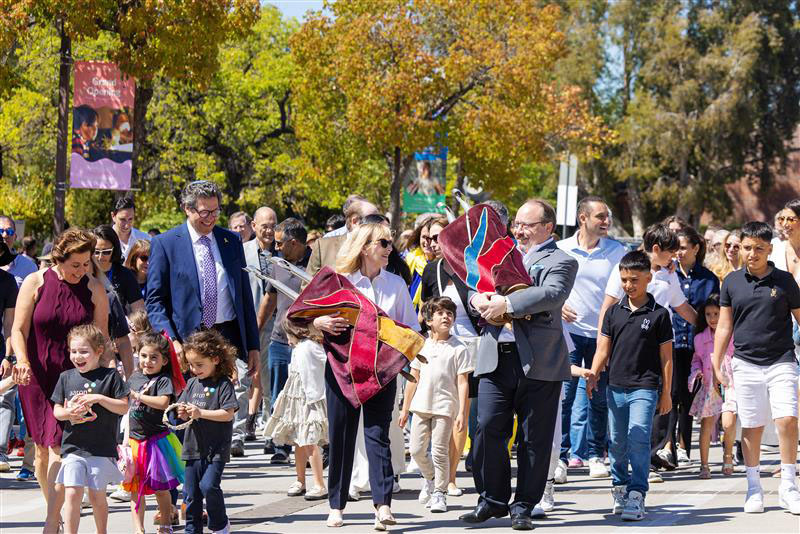
As I toured the new Aaron Milken Center for Early Child Education last Sunday, an initiative of Stephen Wise Temple under the leadership of Rabbi Yoshi Zweiback, I was hoping not to see too many digital screens. I’ve been engrossed these days in a book (“The Extinction of Experience” by Christine Rosen) that chronicles how the abuse of digital technology is undermining our very humanity. If that is true for the general population, imagine how true it must be for kids who just start out.

The new center looked promising from the welcoming remarks in the synagogue sanctuary. Major donor and visionary Lowell Milken spoke of creating “a living memorial providing benefit, tangible and lasting, for thousands of parents and children today and far into the future, one that will help contribute to Jewish continuity… in which future generations of children will develop a love of Judaism, and a love of Israel.”

There was plenty of love in the room, not least because Milken harkened back to his son Aaron, for whom the center is named. “I’ll never forget the first day of preschool for Aaron, 17 years after his oldest brother, Jeremy, when Aaron and I walked hand in hand into the same classroom and greeted Cynthia, the same teacher, nor will we forget all the memorable experiences that we enjoyed in all the years thereafter.”

Milken acknowledged that “while this occasion is one of great joy and accomplishment, it is also bittersweet for Aaron’s absence is reflected in a constant presence.” That constant presence will be reflected in the new center, which is the “sweet” in the bittersweet.

“As we now see the original vision becoming a reality, with the opening of his new campus today, it is on a sweet dimension that I’d like to dwell,” Milken said. “As the school and new facility will perpetuate Aaron’s memory, creating a living memorial, stemming from something that mattered greatly for him throughout his life.”

It was fortuitous that Milken spoke of the past, because there is at least one thing about the past that schools today would do well to bring back: real interaction in real time to counter the digital life that so many kids have grown accustomed to.

That’s why I was hoping not to see too many digital screens as I started the tour. The first thing that struck me was the marriage of the structure with nature and open skies. It helps of course to be on a major mountaintop— the views are spectacular. The space feels designed to nurture creativity and spontaneity, a sense of dreaming, a sense of possibility within safe boundaries.

I walked through the learning spaces and while the design is state-of-the-art, it’s not technology that dominates. It’s the openness and the flow. I saw lots of spaces for books, for art, for strolling through nature, for communal mingling, for prayer. And no, I wasn’t assaulted with digital screens.

Early education is so obviously crucial because it represents the foundation of a kid’s life. Just like the planting of a tree and Judaism itself, the stronger the foundation the longer it will last and the more it will thrive.

On the tour I bumped into my friend Richard Sandler, who is very involved with Milken Community School, which is located nearby and used to be associated with Stephen Wise. Even though they are now independent, I sensed a special bond between the two. Last year, the Milken school purchased the American Jewish University campus, also nearby, and Richard mentioned that it has its own exciting plans for expansion and for building a brighter Jewish future.

The fact that the Milken name is on both has created a kind of educational “ecosystem” that can serve as an innovative model for the rest of the country.

One can imagine a Jewish kid starting in the natural and stimulating spaces of the Aaron Milken Center and eventually graduating from Milken Community School with a top-notch education– an education that will, as Lowell Milken says, “help contribute to Jewish continuity… in which future generations of children will develop a love of Judaism, and a love of Israel.”

On a personal note, it seems to have worked with my daughter Mia, who graduated from Milken several years ago and is now raising a proudly Jewish family in the mystical city of Tsfat in Northern Israel. From what I hear, there are no digital screens in her kids’ pre-school.

Envisioning a Milken Ecosystem: Education for the Jewish Future Read More »

When Souls Watch Over Us: A Jewish Reflection on Eternal Connections

I sat with my Bubbie near the end of her life, holding her frail hand — the same hand that once turned scraps into Shabbos feasts. Hands that grated potatoes for kugel until they ached. Hands that made homemade dressing, baked banana chocolate cake, and her famous moon-cookies. Hands that crocheted kippot for Zayde and mended my torn clothes —  reduced to bone and fragile skin.

Her nails, always perfectly manicured in sparkling fuchsia— were chipped and fading, but still holding a trace of her vibrant spirit. 

She lay on a hospital cot set up in her living room, surrounded by walls that had witnessed decades of her life. Her Alzheimer’s had stolen so much. Bubbie and I were so close. We used to bake together, sew together, crochet together, and read Yiddish stories together. Now, she looked at me with blank, searching eyes, unsure if I was a nurse, a stranger, or a distant memory. I sat there holding her hand, already grieving the loss of her before she was even gone.

Then suddenly — as if a veil had lifted — she turned her head, and for a brief moment, a light returned to her eyes, an awareness to her soul. With all the strength and excitement that she could gather, she became animated and started speaking — but not to me.

She was talking to her father — her father who had died in the Holocaust — as if he were standing right there beside her. Her face softened, her voice filled with warmth and love, and she gently shook free of my hand to reach toward him, her frail fingers stretching out to someone I couldn’t see.

At first, I told myself it was just the Alzheimer’s — maybe confusion, maybe a trick of the mind. But there was something so real about the way she spoke — so clear, so present — as though she knew exactly what she was seeing.

Later, she turned to me and asked, “Where is my father? Where did he go?” I didn’t have the heart to tell her he had died decades earlier, during the Holocaust — it would have shattered her all over again. So I simply said, “I don’t know.”

I’ve carried that moment with me ever since. I wonder: What if she really was seeing her father? What if, as she lay between this world and the next, he came to ease her way and guide her home?

She passed just a few days later.

On the way home from my Bubbie’s funeral, as I sat quietly in the car, a thought crossed my mind — Would I ever be able to talk to Bubbie again?

But right behind that question came a rush of guilt and shame — as if even wondering about such things was somehow wrong. I could almost hear Bubbie’s voice in my head, saying in Yiddish, “Nisht for Yidden” — “That’s not for Jews.”

Still, I couldn’t shake it. I wanted to know: what happens to the soul after someone dies? And is there any ways to stay connected? Or is death really the end of that bond?

This longing set me on a path — a quest to understand if love and connection can reach beyond this world. But as I explored this mysterious and spiritual realm, I struggled with a painful question that kept gnawing at me: Is this even a Jewish thing?

This longing set me on a path — a quest to understand if love and connection can reach beyond this world. But as I explored this mysterious and spiritual realm, I struggled with a painful question that kept gnawing at me: Is this even a Jewish thing?

I grew up surrounded by Judaism. I’m the granddaughter of Holocaust survivors. My family was eclectic, active in Reform, Conservative, and Modern Orthodox communities. I attended Jewish day schools from kindergarten through 12th grade. I had celebrated countless Shabbos dinners, holidays, and family gatherings, sat through years of Torah and Talmud study — went to Jewish camps, yet never once did I hear anyone speak about what happens to the soul after death. In my modern Jewish world, no one ever talked about staying connected to those who had passed on.

Was believing in the possibility of ongoing connection with those in the next world something Judaism embraced? — or was it something we were supposed to stay far away from?

For a long time, I was afraid that even asking these questions would get me “kicked out of Judaism.” But the deeper I searched, the more I discovered that Judaism is profoundly rooted in the belief that the soul continues after death — and that our connection to those we love is never really broken.

I began to explore Jewish teachings on the afterlife, studying with Rabbi Dr. Belinda Silbert, author of “Survival Kit for the Hereafter,” and taking courses on “Life After Death through Chabad” with Rabbi Avraham Plotkin, author of “7 Conversations with Jerry” — exploring practical ways and spiritual “portals” to reconnect with loved ones in the next world.

Through these teachings, I discovered that this connection between the living and the dead is not only real but deeply embedded in our ancient, mystical, Kabbalistic, and Chassidic traditions — a beautiful part of Judaism that somehow we don’t speak about enough.

Is This a Jewish Thing? Absolutely, Yes.

Through these teachings, I discovered that this connection between the living and the dead is not only real but deeply embedded in our ancient, mystical, Kabbalistic, and Chassidic traditions — a beautiful part of Judaism that somehow we don’t speak about enough.

The Torah cautions us against Necromancy, improper ways of attempting to connect with the dead. Necromancy (Devarim 18:10–11) is strictly forbidden. As Rashi explains — and as further clarified in the Chabad Kehot Chumash — what is prohibited is propping up a corpse under one’s arm to make it speak or placing a bone of a creature called ayido’a in one’s mouth to speak for or summon the dead.

However, Judaism does not deny that the souls of the deceased remain present. In fact, as reflected in our tahara rituals and the custom of reciting Tehillim at the bedsides of those awaiting burial, our tradition acknowledges that the soul lingers near the body as it transitions from this world to the next.

The Torah is clear: we are meant to seek connection with G-d — not through forbidden practices, but through holy and permissible ways that honor and uplift the souls of the departed.

The Gemara in Berachot 18 teaches that the dead are aware of the living — which is why we don’t walk through cemeteries with exposed tzitzit, as it would mock those who can no longer perform the mitzvot.

Our tradition is filled with examples of staying connected to those who have passed. We visit the graves of tzaddikim, for example, asking for their merit to help us. Chassidim leave kvitlach — handwritten notes and prayers — at the graves of righteous souls.

Rebbe Nachman of Breslov famously promised to his followers that from heaven, “by their Peyot, I will pull them out of Gehenom” if they visit his grave in Uman, recite the Tikkun Haklali, give a few coins to charity, and commit to improving their ways. 

In fact, Breslover Chassidim even wear amulets that contain a special note, believed to have been written from heaven by Rebbe Nachman to one of his students — a tangible reminder of the ongoing relationship with him.

Rabbi Zushi Cunin of Chabad shared that the idea of connecting with the righteous at their gravesites is a deeply rooted theme in Judaism, we even know Caleb went to Hebron to pray at the tomb of the Patriarchs, the Cave of Machpelah, for the strength to resist the conspiracy of his comrades. Rabbi Zushi went on to explain that importantly, we do not pray to righteous people; we pray only to Hashem. Yet, when we pray in their presence, their soul is mostly in heaven. But there is a certain dimension of their soul that is here in this world. While the essence of their soul resides in the spiritual world, a dimension of their soul remains here. This connection is mutual: we benefit from their elevated spiritual state, and they benefit from our connection, since they no longer manifest in the physical world without us.  They have the ability to empower us through our struggles, and through this bond, we form a bridge between worlds — drawing strength and guidance from their presence.

They have the ability to empower us through our struggles, and through this bond, we form a bridge between worlds — drawing strength and guidance from their presence.

Both Zisi Cunin and Rabbi Yehoshua B. Gordon recall the same shiva in 1957, after the passing of a grandparent, when the Lubavitcher Rebbe comforted the family by saying, “Don’t worry — they’re still with you. It’s like they’re just on the second story, looking down at you — ain shtok hecher — one floor higher, but still with you.” Rabbi Gordon added that the Rebbe explained, “When someone passes away, they don’t go far — they’re just one floor up, watching over us, interceding, praying, and blessing.” 

The Zohar (Parashat Pinchas 219b) even teaches that parents who have passed attend their children’s weddings. In many Chassidic and other communities, it is customary for brides and grooms to visit the graves of their parents before the wedding to “invite” them to be present and to bless them on their special day.

So yes — believing in an ongoing connection with the souls of our loved ones is deeply rooted in Judaism.

The Zohar (Shemot 16b) even says that the souls of the dead pray for the living, continuing to advocate for us from the next world. When my Zayde passed away, my Orthadox cousin, Lizzie Rubin, said “He’s with his first family now, and he can do more in heaven than he was able to do here to advocate for us.”

Those words stayed with me. What if our loved ones really do continue to help us from above? 

This idea — that souls continue to act on our behalf — is not just sentimental; it is embedded in our deepest mystical teachings.

During the heartbreaking week when we learned of the deaths of the Bibas babies — a tragedy too painful to comprehend — Rabbi Dr. Jason Weiner shared a teaching from the Zohar on that week’s Torah portion, Parashat Mishpatim, that shook me to my core. It speaks about the souls of innocent children who die tragically:

“But the greatest grief of all emanates from those ‘oppressed ones’ that are but little sucklings, removed from their mothers’ breasts. These can cause the whole world to weep, and there are no tears like theirs, for these are tears that spring from the deepest recesses of the heart, making the whole world wonder: ‘Where is the justice of G-d? Why do the innocent die?’

The Zohar continues, it is these tears that intercede for the living and protect us. Because of their innocence, they attain a place close to G-d, one that even the greatest tzaddikim cannot reach. As it says, ‘Out of the mouths of babes and sucklings, You have founded strength’ (Psalm 8:3).”

The Zohar tells us that these pure souls advocate for us in ways we cannot see, and that G-d unites with them in a special bond of love. They are not lost. They are elevated, cherished, and powerful in ways beyond our comprehension.

As the Zohar says, “The tears of these souls protect the living.”

Rabbi Yisroel Levine of Chabad shared with me a teaching from the Talmud: when Rabbi Yochanan ben Zakkai was about to pass on, he said “prepare a seat for Chezkia the King of Judah, who has come to welcome me.” Just as I witnessed with my Bubbie — reaching out to her father as she neared death — our sages describe the righteous coming to guide souls as they leave this world.

As a chaplain — I sit with those at the edge of life and hold space for the mysteries we cannot see. I’ve sat with countless dying patients, witnessing again and again what I first saw with my Bubbie — people reaching out to loved ones in spirit, having conversations with family members who passed long ago.

Experts like David Kessler, a leading voice on death and dying, share that many people see loved ones in spirit before they pass — especially mothers. They may reach out or focus on something unseen, often dismissed as medication or dementia. But what if it’s real? Kessler says these visions often occur not only in the final moments but even weeks before death, as if the veil between worlds is already thinning.

Through my own journey — from sitting at my Bubbie’s bedside to walking with patients at the edge of life — I’ve learned to sit gently with the unknown. In those sacred moments, I have witnessed things that leave me wondering if perhaps there is a quiet gathering at every bedside — souls of loved ones and righteous souls coming to comfort and guide the way home.

There are so many beliefs held within Judaism — and I’ve come to learn that woven throughout our tradition are deep teachings that speak of an eternal connection, of life that never truly ends but simply changes form. Teachings that say the bonds of love and spirit are never broken.

As a chaplain, I don’t pretend to have all the answers. But what I can offer is a willingness to sit in that sacred space of mystery — to honor the questions, the longings, and the quiet moments when something beyond words feels present.

Perhaps if we allow ourselves to be curious — to open our hearts to the possibility that love reaches beyond this world — it might bring some comfort and peace, and possibly change the way we understand life, death, and everything in between.


Evey Rothstein is a rabbi, spiritual care provider, light worker, designer, and host of the podcast “Let Yourself Sparkle,” where she explores creative ways to light up the body, mind, heart and soul.

When Souls Watch Over Us: A Jewish Reflection on Eternal Connections Read More »

Wikipedia Editors Blacklist Heritage Foundation Following Report of Plan to Unmask Antisemitic Editors

Wikipedia editors decided to blacklist The Heritage Foundation’s website after a report came out that the conservative think tank is working on a plan to unmask various editors that the think tank believes are promulgating antisemitic content on Wikipedia.

The Forward reported in January that it had obtained documents purportedly outlining Heritage’s plan to “identify and target” the editors, which included the use of “facial recognition software and a database of hacked usernames and passwords in order to identify contributors to the online encyclopedia… The Heritage Foundation sent the pitch deck outlining the Wikipedia initiative to Jewish foundations and other prospective supporters of Project Esther, its roadmap for fighting antisemitism and anti-Zionism. ” A spokesperson for Heritage told The Forward that they couldn’t comment on the matter. Mike Howell, executive director of the think tank’s investigative arm, was in The New Yorker on March 4 that Heritage’s “investigation” of Wikipedia will be provided to “the appropriate policymakers to help inform a strategic response.”

In response to The Forward article, Wikipedia editors launched a discussion known as Request for Comment (RfC) on Jan. 8 how editors should treat the think tank’s reliability going forward. In RfCs, editors put in their “!votes” explaining their stated position on the best way to handle an issue in regards to site policy; a closer (an uninvolved Wikipedian in good standing) is often needed to render a verdict on the discussion based on the numbers and strength of the arguments presented. In this RfC, the closer, administrator “Dr vulpes,” concluded on Feb. 8 that there was consensus in favor of blacklisting the think tank; one editor explained to me that this means any links to Heritage’s website on Wikipedia will “be automatically flagged by an edit filter that will treat it like spam” and thus will be blocked from the site altogether.

“Although blacklisting is more often used to deal with spam or disruptive links it was noted that there is a possible risk to editors and the community by allowing such links to stay on the site,” Dr vulpes wrote. “As reported such links could be used to track users and editors which raised the option of blacklisting the Heritage Foundation. Several participants argued that blacklisting is the only sure way to block the direct use of heritage.org links in citations, which would prevent anyone from inadvertently clicking them. Many editors pointed out that blacklisting is not just a reliability decision but a security measure that is similar in nature to blacklisting malicious domains that track or harm our users.”

Dr vulpes also noted that myriad editors in the discussion had cited instances in which Heritage “has promoted false claims about election fraud and published unsupported scenarios about election interference. Academic sources like ‘Climate Change Counter Movement’ note Heritage Foundation’s pattern of misinterpreting evidence and promoting climate skepticism. The research cited by [another editor] shows Heritage has published disinformation about various policy matters including FDA regulations.”

The closer also noted that editors had pointed out in the discussion that blocking links to Heritage’s website would not necessarily prevent its views from discussed on Wikipedia, as any of the think tank’s views mentioned by third-party sources could be cited in articles.

“In conclusion, this discussion revolved around balancing Wikipedia’s need for reliable sources against protecting editors from a group whose published work is regarded as misleading and which appears willing to exploit links on Wikipedia to target those members of our community,” Dr vulpes added. “The pattern of misinformation, threat to our community, and the apparent ineffectiveness of lesser sanctions lead to a rough consensus that the Heritage Foundation should be blacklisted.”

One editor told me, “My understanding on decent reporting is that whatever people think is going on with Heritage pertaining to any potentially ‘wiki-illicit’ activities is mostly smoke. I do think that Heritage is interested in tackling whatis widely considered to be a serious bias and radical infiltration problem on Wiki. I do not think there was any serious intention to undertake phishing activities to expose editor identities (despite some boldly authored deck of unclear provenance appearing on the internet).” Regarding the decision to blacklist them from Wikipedia, the editor contended that “it is most definitely understandable in a manner of speaking, but shouldn’t have happened without actual evidence that Heritage was actually undertaking such activities. In the absence of actual evidence, this has only resulted in an erasure of materials by a conservative think tank, and these actions could be interpreted by many as a cover to erase non-liberal opinions from the website (which many have accused wiki of tolerating or encouraging).”

Another editor told me that the blacklist “is typically only reserved for really abusive sites” that are putting out “malware.” “So they’re not really using it for what it’s supposed to be used for,” the editor said, adding that they think editors are “basically singling out Heritage because of their public campaign and they’re being a little retaliatory and vengeful.”

The editor acknowledged that Heritage “kind of brought it on themselves” and that there probably aren’t too many instances in which Heritage is being used on Wikipedia anyway since it’s mainly considered a primary source and thus its use is “limited” on Wikipedia by nature. But, “it’s very unusual and definitely an exception to the established norms to blacklist them just because they said they wanted to doxx editors,” the editor added. “Admittedly that was a stupid thing for them to put into print… I don’t think they have a credible way to do it, but if that ever did cause anyone any harm then that would give them some liability… but it also wasn’t smart because they’re basically poking the bear.”

“It’s very unusual and definitely an exception to the established norms to blacklist them just because they said they wanted to doxx editors.” – Wikipedia editor

This editor would prefer that there be less usage of sources like Amnesty International, which is considered generally reliable on Wikipedia, first. The editor doesn’t think either Amnesty or Heritage should be used much on Wikipedia.

A different editor acknowledged that if The New Yorker “claims a specific person at Heritage basically confirmed this story (or at least some aspect of it) then yes, I guess that makes it true. Not sure if we have enough evidence to justify the blacklist but it still gives a lot of fuel to those who want to [blacklist] THF. This is something where I would love to know more about what is actually going on. My guess is this isn’t some sort of paid campaign, rather it’s like-minded people who feel they are ‘doing the right thing.’ … We certainly don’t react as negatively when sources like the SPLC [Southern Poverty Law Center] do something underhanded to ‘expose’ the other side.”

The editor further contended that they don’t like how editors are fine with citing the SPLC directly but not Heritage for things like their economic freedom index. “I think we shouldn’t directly cite either one,” the editor said. “I would only cite them when a RS [reliable source] discusses their views first. But the rules for sources we like are different than for those we don’t like.” This editor added that while the decision to blacklist Heritage won’t change “much day-to-day” on Wikipedia, it illustrates “just how biased many editors are and it will be seen as more evidence by those on the right that Wikipedia is biased while those on the left will see it as further proof that those on the right are all crazy and that Wikipedia needs to crack down on more of these dangerous right-wing sources. That’s probably bad all around.”

Wikipedia Editors Blacklist Heritage Foundation Following Report of Plan to Unmask Antisemitic Editors Read More »

Coach of #1 College Basketball Team in Nation Standing Up for Israel

Before taking a single question about the Auburn Tigers men’s basketball team’s 82–70 victory over Creighton University that advanced his team to the tournament’s Sweet Sixteen round, Head Coach Bruce Pearl began his postgame press conference to advocate for Israel.

“I believe it was God’s plan to give us this success, success beyond what we deserve, to give us this platform, to give me an opportunity to just start this press conference really briefly and remind the world that Eden Alexander is still held hostage in Gaza right now,” Pearl said. “An American held hostage. And there aren’t enough people in this country that know his name.

Wearing a set of “Bring Them Home” dog tags that hung over his orange Auburn polo shirt, Pearl said, “So I asked the players if it was okay if I started out this press conference and just called out the name of an American. Bring the hostages home.”

When a reporter asked what prompted that statement, Pearl said, “It starts with my faith. It starts with answering a question: Why? Why has God blessed Auburn and this basketball team the way He has all season long? And honestly, it’s to, I think, put us on a platform — in this case right now, myself as a Jewish-American who loves his country more than anything else in the world. My grandfather came over here at 11 years old in 1929. He became a citizen when he was 32 years old — said it was the greatest day of his life. This Jewish-American loves his country more than anything else. At the same time, over in Israel, that’s our ancestral homeland for the Jewish people, and it’s under attack. It’s under attack, it’s under siege, and all it wants to do is live in peace with its neighbors.”

Pearl continued, “And you know what? There are some Arab countries that actually want peace with Israel right now. But there’s a segment of the population that is there in the Middle East that has been doing nothing but attacking Israel for 80, 85 years. Oct. 7 was the worst day since the Holocaust for the Jewish people. And they say they want to do it again and again and again. We have Americans that are held hostage in Gaza right now. It’s unacceptable.”

Auburn entered this year’s “March Madness” NCAA tournament as a No. 1 seed and was ranked the top team in the country when the tournament began. They defeated Alabama State on March 20 in the first round, then beat the Creighton Bluejays on March 22 to advance to the next round. It marks only the sixth time in program history that Auburn has reached the Sweet Sixteen, and only the second time under Pearl. In the 80 years of the NCAA tournament, Auburn has advanced to the Elite Eight just twice and made the Final Four once — in 2019, also under Pearl.

Pearl’s advocacy for Israel in a college basketball setting has not been limited to the NCAA Tournament. On Feb. 4, immediately following a 98–70 home win over Oklahoma, Pearl walked over to a section of 120 Jewish high school students from New York, New Jersey, and Florida and led them in chanting “Am Yisrael Chai.” The students had traveled to Auburn as part of a trip organized by Athletes for Israel, a nonprofit that uses sports to combat antisemitism and create inter-community dialogue.

The chant was captured on television and circulated on social media, receiving more than one-million views on Instagram. Pearl also wore a pin displaying the Star of David, the American flag, and the Israeli flag during the game.

During the SEC Network broadcast of the Auburn-Oklahoma game, play-by-play announcer John Schriffen said, “Bruce Pearl said it’s so important for these young students to come here to campus because he loves to be able to break down stereotypes for what the Deep South is for Jewish students. He says he loves to have also non-Jewish athletes go to Israel and then have them come back as allies.”

“Bruce Pearl has been an ambassador for them,” color commentator Daymeon Fishback said during the same broadcast.

Athletes for Israel was founded by Dan Posner, a Detroit native who works in finance in New York. The organization has become known for taking both professional and college athletes to Israel. This time, they brought students to Auburn.

“We got to our kids, we played this All-Star game, all All-Star kids against the All-Star of an Auburn, Alabama public school,” Posner said. “The guys from the [Auburn] team, Chad Baker-Mazara and Tahaad Pettiford, two of the all-stars of the team, came to hang out with us and interact with our kids and just chill with us. That was a huge thrill for our kids. This is the number one team in the country.”

Pearl helped coordinate and host the visit.

“The Athletes for Israel group does so much great work in the community, and Bruce Pearl said this campus has nothing but love for everyone as he embraces diversity,” Schriffen said on the broadcast.

Students participated in a weekend of leadership sessions, basketball clinics, and informal interaction with Auburn’s student body. The weekend ended with the Auburn-Oklahoma game.

Posner said, “Because sports is something where it doesn’t matter who you’re from, the color of your skin, it’s about if you could play — it’s the automatic meritocracy. You play hard, you work hard, you fight against each other, but at the end of the game, you shake hands.”

“Sports is something where it doesn’t matter who you’re from, the color of your skin, it’s about if you could play — it’s the automatic meritocracy. You play hard, you work hard, you fight against each other, but at the end of the game, you shake hands.” – Bruce Pearl

“For every hour you’re on the court, you spend hundreds of hours preparing for it. That’s a lot of what our faith teaches us,” Posner said. “We can appreciate that at the end when you hit a home run and you score a touchdown, often, what do athletes do? They point up above, they cross themselves, they kneel, they pray. It’s showing appreciation, it’s showing gratitude. Those are values that Americans hold dearly, and I think Israelis hold dearly. When we come over to Israel and visit, we see that.”

Athletes for Israel also runs an educational initiative called the Eddie Jacobson All-Star Fellowship, named after President Harry Truman’s longtime Jewish friend and business partner. The program offers high school and college students training in Israel advocacy, media literacy, and public speaking, with the goal of preparing them to serve as effective pro-Israel ambassadors on their campuses and in their communities.

Pearl’s ties to Israel go beyond public statements. In 2022, he brought the entire Auburn men’s basketball team to Israel and the UAE for an 11-day trip. They played three games — against the Israel Under-20 National Team, the Israel All-Star Select Team, and the Israel National Team. For many players, it was their first trip outside the United States.

“I’m a Jewish American basketball coach and I’m a proud Zionist,” Pearl told The Journal at the time. “Israel loves basketball and Israeli basketball’s really good. They pay well, have a great, great following and obviously it’s a country that has a great relationship with the United States. They love us and therefore they love the athletes that go [to Israel].”

During that 2022 trip, Pearl called the Journal multiple times and could hardly contain his excitement and amazement at what the players were experiencing.

On their first night, Pearl led the team in Kiddush and Hamotzi while overlooking Jerusalem. They later visited Yad Vashem, placed notes in the Kotel, floated in the Dead Sea, and some players chose to be baptized in the Jordan River.

The team visited Bethlehem and toured the Church of the Nativity with Palestinian tour guide and basketball coach Kamal Mukarker. He hosted the entire Auburn travel group for lunch at his home.

Pearl said he and Mukarker laughed about the fact that in many ways, Arabs and Jews are more alike than Alabamians and Californians. “It didn’t matter that this Jewish-American basketball coach wanted to come to Bethlehem and shake hands with a Palestinian-Christian basketball coach and go, ‘brother, there is way more that bonds us than separates us and divides us.’”

Pearl has said that he hopes these kinds of visits will become routine. He envisions a future international tournament, which he calls the Abraham Accords Cup.

“I’m going to work on trying to get other college basketball teams to do this in the future,” he said. “This tournament is going to live and go to UAE or Morocco or Bahrain and play in that country for a couple games. And then go to Israel and have that trip be normal, like no big deal.”

Pearl has since helped coordinate and fund Israel trips for other programs, including Kansas State and the University of Arizona.

“There’s a huge interest in a lot of demand to come to Israel because Israel is such a powerful place,” Posner said.

Coach Pearl and the Auburn Tigers will face 5-seed Michigan Wolverines in the Sweet Sixteen on Friday, March 28 in Atlanta, airing nationally on CBS.

Coach of #1 College Basketball Team in Nation Standing Up for Israel Read More »