fbpx

March 21, 2025

Iris Bahr Brings Her Wildest Stories — and Darkest Jokes — to the Stage in ‘Stories From the Brink’

Iris Bahr is bringing her seventh solo show to Los Angeles this month — and she wants you to “schlep to the East Side” for an entertaining evening.

“Stories From the Brink,” which plays March 21 and 22 at The Lyric Hyperion Theatre, is a fast-paced, character-driven, 55-minute journey through Bahr’s life as a secular Israeli kid from the Bronx, a reluctant yeshiva student, an IDF soldier, a “Curb Your Enthusiasm” guest star, and now a caregiver navigating her mother’s dementia.

The show begins in Tel Aviv on Oct. 7, 2023, where Bahr was when Hamas terrorists attacked Israel. It became the moment everything changed for Bahr. As with so many Jews around the world over the last year and a half, the attacks strengthened her Jewish identity.

“I decided to kind of frame that and then put a whole show together surrounding [being in Israel on Oct. 7],” Bahr told the Journal. “Some are actual experiences, some are perceived, some are being close to death. But a big theme of the show is being Jewish as worry — as worry is love. It’s the Jewish notion of love is worry. I think that that’s a through-line that takes us through a lot of the show and my relationships.”

From there, the show unpacks chapters of Bahr’s life in a series of standalone vignettes. She shares a near-death rafting incident, childhood culture clashes, and a surreal journey through Israel’s pandemic travel bureaucracy when her mother had a stroke.

“My mom had a stroke while she was talking to me on a video chat,” Bahr said. “And the ensuing caregiving for her and all this stuff, I realized that I wanted to venture into the nonfiction kind of storytelling and long form storytelling.”

Bahr, best known through her work as Rachel Heineman on “Curb Your Enthusiasm” (including the infamous sundown ski lift episode) and Perla on “Hacks” — has a long track record of original, self-written solo shows. Her earlier works like “Die Enough” and “Dai” (Hebrew for “enough”) featured fictional characters. But “Stories From the Brink” is more personal than ever.

“I always believe that first and foremost, an honest one-person show should be entertaining,” Bahr said. “This is not a therapy session for me. It could be a therapy session for other people — but it’s not.”

But audience reactions suggest the show really taps into some powerful emotions.

“I think of live theater as the basis of a communal experience which can be very healing and therapeutic — besides just the laughter.”

“There’s not a single show where people don’t run up to me crying and hugging me needing a hug from me. They say, ‘thank you so much for doing this’ and ‘this is exactly what I’m going through and it feels so isolating.’ I think of live theater as the basis of a communal experience which can be very healing and therapeutic —besides just the laughter.”


View this post on Instagram


A post shared by Iris Bahr (@iris.bahr)

The show covers a lot in under an hour. Bahr moves through stories about being mocked in Israeli middle school for her American accent, and her shifting sense of home and identity between New York, Los Angeles, and Tel Aviv.

“I always felt like an alien, an outsider,” Bahr said. “At the yeshiva, I felt like I was living a double life. Everyone else was Orthodox. And my dad was eating bacon and dragging me to the Guggenheim on Saturdays.”

The show also confronts the exhaustion of caregiving for her mother in Israel.

“My mom is convinced that she’s currently in New Jersey, and I don’t know why,” she said. “I’m killing myself to pay for a nursing home overlooking the Mediterranean, and my mom thinks she’s in Newark.”

But humor is present in every story, even the dark ones.

“I find the humor even in the darkest situations,” Bahr said. “There’s just got to be a lot of fun adventure.”

Bahr has spent decades toggling between acting, writing, directing, and stand-up. She created and starred in the improvised series “Svetlana,” executive produced by Mark Cuban, and has performed in dozens of TV shows including “Elementary” and “The Brink.” She’s also the author of “Dork Whore,” “Machu My Picchu,” and co-wrote “The Book of Leon” with “Curb Your Enthusiasm’s” JB Smoove.

Offstage, Bahr has been vocal about Jewish identity, especially in the wake of rising antisemitism. She recently organized the first-ever Jewish Heritage Day at her son’s public school and makes a point to wear her Magen David in public.

“I like wearing my Magen David and I wear it even when I’m on the train,” Bahr said.

Bahr hopes Los Angeles audiences join her for a fun evening of live theater — and is specifically calling for people on the west side to go on a slight road trip this weekend.

“I know that sometimes people don’t like to schlep or everything feels like a schlep to schlep out to the east side,” she said.

“Stories from the Brink” is a sharp and deeply-relatable 55-minute respite from the stressors of the week. Bahr puts on the kind of show that makes trek across town absolutely worth your time.

“Stories From the Brink” will be performed March 21 and 22 at The Lyric Hyperion Theatre in Los Angeles. For tickets visit https://www.eventbrite.com/e/stories-from-the-brink-jan-dates-rescheduled-to-march-tickets-1042498570287?aff=oddtdtcreator

For more information on Bahr, visit www.irisbahr.com or follow @iris.bahr on Instagram.

Iris Bahr Brings Her Wildest Stories — and Darkest Jokes — to the Stage in ‘Stories From the Brink’ Read More »

Life After Loss

Six deaths. In the course of a year and a half, four thirty-something members of my synagogue had passed away from cancer, after a painful and slow decline.  At the same time, a nine-year-old child suddenly died from an aneurysm, and a twenty-seven-year-old newly married man died from unforeseen complications in surgery. The families were in agony. No words could describe the loss they had experienced.

I officiated at these funerals. At the time, I had been a synagogue Rabbi for about ten years. On the outside I was all professional; but inside, I was lost. Even though I was not a family member, my soul was shaken just from observing their parents’ grief. Horrible things had just happened to good people who were good friends. According to professional protocol, a rabbi should set boundaries and keep an emotional distance from his congregants; but who can actually do that?

I was hurting. Tragedies shake you up theologically, and you wonder how God could allow such suffering. But the existential impact is greater. The expected order of the universe had been turned upside down; the young were dying before their parents.

Tragedy lurks in the shadows and mocks our pretensions. In the back of our minds, we are aware of this reality; but we try desperately to repress it. We tell others about the importance of “closure” as if it can magically make things better. We try to “move on” quickly. But there are times when all of these superficial palliatives fail, and we are reminded, just as I was that year, that life is vulnerable and death is everywhere.

At that moment, the question arises: What does life after loss look like?

Parshat Parah is one of four special Torah readings that are read in the Hebrew months of Adar and Nissan. It describes the purification process for someone who comes into contact with a dead body; and this was a necessary prerequisite for anyone who wanted to bring the Passover sacrifice in the Temple.

Purification occurs after a complex ritual. A Parah Adumah, a red heifer, is sacrificed outside of the camp. Its carcass is burnt, and the ashes are mixed with water; the mixture is then sprinkled on the impure person on the third and seventh days. They then immerse in the Mikvah, and after nightfall, are considered pure.

In the Talmud and Midrash, the Parah Adumah is seen as the paradigmatic chok, a law without a clear reason. The Parah Adumah is specifically sacrificed outside of the sanctuary, while all other sacrifices must be done inside the sanctuary. Paradoxically, this sacrifice which purifies the impure renders all those involved in preparing the sacrifice and ashes impure. The Parah Adumah ritual is complicated and strange.

Actually, the mystery of the Parah Adumah is its very message. In the face of death, life becomes a bitter riddle. The Parah Adumah ritual reflects this; it acknowledges that life after loss is a struggle. Sometimes there are convoluted twists and turns before you can start over again. And even when purification is done, the residue of death remains, rendering others impure.

The road forward from tragedy is confounding. And it is precisely here that the mystery of renewal meets the mystery of faith.

Rabbi Joseph B. Soloveitchik speaks about the difference between two different modes of purification: tevillah, immersion in a mikveh, and haza’ah, sprinkling water. After coming into contact with a dead body, immersion in a mikveh is not enough. Mortality is a trauma too large for one to grapple with alone; they must look to others for help. And that help, Soloveitchik explains, comes from God:  “The real cleanser of the morbid state induced by threatening death is God Himself. We have faith that He compassionately cares about us and that we will not be abandoned.”

It is a profound act of faith to meet death and continue to believe passionately in life. And that faith is truly otherworldly.

Part of this faith is to believe that your own existence is deeply meaningful, both in life and in death. Rabbi Samson Raphael Hirsch sees the Parah Adumah as a reminder that we are more than physical beings. He explains that one might mistakenly believe that:

… The human corpse demonstrates the power of death for all to see, and the superficial observer perceives in the corpse the power of nature dominating everything, including man. If the whole man has succumbed to death; if the corpse lying before us, overwhelmed by the compelling forces of nature represents all there is to man, then man, even during his own lifetime, is no different than every other living being….

Hirsch explains that the entire Parah Adumah ritual signifies that this is not so. The young, unbroken heifer filled with the red glow of life represents our physical existence; yet even after our physical being is reduced to ashes, the soul can still connect to the fountain of life, and be brought into the sanctuary before God. He explains, “man is an amalgam of the heavenly and the earthly, the godly and the animal, the eternal and the transitory.” Death cannot extinguish what is eternal.

Humans have moral freedom, and leave behind a spiritual legacy. Our souls will live on. And so do the souls of those we love, those who are gone but never forgotten. Once we recognize this, the difficult task of living life in a tragic world becomes much more bearable.

Parshat Parah continues to be read, even though there is no Parah Adumah and no Passover sacrifice. Rabbi Yechiel Michael Epstein notes that some authorities consider the obligation to read this section to be a biblical obligation. He wonders why this should be so; Parshat Parah is a passage that no longer serves any practical purpose.

Yet we continue to read Parshat Parah today because it carries a timeless message: One can live on after profound loss. Renewal is always possible. One can laugh and love again.

And this is the story of the Jewish people. No matter what has happened, we have never stopped believing in life.

Years ago, I saw a museum display that contained an ordinary-looking Chuppah. It was blue and white with gold fringes, with the Hebrew word Zion in the center of a large Magen David, surrounded by the words of the wedding blessing: kol sasson vkol simhah, kol hatan vkol kallah, “the sound of joy and gladness; the voice of bridegroom and bride.”

But this was no ordinary Chuppah at all.

It was one of about 80 chuppot, manufactured in Mandatory Palestine, that were distributed by the Joint Distribution Committee in Displaced Persons Camps in Europe. The people who got married under those chuppot were young Holocaust survivors ready to begin a new life.

It seems impossible that these survivors could find faith in life again; and much like the Parah Adumah, how they were able to do this is a mystery. But thanks to people like them, families, communities, and the Jewish people have survived and thrived.

Keeping our faith in life, even after a profound loss, has made all of the difference.


Rabbi Chaim Steinmetz is the Senior Rabbi of Congregation Kehilath Jeshurun in New York.

Life After Loss Read More »

Hearing the Silent Aleph – Torah portion Vayakhel


Hearing the Silent Aleph –  

Vayakhel  

©️Rabbi Mordecai Finley, 2025


This week’s Torah portion, Va-yakhel, is the first of two Torah portions concerned with the building of the Mishkan. In next week’s portion, Pekudei, we find the actual dedication of the Mishkan. I would like to focus in these few words on what happened just before the people got to work on building the Miskhan.


We’ll start with selection from the a midrash on the giving of the 10 Commandments in Exodus chapter 20, a well-known rabbinic commentary on that foundational event in the Jewish religion. Think of this commentary as a poem. Here is my paraphrasing and commentary on the poem.


When God began to speak the 10 Commandments, the people said “This is too much to bear. Just speak the first commandment, and let Moses tell us the rest.”


If God would speak to you right now, say a few things that you must know and must do, and a few things you must never do, do you know in your heart of hearts what God would say? Could you bear it? We might say, “Whatever You need to say to me, God, please just keep it brief.”


The Midrash continues,


God began to speak the first commandment, “I am Adonai your God, Who took you out of the land of Egypt, out of the house of bondage.” The people said, “This is too much to bear. Just speak the first word of the first commandment, and let Moses tell us the rest.”


Even that first commandment was too much. Not the content of the commandment, perhaps, but the fact that the heart of the universe peered into your heart and had something to say.


God relents, and will speak only the first word:


God began to say just the first word of the 10 Commandments, “Anokhi,” “I.” The people said, “This is too much to bear. Just say the first letter.”


God’s saying “I” implied a “You.” The people weren’t ready for an “I and You” moment with God.


God agrees only to speak the first letter. The first letter of the first word of the 10 Commandments, “Anokhi,” is the silent “aleph” – not “ahh” – just nothing. Aleph is a placeholder for a vowel. We assume that God articulated the silent aleph. The story ends here.


What happened? God communicated to the people the silence before speech, the meaning before words. According to the story, Moses hears the rest, and then God writes the words on stone tablets. Moses is to deliver this petrified (as in “turned to stone”) speech to the people.


Last week’s Torah portion, Ki Tisa, tells us how that went. Not well. The day that Moses arrived, the people broke bad. Just before Moses got down the mountain, they had Aaron form the Molten Calf. According to Exodus 32, they danced and frenzied and worshipped that Molten Calf.


I don’t think that the main motivation of the people was to worship the Molten Calf. I think their main motivation was to hide from God, to use the Molten Calf as a mask. They couldn’t bear being spoken to by God. The people needed to do something, anything, to get that silent aleph out of their heads. That silent aleph was driving them crazy.


The story in Exodus 32 tells us that Moses, upon seeing the people worshipping the Molten Calf, smashed the petrified commandments, thinking the people didn’t deserve them, that they had committed apostasy. God backed Moses up. I think Moses and God, as presented in this story, were too angry to understand what was really going on.


The people were terrified. They weren’t guilty of apostasy, in my mind; they were guilty of avoidance, in the extreme. They wanted to do anything but face what was happening inside of them. Worshipping the Molten Calf was a way to regress to rigid thinking. We all do that. When we can’t bear the truth of a moment, we have to shut down our thoughts. If we were attentive to the truth of the moment, we might have to change our lives.


I don’t think the people were against the 10 Commandments. According to this midrash, the people didn’t know what the commandments were. Moses hadn’t told them yet. I don’t think the people in this story thought very much about what the commandments contained. They just weren’t thinking.


I think they just couldn’t stand the silent aleph. That silent aleph spoke eternity. Everything that could be known and cannot be known. All being and all non-being. God’s being, communicated in the Un-sound, the No-thing.


Perhaps they thought, in retrospect, they should have just listened to what God wanted to say, and then tuned it out. Listening to the silent Aleph was far more difficult than they could have imagined.


Here is a thought experiment. Think of someone that you love. Imagine sitting across from them, looking at each other’s eyes. Blink and breathe, that’s it. No speech. Just the presence and the eyes. In this thought experiment, do it for a few minutes straight. Try imagining it.


Eventually, you will see each other’s souls. You will blink your way into theirs, into knowing the God that fills their souls, the eternity-filled silence of God. Now imagine you and this other person are being ordered to this, but you have this one way out. If it becomes too uncomfortable, you can just go into the next room where a party is happening. Drinking, dancing. A calf-shaped piñata.


God wanted us to look into God’s eyes and God’s heart. “Don’t follow your own eyes and hearts after which you go astray,” God would later say to the people.


“Just for a few minutes, set your eyes and hearts upon me.” The people chose the party option.


Last week’s Torah portion ends, in Exodus chapter 34, with an anything but clear reconciliation.  Here is the essence. The commandments were engraved on new tablets. Moses brought them down the mountain. The people accepted the commandments, all the words. Moses explained everything.

.

Why could they listen this time? The way the ancient rabbis tell it, the people changed because they decided to. They sat quietly the whole day, waiting for Moses to come down the mountain. No drinking, no eating, no dancing, no Molten Calf. The ancient rabbis say that in order to be present to the Presence when Moses came down the second time, the people created, of their own accord, a deep Sabbath, a Shabbat Shabbaton. The ancient rabbis say that in deciding to stay quiet, and do nothing but stay quiet, the people spontaneously invented Yom Kippur. Our observance of Yom Kippur is, at its core, a reenactment of our receiving the second Tablets. A quiet we imposed on ourselves so that we could listen.


In my telling, they decided to place their eyes upon God, eyes meaning the perceptive apparatus comprising their hearts, souls and might, for a full few minutes, a few minutes that opened a gate into eternity.


They breathed in the silent aleph of this Sabbath for the soul. After the Sabbath of receiving the second Tablets, they got busy building the Mishkan, the focus of this and next week’s Torah portions.


All you could hear was the work. The people didn’t talk much that day.

Hearing the Silent Aleph – Torah portion Vayakhel Read More »

Book Review: ‘The Jews: 5,000 Years and Counting’

Comedy writer Rob Kutner’s latest book, “The Jews: 5000 Years and Counting,” is a hilarious and informative Judaism lesson wrapped in a comedy special — equal parts Monty Python’s ‘Life of Brian’ and “The Daily Show.” This is the kind of bar/bat mitzvah gift that stays on the bookshelf far into adulthood.

Best known for his writing on “The Daily Show” and “Conan,” Kutner doesn’t just tell Jewish history — he roasts it, celebrates it as it flies through five millenniums of punchlines.

The book, published by Wicked Son Press, is well-researched and presents Jewish history in a satirical and engaging way. A book like this can easily take a detached or nihilistic route. Kutner does neither, the book remains warm until the end. The chapters can really be read in any order. Start with the chapter where King David gets a ‘Rock Star Documentary,’ or the chapter where King Solomon becomes a wise guy stand-up comic.

The book delivers laughs the way the best “Late Night with Conan O’Brien” sketches back in the 1990s and early 2000s— big, absurd and goofy. Kutner’s writing feels like the surreal bits seen on that show packaged in Jewish history, where biblical figures become these oversized, ridiculous characters, yet somehow still remains informative.

“I wanted to go big with these figures, the way Conan would,” Kutner said. He reimagines the great rabbis of Jewish history as action figures, each with their own special power. His son was into Pokémon at the time, so why not ordain those characters and give them a yad?

“These incredibly cerebral, quiet guys sitting in dark rooms scratching away on scrolls — what if they were ninja warriors?” Kutner wondered as he wrote.

In a chapter titled, “World Repair Service,” the book dives into how Jewish immigrants to the U.S. in the 20thcentury were advocates of workers’ rights, civil rights and women’s rights. It sounds encyclopedic, but the facts are qualified with hilariously-written truth bombs.

“Jews know what it’s like to be exploited workers (read: unpaid under the hot Egyptian sun). And we invented the Day of Rest. We’ve been trying to share both of those ideas for centuries. No matter how many times we get labeled ‘Commie Pigs.’”

“Jews know what it’s like to be exploited workers (read: unpaid under the hot Egyptian sun). And we invented the Day of Rest. We’ve been trying to share both of those ideas for centuries. No matter how many times we get labeled ‘Commie Pigs.’”

In the same chapter, Kutner writes, “Israel was a nation built to welcome, heal, and rehabilitate people fleeing terrible things from all over the world. Once it got on its feet, the Jewish state started offering these services to non-Jews everywhere. Starting in the 1970s, Israel began granting safe haven to refugees in distress from all around the globe. In the 1980s, they stepped this up by flying in crews to help nations struck by natural disasters and terrorist attacks. In 1995, Israel created a permanent government agency for this purpose.”

While “The Jews: 5000 Years and Counting” is a silly satire, it is also backed by real research. Kutner fact-checked rigorously, consulting scholars, clergy, and Jewish history experts to ensure the book stayed air-tight on Torah references, historical accuracy, and religious lore.

“You have to keep the integrity of the thing you’re making fun of,” Kutner said. “Otherwise, it’s just a dumb joke.”

For historical grounding, he worked with historian Paul Lerner of USC and Jewish history expert Jarrod Tanny, among many others in the acknowledgements.

“I was trying to find the Venn diagram of Jewish historians with a sense of humor and a sense of perspective,” Kutner told The Journal. “There’s plenty of funny Jews, and there are plenty of historians, but historians tend to be very serious or have a lot of gravitas. I needed people who could handle both.”

He also wanted input from those who study Torah and Jewish law seriously.

“A lot of the Torah references, I ran by people who are either rabbis or well-versed in Jewish texts, just to make sure I wasn’t misrepresenting something,” Kutner said. “It’s funny, because people think a book like this just kind of flows out, but you’d be surprised how many drafts and double-checks go into even the silliest jokes.”

There’s a Jewish pirate during a section on the 15th century Spanish Inquisition. There’s even a debate between the founders of, Orthodox, Conservative, Reform and Reconstructionist Judaism. Kutner writes, “May the best movement win! Or — to manage expectations within Jewish history — survive.

“I didn’t want to make it feel like a classroom lecture,” Kutner said. “I wanted it to feel like you’re watching something unfold in a way that’s fun but still teaches you something.” Kutner also believes the book is valuable for non-Jewish audiences.

“There are a lot of people who are just allies or curious about Judaism,” Kutner said. “This is a way to bring them up to speed without making them dive into a 900-page tome. There are really dumb and toxic conversations happening right now around Judaism and Jewish history, and I’d like to think this book could help disarm some of them.”

“The Jews” shows how through 5,000 years, humor is one of the reasons the Jewish people have persisted.

“One of the responses I’ve been getting is, ‘How can you laugh at a time like this?’” Kutner said about early reviews of the book. “And my response is, ‘Because I’m Jewish. That’s the only choice I have.’”

“The Jews: 5,000 Years and Counting” is available anywhere books are sold.

Book Review: ‘The Jews: 5,000 Years and Counting’ Read More »

“Here There Are Blueberries” Brings a Nazi’s Photo Album to the Stage

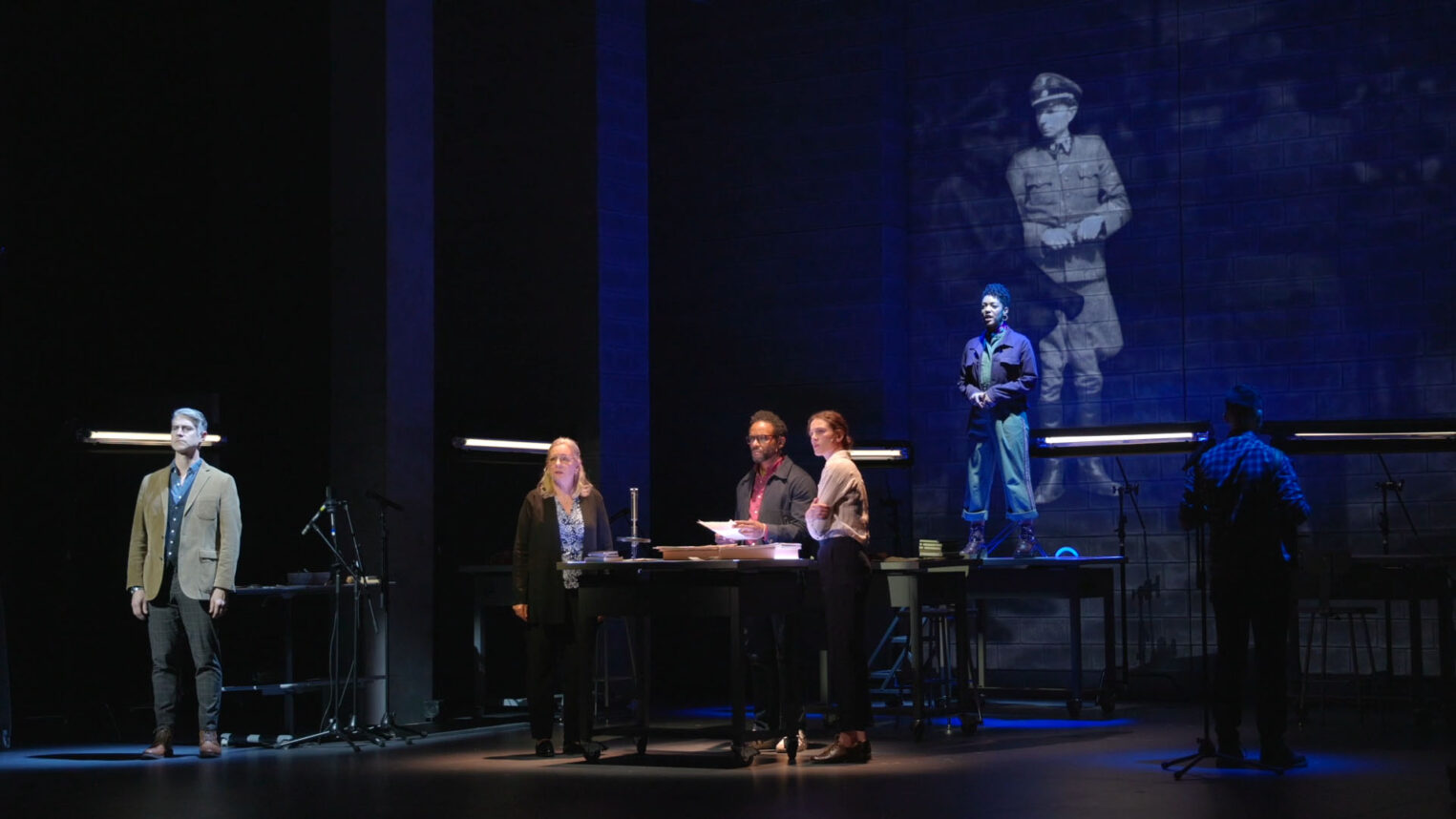
An anonymous American World War II veteran contacted the United States Holocaust Memorial Museum (USHMM) in December 2006 about an album containing photographs of SS officers at Auschwitz. They weren’t snapshots of the Nazis committing atrocities, but eating blueberries, playing music, and enjoying their days off. There was a disturbing ordinariness to them — they weren’t monsters. The scenes between committing murder looked mundane. That is the basis of “Here There Are Blueberries,” a new play by Moisés Kaufman and Amanda Gronich, on stage at the Wallis in Beverly Hills until March 30.

The album was found in an abandoned Frankfurt apartment in 1946 by a U.S. Army officer serving in the Counter Intelligence Corps. He kept it for decades before donating it anonymously to the United States Holocaust Memorial Museum in January 2007. The photo album became news in September 2007 when The New York Timesreported on it in an article titled, “In the Shadow of Horror, SS Guardians Frolic.” The album is believed to have been made by Karl Höcker, an SS officer at Auschwitz, It had 116 photographs showing Nazis seemingly taking a break. USHMM says the photos were taken between May 1944 and January 1945 — “the period during which the gas chambers were operating at maximum efficiency.”

The images are a jarring look at how those responsible for the Holocaust viewed themselves — not as killers, but as ordinary people enjoying their free time. Excerpts can be viewed on the USHMM website.

“The [Nazi] owner of the album had put this thing together as a scrapbook of his time there,” Gronich told the Journal. “So we’re literally looking through the eyes of the perpetrators. It’s their version of the story. It’s how they perceived what Auschwitz was. Through these pictures, we see not only a glimpse of how the perpetrators viewed their day-to-day lives there, but also how they envision what the world might look like if they were the victors.”

“The [Nazi] owner of the album had put this thing together as a scrapbook of his time there. … So we’re literally looking through the eyes of the perpetrators. It’s their version of the story. It’s how they perceived what Auschwitz was.” – Amanda Gronich

Kaufman’s Tectonic Theater Project began developing “Here There Are Blueberries” through workshops in 2016, with Gronich co-writing.

“I thought at first, this is impossible,” Gronich said. “We can’t make a play about an album of photographs. And even if we could make a play about an album of photographs, we can’t make a play about that album of photographs. But again, I had never worked on anything about World War II, and I had this personal connection. So I sort of took a deep breath and I said, well, if we can figure this out, it would really be such an extraordinary journey for an audience.”

The play premiered in 2022 in San Diego. Its 2024 run at New York Theatre Workshop was the highest-grossing production in the theatre’s history. It was also a finalist for the 2024 Pulitzer Prize for Drama. The story follows the museum archivists who first examined the album and the historical detective work that followed after it made international headlines.

The Company of “Here There Are Blueberries”

“A businessman in Hessen, Germany recognized a family member,” Gronich said. “And so he embarks on this journey working with the museum to track down people who have relatives in the photographs. And what does that mean? … When we interviewed these descendants of people in the photographs, I (was) so intrigued. They don’t have the luxury of distance. They are descendants of Nazis. And how are they grappling with this continuum of complacency, complicity, and culpability? For them, looking at these pictures, when we interviewed them, it wasn’t, ‘Oh, what does this picture say to you?’ It was, ‘Oh, and that’s your father and that’s your grandfather.’ In some ways, these pictures in the Höcker album are family photos for them so that they’re grappling with history in a very immediate way… again, where is the luxury of distance? And if you don’t have that, you really are forced to reckon with your own family and your own role in history. And that’s really something that I think we all need to do. All of us need to be reckoning with history in a very personal and immediate way.”

The play blends live actors with projected images from the album.

“The actors interact with the images almost as though they were scene partners,” Gronich said. “It’s really a detective story.”

What makes “Here There Are Blueberries” so unsettling is that it refuses to treat Nazis as monsters. Monsters are easy to dismiss. But these men and women were human. They ate blueberries, played music, and laughed — then returned to their roles in mass murder. That contradiction is what makes the play so haunting.

“To prevent this from happening again, we need to understand how it happened,” Gronich said. “We are not exonerating, we are not apologizing for, we are not explaining it away. We are simply saying, human beings did this. And for us to examine how human beings do this, it helps us to understand the recipe. If we can understand the recipe for the making of a Nazi, we hopefully can make sure we never make that recipe again.”

The play draws from the field of “perpetrator studies,” which examines the mindset and behaviors of those who commit atrocities. “Perpetrator studies is sort of a new — I mean, not new, but it is being investigated more fully now, in the moment in history that we find ourselves,” Gronich said. “And we have to be willing to look at how ordinary people were capable of doing this.”

Gronich, whose past work includes “The Laramie Project,” describes audience reactions as unlike anything she has seen before.

“In all my years in theater, I have never seen audiences so wrapped,” Gronich said. “You can hear a pin drop.”

The Los Angeles debut of “Here There Are Blueberries” runs through March 30 at the Wallis Annenberg Center for the Performing Arts in Beverly Hills. Tickets are available at TheWallis.org

“Here There Are Blueberries” Brings a Nazi’s Photo Album to the Stage Read More »

What We Lose When We Lose the Humanities

In the U.S., the proportion of undergraduate students studying the humanities dropped approximately 30% between 2005 and 2025. According to Statistics Canada, student enrollment in the humanities in Canada has been declining precipitously since 2008. Humanities enrollments in universities have dropped by 50% over the past 30 years.

The humanities—history, languages, literature, fine arts, philosophy and music—complement the STEM world in which we live. If science, technology, engineering and mathematics dominate the world of the practical and the physical, the humanities remind us of the immaterial, the spiritual, the imagination and the aesthetic. To ignore the humanities is to neglect the world within each and every one of us.

History gives us background knowledge of how we got to where we are, context for current events and perspective on behavior through time. Fine arts and music develop appreciation of the aesthetic, the world beyond words. Philosophy shapes our vision of ourselves and our world. Languages open vistas on other cultures and illuminate the unexplored corners of the world. The stories of literature reveal not what happened but how life was experienced and what it felt like to live in the time of Shakespeare and Charles Dickens and Mark Twain.

The idea that the humanities have no “use” in the workforce has been debunked by experts in business and industry. An article in the New York Times by Aneesh Raman, a workplace expert at LinkedIn, and Maria Flynn of Jobs for the Future, asserts that “there will be new categories of jobs that emerge as a result of AI’s capabilities … and that those jobs will be anchored increasingly around people skills.” Their conclusion “comes down to whether we believe in the potential of humans with as much conviction as we believe in the potential of A.I.”

Daryn Lehoux of Queen’s University writes that “the point is to prepare students to tackle the complex, unpredictable and novel situations [they] will encounter in the world after graduation.” He adds that the humanities stress “the close examination, careful analysis, creative reconfiguring and constructive debating of challenging questions that have no easy right or wrong answers,” which he calls “critical job skills.”

So much for the idea that the humanities are a frill, useless in the marketplace, a luxury in a “real world” of business, science and technology. In an increasingly mechanistic world of algorithms and robot workers, human skills, fueled by the study of the humanities, will still be indispensable.

In an increasingly mechanistic world of algorithms and robot workers, human skills, fueled by the study of the humanities, will still be indispensable.

The humanities are the bulwark against the dehumanizing of our world and ourselves. They are the opposite of programmed machines and algorithmic conditioning. They embody the creative spirit and human imagination. The sculptor, the writer, the composer, the artist have a vision of life and shape that vision and share it in art, architecture, novels, poetry and music. The humanities are part of a meaningful life. They are the soul in the body of life. The humanities denounce, protest, inspire and illuminate—the very soul of the human enterprise.

Given the current situation on university campuses, it is hard to make the case for universities, whether in the humanities or STEM subjects. Woke culture, in which western democracies and Israel are portrayed as colonial oppressors, is a virus attacking the simple-minded. It is political correctness on steroids. Every subject is politicized and taught through the lens of western civilization, which is portrayed as corrupt. It will eventually fall into disrepute and go the way of all shallow fads that are crushed under the weight of their own obtuse bias.

Bret Stephens in The New York Times reminds us that universities “were not meant to be a collection of antagonistic interest groups presided over by a vast administration” or “a battle ground for political conflicts imported from beyond the campus gate.” We should not “forsake knowledge-seeking for advocacy.”

Students should focus on attending universities that have not been infected by the virus of politics masquerading as traditional courses, as well as universities in Israel where courses are taught in English, and they should include humanities courses in their programs.

In the meantime, the rest of us can attend concerts, read books, visit art galleries and museums and experience the glory of the civilization that has been bequeathed to us. Their value has proven itself over the centuries and continues to inspire and elevate us. Now, more than ever, when our culture is prey to the superficial and the automated, we need the human in the humanities.


Dr. Paul Socken is Distinguished Professor Emeritus and founder of the Jewish Studies program at the University of Waterloo.


What We Lose When We Lose the Humanities Read More »

Beit T’Shuvah Runs in LA Marathon, Helstein Honored, NCJW/LA Service Center, Repair the World

Last Sunday morning, 37 members of Beit T’Shuvah’s Gilberg Family “Running4Recovery” Team participated in the Los Angeles Marathon, completing both the full and half marathon alongside more than 25,000 other runners. 

The team, made up of residents, alumni and community members, trained for five months leading up to the race as part of Beit T’Shuvah’s commitment to recovery through its Mind and Body Program.

Running 4 Recovery is a 16-year-old tradition at Beit T’Shuvah, a residential addiction treatment center and Jewish spiritual community.  The program uses marathon training as a tool for personal growth and accountability. Participants are in recovery and most have never attempted long-distance running before joining the team. Through structured training, they build physical endurance and mental resilience, reinforcing the principles of recovery in a tangible way.

As of press time, the team had raised more than $76,000 to support Beit T’Shuvah’s mission of providing treatment to those struggling with addiction. The funds go directly toward programs that help individuals rebuild their lives and provide scholarships to those who cannot afford treatment on their own.

The fundraising continues through May 1.


Councilmember Katy Yaroslavsky, Hilary Helstein, and Councilmember Bob Blumenfield honor Hilary Helstein’s work as a filmmaker and Los Angeles Jewish Film Festival director. Courtesy of L.A. Jewish Film Festival

The City of Los Angeles and the Los Angeles City Council honored Hilary Helstein, who is the director and co-founder of the Los Angeles Jewish Film Festival and an award-winning filmmaker, with an award of distinction. The citation recognizes her powerful film, “As Seen Through These Eyes,” screened earlier this year, as well as her unwavering passion and commitment to Holocaust remembrance and to preserving history through film. 

The honor, given on March 7, also acknowledges her outstanding contributions to the city’s cultural excellence through the Los Angeles Jewish Film Festival and the profound impact it has on the greater Los Angeles community.


From left: State Sen. Maria Elena Durazo, Jewish SGPV Executive Director Jason Moss, U.S. Rep. Judy Chu, and NCJW/LA CEO Marjorie Gilberg are joined by several community partners at NCJW/LA’s new relief center. Courtesy of National Council of Jewish Women/Los Angeles

National Council of Jewish Women/Los Angeles and the Council Shop recently opened a distribution relief center, serving those impacted by the recent wildfires. The center launched March 8, coinciding with International Women’s Day. The facility, the NCJW/LA and The Council Shop Distribution Relief Center, are located in Highland Park.

The day before its official opening, a preview tour drew community leaders, elected officials and members of the media. Among those in attendance were U.S. Rep. Judy Chu (D-Pasadena); California State Sen. Maria Elena Durazo (D-Echo Park); Anthony Cespedes, a senior advisor for LA County Supervisor Hilda Solis; and Jason Moss, executive director of the Jewish Federation of the Greater San Gabriel and Pomona Valleys.

Organizations represented at the event included Mama 2 Mama, a nonprofit serving expecting mothers; Alliance for a Better Community, an advocacy group serving Los Angeles’ Latino community; and the Boys and Girls Clubs of Pasadena.

The 20,300-square-foot center is a dedicated space designed to help provide aid to thousands of community members impacted and displaced by the recent Los Angeles wildfires. Shoppable items include new and gently used clothing, household goods, diapers and toys, as well as new toiletry items.

It will be open to eligible individuals and families through April 7, on Saturdays and Sundays from 9 a.m.-4 p.m. and Mondays from noon-7 p.m.

In the aftermath of the fires, NCJW/LA has provided more than $230,000 in fire relief vouchers to impacted families.  The organization is seeking volunteers to support daily operations at the recently opened relief center. Those interested can contact volunteer@ncjwla.org for more information.


Repair the World’s wildfire response ambassadors. Courtesy of Repair the World

Repair the World Los Angeles has activated a Jewish service response, gathering volunteers to serve the city through volunteerism, following the wildfire devastation that struck Los Angeles in January. 

Through Repair’s Wildfire Response Service Corps, Ambassador program and episodic events, eager volunteers are working alongside local service partners in urgent efforts to rebuild and restore, the organization’s leadership said.

Case in point: last month at a Habitat Restoration Day, led by Friends of the LA River (FOLAR) in partnership with Repair the World at the Sepulveda Basin, a Repair the World service corp member, Orli Friedman, brought her group of friends to join hundreds of volunteers removing an invasive species threatening the native environment and creating future wildfire hazards.

“When we feel connected, we naturally feel motivated to serve,” Friedman said. “The ambassador program offers me the opportunity to organize community events and work with service partners, supporting initiatives that are meaningful to me. It’s an honor to bring my community together in service of our local world.”

To learn more about Repair the World’s wildfire response and volunteer opportunities, visit https://rpr.world/LAWildfireResponse.

Beit T’Shuvah Runs in LA Marathon, Helstein Honored, NCJW/LA Service Center, Repair the World Read More »