The Jewish Faculty Resilience Group (JFrg) at UCLA held an event at Stephen Wise Temple on Sept. 15 explaining how they are preparing for the beginning of the academic year.
The event was titled “Back to School Amid the Israel-Hamas War” and around 200-300 people attended. Kira Stein, founder and chair of the JFrg at UCLA, explained that the group was formed in Nov. 2023 to “create a support network for Jewish faculty and staff at UCLA” and figure out how to combat antisemitism campus head-on. The JFrg at UCLA now has 300 members.
“The rise of anti-Jewish encampments on campuses didn’t just happen overnight,” Stein said, attributing it to “university leaders tolerating antisemitic indoctrination” and the “teaching [of] false libelous narratives about Israel Israelis and American Jews who simply support Israel’s existence.” Stein said that there needs to be “more than just a playbook and a plan” to combat antisemitism and that the JFrg has developed a rapid response team to counter campus antisemitism; it hopes to expand this initiative across the greater Los Angeles area.
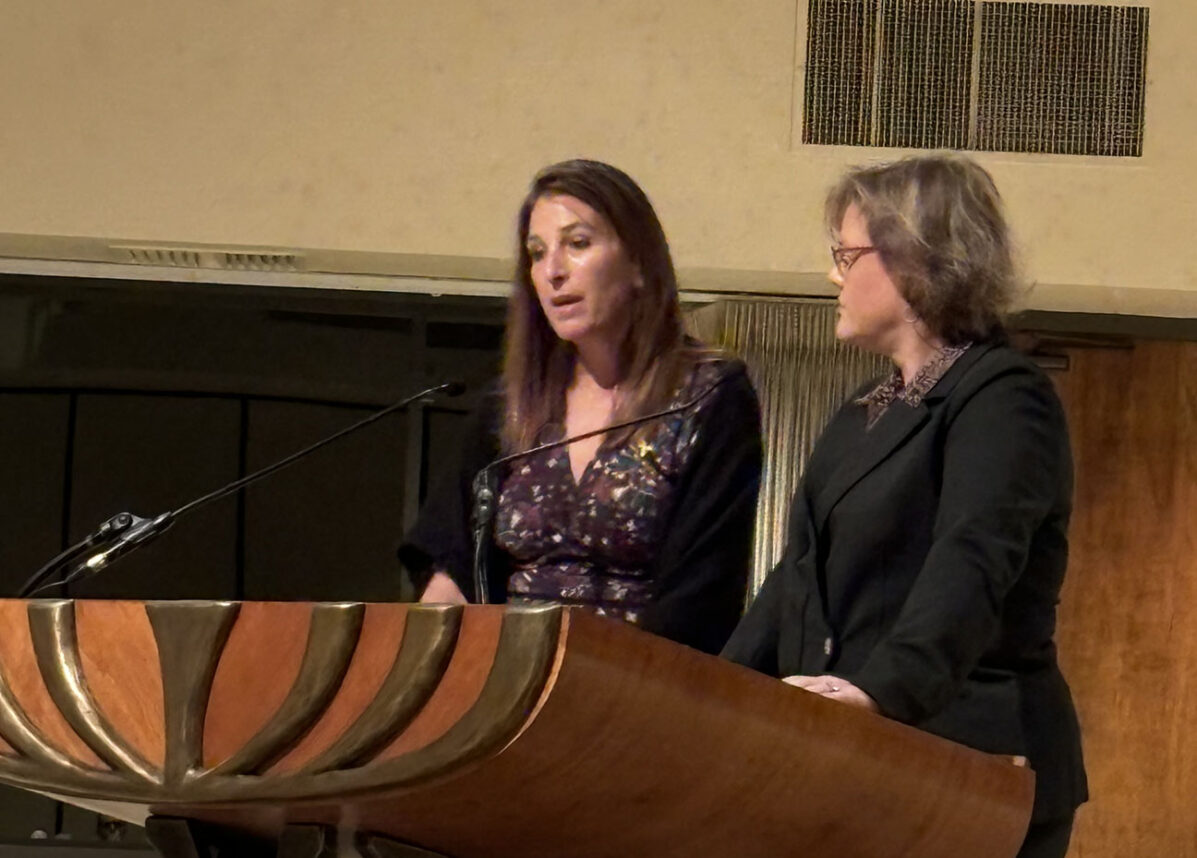
Melissa Simon (left) and Kira Stein (Photo by Aaron Bandler)
Molly Fox, an associate professor of anthropology at UCLA, said that the anti-Israel movement “took over my department and UCLA more generally” and she felt “isolated and scared,” but that changed when she met JFrg; Fox is now the co-chair of the JFrg’s Anti-Jewish Incident Report (AIR) Committee. Fox explained that the committee follows up on reports of antisemitic incidents, meets with victims, access support resources they need and demands accountability and make sure Jews and Israelis are protected at UCLA. The committee needs to hire data managers, analysts and support staff. She pointed out that while politicians and pundits have been talking about the issue of antisemitism, “we’ve been left to deal with it on our own.”
Throughout the night, students and faculty members shared their experiences of antisemitism at UCLA. Student Eli Tsives told attendees that when he was walking near the encampment, the encampment’s security team members surrounded him, and pushed and pulled him away from the encampment “while actual campus security” simply watched; he claimed that the campus security said they were instructed to stand down. Tsives also claimed that there were people wearing keffiyehs and waving Palestinian flags while chanting “f— the Jews” in a campus parking lot.
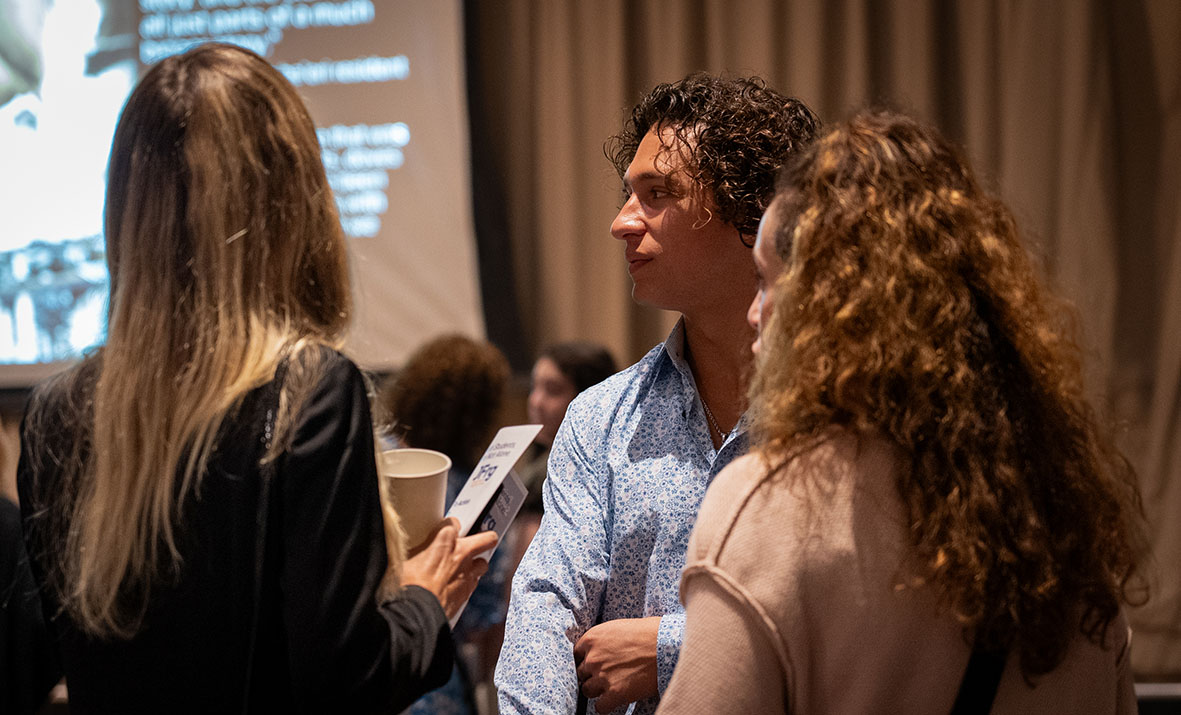
Eli Tsives, center. (Photo by Or Barak)
Tsives, who was featured in a viral video that showed encampment members blocking him from using the main entrance on campus, told attendees that his experience wasn’t “unique” and that “when we needed support … many deans chancellors and presidents stayed silent.” He added that “many Jewish students lost faith in their institutions” and are afraid to show their identity. But there have been Jewish students who have “walked through the flames of anti-Israel protests” proudly displaying their Magen Davids, calling out their anti-Israel teachers and providing support to one another. “These brave students… remind us that true strength is that when the world punches you in the face you look back and smile,” Tsives said.
“When we needed support … many deans chancellors and presidents stayed silent.” – Eli Tsives
He encouraged Jewish faculty to attend events put on Jewish students, and told Jewish students that “we don’t speak up because we want to, we speak up because we have to,” and to “be the voice in our community.”
Yitzy Frankel, a UCLA law student who is suing the university over its handling of the encampment, told attendees that UCLA “failed us all of us” and “aided and abetted” the encampment. Frankel explained that because he’s a law student, he decided to fight UCLA “in the courts.” He recounted how a federal judge blocked UCLA from allowing and assisting antisemitic activity on campus in an Aug. 13 injunction, “calling UCLA’s actions ‘unimaginable and abhorrent.’” UCLA announced they were appealing the matter because it would “hamstring its ability to manage its campus,” Frankel said. A week later, the university dropped their appeal.
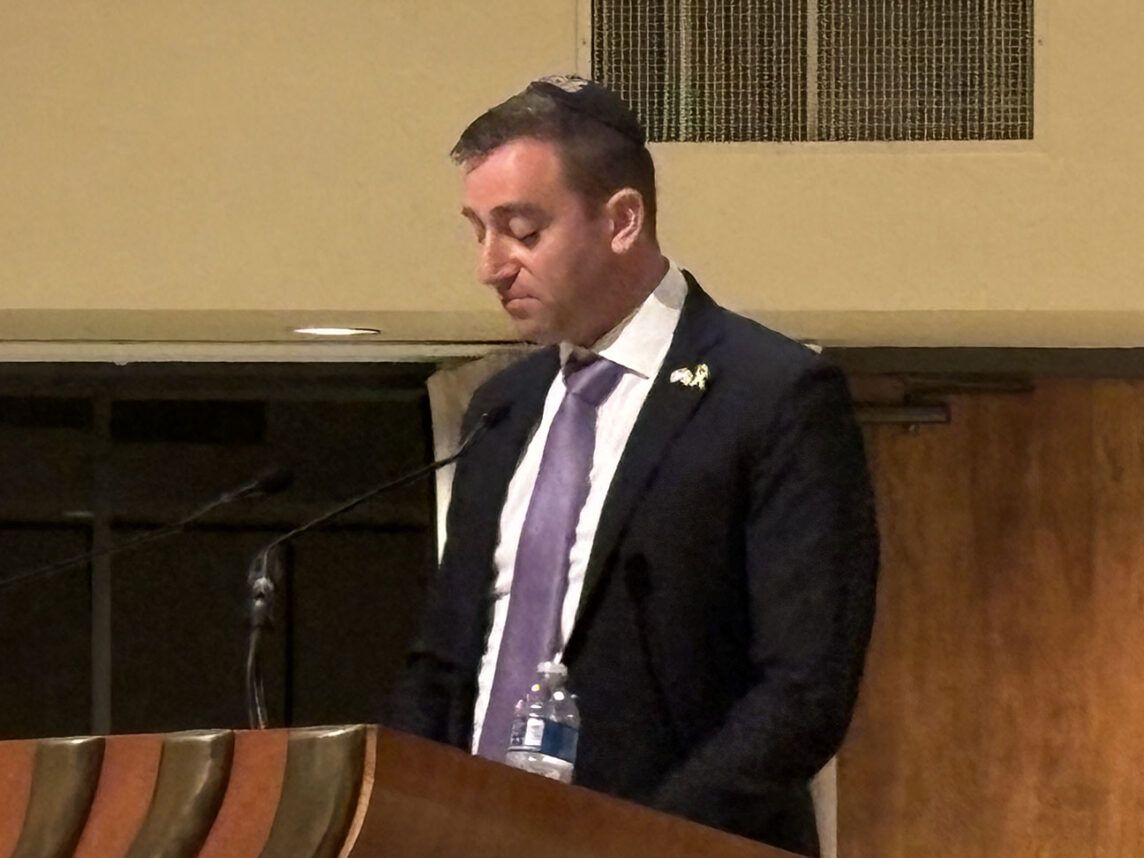
Yitzy Frankel (Photo by Aaron Bandler)
Toward the end of his speech, Frankel pointed out that the Philistines, ancient Egyptians and Nazis have all perished after trying to kill the Jews; Hamas is “a work in progress.”
Nir Hoftman, an anesthesiologist at UCLA, told attendees that Jews are vastly underrepresented at the university’s medical school to the point where “we are almost an extinct species as far as the students are concerned.” Hoftman pointed to a systemic racism course referring to Jews as white oppressors as an example as to why there are so few Jews at the medical school.
Medical students then spoke. One student told attendees that the first time he ever felt unsafe over his Jewish identity was when in his class group chat someone endorsed the violence on Oct. 7, and when he told the school about it, the reply was nothing could be done out of fear of a lawsuit. He claimed to have received several intimidating phone calls and was told he couldn’t determine what antisemitism is. Additionally, he had to walk by a “from the river to the sea” poster every day. Such hateful rhetoric is “unbecoming of future physicians,” the student contended, asking “how will future doctors” hide their biases against Israelis, Zionists and Jews.
Eliana Jolkovsky, who goes by “@ThatKoreanJew” on social media, recalled receiving an email calling on the Jewish Medical Student Association to retract their statement saying that Hamas took hostages and engaged in rape on Oct. 7; the statement was not retracted. She also recalled a classmate insisting that there was “no proof” to such allegations that any video evidence was simply Israeli propaganda through the use of artificial intelligence; other classmates excused the Oct. 7 massacre. “These are your future doctors,” Jolkovsky said.
She urged Jewish students to “use your voice organize call out the double standards” and called for the school to hold hateful students accountable.
Dr. Vivien Burt, professor emeritus of psychiatry at UCLA, attended a lecture in which Bushnell’s self-immolation was glorified and Israel was referred to as “Occupied Palestine.” The lecture, Burt contended, violated a UC resolution barring political indoctrination. Those that spoke out against it and other instances of antisemitism at the faculty meeting “were vilified mocked labeled as racists by students who shouldn’t have been there,” Burt said. She added that “faculty leaders fail to hold residents and students and participating faculty accountable for these actions” and that such leaders who are silent are also complicit in the spreading of antisemitism.
“This isn’t new,” Burt said, pointing out how silence 80 years is what “spawned the Holocaust.”
But Burt said that she “won’t stop speaking” and “we are strong, we are resilient, we are determined.”
Stein concluded the evening by saying that the JFrg fulfills a “unique need” and that unlike various national Jewish organizations, “we’re on the ground … we’re in the trenches.” She stressed the importance of standing by faculty so that “Jewish students can learn.” But the JFrg is “being stretched to the limit” since they’re “fighting an avalanche with a shovel.” Stein urged attendees to donate directly to the organization or indirectly via Hillel. “Your support is the oxygen that keeps this movement alive,” she said, encouraging attendees to “stand tall and proud for Zionism.”
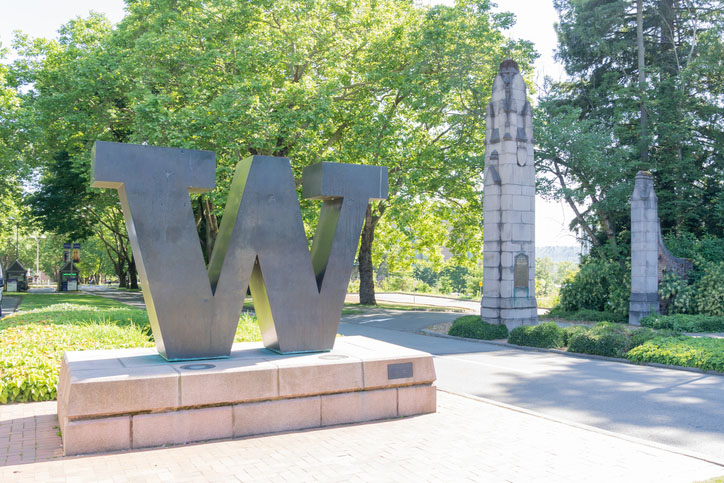
The Louis Brandeis Center for Human Rights Under Law announced on Oct. 1 that they have filed a complaint to the Department of Education’s Office of Civil Rights (OCR) against the University of Washington (UW) for failing to properly address “rampant” antisemitism on campus.
The complaint notes that over the past six months, there has been multiple instances of antisemitic graffiti scrawled across the campus. Examples cited include “Zionists (piss on ‘em)” on a urinal, “Zionists f— off” on a campus building, and “Save a life … kill your local colonizer” alongside an inverted red triangle (the symbol commonly associated with Hamas targets) on the campus George Washington statue.
“On information and belief, the University allowed the graffiti on the GW statue to remain for over 24 hours and it was a faculty member who had to take matters into their own hands and clean it up,” the complaint alleges. “Numerous students and faculty members emailed the administration to report the antisemitic graffiti all over campus. And yet the administration did not take steps to promptly address it and prevent it from recurring. “
The complaint proceeds to delve into the experiences of an anonymous UW Jewish student identified as “Student A.” Student A was allegedly confronted by members of the anti-Israel encampment on campus who referred to them by saying: “Watch out, this guy is a known Zionist.” Student A came back to the encampment the next day holding an Israeli flag, prompting the encampment members to try and “grab the Israeli flag he was holding and tried to surround him and cover the Israeli flag with umbrellas. Several people who were participating in the encampment encircled Student A, obstructed his movement and prevented him from walking through the quad. Student A, who understands Arabic, heard someone say in Arabic, ‘Let’s go get the knife,’ which prompted Student A to run away.”
Later, when he was walking on campus with a friend after a party, the encampment members recognized Student A and followed him. “The individuals who followed Student A and his friend swore at them in Arabic,” the complaint states. “Then, members of the encampment ran up to them at full speed with hammers, threatening ‘Yo, bro, shut the f— up, I’ll f—ing end you.’ The students held the hammer close to Student A’s face. When Student A said, ‘you’re not going to touch me,’ the other student said, “I’ll kill you.’ Student A and his friend backed away and left. Student A recognized one of students as the same student who had harassed him earlier that day.”
The complaint then alleges that Student A reported the incidents to the university, and was told “sorry” by an administrator but no follow up ever occurred. He decided against filing a police report because he wouldn’t be able to stay anonymous, and when he told university police he was concerned for his safety, an “officer expressed his understanding but neither campus police nor the University offered further assistance or protective measures for Student A,” the complaint claims.
Another anonymous Jewish student in the complaint, identified as Student B, was allegedly subjected to shouts of “you’re not welcome” and “we know who you are … go away” when he passed by the encampment; Student B was wearing a yarmulke. “Many of the individuals who participated in the encampment were dressed in black and carrying sticks and shields,” the complaint states. Student B discussed the incidents with campus and local police and with a university dean, but the complaint notes that “the University did not provide support or protection in response to these complaints, and police told Jewish students to “go around” the encampment for their own safety.”
“As a result of the antisemitic harassment and intimidation he faced on campus based on his Jewish identity, Student B hid his yarmulke to avoid being recognized as a Jew and targeted,” the complaint states. “Student B missed classes and other opportunities on campus because he was afraid to walk through the encampment and had to avoid the area for fear that he would be further harassed and targeted on the basis of his Jewish identity. Following his freshman year at UW, Student B transferred to another university due to the hostile climate and antisemitism he faced on UW’s campus.”
The final incident mentioned in the complaint is the UW Board of Regents meeting on Sept. 12, where “Jewish students and other members of the local Jewish community were subjected to verbal harassment and intimidation that contributed to the hostile environment at UW. At the meeting, members of the Jewish community and University who spoke about antisemitism and anti-Jewish hostility on campus, were interrupted, shouted down and verbally harassed by anti-Israel protestors in the audience, some of whom identified themselves as UW students.” The meeting ended early as a result, and the university condemned those who disrupted the meeting as being “antithetical to free dialogue.” But, according to the complaint, “the University has not since addressed the heightened hostile environment for Jewish students at the University. The message from UW, based on the events that transpired at the Board meeting, is that UW will not have the backs of Jewish students who speak up about antisemitism on campus or ensure their access to opportunities at the University is not denied on the basis of their shared ancestral identity connected to Israel.”
The complaint concludes by contending that the university has not satisfied its legal obligations under Title VI of the Civil Rights Act to ameliorate the hostile environment against Jewish students on campus; the complaint calls on OCR to, among other things, require the university to better enforce its policies against vandalism, provide better safety and fully investigate every reported instance of “discriminatory, harassing and threatening conduct against Jewish students.”
“It didn’t require any special reading of the tea leaves to see that Jew-hatred was rapidly escalating at the University of Washington and action was required,” Brandeis Center Founder and Chairman Kenneth Marcus said in a statement. “This could have been prevented but left unaddressed, graffiti and threatening messages directed at Jews quickly moved to dangerous bullying, intimidation, physical threats and discrimination. The Administration cannot continue to sit idly by. Jew-hatred will likely continue to spread like wildfire until the university takes concrete steps to address it, as they are required by law.”
This could have been prevented but left unaddressed, graffiti and threatening messages directed at Jews quickly moved to dangerous bullying, intimidation, physical threats and discrimination. The Administration cannot continue to sit idly by. Jew-hatred will likely continue to spread like wildfire until the university takes concrete steps to address it, as they are required by law. – Kenneth Marcus
Victor Balta, university spokesperson and assistant vice president for communications, told The Journal, “The University of Washington is committed to providing a safe and welcoming environment for all students, faculty and staff, and we are cooperating with the Office of Civil Rights as it investigates these complaints. We are in active discussions with OCR to resolve the matter and address the concerns these complaints have raised. While we are anticipating the Oct. 15 release of the final report and recommendations from the UW’s task forces on antisemitism and Islamophobia, we have taken steps to reiterate our community expectations and guidelines around freedom of expression.” Balta pointed to University President Ana Mari Cauce stating in a recent blog post that “when protest activities become disruptive, inciting or are accompanied by the destruction of public resources, we will first and foremost take action to protect people’s physical safety. We will also take whatever action is necessary and appropriate to allow the University to continue operations and serve our teaching, research and service mission. This includes enabling all community members to use public spaces and facilities appropriately and without being harassed or threatened.”
Balta added that “some allegations of alleged antisemitic behavior have been reported to us and referred to the appropriate investigative office at the UW. We encourage any Jewish student facing bias or harassment on campus to report it through our university bias or student conduct reporting tool. These reporting mechanisms are actively reviewed, and follow-up is coordinated by the Office of Student Life. We take reports seriously and are committed to doing all we can to address them.”
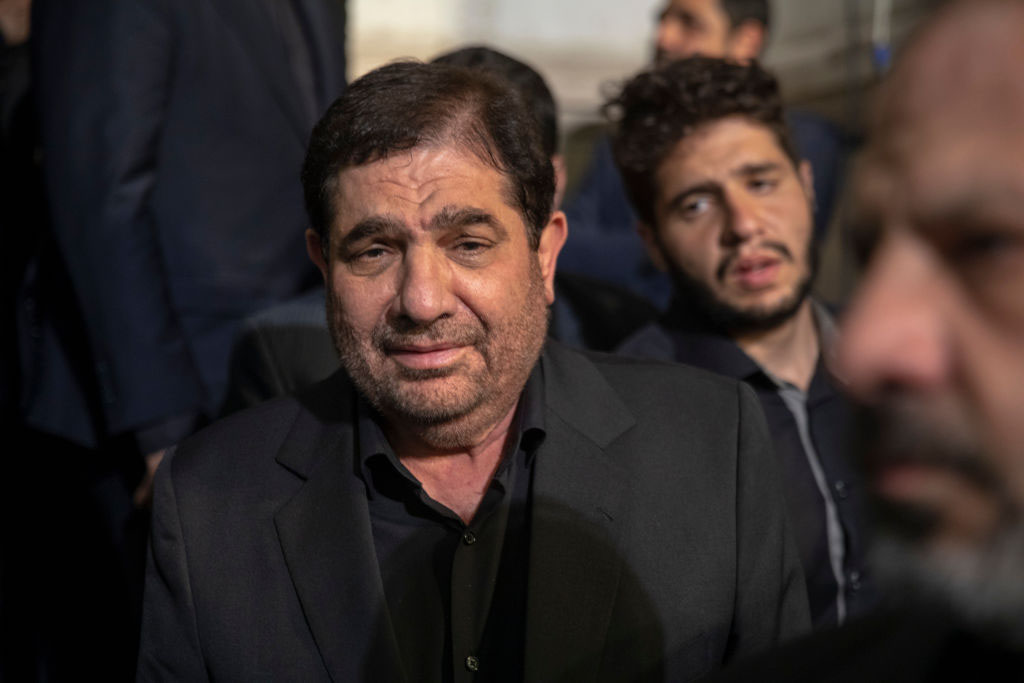
While Iran’s new president, Massoud Pezeshkian, sparked controversy in New York with his comments about “reducing tensions” with Israel and by participating in a conference organized by the Iranian delegation, which also included an Israeli citizen, Iran’s Supreme Leader, Ali Khamenei, swiftly appointed Mohammad Mokhber—former Vice President under Ebrahim Raisi (who died in a helicopter crash) and later interim president—as his “advisor and assistant.” This marks the first time Khamenei has granted such a position to anyone.
Some analysts interpret this move as a response to Pezeshkian’s remarks, which they see as being at odds with Iran’s official policy on Israel. Despite the foreign minister, who accompanied Pezeshkian to New York, denying these statements, Khamenei seems determined to show that nothing has changed to avoid unrest among his supporters in Iran and the region. Given that Pezeshkian was once said to be aligned with the so-called reformist camp, it’s likely Khamenei wanted to limit his influence.
In the decree appointing Mohammad Mokhber, Khamenei stated: “In light of your committed and impactful services in managerial and economic areas, especially in the martyr Raisi’s government, and your wise and prudent policy of utilizing talented, motivated, and hardworking youth, I hereby appoint you as my advisor and assistant. It is expected that, in line with this policy, you will continue to identify young talents and collaborate with them through logical planning, assisting governmental and non-governmental organizations in utilizing these resources.”
At first glance, it seems that Khamenei, who had been working to consolidate power before Raisi’s death, is now trying to build a loyal government within his office, appointing individuals who will support him unwaveringly. His goal is to withstand the immense internal and international crises currently pressing on the regime. However, another possibility exists.
Hitting An Impasse
Looking at the situation in Iran: According to regime-controlled newspapers, over 90% of the population is dissatisfied, with 75-80% living below the poverty line. In the last two presidential and parliamentary elections, more than 90% of the people boycotted the polls despite various pressures. These numbers are loud alarm bells for Khamenei, signaling the potential for another uprising, likely to be more intense than the major uprisings of 2017, 2019 and 2022.
Although Khamenei managed to suppress these earlier uprisings through violent crackdowns, thousands of Resistance Units affiliated with the opposition OMPI /MEK (Mujahedin-e Khalq) have already carried out more than 20,000 acts of propaganda in just one month. These units, scattered throughout Iran, could mobilize the street power necessary to topple the regime in the next uprising, despite the regime’s relentless repression.
These units, scattered throughout Iran, could mobilize the street power necessary to topple the regime in the next uprising, despite the regime’s relentless repression.
To stave off such an uprising, Khamenei has been fueling conflict in the Middle East, hoping that external wars will prevent domestic rebellion. However, this dangerous strategy has begun to backfire.
External Threats
The assassination of Ismail Haniyeh in Tehran, within a highly secure area, followed by the explosion of communications devices and Israel’s targeted attacks on Hezbollah centers, are not merely military strikes; they are intelligence breaches, signaling an internal collapse within the regime. It’s like a tree being hollowed out from within by termites. As a result, the entire Islamic Revolutionary Guard Corps (IRGC) is being subjected to a renewed counterintelligence review.
The Heart of Warmongering
Among Iranian dissidents, there is a saying that the heart of the regime’s warmongering lies in Iran, and that the wars it has started will eventually reach this heart. Recent events, especially the bombings targeting Hezbollah, confirm this, and it’s something that deeply worries Khamenei. Could a targeted strike in Tehran ignite the powder keg of dissatisfaction among the Iranian people?
Pezeshkian’s remarks might be an attempt to lower external tensions. For decades, the mullahs have used slogans like “Death to America” and “Death to Israel” as rallying cries to mobilize backward forces in the Middle East, ensuring their survival through warmongering and terrorism—always a cover for domestic repression. This is why Khamenei now pretends to strongly oppose Pezeshkian’s comments.
Meanwhile, for the first time, Mojtaba Khamenei, the son of Ali Khamenei, has been publicly mentioned in regime newspapers with the title of “Ayatollah.” This title, a religious rank higher than that of former presidents Hassan Rouhani or Ali-Akbar Hashemi-Rafsanjani, signifies that Mojtaba is being positioned as his father’s potential successor. In a public video clip addressed to his students, Mojtaba stated that he could no longer continue teaching. He currently oversees the intelligence agencies, plain clothes forces, and Iran’s state radio and television.
It appears that the old dictator, whose cunning and deceit have sustained his regime for four decades, is now grappling with numerous internal and external crises. To navigate these challenges, he is making efforts to reduce tensions with Israel, hoping to fortify himself against the threat of a potential uprising.
Hamid Enayat is a political scientist, specializing on the topic of Iran, who collaborates with the Iranian democratic opposition.
The High Holy Days are filled with wonderful gatherings of family, friends and, typically, an abundance of rich, heavy foods.
Whether you have dietary restrictions, or are vegan or vegetarian, you can still honor the holiday meal by eating in a way that feels healthy without compromising flavor and tradition.
Growing up, board-certified nutritionist Dawn Lerman always looked forward to the Jewish holidays, as they were pretty much the only times they had real food in the house or ate together as a family.
“My ad man dad, who often tipped the scale at 450 pounds, only wanted to eat food that had a marketing promise of weight loss attached to it,” Lerman, author of “My Fat Dad: A Memoir of Food, Love and Family, With Recipes.” “My mom, a feminist, was allergic to anything that was domestic.”
During the holidays Lerman and her mother would cook together, recreating her maternal grandmother Beauty’s old-world recipes
Over the years, Lerman tweaked her grandmother’s recipes, adding a modern flare, while incorporating her dad’s rotating diets and the dietary restrictions of her family and friends.
If you are looking for a delicious satisfying appetizer bursting with antioxidants to brighten your holiday table, Lerman’s sweet potato hummus is bursting with flavor and texture.
“Because of its high protein and fiber content, it will also help control your appetite,” Lerman said. “My dad named it the caviar of hummus, exclaiming that it was almost illegal for something so nutritious to be this delicious.”
Sweet Potato Hummus
1 large sweet potato (about 9 ounces)
1 (15-ounce) can chickpeas, drained and rinsed
5 Tbsp olive oil (plus additional, as needed, for thinning)
2 Tbsp tahini
2 Tbsp fresh lemon juice
2 garlic cloves, peeled
1 tsp ground coriander
1 tsp ground cumin
1/4 tsp kosher salt
Pinch of nutmeg
Position the baking rack in the middle and heat the oven to 425°F.
Wrap the sweet potato in foil and bake in a shallow baking pan, until it can be easily pierced with a knife, about 45 minutes. Transfer to a cooling rack and allow the potato to cool completely.
Peel the skin off the sweet potato and transfer to a food processor fitted with a blade.
Add the chickpeas, olive oil, tahini, lemon juice, garlic, coriander, cumin, salt and nutmeg, and process until smooth.
If the hummus is too thick, add a little extra olive oil or water and process until the desired consistency is reached. I like it a little on the chunky side.
* * *
Stuffed cabbage is the ultimate comfort food, and is perfect for a holiday or any meal.
“It is filled with protein and rice that is slowly braised in a sweet and sour sauce,” Lerman said. “My version uses ground turkey and cauliflower rice, retaining all the tradition while making it a bit more heart healthy.”
In the recipe are swaps that are easy to incorporate, for anyone who is vegetarian or grain-free.
Courtesy of Dawn Lerman
Beauty’s Stuffed Cabbage
1 medium head cabbage
1/2 cup finely chopped onion
2 tsp garlic, minced or chopped
1 Tbsp olive oil or coconut oil
1 cup of sauteed riced cauliflower (you can also use white rice, brown rice or quinoa)
1 1/2 pounds ground turkey (for a vegetarian version, substitute Beyond Meat, lentils or sauteed tofu)
14.5 ounce can diced tomatoes
10 tsp tomato paste
1/4 cup brown sugar, or sugar of choice (I like monk fruit sugar)
Salt and pepper to taste
Preheat the oven to 350°F.
Leaving the outer leaves on, wash and core the head of cabbage as best you can. Place it, cored side down, in a large pot of water containing about 3 inches of water.
Bring the pot to a boil to steam the cabbage. After the water comes to a boil, peel off the two outer leaves and set aside (do not use these for rolling)
In the meantime, in a frying pan, sauté garlic and onion in olive oil. Cool.
Sauté the riced cauliflower. Cool.
In a medium-sized bowl, mix the diced tomatoes, tomato paste, and brown sugar together.
In a larger bowl, combine the protein with the rice, the onion and garlic mixture and 1/2 cup of the tomato mixture. Season with salt and pepper. Stir to blend.
To assemble the cabbage rolls: Take a cabbage leaf, add 1/3 cup meat mixture to the middle of the leaf, fold the bottom up, sides in and top over and place, folded-side down, in a baking dish.
Continue rolling until all the protein is gone. Pour tomato mixture over the rolls. Bake for one hour, covered.
* * *
“Eating pumpkin during the High Holy Days symbolizes abundance for the year to come,” Lerman said. “Baked with cinnamon and sugar, it infuses the kugel with a caramel flavor.”
Lerman adapted her grandmother Beauty’s recipe and her vegan daughter adapted it further.
Courtesy of Dawn Lerman
Pumpkin Kugel with a Pecan Topping
8 oz baby shell noodles (you can use gluten free)
1 stick (4 oz) unsalted butter, melted, plus a little more for greasing the pan (you can substitute coconut oil)
1/4 cup of pumpkin
8 oz cottage cheese or cashew cheese
3 oz cream cheese or vegan cream cheese
3 eggs, beaten (or use an egg substitute)
4 oz of yogurt (you can also use coconut or cashew yogurt)
1 cup milk of your choice (dairy, almond, oat)
1/2 cup sugar of your choice (coconut sugar works well)
1 1/2 tsp vanilla
1 tsp ground cinnamon
1/2 cup raisins
Chopped pecans
Toppings (optional):
A little extra cinnamon and sugar to sprinkle on top of the raw kugel
Preheat the oven to 375°F.
Parboil the shells in salted water for about 4 minutes. Strain the shells and set aside.
In a large mixing bowl, combine the butter or coconut oil, pumpkin puree, cottage cheese, cream cheese, beaten eggs, sour cream, milk, sugar, vanilla and cinnamon.
With an electric mixer, beat until well combined. Then fold in the shells, raisins, apples, and lemon juice.
Pour into a greased, approximately 9 × 13-inch baking dish. You can sprinkle the optional toppings on top, if desired.
Bake until the custard is set and the top is golden brown, about 60 minutes. Cool and slice.