fbpx

July 17, 2024

Remembering Dr. Ruth, ‘America’s Sex Therapist’

Dr. Ruth Westheimer, the sex therapist, media personality and educator, died on July 12 at her home in Manhattan. She was 96. Not only was she a trailblazer in the field of sex and relationship advice and commentary, she was also a Holocaust survivor. 

Dr. Westheimer influenced an entire generation of advice columnists. One of many who followed in her footsteps in imparting sex and relationship wisdom to the masses is author and sex-advice columnist Dan Savage, who characterized Westheimer’s legacy succinctly.

“Dr. Ruth — tiny Dr. Ruth — was a giant, not just in the field of sex-and-relationships, but a giant presence in the culture,” Savage told the Journal. “To have gone through everything she did — to have experienced the worst of humanity and to still be able to love so deeply and want the best for her fellow human beings — is profoundly moving. That’s what I will remember when I think of Dr. Ruth.”

Born Karola Ruth Siegel on June 4, 1928, in Frankfurt, Germany, she was the only child of Orthodox Jewish parents, Irma Hanauer and Julius Siegel. Westheimer’s father owned a store and her mother was a homemaker. Julius routinely took his daughter to synagogue, which Westheimer spoke about at length in her testimony with the USC Shoah Foundation. 

Westheimer recalled that she grew up in a supportive household and was often spoiled with dolls and roller skates. But in November 1938, when Westheimer was 12, her father was arrested during Kristallnacht and sent to Dachau labor camp. To protect her, Westheimer’s mother and grandmother arranged for her to be sent to Switzerland via the Kindertransport. 

In Switzerland, Westheimer lived in Wertheim at an Orthodox Jewish Children’s Home where the living conditions were rough. She was grateful for the shelter and food but found the expectation to be constantly grateful and never complain to be overwhelming. Still, Westheimer prayed, learned Hebrew, kept kosher, and observed Shabbat. Her boyfriend at the time, named Putz (who Westheimer said was still friends with at the time of her Shoah Foundation testimony in 1998) often brought home books. When he’d sleep over, Westheimer would crawl under the staircase to read them. 

Westheimer would live there for the next six years. By the time the war had ended, her parents were murdered, as were her grandparents at the Theresienstadt Ghetto. “When we realized that the war was over, I remember what I wrote in the diary that ‘the canons have stopped, now the hearts can start talking again,’” Westheimer said. 

After World War II, at the age of 17, with all of her family members murdered, Westheimer and her friends moved to a kibbutz in the British Mandate of Palestine. There, she joined the Haganah — a precursor to the Israel Defense Forces — that fought for the establishment of the State of Israel.

After World War II, at the age of 17, with all of her family members murdered, Westheimer and her friends moved to a kibbutz in the British Mandate of Palestine. There, she joined the Haganah  that fought for the establishment of the State of Israel. 

“I learned to assemble a rifle in the dark and was trained as a sniper so that I could hit the center of the target time after time,” Westheimer wrote in The New York Times in 1990. “As it happened, I never did get into actual combat, but that didn’t prevent my being severely wounded. I almost lost both my feet as a result of a bombing attack on Jerusalem.” She married David Bar-Haim, an Israeli soldier, in 1950 and they moved to Paris that same year. Despite lacking a high school degree, Westheimer was admitted to and studied psychology at the prestigious Sorbonne University. Westheimer and Bar-Haim divorced in 1955. She would marry her second husband, Dan Bommer in 1956. They moved to New York where Westheimer continued her studies at the New School for Social Research. There, she earned degrees in psychology and sociology in 1959, with a thesis on the children of Heiden camp. Westheimer and Bommer had a daughter, Miriam Yael, but following yet another divorce, Westheimer would become a single mother. 

In 1961, she married Manfred “Fred” Westheimer, an engineer and fellow Holocaust survivor. Westheimer and Fred would remain married until he passed away in 1997. “My late husband, Fred Westheimer—a wonderful man, we were married for 38 years,” Westheimer told an audience at Columbia in 2013. 

She became a U.S. citizen in 1965. From 1967-1970, Westheimer worked at Planned Parenthood of New York City. While working there, she earned a doctorate in education from the Teacher’s College at Columbia University. Her thesis was on “the contraceptive use and abortion histories of more than 2,000 women.” During the 1970s, she became an associate professor and taught sex counseling at Lehman College in the Bronx. After training in sex therapy with Dr. Helen Singer Kaplan, Westheimer opened her own practice in 1975. 

In 1980, Westheimer’s life would change forever when she was scouted by a manager at New York’s WYNY-FM radio station, Betty Elam. Westheimer began to broadcast her show “Sexually Speaking,” a weekly 15-minute show on Sundays. It would be the first major step toward eventually becoming known as “America’s sex therapist.” In 1983, Westheimer published her first book, “Dr. Ruth’s Guide to Good Sex,” which became a bestseller. Over the years, she would author more than 40 books across the field of sex and relationships. By 1984, “Sexually Speaking” became nationally syndicated, propelling her to become a household name. Everyone from teenagers to the elderly would tune in for candid, kind-spirited advice on sex and relationships. 

Her Jewish roots were always a part of her existence. In 1995, Westheimer co-authored “Heavenly Sex: Sexuality in the Jewish Tradition” with Jonathan Mark. The book is described as revealing “how the Jewish tradition is much more progressive than popular wisdom might lead one to believe. 

In her second-to-last book, “The Doctor Is In: Dr. Ruth on Love, Life, and Joie de Vivre” Westheimer advised about boredom — a feeling she didn’t appear to endure much in her active, nine-decade life: “The first step to fighting boredom is to recognize it. One clue is that you’re always tired even though there’s no particular cause, like a baby who wakes you five times a night or financial worries that keep you from falling asleep. The reason that you are tired is that there’s nothing about your life that makes you excited. If you have nothing to look forward to, then a listless funk will surround you, and a nap becomes enticing because at least your dreams are somewhat entertaining.”

Westheimer’s final book, “Roller-Coaster Grandma: The Amazing Story of Dr. Ruth” was published in 2018. It was a graphic novel for kids aged 8-12 about her life from escaping the Nazis to becoming a professor and respected media icon.

In 2023, Westheimer successfully lobbied Democratic New York Gov. Kathy Hochul to create the role of Loneliness Ambassador — focusing on combating loneliness among older adults. The New York Times reported in November 2023 that “reading the diary now, Dr. Westheimer recognized the parallels between human sexual problems and struggles with loneliness. No one wants to admit to having trouble with intimacy, and no one wants to admit to not having enough friends.”

Her concern for mental health of all those she advised over her career is embodied in the final words in her Shoah Foundation testimony from 26 years ago: “My message to the next generation is to not forget the past, maybe to draw a lot of strength from being Jewish and from all of those experiences that we Jews have had, and to be wonderful parents and grandparents and to keep on that tradition of family life and being together for many years to come.”

As the world of relationship and love advice continues without its matriarch, a new generation of Dr. Ruths are working on the path that she paved for so many decades. One of the most prominent people walking that path today is relationship coach, podcaster and author Jillian Turecki.

“I was — still am — such a fan of Dr. Ruth,” Turecki told the Journal. “Her legacy is so immense: It was such a revolution to hear this woman teach people that sexual attraction isn’t just something of the body — it also has to include the brain. She shared the radical idea that sex and desire require our creativity — we can’t always just have the same version of intimacy or the same conversations. She really pioneered the idea that nurturing all parts of intimacy is what makes a strong relationship. Before Dr. Ruth, public dialogue on sex and relationships was taboo and often so clouded in euphemism that it was impossible to learn anything. Because of Dr. Ruth,  public dialogue on sex and relationships became conversational. Dr. Ruth made it okay to talk about sex and relationships instead of hiding everything behind closed doors and wondering why it didn’t feel right. But Dr. Ruth did something else, too: She added humor. She added directness. She normalized sexuality, and gave us all permission to explore it.”

Westheimer is survived by their two children, Miriam and Joel, and four grandchildren.

Remembering Dr. Ruth, ‘America’s Sex Therapist’ Read More »

Don’t Just Grieve—Love

Suffering is part of life. It’s also a central theme in the Jewish faith. Indeed, every summer, Jews commemorate two calamitous days in our history by abstaining from food and drink.  On the Seventeenth of Tammuz, we remember several tragic events, like the siege of Jerusalem by the Babylonians. And on the Ninth of Av, we mourn the destruction of the Temple in Jerusalem. 

But suffering and anguish are not aspects only of Jewish history. They also animate the Jewish experience today. This summer, as we fast and remember the disasters of the past, our hearts and minds will be focused on the distress of the here and now—especially the atrocities of October 7th.

But how are Jews supposed to respond to pain and suffering? Rabbi Abraham Joshua Heschel had an answer. 

Heschel urged us to first acknowledge that “ordeals” and “anguish” are part of the “totality of life.” But accepting such a reality shouldn’t lead to “complacency” or “fatalistic resignation.” Instead, Heschel counseled us to be “keenly sensitive” to the “adversity and evil in [our own lives] and in that of others.” In other words, the mere recognition that suffering is an inevitable aspect of the human experience shouldn’t result in apathy. 

Ultimately, Heschel advocated for a particular response to “adversity and evil.” He thought we should “rise above grief.” Indeed, to Heschel, responding to calamity with “grief”, “seem[ed]” like a “sort of arrogance.”

Heschel advocated for a particular response to “adversity and evil.” He thought we should “rise above grief.” 

Why? Well, Heschel reminded us that “[w]e never know the ultimate meaning of things, and so a sharp distinction between what we deem good or bad in experience is unfair.”  We should, in other words, practice some epistemic humility.  We are not omniscient. We don’t—and can’t—know why suffering happens. That type of knowledge is held by God alone.  Responding to tragedy with grief, then, suggests we understand what’s outside our reach.

At first blush, Heschel’s position sounds harsh. Are we truly not supposed to grieve when we confront murder and destruction? 

But, again, Heschel did not advocate apathy—indeed, he thought that mankind could respond more poignantly to tragedy. He urged us to enlist a more powerful weapon against suffering: love.  As he bluntly put it, “[i]t is a greater thing to love than to grieve.”  

If we were to understand suffering, we might grow apathetic towards it. Don’t we often try to combat death, disease, and destitution so valiantly because we find them so incomprehensible, so undeserved, and so senseless? It’s the impossibility of understanding that motivates our resistance.

Recall what happened when Moses spoke to God at the burning bush. He desperately tried to understand why the Jewish people were in bondage. He asked God: “Why have You brought trouble to this people?”

And how did God respond? He didn’t explain to Moses why the Jewish people were enslaved. In fact, He never provided Moses with a rationale. But that’s not to say that God didn’t care about the plight of the Jewish people. Of course He did. As Rabbi Jonathan Sacks has written about this exchange: “God does not want people to be poor, hungry, sick, oppressed, uneducated, deprived of rights, or subject to abuse.” But rather than giving Moses an explanation, he enlisted him in His cause: He sent Moses to free the Jewish people from slavery. 

That’s how we are all supposed to respond to suffering. 

We don’t need to understand suffering. We need to fight it. As Rabbi Sacks wrote: “When it comes to the poverty and pain of the world, ours is a religion of protest, not acceptance.” Judaism calls upon us to answer suffering with sacrifice. It asks that we respond to calamity with charity. It instructs us to combat pain with prayer. In short, we’re supposed to love—not merely to grieve. 

Heschel advocated for just that. And he practiced what he preached. When Heschel witnessed racial injustice in the United States, he didn’t just grieve. He linked arms with Martin Luther King Jr. as they marched in Selma. Heschel didn’t just lament—he loved. 

We should do the same. As Jews fast this summer, we should reflect on the tragedies of the past and the ongoing trials of the present. But reflection cannot turn into resignation. We’ll have to “rise above grief.” And like Moses and Heschel, we’ll have to choose love.


Elias Neibart is a student at Harvard Law School and was previously a Krauthammer Fellow at the Tikvah Fund. 

Don’t Just Grieve—Love Read More »

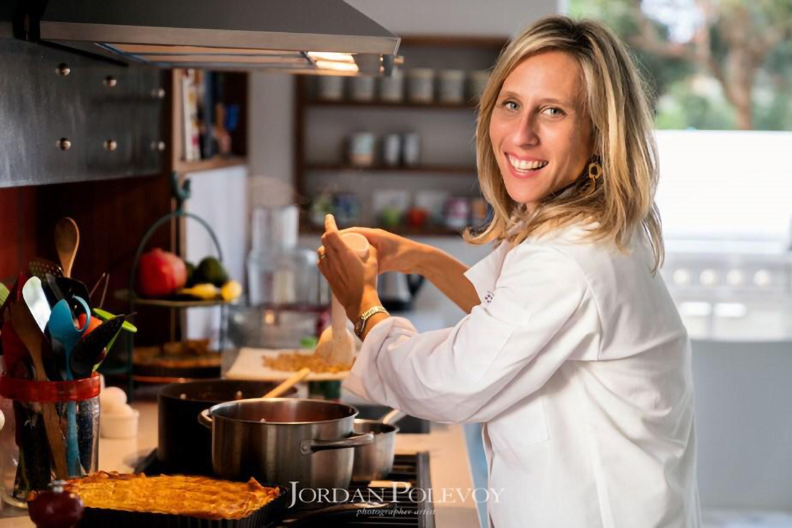
Chef Shawna Goodman: Cooking in Israel, Sharing Recipes and Overnight French Toast

Shawna Goodman, a Canadian chef, who has lived with her family in Israel for the last 10 years, loves being connected to agriculture and celebrating the seasons through food.

“As a Canadian, eating local would have meant eating apples and maybe some potatoes and some onions, because most of the year we’re under mega snow,” Goodman told The Journal. “Being a chef in Israel … I really appreciate when something comes in bloom and something becomes ripened, and it’s usually from my backyard or my friend’s backyard; the sharing and the partaking in what’s around me is inspiring.”

Goodman, who graduated from the Natural Gourmet Cooking School and in pastry arts from the Institute of Culinary Education (formerly, Peter Kump’s Cooking School), both in New York City, also trained at the Cordon Bleu School in Paris.

Goodman grew up in Montreal, and came from a dedicated, committed Jewish Hamish community. Her husband, whomshe met at summer camp, had this “insatiable itch” to be part of the story.

“I really didn’t understand what that meant until we took our family abroad for a year, and that was 10 years ago,” she said. “Just realizing the gift of time and living during a period of time. where Israel is flourishing … it sounds so farfetched, but everyday just feels really like a gift.”

Goodman combines her love of cooking and living in Israel with her philanthropic work, creating culinary opportunities to highlight the social needs in Israel; she also leads Shefa, a yearly tour of Israel for women. Goodman said that most Israelis are doing a lot of cooking these days, and not necessarily for themselves.

“The incredible initiatives that are coming from everybody’s regular kitchen … and the capacity of giving is beyond,” she said. “There’s no greater comfort than someone’s home cooked meals.

She added, “So many people and families are divided with this war effort; the power of the meal is huge.”

Goodman explained that Shabbat every Friday has been an opportunity to come together as a community, process what’s going on, share food and try to rejoice.

“The cooking has just been really nurturing right now,” she said. “And as a Canadian, again, I only know apples, so to have lychees [falling off the trees] in my backyard is wild.”

Goodman attributes her love of food to her mom, who loved to cook and let her play in the kitchen growing up.

“My mother really didn’t mind the mess,” Goodman said. “She really allowed me to get my hands dirty; it was just another art room … and a nurturing space, as well.”

These days, Goodman goes to bed reading cookbooks, enjoys scrolling through food pics on Instagram and loves reading other people’s food stories.

“Food is an entrée into people’s souls,” she said. “It’s what makes them tick, what makes them cry, what makes them nostalgic, what makes them feel loved [and what gives them stability.”

Goodman believes you see a lot of character in how someone shares – or doesn’t share – their recipes.

“Every recipe under the sun is online; this is not protective material anymore,” Goodman said. “It’s a great compliment when someone asks you for a recipe.”

Chef Goodman’s recipe for overnight French toast is below.

“It’s a really comforting recipe where it’s using up challah, if you can even have challah leftover,” she said. If you don’t have challah, you can use brioche or another rich type of bread.

Mix it with milk and vanilla and eggs, press it into the bread and let it soften overnight. The next morning, all you have to do is bake it in the oven and enjoy!

While this is Goodman’s most requested recipe, she finds most joy in creating recipes with whatever she has on hand. In culinary school, they tested the students by giving them a random group of ingredients. They would be graded, based on things like texture, color and flavor.

“I happen to love cleaning out my fridge and using everything up,” she said. “I like beginnings and ends [and] I love the creativity and the challenge.”

Follow Chef Shawna Goodman on Facebook.

For the full conversation, listen to the podcast:

Overnight French Toast with Blueberries

SERVES: 6-8

Ingredients

Caramel:

1 cup (250 ml) packed brown sugar

1⁄2 cup (125 ml) unsalted butter

1 teaspoon (5 ml) cinnamon, optional

Toast:

12 thick slices challah or brioche

1 1/2 cups (375 ml) fresh or frozen blueberries or raspberries

Custard:

5 large eggs

1 1/2 cups (375 ml) milk

1 1/2 teaspoons (7 ml) vanilla extract

1/2 teaspoon (2 ml) salt

For the caramel, bring the brown sugar, butter and cinnamon to a boil in a small saucepan and stir with a wooden spoon. Let boil for 2 minutes and turn off the heat. The caramel will be brown, thick and bubbly.

Drizzle the caramel evenly over the bottom of a 9 x 13-inch (3.5L) baking dish. Cover with 6 slices of bread. Scatter the berries over the top. Place the remaining 6 slices of bread on the fruit.

For the custard, whisk together the eggs, milk, vanilla and salt in a medium- size bowl. Pour this evenly over the bread. Press down lightly with plastic wrap so that the bread absorbs the custard. Refrigerate overnight.

Preheat the oven to 350°F (180°C).

Remove the plastic wrap and bake the French toast uncovered for 40-50 minutes until puffed and golden. Cut into squares, invert to show the caramel and place on a serving platter.

Variation Sliced bananas, raspberries or a combination of both may be

used instead of blueberries.

Heat leftovers, if there are any, in the microwave.

Chef’s Tip: To clean the dried caramel from the pot, fill the pot with water and bring to a simmer. Let sit and then clean. Residue will wash away quickly.


Debra Eckerling is a writer for the Jewish Journal and the host of “Taste Buds with Deb.Subscribe on YouTube or your favorite podcast platform. Email Debra: tastebuds@jewishjournal.com.

Chef Shawna Goodman: Cooking in Israel, Sharing Recipes and Overnight French Toast Read More »

ScarJo Sticks the Landing In ‘Fly Me To The Moon’

With conspiracy theories ablaze these days, you may hear some claim that America faked the moon landing in 1969. In “Fly Me To The Moon,” Woody Harrelson plays Moe Berkus, who wants to make sure President Richard Nixon looks good so he hires Kelly Jones (a luminous Scarlett Johansson) to produce a believable fake moon landing that could be used if there were problems with the real landing.

With her sass and good looks, Kelly can get virtually any man to do what she wants, and when she meets Cole Davis (Channing Tatum), the Apollo program’s launch director at a diner, he is quickly smitten with her. They meet again when her job is to make NASA marketable at a time when some see big spending as a waste of money and Senate approval is needed. While Buzz Aldrin and Neil Armstrong don’t say much, they agree to pose in front of red mustangs and advertise fancy watches so NASA can make some money.

Directed by Greg Berlanti, you get the feeling you are in 1969. The kiss between Kelly and Cole is sweet and PG. While Tatum is strong in some moments where he is managing the mission to the moon, he doesn’t show the right chemistry needed in romantic scenes with Johansson. Perhaps Tatum believed that his character was supposed to be a guy so focused on work that he was shy with women, but with his good looks, you can’t help but scream at the screen: “Come on, man!” The movie has the sleek mid-century modern feel of AMC’s hit series “Mad Men” and Johansson is stellar in the opening of the film, when she has to convince three men who don’t take her seriously that she actually knows her stuff.

Ray Romano has some funny moments as the deputy director, Henry Smalls.  In one of the most tension-filled scenes, when a journalist (Jewish actor Peter Jacobson) presses Cole on the failure of a previous mission when Cole only expected softball questions and nearly beats the daylights out of him, leaving Kelly to have to do damage control.

One of the many fine supporting performances is by Gene Jones (whose life was saved by a coin toss in “No Country for Old Men”) who plays Senator Hopp, who doesn’t want to fund the mission but is charmed by Kelly. Johansson’s real-life husband, Colin Jost, has a small role as an unimpressed Senator.

We take it for granted in 2024 how amazing the moon landing felt in 1969.

We take it for granted in 2024 how amazing the moon landing felt in 1969, fulfilling the promise of President Kennedy. While some might be worried the film will serve to remind people that governments lie (the twist in the film is fictional, although some in tin foil hats still believe Jewish director Stanley Kubrick faked the moon landing) most will be entertained by the film, largely due to Johansson’s out-of-this-world charisma.

Kelly gives Armstrong some possible things to say when he makes his first step on the moon, but he comes up with the iconic “one small step for man, one giant leap for mankind.” Harrelson, as always, is hilarious as a hectoring pest with a nefarious smile.

“Fly Me to The Moon” takes some small steps forward and is worth seeing and long as you won’t be heartbroken that Tatum doesn’t bring Cupid to the love party.

ScarJo Sticks the Landing In ‘Fly Me To The Moon’ Read More »

Is Calmer Speech in This Election Cycle a Pipe Dream?

Ever since the Biden-Trump debate debacle on June 27, I’ve read obsessively about the unraveling of the Biden campaign. His obvious and alarming physical and mental decline — furiously denied by much of the media and White House staffers — has been proven beyond all doubt. The emperor may still have bespoke suits and super cool sunglasses, but there is increasingly no “there” there. 

The lies about the president’s condition have infuriated the public. For Democrats who have insisted since 2016 that Donald Trump posed the clear threat to democracy, David Suissa has parried with this: “If you hide for years from American voters that their president is mentally unfit for the job, how is that not a flagrant undermining of democracy?”  

I’ve also been riveted by the Biden family psychodrama, where his inner circle, seemingly his wife Jill and his son Hunter, support his decision to stay in the race. These people are pathologically selfish. Joe Biden cannot even finish a sentence that isn’t read from a teleprompter. It is cruel and demeaning to allow him to dodder on this way, and it threatens national security. Who’s been making the decisions in the Oval Office and sliding papers in front of Joe, saying, “Just sign here”? And for how long?

In the midst of these Democratic party agonistes, Donald Trump survived an assassination attempt. It was miraculous. In turning his head at just the right angle at just the right second, he only lost part of an earlobe instead of his life. I hope that even those who despise Trump appreciate what a gift this was. Had he been killed, the country would have seen a dangerous outpouring of anger and frustration that would have spilled onto the streets.  

The photos and videos of Trump, literally bloodied but unbowed, insisting on standing up to face the crowd and making the Secret Service wait while he offered his trademark fist bump and yelled “USA!” against a backdrop of an American flag, will become iconic images in American history.

At 78, the physical and psychic stamina he displayed, his calm and determined response under literal fire, will only further diminish the rapidly shrinking Joe Biden. Some believe that Trump’s surprisingly brave and controlled reaction to the shooting has decisively won him the election. He came across as indomitable, someone with divine protection, someone with the presence of mind to show moxie and leadership in a moment of terror. Who knew? 

Still, 25% of survey respondents told Pew Research in May that they dislike both Joe Biden and Donald Trump, the highest unfavorable ratings of any presidential candidates in 30 years and an unfavorable rating that doubled since 2020. Much of the public feels depleted by the ugliness of the political games, by the hyperbole, the lawfare, defamations, threats that the world will end if “he” gets elected, and the open contempt of those who disagree with their political views. Both Biden and Trump have lied chronically and recklessly and are guilty of contributing to this atmosphere.

Much of this language cheapens real evil. George W. Bush was compared to Hitler, as Trump has been. In 2016, feminists conjured dystopian images from Margaret Atwood’s “A Handmaid’s Tale,” predicting that women would lose all rights to self-agency under Trump. Right-wingers engage in their own fearmongering, and extremists on both sides warn that if their opponent wins, it may be the last democratic election we will ever have. Enough already. 

None of the name calling or threats are new. In his time, George Washington was called a hyena, a horse beater, a spoiled child and a tyrannical monster. Teddy Roosevelt, while assistant secretary of the Navy, said President William McKinley had “no more backbone than a chocolate éclair.” At the Bull Moose convention in 1912, former President Roosevelt warned delegates, “We stand at Armageddon and we battle for the Lord.” During that same campaign as a third-party candidate against Republican President Taft, Roosevelt was shot in the chest while delivering a speech. “I have been shot,” he told the crowd, “but it takes more than that to kill a Bull Moose.” (Trump probably would be jealous.) 

Vitriol will always be part of the political game, but Americans rightly worry about the “culture of contempt” that our current levels of animosity foster. Political differences have fractured or destroyed so many relationships, and infected the workplace with militant stances that brook no dissent. We have also suffered from an increasing amount of political violence that further tears at the fabric of society.  None of this is sustainable. Democrat, Republican or Independent, we are in this together and need to find a way forward more peacefully. 

How we speak to and about one another is key. Judaism teaches us how careful we must be in choosing our words. As the late Chief Rabbi Jonathan Sacks said, “Words can create worlds and words can destroy worlds.” In politics, if you can’t make your case without resorting to bashing the other side, you’ve got a weak case indeed.

As the late Chief Rabbi Jonathan Sacks said, “Words can create worlds and words can destroy worlds.” In politics, if you can’t make your case without resorting to bashing the other side, you’ve got a weak case indeed.  

Rabbi Efrem Goldberg of the Boca Raton Synagogue has noted that the Hebrew word for anger is “ka’as,” which is connected to the word “chaos.” Anger loosens our inhibitions, even “takes us out of this world,” according to Pirkei Avot, and in extreme circumstances lets us rationalize violent acts against others.

We’re still four long months from the next presidential election. The drama is likely to stay high, but we can try to lower the temperature on the political talk. There’s just too much at stake.


Judy Gruen is the author of “Bylines and Blessings,” “The Skeptic and the Rabbi,” and several other books. She is also a book editor and writing coach. 

Is Calmer Speech in This Election Cycle a Pipe Dream? Read More »

The Choice of J.D. Vance Is a Middle Finger to Identity Politics

It makes no sense.

Why would Donald Trump pick as a running mate a white man from Middle America who’s just like him?

Wasn’t Trump supposed to broaden his base to increase his chances of winning in November, and pick someone like a woman or a person of color or a more classic conservative?

Instead of expanding his reach, Trump has doubled down on his ideology, choosing J.D. Vance, someone who once called him “cultural heroin” for Middle America while musing that he may be “America’s Hitler.”

Evidently, Trump must have been so eager to build a MAGA future for America that he forgave Vance for those horrible things he said about him while he was the celebrated author of “Hillbilly Elegy.”

I always assumed, though, that Trump was so obsessed with returning to the White House that he wouldn’t take any chances and pick a complementary running mate such as Marco Rubio, Tim Scott, Glenn Youngkin or even Nikki Haley.

What happened?

One theory is that after the failed assassination attempt against him, Trump figured he had victory in the bag and might as well pick someone he felt was the best person for the job.

That may be so, but we’re still left with a stunning choice, devoid of the usual political machinations. You might call Vance the antidote to Vice President Kamala Harris, who Biden made clear was chosen more for her gender and racial identity than for, you know, merit.

You might call Vance the antidote to Vice President Kamala Harris, who Biden made clear was chosen more for her gender and racial identity than for, you know, merit.

In that sense, choosing Vance is a kind of middle finger to identity politics. Vance’s only identity is merit. It just so happens that he’s white.

The obvious advantage to choosing people based on merit is that it feels real. No one can accuse you of playing games just to win. Trump, love him or hate him, isn’t playing the typical identity games with his choice of Vance. He seems ready to risk it all for what he believes in.

He’s even violating one of his cardinal rules—never pick someone who can outshine you. Vance is a razor-sharp, charismatic figure who is both fearless and articulate. He’s the living embodiment of the American Dream, going from a hellish childhood to Yale Law School, including stints in the Marines and Silicon Valley before winning election to the U.S. Senate.

Regardless of which political side you’re on, this focus on merit is a breath of politically incorrect fresh air.

Just as our cynicism for modern-day politics was reaching all-time highs, just as the primal grab for power overruled the common good, a divisive and polarizing political figure decides to eschew political games and focus on excellence.

The Democrats seem mired in the opposite camp. Their lust for power has led them into serial blunders that have come back to haunt them. In addition to aggressively hiding for years President Biden’s mental decline, until it blew up in their face, they were single-mindedly obsessed with taking down Trump any way they could.

“Whatever the respective merits of the many cases against him,” Bret Stephens writes in The New York Times, “the bald effort to embarrass, paralyze and ultimately criminalize a political opponent smacked, to millions of Americans, as a much graver danger to democracy than, say, whether hush-money payments to Stormy Daniels constituted a campaign-finance violation.”

The Democrats were right to expose the dangers of Trump. But since they were devoid of any self-reflection or self-criticism, they were incapable of doing anything else, throwing the whole kitchen sink to take him down and stay in power. Eventually their bald obsession caught up with them and left them with a big mess and a losing hand.

Trump, of course, has been as messy and power-hungry as anyone, which makes his risky choice of a young MAGA clone who used to insult him that much more notable.

Who knows, maybe a little voice came to him in the middle of the night last week, after he missed having his brains blown off by a few centimeters.

“You’ve been a narcissistic and lying bully your whole life, who would do anything to win,” the little voice told him. “Now you’ve dodged the ultimate bullet. Don’t push your luck, big guy. For the last major decision of your life, put merit above your ego. Pick someone who you’ll think will make America great again, even if it’s not you.”

The Choice of J.D. Vance Is a Middle Finger to Identity Politics Read More »

Are Jews Cursed or Blessed?

The pagan prophet, Balaam, is hired by Balak, King of Moab, to curse the Jewish people. Balaam makes several pronouncements, the most famous being: “Lo, it is a people that dwells alone, not reckoned among the nations” (Numbers 23:8-9). For many generations, in exile, powerless and persecuted, Jews have referred to that quotation as an explanation of their isolation and vulnerability. But is it really a curse?

Rabbi Jonathan Sacks, in his comments on this portion, concedes that the word “alone,” in Hebrew, is typically used negatively in the Torah: “It is not good for man to be alone” (Gen 2:18), “He shall dwell alone, outside the camp (Lev. 13:46) and “How alone is the city once filled with people” (Lamentations 1:1). And historically, prejudice against Jews seems only to reinforce the idea of a cursed people, but Rabbi Sacks points out that commentators take the meaning differently. Ibn Ezra says that being alone means that they don’t assimilate and Ramban says that it means that Jews maintain their integrity.

In fact, God says to Abraham: “Through you all the families of the Earth will be blessed” (Gen.12:3). “Abraham,” says Rabbi Sacks, “was different from his neighbors, but he fought for them and prayed for them. He was apart but not alone.”

Judaism is the only religion associated with a single country, Israel. You can be Christian, Muslim, Hindu or Buddhist anywhere, but the fullest expression of Judaism was practised for centuries at the Temple in Israel, where God told Moses to lead the people after the Exodus. 

The Jewish Diaspora throughout the world has thrived and contributed enormously to the world, but its spiritual home is the land of Israel, its source and its wellspring. Prayers formulated 2,000 years ago, and still in prayerbooks today, express yearning for Zion and the restoration of Jewish sovereignty in its ancestral homeland. Zionism and Judaism are two sides of the same coin. To be a Jew is to be a Zionist.

The founder of modern Israel, Theodor Herzl, was an assimilated German Jew who attended the trial of Alfred Dreyfus in Paris in 1894 and heard the crowds shout “Death to the Jews.” He realized, as a secular Jew, that Jews needed to reestablish Zion for their protection. His prescience was remarkable. He saw that enlightened France, the great center of European culture, was not safe for Jews. The secular Jew became a passionate Zionist.

Now, we look back and realize that if there had been a sovereign Israel during World War Two, countless Jews would have been saved. It was Robert Frost who wrote that “home is the place where, when you have to go there, they have to take you in.” Frost’s insight makes the case for the State of Israel. That is why a dire threat to Israel results in great anguish and overwhelming support from most Diaspora Jews. They know, from experience, that their own security is in danger too. There is an inextricable link between the condition of the Jews in the Diaspora and in Israel.

Israel now finds itself on the front lines of a civilizational war, and our future — and that of Diaspora Jews as well our non-Jewish neighbors — hangs in the balance. Antisemitism is, and always has been, the sign of a world in crisis, anger looking for a scapegoat. 

So, given Jewish history in Israel and the Diaspora, is Balaam’s description of the Jews a curse or a blessing? To answer the question, we must understand that those famous words were not his only ones. He declared “No harm in sight for Jacob/No woe in view for Israel” and “How fair are your tents, O Jacob, your dwellings, O Israel” (Numbers 23:8-9). Balak was exasperated with Balaam, interpreting his words as a blessing, not a curse. 

Rabbi Joseph Ber Soloveitchik, for decades the leader of modern Orthodoxy in the U.S., argued in “Kol Dodi Dofek” that secular Zionism falls short of the religious ideals for which Israel stood from the time of the Covenant on Mount Sinai. For him, “the mission is not to nullify the special loneliness of the community of Israel … but to raise the people to the level of a sacred community nation, [one] permeated with morality and religious principles that transcend history.”

Religious or secular, it is impossible to deny that there are many tragic chapters in the long history of the Jewish people. We have too often been “the other.” Jews question social orthodoxies, challenge the status quo, fiercely oppose injustice and believe in education for all. That unconventional and unyielding challenge to societies is interpreted by some as arrogance, by others as too different to “fit in” and by yet others as proof of difference.

This ever-dying people persists in living; this stubborn and headstrong people are singular and unique. Hated by many, appreciated and admired by many others, Jews are both cursed and blessed and remain undeterred in making a contribution to the world.

But this ever-dying people persists in living; this stubborn and headstrong people are singular and unique. Hated by many, appreciated and admired by many others, Jews are both cursed and blessed and remain undeterred in making a contribution to the world, in Israel and in the Diaspora since the appearance of the first Jew, Abraham, whose name refers to his origins on “the other side” of the river. He opposed the established order and revolutionized the world. And so have succeeding generations.


Dr. Paul Socken is Distinguished Professor Emeritus and founder of the Jewish Studies program at the University of Waterloo.

Are Jews Cursed or Blessed? Read More »

Rabbi Michael Perice’s Journey From Opioid Addict to Spiritual Leader of Beit T’Shuvah

When Rabbi Michael Perice began his recovery from opioid addiction in 2011, he couldn’t imagine that 13 years later, he would be a nationally recognized rabbi in the addiction and mental health space, helping hundreds of people on their recovery journeys. 

Rabbi Perice initially discovered his spiritual calling as a rabbi during recovery. His desire to help others struggling with addiction would eventually lead him to serve as the new senior rabbi of Beit T’Shuvah, a Los Angeles-based addiction recovery community, treatment center, synagogue and educational institute. 

“I found my purpose,” said Perice. “Had I not struggled in that way, I probably would have taken a different path.”

Founded in 1987, Beit T’Shuvah provides treatment for drug, alcohol and gambling addiction, using Jewish spirituality, addiction counseling and therapy to help residents achieve lasting sobriety. The program implements intervention services, residential care and aftercare for those of all religious backgrounds. 

When Beit T’Shuvah announced Perice would be serving as its new senior rabbi, he saw it as a full-circle moment. 

“As a person in long-term recovery, I have been inspired by the mission and lifesaving work of Beit T’Shuvah for many years,” said Perice. “Being its next rabbi is not only an honor but the culmination of a spiritual, personal and professional journey.”

Perice, who previously worked as senior rabbi at Temple Sinai in Cinnaminson, New Jersey, said his appointment is an opportunity to extend Beit T’Shuvah’s reach in the Jewish community and beyond by establishing partnerships with organizations and thought leaders in the recovery and addiction space. He also plans to develop outreach programs to support residents’ families and friends alongside Beit T’Shuvah staff.

“Rabbi Perice’s compelling story of recovery, coupled with his charisma and deep spirituality, will be a key element to help Beit T’Shuvah residents connect with their core beliefs and achieve lasting sobriety,” said Keith Elkins, chair of the Beit T’Shuvah board. 

For the last 13 years, addiction has remained an issue close to Perice’s heart. Since being ordained by the Reconstructionist Rabbinical College in 2020, Perice has advised non-profits, major health institutions and congressional legislators on issues related to addiction and recovery. He also served as an advisory board member for Safe House, an overdose prevention nonprofit, and the City of Philadelphia through the Department of Behavioral Health and Intellectual Disability Services.

“Through Rabbi Perice’s leadership, Beit T’Shuvah will inspire a renewed commitment to providing soul-enriching programs and services that nurture the mind, body and spirit,” said Elkins.

In 2021, Perice was featured in an article by the Philadelphia Inquirer, leading to speaking engagements at synagogues, medical schools and community spaces. In sharing his own story of recovery, Perice has helped raise awareness and access to addiction treatment. 

“Addiction teaches us many lessons, but recovery gives us the wisdom to live them,” said Perice. “My goal is to lead us into a future where that wisdom is shared and is accessible to as many people as possible.”

“Addiction teaches us many lessons, but recovery gives us the wisdom to live them. My goal is to lead us into a future where that wisdom is shared and is accessible to as many people as possible.” – Rabbi Michael Perice

As Perice assumes his new role, he hopes to continue Beit T’Shuvah’s long legacy of community-focused care. 

“Beit T’Shuvah teaches us that connection is the key to overcoming addiction,” said Perice. “That is why I am here. I’m here to help find that connection within each individual in a community where discovering and elevating our authentic selves is what makes us human.”

Rabbi Michael Perice’s Journey From Opioid Addict to Spiritual Leader of Beit T’Shuvah Read More »

The Reality of Sharia

The biggest winner of Europe’s recent elections was the Islamist-leftist alliance. For those who still find an alliance between the left and homophobic, misogynistic Islamists incomprehensible, please keep in mind that the left globally is no longer liberal. Leftism has become a big tent for all varieties of illiberalism, including Islamism.

Post-election videos show Islamists celebrating leftist wins, praising Sharia Law, and bashing Western democracy, with signs like “Sharia will dominate the world.” Islamist activists were successful in using anti-Zionism and a cultural war against liberal democracy to mobilize Muslims to vote.

Polls in France indicate that 28% of Muslims — and 50% of younger Muslims — envision the country becoming a Muslim state. 

As the election results began to emerge, more than 2,000 Jewish families in France began the Aliyah process. And then, on cue, the Sharia/leftist backlash began: Critics of the election results were immediately labeled “anti-immigration” and of course “Islamophobic.” As with everything happening today, we were told: What you’re seeing is not what you’re seeing.

Calling Jews “anti-immigration” is of course particularly ironic. How can we be anti-immigration if we’re all, in one way or another,  immigrants?  True, many of our ancestors were forcibly brought to Rome as slaves. Not the typical immigrant experience, but the rest of us were fleeing the Spanish, the Russians, the Nazis, and/or the Islamists and arrived with nothing but hope. 

Most Jews are, needless to say, against any immigrants who want to kill us. More broadly, we’re against immigrants who want to replace Western laws with Sharia Law. A foundational principle of Western democracy is that one doesn’t need to lose one’s identity to live here and flourish. In fact, classical liberalism extols the beauty of living in a multicultural mosaic. Problems arise when people want to retain parts of their identity that are anti-Western, like honor killings, child marriage, beheading babies, and burning the elderly alive. 

If only there were things like universities where leftists/Islamists could learn stuff like this.

For many of us, the label of “Islamophobic” lost all significance after Oct. 7. Every poll of Muslims both in the West and in the Middle East has shown full support of Hamas and Oct. 7. The Hamas charter quotes verbatim from Hadith Sahih 2922: “The last hour would not come unless the Muslims will fight against the Jews and the Muslims would kill them.”

The Quran itself states in Surah 8: “I will cast terror into the hearts of those who disbelieve. Therefore strike off their heads and strike off every fingertip of them.” And in Surah 9: “Fight those who believe not in Allah nor the Last Day.” 

Many continue to argue that there is a huge difference between Islam and Islamism, the latter defined as the radicalization or politicization of Islam. I used to believe in this difference. I have Muslim friends who are more liberal than some leftist Jews. As an Israeli friend put it: “Israelis have to believe there is a difference. We would lose all hope if we didn’t.”

And yet, the IDF found 50 tunnels connecting Egypt to Gaza, tunnels that supplied the weaponry for Oct. 7. So even if Egyptian President Abdel Fattah El-Sisi himself is not radical, he can’t do much when the Muslim Brotherhood builds tunnels, kills Egyptian Christians, and establishes terrorist cells throughout Egypt and the region.

On the other side, some argue that phobia means an “irrational fear,” and that fear of Islam’s radical past and present is rational. OK, so we ditch the word Islamophobia. But it is perfectly rational to have a fear of Sharia colonization. 

After 9/11, synagogues in New York City implemented metal detectors and enhanced security in general. Despite the fact that 9/11 was an act of anti-Western terrorism, nobody called the synagogues Islamophobic. Because 23 years ago, a measure of sanity still prevailed in the public discourse. And though Islam’s history of forcing Jews to convert, live in servitude as dhimmis, or be killed was not the main focus, it was also not dismissed.

What a difference two decades have made. Islamic propaganda has not only seeped into our schools and media, it has created a distortion of both history and reality.

Those of us living in reality — daily violent riots, death threats, an avalanche of lies — didn’t need Europe’s elections to know that the world has entered a new period of Sharia conquest. 

Those of us living in reality — daily violent riots, death threats, an avalanche of lies — didn’t need Europe’s elections to know that the world has entered a new period of Sharia conquest. What’s happening in Israel is just the beginning. Stating the obvious doesn’t make you a hater; it makes you a realist.


Karen Lehrman Bloch is editor in chief of White Rose Magazine.

The Reality of Sharia Read More »

Was the Assassination Attempt on Trump Predictable?

The assassination attempt on former President Donald J. Trump was horrific. It was also unsurprising. Anyone following politics with an intellectually honest lens shouldn’t be shocked by the attempt on Trump’s life. The 2000 election of George W. Bush over Al Gore sent leftists into a frothing rage from which they have yet to calm down. The 2016 election of Trump over Hillary Clinton caused many formerly reasonable people to suffer psychological breakdowns. For far too many Democrats, politics has become a win-at-all-costs blood feud. 

Democrats openly fantasized about assassinating President George W. Bush. The late Dr. Charles Krauthammer coined the term “Bush Derangement Syndrome” to describe “the acute onset of paranoia in otherwise normal people in reaction to the policies, the presidency — nay — the very existence of George W. Bush.” 

Trump Derangement Syndrome is not new. Leftists hate Trump because he threatens their power. As Trump himself said, “They’re not after me. They’re after you. I’m just in the way.” 

Look at the left’s behavior since Trump descended that escalator in 2015. They spent every waking minute trying to convince Americans he is a monster. They demonized him in ways transcending normal human or political discourse. The same liberal Democrats and leftists who bring up election 2020 refuse to accept that Trump won in 2016. Hillary Clinton was supposed to be their anointed first woman Commander-In-Chief. Trump prevented that. The left never accepted his election. 

The left began by trying to tear down American institutions. They pushed to abolish the electoral college and institute a popular vote mandate — the very thing the Founding Fathers warned against. On the first full day of Trump’s presidency, liberals held a violent “resistance” rally, borrowing a term coined by Yasir Arafat to justify political violence. Celebrities including Madonna, Wynona Judd, Johnny Depp and others shrieked about harming Trump.

On the first full day of Trump’s presidency, liberals held a “resistance” rally, borrowing a term coined to justify political violence. Celebrities including Madonna, Wynona Judd, Johnny Depp and others shrieked about harming Trump. 

Leftist bloodlust briefly slowed six months into Trump’s presidency when a deranged leftist shot Louisiana Congressman Steve Scalise. The Bernie Sanders supporter admitted his desire to kill as many Republicans as possible. Once Mr. Scalise began recovering, leftists returned to form. 

Trump’s first two years in office were consumed with Democrats insisting he was a spy for the Russian government. When that preposterous belief imploded, Trump was impeached over a phone call with a Ukrainian leader. When he was acquitted, the COVID pandemic arrived. As COVID was raging, the George Floyd riots were unleashed. Leftist groups created during Barack Obama’s presidency ran wild without consequences. Occupy, Black Lives Matter and Antifa burned everything in sight.

Having been stung by 2016, Democrats left nothing to chance in 2020. While the 2020 election was not “stolen,” it was rigged. Democrats in several swing states violated their own state constitutions in a desperate attempt to stop Trump. In Wisconsin, dropboxes were illegal. Nevertheless, dropboxes were put in Milwaukee, Madison and other Wisconsin Democrat strongholds. 

Trump was repeatedly accused of fomenting violence after the 2020 election. This was untrue. He went to court. When courts ruled against him, he appealed. He worked within the system. Then came the Jan. 6, 2021 events that Democrats milked for all they were worth. 

Until Jan. 6, political violence in America was almost exclusively leftist. The Weather Underground, Earth Liberation Front, Animal Liberation Front and others engaged in leftist political violence. Radical environmentalists chained themselves to trees to stop development. Today they throw paint on priceless paintings and glue themselves inside art galleries in the name of fighting climate change. Leftist agitators block traffic and shut down bridges and roads in the name of leftist social causes. 

When there were no causes to promote, leftists invented tragedies to declare themselves victims and conservatives aggressors. Entire leftist movements were promoted and advanced based on fiction. The gay rights movement got a boost from the death of Matthew Shepard. Yet Matthew Shepard was not killed for being gay. He was a drug dealer killed in a deal gone bad. His sexuality was irrelevant to his death. Making him a leftist cause célèbre allowed his supporters to demonize conservatives. 

The Black Lives Matter (BLM) movement was based on a lie. BLM formed when a white police officer killed a black man named Mike Brown. Mr. Brown was a violent criminal who robbed a liquor store. Brown tried to kill the officer, who used justified lethal force in self-defense. Brown’s last words—“Hands up, don’t shoot” — became a rallying cry, but he never uttered those words. His death was exploited to create a fictional crisis of white police officers murdering young black men. Actual death statistics exposed this supposed epidemic as fantasy.

The deaths of Matthew Shepard and Mike Brown allowed wealthy white liberals to invent a narrative of a Republican war on minorities. This made it possible for those in charge of leftist organizations to raise large sums of money to promote leftist causes. Gay people and black people were explicitly and falsely led to believe that white Republicans were plotting to kill them all.  

In 2012, then-Vice President Biden fanned the flames by telling a black audience that Republicans wanted to “put y’all back in chains.” 

Things got even more ridiculous with the 2019 Jussie Smollett hoax. Smollett was an actor who happens to be gay and black. He claimed he was physically beaten on Chicago’s South Side by a couple of white men yelling, “This is MAGA country.” Any conservative who questioned Smollett’s preposterous story was deemed racist and sexist. Because it happened during Trump’s presidency, it was somehow Trump’s fault. 

The truth was that Smollett hired two black African immigrants to beat him up.  

Those who labeled Smollett a liar had their social media posts about him censored. On Facebook, I tried to joke that “Americans need more illegals and refugees to do the jobs Americans refuse to do … such as beating up Jussie Smollett.” 

That joke about outsourcing was considered a promotion of violence and punished with a 30-day Facebook ban.

As for Smollett, he was initially given a free pass from Cook County District Attorney Kim Foxx, after being telephoned by a friend of Smollett’s, former First Lady Michelle Obama. 

No matter how crazy the actions of the left, everything in life had to be blamed on Republicans, conservatives, and especially Trump. 

During the August 2020 George Floyd riots, an 18-year-old man named Kyle Rittenhouse used justifiable self-defense to shoot three people trying to kill him. The left labeled Mr. Rittenhouse a racist even though his victims were all Caucasian. Although the three people he shot were violent criminals and one was a convicted pedophile,  the media portrayed Rittenhouse as a cold-blooded murderer. When a jury quickly acquitted him, leftists seized upon the Rittenhouse verdict as evidence that white Republican men could murder with impunity as long as Trump was President.

Ridiculous commentary emanated from the 2022 Academy Awards. Actor Will Smith charged the stage and slapped comedian and emcee Chris Rock. The next day on “The View,” actress Joy Behar blamed Trump for the violent culture permeating America. Even by the low standards of “The View,” this was insane. A black Democrat attacked another black Democrat, yet somehow a white Republican who had been out of office for over one year was responsible for the violence.

Add the constant accusations that the Tea Party movement was violent. The movement stood for “Taxed Enough Already.” They wanted limited government. They were labeled white racists despite having many minority members. The Obama administration used the IRS to target Tea Partiers and bully them out of the political process.

These and plenty of other incidents fed into the media narrative that Republicans, particularly white male conservative Trump supporters, walked around with guns looking for minorities to physically harm or even kill. Meanwhile, leftists were tossing Molotov cocktails and setting businesses, cities and neighborhoods on fire. A complicit liberal media reached its nadir by describing a leftist riot with a building aflame as “mostly peaceful.” 

All Jan. 6 did was reduce left-wing violence from nearly 100% of all political violence down to 99%. Nearly 30 years ago, Eric Rudolph bombed abortion clinics and Timothy McVeigh bombed the Federal Building in Oklahoma City. In the 30 years since, leftist violence has been the norm. Jan. 6 gave Democrats a lifeline, but it was also based on a false narrative. Trump told his supporters to approach the capitol “peacefully.” Democrats on their select committee hid exculpatory evidence and selectively edited tapes to put Trump in as damaging a light as possible. Democrats compared Jan. 6 to Pearl Harbor and the Holocaust, another attempt to link Trump to Adolf Hitler. 

Voters were more concerned about inflation than about some alt-right doofuses acting like unruly South Beach Spring Breakers. 

Democrats thought winning in 2020 would end things, but Trump proved resilient. More galling to the left, by 2023 Trump’s policies were more popular than President Joe Biden’s policies. Rather than let voters decide the 2024 election, Democrats began a carefully coordinated lawfare campaign. Institutionally, Democrats tried abolishing the filibuster, packing the Supreme Court, and physically intimidating SCOTUS justices who issued conservative rulings. Justice Brett Kavanaugh faced his own assassination attempt as rioters targeted his home. On the lawfare side, Trump was indicted in several states on charges so thin that politically liberal constitutional scholars Jonathan Turley and Alan Dershowitz recoiled.

Democrats thought winning in 2020 would end things, but Trump proved resilient. More galling to the left, by 2023 Trump’s policies were more popular than President Joe Biden’s policies.  

Most of the legal cases against Trump collapsed. Trump easily won the GOP nomination for the third straight presidential cycle. Trump then crushed Biden in the first 2024 general election presidential debate. 

Democrats and the few remaining Republican “Never-Trumpers” panicked. They had spent months and years labeling Trump as Hitler, a racist, a rapist, an insurrectionist, and a threat to democracy itself. Impeachment failed. Indicting him failed. Censoring him and his supporters on social media platforms failed when he built his own Truth Social site. Accusations that he had sympathized with Charlottesville Nazis, called our military “suckers and losers,” and told Americans to drink bleach were all debunked. Attempts to portray Hunter Biden’s laptop as Russian disinformation fooled only the most rabid leftist partisans. Trump did not conspire with Vladimir Putin to make Hunter Biden smoke crack and cavort with call girls.

Panicked Democrats are now pretending to be shocked at the Biden mental health coverup that they themselves were part of covering up. Government secrecy is a threat to democracy we ignore at our peril.

Making matters worse, liberal media attempts to portray Trump as mentally unstable and Biden as cognitively functional have both been exposed as fraudulent. Panicked Democrats are now pretending to be shocked at the Biden mental health coverup that they themselves were part of covering up. Government secrecy is a threat to democracy we ignore at our peril. 

Desperate Democrats’ newest bogeyman is Project 2025. It would somehow allow conservatives to enslave minorities and end their lives. In reality, Project 2025 is a boring policy pamphlet created by the Heritage Foundation, a conservative think tank. These people don’t murder Americans. They occasionally bore everyone not attending CPAC. This policy pamphlet is also somehow Trump’s fault despite his coming out against it. 

Democrats cannot run on their record, so their only hope of staying in office is to convince Americans that Trump and his supporters are genocidal madmen hellbent on annihilating them. 

There was only one way left to stop him from becoming President again. 

The shooter was a 20-year-old registered Republican who donated to Act-Blue, a Democrat superpac that funds leftist groups. 

The attempted murder of Trump that killed an innocent Pennsylvania rallygoer was the furthest thing from a surprise. It was the inevitable result of a leftism bereft of ideas, unable to govern, enraged at everything, and willing to use anything including violence to maintain power.


Eric Golub is a retired stockbrokerage and oil professional living in Los Angeles.

Was the Assassination Attempt on Trump Predictable? Read More »