fbpx

April 24, 2024

If You Heard What I Heard Teams Up with Matisyahu for ‘A Night of Resilience’ Benefit

On May 8, Matisyahu will be performing an acoustic concert, “A Night of Resilience,” in Beverly Hills. The show is going to benefit If You Heard What I Heard, a nonprofit that films the grandchildren of Holocaust survivors telling their grandparents’ stories. 

The singer, who has been touring around the U.S. to promote his latest EP “Hold the Fire,” has faced show cancelations due to security concerns over anti-Israel protesters. At some venues, workers refused to come in because of Matisyahu’s vocal support of the Jewish state.

For Carolyn Siegel, Founder and Executive Director of If You Heard What I Heard, it was important to collaborate with Matisyahu because of these cancelations. “For those of us who are 3G’s, grandchildren of Holocaust survivors, it was very upsetting to see Matisyahu shows being canceled due to baseless hate” she said. “We see many similarities between our organization’s values and Matisyahu’s messages through his music, particularly those of resilience, hope, and strength. In teaming up with Matisyahu, it’s important for our organization to make sure those values are present at this event, and at the same time, show support for this Jewish artist and Zionist who has had to face hate recently, just like our grandparents faced hate not so long ago.”

Carolyn Siegel Photo by Zusha Goldin

Siegel, a grandchild of Holocaust survivors herself, has recorded 54 interviews since launching in 2021. People like Scooter Braun and Josh Gad have shared their stories. “Recording these stories gives our interviewees a different perspective on what their grandparents went through,” Siegel said. “It gives them the tools to figure out how they’re going to share their story with their kids when their kids are old enough, and it inspires them to make sure the world never forgets.”

At press time, the venue for “A Night of Resilience” has not been announced, but tickets start at $54. Sponsorships are available for $5,000, $10,000 and $15,000. All proceeds from the show will benefit If You Heard What I Heard, and will be used to record more stories to ensure they aren’t forgotten. This is important, since the number of Holocaust survivors still alive is dwindling.

And If You Heard What I Heard’s work has made an impact. Siegel told the Journal about the organization’s Education Advisor, Dena Grimshaw, who recently had a situation where “she caught a student drawing a swastika, but instead of going the disciplinary route, she instead shared two of our interviews with him,” she said. “At the end, he was visibly moved by hearing these stories and genuinely apologized. That’s one piece of the value of our work. We’re educating today’s generation not just so they won’t forget, but also because we can instill more kindness and empathy for all groups.”

“Seeing the amount of antisemitism and threats towards Israel today, we’re having this concert to celebrate our resilience as a people.”

What Siegel wants to do with the concert is inspire Jews, showing them that no matter what has happened to the Jewish people throughout history, they have survived. “We timed this event specifically to take place on May 8th, in between Yom HaShoah, the commemoration of the Holocaust — one of the darkest periods in our history — and Yom Ha’atzmaut, the celebration of the independence of our Homeland, Israel. Seeing the level of antisemitism and propaganda against Israel today, it was really important to us to bring our community together in our resilience as a people. I hope everyone walks away feeling inspired to help us make sure the world will never forget.”

For tickets to “A Night of Resilience”, visit http://Ifyouheardwhatiheard.com/Matisyahu.

If You Heard What I Heard Teams Up with Matisyahu for ‘A Night of Resilience’ Benefit Read More »
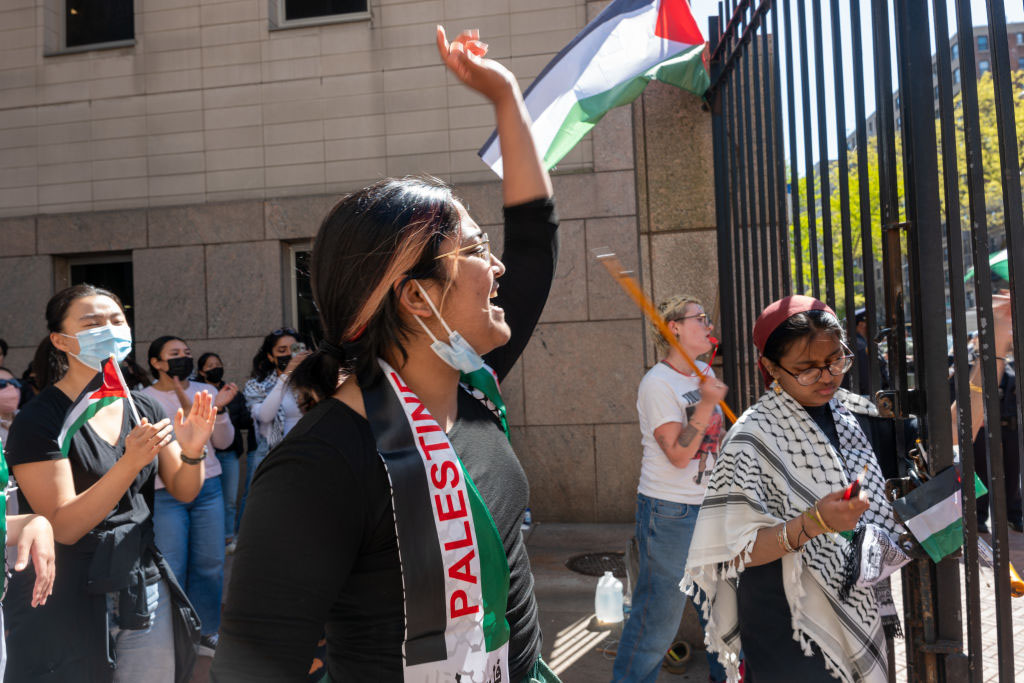

Campus Rioters Not Just Hateful and Dangerous But Phony

What started several months ago with calls for a ceasefire in Gaza has morphed into rabid and violent campus protests against … what, exactly?

Certainly not the war in Gaza. Israeli troops have long evacuated most of Gaza, humanitarian aid has been flowing in, and while Benjamin Netanyahu keeps promising that the IDF will enter Rafah at some point, his restraint speaks louder than his bluster.

In fact, one can argue that the ugliest thing happening in Gaza right now is the continuing horror of terrified hostages being held captive for over 200 days by the terror group Hamas.

So, if you’re a college student looking for a noble cause, I can’t think of a nobler one than “Let the Hostages Go!”

Imagine for a second if instead of “Hamas we love you” and “We support your rockets” and “Burn Tel Aviv to the ground,” the protesters setting up “liberation zones” at Columbia and other campuses would direct their anger at Hamas, with banners and chants calling to “Liberate the Hostages, Don’t Wait Another Day!”

What these protesters miss is that it’s not enough to have the “optics” of justice-seeking warriors unafraid to take on the police and get arrested — as in the epic protests against the Vietnam War on those same campuses during the 1960s.

It’s not enough to perform justice — to set up tents and play drums and wear keffiyehs and yell “globalize the Intifada” and throw temper tantrums trying to convince the world there’s no country worse than Israel.

To come across as authentic, a cause also needs credibility.

These Israel-hating groups lost their credibility right after Hamas murdered, mutilated, raped and burned alive 1200 Israelis on Oct. 7 — before any war started in Gaza. Instead of condemning the carnage, they brazenly defended it in the name of “resistance” and “liberation.”

The protests now roiling our campuses have never been about a war or about helping the Palestinians. The war was the ideal pretext for protesters to unleash years of pent-up fury against Jews and Israel and everything they hate about the West. These riots are anti-America as much as they are anti-Israel.

If they cared about justice, these wannabe rebels might have marched for the millions of oppressed souls in places like Afghanistan, Syria, Sudan, Yemen, Ethiopia and Iraq. A quick Google search would have given them all the ammunition they needed to feed their outrage.

Instead, they have directed their rage at pro-Israel students, at elite universities and their feckless leaders, at the United States, at Western civilization, at law enforcement, at pretty much anyone who disagrees with them and is not named Hamas.

These disruptive acts have nothing to do with free speech. Intimidating and harassing fellow students, and violating university codes of conduct, is not protected speech. If anything, it is an assault on the free speech of others.

As we confront this hateful assault that singles out Jews and Israel, it’s important we not overlook the hypocrisy and the phoniness.

These are not noble warriors. If they cared so much about Palestinians, they wouldn’t have remained silent for decades while Palestinians suffered (and continue to suffer) their worst oppression in places like Jordan and Lebanon. But those “other” Palestinians never mattered, just as millions of refugees around the world don’t matter, because they have no connection to the world’s ultimate oppressors — the Jews.

No wonder so many of these groups went berserk right after Hamas invaded Israel and committed the worst massacre of Jews since the Holocaust. They couldn’t swallow the possibility that big, bad Jews would enter the oppressed class, even for a day or two.

In this narrative, Israel will forever be an oppressor state. That’s why we shouldn’t fall for the trap of “criticism” of Israel. These protests are about crushing Israel, not criticizing it. No one has ever claimed that Israel is perfect. In fact, you’ll find the biggest protests against the Israeli government in Israel itself. If ever there was a country that didn’t need more piling on, it would be Israel.

The fact that the United Nations condemns Israel more than all other nations combined tells us plenty not about Israel but about the feckless United Nations.

The fact that campus rioters focus their venom on the world’s most condemned nation tells us plenty not about Israel but about the rioters. It tells us, among other things, that these are not cool revolutionaries; they’re boring conformists.

Anxious Jewish students need not be fooled by the optics of protest. They can gain strength from knowing the true colors of those trying to intimidate them.

The hysterical rioters in their midst are not social justice warriors who want peace in Gaza. They are blowhards pretending to be rebels and picking on the world’s easiest target.

The only thing real about their cause is the terror group they support.


Campus Rioters Not Just Hateful and Dangerous But Phony Read More »

Divining the Future

If someone had told me last summer that I would be so worried about Israel that I would wake up in the middle of the night in a cold sweat, I would have scoffed. Yet, we are all living exactly that nightmare.  

“It is difficult to make predictions, especially about the future.” That adage is attributed to everyone from baseball’s greatest sage, Yogi Berra, to Nobel Prize-winning physicist Niels Bohr.  Regardless of who actually said it, it is spot on.

Still, we feel compelled to divine what is coming next.  Business leaders speak about seeing around corners; hockey players about skating not to where the puck is, but to where it is going. And politicians assure us that if we place our faith in them, they will lead us to salvation, rather than off a cliff.  

Most of us rely on the guidance of “experts” to foresee the days ahead, and those so-called experts aren’t shy. Watch the Sunday morning talk shows or read the op-ed section and you will encounter pundits predicting the outcome of the upcoming presidential election with a confidence that is belied by their past records. The same is true for economists telling us when a recession will come. Trust me, I’m an economist. Or better yet, don’t. The “experts” seem as sure of themselves as when they said that Hillary was a shoo-in, or that the sole way to bring down inflation was to slow the economy and increase unemployment. 

If only we had the farsightedness of our biblical heroes. When Pharoah dreamt that seven healthy cows grazing by the Nile were devoured by seven gaunt ones, and that seven healthy ears of grain were swallowed by seven diseased ones, his advisors were mystified. But not Joseph, who correctly foresaw seven years of bountiful harvests to be followed by seven years of famine. Think of it – Joseph knew not just what was going to happen over the next 12 months, he could see 14 years ahead! And then there was Abram in Genesis 15, who learned from G-d that his descendants would be enslaved for four centuries before claiming the land of Israel. How many of us can guess what tomorrow might bring, much less 400 years?

I would happily settle for being able to see through the end of 2024. Will President Biden be reelected? Will Israel be at peace?

Some cherish surprises; others would prefer not to hear bad news. I asked that if Israel were one day no longer a Jewish state, would they want to learn that now?  Except for one Israeli friend, the rest would rather live out their days in blissful ignorance.

Might it be better to never know the future? I posed that question to a number of friends, and many said yes. Some cherish surprises; others would prefer not to hear bad news. Most poignantly, I asked that if Israel were one day no longer a Jewish state, would they want to learn that now? Except for one Israeli friend, the rest would rather live out their days in blissful ignorance.

Of course, the answer could be different if we were able to act on that knowledge. What will come doesn’t just happen to us; we often determine it. If, for example, learning about a potential life-altering medical condition leads you to adopt a healthier lifestyle or to have a surgical intervention, we would certainly want that information. So visualizing a challenging future could be an effective impetus to action.

But that doesn’t change the fact that it is no easy task to anticipate what is to come. When I was a Ph.D. student I took a class with Lawrence Klein, who went on to win the Nobel Prize in Economics for his work on predicting economic trends. One day he mused that the secret to successful forecasting is either to keep your time frame very short, assuming that tomorrow will look much like today, or to go very long, far enough in the future that when your bad predictions come to roost, you are but a distant memory.  

I have taken that lesson to heart and am confident in the following:  Congress will be gridlocked over the coming weeks; and, G-d willing, a quarter century from now Israel will be a secure and prosperous Jewish homeland, that is a beloved member of the global community.


Morton Schapiro is the former president of Williams College and Northwestern University.  His most recent book (with Gary Saul Morson) is “Minds Wide Shut:  How the New Fundamentalisms Divide Us.”

Divining the Future Read More »

When Hatred Spreads

There are approximately 6,000 colleges and universities in America, and almost all of them will hold commencement ceremonies in the next few weeks to honor their graduates. That means there will be approximately 6,000 potential controversies that these schools will be forced to navigate as anti-Zionist protesters seek a way to make their voices heard against the Jewish state. 

Just a week ago, it would have been difficult to believe that any of those institutions of higher learning would mishandle their own challenge as badly as the University of Southern California has managed to do with theirs. But as violence roiled the Columbia and Yale campuses last weekend, and as examples of intimidation, harassment and other types of abuse against Jewish students flare up across the country, it’s becoming clear that the anger and ugliness that have divided colleges and universities since the Hamas terrorist attacks last fall are not going away. It has now been more than six months since the Simchat Torah Massacre, and as we try to celebrate Passover under the shadow of modern-day persecution, we are no closer to comity or even calm than we were on Oct. 8.

If you are reading a column like this one in a publication like this one, you already know the details of the USC controversy. You know how a faculty committee selected a young woman to serve as the school’s valedictorian this spring, despite the links on her social media profile to websites trafficking in both anti-Zionist and anti-Semitic content. You know that the website to which she linked called for the complete “abolishment of the State of Israel” and that such language meets the U.S. State Department’s definition of antisemitism, which refers to “denying the Jewish people their right to self-determination.” 

You know how the university’s leaders concocted what they believed to be a self-protective solution, announcing that they would cancel the student’s speech in the name of campus safety. This rhetorical fig leaf enraged both pro- and anti-Israel stakeholders, most of whom agreed that the unwillingness or inability of USC leaders to take a stand on either side of this increasingly vitriolic debate was evasive at best and cowardly at worst. Canceling the speech either because of the student’s political grounding or allowing it on free speech grounds would have certainly angered one side or the other. Ducking the decision simply infuriated both.

At the same time that this dispute has raged across Trojan Nation, we have watched even worse anti-Israel discord embroil scores of other colleges and universities across the country. When this column was filed, the disturbances at Columbia and Yale had been joined by similar disruptions at Harvard, Berkeley and several other schools. By the time you read this, the unrest is likely to have spread much further.

It would be tempting to wonder what is so wrong with a system of higher education that has permitted – if not encouraged – such intolerance and ugliness. But such a question would miss a larger point, as our campuses are not unique because of the attitudes they harbor. Rather, the only thing that differentiates colleges and universities from the rest of society is that most of us who are not enrolled in institutions of higher education have the luxury of avoiding those whose views are so unacceptable to us.

Most of us can retreat to our homes and neighborhoods and offices and restaurants and communities, where we surround ourselves with those who either approve of our support for a safe and secure Israel or at least who keep their disagreement to themselves. Our children and grandchildren of college age enjoy no such luxury. If these students are to pursue the education to which they are entitled, they have no choice but to confront their most virulent haters face-to-face on a daily basis, too often without the support of university administrators hopelessly overmatched by the demands of this vicious and unforgiving moment.

We need to protect our children, of course. But this is not only a problem for college students. It is a crisis that we will all soon face.

We need to protect our children, of course. But this is not only a problem for college students. It is a crisis that we will all soon face.


Dan Schnur is the U.S. Politics Editor for the Jewish Journal. He teaches courses in politics, communications, and leadership at UC Berkeley, USC and Pepperdine. He hosts the monthly webinar “The Dan Schnur Political Report” for the Los Angeles World Affairs Council & Town Hall. Follow Dan’s work at www.danschnurpolitics.com.

When Hatred Spreads Read More »

More than 300 Clergy Members Sign Letter Asking Columbia University To Protect Jewish Students.

In the wake of disturbing videos of Columbia University, an open letter has been written by two Los Angeles rabbis and signed by a coalition of more than 300 clergy leaders of different faiths. Rabbi Erez Sherman of Sinai Temple in Los Angeles and Rabbi Nolan Lebovitz, senior rabbi of Valley Beth Sholom in Encino said they drafted the letter with Rabbi Stuart Weinblatt of the Zionist Rabbinic Coalition and got numerous clergy members to sign on because the status of Jewish safety at Columbia University has reached a tipping point.

“I’m a Columbia University alum, so I’ve been tuned in to what was happening,” Sherman told the Journal. “I wrote an article [for the Journal] in 2019 that was called “Silence on Israel results in fear on campus.” It’s hard to believe I wrote that five years ago and this is happening today.”

Sherman said he has built interfaith alliances with Christina clergy and progressive Muslim clergy.

“It’s times like these when those alliances are important,” Sherman said.

Lebovitz said he is disturbed by what he has seen.

“I’m a grandchild of four survivors of the Shoah and the notion that Jewish students feel unsafe in universities around the country is an abhorrent reality,” Lebovitz told the Journal. “Something has to be done. I think it’s up to faith leaders who maintain a sense of moral clarity and understand right from wrong to stand up at this moment. Rabbi Sherman and I crafted this letter that allowed for faith leaders of Jewish, Christian and even Muslim backgrounds to stand together, united and say Jewish students are not alone. There cannot be unsafe campuses around the country for Jews. If you study history, as soon as a campus or a country becomes unsafe for Jews, it becomes unsafe for everyone. What happens at Columbia, what happens at Berkeley, what happens at UCLA, this is a warning sign for all of us.”

He added that while there is a First Amendment right, the line has been crossed.

“Every American should believe in free speech,” Lebovitz said. “What we’re seeing in at college campuses is Jew-hatred, hate speech and crosses the line into intimidation. It’s clear from the videos of Columbia that these protestors follow Jewish students and according to reports exits were blocked.”

Also signing the letter was Rabbi Jeremy Ruberg, a graduate of the Jewish Theological Seminary and Columbia University. Ruberg, who serves as the rabbi for Lifelong Learning at temple Emanu-El in Closter, New Jersey, said it hurt to see what was going on at the place he studied.

“It’s extremely disturbing,” Ruberg told the Journal. “I could have never imagined a place that was so friendly and welcoming with rich life for Jewish people has become so offensive. It’s heartbreaking. I hope the administration will apply its rules properly and Jewish students will be able to travel freely on campus without fear.”

Bishop Robert Stearns, founder and president of Eagles’ Wings, and Bishop of the Tabernacle Church in Buffalo, New York, was in Israel on Oct. 7 as he’d brought a group of more than 300 to the Holy Land.

“I am sadly not surprised at the horrific Jew hatred on display at Columbia,” Stearns told the Journal. “The problem has been building since Oct. 7, because President [Minouche] Shafik has done absolutely nothing to stop the increase of antisemitism on campus or foster what a true “safe space” should be which is robust dialogue for all side in an atmosphere of safety, not ‘mob rule.’ She needs to be removed from her position immediately. Christians and many others faith and minority communities in America absolutely will not stand by while our Jewish friends are being attacked in America.

Rabbi Elie Buechler, director of the Orthodox Union-Jewish Learning Initiative on Campus program at Columbia and Barnard posted online that students should stay away from campus until safety conditions had improved.

The letter reads as follows:

“On Saturday night, April 20, Jewish students at Columbia joined together to protest antisemitism. According to witnesses, they carried American and Israeli flags and sang “One Day” by Matisyahu, yearning for peace. They were met by counter-protesters who hurled hate speech at them and called for violence against Jews and Israel. This tidal wave of Jew hatred continued into Sunday with videos of attacks on Jewish students on social media. Freedom of speech has crossed a redline at Columbia University and other campuses across the country. We. As leaders of all faiths demand that Jewish students feel safe and protected in this country.

“This tidal wave of Jew hatred continued into Sunday with videos of attacks on Jewish students on social media. Freedom of speech has crossed a redline at Columbia University and other campuses across the country. We. As leaders of all faiths demand that Jewish students feel safe and protected in this country.”

“History proves that when Jews no longer feel safe in society, that society is no longer safe. We call upon Columbia University and New York City to ensure a safe and secure environment for Jewish students and Zionist students of all religious backgrounds. We call on all law enforcement to pay greater attention to the dangerous rhetoric and menacing behavior of the protests against Israel and Jews sweeping across this country before it is too late.

“American Jews are not alone. We stand among friends and allies from all communities in our desire to restore sanity, safety and security to our streets here in America. On this eve of Passover, a holiday that celebrates the Israelite liberation from slavery to freedom, we demand safety and security for Jews in America. Psalm 133 teaches us ‘How good and pleasant it is when brothers live together in unity.’ On behalf of each of our communities and organizations, we can no longer stand idly by as the psalmist’s dream becomes impossible for Jewish students.”

Columbia University President Nemat “Minouche” Shafik testified before Congress several months after a similar hearing resulted in resignations of Harvard President Claudine Gay and University of Pennsylvania President Liz Magill. Shaif said there were no anti-Jewish protests but when New York Republican Congresswoman asked if there were slurs or chants such as “F— The Jews,” “Death to Jews” and “Jews out,” Shafik said those were anti-Jewish but that the protests were not labeled as anti-Jewish protests.

More than100 Columbia University students were arrested after they refused to leave their encamped tents after Shafik authorized the NYPD to clear the encampment.

It was announced that classes at Columbia on Monday would be remote.

More than 300 Clergy Members Sign Letter Asking Columbia University To Protect Jewish Students. Read More »

If You Can Invite One More to Your Passover Seder, You Should

In late April 2023, I read a heartbreaking story a few weeks after Passover. It was on the website PostSecret, where people from around the world mail in anonymous secrets to be published weekly for the millions of readers. Some are humorous (“I give decaf to customers who are rude to me”), yet many have to do with secret depression and suicidal ideation (“My first rescue dog really did rescue me, saving his life and the lives of my other dogs has kept me from taking my own”).

Some are shameful, some are terrifying, and some are dark confessions.

But last year, there was a PostSecret that read, “I’m Jewish and I work at a Jewish organization in a big U.S. city. Many,many people around town know me from what I do for work. Still, nobody in town invited me to their Passover Seder. I’m too ashamed to ask anyone if I can come join theirs and I feel like a total reject going to the “community” Passover Seders. Passover is always the loneliest 2 nights of the year for me.”

I was absolutely gutted to read that. Whoever that person is must have felt so low and left out. No Jew who wants to be a part of a Passover Seder should ever go a year without being invited to one.

In the spirit of that, I implore anyone reading this a few things:

• Check in with your friends and family and ask if they need a place. Especially the people who you assume will certainly have a place to go to. Check in with the elderly, the divorcee, the single parent, the bachelor and bachelorette, and anyone whose family lives in a different time zone.

• If you can offer one more seat at your Seder table, do it.

• If you attend a community Seder where you don’t know anyone, remember, that does NOT make you a reject — it means you’re adventurous.

Since 2014, OneTable Shabbat has linked members with “accessible, inclusive, and meaningful” in-person Shabbat dinners. In fact, over the last decade, OneTable has facilitated over 125,000 Shabbat dinners in over 700 cities. Those have included over 250,000 individual people. This past Spring, OneTable filled its 1 millionth Shabbat seat. And yes, OneTable hosts Passover Seders too.

This year more than any other in recent memory has many community members seeing the need to fill as many seats at the Seder table as possible. It’s a perilous moment in history for the Jewish people, but also an extraordinary opportunity for the community to come together.

“It’s especially important to be as generous and as inclusive as possible,” Rabbi Sheri Manning of Ohr HaTorah told the Journal. “It may not be at the top of someone’s mind that there are some people out there that are really hoping and waiting for an invitation. It might make a difference in one or two people’s lives this year. Especially post-COVID, plus with what’s going on in Israel.”

Manning continued, “because holidays are so particularly challenging that even though we have the mitzvah that’s repeated, I think no less than 36 times in Torah, not to oppress the stranger and the widow and the orphan, it would not be an oppression to exclude somebody from your table,” Manning said. “But because it is such a sensitive issue when somebody doesn’t have a place to go, to the person who is not invited, it does feel like it’s an act of oppression. So I think with respect to that heightened sensitivity of how a person you feel who may not want to invite himself and then has to feel the sadness and loneliness of having no place to go, if we look at that as being an oppressed state, then we can see how it really makes sense for us to be as generous and open and welcoming as possible.”

Producer and writer Daniela Schimmel Polk offered insights on the emotional climate many are experiencing, highlighting the importance of community and inclusion during Passover.

“We are experiencing a collective sense of anxiety, alienation, and grief as a nation and should be sharing in the beauty of our past struggles and redemption together to feel a sense of hope,” Polk told the Journal.

Polk was originally planning to attend a friend’s Seder but pivoted to hosting one herself because she wants to have a place to go.

“I know I’m not alone, everyone is feeling the same sense of fear and hopelessness with the news and the historic rise in antisemitism. We have to stand strong together and celebrate being Jewish now more than ever when we are being villainized — once again — for upholding our right to defend ourselves,” Polk said.

Jewish traditions have immense power to heal both in the Jewish community and beyond, as evidenced in the experience of actress and foster care advocate Angela Featherstone. Though Featherstone herself was not born Jewish, for over 15 years she has regularly attended Shabbat services led by Rabbi Mordecai Finley of Ohr HaTorah Synagogue. She has studied Hebrew as well. During two separate troubling times in Featherstone’s life, she climbed out of the rut due in part to the support from the Jewish community who invited her to join them for Shabbat week after week. She credits Judaism for transforming her life for the better in a multitude of ways.

“When I first joined Ohr HaTorah, Dave Mamet explained to me about why we rush when we’re called to the Bima,” Featherstone said. “When you have an Aliyah at Shul, you go directly to the Torah fast, as you do to a lover. And when you leave the Bima, you go very slowly, you take the longest way.” For many years, Featherstone went to the Passover Seder of a Haredi family where she was the only non-Jew out of several dozen attendees.

“If you answer Hashem’s call enough, then maybe you get to experience what it’s like to be Jewish — maybe,” Featherstone said. “A million people are probably going to say I’m wrong, but that’s my experience of when I am at Seder and I have this profound experience of what it means to be Jewish. It’s very much about being called and answering the call.”

So if you have an additional spot to offer, offer it up. If you’re hosting a Passover Seder, it’s a golden opportunity to strengthen your attendees’ sense of community as the Jewish people. There’s a special power in extending invitations wherever possible. And for many, an invitation to an annual gathering can be a transformative moment for them, and perhaps even a call to be part of something greater.

But of course, you should always use discretion when handing out invitations to anything. This lesson was on full display in the seventh episode of season five of “Curb Your Enthusiasm” titled “The Seder.” Larry David invited Rick (played by Rob Corddry), a new friend he made at the country club, to his Passover Seder. It was the least David could do, after all, Rick helped him improve his golf swing. Still, David invited Rick knowing full well that he was a reviled sex offender who just moved to their neighborhood. It’s whimsically frightening and worth rewatching.

So whoever the Jewish professional is that anonymously told the PostSecret community last year that Passover is the “loneliest two nights of the year,” I hope this message finds you in a much better headspace and at a meaningful and fulfilling Passover Seder this year.

Dayenu.

There Is Hope And There Is Help.

The 988 Lifeline provides 24/7, free and confidential support for people in distress, prevention and crisis resources for you or your loved ones, and best practices for professionals in the United States. https://988lifeline.org/

There are always several Jewish events going on every week in Los Angeles, and you can find out more about them on the Jewish Journal’s “What’s Happening” Events Calendar: https://jewishjournal.com/la-calendar/

If You Can Invite One More to Your Passover Seder, You Should Read More »

The Threat of Islamophobia

After 9/11, President George W. Bush repeatedly said that the war against terrorism is not a war against Islam. “The face of terror is not the true faith of Islam,” Bush said at the Islamic Center of Washington, D.C. a week later. “That’s not what Islam is all about. Islam is peace.”

At the time it seemed to make sense for Bush to take that route. It very much felt like all Americans were united against terrorism, and focusing on Islam would distract and perhaps undermine the war against terror. Most people understood that demonizing innocent Muslims for the actions of a small minority would be a grave injustice. There were no mobs of rioters on the streets or on our campuses rationalizing 9/11, much less calling for more attacks.

That’s not the case today. New York City, most especially Columbia University, has been a cauldron of Hamas “disrupters” calling for repeated attacks on Israel, Jews in the diaspora, and Americans in general. From Oct. 8 on, “Globalize the Intifada” became the main chant of global Hamas supporters.

In the past week alone:

• Rioters at Columbia have screamed: “Al-Qassam you make us proud!” “Hamas we love you!” “Burn Tel Aviv to the ground!” and “The 7th of October is going to be every day for you.”

• Arab Israeli journalist Yoseph Haddad was assaulted at Columbia.

• The Orthodox Rabbi at Columbia/Barnard urged Jewish students to go home until the campus unrest settles down.

• A Jewish student at Yale was stabbed in the eye.

• A group of Yale students formed a human chain to block a Jewish student from entering the university.

• Five windows were smashed at Kehillat Shaarei Torah synagogue in north Toronto. 

Part of the reason these mobs have been able to riot illegally is because of the threat of one word: Islamophobia. Although the first recorded use of the term in English was in 1923, it came into popular use after 9/11 as a way to quash any criticism of actions by Muslims — including honor killings, child marriage, hanging of gays, the ongoing slavery of Africans and, yes, terrorism. When cancel culture went into high gear around 2015, it became the ultimate smear tactic, even more powerful than “racist.” 

There is no question that fear of being accused of that word has prevented cities all over the world—but most especially New York City — from responding to violent rioters the way they should. I have been told by multiple alumni that the Columbia Board of Trustees fears being called Islamophobic. As Bill Ackman tweeted: “How would @Columbia respond if the students took over campus in support of the KKK and called for the genocide of other ethnic minorities? Would …. the University’s code of conduct suddenly have operative impact?”

As Bill Ackman tweeted: “How would @Columbia respond if the students took over campus in support of the KKK and called for the genocide of other ethnic minorities? Would …. the University’s code of conduct suddenly have operative impact?”

Islamic terrorists use verses from the Koran to justify their killings. Such as: 

“I will cast terror into the hearts of those who disbelieve. Therefore strike off their heads and strike off every fingertip of them.” —Quran 8:12

“Fight those who believe not in Allah nor the Last Day, nor hold that forbidden which hath been forbidden by Allah and His Messenger, nor acknowledge the religion of Truth, (even if they are) of the People of the Book [Jews and Christians], until they pay the Jizyah with willing submission, and feel themselves subdued.” —Quran 9:29

It’s not Islamophobic to point this out. It’s also not Islamophobic to show that jihad — military struggle against the Kafir (non-Muslim) by any means necessary — is part of Islam’s foundational texts. The word “jihad” can be found more than 160 times in the Koran. Most important for today, jihad is not just physical conflict but what could be called “civilizational war,” utilizing all aspects of civilization to defeat non-Islam. Not all Muslims adhere to these particular passages, but many do. It is impossible to recognize the danger the latter pose if we denounce attempts to describe their beliefs.

The great crusades ended in 1291; jihad continues to this day. Fifty-seven percent of American Muslims have said that the Oct. 7 attack against Israel was “justified.” It’s not Islamophobic to point any of this out.

It’s also not Islamophobic to fear honor killings, persecution of gays, and the ongoing enslavement of Africans. In fact, it’s illiberal to hide these facts — which leftist media have done for decades.

An Israeli friend once said to me: “Israelis have to believe that there’s a difference between Islam and Islamism, the radicalization of Islam. We have no choice.” I understand that. Not believing in a distinction quashes all hope for peace in the Middle East. And the Abraham Accords as well as the help from Jordan and Saudi Arabia against Iran gives reason to provide hope.

But none of this means that we have no right to fear the millions who want to “globalize the Intifada.” We would be fools not to fear them. Most important, city governments and university administrations need to stop fearing the word Islamophobia and begin to act with moral clarity. The alternative goes against everything this country stands for.


Karen Lehrman Bloch is editor in chief of White Rose Magazine.

The Threat of Islamophobia Read More »

A Passover Call to Action for College and University Presidents

Over the past 72 hours, the campuses of Columbia University, Barnard College, and Yale University have become increasingly hostile and unsafe spaces for Jewish students and staff, as threatening and unlawful antisemitic, anti-Israel protests have been allowed to rage unchecked. 

At these schools, Jewish and Israeli students, faculty, and speakers have been repeatedly verbally harassed, subjected to death threats, warned that the atrocities of October 7 will be inflicted on them 10,000 times over, barred from entering central areas of their campuses, and in the worst cases, physically assaulted and sent to the hospital. The situation at Columbia has deteriorated to the point that the school’s president announced at 1 a.m. today that all in-person instruction would be canceled and moved online. 

The extreme tactics of those creating these encampments and related protests are unacceptable at every level: They are denying students access to safe learning opportunities and campus life. They are flagrantly violating clear campus policies and rules with impunity. They are fostering hate and discrimination, often targeted specifically at Jewish and Israeli students who are part of their campus communities. And while we fully support robust dialogue, debate and other expressions of free speech, these abuses are not even remotely within the bounds of free speech principles. 

Responsible expressions of free speech allow for and depend on time, place and manner restrictions that the encampments and associated protests are brazenly defying. Instead, these impermissible tactics are creating precisely the type of hostile and discriminatory learning environment prohibited by Title VI of the Civil Rights Act, and they cannot and must not be allowed to persist. 

Today, as millions of Jews around the world, including hundreds of thousands of Jewish college students, celebrate the first night of Passover — the holiday that commemorates the Jewish people’s escape from persecution in Egypt en route to the Promised Land of Israel — we call on and insist that all college and university presidents and administrators take more aggressive action to re-take control of their campuses and ensure the safety of their Jewish students and other students being subjected to the threats, risks, and abuses posed by these growing encampments:

1. Aggressively enforce your institution’s existing rules, regulations, and codes of conduct. These rules exist for the safety and well-being of all students. A failure to enforce them simply leads to further license for students and outside actors to assert their control over your campus (see below). 

2. Restrict outside agitators from accessing your campus and fomenting violence and discrimination. It’s clear that many of the participants in unlawful protest activities are agitators from outside groups. You have every right to prevent them from co-opting your campuses for their political ends, and must implement the aggressive security measures necessary to restrict their access to your private campus spaces. 

3. Anticipate and plan for a variety of scenarios involving potential protests and disruptions, and establish a clear delegation of responsibility for student affairs, law enforcement, and related university functions to respond to each scenario. Given the clear objective of groups like SJP to replicate unlawful encampments at other campuses, take the initiative to prepare for and prevent these abuses. In addition to your own campus security, you can also draw on the resources and expertise of the Secure Community Network (U.S.) and the Community Security Initiative (NY).

4. Prevent protests from targeting known Jewish locations, student groups, and individuals. Take all necessary steps to protect Jewish facilities such as Hillel and Chabad centers, Jewish Greek life buildings, and other locations where Jews congregate together as a community. Here too, don’t wait for outside agitators and student protest organizations to target these locations, as so many already have — be proactive in getting ahead of these risks. 

These aggressive protests, featuring pro-Hamas, anti-Israel, and frequently anti-American rhetoric, are not random, and they are not spontaneous. They are part of a highly coordinated, planned and communicated campaign by SJP and related groups to further demonize and ultimately eliminate the nation of Israel, the world’s lone Jewish state (regardless of what actions Israel does or doesn’t take); and to harass, silence, and threaten Jewish and Israeli students and staff who dare to express their Jewish identities in a way that recognizes the significant role of Israel within Jewish history, faith, practice, and community.

As we prepare to host tens of thousands of Jewish students at Hillels tonight for the first Seder, and continue to think of and pray for the 129 hostages still held in Gaza, now is the time for moral clarity and decisive action. We call on all colleges, universities, and campus officials to do their part to ensure the safety of their Jewish students, and all students.

Hillel International

April 22, 2024

A Passover Call to Action for College and University Presidents Read More »

A Public Message to the COO of Columbia

Reprinted from a post on X.

Mr. Cas Holloway:

Cas, you’re a really great guy. 

I know it. I saw it in your eyes today. This is why know that, deep-down, you know I’m right. You may not like my style, but I know you agree with almost everything that I have been saying. I just know it. I am still trying to understand how you could stand just stand there, look me in the eyes, and not let me on to campus. 

How could you keep a straight face when you capitulated to the pro-Hamas mob, refusing entry to the most vocal voice for the Jewish and Israeli students, staff and faculty at Columbia? I think I know how. 

You were just doing your job. You were just doing your job when you denied a Jewish professor access to campus (by the way, all I wanted to do was to read the names of the 133 hostages, thanks for asking). You were just doing your job when you sided with those that support Hamas. 

You were just doing your job when you couldn’t say for a full minute whether Hamas is a terrorist organization. (Remember that meeting? It’s all recorded. You were just doing your job.)

Look, I get it. You’re scared. You are worried about how the pro-Hamas extremists (and the brainwashed cult they’ve amassed) will react if you try to disperse them. But that’s exactly how terrorism works. It’s an ideology that forces you to act in certain ways through explicit and implicit threats.  

Look, I get it. You’re scared. You are worried about how the pro-Hamas extremists (and the brainwashed cult they’ve amassed) will react if you try to disperse them. But that’s exactly how terrorism works.

Hamas doesn’t need to bomb all the buses in Israel for me to be scared of riding a bus in Tel Aviv. It’s the same at Columbia. At this point, the pro-Hamas mob at Columbia has broken basically every possible rule of the university (and possibly multiple state and federal laws). The NYPD has stated that they are ready to act, if President Shafik lets them in. 

And you’re the person who needs to make that call. That is damn scary. But being scared is not an excuse for not doing the right thing. Being scared is not an excuse for choosing the pro-Hamas mob and their violent chants over the Jewish professor who believes in co-existence. The problem is that you are not alone. 

There are thousands of administrators like you all over U.S. campuses who are also scared. Like you, they want to stay out of it. Like you, they are just doing their jobs. And there were millions of Germans like you in the 1930s. Good Germans, upstanding Germans, who were just doing their jobs. 

Who do you think ran the universities of Berlin and Munich and Heidelberg and Frankfurt in the 1930s? Who helped the Hitler Youth check out books by Jewish authors to burn outside of campus? Administrators. Just like you. 

Cas, what I am trying to say is learn from history. Now is not the time to just “do your job.” The entire nation is looking at you. You have the opportunity to show your kids, show your family, that when the time came, you stood up for what’s right. 

Do the right thing: 1. Disperse the illegal encampment 2. Expel the radical extremists who are brainwashing this pro-Hamas mob (and start enforcing the suspension of those leaders who are miraculously back on campus) 3. Dismantle all the student organizations in CUAD (the coalition behind all the antisemitism and calls for terrorism on campus) and suspend all their leaders. 4. Deal with your pro-Hamas faculty. Do something about them. Seriously. 5. Restore my right to be Jewish in public wherever I want to be. 

I have every right to be on campus. Don’t bow to those who cheer on Hamas. Don’t just “do your job.” (By the way — If they won’t let you do this, quit. Show the world what you stand for. Be a hero. I know it’s scary, but I promise — if you do the right thing, I will have your back. It’s never personal for me. Never has been, never will be.)


Shai Davidai is an Assistant Professor at Columbia Business School. 

A Public Message to the COO of Columbia Read More »

Jewish Students Are Paying the Price of Columbia’s Failures

Within a few short days, the scenes at Columbia University, my alma mater, have escalated from meddlesome to downright hostile, threatening, and antisemitic. Despite the insistence of so-called activists that the members of the “Gaza Liberation Encampment,” as they’ve coined the zone of tents, signs, and keffiyehs in front of the campus library, are merely peaceful protesters, a steady stream of videos has emerged of Jewish students being targeted and harassed. Notable examples include mobs telling Jews to “go back to Poland” and “stop colonizing,” hordes marching towards “Zionists” trying to enter the encampment and chanting in unison that they will “push them out” so they don’t “destruct their community,” and a blonde-keffiyeh clad woman, identified as Isabella Giusti, the daughter of millionaires from Georgia, standing in front of a Jewish group with a sign reading “Al-Qassem’s Next Targets.”

The scenes are a deep moral stain on the university, which bears full responsibility for creating a culture in which such open antagonism can freely fester. This despicable culture didn’t happen overnight—it is the result of countless horrible decisions by university management, from the professors who freely spew antisemitic rhetoric to the trustees who accepted millions of dollars from Qatar. Their culpability is a lasting shame—and the greatest disgrace is the way Jewish students must pay the price of their failures with their on-campus safety. Far from rushing to rectify their self-made situation, the administration of Columbia University is still failing to act appropriately, leaving the students of the Gaza Liberation Encampment free to act unfettered while footage emerges nightly of their insane behavior and targeted antisemitic threats.

This despicable culture didn’t happen overnight—it is the result of countless horrible decisions by university management, from the professors who freely spew antisemitic rhetoric to the trustees who accepted millions of dollars from Qatar. 

One might ask, why has the NYPD not stepped in to help Jewish students and quell the campus unrest? After an initial wave of student arrests, the university now apparently refuses to allow the NYPD onto campus to remedy the situation, despite its well-documented escalation into antisemitic harassment. In his statement condemning the hate speech on campus, Mayor Eric Adams made clear note of the university’s unwillingness to call in the police to restore security—let alone make arrests—pointing out that Columbia is a “private institution on private property” and therefore that “the NYPD cannot have a presence on campus unless requested by senior university officials.”

Instead, the university’s plan for keeping Jewish students safe seems to be relying on the internal security force, who have proven lamely ineffective not only at lowering the intimidating tenor inside Columbia’s gates but also at enforcing the campus lockdown meant to keep bad actors out of the school in the first place. Just take the videos that emerged Saturday night of Nerdeen Kiswani, the leader of Within Our Lifetime, a “pro-Palestinian” organization that routinely celebrates violence, antisemitism, and terror, leading a crowd in front of the school’s library in a chant of “There is only one solution: Intifada revolution.” Kiswani’s inflammatory presence on campus, when she is obviously not a student who holds a Columbia ID, underscores the administration’s clear inability to enforce even its own middling policies, leaving Jewish students vulnerable to the incursion of hostile figures from outside the school.

The university was happy to ban one “protester” from campus, however—the Jewish Israeli professor Shai Davidai, who has been tirelessly exposing the antisemitism at Columbia. Davidai’s ID was deactivated by campus officials, preventing him from walking through campus or entering any buildings beyond the business school where he still teaches class, with Columbia’s COO writing in an email that his presence was an “obvious risk to the safety of students. “Meanwhile, the same morning that Davidai was banned, the pro-terror professor Mohammed Abdou, who notoriously endorsed Hamas, Hezbollah, and Palestinian Islamic Jihad right after the October 7 attack, was still roaming the Liberation Encampment and freely engaging with students. And the same morning, signs still abounded across the tents with slogans like “Glory to He Who Makes the Occupier Taste Bitterness” and “A Message to the Scum of Nations and Pigs of the Earth,” a line taken from the manifesto of the Palestinian terrorist group Lion’s Den.

The Columbia administrators have clearly lost control. Their cowardice and inability to act has ceded the campus to the antisemitic mobs, who delight in making Jewish students feel unwelcome and unsafe. The university must end this situation now—ideally by first imposing their own disciplinary measures on students, expeling and immediately revoking campus access for those who do not cooperate, even if there are dozens, and then by sending in the NYPD or even the National Guard if they continually fail to comply. Once the encampment is dealt with, Columbia must then turn to the much more difficult challenge of fixing its culture of hate masked as progressivism. Hateful professors who stoke violence must be fired, students who violate policies must be appropriately disciplined, and Jewish students must receive the same protection and attention from university officials as they would extend to any other marginalized group, rather than the clear double standard of neglect that has so far been happening.

Just imagine if there was an angry mob calling for black students to “go back to Africa” because they “have no culture,” or if a white woman was standing in front of a group of black students with a sign reading “KKK’s next victims.” The university—and the student body—would go into overdrive remedying the problem and disciplining the bad actors, and for good reason. But there is no ideological consistency when it comes to slights against Jewish students, who are not only ignored but are also, to use the language of the left, gaslit by their peers and the broader university while they invalidate and minimize the impact of antisemitic harassment. The double standard between Columbia’s treatment of all other marginalized groups and the way it treats Jews is sickening, and remedying it through the equal application of discipline and morals is another good step in fixing its long-rotting problems.

But the double standard also comes from students leading the protests, who want to have it both ways—to espouse violent rhetoric and call for sophisticated political action like adults, and to escape consequences like children. Columbia University must tell them that this is no longer acceptable—despite the arts-and-crafts signs and call-and-response songs in the encampments, these students are adults, not overgrown children, and they must face full accountability for their actions. While it may take generations for the university to undo all the damage it has done, the project of enforcing rules, holding bad actors accountable, and making Jewish students safe can—and should—start today.


Dr. Sheila Nazarian is a Los Angeles physician whose family escaped to America from Iran. She stars in the Emmy-nominated Netflix series “Skin Decision: Before and After.“

Jewish Students Are Paying the Price of Columbia’s Failures Read More »