fbpx

March 22, 2024

UCLA Condemns “Ugly Antisemitic” Pig Display

UCLA issued a statement denouncing a display depicting a pig holding a bag of cash and a Star of David cannister that was on campus earlier this week.

The Israel War Room X account posted an image of the display on Thursday, March 21; the display had the words “UC Regents” in front of flames and a clock behind it that said, “Time is running out.” The display was in front of the UCLA Luskin Conference Center, where the UC Board of Regents were holding their meeting.

In an email to community members on Thursday, UCLA Hillel Executive Director Dan Gold wrote that “BDS activists camped out” and made a scene, including “ugly displays and slogans.” “This has become routine … yet we cannot accept it as normal!” he added. Gold told the Journal in a text message that Jewish students “were very disturbed, upset and concerned” about the pig display.

“The most recent display of Jew-hatred on a University of California campus speaks volumes to what Jewish and Israeli students are experiencing every day. Students and faculty across California are impacted by this hateful bigotry and it must come to an end.” – Jeffrey Abrams

Anti-Defamation League Los Angeles Regional Director Jeffrey I. Abrams said in a statement posted to social media, “The most recent display of Jew-hatred on a University of California campus speaks volumes to what Jewish and Israeli students are experiencing every day. Students and faculty across California are impacted by this hateful bigotry and it must come to an end.” Abrams urged the UC Regents to “denounce this antisemitic display and make clear that there is no tolerance for antisemitism on University campuses. Their silence on this issue is complicity.”

In a Friday statement to the Journal, the university said: “We are offended and deeply saddened by the ugly antisemitic caricature that was displayed as part of a protest aimed at the University of California Board of Regents that met at UCLA on Wednesday and Thursday of this week. The protest has ended and the display has been removed. Ethnic slurs and racist depictions are an affront to UCLA’s Principles of Community and True Bruin Values, and to the diverse, inclusive academic community we aim to cultivate. It is absolutely critical that Jewish members of our community — as well as those of all backgrounds and faiths — are treated with respect and dignity, and we remain committed to doing all we can to ensure the safety and protect the rights of everyone on our campus.”

Gold also noted in his email that the UC Regents President Michael Drake announced during the meeting that the 10 UC campuses will be partnering with the Hillel Campus Initiative, which Gold called “a welcome and necessary step to better address campus antisemitism and take meaningful action to ensure our campuses are free of hate and fully accepting and inclusionary for all Jewish students, faculty and community members.”

According to The Los Angeles Times, one of the issues discussed during the UC Regents meeting was a proposal requiring faculty departments to put any polemical commentary statements up to a vote before posting and clarifying who exactly they are speaking on behalf of. The proposal would also require that faculty polemical commentary be posted on a webpage clearly marked as an opinion page that’s not speaking on the behalf of the university. The proposal has been tabled until May; when it was first introduced by Regent Jay Sures, pro-Palestinian protesters shouted “shame on you!” and accused Sures of attempting to censor their point of view.

Also during the meeting, Jewish students spoke out during public comment, where they denounced the “growing harassment against faculty and students who support Israel, including a ‘barrage’ of unjustified negative student evaluations of faculty, classes disrupted by protests, swastikas painted on buildings and signs calling Jews ‘the new Nazis,’” the Times reported. A pro-Palestinian student urged the UC Regents to divest “from firms that support the ‘ongoing genocide and ethnic cleansing’ of Palestinians,” per the Times.

UCLA Condemns “Ugly Antisemitic” Pig Display Read More »

Fighting for Jews by Fighting for America

One way to fight Jew hatred is to identify, condemn and punish the haters. We do plenty of that already, which makes sense and should continue. But fighting only for our side carries its own risks. For one thing, it can make us look reactive, weak and insular. This goes against that classic image of the popular and confident American Jews who helped build America.

What happened to those assertive Jews with that special swagger, one might ask?

They’re all still very much with us, of course, but in the current climate of Jew hatred that has spread like a virus, that Jewish archetype has been submerged. Especially in the wake of Oct. 7, most Jews today are busy fighting for their side. I get it. I’m like that, too.

But as important as that fight is, it’s not sufficient. It overlooks a bigger opportunity, a bigger calling.

The fact is, America today is broken, and the more it is broken, the worse it is for the Jews.

“Success” has been replaced by “white privilege.” Skin color now determines moral status. Meritocracy has given way to misplaced discrimination, education to indoctrination. Social progress is ignored to promote a version of America that is irredeemably flawed. Extreme partisanship has replaced difficult problem-solving, commitment to narrative has replaced a search for truth, and loyalty to party has replaced loyalty to country.

America is no longer that place where everyone is encouraged to work for their dreams. For too many, permanent victimhood is the new aspiration.

The good intentions behind this new America—fairness, justice, inclusion, diversity, etc.—were so misused and distorted they ended up eroding the very values on which this country was founded.

Those values, let’s remember, have a lot to do with the Jews. As Bret Stephens writes in Sapir, “It’s hard to overstate the extent to which the United States is founded on ideals that are philosemitic by conviction, design, and effect.”

Stephens touches on a notion that has gotten lost in our post-Oct. 7 battles: the friendship between the Jews and America. “Like all great friendships,” he writes, “the one between America and the Jews rests on a foundation of shared values and aspirations.”

We need to revive those shared values and aspirations, because they are as Jewish as they are American. The American Dream and the Jewish Dream are joined at the hip.

“America’s Jews rose because we are blessed with a culture that values education, initiative, rectitude, hard work, personal responsibility, and full participation in the society of which we are a part,” Stephens writes. “We rose, too, because, for the most part, the broader American society respected and even revered Jewish heritage instead of reviling it, and admired Jewish success instead of envying it.”

Given that American and Jewish values are so intertwined, Jews are the ideal people to help revive them in a fair and decent way. That’s why we can’t allow our immediate fight against antisemitism to make us forget our long tradition of fighting to make America better.

“America looked to the Jewish story as an indication of divine blessing, and therefore as a source of inspiration for the sort of country America was called to be,” Rabbi Meir Soloveichik writes in his recent essay, “What Jews Mean to America.”

At a time when both America and the Jews are hurting, Jews must renew their mission of being an inspiration for the sort of country America was called to be. The Jewish fight is the American fight. Recent polls show that Jews still have major support throughout much of the country, regardless of the propaganda spread by the haters. We can build on that support.

We can’t allow our immediate fight against antisemitism make us forget our long tradition of fighting to make America better.

While we continue our fight against the haters and in defense of Israel, let’s incorporate the theme of “Jews for America” in our activism. America must be reminded how much we care about this nation, and Jews must be reminded that reviving the American Dream is also good for the Jews.

Fighting for Jews by Fighting for America Read More »

Ordinary Superheroes

Wearing masks and costumes is a Purim tradition that seemingly arrived from nowhere. First mentioned in the early 1300’s in Southern France, the custom quickly became well accepted; so much so, that several halakhic rulings allow costumes that violate halakhic prohibitions to be worn on Purim. This custom is now universally accepted, and the yearly pre-purim question is: what are you dressing up as?

One contemporary Sephardic Rabbi, Rabbi Meir Mazuz, wrote that wearing costumes on Purim is a purely Ashkenazic custom, which European Jews adopted from their Christian neighbors; he advised Sephardic Jews not to dress up for Purim. Yet even Rabbi Mazuz had to reverse course. When a young father who had read his book decided to forbid his children from wearing costumes, the mother sent an anguished note to Rabbi Mazuz about her children being the oddballs of their class. In response, Rabbi Mazuz wrote back that “there is no prohibition to dress up, especially after it has now become the general custom of all Jews.”

There are many theories about the reason for wearing costumes on Purim. The Eliyahu Rabbah relates this custom to the turning point of the Book of Esther, when Mordechai puts on the king’s clothing. Another explanation is that the masks in particular reflect the theme of hiding: both Esther hiding her nationality, and God hiding his face from the Jewish people.

Others see this custom as an expression of the general ambiance of Purim. Jeffrey Rubenstein, based on Victor Turner’s analysis of medieval carnivals, sees Purim as a holiday in which social status and structure are reversed. He notes multiple customs that reinforce this idea.  Communities had fake Purim Rabbis who parodied the Rabbi, and held Purim shpiels in which the leadership of the community was lampooned.

The wearing of costumes by children is very much a part of this. As Rubenstein notes, children are relatively powerless every other day; but on Purim, they wear costumes that exude power and authority. They have changed their social position by putting on a new set of clothes.

Rubenstein’s description of Purim is correct; but how did it arise? According to Yonatan Grossman, the rowdy atmosphere of Purim is an outgrowth of the Book of Esther itself. He references Mikhail Bakhtin’s studies of literary “carnivals”, books in which where hierarchy, status, and refinement are wordlessly tossed aside, much like a carnival. Esther is very much a book of carnivalesque reversals, in which the lowly become great, the hidden is revealed, and the weak become strong. In addition, eating, drinking, and lovemaking are on center stage in the Book of Esther, much like a carnival, where the sensual gets top billing.  Our exuberant Purim celebrations are rooted in the text of the Book of Esther.

With this being the case, I would add that there is one further reversal in the Book of Esther that must be mentioned: previously marginal Jews take on leading roles. Both Esther and Mordechai don’t seem to be profoundly attached to the Jewish community at the beginning of the book. Mordechai (or his family) left Israel during the exile of Yehoyachin, an early Babylonian exile of the elite. The Babylonians brought these Jewish leaders back with them, with the intent of assimilating them into local culture and religious practice, (as the Book of Daniel makes clear.) Mordechai’s name is a foreign one, named after Marduk, the local Babylonian God. (The Tanakh mentions a Babylonian King with a similar name, Evil-Merodach, which means “the servant of Marduk.”) Esther also has both a Jewish name and a Persian one; her Persian name comes from the Goddess of love and war, Ishtar.

Mordechai and Esther seem to be content to assimilate ever so gently into Persian society. What is particularly telling about their attitude is their joint decision that Esther should hide her Jewish identity in Ahasuerus’ palace. Why did they do that? Perhaps the best theory is offered by the 12th-century commentaries of Rashbam and Rabbi Yoseph Kara, who say that Esther hid her Jewish identity so it wouldn’t undermine her chances to be queen. Rabbi Yoseph Kara writes that Mordechai told Esther the following:

But you, even if you succeed in the eyes of the king, and are considered to be deserving, (your appointment will be opposed because being Jewish) will be considered dishonorable in the eyes of the ministers, because Jews are despised in the eyes of all the peoples and hated in the eyes of the nations. Therefore, if the king asks you what nation you are from, do not say what is your nation and your homeland. And then, perhaps you will find favor in the King’s eyes, and he will choose you to rule in the place of Vashti.

Esther hides her Jewish identity in order to be chosen as the Persian queen.

Once Esther is chosen, she seems to have no concern about what she eats. This stands in stark contrast with Daniel, who after moving into the royal palace refuses to eat the meals, and eventually is given a vegetarian diet. (Daniel 1:8ff). In the Talmud, the sage Samuel concludes that Esther ate pork, that most unjewish of foods, in the King’s palace.

Esther and Mordechai are not stereotypical Jewish leaders; no one would have expected them to risk their lives to save the Jewish people.

But they did.

Purim is a story of marginal Jews who take center stage, of an awakening of Jewish pride in the face of an implacable foe; much like Jews today.

I go to a lot of Jewish community events; and in attendance are the usual suspects, the dedicated stalwarts of the community. But not this year. There are new faces everywhere, at every event; there are people who didn’t go to synagogue who are coming now, and there are people who never went to Israel who are making their first trips after October 7th. It is remarkable to see the overwhelming outpouring of support for Israel in the Jewish community, oftentimes from Jews who had not engaged before. Once again, an army of Mordechais and Esthers have come to save the day. No one expects a Purim hero to be a hero; not then, and not mow.

It is here where we need to reflect again on costumes. As Rubenstein noted, from an anthropological perspective costumes tell us about breaking social barriers. But costumes also tell us a story about ourselves; children very often play dress-up with their parents’ clothes and mimic their actions. From a psychological perspective, costumes are about potential, possibility, and imagination.

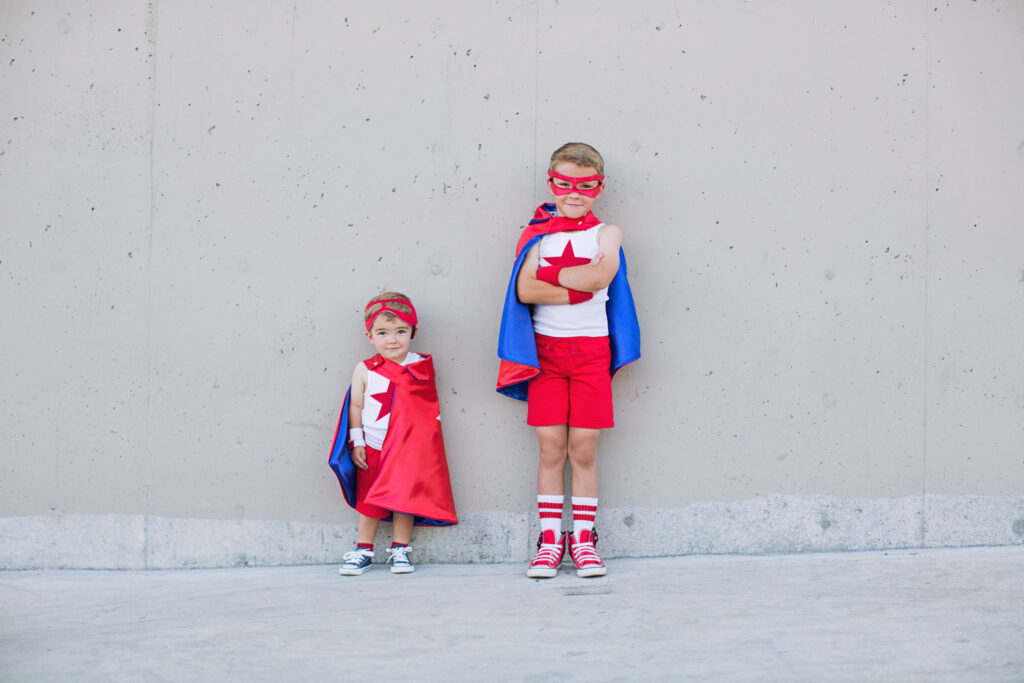
Children love to dress up as superheroes. Every Purim, a parade of Marvel and DC comics’ best and biggest show up in the synagogue, ready to sound their graggers. The costumes may seem cute to us, kids offering an homage to their favorite TV characters. But actually, by wearing costumes, they are preparing themselves for a true Jewish future; one day, they too might have to step up and be superheroes. And that is exactly what Purim is about.

Those children who once dressed up as Batman and Superman are now superheroes, just without the cape.

Endless stories tell of the heroism of everyday people. Two brothers, Noam and Yishai Slotki of Beersheva, both young fathers, rushed to Kibbutz Alumim on the morning of October 7th to fight Hamas; both ended up falling in battle. Rami Davidian, an oil and gas salesman, saved hundreds of people from the Nova festival; at one point, he impersonated being a member of Hamas and got a group of terrorists to turn over to him a young woman they had captured. After an army unit finally arrived at her home in Kfar Aza, Gali Ayalon, a 15-year-old, became a virtual scout for them, guiding them by text message to the homes where people were hiding.

The exceptional bravery of the ordinary Israeli inspired the group Hatikvah 6 to compose the song “Superheroes,” which was just released a few weeks ago. The lyrics are about how ordinary people, teachers, lawyers, electricians, and bus drivers, are taking on remarkable tasks in this war against Hamas.

The song goes on to explain:

It’s true that everyone here looks normal,

But we are a nation of superheroes

There is always a soldier hidden within

Ready to save the world…

And it doesn’t matter if in the middle of life,

or in the middle of a soccer game

Everyone will drop everything in a second if our country calls them

This is not a parallel universe or a Marvel comics reality

This is our story – the people of Israel

Yes, they are ordinary superheroes. And they’ve been training for that role every Purim since the days of Esther and Mordechai.


Rabbi Chaim Steinmetz is the Senior Rabbi of Congregation Kehilath Jeshurun in New York.

Ordinary Superheroes Read More »

The New American Reality: Implications for the Jewish Community

There are various factors that are reshaping the American story, which has profound implications for America’s Jews.

George Packer seeks to capture these new realities, when he writes: “The large currents of the past generation—deindustrialization, the flattening of average wages, the financialization of the economy, income inequality, the growth of information technology, the flood of money into Washington, the rise of the political right—all had their origins in the late 70s. The US became more entrepreneurial and less bureaucratic, more individualistic and less communitarian, more free and less equal, more tolerant, and less fair. Banking and technology, concentrated on the coasts, turned into engines of wealth, replacing the world of stuff with the world of bits, but without creating broad prosperity, while the heartland hollowed out. The institutions that had been the foundation of middle-class democracy, from public schools and secure jobs to flourishing newspapers and functioning legislatures, were set on the course of a long decline.”

Four core elements help to frame the nature and scope of the changes we are experiencing as a society:

  • The demographic character of America is being recreated.
  • The political culture of this society is experiencing new and significant stresses and threats.
  • The American economic story is transitioning in significant and challenging ways.
  • The role and place of religion in the United States is undergoing profound change.

Let’s take a deeper dive into some of these transformative and challenging trends, unpacking their significance both for our general society and most certainly for the Jewish community.

Racial and Religious Hatred, Along with Populist Nationalism, Are Changing America

Religious prejudice and ethnic hatred have deep roots in American cultural history. Over the past century, extreme forms of nationalism have generated various forms of political extremism, including expressions of antisemitism. Just as these forms of religious prejudice and excessive nationalism are being manifested on the right, other expressions from the progressive left have made the political marketplace far more challenging. In this environment, anti-Israel messages and anti-Jewish sentiments have become emergent themes. In response, we will need to devise a new paradigm that is responsive to these new threats to Judaism, Zionism and the State of Israel.

Religion in America is in a Deep Tailspin

As referenced in my earlier work, American religious life is undergoing a fundamental transition. A newly released Pew Study shows that “four-in-ten U.S. adults … lament what they perceive as religion’s declining influence on American society, while fewer than two-in-ten say they think religion is losing influence in American life and that this is a good thing.”

What is this emerging reality likely to mean for American Judaism? Despite the data that many Americans identify as “unchurched,” there is nonetheless a profound interest around spirituality and the search for “community.” Here is where Judaism can make a profound and significant contribution, as Americans struggle in finding personal meaning and in recapturing a sense of community.

The Character and Content of America Itself is Changing

As basic ideas such as pluralism and the celebration of core freedoms come under assault, the Jewish tradition’s focus on liberty may offer some valuable insights for American audiences. Jews believe that these religious principles are central to their American identity, while offering to the society some meaningful insights into how Jewish thought valued the ideals of freedom and justice.

The Great American Demographic and Generational Shift is Underway

Among the significant outcomes that will change the religious equation in this country, Islam will replace Judaism as this nation’s third major religious community (Catholicism, Protestantism, and Judaism).

A Wall Street Journal story focuses on another aspect of the demographic shifts now underway. “The U.S. is at the beginning of a tidal wave of homes hitting the market (21 million) on the scale of the housing bubble in the mid-2000s. This time it won’t be driven by overbuilding, easy credit or irrational exuberance, but by an inevitable fact of life: the passing of the baby boomer generation.”

The demographic transitions within this nation are also contributing to the formation of a multi-racial, multi-ethnic social order. Millennials and Gen Z are reshaping the cultural norms and social behaviors of 21stcentury America. This new generational and demographic paradigm will be key to the reframing of 21st-century American Jewish life and thought.

The Fourth American Economic Revolution is at Hand

 As technology, trade and consumer behaviors drive the new economy, the American economy will experience  an array of new challenges, involving job losses, the rise of artificial intelligence and the presence of a changing marketplace contributing to the reorientation of the idea of work and the retooling of this nation’s workforce.

The “Creative Edge” Has Dissipated

 The “creative edge” once uniquely defined the America story, but today such creativity is no longer so dominant. That intellectual spark that distinguished Americans within the arts, sciences and humanities appears to be diminishing. Some analysts believe that this nation is shifting from a culture of innovation to a mindset of preservation.

The “creative edge” once uniquely defined the America story, but today such creativity is no longer so dominant.

Where once science and industry were the hallmarks of research investment and development, today the accumulation of financial resources is the new measure of entrepreneurship. Correspondingly, in this new Gilded Age, are Jewish Americans modeling a similar pattern of accommodation to the existing order, no longer being seen as innovative pathfinders?

The Communications Revolution is Altering our Relationships and Connections

Operating in this new social media environment will represent a fundamental challenge. The revolution taking place is reinventing both the forms of communication and the rewiring of our networks of engagement. Our connections with other individuals, institutions and ideas are being reframed in an age where texting, X accounts, and the cell phone have reoriented how we communicate and with whom. How we receive and employ news, frame ideas, and build arguments are all radically changing.

In the process of undoing the ways individuals engage, we have also changed the content of our relationships. Truth, once seen as a noun, fixed in place and sacred in meaning, has taken on the character of becoming an adjective. Facts are seen as a relative proposition, subject to circumstance, convenience and context.

Voluntarism: A Core American Value in Free Fall 

One of the measures that defined the uniqueness of this society has been voluntarism: “Today, fewer Americans are volunteering their time and money on a regular basis. The national volunteer rate has not surpassed 28.8 percent since 2005, and in 2015, it dipped to its lowest, at 24.9 percent.”

Volunteering has been seen as a distinctive American practice, and with its decline, is our nation losing one of its core social attributes?

Jews emulated this concept of voluntary engagement in support of their communal and civic institutions. With lifestyle changes and a transformative economic environment, one can readily account for the undoing of this volunteer cultural model.

Political and Social Crisis Are Re-Engineering Beliefs 

People are questioning systems, while still believing that government can be responsive to societal needs, even if it often isn’t. The concurrent belief that the system is “rigged” has become a more dominant part of American culture. When a society losses trust in its core institutions, minority communities are most directly impacted. A shared acceptance in connection with both the values and instruments of government provides protection and security for groups more marginal to a society. For Jews who have long been invested in the American story, observing such a political disconnect should be seen as alarming and unsettling.

Demise of Community and Absence of Leadership

Lastly, but clearly significant, the demise of community and the weakening of Jewish institutional leadership both appear to be significant 21st-century trends. In a society marked by division, the undermining of institutions and the unraveling of confidence in leadership represent two major structural outcomes. Just as we see these trends present within the broader society, these patterns are evident as well within the Jewish community.

Each of these trend lines, introduced above, have broad implications for society and a specific impact on Jews. As the economic, cultural, social and demographic features of this nation undergo significant change, these forces will continue to influence both the content and direction of Jewish life in America.

This is a moment for the Jewish leaders and communal institutions in alignment with other religious, civic and political groups to mobilize national think tanks, university leadership and corporate executives in framing ideas about the future of the “American story.” These essential conversations that need to take place require bipartisan and cross-cultural engagement if we are to re-envision the American dream.


Dr. Steven Windmueller is an Emeritus Professor of Jewish Communal Studies at HUC-JIR, Los Angeles. His writings can be found on his website, www.thewindreport.com.

The New American Reality: Implications for the Jewish Community Read More »