fbpx

March 6, 2024

“Some of My Friends Were Crying”: Jewish Students Testify in Congress on Campus Antisemitism

On Feb. 29, students from some of the nation’s top universities shared their experiences in dealing with antisemitism on campus since the Oct. 7 massacre in a bipartisan roundtable hosted by the U.S. House Committee on Education and the Workforce.

Columbia University student Eden Yadegar, whose parents fled from Iran 45 years ago, told the roundtable that she, a Middle East Studies and Jewish Studies double major, could not register for a course on Israel because it was taught by a professor who celebrated the Oct. 7 massacre as “awesome,” “jubilant” and an achievement. Yadegar proceeded to list various instances of antisemitism that have occurred on campus, including people shouting “F— the Jews” and bulletin boards being “smeared with posters promoting age-old antisemitic tropes depicting Jews and Israelis as animals.” She also claimed that university staff provided those conducting an unauthorized “teach-in” in the lobby of a university building on the Oct. 7 “counteroffensive” with umbrellas so they could hide their faces from being recorded. The university also asked Jews and Israelis to leave the building, Yadegar alleged. 

Additionally, a “Jewish student was attacked with a stick outside of the library” and “another was surrounded by an angry mob who demanded ‘Keep f—ing running’ during an anti-Israel protest,” Yadegar said.

“At Columbia University, the Jewish community is alone,” she continued. “We are ostracized, mocked, harassed, assaulted and scapegoated, simply because of our identities. Students have removed their kippot and Jewish star necklaces for fear of becoming a target on campus. We cautiously map the routes we take to class to avoid being yelled at, spit on, accused of committing genocide, or threatened by calls for genocide. We have received no support from our administration, and minimal from our non-Jewish professors and the majority of our non-Jewish peers.”

Cooper Union student Jacob Khalili recalled being inside the school library in October when anti-Israel protesters banged on the locked doors and glass walls of the library while espousing “hateful chants … Some of my friends were crying, and several of us were texting loved ones and alumni for help,” he said. “Some called the police. Neither campus security nor police removed the demonstrators.  To our relief, the demonstrators eventually left the building.” 

Additionally, “we were later shocked to learn that President Sparks was offered but refused police intervention,” Khalili continued. “We were also told by a member of administration that, to avoid the demonstrators, President Sparks herself had ducked out of the building through a back exit.”

To this day, none of the protesters involved in that incident have been disciplined by the school, claimed Khalili.

UC Berkeley student Hannah Beth Schlacter gave a lengthy testimony on the “25-year history of anti-Jewish hostility,” including the recent Feb. 26 incident when pro-Palestinian protesters shut down a scheduled lecture of Israeli attorney and former Israel Defense Force (IDF) member Ran Bar-Yoshafat. “Instead of terminating the mob and forcing the riot to end by removing protesters, UCPD [UC Berkeley Police Department] forced the Jewish students to cancel their event. Jewish students were then evacuated for their safety,” said Schlachter. “The consistent message the university put forth afterwards was that they were understaffed — they did not have more police officers to send — and that the event was unprecedented. Despite all of this, it is crucial to note that when Jewish students first raised concerns for their safety regarding the event, UCPD said they would not bring security. More alarming, when Jewish students shared images with the police of what was promoting the riot — including fighting language, reference to a specific time and place — the police did not treat it as a direct threat.”

Harvard student Shabbos Kestenbaum, a descendant of Holocaust survivors, recounted several antisemitic incidents on campus in January, including posters calling for the release of the hostages being vandalized with messages like “Israel did 9/11” scrawled on the posters; a poster of baby Kfir Bibas had “evidence needed, head still on” written on it. The university has not done anything about this incident, Kestenbaum said. Kestenbaum also alleged that a “Harvard employee posted a video to his social media waving a machete with a picture of my face and other prominent Jewish activists, declaring his intention to ‘fight’ and ‘have a master plan that he won’t get into right now.’” Despite reporting this employee to Harvard, the university still employs this person, Kestenbaum claimed.

Following the now-infamous testimony of then-Harvard President Claudine Gay, who said it “depends on the context” whether calls for genocide against Jews violate university policy, the university formed an “Antisemitism Advisory group” that “disbanded” because it “was so remarkably ineffective,” Kestenbaum said. Now the university has a new Antisemitism Task Force that “is so remarkably ineffective that its most effective member and co-chair, Raffaella Sadun, recently resigned. The other co-chair, Derek Penslar, has claimed that antisemitism at Harvard is ‘exaggerated.’” Kestenbaum later added: “I know of Jewish students at Harvard who do not wear their kippahs publicly anymore, have changed majors due to hostile anti-Israel environments, have been spat on for their religious identity, and more.”

“We are not Jews with trembling knees … We are proud Jews who carry with us the tradition of resilience in the face of persecution, and we will not be silenced.” – Eden Yanegar 

But the students remain undeterred in their fight. “We are not Jews with trembling knees,” Yadegar declared. “We are proud Jews who carry with us the tradition of resilience in the face of persecution, and we will not be silenced.”

The other students that testified were Joe Gindi from Rutgers University, Kevin Feigelis from Stanford University, Noah Rubin from the University of Pennsylvania, Talia Khan from MIT and Yasmeen Ohebsion from Tulane University. Their testimonies were not under oath.

Rep. Virginia Foxx (R-N.C.), who chairs the committee, said before the students shared their testimonies, “Even after December’s hearing, university leaders are still not correcting course. Let me be clear: This is not about policing speech or opinions, even if disagreeable or offensive. It is about protecting Jewish students from the harassment, threats, intimidation, and assaults plaguing their campuses — as universities are obligated to under Title VI but have repeatedly failed to do. That failure is unacceptable.” Foxx also lauded the students’ “leadership in combating antisemitism on your campuses and having the courage to speak out. Your testimonies will help inform the Committee’s ongoing investigation into antisemitism in postsecondary education.”
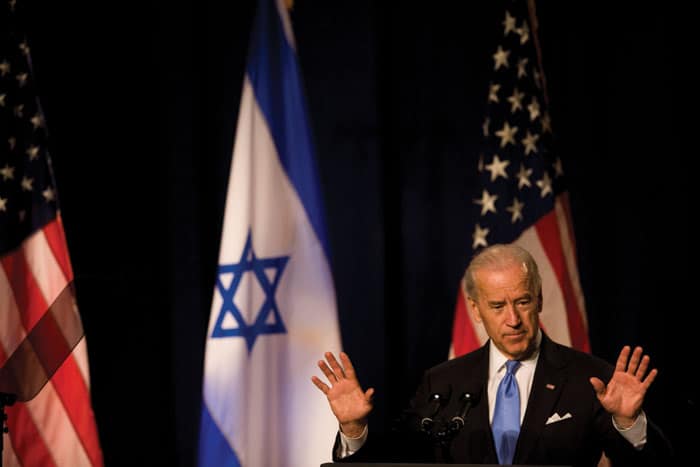
“Some of My Friends Were Crying”: Jewish Students Testify in Congress on Campus Antisemitism Read More »

Trouble in the Polls, for Both Biden and Israel

We all know the cliches. 

The only poll that matters is on Election Day. Polls are just a snapshot in time. People change their minds when they learn new information, so polls can always change.

All of these familiar bromides are true, but they also represent a convenient way for committed partisans — in both parties and on all issues — to deny political reality when it is inconvenient or does not reflect our own wishes. The majority of American Jews are supporters of both Joe Biden and of Israel, which means that many members of our community are currently struggling to digest, diminish or deny recent polls that show both the U.S. president and the Jewish state losing ground with American voters.

A new round of national surveys has been released in recent days, showing Biden continuing to run behind Donald Trump and demonstrating that the voters’ faith in the president on the economy, immigration and other key issues is decidedly lacking. Perhaps the biggest concern for the president’s reelection team has been their candidate’s difficulty in securing the Democratic base, especially young people, Black and Latino voters and other progressives. The voters who should be most enthusiastic in support of their nominee are aggressively diffident toward him, and their impatience with his progress on issues like climate change, police reform and voting protections has been exacerbated by their overwhelming opposition to his approach in the Middle East and his support for Israel in the Gaza War.

As the war continues, Israel has also struggled in its efforts to retain American popular support. A Wall Street Journal poll released over the weekend (https://www.wsj.com/politics/u-s-voter-sympathy-for-palestinians-grows-as-israel-war-drags-on-wsj-poll-finds-e515aab9) demonstrates the challenge: more than 40% of voters in this country now believe that Israel has “gone too far” in its response to the Hamas terrorist attacks, more than doubling the 19% who think the Israelis have not gone far enough. (Twenty-four percent say the response has been about right.) 

Public opinion polls are most reliable when we look not just at the raw numbers, but rather at the up or down trajectory as time passes. For example, a candidate with 52% support may or may not be ahead of their opponent, but if trends from previous polls shows that level of support rising, we can assume that their candidacy is heading in the right direction. Conversely, if that same candidate was at 60% in earlier polling, things are clearly headed in the wrong direction.

When the Wall Street Journal took the same poll in December, 26% of Americans said that the U.S. was doing too little to help the Palestinians. By last week, that number had risen to 33%. Similarly, the most recent Journal poll showed that 30% of respondents thought the U.S. was doing too much to help the Israeli people. Two months earlier, only 22% answered the same question affirmatively. A several point shift such as this should be a matter of concern to us, but if these tendencies continue in this direction, our worries should be much greater.

Neither the polling on Biden or Israel should be taken with absolute faith by supporters of either. Polls do change. But they don’t change by themselves. They change when a determined group of advocates for a candidate or cause decide to take on that challenge – and when they are willing to see the world as it is rather than as they hope it will be.

It’s time to broaden our Israel outreach to communicate with those who don’t already agree with us — a much less pleasant task, but a much more productive one.

Biden might beat Trump this fall, but he will need to motivate young people, minority voters and other progressives to turn out for him. Israel too, can win back these same voters, but it will not happen easily or quickly. Most of these audiences have only been hearing one side of the argument for many years, because most of us in the pro-Israel community have been content to talk only to each other. It’s time to broaden our outreach to communicate with those who don’t already agree with us — a much less pleasant task, but a much more productive one.


Dan Schnur is the U.S. Politics Editor for the Jewish Journal. He teaches courses in politics, communications, and leadership at UC Berkeley, USC and Pepperdine. He hosts the monthly webinar “The Dan Schnur Political Report” for the Los Angeles World Affairs Council & Town Hall. Follow Dan’s work at www.danschnurpolitics.com.

Trouble in the Polls, for Both Biden and Israel Read More »

Three Contemporary Political Ideas That Are Important to America’s Jews

The rise of national conservatism, the return to populist politics, and the presence of Christian Nationalism represent a set of political ideas that are challenging traditional beliefs and practices. Each of these movements will be significant to the 2024 election. Accordingly, it becomes important to understand the impetus and development of these ideas, in addition to how they are shaping this year’s campaign and the policy positions of particular candidates, as well as how they are attracting the attention of prospective voters. More directly, how do these three political tools impact America’s Jews?

What is National Conservatism?

“National Conservatism” represents a set of beliefs that serves as central ideological themes for various political parties, candidates and even national policies across the globe. It differs from traditional conservative political thought in a variety of ways. The seeds of this philosophy have been emerging over the past 50 years, but its actual impact is only now being experienced.

The argument that undergirds this movement is linked to its supporters’ belief that many liberal societies are in decline and that the evolution of this alternative political approach seeks to reverse these negative trends. At its base, national conservatism is about the preservation of certain core social values. If we see liberal societies, for example, promoting church-state separation, multiculturalism, and DEI (Diversity, Equity, and Inclusion), by contrast, what we observe with national conservatist regimes involves a commitment to the public role of religion, the promotion of family values, and specific attention to monoculturalism. Where liberal governments are advancing immigration, internationalism and multilateralism, one can find policy positions supported by national conservatives designed to restrict immigration and to foster a foreign policy built around isolationism, militarism and unilateralism.

Some of the current manifestations of this political philosophy are represented by governing parties today in Hungary, India, Russia and even Israel. Around the world there are various political parties that embrace national conservativism. Donald Trump’s 2024 campaign messaging draws from these ideas as well. As a result, the former president’s views on NATO, immigration and culture are extracted from the national conservative playbook. National conservatism is now a part of the American political story.

One of the leading architects of this new ideology is Dr. Yoram Hazony, an Israeli American whose books “The Virtue of Nationalism” and “Conservatism: A Rediscovery” have had a profound influence on Western political thought and practice.

Another ideological godfather is Patrick Deneen, a Professor of Political Science at Notre Dame. Deneen argues that to achieve “common good conservatism” a society must “radically overthrow the liberal ideology of progress” and replace of the current elite structure with a “better aristocracy” brought about by “muscular populism.” In advancing the “common good Deneen seeks to promote the unity between the state and church. He argues that liberal elites have failed in being responsive to the social and economic concerns of the public  and as a result are only serving their self-interests. In building his case, Deneen charges liberal regimes with failing to preserve limited government and to maximize the political representation of the populace.

As a number of these ideas run counter to democratic liberal perspectives, many Jewish voters and some Jewish organizations have pushed back against this movement and its various political spokespersons. In turn, sectors of the Orthodox Jewish community and some mainstream Jewish conservatives have embraced national conservatism, believing that its ideas reflect their political and cultural values.

Unpacking “Populism”

Populism has a long history within American politics and culture. President Andrew Jackson in many ways employed “populist” ideas to further his Presidential agenda in the 1830s. The “Populist Party” was formed in the 1890s, allowing William Jennings Bryan to build a movement of disaffected voters to mobilize around his 1896 presidential campaign. Indeed, populist ideas and personalities would continue to be present throughout the 20th century, and such figures as Huey Long, George Wallace and Ross Perot sought to play off such notions in their respective presidential campaigns. Trump’s 2024 campaign employs a number of these populist elements.

Populism has a long history within American politics and culture.

Some of the core features of populism, posted below, are best described by Dan Misch:

  • A particular focus on the homogeneous nature of the population.
  • Populists communicate directly to the masses bypassing media and other venues to address their concerns.
  • While expressing a call for unity, its leaders condemn their political opponents.
  • Populists tend to simplify politics, while challenging traditional democratic practices.
  • In seeking to explain why the masses are struggling, populists attack the elites for their economic power and control.
  • Populism opposes large business and financial interests.
  • At times, populist politicians employ conspiratorial ideas and seek to promote alternative realities.

With both populism and national conservatism there are strains of antisemitic beliefs and behaviors, and we can identify various political actors who have employed anti-Jewish messaging as part of their campaign strategy.

The Impact of Christian Nationalism

The author and pastor Matthew McCullough defines Christian nationalism as “an understanding of American identity and significance held by Christians wherein the nation is a central actor in the world-historical purposes of the Christian God.”

Its adherents hold that the United States is meant to be a Christian nation and seek to “take back” America for God. This ideology, aligned with the more radical Christian Identity movement, supports the presence of Christian symbols in the public square, promotes the idea that Christmas ought to be observed as a national holiday and that nativity scenes should be broadly exhibited, and endorses prayer in public settings including schools. Author Bradley Onishi has described this theologically infused political ideology as a “national renewal project that envisions a pure American body that is heterosexual, white, native-born, that speaks English as a first language, and that is thoroughly patriarchal.”

Former President Trump recently promised “to use a second term to defend Christian values against those on the Left who ‘want to tear down crosses where they can and cover them up with social justice flags.’”

Reflections

As we move into the 2024 election, these ideas are likely to be significant factors. No doubt, some of the messaging we will see during this campaign season will reflect these respective movements. Unpacking these ideas reminds us that candidates and their handlers construct campaigns employing specific themes to which they believe their core constituencies will be particularly responsive.


Dr. Steven Windmueller is an Emeritus Professor of Jewish Communal Studies at the Jack H. Skirball Campus of HUC-JIR, Los Angeles. His writings can be found on his webpage, www.thewindreport.com.

Three Contemporary Political Ideas That Are Important to America’s Jews Read More »

Phil and Lily Rosenthal: “Just Try It,” Food Adventures and the Joy of Eating

Do all Jews love food as much as Phil and Lily Rosenthal? Possibly.

Do all cultures have some sort of food affinity? Definitely.

“In every culture, there’s this pride and this feeling that we love food the most,” actress, writer and producer Lily Rosenthal, told the Journal.

“If you talk to a Chinese person, they say you’ll never eat more than in a Chinese person’s house,” Phil Rosenthal,creator and host of “Somebody Feed Phil” on Netflix, told the Journal. “If you say you go to a Greek person, they’ll say [the way] you tell you’re at a Greek person’s house [is] there’s no space between the dishes.”

Same with Italians. Phil, who also created “Everybody Loves Raymond” adds that if you go to Ray Romano’s mother’s house, you never tell her you are full.

“Every culture loves food; we don’t own that,” he said. “I will say, though. if you’re Jewish, you love food.”

In addition to being a fun and enthusiastic father-daughter team, Phil and Lily Rosenthal are the authors of, “Just Try It!” a children’s book, beautifully illustrated by Luke Flowers. “Just Try it!” is a semi-autobiographical story about a food-loving dad encouraging his picky eater daughter to try something new at a food truck festival.

A couple of years ago, Phil got a text from Lily, suggesting he write a kids book, since so many children love “Somebody Feed Phil.”

“They’re trying foods all the time,” Lily said. “They’re cooking because of him.”

He texted back, saying. “Yes. If you do it with me.”

The book is loosely based on their relationship, though a bit exaggerated for creative purposes.

“I didn’t love mustard, I didn’t love crust on a sandwich,” she said. “I still don’t love it, but I tried it.“

She adds, “You could be a bite away from your new favorite food.”

The point of the book is for kids to be as excited as “the dad” is to try new things.

“I meet a lot of grownups who won’t try things,” Phil said. “So [the book] is for them, too”.

As much as the Rosenthals love food, neither of them actually cooks.

“I used to fool the children into thinking that I was an amazing chef,” Phil said.

Lily explained how he would make “Daddy’s famous peanut butter and jelly sandwich [and] Daddy’s famous bowl of cereal.”

While Lily can prepare some things, she would never consider herself a cook. However, she found a workaround.

“If you can’t cook, but your family loves food, you do something for them,” she said. “You date a chef.”

Lily’s favorite Jewish food is her perfect bagel.

“Let me paint a picture,” she said. “It would be the bagel first and then scallion cream cheese, and then [I press] the capers [into the cream cheese], so they don’t roll off. Then she adds the tomato and onion; the lox on top.

While Phil loves all food, especially pizza (“I could live on pizza, because pizza can be ever-changing,” he said. “It’s a blank canvas for you to paint on.”), his favorite Jewish food is his mom’s matzo ball soup.

“People ask me what my last meal would be, and I say, childhood favorites: pizza, hot dogs, fried chicken, roast chicken. burgers, cookies, things like that.,” Phil said. “ But I would then finish with matzo ball soup, because … that would take me right back to my earliest [food] memory.”

Lily’s earliest food memory is from when she went to Jewish elementary school. She took pride in being on the committee that delivered challahs to each classroom on Fridays.

“If you were lucky, your parents would order the chocolate chip challah,” she said. “And [they] would make you challah French toast the next day, after Shabbat, with the leftover challah.”

The Rosenthal family has a new diner opening soon in the LA-area. From this conversation, it sounds like that chocolate chip challah may be added to the menu.

“It’s named after my grandparents, my dad’s mom and dad,” Lily said. “It’s going to be called Max and Helens.”

Some people eat for fuel, and that’s okay.

“I just don’t want to go out with them,” Phil said.

“Everybody’s different, everybody has their own feeling,” Lily said. “We find so much joy in food, we can’t imagine such a thing.”

“It’s like the center of our social life,” Phil said.

Lily talks about how family vacations are planned around eating.

“If we’re having a big lunch [we’ll] go light for dinner,” Lily said. “It’s a strategic thing. At every meal, he’s planning his next one.”

“Just Try It” is more than just a book about food. It’s an illustration of their family philosophy. It’s about having a little bit of an open mind.

“It’s all about broadening horizons, whatever that looks like,” Lily said. “For us, it’s food.”

“I’ve never been a particularly brave person, but I felt like every time I took a baby step out of my comfort zone, and you see it in the show, that’s where the magic happens,” Phil said. “That’s where you grow as a person.”

Learn more about “Let’s Try It!,” “Somebody Feed Phil” and their upcoming events at PhilRosenthalWorld.com.

For the full conversation, listen to the podcast:


Debra Eckerling is a writer for the Jewish Journal and the host of “Taste Buds with Deb.Subscribe on YouTube or your favorite podcast platform. Email Debra: tastebuds@jewishjournal.com.

Phil and Lily Rosenthal: “Just Try It,” Food Adventures and the Joy of Eating Read More »