fbpx

March 6, 2024

Rosner’s Domain | Deciphering Kamala Harris’ Speech

Let’s assume that when Vice President Kamala Harris decided to speak about Israel and Hamas March 3, it was not an off-the-cuff decision. Let’s assume her speech was thought through, that it had a certain purpose, and that her imminent meeting with Minister Benny Gantz, a member of Israel’s war cabinet, was on her mind. Let’s assume the speech was meant as a message – and let’s try to decipher this message. Does it make sense?

You can read the whole thing. It isn’t long or complicated. And yet, it is difficult to understand. Why? Let’s see what she says, line by line.

“I must address the humanitarian crisis in Gaza.” No, she does not. She wants to address it, but doesn’t have to. A decision to address it is a decision to direct a spotlight at something: Gazans are suffering. It is a decision to emphasize something that complicates the war effort, and could erode Israel’s ability to achieve its objectives. Harris made the choice, maybe because she cares about human suffering, maybe because of political considerations, maybe because she doesn’t believe Israel can achieve its goals. We don’t know why she made this choice, because her speech doesn’t include an explanation. 

“Too many innocent Palestinians have been killed.” Had she said “many,” it would have been a state of fact. But she said “too many.” What does “too many” mean? It means that the aim doesn’t justify the cost. Compare this situation to one that Ross Douthat described in a recent New York Times column: “Retaking Mosul from the Islamic State’s fighters … left between 9,000 and 11,000 inhabitants of the city dead.” Now try Harris’ description on that calamity: She could say “many innocent residents of Mosul have been killed.” She could say “too many innocent residents of Mosul have been killed.” The latter means one of two things: Either that U.S. forces could have achieved the same result with fewer civilian casualties – or that retaking Mosul from the Islamic State was not worth the cost in human life. Which of these two critiques does she level at Israel? 

“The Israeli government must do more to significantly increase the flow of aid.”  This is concrete and understandable. Harris sees people suffer, she demands they get more food and aid. But let’s see what she says next: “They must not impose any unnecessary restrictions on the delivery of aid.” They – namely Israel – must not impose unnecessary restrictions. Well, that’s obvious, isn’t it? Why would anyone do something that’s unnecessary? Clearly, what she means to say, and that’s quite clear, is that Israel does impose unnecessary restrictions. Let’s see what else Harris says.

“Hamas cannot control Gaza, and the threat Hamas poses to the people of Israel must be eliminated.” This is a strong statement. It means that the U.S., at its core, still supports Israel’s stated aim of the war: eliminate Hamas rule. But how does one eliminate Hamas rule? By waging war. And what happens in such a war? People suffer. One can’t conquer Mosul – or Gaza – without extracting cost. But since Harris is still on board concerning the goal of the war, the criticism she levels at Israel is apparently of the first type we mentioned: “the same result could be achieved with less civilian casualties”.

But here’s a question Harris does not answer: What would be the trade-off? I see three options. One – she believes that there can be less human suffering at no cost. If that’s her assumption, it’s easy to understand her sentiment, but let’s say that such an assumption is not realistic. There must be a trade-off involved in any change of war tactic. Two – she believes that Israel can take more risks to its own soldiers, as it attempts to ease the suffering of Gazans. If that’s the case, Israelis beg to disagree (and Americans would also disagree had she proposed a similar remedy in the case of American soldiers in Mosul).  Three – she is willing to risk Israel’s ability to come out victorious from the war. In such a case, her “Hamas cannot control Gaza” part of the speech is less than genuine. 

“Hamas claims it wants a ceasefire.  Well, there is a deal on the table.  And as we have said, Hamas needs to agree to that deal.”  This is where I got confused. Is Harris sending a message to Israel or Hamas? Let’s say Hamas does not accept Harris’ demand — does this cancel her previous demands of Israel? Or maybe she sees these two demands (Hamas accepts a deal, Israel does not impose unnecessary restrictions) as separate and independent of one another? 

Let’s take her speech as a general guideline on what to do next. Is it a useful guideline, or just a wish list of things that can only be imagined as compatible in a speech rather than in reality?

Confusing or not, let’s assume she means well. Let’s take her speech as a general guideline on what to do next. Is it a useful guideline, or just a wish list of things that can only be imagined as compatible in a speech rather than in reality? 

As they say, only time will tell.

Something I wrote in Hebrew

The end of March is the deadline on Haredi draft negotiations, so this topic stays with us, and is a threat to the stability of the government. Here’s what I wrote this week: What will be the working tools of the ultra-Orthodox politicians in the draft negotiation? There will be three. First – a threat to overthrow the government. If the government falls, it will be impossible to move the draft forward for some time. The second tool is seduction. Give us what we want – they will say to Benny Gantz – and we will make you prime minister. The third tool is the control of details. The ultra-Orthodox will accept certain principles, but will make sure that the actual arrangement does not bring about a significant change in reality itself.

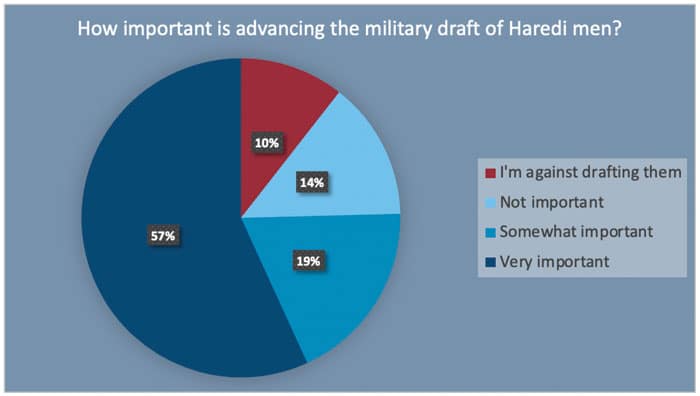
A week’s numbers

Opposition to the draft is law, but there’s strong resistance within the coalition parties.
A reader’s response:

Asher Katz wrote: “Do Israelis still think Biden is a friend?” My response: I’ll tell you next week, when I get the results of a new poll we commissioned. 


Shmuel Rosner is senior political editor. For more analysis of Israeli and international politics, visit Rosner’s Domain at jewishjournal.com/rosnersdomain.

Rosner’s Domain | Deciphering Kamala Harris’ Speech Read More »
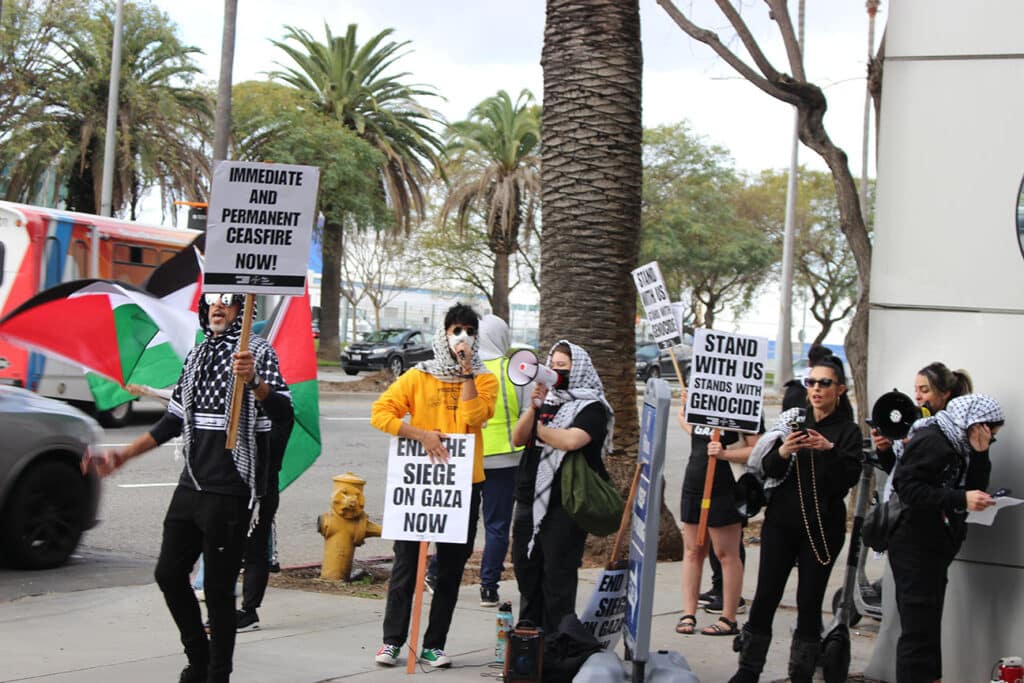
Pro-Palestinian Protest Outside First Day of StandWithUs Conference

A group of around 30-40 pro-Palestinian protesters gathered outside StandWithUs’ Israel in Focus International Conference on Friday, March 1.

The group stood outside the Los Angeles Airport Hilton from around 8 to11:30 a.m., holding signs with anti-Israel slogans: “StandWithUs Stands With Genocide,” “End the Siege on Gaza Now,” and “Defunding Israel Lies.” They also chanted slogans like “Zionists go back home, Palestine is ours alone.”

The night before, the Palestinian Youth Movement (PYM) posted to Instagram a call to “shut down the StandWithUs international conference in Los Angeles.”

At the beginning of the conference, StandWithUs Israel Executive Director Michael Dickson said, “Right now a hate group that celebrated the genocidal atrocities of Oct. 7 is outside protesting this conference.” Behind him was an image of an Instagram post from PYM that stated, “Long live Palestinian resistance” next to a picture of Israel followed by a promotion of a Oct. 9 rally.

“We will not be intimidated … no amount of hate will stop us. The people of Israel live. Am Yisrael Chai.” – Michael Dickson

“What these extremists don’t realize is that they’ve inspired generous supporters of StandWithUs to step up for all of us,” Dickson continued. “Starting now, for every minute this hate group spends, generous donors have committed that StandWithUs will receive at least 1,000 more dollars to the support the work that all of us are doing around the world.” He declared “we will not be intimidated” and “no amount of hate will stop us. The people of Israel live. Am Yisrael Chai.”

Rabbi Yossi Eilfort, founder of the nonprofit security organization Magen Am, told conference attendees that it’s better for the attendees to not give the protesters the engagement they seek and instead connect “with other students and [learn] more about what we’re doing … We really can’t be touched if we’re focused on what we’re doing, and that’s really part of community,” Eilfort said.

He pointed out that “when protesters march against us, against Israel, they come to the heart of Jewish communities and that’s where they do their marches. By contrast, our marches are in the heart of Jewish communities “because we love what’s behind us” whereas “our enemies” march out of hate, said Eilfort. “Let’s fight smart and let’s make sure we win.”


Pro-Palestinian Protest Outside First Day of StandWithUs Conference Read More »

Satirical Semite: Dating FAQs

The dating frontlines are crazier than ever, and 2024 promises to include even more lunacy. Clear patterns emerge if you hang around somewhere long enough. There are three commonly-asked questions that I get asked on dates. I wanted to answer “thank you for asking! I’ve written it all down in an article, and I’ll send you a link by AirDrop” (I don’t date people who use Android phones) but that wasn’t practical because I hadn’t written them down. Until now.

Question One that I get asked in 2024 is highly intrusive and dives straight into personal medical history. “Are you vaccinated?”. Yes, but the question is really a euphemism for “I believe the propaganda that COVID vaccines make people infertile, I want to have kids someday, so I want to know if your body is still fit for procreation, as well as recreation?”

I want to share that, yes I had two vaccine shots and one booster, no I wouldn’t have any more because I stopped believing in their efficacy, yes plenty of people have still had children after receiving a vaccine — including one of my best friends, whose two beautiful daughters are a living antidotes to this meshugas – and no, we will not be having a second date.

Question Two is more complex, and gets asked on 90% of dates: “Why haven’t you been married before?” Possible answers range from the respectful – “great question, I’m glad you asked” (except I’m not), the evasive – “don’t know”, the existentially bewildered – “ask Hashem!”, the paranoically-despairing – “it’s my sub-average looks!” “My off-center Jewish nose!” “My sub-6-foot Ashkenazically-challenged lack of height!”;  to the subject-deflecting “who do you think really blew up the Nordstream 2 pipeline?”

Admittedly the cadence of that paragraph does remind me of favorite monologue from my favorite 19th-century French play “Cyrano de Bergerac,” which in turn sounds like a completely pretentious sentence, but at this point in the date I’d willingly face rejection for pretension as a trade for having to sit through another minute of those dates.

The problem with the “Why haven’t you been married before?” line of questioning is that it feels too Freudian-therapy-on-a-couch for a relaxed getting-to-know-you conversation. 

The problem with the “Why haven’t you been married before?” line of questioning is that it feels too Freudian-therapy-on-a-couch for a relaxed getting-to-know-you conversation. It’s also the subtext for three other questions:  1) What is wrong with you that you’re still single?;  2) Do you have the emotional awareness to know what is wrong with you?; 3) Can you learn from that diagnosis, display the emotional intelligence to acknowledge your mistakes and personality faults, and have you taken sufficient action from this self-reflection to change course? 

At this point on the date I just want to talk about who really blew up the Nord Stream pipeline. Or anything else. Except question three. 

Question Three is “What are you looking for?”  Wrong answers include “someone just like my ex-girlfriend,” so a safe zone is something non-specific like “I’m looking for a smoking-hot heiress of child-bearing age with ailing parents and no siblings”.

Question Four is the nightmare. Fortunately it is rarely asked, but when it is, my cover has immediately been blown, it’s cards-on-the-table time, and there is nowhere to hide. It goes like this; “I did some research before meeting you, and wondered if I will end up being written about in one of your satirical dating columns?”

Obviously the answer is no! Definitely not. It’s probably unlikely. Well, it’s fair to say that it’s quite unlikely. It really depends on how bizarre the evening gets. And whether it turns into a story. The most honest answer would be “OK, everything has its price, if I can recoup some of the financial losses from these decades of tragicomedy dates by selling the story to the highest bidder, then it’s a “yes”,  at which point I pull out a release form from my briefcase, dial in my lawyer as a witness on Facetime, and ask my date to sign on the dotted line.

The best question of all time was “PLEASE can I get mentioned in one of your columns?” As a direct response to her question, hello to Rebecca in Chattanooga, Tennessee! (Obviously I have changed her name and location for both anonymity and discretion, since her name isn’t really Rebecca, but it’s Claire, and she lives in London, England).


Marcus J Freed is an actor, author, marketing consultant and founder of The Jewish Filmmakers Network. www.marcusjfreed.com, www.freedthinking.com and on social @marcusjfreed. 

Satirical Semite: Dating FAQs Read More »

A Palestinian State Isn’t a Reward for Hamas. It’s a Punishment.

The Biden administration is hard at work putting together a deal for Israel, Saudi Arabia, and the Palestinians that would involve the normalization of relations between Israel and Saudi Arabia alongside certain “irreversible” steps towards the creation of an independent Palestinian state. 

There are many good reasons to support such an initiative. There are also many good reasons to oppose it. Palestinian support for Hamas is high and the possibility that a Palestinian state would be an existential threat to Israel is not to be lightly dismissed. 

There are also bad reasons to oppose this initiative, one of which is that any talk of Palestinian statehood now—so soon after October 7th—would constitute a reward for Hamas for committing terrorist atrocities.

I’m not unmoved by this argument. The fact that October 7 and the subsequent war has put Palestinian statehood back on the international agenda could be said to send a powerful message that terrorism gets you what you want. But this line of thinking rests on the faulty assumption that Hamas wants a Palestinian state.

If Hamas wanted a state, they would have used Israel’s withdrawal from Gaza as an opportunity for state building and diplomacy. If they had demonstrated any intention to live as peaceful neighbors, it’s likely that further Israeli withdrawals in the West Bank would have followed.

They do not. If Hamas wanted a state, they would have used Israel’s withdrawal from Gaza as an opportunity for state building and diplomacy. If they had demonstrated any intention to live as peaceful neighbors, it’s likely that further Israeli withdrawals in the West Bank would have followed. Instead, they turned an opportunity into a nightmare—both for their own people and for the residents of Israel’s southern towns—a nightmare that has culminated in the horrors of the current war. 

That anyone fails to grasp this is beyond my comprehension. Hamas has said this plainly, to the New York Times no less. Their goal is that “that the state of war with Israel will become permanent.” 

Statehood would be a disaster for Hamas’ cause. If the Palestinians had their own sovereign state, the world would have much less patience for their belligerence against Israel. They might still have allies among the radical campus left, who would agree that Israeli Jews must be cleansed from all the land “from the river to the sea,” but most people would see Palestinian statehood as the end of this long bloody story and would hope to never hear of it again.

Were the new Palestinian state to demand that Palestinian refugees be allowed to “return” to Israel, it’s hard to see such a demand being taken seriously. Most people would take it for granted that Palestinian refugees may be repatriated to the newly formed Palestinian state and would be confused by demands for anything else.

Were the new Palestinian state to attack its neighbor, the international community would not see this as the justified lashing out of a subjugated minority. Rather, most people would start to view the Palestinians the way they view Iran today—as extremist troublemakers. 

Hamas knows this. So long as there is no Palestinian state, their case against Israel remains open. Once there is a Palestinian state, it’s closed. For good. 

There is reason to believe that the October 7 attacks were timed to disrupt previous normalization talks between Saudi Arabia and Israel. That deal, it was speculated, would have included “major concessions” to the Palestinians. If Israel lets Hamas’ horrifying assault succeed in extinguishing this progress towards regional peace, that truly would be a reward for terror. To continue with the negotiations—to push through war towards a better future—is a far more effective strategy.

A Palestinian state is chiefly desirable because Palestinians deserve to be in control of their own destiny. It’s also desirable because it would send a message—to extremist Palestinian factions and to the international community—that the debate about Israel’s existence is over. 

Implementing such a state in a way that won’t devolve into another Gaza and put Israelis at risk is a complicated problem to solve, but not an impossible one. Most importantly, it wouldn’t be a concession to Hamas. Indeed, it may be the only real way of defeating their ideology.


Matthew Schultz is a Jewish Journal columnist and rabbinical student at Hebrew College. He is the author of the essay collection “What Came Before” (Tupelo, 2020) and lives in Boston and Jerusalem.  

A Palestinian State Isn’t a Reward for Hamas. It’s a Punishment. Read More »

JNF-USA Luncheon Features Speech from Amb. Michael Oren

On the afternoon of Friday, Feb. 23, hundreds of JNF-USA donors and supporters gathered for the Brentwood Stand with Israel Luncheon at the Luxe Sunset Boulevard Hotel. There, they raised money for Israel, heard from pro-Israel speakers, celebrated JNF-USA’s accomplishments over the past few months and listened to a keynote speech from author and former Ambassador Michael Oren. 

According to Cynthia Hizami, director of planned giving, West Coast JNF-USA has raised $56 million for Israel since Oct. 7. 

“We have watched as the world has not judged Hamas for their pure evil, but blamed Jews and Israel,” she said. “But our bond with Israel is stronger than ever.”

Since the war in Israel broke out, JNF-USA has helped thousands of Israeli residents relocate to safer areas, started an emergency campaign to raise funds, offered volunteer trips to help rebuild the affected areas, distributed care packages to soldiers and offered psychotherapy to those who have been traumatized. 

“I see a coming together of the Jewish community at this very tough time,” United States Representative Brad Sherman (D-Sherman Oaks) said. We have a lot to do to support Israel.”

Sherman has been a leading voice to make Israel a visa-waiver country and got it implemented two months early so it could “apply at this very difficult time,” he said.  He brought an American flag and presented it to Jewish National Fund-USA Co-Presidents, Fred Toczek and Susie Satzman Toczek, for their community-building work. 

In his speech, Oren was insistent that when the world calls for a ceasefire in Gaza, “we have no choice but to fight. A ceasefire means Hamas wins. Hamas gets away with mass murder and we lose. Period.” The author of “2048: The Rejuvenated State” and “Ally: My Journey Across the American-Israeli Divide,” also discussed the uptick in antisemitism. “The Jewish community is experiencing antisemitism like I did when I was a kid, but a hundred times over, especially on college campuses,” he said. “It’s so lonely and painful.”

The former ambassador highlighted how Hamas indoctrinates Palestinian children from a young age, using their twisted version of “Sesame Street” to talk about “taking over the White House,” he said. “This is what they learn. Anyone who wants true peace between Israelis and Palestinians has to begin with reeducation. It simply won’t happen without that.”

Oren took a long view of the current war, citing prior conflicts and how they ultimately led to a positive result for Israel.

“Since 1948, we have to remind our enemies every couple of years that it’s not a good idea to attack us.” – Michael Oren

“Since 1948, we have to remind our enemies every couple of years that it’s not a good idea to attack us,” he said. “The Egyptians tried it four times … the U.S. waged a war on Germany and Japan to take down Germany and Japan, not to destroy their countries. [Hamas] absolutely wants to destroy us. And they failed. Eventually, the Egyptians realized it wasn’t a good idea and they made peace. The Jordanians realized it wasn’t a good idea. The Abraham Accords countries realized it wasn’t a good idea. Right now, we’re reminding Hamas it’s not a good idea.” 

When Israel isn’t at war and fighting for its life, it’s building itself up — just like it’s always done. “What do we do in the intervals of these actions?” Oren asked. “We built one of the most successful nation states on this planet. Israel is a super successful nation state.”

Despite all the issues that Israel is facing right now, what gives him hope is the fact that the Jewish community is so united in this moment. He pointed out how 360,000 reservists came back to serve in the IDF following Oct. 7, which was unprecedented, and how everyone is banding together to help Israel win the war and continue its mission as the world’s only Jewish state.

“We are a family, we are a mishpacha,” said Oren. “There is nothing like it.”

JNF-USA Luncheon Features Speech from Amb. Michael Oren Read More »

Richard Lewis: Punching Back at the Pain

“The best way to have an affair without feeling guilty is to sleep with your therapist.” – Richard Lewis

Richard Lewis had Parkinson’s disease and died from a heart attack. He was 76.  When the news broke of his death, the calls came in as if a member of my immediate family had passed. One after another, people texted and emailed me that they were sorry for my loss. So many people knew and loved him. 

That’s the thing about great comedians. People love them. They feel like they know them. A great comedian gets into your soul. They are the ones that many people go to when their lives get dark.

Like any boxer who had a rough childhood and comes out punching, so did Lewis. Instead of punching with his fists, he punched with his jokes. 

“I’m in Pain,” “I’m Exhausted,” “I’m Doomed” and “The Magical Misery Tour” are the names of four comedy specials written by and starring Lewis. His pain was his credentials — he wore it on his sleeve. Lewis also starred alongside Larry David in “Curb Your Enthusiasm.”  Larry David said after Lewis died, “He had the rare combination of being the funniest person and the sweetest. And today he made me sob and for that, I’ll never forgive him.”  

The first time I saw Lewis live was around 1975 at The Improvisation Club in Hell’s Kitchen New York on 44th and 9th. Lewis would destroy a crowd like so few before him and a handful since. He was dangerous. He was one of the best club comics in the history of nightclubs. 

When I was thinking about becoming a comic, seeing Lewis perform could have easily dissuaded me. Imagine you wanted to be a violinist and one of the first people you saw perform was Jascha Heifetz. When I saw Lewis, my head exploded. Lewis was my Heifetz. His pain was his Stradivarius. He was a genius. Like Michelangelo, he sculpted each comedy bit into perfection. 

At times he looked like a caged animal.  He ran his fingers through his hair, hair needing to be both cut and washed. He would confess his sins and foibles to a room of strangers while under a bright light looking worried and sweating like he was being interrogated. He would look down at the floor and then quickly lift his head to the skies. Free-formed and set loose, he would say almost anything about anything that gnawed at him. And the laughter from the crowd was proof he was not alone. 

More than any of his family, his audience got him. Lewis shared his pain on stage. And trust me, Lewis was in pain. I loved Richard Pryor and Lenny Bruce, who along with Lewis were the most honest and likable of all the soul-bearers. But I loved Lewis more because I could relate to him more since he was Jewish. 

Thank God, Lewis found stand-up comedy, both for his audience’s sake and for his. He said, “Comedy is the art of turning pain into laughter.” 

Lewis did something most comics can’t do.  He remained a force for most of his career. He said, “I’ve learned that laughter is the best response to adversity. It disarms life’s challenges and gives us the strength to keep going.” And Lewis had adversity. Lewis was an alcoholic and drug addict but thank God, got sober a few decades back. No more needing to dull his soul with drink and drugs. He faced his angst head-on while being clean and sober. I would call him yearly to congratulate him on his continuous sobriety.  

One of the last times I saw Lewis on stage was in Brea, California at The Improv. I sat slack-jawed and bewildered as to how someone could be that open and that funny. 

When I asked him to be on my podcast, he told me he was in too much physical pain. That was maybe two years ago. After multiple surgeries, Lewis’ pain was not relieved. So not only did he spend much of his life in mental anguish, but he also spent his last few years physically in pain.

He did what we are all supposed to do.  What God wants us to do. That is to lift the spirits of our fellow travelers.  

Everyone who knew Lewis spoke of how kind he was. He had a smile that could stop the rain. He did what we are all supposed to do.  What God wants us to do. That is to lift the spirits of our fellow travelers.


Mark Schiff is a comedian, actor and writer, and host of the ‘You Don’t Know Schiff’ podcast. His new book is “Why Not? Lessons on Comedy, Courage and Chutzpah.”

Richard Lewis: Punching Back at the Pain Read More »

A Lost Generation’s Deification of Aaron Bushnell

I saw it on social media first. There he was, a man wearing a U.S. Air Force uniform, dousing himself in flammable liquid and setting himself on fire in front of the Israeli embassy in Washington, D.C. “Free Palestine!” he yelled through the flames, as secret service agents rushed to douse them. My first thought was that regardless of his ideology, this was an incredible waste of a life. Undoubtedly he thought he was doing something honorable, that sacrificing his life in this way would save the life of someone else, and that people would respect him for what he had done. How tragically misguided, I thought. It’s indisputably clear that there are mental health struggles at play here, I thought. No one, I concluded, will praise such an act.

I could not have been more wrong.

Within hours, praise of Aaron Bushnell began to appear all over social media in progressive and anti-Israel circles. The man ablaze had been deified, had become a god to be worshipped, elevated to the highest level of selflessness and moral clarity. “We should all aspire to such selflessness” was the whisper that grew louder and louder in the passing hours.

Cornel West’s praise of Bushnell on X, receiving more than six million views, was perhaps the most shocking: “Let us never forget the extraordinary courage and commitment of brother Aaron Bushnell who died for truth and justice! I pray for his precious loved ones! Let us rededicate ourselves to genuine solidarity with Palestinians undergoing genocidal attacks in real time!” West, a consistently provocative academic, political activist and presidential candidate, has been outspoken about his support of Palestinian “resistance.” He has regularly accused Israel of genocide and apartheid, so he wasted no time in hijacking Bushnell’s self-immolation for his own platform by essentially deifying him.

It’s a reckless statement to make, especially given that, as Eylon Levy reminds us, suicide is “scientifically proven to be contagious.” But the higher the body count, the better. It turns out that Hamas’s strategy is also the strategy of many on the progressive left. The more bodies we can add to the pile, the more damning it is for Israel. Never mind the reality of how those bodies got there. And, come to think of it, never mind reality itself.

But West wasn’t the only one—not by a long shot. Predictably, Jewish Voice for Peace posted a thread honoring Bushnell’s act of “giving his life for justice,” calling self-immolation “a highly spiritual embodiment of one’s most deeply held values,” and stopping just short of naming Bushnell the next messiah. How such a statement figures into Jewish values is anyone’s guess. (Hint: it doesn’t.)

“Rest in power,” said Dr. Jill Stein, a presidential candidate with the Green Party and a medical doctor, using the words typically reserved for victims of racism. And in an episode of “Democracy Now!” Ann Wright, a retired U.S. Army colonel and former diplomat, called the self-immolation an “act of courage, an act of bravery, to call attention to U.S. policies.”

Using particularly disturbing rhetoric, Mohammed El-Kurd, The Nation’s Palestine Correspondent, posted on X in response to criticism of Bushnell: “You can’t protest peacefully. You can’t boycott. You can’t hunger strike. You can’t hijack planes. You can’t block traffic. You can’t throw Molotovs. You can’t self-immolate. You can’t heckle politicians. You can’t march. You can’t riot. You can’t dissent. You just can’t be.” In one post, suicide is transformed into the ultimate expression of being. Apparently there is no quicker ascendency to god-like status than via suicide.

The list of supporters, nearly breathless in their adulation of the man in flames, goes on and on. And these voices are joined by the ones who started this war in the first place.

Hamas put out a statement blaming President Biden for Bushnell’s self-immolation and saying that he had given his life “to shed light on the Zionist massacres and ethnic cleansing against our people in the Gaza Strip.” It’s no secret that Hamas values death, so this comes as no surprise. Martyrdom is valued above all else for the terrorist group, who also stated that Bushnell would “remain immortal in the memory of our Palestinian people and the free people of the world.” The gaslighting—no pun intended—is heavy here, given that Hamas’s control over the people of Gaza makes them anything but free.

The long list of supportive statements continues to grow. But words of support are eclipsed by actions. Several anti-Israel activist groups in Washington, D.C., Los Angeles, New York City, Cleveland, Houston and Atlanta among others have organized vigils in Bushnell’s honor in front of federal offices and Israeli consulates. Young people in particular have whipped themselves into a frenzy as they seek to lift up Bushnell’s spectacle of violence as the antidote to the violence they claim to abhor.

The irony is profound. Bushnell used fire and violence to protest the violence of a war that was started when Israeli families were burned alive by Hamas. But who remembers that inconvenient truth?

The irony is profound. Bushnell used fire and violence to protest the violence of a war that was started when Israeli families were burned alive by Hamas. But who remembers that inconvenient truth?

And speaking of remembering, it’s not that self-immolation is new. There have been others in recent history. But while some have been largely ignored, Bushnell’s self-immolation seems to have struck a different chord, especially among the generation that has been consumed with finding opportunities to express outrage and with rooting out so-called oppressors from society—an impulse for which we can thank DEI programs pushing Marxism rather than true tolerance. From the BLM marches and protests to the hysterics surrounding gender identity politics to the violent shouting down of campus speakers whose viewpoints they don’t agree with, an entire generation of young people has found its religion. 

That they need to find this new “religion” is exactly the problem. 

Over the past couple of decades religion in America has experienced a rapid decline. Christianity in general has taken a massive hit, given that approximately 31% of people raised Christian became unaffiliated between the ages of 15 and 29 (over a two-decade period ending in 2019), the “tumultuous period in which religious switching is concentrated.” An additional 7% of people raised Christian became unaffiliated later in life, after the age of 30.

And it’s not just Christians who are leaving the faith, though given that most religious people in America identify as Christian, a mass exodus from the Christian community matters. But a quick Google search reveals countless articles heralding the decline of religion in general in the lives of Americans. In 2023, only 16% of Americans surveyed said religion is the most important component of their lives, down from 20% a decade ago. Predictions are that this decline will continue. In America, those who belong to a church, synagogue or mosque are now in the minority. In their book “The Great Dechurching,” Jim Davis and Michael Graham write: “We are currently experiencing the largest and fastest religious shift in the history of our country.” In the last quarter century, around 40 million adults who used to attend church have stopped going.

So why does this matter? The issue isn’t that people have stopped believing in God or in the importance of religious ritual. The issue is that when people leave churches and synagogues and other houses of worship, they are leaving behind a community. And when you leave behind a community, you are opening up a whole chasm of unhappiness that needs to be filled by something else.

Last year when I interviewed Arthur C. Brooks, the happiness expert, the biggest take-away was that if you want to be happy, there are four aspects of life that need to be cultivated: faith, family, friendship, and work that serves others. What he means by faith is not necessarily religion or a belief in God, but rather the faith community—a community where people support each other, but also where the shared belief is that there is something larger than us. Those who belong to religious communities are often involved in volunteering and other projects that serve others. The focus is on others rather than on the self, and in focusing on others, the self is enriched. We become happier and more fulfilled. 

But when we leave all that behind, the human impulse is to substitute something else in its place. There’s a void, a vacuum, that needs to be filled by something else. The rhetoric of social justice that now dominates the curriculum of elementary schools, high schools and universities is like a call to prayer for a generation that is increasingly lost. Social justice is important, but what masquerades as social justice in schools and on university campuses is often something more sinister and politically-driven. But when the need is there—the need to belong, the need to feel that we are doing something that matters, the need to feel that we are part of something larger than us—it’s difficult to parse out these nuances and see agenda-driven programs for what they are. The result is a lost generation falling into step behind an ideology that is ultimately violent and intolerant, an ideology that makes messiahs out of the Aaron Bushnells.

I can’t help but wonder how different things would be if there was a collective push for young people—and older people—to return to faith communities, to communities that work to serve others. Instead of praising the man who self-immolates, we should mourn him, and we should use his death as an occasion to ask ourselves how we got here.


Monica Osborne is a former professor of literature, critical theory, and Jewish studies. She is Editor at Large at The Jewish Journal and is author of “The Midrashic Impulse.” X @DrMonicaOsborne

A Lost Generation’s Deification of Aaron Bushnell Read More »

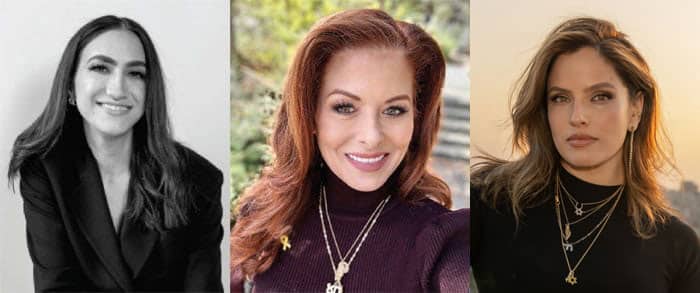
The Unshakable Courage of Mandana Dayani, Debra Messing and Noa Tishby

I recently watched a YouTube video filmed last year in which a Jewish woman tried to have a respectful conversation with a virulently anti-Israel student at UC Berkeley. I was in awe of her courage, grace and cogent arguments. She didn’t need to be there, on a campus where a riot recently broke out against Jewish students in response to an Israeli speaker, and in a city whose school district is now being accused of knowingly tolerating “antisemitic bullying,” according to a federal complaint. 

At one point in the video, a male student screamed in the woman’s face and called her a “dumb motherf—-r.” Another male student referred to the woman and the pro-Israel students surrounding her as “you people,” prompting her to respond, “It’s not ‘you people.’ Don’t discriminate. I’m a person. My name is Noa.”

I’m referring to Noa Tishby, the New York Times best-selling author of “Israel: A Simple Guide to the Most Misunderstood Country on Earth” and Israel’s former Special Envoy for Combating Antisemitism and Delegitimization. A prolific actress, producer and activist, Tishby, a Tel Aviv native now living in Los Angeles, has completed her second book, “Uncomfortable Conversations with a Jew,” co-written with best-selling author Emmanuel Acho, available in late April. 

Witnessing Tishby’s bravery also made me think about actress and activist Debra Messing. Like Tishby, she confronts vicious antisemites with resilience and grace. Messing, who was born and raised in Rhode Island, spoke at the Nov. 14 rally for Israel in Washington, D.C. and recently visited Israel. She sat with soldiers and victims of Oct. 7, simply offering to listen to their stories. I adore Messing for this, and for the fact that she is constantly posting Instagram videos reminding all of us, especially young Jews, not to be afraid. 

And then there’s my childhood friend, Mandana Dayani, a visionary entrepreneur and creator and co-founder of “I Am a Voter.” Dayani, who escaped post-revolutionary Iran as a little girl with her family, also recently traveled to Israel, visiting the remains of decimated kibbutzim in the south and speaking with victims of Oct. 7. Dayani is fearless when it comes to exposing antisemitism and defending (and celebrating) Jews and Judaism, especially on social media. She shares this wonderful fearlessness with Tishby and Messing. 

In honor of International Women’s Day on March 8, I decided to ask each of these extraordinary women two simple questions. Of course, the female victims of Oct. 7, the female IDF soldiers and medics, the mothers and wives of fallen soldiers and so many more Israeli women are heroes who should be honored each day. But day in and day out, women like Dayani, Messing and Tishby are battling antisemites and putting much on the line in defense of Israel and the Jewish people. Their responses to my questions reminded me of “Eshet Chayil,” King Solomon’s tribute to the Jewish woman in the Book of Proverbs, which begins by asking, “A woman of valor who can find? Her value far exceeds that of gems.”

Jewish Journal: For years, you have been targeted online by relentless antisemites, and the hatred directed against you has perhaps never been more acute than in the last five months. From where do you derive such admirable courage and clarity to confront one antisemite or ill-informed person after another? 

Mandana Dayani: Everything I have ever done has been rooted in my commitment to upholding humanity and advocating for more rights for more people. And as we see misinformation being weaponized to divide us and propaganda being deployed with the clear agenda to delegitimize Israel and dehumanize Jews, I refuse to be a participant in the dissemination of more hate and divisive language in this world. 

Progress is not taking rights from one group of people to give them to another. The violence and targeting of Jews today is not activism. It is a witch hunt fueled by bots, propaganda, and an alarming mental health crisis around the world.

“I believe the majority of the world disagrees with the radical ideologies of the mobs inciting violence. We cannot pander to extremists because they are louder or scarier.” – Mandana Dayani

I will continue to ask for more people to do the right thing, to stand up against hate, to share fact-based information, and to lead with compassion. I believe the majority of the world disagrees with the radical ideologies of the mobs inciting violence. We cannot pander to extremists because they are louder or scarier. 

Debra Messing: What has given me strength when the hate and accusations start to penetrate is moral clarity. I always return to “What is my purpose?” I believe [that] because I was given a platform, that it is my responsibility to use it intentionally. I know that antisemitism and anti-Zionism are racism. I know all racism is wrong. I know Israel is the ancestral homeland of the Jews, and I know Israel has a right to exist. I know that I have facts behind me and that it is possible to hold my beliefs about Jews and Israel and also hold compassion for, and acknowledge the suffering and painful history of the Palestinians. 

Noa Tishby: The Berkeley event was intense and hostile. So I am glad it didn’t end up with anybody physically attacking me. I get my strength first and foremost from my mom. When people ask me how I’m such a strong woman, I literally brush them off and send them to my mother because she is the fiercest woman I have ever met. She’s never met a fight that she didn’t want to take on and it’s always for what she thought was right. I think I get my strength from her, along with my sisters, my dad and my entire family.

“I don’t get fazed out by bad comments or when people attack me. I just know that we need to be strong and united and fight for what we know is right.” – Noa Tishby

I also have a very strong compass of what’s right and what’s wrong, and that’s why I’m unmovable on those issues. I don’t get fazed out by bad comments or when people attack me. I just know that we need to be strong and united and fight for what we know is right. There is an unprecedented level of Jew hate that is rising right now and the only way that we can fight against it is to be firmly planted in who we are and stand up against it and not be afraid. So I honestly attribute all of that to my mother, Yael Artzi. She is just incredible.

Jewish Journal: How has your identity as a Jewish woman inspired and informed your tireless advocacy on behalf of Israel and the Jewish people, whether before or after Oct. 7? 

Mandana Dayani: My identity as a mother and activist is deeply rooted in the influences of the strong, brave matriarchs of my family. Our family was held together by their unwavering courage, fortitude, and commitment to upholding the traditions that defined us. 

So many of the values of our culture — welcoming the stranger, tikkun olam, compassion, curiosity, hope, resilience, and a commitment to upholding family and community — all define my activism. My advocacy has always tried to perpetuate these values and to bring in others to do the same — to advocate for humanity as a collective. I sort of see advocacy like a Shabbat dinner table — we always leave the door open and seats available at the table so others can feel welcome and join in. 

Oct. 7 completely shook me to my core. The unspeakable violence we witnessed that day and the unimaginable hatred and propaganda that has since taken hold of so many around the world, woke up many of us in the diaspora. As someone who fled the terrorist leadership of my homeland [Iran] for the opportunity to live safely as a Jew, I believe that my safety and security are inextricably linked to Israel. And I am never going to stop advocating for a world free of that same terrorism that seeks to destroy all the values I mentioned above and democracies around the world.

“I am a proud Jew and it is impossible for me to see the massacre of our people by a terrorist group and not scream out that it is wrong.” – Debra Messing

Debra Messing: I was raised by two very proud Zionist parents. They taught me that it is our responsibility as Jews in the diaspora to protect Israel. I was taught that Israel is precious. I am a proud Jew and it is impossible for me to see the massacre of our people by a terrorist group and not scream out that it is wrong. I know our history of persecution and feel a new potent unity amongst our very diverse Jewish community. I will always stand with the Jewish people and the Jewish homeland. We are all intertwined.

Noa Tishby: I talk about my identity a lot in my first book. My identity was shaped more as a secular Zionist than as being Jewish. I grew up in a very secular family, I always tell people I had never been to a synagogue before I moved to Los Angeles. It’s a beautiful thing because it allowed me to reach my Jewish identity from an independent place and find it for myself. 

I think that living in America as a Jewish person, as an Israeli, after taking being Jewish for granted for so many years, allowed me to connect to it at an entirely different level. I did an event a couple years ago and this rabbi came up to me and said “I read your book, and do you know why God invented America? So Israelis can remember that they’re Jewish.” And I started laughing, but it resonated with me because my Jewish identity was essentially shaped after moving into the diaspora and finding for myself how brilliant and inspiring and beautiful and smart and deep, ancient, diverse and poetic our culture and traditions are. It is such a blessing.


Tabby Refael is an award-winning writer, speaker and weekly columnist for The Jewish Journal of Greater Los Angeles. Follow her on X and Instagram @TabbyRefael 

The Unshakable Courage of Mandana Dayani, Debra Messing and Noa Tishby Read More »

To the Disconnected Jew

To the Disconnected Jew,

You were born a Jew, but that’s about it.

Perhaps you haven’t stepped foot in a synagogue since your bar or bat mitzvah.

Maybe you only go to services on Yom Kippur. 

You might have some Judaica your parents owned; you stash it in a drawer tucked away in your home, but you never take it out. 

To the Disconnected Jew, 

You saw those Chabad Jews in your neighborhood, and thought, “Really? That’s so antiquated. Get with the times. Dress normal like the rest of us and just blend in. Maybe if you did, the world would stop hating us.”

You believed that all this religious stuff was just nonsense. Those stories were made up. The Torah can’t be real. Why would God be so angry and punish us and need our constant praise? 

It’s all a fairytale, you thought. Grow up.

To the Disconnected Jew,

You didn’t have one Jewish friend. You didn’t live in a Jewish neighborhood or work with other Jews. 

You were in one big melting pot, and you liked it that way. You weren’t different from anyone else. You could just be a human among humans – that’s it. The way it should be.

To the Disconnected Jew,

You saw what happened on Oct. 7. 

“Same stuff, different day,” was your first reaction. “Israel is always at war,” you thought. “There will never be peace. The Middle East is a mess. Where was God in all of this?”

Oct. 7 gave you another reason not to believe — just like the Holocaust, where your family members died. 

“God was absent then, and He’s absent now,” you thought. “If God is good, how come the world is such a dark and depressing place? It doesn’t make any sense.”

To the Disconnected Jew,

After Oct. 7, you saw what your friends were posting on social media, those vile lies about Jews. 

You turned on the TV and watched as Jewish students were being shouted down and attacked on college campuses. 

You watched as swarms of hateful protesters took to your city streets and shouted genocidal slogans and promoted the annihilation of Jews everywhere. 

To the Disconnected Jew,

You started to feel scared. You began feeling alienated from your friends — or the people you thought were your friends. 

They posted news articles about how Israel is awful and protested against it. They didn’t reach out to ask how you felt. 

You looked around at work, in the grocery store, while taking a walk. Would someone recognize you as a Jew and attack you? Would you be safe?

To the Disconnected Jew,

We know what you are going through. We understand your struggles. We acknowledge your pain. 

And we have some news for you: Your Jewish brothers and sisters are here, waiting to embrace you with open arms. 

To the Disconnected Jew,

It’s never too late to take a stand.

It’s never too late to find God. 

It’s never too late to proudly declare that you are a Jew.

We don’t care about what you did in the past. 

We only care that you’re here now. 

To the Disconnected Jew,

Every Jew has a Pintele Yid inside of them, that small Jewish spark that can grow bigger and bigger and envelop you in Jewish joy.

Every Jew has a Pintele Yid inside of them, that small Jewish spark that can grow bigger and bigger and envelop you in Jewish joy.

You have discovered your own Pintele Yid. You’re joining a growing number of Jews who are reconnecting post-Oct. 7.

We can’t wait to show you the incredible value of living Jewishly.

We are excited to invite you to Shabbat dinner, to illuminate the beauty of our traditions, to talk about what’s happening in the world and offer you comfort during a deeply distressing time. 

We are your community, we are your brothers and sisters, we are your family. And we love you.

To the Reconnected Jew, 

Welcome home. 

Have you reconnected with your Judaism post Oct. 7? Email me: Kylieol@JewishJournal.com.


Kylie Ora Lobell is the Community Editor of the Jewish Journal.

To the Disconnected Jew Read More »

The Burning Airman and the Passion for a World Free of Jews

On X, a weeping young woman — she’s Jewish, according to the post; a small Magen David tattoo is visible on her right hand — howls over the world’s inability to understand why Aaron Bushnell, a 25-year-old U.S. airman, killed himself by setting himself on fire in front of the Israeli embassy in Washington, D.C. the previous Sunday afternoon. “Are you f—ing serious?” the woman sobs. “His last words were ‘Free Palestine.’ This man was an active service member for our f—ing military — a white man who knew his privilege and he knew the effect that if he killed himself, that he would actually get coverage on the news … And how many more people have to say that they don’t support the existence of Israel for this to end!”

Bushnell’s martyrdom fills her with a grief-stricken ecstasy. She is in the grip of a secular religion in which Jews are again the earthly antichrist and followers are frenzied by the need for purification. No sacrifice is too great, no pain too terrible, in the face of so much evil. 

I’d like to believe the woman is just performing for likes, as some commenters claim, but I don’t. She is, clearly, desperately sincere. She truly believes the world’s sins would be purged if it were only rid of the Jewish state. That the drive to annihilate Israel necessarily threatens the existence of all Jews, including herself, obviously does not occur to her. Bushnell’s martyrdom fills her with a grief-stricken ecstasy. She is in the grip of a secular religion in which Jews are again the earthly antichrist and followers are frenzied by the need for purification. No sacrifice is too great, no pain too terrible, in the face of so much evil. 

The usual Israel-hating suspects tweeted their awe over Bushnell’s suicide. Presidential candidate Cornel West: “Let us never forget the extraordinary courage and commitment of brother Aaron Bushnell who died for truth and justice!” Guardian columnist Owen Jones: “Aaron Bushnell died because he had too much humanity for a world run by people who don’t have any.” Roger Waters posted the gruesome suicide video with the eulogy: “Aaron Bushnell All-American hero.” 

This is a death cult, paralleling that of Hamas itself. And just as Hamas’ death-worship is both suicidal and homicidal, so this Western version threatens not only its followers but, most immediately, Jews. And the more I think about it, the more it seems that truly combatting antisemitism requires delving into the very essence of what it is to be human. 

There are things worth dying for. An altogether different question is whether it’s worthwhile, never mind glorious, to die horrifically as a protest, knowing it will almost certainly have no effect on the thing you are protesting. I’ve tried to imagine the alternate scenario—Jews setting themselves on fire to show their support of Israel—but I can’t. This isn’t because we’re not that committed to our people, but because we know how much more value there is in fighting by remaining alive. Jews have never had to seek martyrdom; throughout history, it’s found the Jews all too often.

Death is only appealing to those who feel their lives have no purpose and whose hearts are empty. The most fortune-kissed generations in history possess, instead of gratitude, guilt over their privilege. They feel they have nothing to live for but the need for atonement, rendering them all too susceptible to martyrdom — and murder.

That so many young people, and older commentators beyond the usual Israel-bashers, find his self-immolation inspiring reveals a measureless chasm in our society.

My views about Israel’s war on Hamas are worlds apart from Bushnell’s. Still I felt a jolt of recognition after learning he grew up in an insular Christian organization described as something of a cult. He’d left it for the military, substituting one high-control group for another, then became a familiar figure in socialist and anarchist groups. I imagine he was looking for something to consume him, a sense of belonging and intense purpose, and he thought he’d found it in the battle over the Holy Land. That so many young people, and older commentators beyond the usual Israel-bashers, find his self-immolation inspiring reveals a measureless chasm in our society.

I railed against Israel for many years, and I realize that by speaking of the yearnings of an Israel-hater, some may wonder whether my belated embrace of Zionism is really total. These horrific post-Oct. 7 times cry out for taking a clear side, and I am firmly committed to the side of Israel. I’m not so naïve as to think the people rampaging like pogromists on campuses and in city streets can simply be won over through empathy and compassion.

At the same time I increasingly see that the crisis facing us isn’t just political or social, but spiritual. In “The Strange Death of Europe,” Douglas Murray writes that certain questions — What am I doing here? What is my life for? Does it have any purpose beyond itself? — have always driven human beings, but in the West today there’s a sense that the story — the answers we’ve turned to in the modern age — has run out. Science and historical criticism have probably dealt an irreversible blow to the literal-truth claims of religion, but there’s begun to be a drift toward affirming that “Western liberal societies may in fact owe something to the religion from which they arose.” 

I’ve experienced something similar in my own attempt at redemption: Asking why I believed antisemitic things inexorably led me to begin exploring Judaism. For most of my life I believed, as do my family and my now-ex-comrades, that a belief in God isn’t necessary to lead a full, moral and purposeful life. Now I’m not so sure. I can’t make myself believe, but I’ve begun to see the wisdom of respecting the traditions and beliefs that sustained my mother’s family through their darkest days and greatest joys. It takes a lot of hubris to repudiate the deepest answers in which mankind believed for millennia, asserting that each of us must, and can, find our substitute in environmentalism, an online group or (in the case of some of us) a Trotskyist organization. 

That this is not working, that the story seems to have run out, is manifested by the significant numbers of people who find transcendence in the grisly livestreamed fiery death of a troubled young man. That they see Jews as the essence of what they are fighting against, the embodiment of evil, is a feature of their religion, not a bug. And unless society finds a new story to sustain itself, the fire will continue to rage.


Kathleen Hayes is the author of ”Antisemitism and the Left: A Memoir.”

The Burning Airman and the Passion for a World Free of Jews Read More »