What personal qualities are required for a person to take an idea, whose source is from a mysterious realm, and make it real in this world?
Creative artists know this question well. Painters, sculptors, musicians, writers, architects, composers, poets – in every realm of creative activity there are those who say that the ideas that come to them are ultimately not theirs. The source is mysterious; the work of the artist is to turn that mystery into reality.
In this week’s Torah portion, Ki Tisa, there are terms for those qualities that help us take ideas and make them real. The terms for those qualities needed are “chokhmah, tevunah ve-da’at” – “wisdom, insight and knowledge.” In Exodus 30, God reveals to Betzalel an image of the tabernacle that the Israelites are to build. Betzalel becomes the visionary architect, who is to render a divine plan into reality. “Be-tzal-el” literally means “in the shadow of God.” The Hebrew word “tzel,” “shadow,” is the root of the word, “tzelem,” “image.” A shadow outlines an image.
This term, “b’tzal-el,” takes us back to Genesis 1: 27: “Vayivra Elohim et ha-Adam b’tzalmo, b’tzelem Elohim bara oto,” “And God created the human being in His image; in the image of God He created him.” The Adam (human being) is later split into male and female. The female later gains the name Eve (mother of all life).
The name Betzalel suggests a continuation of Adam and Eve, who were exiled from the garden when they tasted of the tree of knowledge. Betzalel, on the other hand, is creating a structure to get us back to the Garden, to the Trees of Knowledge and Life.
The ancient Rabbis who created our liturgy some 1800 years ago used these same words, “wisdom, insight and knowledge,” as the basis for the first blessing of the 13 weekday prayers. The first of the middle 13 weekday blessings says (in the Sefardic prayer book),
You graciously bestow upon human beings knowledge (da’at), and teach to mortals insight (binah). Graciously bestow upon us, from you, wisdom, insight and knowledge.
In the prayer book, the unique qualities of the inspired architect are now graciously bestowed upon every human being. This prayer seems to be a direct response to the Garden of Eden story. In that narrative, we were forbidden to eat of the fruit of the Trees of Life and Knowledge (Da’at). Here, God graciously bestows knowledge to every human being.
And – if Torah is a “Tree of Life to all to hold fast to it (Proverbs 3:18)” – we are given the ability to adhere to the Tree of Life, as well. We don’t have to live east of Eden anymore; – we can return to the Garden.
This blessing in the prayer book is philosophic in nature, as it reflects on the nature of the human being. This prayer is an example of the “wisdom tradition” in the Bible – mostly concentrated in Proverbs, parts of Psalms, the book of Job, and Ecclesiastes. That wisdom tradition continues into the rabbinic era, and like those in the Platonic and Stoic schools of thought, the Sages believed that there is an “upper wisdom,” a spiritual and moral blueprint of the universe, as well as the inner universe. This upper wisdom, emanated from the Divine, seeks to be known and lived by human beings.
From this perspective, Betzalel, the visionary architect who is building the Tabernacle, is a poetic archetype for each of us. This idea teaches us that in every moment of conscious life, we are building an inner Tabernacle, a structure that allows for meaning and purpose to constantly unfold within us into the present. This idea, that we are constant architects, is one that can cause us to slow down and consider. Think of every aspect of your life as the building material – your living space, your body, your relationships, your work, your conduct, your thoughts, feelings, values and all the other dimensions of your life.
We often forget that we are building a structure with our limited time here. As we hurl or plod through life, our focus can fall just to the next moment, the next problem to solve. When we pause and step back, we might realize now and then that this structure we are building, sometimes a bit haphazardly, is collapsing, if not into shambles, then maybe into disarray.
This little blessing, “You graciously bestow upon human beings knowledge,” said 18 times a week by a traditional Jew, reminds us constantly that we are like Betzalel, rendering a Divine image into reality. Think that the Divine is imaging some blueprint of you into your soul, and only you can bring this vision of you into being.
Unlike the Mishkan, the tabernacle built in the desert, the blueprint for our souls is dynamic, changing through time and circumstances. We never receive a final version. We don’t know with any certainty whether we are forming our lives from imperfectly understood images or outdated blueprints.
We build anyway, with love and care and all the precision we can come up with. We work, we risk, we repair, we redesign, we start over. Life is done with us before we can ever finish. We build anyway.
When people in the Jewish community think of genetic diseases, they usually think of Tay-Sachs disease. The most common form is infantile Tay-Sachs, in which symptoms start at around three to six months of age. The baby can become overly startled by noises and movement, lose the ability to sit, turn over or crawl, have difficulty swallowing and lose vision or hearing. The condition is usually fatal by the age of three to five.
Tay-Sachs is passed down from parents to child. When both parents carry a mutation or change in the Tay-Sachs gene, each of their children is at 25% risk for the disease. While the gene that causes Tay-Sachs is more often found in people with an Ashkenazi Jewish background, the disease occurs in all populations across ethnic backgrounds. Therefore, non-Jewish and interfaith couples are also at risk for having affected children.
Tay-Sachs disease is caused by the absence of an enzyme (hexosaminidase A) that helps break down fatty lipids called gangliosides. The lipids subsequently build up to toxic levels in the brain and spinal cord, affecting the function of the nerve cells. After researchers linked this enzyme, or more specifically, the lack of it, to Tay-Sachs in 1969, carrier screening for the disease was able to be implemented across the Jewish community beginning in the 1970s. Potential parents now had the vital information to know if they were at risk for having an affected child. As a result, the number of babies born with Tay-Sachs has reduced significantly in the past 50 years.
But while some people think that Tay-Sachs has been eliminated, babies are still being born with this disease. How is this possible, when genetic testing is so readily available?
The fact is, many people still don’t know about the need for testing. Take Bonnie Davis’ family, for instance. Her son Adam was born with Tay-Sachs, as Bonnie and her husband were unaware that a simple genetic test could have informed them of their genetic risk. Bonnie says, “Tay-Sachs is commonly carried by Ashkenazi Jews, which we both are. Our obstetrician should have met the standard of care and provided us with the option to obtain genetic testing. He didn’t. Most rabbis will counsel Jewish couples to have genetic testing prior to marriage. Ours didn’t. Many Jewish youth learn about Tay-Sachs at religious school or on their college campus. Neither of us did.We fell through the cracks and never knew we needed genetic testing. Knowledge is power and knowing your carrier status for genetic diseases gives people the power to create a healthy family and avoid the devastation of having a child with a fatal genetic disease.”
One person who was moved to action by her child’s death from Tay-Sachs is Shari Ungerleider. Shari, who lost her son Evan 24 years ago, reflects, “Evan’s memory propels me to act, transforming tragedy into a force for good. Raising awareness about carrier screening has become my mission, sparing others the anguish we endured. Preconception carrier screening, coupled with genetic counseling, is essential for all aspiring or expanding families.” Shari is now an outreach coordinator for JScreen, a nonprofit genetic testing initiative out of Emory University. Shari and her husband Jeff have gone on to have three other healthy children. She explains, “With each of my other pregnancies, I updated my carrier screening for diseases that were added to the panel. Knowing that Jeff and I were both carriers for Tay-Sachs disease, we were able to make family planning choices that enabled us to have healthy children. We chose to get pregnant naturally and have a CVS test performed at ten weeks. From the bottom of my heart, I believe that every couple should be able to make educated decisions based on accurate genetic information.”
Accurate information was something not afforded to Kevin and Lisajane Romer. Their son Mathew, born in South Florida in 1995, was diagnosed with Tay-Sachs despite both parents being tested and told that they were not carriers. “We did everything right. We both got tested beforehand and were told that neither of us was a carrier,” Kevin recalls. The couple later learned that their screening tests had been both administered, and interpreted, improperly. So, in addition to caring for their dying child, Kevin said, “We made it our immediate mission to improve testing procedures and protocols. We didn’t want any other parents to be blindsided and so we did something about it and founded The Mathew Forbes Romer Foundation.” Since its launch, the foundation has helped genetically test thousands of individuals at screening fairs. In addition, it has funded and produced, in association with Dr. Michael Kaback, the first ever laboratory training video and distributed it to 40 laboratories worldwide to help prevent errors in genetic testing.
With the mission to spread awareness about the importance of genetic carrier screening in both the Jewish and non-Jewish communities, the Jewish Journal helped launch and market GeneTestNow eleven years ago. Since then, technology has advanced considerably. Instead of blood tests that screen for just a few genetic diseases, at-home saliva tests like those offered by JScreen test for more than 200 genetic diseases, making screening more comprehensive and accessible than ever.
As much as we’d like to wish that Tay-Sachs is no longer a problem, the disease remains a deadly foe. But with carrier testing, couples can get the information they need to put the odds on their side and plan for healthy families.
For more information about genetic carrier screening, visit GeneTestNow.com.
A Jewish dentist was murdered and two others were injured on Feb. 29 in a shooting at a dental office near San Diego.
The man who died at the scene was Dr. Benjamin Harouni, a 28 year old dentist.
A suspect, who El Cajon police are identifying as 29-year-old El Cajon resident Mohammed Abdulkareem, was apprehended at 9:30 pm near Balboa Park in Downtown San Diego. El Cajon is about 15 miles northeast of downtown San Diego.
The suspect, identified as 29-year-old El Cajon resident Mohammed Abdulkareem, was reported to have fled the shooting in a white U-Haul rental pickup truck. Investigations also revealed that Abdulkareem was a former patient of the dental office. While the exact motive behind the shooting remains under investigation, it is believed that Abdulkareem was a disgruntled former customer.
“Abdulkareem was found to be armed with a loaded handgun and several loaded handgun magazines,” El Cajon police wrote in their report on March 1. “Records checks on the handgun later showed that it was legally purchased by Abdulkareem, just 2 weeks prior to the shooting.”
The report also said that Abdulkareem has been charged with “multiple felony charges, including one count of murder and two counts of attempted murder. Further investigation into the incident may reveal additional felony charges.”
Also injured in the attack was administrative assistant Yareli Carillo and office manager George Issaian. Carillo was shot in the legs and Issaian was shot five times. They are both expected to make a full recovery.
Following Harouni’s funeral on March 3, a public vigil was held in El Cajon. There, Mayor Bill Wells addressed the community concerns about classifying Harouni’s murder as a hate crime.
“I will not let anything be swept under the rug, and when I understand what the truth is, I will share that with you,” Mayor Wells said to the mourners. “We may need to be a little patient. This may take a little bit of time.”
Advocacy group StandWithUs expressed a similar sentiment in a statement on March 1, saying that “media outlets have been dismissing the shooting as a result of mental instability, as they often do when Jews are the victims of murderous hate. We call on law enforcement to investigate this as a hate crime.” Harouni was an inaugural member of the StandWithUs Kenneth Leventhal High School Internship program in 2012, which aims to train 11th and 12th graders to be community leaders, learn about Israel, and combat antisemitism.
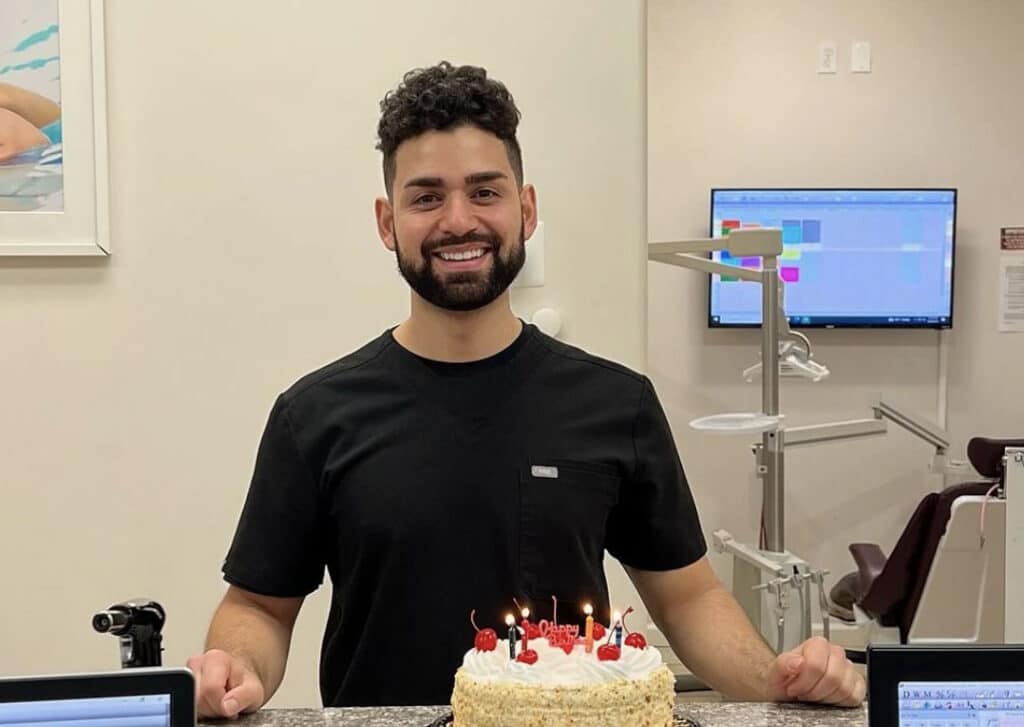
Harouni was a 2018 graduate of the University of Southern California where he earned undergraduate degrees in Natural Science and Political Science. He earned his Doctorate in Dental Surgery from Arthur A. Dugoni School of Dentistry in San Francisco in 2022. The Smile Plus Instagram account had a post on February 20th celebrating Harouni’s birthday with a cake in the office.
“Benjamin’s life was a shining star,” Rabbi Zalman Carlebach of Chabad of San Diego said at the vigil. “He lived a short 28 years. Let us not walk away feeling darkness and feeling sad, but in order to honor the life of Benjamin Harouni, let us walk away from tonight thinking how we can light this world with acts of goodness and kindness.”
Harouni’s brother Jacob announced at the vigil that in the next few weeks, the family will be creating a foundation to stop hate and promote peace and love in his honor and legacy and that “there’s no way Ben would leave this world without leaving a legacy.”
“Ben was an extremely positive person and someone who always had his head on his shoulders, always putting others over himself,” Harouni’s brother Jacob said. “He was the best friend anyone would ever wish for, whether it was buying concert tickets and hotel rooms for his friends and family to enjoy with him or simply just making time to help me with my homework. He was a giver. Not only was he the kindest soul, but he was an extremely driven person. Ben loved to make people smile, which is why he pursued dentistry. He loved to help people regardless of who his patients were. He would give the highest quality care to every single one of them. Once he told me about a patient he had seen and how bad he felt for their situation, I proceeded to ask him why he decided to continue to see underprivileged patients when he could make more money running his own private practice. He told me that it didn’t matter to him what the status of his patients were because it wasn’t about the money. He did it because he loved to care for others. He gave all of his patients a hundred percent of his effort in treating them regardless of their financial status, rich or poor.”
Jacob concluded his eulogy by saying, “Ben I love you and I want you to know that we all love you and miss you. I promise you, I’ll dedicate my life to bringing peace to this world. Thank you, Doc.”
Interpretations of the golden calf have always been fraught with controversy. Christian polemics, beginning in the 2nd century Epistle of Barnabas, argued that the Jews annulled their covenant with God when they created the golden calf; worshiping an idol right at the foot of Mount Sinai was an irreversible declaration of disloyalty. Jewish commentaries struggled to fend off this attack, but at the same time, struggled with the narrative itself. How was it possible that the Jews turned their backs on God so quickly?
As a result of these questions, two interpretive strategies arise. One point of view says yes, the golden calf was an idol; and even if betraying God under the Midrash’s metaphorical “marriage canopy” seems surprising, well, surprises happen. People can be very fickle in their commitments. Others mitigate the issue of betrayal by casting the “mixed multitude,” who accompanied the Jews from Egypt, as the villains of the story. They argue it was these outsiders who made the golden calf, not the former Jewish slaves. The mixed multitude were simply reverting to their previous idolatrous ways.
Another school of interpretation argues that the golden calf wasn’t an idol at all. Yehuda Halevi says the golden calf was just a physical representation of the one, invisible God, a tangible object to help bring a greater sense of connection to the divine. Or, perhaps the Jews were simply looking for a new leader; as the Ramban puts it, “they wanted another Moses.” The Golden Calf would be an oracle to guide them, and it would step into the newly opened leadership position.
The textual evidence on this is ambiguous. On the one hand, the Jews asked for the golden calf in order to replace Moses. Later, after creating the golden calf, they call to have a holiday for God, which seems to indicate that they remained loyal to God. But there is compelling evidence for the other view; the Jews refer to the golden calf as “your gods, that brought you up out of Egypt.” And they stood at the ready to worship it.
It seems like the golden calf was supposed to be both a god and a leader.
But perhaps that’s precisely it; the Golden Calf is a hybrid. If we take a step back and reconsider the purpose of the golden calf, we can reach an unusual conclusion. The golden calf wasn’t meant to replace Moses; they could have picked another person for that. And it wasn’t meant as a replacement for God; they didn’t have to wait for a forty-day delay in Moses’ return to switch to idol worship. Instead, the golden calf was meant to be a Jewish Pharaoh. The Pharaohs were demigods, political leaders who at the same time were divine figures, monarchs who were at the same time the close family of the Gods.
Having a demigod as your leader changes the political order. As Joshua Berman explains in his book Created Equal, in the pagan culture of the ancient world, the common man was ignored by God; he was created to serve the gods, nothing more. A demigod as king meant that the entire population was subservient, and there at the beck and call of the king. Once we recognize this, it becomes clear that slavery was not just a feature of ancient Egypt, it was its organizing principle. Everyone could potentially be a slave.
The covenantal order in Judaism is dramatically different. God raises man up to be His partner, accepting human beings as worthy associates who are created in the image of God. This view offers human beings greater dignity, but at the same, is far more demanding.
One must recognize the transaction between the Pharaoh and his constituents is not one-sided. Some people prefer autocracy. Yes, in Pharaoh’s Egypt, being a mere human meant you must endure a lack of rights; but at the same time, one has far fewer worries. After all, you have a god in charge, what could go wrong? A demigod is by definition a perfect leader.
And that is what the Jews are choosing with the golden calf.
One of the fascinating details in the text is that the Jews rejected Moses because he was late. It should be mentioned that Ibn Ezra takes a more plausible approach to this lateness; he writes that the Jews had no idea when Moses was supposed to return, and on day forty, finally lost their patience. Rashi, however, takes an approach based on the Talmud, and says that Moses was just an hour late when the Jews decided to turn to the golden calf.
This behavior seems strange: had the Jews never seen anyone be late before? More importantly, why didn’t the Jews send out a search party to look for Moses?
Clearly, the Jews weren’t just rejecting Moses, they were rejecting human leadership. Human beings are flawed, fragile, and eventually die. Demigods are flawless; and the Pharaohs conveyed the image of being invulnerable. (This had to have been a lot of work. The Midrash mockingly says that Pharaoh would go for a regular swim, and only then would he take care of his bodily needs, hidden away from the prying eyes of others. Such is the task of a fake demigod.) For a people used to the image of an invulnerable demigod, a leader who shows up even a few minutes late is frightening. Moses simply is all too human, all too vulnerable. And all too disposable.
A Pharaoh offers the allure of a political order without problems. A demigod runs everything, and no one else must worry, content that they are in good hands. All they need to do is live a servile life.
The covenantal order is quite different. Humans are full partners with God, and bring to the relationship all the messiness of being a human. Tablets can be broken. Leaders might be late, or even disappear. Problems are everywhere, and you always have to worry about them.
But the power of a covenantal order is that with patience all can be restored. It is about a great partnership, one that goes from person to person and generation to generation. Occasionally partners will fall short of their obligations; but every covenant carries with it the possibility of forgiveness and the optimism of renewal.
This is why the worthless broken tablets will eventually have more power than a grandiose Pharaoh. Covenants can always be reborn and rebuilt.
Israel is at a moment when covenantal patience is needed more than ever. Some commentators have even asked whether this war proves that the Zionist dream is futile; wasn’t the entire point of the State of Israel the ensure a safe haven for the Jews? They argue if Israel is no longer safe, it no longer has a purpose.
This a significant challenge, and needs to be taken seriously. After October 7th, everyone is unsure about what will happen to the Israeli dream; and we recognize that this horrible conflict may last a long time. A heartbroken nation is searching again for a missing Moses.
The unwillingness to accept problems patiently is no different today than in the times of the golden calf. Some still hope for quick and easy solutions. We think if we get a few experts to write position papers, all problems will be solved; this is what one former Israeli chief of staff called “solutionism.” This attitude makes sense to us, because we live at a time of powerful demigods as well; most of our problems are solved with technology and wealth. But not all of them. And we are confounded when some problems don’t seem to go away.
It takes courage to hold on to the covenant when you have to wait, uncertain of what will follow. That is why we should be particularly proud of those who move forward despite this uncertainty.
In the past few weeks, Israeli media has reported on communities that are slowly returning to the Gaza envelope; one such report was headlined “between joy and fear.” These returning residents are coming back to an uncertain reality, with the sounds of a war that is still going on in the not-too-distant background. They explained to reporters that yes, the nightmares of October 7th play over and over again in their heads. They can point to neighboring houses, and say who is returning, and who is not. They completely understand why some of their friends will never come back. But they are choosing to come home anyway.
They know there are no easy solutions; but they are not going to give up. They are patient with the present, and have hope for a better future.
It is about them that Yehuda Halevi wrote in his Kinnah, Tzion Haloh Tishali. He describes those Jews who were steadfast in their love for Zion and declares:
Blessed is he who waits, and arrives to see the rising sun of your dawn, and is there for daybreak…and rejoices in happiness of your return to the days of your youth.
May God bless these returning residents, and protect them. May they too see their communities return to the days of their youth, and the glory of their past.
Rabbi Chaim Steinmetz is the Senior Rabbi of Congregation Kehilath Jeshurun in New York.
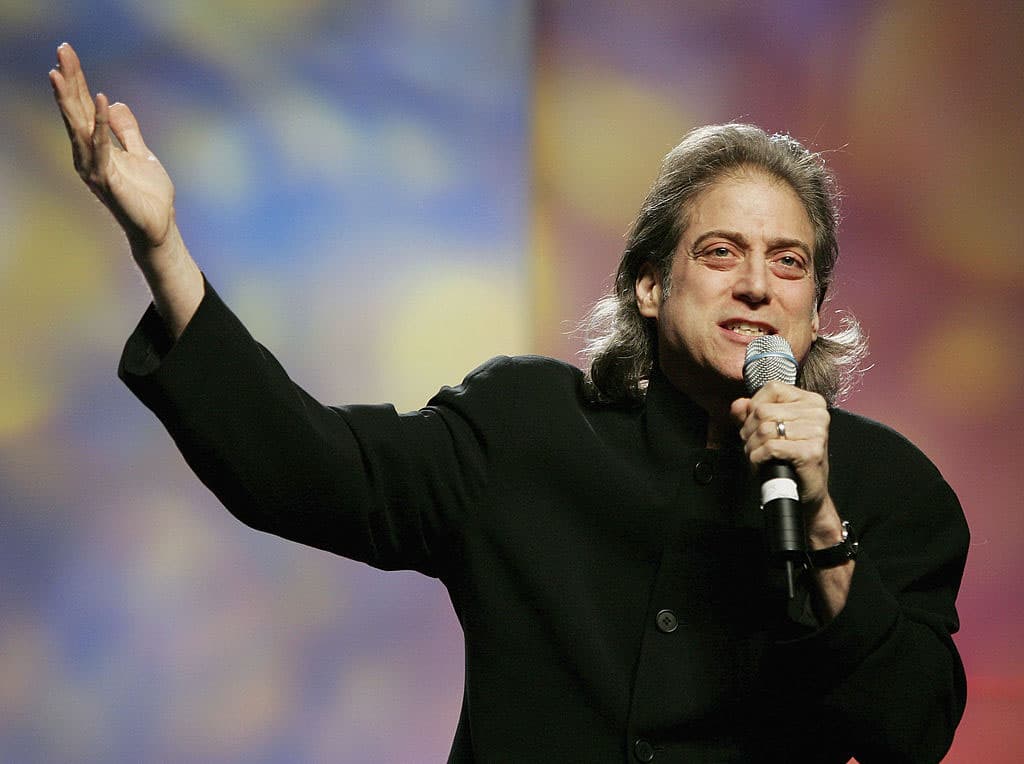
Comedian Richard Lewis died Feb. 27 from a heart attack at the age of 76. He spent over 50 years in show business, from standup comedy specials to unforgettable recurring episodes of “Curb Your Enthusiasm.”
Born on June 29, 1947 in Brooklyn, New York, Lewis was raised in Englewood with his parents. Bill and Blanche. His brother Robert and sister Janet were both much older than him, which is why he would often refer to himself as a “mistake child.”
In the book “I’m Dying Up Here,” author William Knoedelseder wrote that the age gap between Lewis and his siblings led to a period of isolation in his life that would shape his comedy. Lewis recalled bonding with his parents while watching “The Honeymooners” on television. In a 2017 interview, Lewis remembered being as young as five years old, feeling his affinity for comedy develop while watching Mel Brooks, Carl Reiner, Jonathan Winters, and Lenny Bruce on television The principal of his high school told him “Richard Lewis, you are the troublemaker of this school.”
In 1969, Lewis graduated from The Ohio State University with a degree in marketing. The following year, he returned to New Jersey, hoping to get a job writing for a television show hosted by comedian Robert Klein. Although Lewis didn’t get the job, the praise he received from Klein’s manager encouraged the young Lewis to keep going. In April of 1971, his stand-up comedy career started in earnest due to a sudden life event: His father passed away from a heart attack at age 57.
“When my father dropped dead, I realized that there was such a hole to fill in that it was pretty horrible for everybody in the family,” Lewis told Marc Maron in an interview in 2011. “My mother and brother and sister and everybody else. So anyway, the truth of the matter is, going on stage did really help fill that hole.” His first stand-up gig was at the now shuttered Champagne Gallery in Greenwich Village — and the crowd’s reaction was a sign of good things to come. He cut his teeth for three years on the comedy circuit and was invited to perform on “The Tonight Show Starring Johnny Carson” after a show at the Ice House in Pasadena. Though it would be the first of many late night television appearances for Lewis, it did not go well.
Still, he’d become a regular at The Improv in Hell’s Kitchen. He was hired as a regular guest on “The Sonny & Cher Show” on ABC. That was enough to get Lewis to permanently relocate to Los Angeles, where he’d become a regular at The Comedy Store, where befriended other comedians such as David Letterman and Jay Leno. By 1977, Lewis was opening for Sonny and Cher’s concert tour. In 1979, Lewis made his screen acting debut in “Diary of a Young Comic” on NBC.
During this time, Lewis’ alcohol addiction was spiraling. His inebriated hijinks and depression were often the source of many of his premises on stage standup, which earned him the nickname, “The Prince of Pain.” In 1985, Lewis recorded a stand-up special for Showtime, “I’m In Pain.” His opening lines were, “I just spent about a week with family. And I am absolutely thrilled and delighted to be here in front of strangers. I can’t believe this. My mother — she put a satellite dish up. I said, ‘she’s into sports? I can’t imagine discussing the pennant race with her.’ It had to be like a Jewish satellite dish, it picked up problems from other families.”
The titles of his HBO comedy specials emphasized the same sentiment: “I’m Exhausted” (1988), “I’m Doomed” (1990) and “The Magical Misery Tour” (1997). His two books laid it on even heavier: “The Other Great Depression: How I’m Overcoming, on a Daily Basis, at Least a Million Addictions and Dysfunctions and Finding a Spiritual (Sometimes) Life” (2002), and “Reflections from Hell: Richard Lewis’ Guide On How Not To Live” (2015)
The year 1989 was enormous for Lewis. He achieved a lifelong goal by performing to a sold out audience at Carnegie Hall. That spring, Lewis would co-star with Jamie Lee Curtis on the ABC sitcom “Anything But Love” as neurotic journalist Marty Gold. The show would run for four seasons. At the moment, the show isn’t on any streaming platforms but several episodes can be viewed in full on YouTube. Lewis was keenly aware of this, according to Curtis.
“Richard’s last text to me, was hoping that I could convince ABC/Disney to put out another boxed set of episodes of the show,” Curtis wrote this week. “He also is the reason I am sober. He helped me. I am forever grateful for him for that act of grace alone. He found love with Joyce and that, of course, besides his sobriety, is what mattered most to him. I’m weeping as I write this. Strange way of saying thank you to a sweet and funny man. Rest in laughter, Richard.”
In 1993, Lewis co-starred in one of his most memorable roles of his career, as Prince John in Mel Brooks’ “Robin Hood: Men in Tights.” “I was so sorry to hear that we lost Richard Lewis,” Brooks wrote on X. “I will miss him very much. He was so funny, and I was so lucky to have him play Prince John in ROBIN HOOD: MEN IN TIGHTS. But I was even luckier to have him in my life.”
Lewis’ website touts that “he may hold title to having the most late night talk show appearances, with well over 100 guest slots.” He performed on” The Tonight Show,” 22 times, “Late Night with David Letterman” 44 times and another nine times on Letterman’s CBS show. “I learned a lot of valuable lessons doing these shows … Letterman really gave me my first real break,” Lewis said in 2011. “I was on every six weeks for years, and I had endless amounts of material.”
On August 3 1994, after being hospitalized,. Lewis got sober for good. One year into his sobriety, he landed his first dramatic leading role, in the film “Drunks,” about an Alcoholics Anonymous meeting. He would also have a supporting role in the film “Leaving Las Vegas,” which centered around similar themes of alcoholism and depression. “This made me feel excited,” Lewis said about those roles. “I knew I’m not going to do Shakespeare, but I have a range. But I was type-casted.” Being typecast also left Lewis taking Jewish character roles, including a recurring role as Rabbi Richard Glass in nine episodes of Aaron Spelling’s “7th Heaven.
Lewis would spend the rest of his life speaking openly about his sobriety and encouraging others. “When you help somebody come out of the darkness, there’s nothing better than that,” Lewis said. “I think the alcoholism and the drug addiction probably prevented me, maybe by this time I would have directed a few movies and thrown away millions of dollars and given away at the height of my career opportunities because I just wanted to party. But you know what? I know people who hung themselves.”
One of the most fortunate turns in life for Lewis was in the late 1990s. “Larry [David] came over to my house and said, ‘do you want to play yourself?’” Lewis recalled in an interview. “He says he knew that it would pretty much bury me as a dramatic actor. I’m playing me. Imagine me getting an Emmy and winning an Emmy. Richard Lewis playing himself, as himself, for himself, by himself. I don’t care about winning. I’m just glad I’m on a great show. But Larry says, ‘you can be my best friend on the show.’”
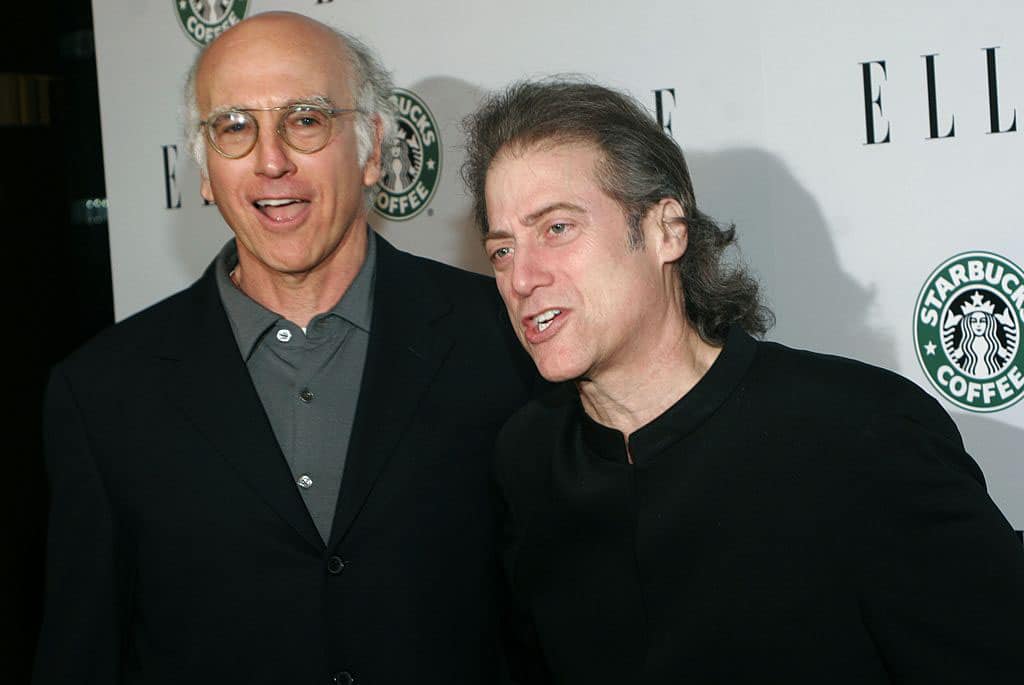
Comedians Larry David and Richard Lewis attend the Launch of ELLE Magazines Premiere Green Issue at the Pacific Design Center on April 11, 2006 in Los Angeles, California (Photo by Matthew Simmons/Getty Images)
They had known each other since they were 12, but it would be incorrect to call them childhood friends. “I went to the sports camp, which was very famous in New York State, and he was there, Larry, a gangly, despicable human being, annoying, I hated him,” Lewis said. “Usually when you meet somebody to camp, we say, ‘Hey, maybe our parents will drive us into Manhattan. We’ll go to Radio City and see ‘Ben Hur’ or some shit. We’re 12, as my mother would say, ‘that’s Z on my list!’ The last thing I would ever do was see this f–ing guy. He annoyed me that much. And vice versa. So I became a comic first, and he was a real fan. He liked me. He liked me. Then he became a comic, and I heard about him. I went, ‘whoa, what a f–ing brain this guy’s got.’ So he helped me move out of my college girlfriend’s apartment. We were inseparable. Every day I saw him, I performed every day, two or three sets a night everywhere.’”
The day that David invited Lewis to play himself on the HBO show “Curb Your Enthusiasm” led to one of the most enduring legacies of Lewis’ half-century in comedy. As of this writing, Lewis has had 40 appearances on “Curb,” including the pilot episode in 1999. Other notable episodes include:
“The Larry David Sandwich” Season 5, Episode 1: Richard is upset that a sandwich at a deli they frequent was named after Larry. They end up bickering in the pews at Rosh Hashanah services.
“Shaq” – Season 2, Episode 8: The episode can also be called, “Larry and Lewis go to a Lakers game and sit way too close for such big mouthed New Yorkers.”
“The Baptism” – Season 2, Episode 9: Lewis confronts David at his office to tell him, “You stole my outgoing message on my answering machine.”
“Foisted” – Season 9, Episode 1: Lewis’ parakeet passes away and Larry sent his “heartfelt” condolences via text. Lewis confronted David by saying, “I don’t care about your f—ing play, because my bird died and you sent the most ridiculous, despicable text: ‘Sorry about the bird, the good news is I’m still alive.’ Prick!”
“Lewis Needs a Kidney” – Season 5, Episode 5: Lewis, in need of a kidney transplant, is miffed that Larry has to think for a whole day about whether he wants to even get tested to see if he’s a match to be a kidney donor to save his friend’s life.
Lewis appeared as recently as episode four of season 12, which aired only two days before his death. In the previous episode, Lewis, who in real life was diagnosed with Parkinson’s disease in April of 2023, informs David that he put David in his will.
Lewis: “When I die, I want you to know how much I cared about you”
David: “I’m not going to keep it, I’m going to give it to charity.”
Lewis: “You’re my best friend, you’re getting it.”
David: “No I’m making a Sherman-esque statement about the will right now.
Lewis: “Listen to you and your historical references.”
David: “If nominated I will not run, if bequeathed, I will not accept.”
Lewis: Well I’m bequeathing.”
David: “Well I’m not accepting.”
Lewis: “Well you’ll have to accept.”
David: “Don’t give it to me!”
Lewis: “Don’t hurt my feelings.”
David: “I’m not going to keep a penny of it.”
Lewis: “You’re hurting me.”
David: “Thank you but I don’t want it.”
Lewis: “I’m giving it to you anyway, pal.”
David: “Oh my G-d, f— you.”
Six episodes of “Curb” remain to be released as of this writing. The cast and crew are tight lipped as to whether Lewis will have a posthumous appearance. Still, David released a fitting tribute to his friend this week.
“Richard and I were born three days apart in the same hospital and for most of my life he’s been like a brother to me,” David wrote on the “Curb Your Enthusiasm” Instagram account. “He had that rare combination of being the funniest person and also the sweetest. But today he made me sob and for that I’ll never forgive him.”
Lewis is survived by his wife of 19 years, Joyce Lapinsky.
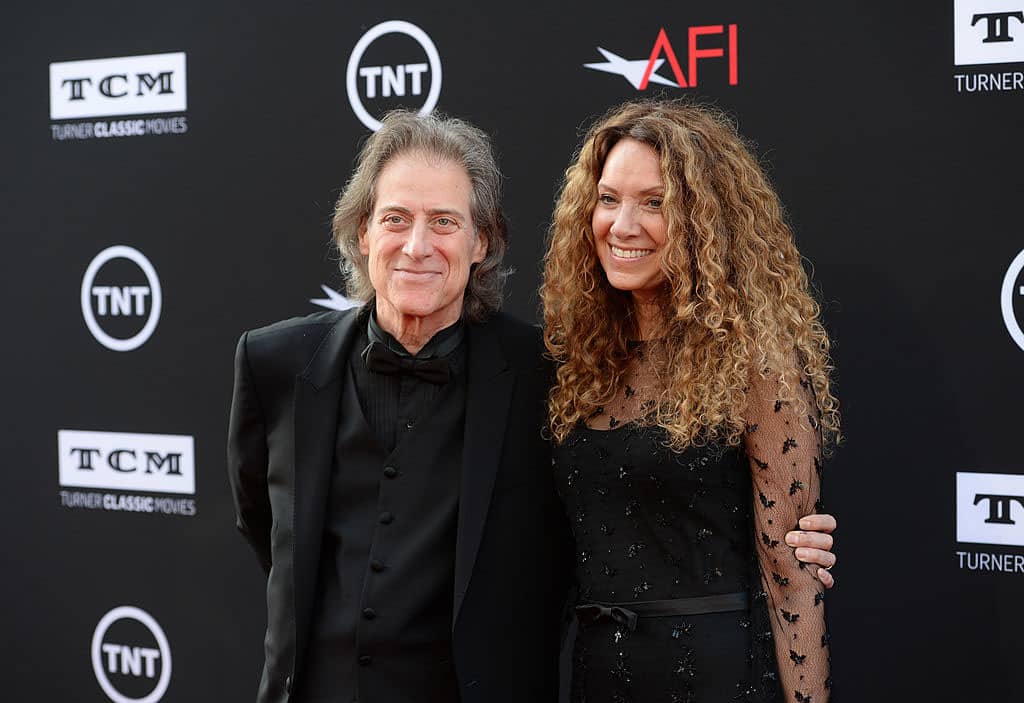
Richard Lewis (L) and producer Joyce Lapinsky attend AFI’s 41st Life Achievement Award Tribute to Mel Brooks at Dolby Theatre on June 6, 2013 in Hollywood, California. 23647_006_JK_0010.JPG (Photo by Jason Kempin/Getty Images for AFI)
Ghostwriter Loren Stephens has been fortunate enough to find her calling twice. First, as director of development for the Anti-Defamation League, where she raised $4 million dollars annually to support the critical work of the organization; she was there for 15 years. Now, she’s a go-to “collaborator” for those who need help writing their stories.
“If we look at our history [as Jews] and look at being driven out of where we lived, and being part of the Diaspora,” Stephens told the Journal. “What can we take with us that is intangible, but [stories] tell people who we are.”
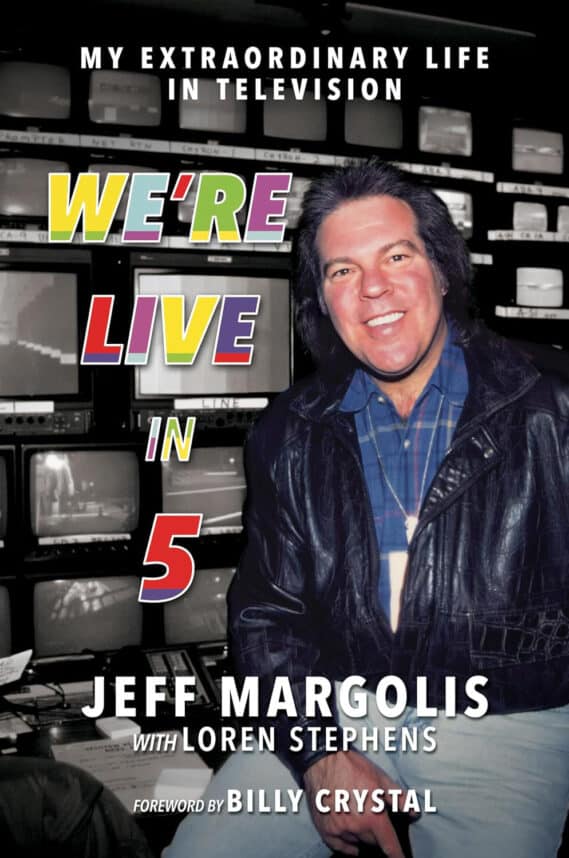
Since 2008, Stephens, the founder of Write Wisdom and Bright Star Memoirs, has collaborated with authors to complete more than 40 books. Her latest collaboration is, “We’re Live in Five: My Extraordinary Life in Television” by Emmy-winning TV producer/director Jeff Margolis. Not all of her clients are Jewish and not even all her projects are nonfiction, though she started out that way.
“In the beginning it was all memoir, whether it was how a CEO starts his company [or a client] living through the Holocaust,” she said. “But I have now written two novels based on true stories, and I’m starting on a third one. If you had asked me back in the day, would you ever be writing a novel for your clients, I couldn’t have imagined it.”
Stephens is also the author of the historical novel, “All Sorrows Can Be Borne.” Inspired by true events, the book tells the story of her husband’s Japanese birth parents and their sacrifice to give him a better life. The novel, she said, is “based on my Japanese husband’s family history, which is fascinating and horrifying and sad.”:
Our stories and those of our ancestors are the most valuable part of who we are, she believes. She gives the example of Henry Louis Gates, Jr., host of “Finding Your Roots.” “He turns on the faucet every time someone comes on his show, because he tells them where they came from, who they were [and] who their family was,” Stephens said.
Guests are in awe of their family history: the good and bad. “We don’t necessarily think it’s wonderful … to hear about what it was like to live in Russia and have the Cossacks come and destroy a town, but we can think to ourselves, ‘There, but for the grace of God [go I],’” Stephens said.
“And the other thing is,” she said, “How brave [were] these people that they were able to escape and find their way to America, so that today you and I can sit here and talk and be happy and grateful for their journey.”
For those interested in writing their own history, Stephens shared some recommendations. “Take a notebook with you wherever you go,” she said. “Write things down that come into your head: you don’t know if they’ll end up in the book, [but] something will spark an idea.” Also, write down your chronology from the time you were born until today. Create a roadmap and circle the parts that are most meaningful. “A memoir, unlike an autobiography, isn’t every little thing about your life, it’s the moments that stand out for you that … have high emotional charge to them,” she said. “They may be turning points in your life where you went left instead of right; it’s the road taken or the road not taken.”
Another way to trigger your memories is to go through photo albums. “Land on those photographs that really speak to you, where your eyes well up or you smile or you think, ‘Oh, God, I remember that day so clearly, I don’t even have to look at the picture,’” she said.
Above everything else, Stephens says to remember: everyone has a story to tell. Don’t listen to naysayers. Don’t let life constantly get in the way. “Give yourself permission to write the book that you’ve always wanted to write,” she said.
One more thing: “Write the book as if you’re writing it for one person, not a universe of people,” Stephen said. “Pick somebody, who you feel is an attentive listener, who really wants to know who you are and what you’ve been through in your life and what you have to share.”





 Since 2008, Stephens, the founder of