
Print Issue: Why the UN Hates This Man | Feb 16, 2024
Print Issue: Why the UN Hates This Man | Feb 16, 2024 Read More »

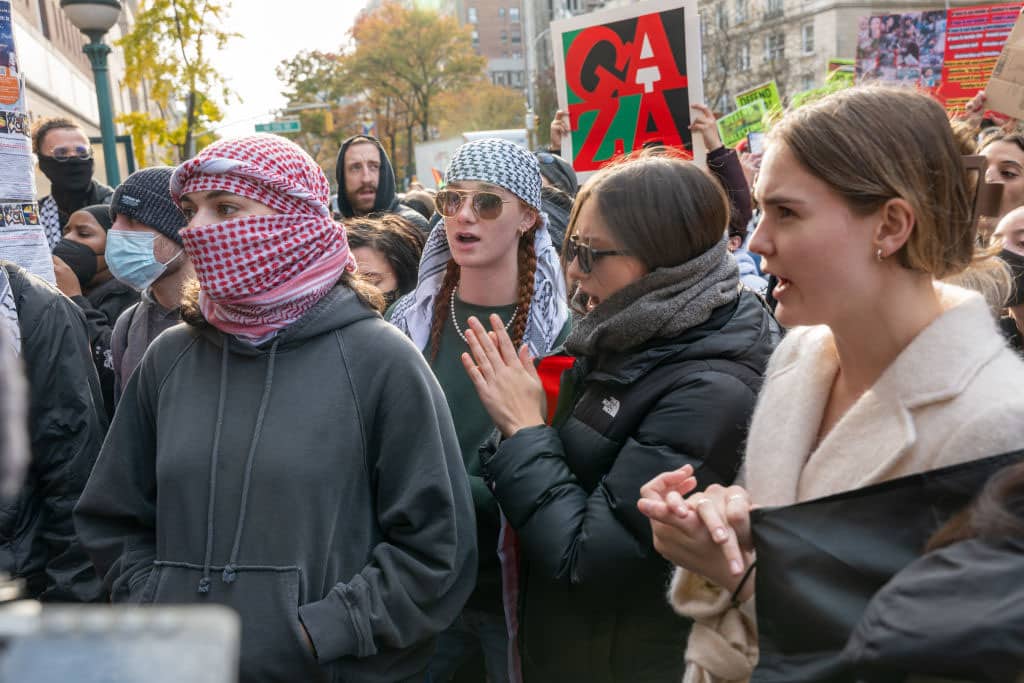
Life and any sense of security have been difficult for the American Jewish community since the vicious attacks on October 7th. Moving well beyond the tragic loss of life and the real rise of antisemitism and hate that all Jews are trying to manage, the Israel-Hamas war has also exposed deep fissures within the American Jewish community. In particular, young Jewish women are leading the charge to the left. In fact, some of the most politically active, harshest critics of Israel and those pushing for an immediate ceasefire are young women.
Jewish women on college campuses have taken a sharp turn toward exceptionally far left, progressive views, promoting a dangerous agenda to silence dissent while encouraging cancel culture. Meanwhile, young Jewish men are notably far less politically and ideologically extreme. Certainly, equality among genders is an important goal worth working toward, and more women in increased leadership roles is a positive outcome of this work. However, religious, lay and philanthropic leadership in the Jewish community must be aware of this crucial difference among genders when it comes to anti-Israel and anti-Jewish political activism.
Looking at the national picture, data regularly show young American men and women have been growing ideologically further apart. Gen Z men have become more conservative over time, while Gen Z women have become more liberal. Young women are more politically active, as women are more likely to vote, care about political issues, and participate in social movements and protests compared to young men. Among Jewish, Gen Z college students who are in the midst of many culture war issues that thrive on our nation’s many campuses, the data reveal that the ideological positions of Jewish women are far more narrow than students on the whole.
The Foundation for Individual Rights and Expression’s (FIRE) 2024 free expression data captures over fifty-five thousand voices from 254 colleges and universities across the country. The FIRE’s dataset illustrates just how pronounced these gender differences are on campuses today. Almost 55 percent of female students identify as liberal while only 15 percent identify as conservative. Nearly 40 percent of men, however, identify as liberal and 25 percent identify as conservative.
Jewish students are more politically imbalanced. Almost three-quarters of Jewish women (73 percent) are liberal and just nine percent of women are conservative. About 56 percent of men are liberal while only 19 percent are conservative. While there is a similar magnitude in the gender gap, Jews are far more liberal than the student population as a whole.
At the top 25 schools, per US News, students skew heavily more liberal. About 71 percent of women and 54 percent of men identify as liberal, while only eight percent of women and 18 percent of men identify as conservative. Jews are, again, more extreme. Of Jewish women, 79 percent are liberal compared to 69 percent of Jewish men; just three percent of Jewish women on top-ranked campuses are conservative compared with 11 percent of Jewish men. Elite colleges dominate social discourse but are not representative of the American public.
The political gender imbalance on college campuses, particularly among Jewish students, poses serious threats to open discourse, and Jewish women are far more likely to support the silencing of dissenting opinions.
Roughly 39 percent of Jewish women find it is always or sometimes acceptable to shout down a speaker to prevent them from speaking on campus, compared to 34 percent of men. For example, if a speaker claims that “transgender people have a mental disorder,” 55 percent of women and 29 percent of men would not allow this speaker to speak. Among Jewish students, about 64 percent of women and 36 percent of men would “definitely not” allow this speaker to speak.
The data show similar trends that Jewish women are far more likely to be comfortable canceling events that promote or engage with positions that they disagree with on other controversial topics, like supporting Black Lives Matter or the issue of abortion.
The data show similar trends that Jewish women are far more likely to be comfortable canceling events that promote or engage with positions that they disagree with…
Certainly Jewish women are welcome to embrace whatever ideologies they want, but that there is little viewpoint diversity among Jewish women on campus today is concerning. The data show that Jewish women are far more open to shutting down views that they find objectionable and what is distressing is that as these women, notably those who are in the elite schools, become leading voices of the Jewish community in years to come.
This poses a danger to civil society and the Jewish community.
We do not need more leaders who come from a leftist, ideological monoculture and echo chamber, especially if they are inclined to silence any and all dissent. Instead, we need leaders of diverse backgrounds who know how to embrace and work with difference. Silencing dissent not only slows down progress and creates anger and animosity, but also it is antithetical to Jewish ideals, which encourage debate and dialogue and celebrate difference.
There is an imbalance among those in the younger Jewish community, and such an imbalance does not represent or promote the central Jewish values of respect, intellectualism and pluralism. There is still time to change. The Jewish community must do more to promote viewpoint diversity and civic debate, which has been the core of the American Jewish experience for centuries.
Samuel J. Abrams is a professor of politics at Sarah Lawrence College and a senior fellow at the American Enterprise Institute.
The Jewish Gender Gap Read More »
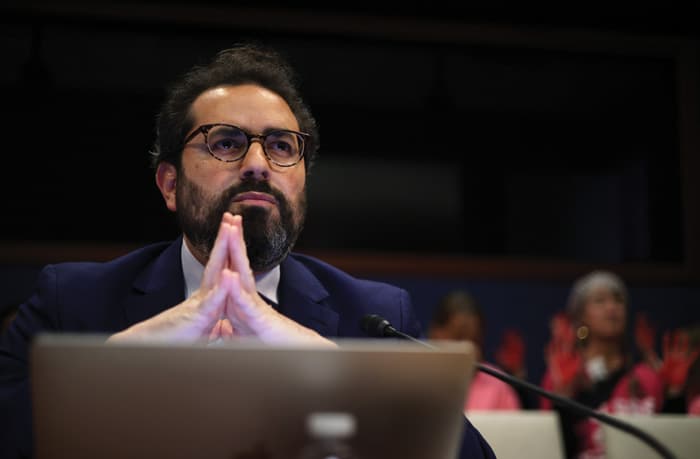
The United Nations, I think it’s safe to say, has moved beyond parody to farce.
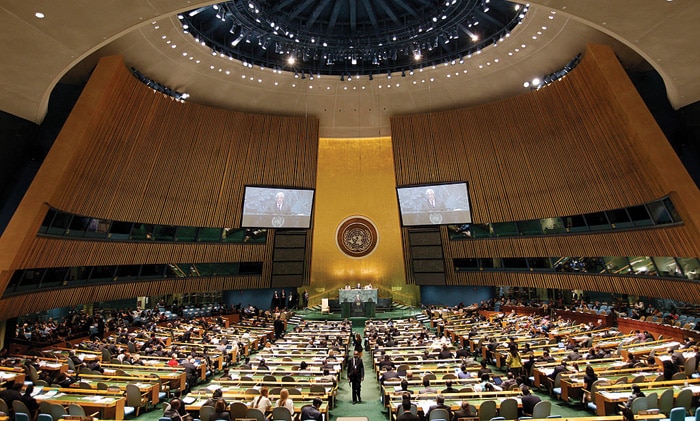
Created in the wake of the Holocaust with the primary goal of preventing future world wars and genocides, its number one target of condemnation since 1967 has been the only Jewish state.
Russia and China are permanent members of the Security Council, tasked with “the maintenance of international peace and security.” Current members of the Human Rights Council include China, Qatar, Cuba, and Sudan. The Commission on the Status of Women finally unloaded Iran, but still includes Afghanistan, Pakistan, Saudi Arabia, and China.
Since 2015, the General Assembly has condemned Israel 140 times; the total against all other countries combined: 65.
Still, the U.N.’s treatment of Israel remains its most barbaric affectation. In 1975, the U.N. declared that Zionism is racism. Since 2006, more than half of all condemnatory resolutions in the Human Rights Council have targeted Israel. Since 2015, the General Assembly has condemned Israel 140 times; the total against all other countries combined: 65. Israel has been made to face the International Criminal Court, because in the morally corrupt human rights industry, Israel’s self-defense amounts to a war crime.
And then there’s UNRWA, whose tight alliance with Hamas no doubt makes ISIS jealous.
Much of the above came to light when in 2004 a Canadian named Hillel Neuer became executive director of UN Watch, a human rights NGO in Geneva, Switzerland. Under his leadership, UN Watch has become the leading force against what he calls the “U.N.’s pathological discrimination and delegitimization of Israel.” He regularly calls out countries and their leaders on human rights abuses, which is what the U.N. would be doing if its mission hadn’t become politicized.
None of this makes him very popular at the U.N. Human Rights Council in Geneva. “When I walk into the room at the U.N., if looks could kill, I’d be dead by a thousand blows,” Neuer told the Jerusalem Post.
On Feb. 7, a bipartisan group of 12 U.S. legislators sent a letter to U.S. Secretary of State Antony Blinken urging him to demand that U.N. Secretary General António Guterres and the head of UNRWA, Philippe Lazzarini, resign over the revelation that a dozen members of UNRWA staff were involved in the Oct. 7th massacre: seven staffers infiltrated Israel; five helped to kidnap Israelis and provide ammunition. In addition, the IDF found that Hamas stored weapons in UNRWA buildings; used UNRWA resources for terrorist activities; and built tunnels under UNRWA facilities. And a recent Wall Street Journal report estimates that roughly 10% of UNRWA employees — 1,200 — are linked to Hamas.
Who initiated this call for their resignations? Hillel Neuer.
Born in Montreal, Neuer was raised in a Modern Orthodox family devoted to Judaism and Israel. At Shabbat meals, “someone would invariably bring out ‘The Encyclopaedia Judaica’ to settle a point of discussion,” he told the Jewish News Service (JNS). At 14, he took his first trip to Israel, igniting a lifelong spark to support and defend the Jewish homeland.
While studying political science at Concordia University, he saw the kind of antisemitism that he would battle years later: “A toxic alliance with radical-left activists.” Neuer earned a graduate law degree in comparative constitutional law from the Hebrew University, and then served as a law clerk for Yitzhak Zamir, then an Israeli Supreme Court judge and a former Israeli attorney general. Neuer went on to practice commercial and civil rights litigation.
In 1993, Morris B. Abram, a civil rights activist and former U.S. Permanent Representative to the U.N., founded UN Watch. In 2004, the executive director position was open, and Neuer, just 35, got the job. The nonprofit had been affiliated with the World Jewish Congress and then the American Jewish Committee. In 2013, under Neuer’s leadership, it became independent, solely funded by donors. UN Watch “has a vital part to play in creating a new center of gravity for the human rights movement,” he told JNS. “There is a whole ecosystem at the U.N. and surrounding it to demonize Israel.” The human rights industry “began with moral clarity fighting against Hitler … And has ended up with people like Ken Roth who attacks Israel as a war criminal every single day, comparing Israel to the Nazis.”
Amnesty International will host events with Hezbollah supporters and Holocaust deniers and continues to “demonize Israel, calling it an apartheid state,” while avoiding any discussion about the estimated million Uyghurs in concentration camps in China, Neuer said. It is well known in the nonprofit world that Amnesty forces its employees to lie about Israel.
Still, Neuer has seen some promising responses to the hate that UN Watch flags, as when Qatar’s ambassador, Hend Al-Muftah, lost the chance to chair the Forum on Human Rights, Democracy and the Rule of Law after UN Watch exposed her homophobic and antisemitic tweets.
In 2016, Chicago Mayor Rahm Emanuel adopted a resolution declaring Hillel Neuer Day, citing his role “as one of the world’s foremost human rights advocates” and his contributions to “promote peace, justice and human rights around the world.”
In 2018, McGill University awarded Neuer with an honorary doctorate of laws for his work to advance human rights, and for being “a voice for those without one.” The university recognized Neuer as “an innovator in creating global platforms for courageous dissidents and champions of human rights from around the world,” and for being “a passionate advocate for human rights, fighting tirelessly against discrimination, torture, and injustice.”
The Tribune de Genève has described Neuer as a human rights activist who is “feared and dreaded” by the world’s dictatorships. The Journal de Montreal wrote that Neuer “makes the U.N. tremble.”
Nineteen-forty-eight was a big year in the world of human rights. Israel was finally reestablished as the homeland of the Jewish people, and the U.N. General Assembly adopted the Universal Declaration of Human Rights. That document, recognized today as a cornerstone of international human rights law, outlines a range of fundamental rights meant to honor human freedom and dignity.
At the time, many of the proponents of human rights were not only Jewish but proud Zionists. But in the past 75 years, things have been subverted to the point where most people who work in the human rights industry — most especially Amnesty International and Human Rights Watch — have not only politicized which human rights they support, ignoring atrocious abuses in the process, but have made Israel their number one target of lies and distortions.
In a 2017 speech, Neuer singled out several Arab countries before the United Nations Human Rights Council. “Where are your Jews?” he asked each one. Silence.
“Jewish refugees from many Arab countries fled to Israel, the United States, Canada, France, and others … These Jewish refugees from Arab lands — whose suffering and losses the U.N. has never addressed — put their hardship behind them and built great lives for their families.”
– Hillel Neuer
In 2018, he answered his own question: “Jewish refugees from many Arab countries fled to Israel, the United States, Canada, France, and others … These Jewish refugees from Arab lands — whose suffering and losses the U.N. has never addressed — put their hardship behind them and built great lives for their families,” he said. “Now, let us contrast this with the situation of those descended from Arab refugees, who fled the area of British Mandatory Palestine during the invasion of nascent Israel by Arab armies. What is holding them back?”
Again, Neuer answered his own question. Palestinians are the only population in the world “not eligible for services by the U.N. Refugee Agency,” he said. “Instead, these descendants are governed by UNRWA, which holds generation after generation trapped in refugee camps, denied integration in the Arab countries they were born in and denied resettlement elsewhere.”
Neuer continually points out the hypocrisy now entrenched in the human rights complex. On Feb. 6, he tweeted: “Massive rallies today in London, Paris, Berlin, Amsterdam for 10.7 million people now displaced by war in Sudan,” above photos showing empty streets in each city.
On Feb. 11, he tweeted: “The U.N. Human Rights Council annual opening will host Iran’s foreign minister even as his regime beats, blinds, rapes, poisons, jails and tortures its own women and girls. On Feb. 26, we are calling on all democracies to walk out on [Iran’s Foreign Minister] Amir Abdollahian … The Ayatollah’s Islamic Republic will not be the only serial abuser of human rights invited to address the UNHCR opening together with Secretary-General António Guterres. Also present will be the foreign ministers of Venezuela, Cuba, Qatar, Turkey, Zimbabwe and the PLO.”
Neuer also has no problem hitting back at the right when necessary. When Tucker Carlson foolishly claimed that no other journalist has even tried to interview Russian President Vladimir Putin, Neuer tweeted: “Mr. Carlson, Americans also have a right to hear from the man who dared to stand up in Moscow to oppose Putin’s war on Ukraine, was sentenced to 25 years in prison, and then sent to a Siberian penal colony. He’s my friend Vladimir Kara-Murza. Will you please try to interview him?”
Neuer has focused on UNRWA for more than a decade, eliciting no response from the U.N.
“UNRWA is the most terrorism-infested agency in the history of the United Nations,” he tweeted on Feb. 6. “Seven years ago, we sent warnings to UNRWA estimating that thousands of their employees were implicated in terrorism. They did nothing. Worse, UNRWA attacked us. Last week it was revealed in The Wall Street Journal that in Gaza alone, 1,200 UNRWA staffers belong to Hamas or Islamic Jihad.”
On Jan. 27 Neuer called for UNRWA Commissioner-General Philippe Lazzarini to resign. On Jan. 31 Neuer called for Secretary General António Guterres to resign. On Feb. 7 a bipartisan group of 12 legislators, led by Rep. Josh Gottheimer (D-N.J.), sent a letter to Secretary Blinken urging him to demand both resignations. “We have lost all confidence in Secretary-General António Guterres’ ability to ensure that the U.N. is not actively supporting terrorism or giving refuge to known terrorists,” the letter stated.
Neuer has repeatedly provided both Lazzarini and Guterres with detailed evidence about UNRWA’s support for terrorism, all detailed in “The Case Against UNRWA”: http://unwatch.org/unrwa-obstacle-to-peace. In a Congressional hearing on Jan. 30, Neuer reviewed the evidence:
• At least 12 UNRWA employees personally participated in the massacre of October 7th.
• 113 UNRWA teachers have been found to support terrorism.
• 1,200 UNRWA employees in Gaza are part of Hamas or Islamic Jihad, meaning actual operatives within the political and military organizations.
• An estimated 6,000 UNRWA employees, half of the UNRWA workforce in Gaza, have close family members in these terrorist organizations.
• 133 UNRWA teachers and staff have promoted hate and violence in social media.
• A report called “UNRWA’s Teachers of Hate” includes the following Facebook post by Elham Mansour, an UNRWA teacher: “By Allah, anyone who can kill and slaughter any Zionist and Israeli criminal and doesn’t do so, doesn’t deserve to live. Kill them and pursue them everywhere. They are the greatest enemy. All Israel deserves is death.”
“They cannot say they didn’t know. Mr. Guterres knew. The head of UNRWA knew. The United Nations knew. They simply chose not to act. But it’s much worse than that. From the beginning, their response to our reports was to attack us for doing the work they failed to do.”
– Hillel Neuer
“They never contacted us for information,” Neuer told Congress. “They refused our repeated written requests to meet to discuss the problem. They cannot say they didn’t know. Mr. Guterres knew. The head of UNRWA knew. The United Nations knew. They simply chose not to act. But it’s much worse than that. From the beginning, their response to our reports was to attack us for doing the work they failed to do.”
Since Neuer’s testimony, the IDF has found that Hamas stored weapons in UNRWA buildings; used UNRWA resources for terrorist activities; and built tunnels under UNRWA facilities, even the headquarters. On Feb. 10 Neuer tweeted: “Terror tunnel discovered right below UNRWA HQ, hiding Hamas intelligence data center, with electrical room, industrial battery power banks, living quarters for Hamas server operators. Electric cables from UNRWA powered the Hamas servers. UNRWA chief: ‘We had no clue.’”
Chris Gunness, a longtime UNRWA spokesman, wrote on Twitter in response to the testimony: “Appeal to journalists: Please don’t turn UN Watch’s baseless allegations about antisemitism into a he-said-she-said story. It’s a nonstory … UN Watch makes a fool of itself again. Credibility dead in the water. Will anyone believe them again?”
Actually, yes. But we’ll never believe anyone connected to UNRWA.
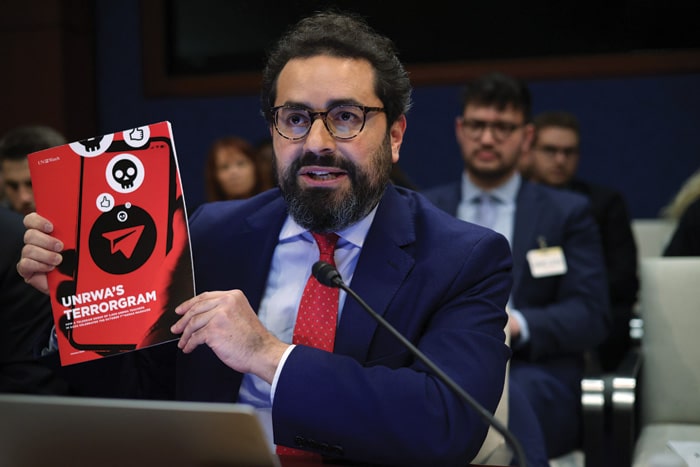
In the hearing, Neuer presented a new report called “UNRWA’s Terrorgram,” which documents a telegram chat group of more than 3,000 UNRWA teachers in Gaza that is replete with messages, photos, and videos cheering and celebrating the massacre of Oct. 7.
On the morning of Oct. 7, UNRWA teacher Safaa Mohammed Al-Najjar celebrated the massacre, posting videos. She praised the Hamas “mujahideen,” the holy warriors, as they massacred, mutilated, and raped Israelis. UNRWA English teacher Abdallah Mehjaz shared a message from Hamas urging Gazans to stay put, to ignore Israeli messages asking them to evacuate for their safety, effectively doing the work of Hamas, to ask Gazans to be human shields.
Israa Abdul Kareem Mezher, an elementary school teacher, celebrated the Hamas terrorists saying: “May Allah keep their feet steady and guide their aim.” When a group member wondered what these “heroes,” the terrorists, were brought up on, Mezher replied, “They imbibed jihad and resistance with their mother’s milk.” And a few days later, this UNRWA teacher asked Hamas to execute their Israeli hostages.
When Stéphane Dujarric, the U.N. spokesman, was asked about UN Watch’s information, he replied on Jan. 11: “I mean, UN Watch, they have a track record. And I think from our end it speaks for itself.”
Indeed, it does.
Neuer concluded his Congressional testimony: “The core problem of UNRWA, the very purpose of the agency, is to perpetuate the war of 1948, to send the message to Palestinians that the war of 1948 is not over. Don’t use cement to build homes, hospitals, and schools here in Gaza. Use it to build hundreds of miles of terror tunnels, to tunnel into Israel, to invade Israel, to go back to where your true homes are.
“That is the message of UNRWA. So we should not be surprised by what happened on Oct. 7 because that is the message that these Palestinians got for more than 70 years in UNRWA schools. UNRWA is a failure. We have to recognize what the Swiss Foreign Minister Ignazio Cassis said. And Switzerland is a country that historically supports the U.N. He said the following: ‘UNRWA has become part of the problem. It supplies the ammunition to continue the conflict. By supporting UNRWA, we keep the conflict alive. It’s a perverse logic.’
“It’s time to put an end to this perverse logic. We are asking Congress to take the lead in dissolving this agency.”
On February 12th, Neuer tweeted, “As Antonio Guterres and foreign ministers from around the world gather in Geneva on Feb 26 to open the 2024 UNHCR (U.N. High Commissioner for Refugees), we will be there to host the first International Summit for a Future Beyond UNRWA. Political leaders, aid officials & experts will transform crisis into opportunity.”
“UNRWA can’t be reformed,” Neuer told me. “Its entire purpose is to dismantle Israel. It’s well past time to dismantle UNRWA, entirely.”
In terms of reforming the larger human rights movement, that’s going to take “a change in the political will of democracies, to finally stand up to dictatorships,” Neuer told me. It’s also going to take “an alternate center of gravity” to begin to restore the true meaning of human rights.
UN Watch began that process 15 years ago with the Geneva Summit for Human Rights and Democracy. Sponsored by a coalition of 25 non-governmental organizations, the Summit meets each year on the eve of the U.N. Human Rights Council’s main annual session. Activists from around the world attempt to raise international awareness of dire human rights situations.
Perhaps Neuer’s greatest accomplishment will be explaining to the world that the universal values of freedom, respect, and dignity that were encoded in the U.N.’s original charter are very much Jewish values.
Perhaps Neuer’s greatest accomplishment will be explaining to the world that the universal values of freedom, respect, and dignity that were encoded in the U.N.’s original charter are very much Jewish values. Which is why the human rights complex’s treatment of Israel is in line with its non-treatment of very real human rights transgressors.
I ended my 2016 book “Passage to Israel” with the lines, “Israel is indeed a mirror to one’s soul. Those who see the beauty, who stand up for the truth, who understand the meaning, will never regret where they stood in this moment in history, when silence is not an option.”
In my decade writing about antisemitism, Hillel Neuer is one of the few who have not only fully embodied those words but made them actionable: creating change, slowly yes because the forces of evil are so strong right now, but still: creating change that will not only finally bring the U.N. back to its original mission, but will allow Israel, the one Jewish state, to finally live in peace.
Karen Lehrman Bloch is editor in chief of White Rose Magazine.
Why the UN Hates this Man Read More »

At a time when Jews face rising antisemitism in the U.S. and around the world, the film “The Zone of Interest” addresses the chilling consequences of indifference. The film does not do so, however, through the usual depiction of Holocaust victims or the atrocities they faced. Instead, it focuses on the life of the Nazi commander Rudolf Höss, who lived just outside the walls of Auschwitz with his family. In this way, the entire film centers on absence: not just the absence of Jews, but the absent conscience and basic humanity of their oppressors.
The film juxtaposes images of the Nazi commander’s family frolicking joyfully in the sunshine with those of a young girl from a neighboring home who sneaks out at night to hide food for the forced labor prisoners from the concentration camp. These sequences, shot as night vision, offer an eerie depiction of the “inside-out” nature of a world where evil flourishes boldly in the bright light of day, while goodness must do its work under the cover of darkness. Yet, with the unique cinematic rendering through night vision, the girl appears white and luminous as the angelic presence she truly is. On one such night, she finds a round tin containing a folded piece of paper. As she reaches for it in the dirt, it shines: a tiny sun lost in the dark depths of the earth. Indeed, it is just that, since the contents contain a song written by Auschwitz prisoner Joseph Wulf, entitled “Sunbeams.”
The next day, with a shaft of light filtering into the room behind her, the young girl sits at the piano and tentatively plays the notes of the song: “Sunbeams, radiant and warm/ Human bodies, young and old/ who are imprisoned here, Our hearts are yet not cold.” With her act of goodness, she rescues these words, this music and this hope, ushering it back into the light of day where it belongs.
This is in stark contrast to the other moment of live music in the film, when a Nazi orchestra plays in a bandshell to an almost empty audience. Only two maimed soldiers look on in a wintry landscape. Their missing limbs suggest the imminent demise of the Nazi regime, and their grotesqueness mirrors the warped souls of those who command them.
Famously, the Nazis, including Höss, upon whom the film is based, justified their actions by saying they were “just following orders.” Yet, the simple, clandestine actions of one nameless girl clearly indicate that even the most young and powerless in society are always able to exercise moral agency. She is the living proof of the possibility of choice, no matter the circumstances.
How much more so is the man who is selected to oversee the transport and murder of tens of thousands. The film reminds the viewer time and again that he and his family choose their oblivion. While their laundry flutters in the breeze, they frolic in the garden with their guests at picnics, as the ashes of thousands rise into the sky behind them. We are later reminded that the stench from the crematoria must no doubt have filled the air. In the household of the young girl who places apples for the prisoners, her mother abruptly closes the window, then hurries to pull the clean laundry off the line, as she registers the smell. The audience cannot quite share the palpable horror of this experience—how can one transmit smell on film?—and yet, as with all the other absences in the film, the mere suggestion is more horrible than any evocation.
This visceral awareness of the proximity of death also occurs earlier, when Höss takes his younger children swimming in the seemingly idyllic river near their home. He soon realizes that human remains have made their way into the water, and not only does he usher his children home to be scrubbed clean, but we see him clear his own nostrils of ashes. There is no escape from the consequences of his evil. Though it may not have penetrated his conscience, it has seeped into the very crevices of his body and that of his children.
The film suggests that this kind of cruelty, once it is unleashed, cannot be so easily directed against only the Jews.
Moreover, his moral contamination has infiltrated his family in ways he could not have imagined. In the final scene with Höss’s sons, the older one, dressed in his Hitler Youth uniform, locks his younger brother in the greenhouse. He then sits outside the door, watching and grinning with pleasure as his brother cries and begs to be released. The film suggests that this kind of cruelty, once it is unleashed, cannot be so easily directed against only the Jews. The evil planted in his children is the legacy that Höss leaves. Near the end of the film, Höss himself looks out on a room of Nazi elites at a party, and reflects on the problem of how they could be gassed in that space, given the height of the ceilings. It is clear that a mind, once warped by evil, is a force that can no longer be contained. It will cannibalize itself and all that it once loved.
The final images of the film show Höss descending a staircase alone, pausing at the landings to cough and retch (are his lungs filled with the ashes of the prisoners after all these years?). He descends the final set of stairs and is swallowed by the darkness. As we watch him vanish, we have the sense that this is his ultimate punishment: not just infamy, or execution, but oblivion. The seeming beauty of his life with his family at the start of the film is undercut here, as is the hubris of the Thousand-Year Reich. Its defeat is embodied by the fate of this one man: a life and a regime built on a foundation of ashes.
The film is ultimately not just about the banality of evil, but also the perils of banality in general. We have a tendency to be distracted by the ordinary concerns and routines of our lives, which numb us to atrocities in our midst. In our era, this self-absorption has risen to a dangerous pitch; we have become trivial creatures and the film alerts us to the stakes of this kind of blindness. It ends with the jarring images of the cleaning crews at Auschwitz in the present day as they vacuum and wash and sweep the sites of humanity’s greatest horrors: stacks of shoes behind glass, the empty barracks and corroded machinery of the crematoria. These final images impress upon us the importance of being not complacent in the face of memory either. The film suggests that, while it is easier than we might imagine to ignore evil in real time, it is even easier to forget those evils once they slip quietly into the shadows of history. And that is when “Never Again” becomes “Now.”
Suzanne Socken has taught English and drama for over 20 years in both Canada and the U.S. She is currently Co-Chair of the English Department at the Community Hebrew Academy of Toronto.
“The Zone of Interest” and the Peril of Banality Read More »
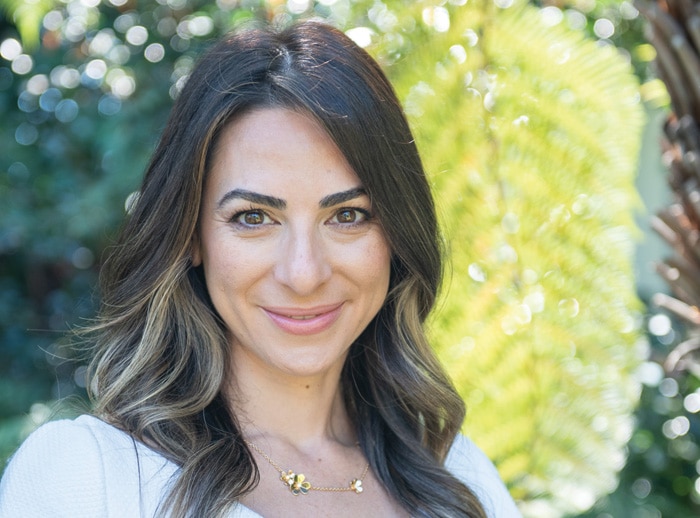
“I am a life-long conservative,” Elizabeth Barcohana told me. Her words may seem innocuous, until one considers that Barcohana was raised in Los Angeles, a staunch bastion of Democratic voters and policymakers.
Barcohana is currently running for the Central Committee for the Los Angeles GOP. If you are not familiar with the inner workings of Central Committees (both the GOP and Democratic parties have them), you’re not alone. “The Central Committee,” Barcohana explained, “is the ‘ground level’ of the political party membership; the people responsible for organizing the ‘boots on the ground’ to increase voter registration, voter turnout, candidate recruitment, campaign support, getting candidates elected, and fundraising.”
There are both Democrat and Republican Central Committees. Their members form the individual county’s party. “The Central Committee is the smallest unit of the GOP party infrastructure,” Barcohana explained. “In Los Angeles County, each Committee consists of seven members. We have 10 candidates running in District 42, the most of any Los Angeles County district.”
Committee members are elected every four years during the presidential primaries. Barcohana’s district, AD 42, includes Agoura Hills, Bel Air, Beverly Glen, Brentwood, Calabasas, Hidden Hills, Malibu, Pacific Palisades, Topanga, and parts of Westlake Village.
Barcohana, a practicing litigator, is the only mother with young children (four children, to be exact) running for a seat. The UCLA (’04) and USC Gould School of Law (’07) graduate is also “only one out of a handful of Jews that participate in the monthly L.A. GOP meetings,” she said.
“I believe that Jewish values obligate us to participate in the civic and political process in America, not only to protect ourselves and Israel, but in service and gratitude to America at large for the lives we are blessed to freely live.”
“I believe that Jewish values obligate us to participate in the civic and political process in America, not only to protect ourselves and Israel, but in service and gratitude to America at large for the lives we are blessed to freely live.”
Full disclosure: I have known Barcohana since the first grade, when she was still known as Elizabeth Berman. Her mother and father, Mitra and Myles Berman, were and remain active members of the local Jewish and pro-Israel community, particularly her father, who is one of the founding members of the Republican Jewish Coalition in Los Angeles.
I asked Barcohana whether, in addition to inspiration from her father, there were any life experiences or specific values that inspired her to be more active in the California GOP. She is no newcomer to the Republican party, currently serving as a California GOP associate delegate, a member of the L.A. GOP Voter Registration Committee, and L.A. GOP’s Past Chairman Richard Sherman’s Alternate on the Central Committee for AD42. “I grew up in a very diverse environment, hearing both liberal and conservative views,” Barcohana reflected. “I was always open to learning about liberal ideas, and heard them often in school and among friends, but ultimately, I disagreed with most of them. And now, as an adult and mother, I understand that merely disagreeing is not enough. You have to actively work against them because they have been destructive to the fabric of American life.”
She continued, “I believe that family, God, and our fundamental freedoms and responsibilities are the foundations of American life,” she said, adding that she is “grateful for the privilege of being an American. Today, these values are most consistent with the values of the Republican Party and its candidates up and down the ballot.”
There is one particular day in Los Angeles that remains etched in Barcohana’s memory: “The day I knew I had to get more involved in local politics was June 2, 2020,” she said. “Los Angeles was under curfew because the streets were open to rioters and looters, but the schools and synagogues were closed to our children. Only the Republican Party was standing up against those policies in any meaningful way.”
Despite her party affiliation, Barcohana sees a vital need for Jews to be involved “on both sides of the political aisle” of Republican or Democratic Central Committees. But when I asked her about Jewish participation in local Republican politics, she responded, “I will answer this way: At Los Angeles County Republican meetings, there are more non-Jews wearing Israeli flag pins and yellow ribbon pins in the room than there are Jews.”
Barcohana previously served on the board of FIDF Young Leadership for Los Angeles, and still supports FIDF. During the 2021 Israel-Hamas conflict in Gaza, she organized a fundraiser to purchase a recreation/rest structure for units operating the Iron Dome in the Negev, allowing soldiers an opportunity for much-needed shelter and shade.
This fall, Barcohana organized a warm clothing drive for Israeli children and families who arrived in L.A. after being displaced after Oct. 7, and who had been accepted into her children’s Jewish school. “I received so many donations from the community that I had to convert my living and dining rooms into a fully-stocked store so the families could take what they needed in privacy and dignity,” she said.
Barcohana describes herself as a “fierce Zionist.” She and her husband, Dr. Bob Barcohana, are also teaching their kids to be educated and impassioned Zionists. “We have an Israeli flag hanging from our banister in our entry way that I plan to keep up until the hostages are home,” she said. “When some were taking their mezuzahs down and taking their necklaces off, I went out and purchased a Magen David [necklace] on Oct. 12 (once I started breathing again) and have not taken it off, including for all of my on-camera interviews during my campaign.”
In discussing local voting patterns, Barcohana rejects the premise that all the precincts in Los Angeles County are strictly Democratic enclaves. “There are nearly one million registered Republicans in Los Angeles County — more than any other county in the nation — and even more conservative-leaning voters. When voter turnout is low, election results are not necessarily an accurate indicator of how conservative people in L.A. actually are,” said Barcohana. “Part of my job on the Central Committee will be to increase voter participation among conservatives.”
Those who are registered as Republicans in AD 42 may vote for Central Committee candidates in the March 5 primary election, and eligible voters that are not registered or wish to change party affiliation must do so by Feb. 20.
Tabby Refael is an award-winning writer, speaker and weekly columnist for The Jewish Journal of Greater Los Angeles. Follow her on X/Twitter @TabbyRefael
Meet the Jewish Mother Running for Central Committee of the Los Angeles GOP Read More »

In the film “American Fiction,” protagonist Thelonious “Monk” Ellison is a Black English professor and author of literary but commercially unloved novels. Portrayed by Jeffrey Wright, Monk is fed up with his woke students and the college administrators who pander to them. The insults against him mount: Monk’s agent cannot sell his next book because it is not considered by publishers to be “Black enough.” He is appalled by the instant success of a debut novel by a glamorous Black author catering exclusively to “Blacksploitation” tropes.
In a fit of pique, Monk writes a satirical novel filled with crack users, rappers, and other characters he imagines will do the job. With a smirk, he titles the work “My Pafology,” his disbelieving agent submits it under a pseudonym, and a publisher snaps it up for a fabulous sum. Monk disdains the white publishers who gush over his joke manuscript as “raw and real.”
I hadn’t seen a film in a theater for a few years and it’s ironic that this was the first to get me back inside. As a Jewish writer in these times, I am drawn to Jewish issues more than any others. Additionally, I have long resented the rigid “diversity” mandates that have elevated preferred minority voices in the publishing world while ignoring Jewish voices. Jews are a tiny minority, but we’ve been pegged as an oppressor class and therefore not considered underrepresented as writers.
I’ve watched as the red carpet has been rolled out by literary agents, magazines, organizers of writing contests and retreats, agents, and publishers for Black, indigenous, and people of color (BIPOC) and other “underrepresented” voices, particularly “gender-non-conforming.” Librarians, booksellers, reviewers, and editors of literary journals and review sites aggressively promote books by BIPOC writers on the front shelves or on home pages. We are all but commanded to read these books to demonstrate our good citizenship and enlightened thinking.
I felt a kinship with Monk, sharing his outrage that his work needed to fit into a limiting and stereotyped narrative. As one character in the film observed, “White people don’t want truth, they just want to be absolved.” I laughed out loud as overeager white publishers and a movie producer expected the author of “My Pafology” to talk like a ghetto gang member, while Monk, an educated man, forced himself to imitate the cadence and the lingo. I found the movie cathartic, often hilarious, and touching.
While Jewish authors publish loads of books each year, I’ve noticed that most hew to genres “acceptable” to mainstream publishers. Holocaust novels still sell, yet few Jewish novels or memoirs grapple with what it means to be a practicing Jew in secular society today.
While Jewish authors publish loads of books each year, I’ve noticed that most hew to genres “acceptable” to mainstream publishers. Holocaust novels still sell, yet few Jewish novels or memoirs grapple with what it means to be a practicing Jew in secular society today. Religious Jewish life had been expected to die along with the six million in the Holocaust, yet the opposite happened. Religious Jewish life has flourished in astounding ways, changing the face of modern Jewry. Outside of Orthodox book publishing, these important stories have gone wanting.
Few Jewish characters in contemporary novels explore what life could mean with deeper religious engagement, or find satisfaction in choosing that path. Dara Horn is among the very few current Jewish writers whose novels treat strong Jewish values and faith with respect and complexity. Where is today’s version of “Marjorie Morningstar” (Herman Wouk), “My Name Is Asher Lev” or “The Chosen” (Chaim Potok)?
To my ongoing frustration, many Jewish authors who write about Jewish Orthodoxy do so with a dismissive or careless attitude. Some are written by celebrated authors who left Orthodoxy, such as Naomi Ragen and Tova Mirvis. Anti-Orthodox memoirs have been published with fanfare while writers of memoirs revealing the beauty of a Torah life search far and wide before finding the one or two indie publishers who will take them. I speak from experience.
Holocaust-themed books, and those featuring Jewish characters who are apathetic about God and their religious identity, are comfortable but limiting genres. Jewish literature deserves novels and memoirs that reflect the larger, more complex, and more spiritually-based recent experience of Jews in the diaspora. This would involve stories that explore a growing commitment to religious tradition, as well as the painful impact of generations of assimilation. Ignoring these stories reflects a subtle anti-religious bias in the publishing world, just as the publishers in “American Fiction” rushed forward another book that reinforced comfortable, bigoted views of the Black American landscape.
However, beyond this soft bigotry, Jewish writers — regardless of religious or Zionist affiliation — have also increasingly faced overt antisemitism. Since Oct. 7, this antisemitism has erupted in fierce, brazen, and ugly ways. Some Jewish writers have had new books review-bombed on Goodreads or NetGalley. Jewish authors pegged as “Zio” on social media are targets for cancellation. Literary conferences and festivals have featured explicitly antisemitic speakers, and authors have called for rejecting Israeli support of conferences. Sheeplike and ignorant, some in the literary community have described the barbarism of Oct. 7, including rape, murder, and hostage-taking, as “resistance.” They called for boycotting these so-called “Zionist literary institutions,” which included PEN America, Best American Poetry, and Harper’s Bazaar, among others. Editors of other respected literary review journals, librarians, and many indie bookstore owners have piled on.
Jewish writers are fighting back. In Fall 2022, Adrienne Ross Scanlan helped draft an Open Letter which described the rise of worldwide antisemitism, the connection between antisemitism and anti-Israel prejudice, and how antisemitism was increasingly being manifested in the literary community. The letter has garnered nearly 200 signatures from writers, editors, literary agents, and readers, though some writers won’t sign out of fear of retribution or being ostracized.
Scanlan co-presented a panel discussion about antisemitism in the literary world at the 2023 Jewish Writers Conference, sponsored by the Jewish Book Council. During the panel, she said, “We need to turn this crisis into an opportunity – an opportunity to talk with each other, to create our own networks, to be ready so that the next time something horrible happens – and it will – we know what we want to say, who we want to say it with, and how we want to get it out into the literary and larger world.” She also wants to see “Jewish writers and our allies forming our own networks and organizations to make our voices known, and to make sure that all perspectives are being heard about what constitutes antisemitism in literary and other circles.”
After Oct. 7, journalist and book editor Howard Lovy decided to write a book called “From Outrage to Action: A Practical Guide to Fighting Antisemitism.” A longtime observer of the Jewish book world, he said, “I have seen the unfortunate ease with which the literary world has accepted and propagated antisemitic narratives. Writers are supposed to see beyond the surface and get at truth. In that way, they have failed, having a blind spot when it comes to Israel and Jewish issues. It’s been a growing problem, something I saw in 2021 when Irish author Sally Rooney refused to allow her books to be translated into Hebrew in solidarity with the anti-Israel BDS movement.”
Frustratingly for antisemites, Jewish endurance and optimism upset the premise of identity politics that has driven this open hatred. This ideology relies on the fiction that a history of oppression inexorably leads to a failure to thrive. Jewish achievement and refusal to wallow in victimhood inconveniently refute this.
Jewish writers should write proudly and prodigiously about their Jewish identities, the complexities, joys, sorrows, challenges, and blessings. We should write to defy those who prefer seeing books where Jews are either victims or plotting their escape from religious Jewish practice. We should write to give strength and inspiration to Jews holding fast to faith — and discovering faith — in a time of remarkable hostility, knowing we will prevail. We should write to leave a legacy for those who will follow.
Judy Gruen’s latest book is “Bylines and Blessings: Overcoming Obstacles, Striving for Excellence, and Redefining Success.”
Jewish Writers Must Defy the Publishing Industry’s Narrow Genres Read More »
In January, San Francisco Supervisor Matt Dorsey (D) attempted to offer documentation of how Hamas mutilated, raped and brutalized Israeli women on Oct. 7 during a committee meeting of the Board of Supervisors. The room immediately burst into booing, hissing and heckling, with attendees calling Dorsey a “liar” and shouting down his remarks.
One day later, at a San Francisco supervisors’ meeting that resulted in a 8-3 resolution calling for a ceasefire between Israel and Hamas, supervisor Catherine Stefani attempted to once again discuss Hamas brutality against Israeli women. “The tone of the meeting itself wasn’t so peaceful,” reported NBC San Francisco. “Members of the public jeered at Supervisor Catherine Stefani as she called out the sexual violence Israeli women suffered during the Oct. 7 attack.”
Needless to say, after the vote was announced, an eruption of excited cheering and “Free Palestine!” emanated from public attendees.
In late November, Oakland passed a permanent ceasefire resolution. When councilmember Dan Kalb proposed adding an amendment that also explicitly condemned Hamas, it was rejected 6-2. A few weeks ago, Chicago approved a resolution that called for a permanent ceasefire between Israel and Hamas by a 24-23 vote. Did I mention that Chicago Mayor Brandon Johnson (D) cast the tie-breaking vote?
The fact that Chicago’s resolution, and every other resolution calling for a permanent ceasefire — from Seattle to Long Beach to Akron to Albany — are non-binding doesn’t matter. “Do I believe that the words that we speak today, how we vote today influences directly international policy? I don’t. I don’t have those illusions,” the Associated Press quoted Chicago Alderman Daniel La Spata, who was one of the sponsors of the city’s ceasefire resolution. “But we vote with hope. We vote with solidarity. We vote to help people feel heard in a world of silence.”
Apparently, those people don’t include Israelis and in particular, Israeli women who have been raped by Hamas.
It hasn’t been easy these past few weeks for Alderman Debra Silverstein, the only Jewish member of the Chicago City Council. A few weeks ago, she all but begged her 49 colleagues to vote “no” on a resolution that demanded a ceasefire without so much as mentioning the release of Israeli hostages in Hamas captivity — a resolution which, shockingly, also made no mention of Oct. 7.
She was jeered and heckled by an angry mob for her public pleas, including her admonition during the meeting that, “There’s not even a single mention of the dozens of raped women.” It was a good thing that police were present when Silverstein added, “We should not pass a resolution unless it makes clear that Hamas cannot and should not attack again.” Clearly, there were many in the room that seemed to believe that Hamas should continue its attacks until Israel no longer exists.
By the day of that vote, Silverstein was perhaps used to the abuse. Several days earlier, protestors disrupted her speech on Holocaust Remembrance Day at city hall, as she spoke poignantly about Nazi atrocities. Yes, she was also heckled during her Holocaust Remembrance Day speech.
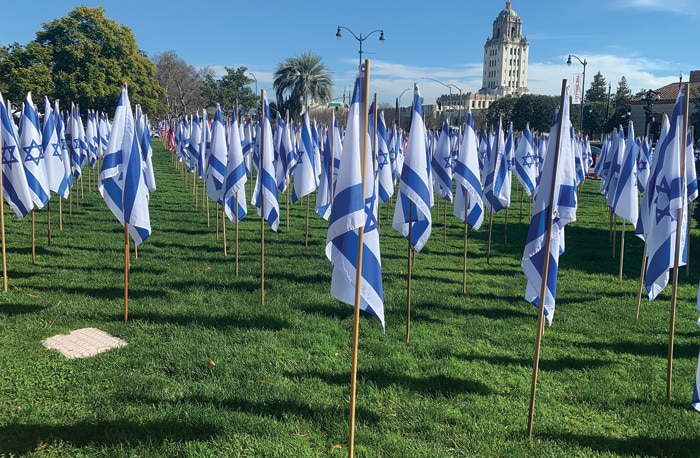
A few days after San Francisco’s symbolic vote, something extraordinary occurred 380 miles south of the Golden Gate City. The City of Beverly Hills, working closely with the Consulate General of Israel in Los Angeles, unveiled 1,400 Israeli flags on the lawn of Beverly Hills City Hall, as part of an art installation that also paid tribute to victims from 30 countries who were also killed on Oct. 7.
“Our city has stood against Israel-hatred and Jew-hatred for as long as I can remember,” former three-time mayor and current Beverly Hills City Council member Lili Bosse told me. “For me, the 1,400 flags are probably among the most sacred spaces that we have in our city. With each flag of a different nation or each Israel flag, I feel the sense of sacredness and holiness of these souls. These were mothers and fathers, sisters and brothers, Holocaust survivors and children,” said Bosse, whose late mother, Rose, was a survivor of Auschwitz (Bosse’s mother and father both lost all of their family members during the Holocaust). For Bosse, the installation is “a way for the world to see; it is also a response to the Holocaust deniers, and now, for those who deny the absolute evil of Oct 7.”
Walking past 1,400 Israeli flags, as well as 30 flags representing every country from Argentina to the Philippines, inspires a sense of solemn disbelief and humility. “I feel very changed by Oct. 7,” Bosse said. “I carry a heaviness and a sadness, and in the same way, I also carry this very strong sense of resilience and fight in me to speak up. As I see the darkness and see and hear the hate, it actually fuels me to speak louder and to ‘never give up,’ as my mother always told me.” Bosse believes that the installation and other expressions of support on behalf of Israel and the Jewish community send a clear message that Beverly Hills stands against terrorism.
In November, Bosse, as well as council member John Mirisch, spoke at the North American Mayors Summit Against Antisemitism in Fort Lauderdale, Florida. In November 2022, Bosse traveled to Athens, Greece to attend the Mayors Summit Against Antisemitism.
After Oct. 7, the city council unanimously passed a resolution in support of Israel, and also condemned Hamas. After a moment of silence following the Pledge of Allegiance and roll call, Mayor Dr. Julian Gold said, “I was thinking we should take a moment of silence for each of them, but we would be here, unfortunately, for a very long time.”
Maintaining the flag installation as a safe space includes the presence of 24-hour security, a real-time, around-the-clock watch center, drones and even signs describing the area as a sacred place. The city has a zero tolerance for “anything that’s illegal,” according to Bosse. “That was key. We will never cower; we will provide a safe space for others to walk by that sacred space,” she said.

A few days after speaking with Bosse, I spoke with council member (and former three-time Beverly Hills mayor) Mirisch, mentioned above. He told me that on Feb. 3, he was “one of the sole” counter-protestors at an anti-Israel rally near the flags’ installation. “I came alone to counterprotest and let them know they weren’t welcome in Beverly Hills,” said Mirisch. “They tried to intimidate me, and eventually I went to a private property on the southwest corner of Cañon Drive and Santa Monica Boulevard, with the permission of the owner, Shawn Far.” Surrounded by anti-Israel protestors, Mirisch, who was draped in an Israeli flag, held a megaphone and sang “Hatikvah,” “Oseh Shalom” and “The Star-Spangled Banner.” He even threw in a Broadway tune to mix things up, then chanted “Bring them home,” in reference to Israeli hostages still being held in captivity by Hamas in Gaza, and “Zan, Zendegi, Azadi” (“Woman, Life, Freedom”), the now-famous slogan in support of Iranian women.
Imagine that: A local city council member, draped in a blue and white flag, standing alone among a sea of Palestinian flags and singing the eternal Jewish prayer for peace, “Oseh shalom bim’romav …”
“As a community, we [in Beverly Hills] are a family. And it is the same as a Jewish community, and for anyone who stands with us. We are family. And no one messes with family.” – Lili Bosse
As the weeks and months progress, we can only expect to see more cities worldwide passing resolutions demanding that Israel should stop protecting itself. That is why I leave readers with a final promise from Bosse, who told me that she is going to fight antisemitism until her very last breath: “As a community, we [in Beverly Hills] are a family,” she said. “And it is the same as a Jewish community, and for anyone who stands with us. We are family. And no one messes with family.”
Tabby Refael is an award-winning writer, speaker and weekly columnist for The Jewish Journal of Greater Los Angeles. Follow her on X/Twitter and Instagram @TabbyRefael
Why More American Jews Should Thank the City of Beverly Hills Read More »
I remember the date I woke up to the reality many Jews discovered on Oct. 7.
March 17, 2011.
It was a week after the horrific murder of the Fogel family, in which a mother, father, and three of their children – including a three-month old baby – were brutally slaughtered in their home by two Palestinian teenagers. At that moment I was six months into the job as the speechwriter for Israel’s Mission to the United Nations. I was tasked with writing remarks for Israel’s Ambassador to deliver about the murders for a major event in New York.
That evening, after the speech, I found myself at a dinner party in Brooklyn with a group of mostly Ivy League-educated 20somethings working in journalism and politics.
I mentioned that I’d had a tough time writing this speech given its subject matter.
One new acquaintance looked up from a different conversation from across the table and said, “Are you talking about that family that was killed in Itamar?”
I replied, “Yeah that’s the one.”
He said, “I can’t imagine how you could feel good about writing a speech like that. Of course, it’s terrible what happened to them, but those people were settlers. They chose to live on Palestinian land, and shouldn’t have been there. What happened in Itamar is inevitable … oppressed people have no choice but to resist.”
“By murdering a three-month-old baby?” I replied, genuinely shocked at this perspective. As my conversation with this guest continued and I looked around, I began to realize that most of the others at the table agreed with him. I wasn’t invited back.
At that point, I had already spent six months as an Israeli delegate at the United Nations, working in the heart of an Orwellian world where Israel alone is relentlessly condemned in resolution after resolution, while Gaddafi’s Libya was appointed as Chair of the Human Rights Council.
When I started working in that theater of the absurd in 2010, I had an implied sense that “serious people” – particularly in the U.S. – could easily recognize the U.N.’s take on Israel as total garbage. I had not internalized that this same crazy thinking could so deeply infect the circles I’d comfortably traveled in my entire life.
Yet, at that dinner table I saw the same hateful insanity that places Jews and Zionists at the center of every evil and provides “context” and justification for any Palestinian crime, even the brutal murder of a three-month-old baby.
In that moment, I recognized that the differences of opinion I had with a growing segment of America’s political and cultural elite were not about this Israeli policy or that Israeli government. They were about something more fundamental: the right of Jews to self-determination – to defend ourselves living as a free people in our own land.
These elite are critical – sometimes disdainful – of Jews exercising military power. I, on the other hand, believe it is the only thing standing between Jews and another Holocaust. The gap in those positions creates a steep hill to climb for every Zionist.
In the years since, this subject has continued to occupy a huge part of my brain space – and the situation has only gotten worse. Much worse.
By so many measures, we are losing the information war: Tik Tok trends; newspaper headlines; polling among young people, progressives, and other growing segments of voters.
[.speaker-mute]By so many measures, we are losing the information war: TikTok trends; newspaper headlines; polling among young people, progressives, and other growing segments of voters; the extreme hypocrisy and disregard for Jewish life shown by those in positions of power and influence – from University Presidents to celebrities to corporate HR professionals.
The situation calls for a reckoning among advocates no less serious than the one that must occur in Israel to account for the colossal intelligence and military failures of Oct. 7.
We are losing for several strategic and tactical reasons.
Israel’s enemies have systematically invested many billions of dollars in an ecosystem of influence, with nodes that all work together as part of a massive network – from lobbyists, think tanks, universities and NGOs to media outlets, influencers, bots, social networks, Wikipedia editors, and K-12 curricula.
As the head of a strategic communications firm for the last eleven years, I’ve seen the erosion of our position up close. While our firm has advised many pro-Israel and Jewish groups, most of our business is outside of the Jewish world. Like many others who do strategic communication for a living, I have seen clearly that there is only one side driving forward a dynamic, effective, outcome-driven strategy relevant in 2024. It is not ours.
As the environment in which information is consumed and opinions are shaped has shifted, Israel’s enemies have anticipated where the field is headed, hired talented professionals, and invested with a systematic and long-term view, building influence platforms over the course of decades.
They have understood that this is not just a question of educating people who don’t understand, “building allies,” “reaching young people,” or “getting out the facts”; it is an information war that requires armies of people with deep subject matter expertise in areas from intelligence and forensic accounting to media and digital strategy to law and policy – all working together toward the same strategic purpose.
The other side has been relentlessly aggressive, working to impose a social and professional cost on donors, students, activists, and advocacy professionals for being openly Zionist.
On the other hand, too often, we have relied on well-meaning volunteers and underpaid nonprofit professionals to fight this fight, staffing this project not much differently than the way we run a local Jewish Community Center.
For the last two decades, pro-Israel groups have operated in silos, with many pursuing redundant, competitive and overlapping projects and far too few focused on building a broader ecosystem like the other side. Our groups are weakened and distracted by their rivalries with each other, and their need to fundraise and respond to the whims and preferences of donors who have no idea what it means to fight an information war.
We have not effectively anticipated social and political trends like intersectionality and rising populism, or navigated the dramatic changes in how media is produced and consumed.
We have allowed a Jewish educational infrastructure to exist in America that has left the vast majority of Jews without basic knowledge of their faith or any sense as to why a connection to Israel is relevant. For many – if not most – American Jews, Israel is a two-dimensional cartoon that they learn about through the same biased and captured media and academic institutions educating the rest of the country.
We have not funded enough innovative projects that reach hearts and minds outside of our echo chamber – and we have not provided enough funding to scale up those that have been effective.
We have not built a large pipeline of talented professionals devoted to pro-Israel work. The high-quality candidates who do take these positions burn out after a couple of years because of the lack of opportunity, low salaries, and the dysfunctional and mediocre nature of so many groups in the space.
We have allowed countless zombie organizations to continue sapping donor resources and the attention of media and policymakers even though they no longer have a constituency or efficacy.
That said, I am cautiously optimistic that Oct. 7 is going to shift this paradigm – that our two-decade collective failure has reached its nadir.
Why? First and foremost, so many Jews – and some non-Jews – who thought this was not their problem before Oct. 7 have had the same wakeup that I had in that Brooklyn apartment 13 years ago.
The shock and horror of Hamas apologists and propagandists taking over our schools, streets, and institutions in the wake of the worst massacre of Jews since the Holocaust has sparked a surge of activism, energy and conviction like I have not seen in 20 years in this space.
Since Oct. 7, I’ve been flooded with inquiries from college students and professionals eager to figure out how they can make a difference for Israel and the Jewish people full-time. In many cases, they are looking to give up lucrative careers in tech or law or finance to do so.
Our firm has advised dozens of people and organizations facing antisemitism in workplaces and schools – most of whom never felt compelled to speak up on this issue before.
Something I never thought I’d say: Jews in the entertainment industry are furious and focused. I’ve seen this up close through our work representing the families of hostages and other victims of Oct. 7. There is not a night on the calendar in L.A. when there is not a high-level meeting or fundraiser in support of the hostages, the fight against antisemitism, or Israel more broadly. The folks showing up to these meetings are not “the usual suspects.” The same can be said about Silicon Valley and Wall Street.
In the coming months, some of this energy and money will be frittered away. Some people will get discouraged, disinterested, and distracted. Some will get intimidated into silence. Some will feel compelled to join the other side.
But a growing core has been mobilized – a core that will now live more Jewish lives, invest and engage more in Jewish communities, and have the courage to stand up, speak out, and devote more resources to the fight against antisemitism.
This group is beginning to see clearly how the other side has fought this battle. It is incubating, building and funding the organizations, initiatives, and programs – some that exist and others that do not yet exist – that will form a powerful new ecosystem. I am hopeful that this surge of interest will not only provide exponentially more resources, but also expertise – particularly in reaching the “cool kids” — and a higher level of accountability and scrutiny for pro-Israel groups, improving or eliminating the ones that have grown complacent and anemic.
There are other reasons that our advocacy efforts may get easier in the U.S. over the next decade.
The inclusion of the Palestinian cause as part of an intersectional social justice coalition was the other side’s most powerful strategy of the last two decades. There is a backlash now underway that will make this approach less effective – and maybe even harmful to them going forward.
The outrage over the Congressional testimony of the Harvard, Penn, and MIT Presidents was not only about antisemitism. It was driven by a broader sense – including among many of the elites who once championed these ideas – that the radical ideologies incubated on campuses have gained too much currency in the culture and need to be curtailed. Like generations before them, many of the young people who now champion radical leftist ideas about Israel will abandon these ideas as they get older, particularly if the wider culture is shifting against these beliefs.
Although no one knows where this war will leave Israel in the next decade, I think the most likely scenario is that the Jewish state emerges stronger, more integrated with its Arab neighbors, and with even more to offer the world on both the security and economic fronts.
While the other side has been preparing for this war for decades, we have been playing dress-up and talking to ourselves. As the communications environment and culture shift, the question for our moment is who is going to more effectively prepare for the information war to come?
Will we emerge from this moment more united, more focused, and more strategic? Or will we allow the dysfunction and failed strategies of the past to continue to define our work?
I pray we can get our act together, because one thing is certain: the cost of failure in the next decade will be exponentially higher than it was over the last one.
Nathan Miller is the CEO of Miller Ink, a strategic communications firm headquartered in Los Angeles. He served as the Director of Speechwriting at Israel’s Mission to the United Nations from 2010-13.

On a recent trip to rural Kernville, California, with my daughter and her family, I sat on the couch with my six-year-old granddaughter Eliana, and we recited the morning blessings together. As I heard her sweet voice repeating the ancient words, I was suddenly suffused with joy – a joy rooted in the deep satisfaction of fulfilling the basic precept: “And you shall teach it to your children.” (Actually, my daughter taught it to her daughter – but that means I taught it to my daughter in a way that made her want to pass it on to her children.) As we recited the words together, the ancient words of the Shema became a shimmering bridge between the past and the future.
What does it take to transmit a tradition? When my children were young, I once dreamt that I was playing a game that involved passing a ball. I dropped the ball, and my team lost. In the dream, I was devastated. I awoke and understood that in raising my children, my primary responsibility was not to drop the ball. I had been handed a gift. My job was to pass it on.
Teaching our children how to live as Jews is an act of transmission – of passing the ball. It forges a link that binds us to our ancestors and carries us into the future. But it does more than that. By giving our children roots in the past and inviting them into ongoing effort to build the future, it also shapes the fabric of their identity, transmitting values, molding character, and providing them with a spiritual foundation for their lives.
As I reflect on those precious moments of davening with my granddaughter, I remember that the seeds we plant today will blossom in their lives tomorrow. Just as Abraham’s early choices grew into the Israelite nation and the Jewish people – so the values we instill in our children when they are young become the compass guiding them through life’s journey, helping them navigate its complexities with wisdom and strength.
Each of us relates to the tradition in our own way, and each of us is uniquely gifted to share the tradition. As we do so, we are accepting the Shema’s command:
You shall teach them thoroughly to your children, and you shall speak of them when you sit in your house and when you walk on the road, when you lie down and when you rise up.
Choosing to take a Jewish action, whether reciting the Shema or selecting a kosher restaurant for a family meal out, affects more than our own lives – it contributes to passing on an identity that has kept the Jewish nation alive against all odds for thousands of years.
And yet, when I think about the obligation not to drop the ball, I realize that this idea expands beyond my role as a parent. Each of us either carries the ball or drops it in the life choices we make. Choosing to take a Jewish action, whether reciting the Shema or selecting a kosher restaurant for a family meal out, affects more than our own lives – it contributes to passing on an identity that has kept the Jewish nation alive against all odds for thousands of years.
Sitting with my granddaughter during her winter break from a Jewish school, sharing Parsha stories with my other granddaughters in Jerusalem, and hearing my grandsons tell me about the Talmud they are learning, I am grateful to feel that, so far, I have not dropped the ball. Will they pass the tradition to their children? Time will tell.
Elizabeth Danziger is the author of four books, including “Get to the Point,” 2nd edition, which was originally published by Random House. She lives in Venice, California.
Transmitting Tradition: Not Dropping the Ball Read More »

A Jewish student at Columbia University was reportedly assaulted by a pro-Palestinian protester while walking back from a pro-Israel rally on Feb. 2.
The student, Noah Lederman, told Jewish Insider (JI) that the pro-Israel protest ended when “when the pro-Palestinians were starting to march,” prompting Lederman to leave. A member of a group of pro-Palestinian protesters wearing a mask and white keffiyeh and holding a camera noticed “my shirt, which in addition to the flag said in English and Hebrew ‘together we will prevail,’” Lederman continued. “Before I could process, the man with the camera shoved me against the wall [of the building] aggressively and pinned me in an attempt to immobilize me. The mob surrounded me. As I broke free, the assailants continued to pursue me, shoving me and yelling ‘keep running, keep f—king running.’” A bystander shouted at the protesters to let him go, and they did.
A spokesperson for the university told JI, “Since the alleged incident took place outside of Columbia’s gates, the NYPD has handled this investigation. The safety of our community is our highest priority.” Lederman claimed that he was pinned up against a university building.
Texas A&M University’s Board of Regents voted to shut down their campus in Qatar in four years by a vote of 7-1.
The university said that they “decided to reassess the university’s physical presence in Qatar in fall 2023 due to the heightened instability in the Middle East,” according to Jewish News Syndicate (JNS). Christians United for Israel (CUFI) Chairman Pastor John Hagee said in a statement that he’s “deeply grateful” for Texas A&M’s decision. “Doha has decided to side with terrorists; as such, Aggies have no business associating with that regime,” he said.
A group of more than 30 pro-Palestinian students at Harvard University participated in a hunger strike on Feb. 9 that lasted 12 hours, The Harvard Crimson reported.
The Harvard students conducted their strike in solidarity with students at Brown University, who went on a hunger strike from Feb. 2-8 as part of an effort to urge Brown to divest from companies that conduct business with Israel. The hunger strike at Brown ceased when University President Christina Paxson rebuffed their demands.
Secretary of Education Miguel Cardona wouldn’t say if the “from the river to the sea” is phrase is antisemitic but did say that “antisemitism can include anti-Zionist statements” in comments to reporters on Feb. 6.
According to JI, Cardona said in response to a question on if “from the river to the sea” phrase is antisemitic, “That’s why I say we investigate each case, and it’s difficult for me to make a statement here about that. If students are feeling unsafe with that, it’s the responsibility of leadership to act. I believe antisemitism can include anti-Zionist statements … we take that into account when looking at cases.” A spokesperson for the Education Department told JI that Cardona “and the Department are acutely aware that many find the chant threatening and antisemitic. Students should never feel unsafe on campuses.”
The Hillel House of England’s University of Leeds was vandalized on Feb. 8 with “Free Palestine” graffiti.
The Union of Jewish Students posted photos of the graffiti on X and issued a joint statement with Leeds Universities Jewish Society (JSoc) that read, “We are heartbroken and angry that after an uplifting and inspiring Challah Bake, our JSoc Hillel House was defaced with antisemitic graffiti. It is shocking and outrageous that those who hate us would stoop to this level.” They added that the university “has serious questions to answer as to how an environment was allowed to be created where a Leeds professor deemed it acceptable to publicise the location of a Jewish building, for the sole purpose of intimidating Jewish students on campus.”
The university said in a statement, “The University of Leeds is deeply shocked and saddened by the events of Friday 9 February during which Rabbi Zecharia Deutsch received threats to his safety and that of his family and Hillel House was attacked. We understand and share the sentiment that has been expressed within and beyond our community, that antisemitism is a hatred that has no place on campus. We totally condemn the antisemitic abuse and threats directed towards the chaplain and his family – such attacks on any individual are unacceptable and will not be tolerated from members of the public or our University community.”
Campus Watch February 15, 2024 Read More »
