fbpx

February 15, 2024

Biscochos— Sweet Rings of Love

Ask an American child “What is your favorite cookie?”

It’s most likely that they will answer, a chocolate chip cookie. But for me, the question of my favorite cookie is more complex.

My childhood memories are filled with cookies. Even more than they love cakes, Moroccans love their cookies. The Moroccan kitchen is filled with so many varieties—some festive for holidays and life cycle celebrations, others for every day dunking in coffee or mint tea. My mother was an expert baker and turned out beautiful cookies on a regular basis, including tortitas (galette), mazapanes, griba and almond cigars. Some of her fancy cookies featured marzipan or nuts, others were more simple variations of flour and sugar, flavored with orange blossom water or fennel seeds.

In the 1970s, as immigrants to the United States, my family enjoyed trying all the different varieties of store-bought cookies. We loved those iconic pink and white frosted Mother’s Circus Animal Cookies, Nutter Butters, and, of course, Oreo style sandwich cookies.

We loved Nilla wafers, especially dipped in milk. My favorite after-school treat was to fill a cup with the wafers and pour milk over them, then eat the sweet mush with a spoon.

While I don’t indulge in these cookies nowadays, passing by their bright packaging in the grocery aisle still gives me a cozy, loving feeling.

Recently, my brother Moise sent my brother Salomon and me a photo of Stella D’oro S-shaped breakfast treats that he had snapped at the market. In our group chat, we joyously reminisced about how good they were and how much we loved dipping these almond-flavored cookies into our hot mint tea. They stand out as my family’s most nostalgic cookie of the 1970s. We always had a package in the kitchen cabinet. Now that I think of it, we probably loved them because that almond flavor was so Moroccan and was the closest to our mother’s home-baked cookies. That makes me smile.

As my brothers and I married, my parents were blessed with grandchildren. Usually my mother would have freshly baked cookies for their visits, but she would also stock up on Pepperidge Farms Milano cookies. To this day, if you ask any of the grandchildren what is their favorite store-bought cookie they will answer, Milanos!

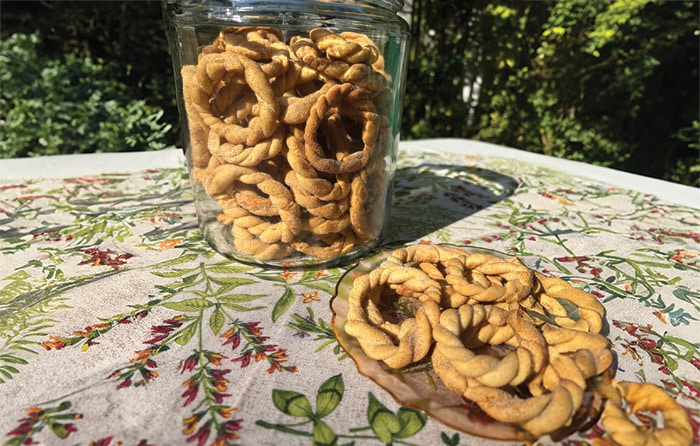
One of the sweetest memories of when I started dating Neil are the Shabbat afternoons spent with him at the home of his honorary aunt Sylvia Aboulafia. Everyone would gather at the kitchen table and we would be served hot coffee. Sylvia would pull out the big Yuban coffee can filled with her freshly baked biscochos. Biscochos are a favorite of the Ladino kitchen. They are a crunchy, slightly sweet, ring cookie that are dipped in cinnamon sugar or sesame seeds before baking. Neil tells me that it was always a platter piled with biscochos that welcomed family and friends for a “vijita”, an extended visit on Shabbat afternoons throughout the Rhodesli community living around Liemert Park and Crenshaw Village in the ’60s of his youth.

Just as the Sephardic Jews were dispersed throughout the Middle East and North Africa, the recipe for biscochos travelled with them. Our dear friend Esther Avrahamy is of Aleppo Syrian and Turkish descent via Cuba, Brooklyn and Miami. Her family also has a love for biscochos, which are often called a sweet ka’ak by Syrian Jews. Whenever her mother “abuela” Miriam visits from Miami, she lovingly bakes a huge batch for her grandchildren and their appreciative friends.

Last week, I had the privilege of spending the day with Esther and Jazmin Duek. We baked dozens of biscochos and many other sweets for the upcoming wedding of Esther’s daughter Miriam (Sephardic tradition is to name in honor of grandparents). The day before the wedding, we will celebrate a Bano de Novia, which is basically a Mikvah party. After the ritual purification of immersing in the Mikvah, the bride, her mother and future mother-in-law will all light candles and recite blessings. These candles will be extinguished and the bride will save these candles to light future Shabbat candles in her new home.  

The tradition is to have 52 cookies tied with a thread or a ribbon. The significance of 52 is twice the numerical value of Hashem, the name of G-d. We also baked a large Magen David from the same cookie dough. Esther and the groom’s mother will each give a blessing for the new couple and break the Magen David over Miriam’s head. This ceremony reminds us of the destruction of the Beit Hamikdash, the Holy Temple. And also to protect the bride from the evil eye. G-d forbid, if the bride is subject to an evil eye, the moment of breaking the Magen David will cause the evil eye to disappear. The bracha of Borei Mi’ne Me’zonot is recited and all the guests indulge in a biscocho.

What is the power of a cookie to create such a tradition? What is it about a cookie that unlocks those special childhood memories? And what is it about a cookie that makes one feel love, friendship, joy?

I don’t think it’s about the actual cookie. It is about the history, the experience. It’s about someone lovingly serving you a cookie and giving you the sense of being taken care of.

I don’t think it’s about the actual cookie. It is about the history, the experience. It’s about someone lovingly serving you a cookie and giving you the sense of being taken care of.

—Rachel

This is the perfect recipe for yummy cookies to keep in your cookie jar. Light, subtle, sweet and deliciously crispy.

Perfect to serve to your loved ones, to make your own special memories!

—Sharon

Biscochos Recipe

4 eggs
1 cup sugar
2/3 cup oil
1 teaspoon vanilla
6-7 cups cake flour
2 teaspoons baking powder
2 teaspoons vanilla essence
Pinch of salt
1/4 teaspoon baking soda

Topping
1/4 cup fine sugar
2 teaspoons cinnamon

Preheat oven to 350°F.
In a stand mixer, combine all the ingredients until the dough comes together and forms a ball.
Place dough on the counter and gently knead for about a minute, until dough is smooth and comes together.
Roll all the dough into walnut-sized balls.
Roll into a thin strand, then double the strand and twist into a rope.
Close into a ring, then dip into cinnamon sugar.
Place cookies on parchment lined baking sheets and bake for about 20 minutes, until firm and golden brown.
Remove cookies from the oven and allow to cool.
Lower oven temperature to 200°F.
Biscochar (crisp) the cookies by placing bracelets on a baking sheet and leave in the oven for one hour.
Transfer to a wire rack and allow to cool.
Store in an airtight container.


Rachel Sheff and Sharon Gomperts have been friends since high school. They love cooking and sharing recipes. They have collaborated on Sephardic Educational Center projects and community cooking classes. Follow them on Instagram @sephardicspicegirls and on Facebook at Sephardic Spice SEC Food.

Biscochos— Sweet Rings of Love Read More »
Rabbis of LA | Mother Teresa Was Right – Ben-Naim Was Meant for the Rabbinate

Many of Rabbi Elissa Ben-Naim’s colleagues could identify the moment when they knew they were destined for the rabbinate. But even after 25 years at Wilshire Boulevard Temple as a day school educator, Rabbi Ben-Naim had to think for a moment when asked what drew her to the rabbinate. Her responses reached deeper. “For me,” the Chicago native who grew up in Cincinnati, the American birthplace of Reform Judaism, said, “it was a series of blessed circumstances, besherts. Growing up in a classical Reform congregation (Isaac M. Wise Temple, named for the founder of the American Reform Movement), I went to Religious School Monday, Wednesday and Sunday. And we went to temple every Friday night.” Being a part of Reform community life “was a way of life for us,” Elissa Schwartz Ben-Naim, who married into a Moroccan family, said. Sort of a regional thing. “Back then in the Midwest, in the ‘70s and ‘80s, temple was a way of life.”

It’s still a way of life for her as Director of Jewish Life & Learning at both the East and West campuses of Wilshire Boulevard Temple’s Brawerman Schools, grades K-6. The schools describe themselves as “the choice of hundreds of families for their commitment to Joyful Judaism.”

As a young woman, Elissa enrolled in the College of Wooster in Ohio “mostly because I was recruited for being Jewish. I was one of about 70 Jewish students in the whole school.” The rabbinate was not in her thoughts. As a freshman, she was the lone Jew in her Religions 101 class.

For the first time, she was not in a Jewish community. She found herself reading Judith Plaskow (the first Jewish feminist theologian) and other Jewish thinkers. “I learned what others felt about Judaism writ large,” Ben-Naim said. “I had exposure to Catholics and Muslims, seeing students turn the pages with tissues. I started my formal study of world religions.” Being in the middle of Ohio in the 1980s, she noted, few universities had extensive classes in Judaism.

When studying religion in general, she became fascinated by other religions. “For a couple years,” the former Ms. Schwartz recalled, “I went to Mass every Saturday with a close friend – just as a spectator, and as a student of rituals and philosophies.” By her senior year, she was writing about women as rabbis.

She earned a Fulbright Scholarship to go to India and do research on the female guru and goddess tradition, and a photo documentary on women participating in religious ritual, Hindu, Islam, Christianity.

During her nine-month post-undergrad study-travel seminar, Ben-Naim had two profoundly emotional experiences: spending a month with the Sisters of Mercy during monsoon season, helping the destitute and dying, and a 15-minute audience with Mother Teresa. She barely slept the night before her meeting with Mother Teresa. Ben-Naim had prepared “well-crafted” questions; she wanted to know how the 82-year-old nun felt about women being ordained as priests. Mother Teresa was having none of it. Her most meaningful guidance was that Ben-Naim should embrace the rabbinate. “It would have been easy for me to have found another religion,” Ben-Naim said.

“But what happened to me, what always has happened to me is part of the beshert experience: I would be meditating my heart out, wanting to understand traditions in religions in India, and davka, I would open my eyes, and there would be a Magen David! Or I would look to my right, and there would be a quote from Isaiah.” She wrote “notebook after notebook of notes and reflections. It was as if my path — everywhere I went, Judaism was beneath my nose.”

The rabbi said she never was in a place where she was trying not to be Jewish or looking for something else. It never got to that point because “it was so obvious I was going to finish my Fulbright and go to Hebrew Union College rabbinical school.” She already had been accepted before going to India.

She has always been halachically minded “because I was raised in such a phenomenal environment that was very spiritual and considered all types of religious ritual as an opportunity to connect to oneself and to the Divine, the halacha stuck with me,” Ben-Naim said. “When I came home from India [in 1992], I decided that was it, that I would keep Shabbat and the other laws.”

“I want to leave an imprint on people the same way I was blessed to receive my education, by Jewish and non-Jewish mentors.“

Then came her first year of rabbinical school in Jerusalem. “I was living with a sense of Shabbat, and learning the system of halacha,” she said. “Thank God I met my husband of 27 years,” and today it is three children and a couple mortgages later … “I have wanted to have a meaningful career and presence in Jewish life,” the rabbi said. “I want to leave an imprint on people the same way I was blessed to receive my education, by Jewish and non-Jewish mentors.”

“It has been,” she said, “so much more than being a rabbi – it is Judaism as a way of life. I have been incredibly fortunate in Los Angeles, at Wilshire Boulevard Temple, being a congregant at B’nai David-Judea, and raising my children from Brawerman, to Milken, to Shalhevet and beyond.”

Rabbi Ben-Naim considers Los Angeles “the perfect place for me as a post-denominational, halachically inspired, rooted person.” 

Rabbi Ben-Naim and her husband have been members at B’nai David nearly three decades, since before they were parents (they now have three children). The rabbi explained they chose B’nai David to be with halachically minded congregants who are open to Modern Orthodoxy “in a way that resonates with me.”

“For her, she said, “when I am looking for a rav or a rabbah, it is beyond gender.

Fast Takes with Rabbi Ben-Nai,

Jewish Journal: What is your favorite Jewish food?

Rabbi Ben-Naim: Sephardic – Arayes, with the right sauces, tahina sauce.

J.J.: What is the favorite place in the world where you have traveled?

Rabbi Ben-Naim: Israel. I would go tomorrow. Two of our sons are living there. One is a soldier.

J.J. What is your favorite off-time pastime?

Rabbi Ben-Naim: A balance between cooking and self-care, working out, exercise.

Rabbis of LA | Mother Teresa Was Right – Ben-Naim Was Meant for the Rabbinate Read More »

Bring on the Dawn

Are you tempted to turn off cable news, stop watching videos of antisemitic protests, and stay in bed?  I know I am.  

Since the long nightmare began on Oct. 7, each morning brings additional horrors.  The fate of the hostages, war on multiple fronts, the silence of people we once thought of as friends — all contribute to a despair that can seem overwhelming.  When, we might ask, will it ever end?  If it is true that it is darkest before the dawn, we await the light, because these days are among the darkest in memory.

It was just a couple of months ago when our outrage was focused on the Israeli government’s heavy-handed and divisive efforts at “judicial reform.”  Few can deny the legitimate threat that misguided attempt posed to Israel’s unity, and to the support for Israel from those of us in the Jewish Diaspora.  But while the good old days may not have been so great, I would return to them in a minute.   

Now we worry not just about Israeli leadership; we worry about whether our ancient homeland will be our forever homeland.

Some commentators have made the point that today’s misery is reminiscent of the ninth plague in the Passover story – darkness.  Rabbi David Wolpe has asked why that plague was so terrible compared with those that came before (water turning into blood, pestilence, and the rest), and the horrible one (the slaying of the first born) that followed.  What, after all, is so awful about darkness?  Light a candle and you will be able to see.  But perhaps, Rabbi Wolpe notes, the type of darkness described in Exodus 10:21, “a darkness that can be touched,” doesn’t vanish in the presence of artificial light.  If it is an internal darkness, nothing can possibly provide illumination.  

If there is such a thing as darkness in our hearts, there might also be an internal light.  In Bereishit, on the first day of creation there was light.  Puzzling, as the sun, moon, and stars weren’t created until day four.  Light without the sun?  Maybe the original light was a spark within each of us, guiding our thoughts and our actions.

If we trust in that internal light, we may be able to overcome the internal darkness.  Faith has invigorated Jews since the days of Abraham.  As one of countless examples, the most powerful miracle of Hanukkah might not be that a small jar of oil burned for eight days; it may be that believers lit the flame in the first place, praying that it would last eight days.  That abiding faith is an integral element of Judaism, helping to explain our resilience in the face of seemingly insurmountable odds.    

Faith not only provides comfort and hope; it inspires us to do G-d’s work here on earth.  And there is so much work to be done.  Write to government officials, travel to Israel, donate your time and money, confront hatred on the internet and in your everyday interactions.  None of this will happen if we close our eyes and hide.

The beautiful and powerful Mi Shebeirach prayer asks G-d, the source of all strength, to bless those in need of healing with the renewal of body and spirit.  And it also asks G-d to help each of us “find the courage to make our lives a blessing.”

Here is my hope: That we take that prayer to heart and summon the courage to thrive; that when we look back at these trying times a year from now, we are able to rejoice in our own recovery and that of the State of Israel.

Here is my hope: That we take that prayer to heart and summon the courage to thrive; that when we look back at these trying times a year from now, we are able to rejoice in our own recovery and that of the State of Israel; that the global Jewish community emerges more united than it had ever been in the past; and that Judaism continues to serve as a beacon of light for all humanity.  Kein Y’hi Ratzon.  May it be G-d’s will.  And may it be the result of courageous people refusing to succumb to the darkness of despair.


Morton Schapiro is the former president of Williams College and Northwestern University.  His most recent book (with Gary Saul Morson) is “Minds Wide Shut:  How the New Fundamentalisms Divide Us.”

Bring on the Dawn Read More »

How Hebraic Heroes Inspired America

Years before Jewish Comic book creator Stan Lee (né Stanley Martin Lieber) invented Spider-Man and Jerry Siegel and Joe Shuster sketched out Superman on Mama Shuster’s challah board, Hebraic heroes were inspiring America. Yet while millions hungrily consume the latest Marvel cinematic masterpieces and await DC’s relaunched universe, hardly anyone knows that the Persian Jewish Queen Esther and the muscular Samson were inspiring America long before Ms. Marvel and the Man of Steel.

That’s why, in celebration of Presidents Day 2024, Yeshiva University’s Zahava and Moshael Straus Center for Torah and Western Thought and OpenDor Media are partnering in the production and release of a series of four short videos for educators, showcasing the Hebrew Bible’s impact on the annals of American heroism.

Learners are invited to compare and contrast the biographies of leading female American historical figures, including Betsy Ross, Harriet Tubman, Susan B. Anthony and Eleanor Roosevelt, through the prism of Esther in the Purim story.

The first, “Esther in America,” inspired by the Straus Center’s book by the same title, depicts how the unlikely savior of the Jewish diaspora circa the fifth century BCE served as a beacon of courage for colonial revolutionaries, abolitionist Sojourner Truth and President Abraham Lincoln. They cited Esther’s strength, drew from her fortitude, and sought to emulate her statesmanship and self-sacrifice on behalf of her nation. The accompanying educational resources invite teachers to discuss with their students questions like “Why do you think the character of Esther has resonated so strongly in general American history? What does she represent and how did that apply to the people she inspired?” Learners are invited to compare and contrast the biographies of leading female American historical figures, including Betsy Ross, Harriet Tubman, Susan B. Anthony and Eleanor Roosevelt, through the prism of Esther in the Purim story.

The second clip, “The Exodus in the Eyes of America,” draws on the Center’s Proclaim Liberty Throughout the Land: The Hebrew Bible in the United States and the newly released Passover Haggadah A Promise of Liberty. It shows how the Exodus, the unifying narrative of the Jewish people, forged the faith of the United States’ founders. William Bradford, the renowned Governor of the Plymouth Colony, saw the first arrivals on our shores as water-worn escaped Israelite laborers. Decades later, influential pamphleteer Thomas Paine referred to England’s George III as Pharaoh. Pastors quoted verses from the Song of the Sea to inspire the American Revolution’s troops. Thomas Jefferson and Benjamin Franklin even suggested scenes from the Israelites’ travels in the desert for the seal of the United States. The Underground Railroad’s Harriet Tubman was seen as a modern-day Moses and Frederick Douglass called upon his fellow citizens to ensure that July 4th in America celebrates true freedom for all citizens, as Passover does for all Jews. Martin Luther King Jr.’s vision of seeing the Promised Land over the mountaintop also drew from the wellspring of the ancient biblical tale. This video’s additional resources note how since the 1800s, the Exodus has inspired Black Americans – from slaves to Civil Rights activists to President Obama. Yet, the relationship between the Black and Jewish communities in the U.S. is a complex one. It encourages students to consider “What are areas which the two communities have in common? What are places where there has been conflict or disagreement?”

The third video, “The Bible and the American Presidency,” notes how President Biden’s inaugural address citing a verse from Psalms that describes how “joy cometh in the morning” follows a long presidential tradition of turning to scripture to unite the country. George Washington praised the “almighty Being” who presides in “the councils of nations.” Lincoln’s Gettysburg Address reference to “four score and seven years ago” drew from Psalms 90. James Madison studied Hebrew, and Calvin Coolidge carried the Bible wherever he went. Jimmy Carter taught Sunday school and Bill Clinton studied the book of Joshua when working on seeking peace in the Middle East. As Vice President, Harry S. Truman spoke of how “since biblical times” the Jewish people have made an everlasting impact on “the moral code of mankind.” Later, after having recognized the reborn State of Israel, a position rooted in his affinity for the Bible, Truman declared himself “Cyrus,” an allusion to the ancient king who allowed for the return to Judea. George W. Bush, in one of his inaugural addresses, credited “the truths of Sinai” as shaping the ethical code of the United States. The educational materials accompanying this video call upon students to debate whether the invoking of the Bible by presidents cross the barrier between religion and state that was so important to America’s founders. It asks us to consider what is positive and what could be potentially dangerous in American presidents and their followers invoking biblical traditions.

The last in the series, “Heroes of the Hebrew Bible,” serves to summarize the great adventures of the Bible’s Ancient Avengers. Samson’s temple-toppling strength was seen as foreshadowing the struggle of abolitionists like John Brown and the aforementioned Frederick Douglass. Ruth’s loyalty to Naomi served to symbolize the US’s support of England during the early days of WWII. The young shepherd boy David served to solidify rebellion against the taunting and tyrannical British army in the late 18th century. The valor of Daniel, taken into captivity in Babylon and fearless in the den of ferocious beasts, was a model for both Sojourner Truth and Martin Luther King Jr. And Elijah, that prophet who heard God’s “still small voice,” was a predecessor for many who, like Civil Rights leader and namesake Elijah Cummings,  “even worked a few miracles” in the fight for a more equitable America. The accompanying discussion prompts invite teachers to consider whether and how public, secular private, or sectarian private schools can include these stories in their curriculum.

As Americans mark Presidents Day, many might find themselves heading to see the latest blockbuster or kicking back on their couches to watch their beloved heroes grace their favorite streaming platform. But they would be wise to crack open the pages of the Hebrew Bible and view our videos — for the tale of the Jewish impact on America and how the Hebrew Bible’s heroes have inspired the United States is still being scripted.


Rabbi Dr. Stuart Halpern is Senior Adviser to the Provost of Yeshiva University and Deputy Director of Y.U.’s Straus Center for Torah and Western Thought. His books include “The Promise of Liberty: A Passover Haggada,” which examines the Exodus story’s impact on the United States, “Esther in America,” “Gleanings: Reflections on Ruth” and “Proclaim Liberty Throughout the Land: The Hebrew Bible in the United States.”

How Hebraic Heroes Inspired America Read More »

LA Jewish Film Fest Screening, Federation Education Summit, “Jacob the Baker” Premiere

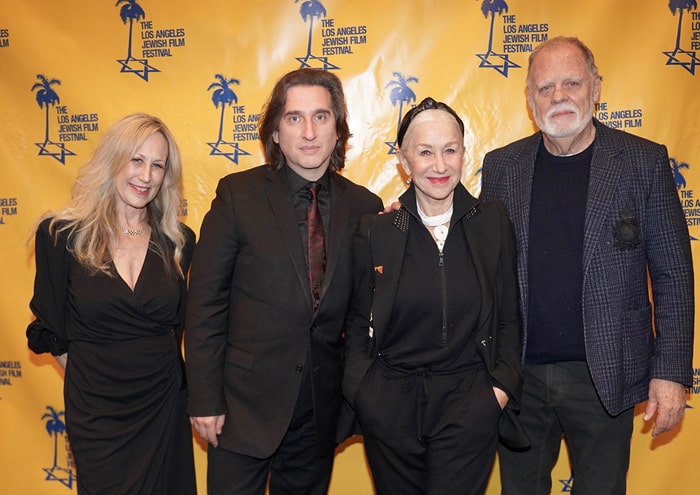
On Feb. 6, the world premiere screening of acclaimed pianist, storyteller and actor Hershey Felder’s newest film, “Noble Genius: Chopin and Liszt,” was held at the Saban Theatre in Beverly Hills.

The event was held in partnership with the Los Angeles Jewish Film Festival (LAJFF) and Temple of the Arts and, despite the heavy rains, drew about 800 guests. The celebrities out in force to support the film included Oscar-winning actress Helen Mirren; acclaimed director Taylor Hackford, who is Mirren’s husband; actors Patrick Duffy and Linda Purl; composer Charles Fox, and two actors in the film, Sally George and Jonathan Sylvestri.

“Noble Genius” is set in Weimar, Germany, in 1852. In the film, the romantic world of piano virtuoso Franz Liszt and his friend and rival, Fryderyk Chopin—and the women who influenced them—comes alive. It’s a story of intrigue, manipulation and the world’s greatest piano music. 

“The Los Angeles Jewish Film Festival was deeply honored to be chosen to co-host this exclusive one-night-only world premiere event,” LAJFF Executive Director Hilary Helstein said. “This extraordinary and unique drama from our beloved LAJFF friend, Hershey Felder, is a colorful and highly charged exploration of the relationship between two of the most remarkable composers who ever lived.” 


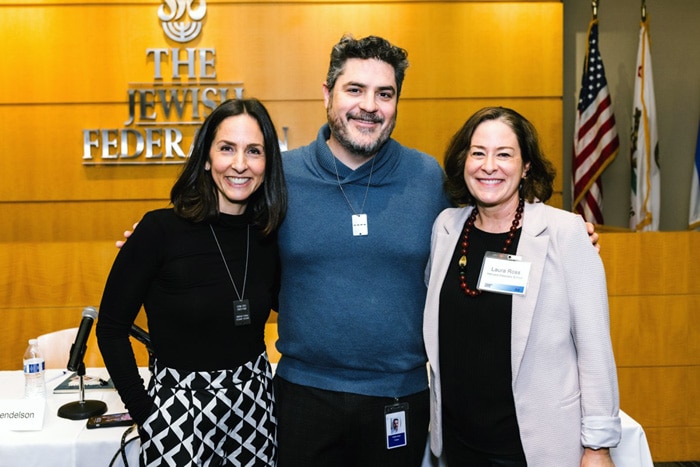
From left: Joanna Mendelson, senior vice president of community engagement at Jewish Federation Los Angeles; L.A. Federation President and CEO Rabbi Noah Farkas; and Laura Ross, head of school at Harvard-Westlake. Courtesy of Jewish Federation Los Angeles

The Jewish Federation Los Angeles convened 50 schools, including 125 school district superintendents, heads of school, DEI directors, and other educational leaders from public and private schools throughout Los Angeles County, as part of its inaugural “Education Leaders Summit: Understanding, Embracing and Including Jewish Students in Your School Community.”

The Feb. 7 summit helped education leaders learn more about the experiences of Jewish students and parents and how to best support them during these challenging times. The program examined the classic and modern-day tropes of antisemitism and ways to combat antisemitism in schools; how to understand the diversity of the Jewish people while learning about Jewish history and Israel; and ways to gain tools and resources that will make school environments more hospitable to Jewish students.

Speakers included experts in the fields of education and curriculum development, as well as in Jewish history and Israel. They included LAUSD Board of Education Member Nick Melvoin; State Sen. Ben Allen (D); VBS Rabbi Nolan Lebovitz; StandWithUs Director of Research and Strategy Max Samarov; ADL Regional Director Jeff Abrams; L.A. Federation Senior Vice President of Community Engagement Joanna Mendelson; Zioness Founder and CEO Amanda Berman; L.A. Federation President and CEO Rabbi Noah Farkas; and UCLA student Jaden Penhaskashi.

The event was held amid rising antisemitism and disinformation about Israel in Los Angeles’ public and private schools. According to hate-monitoring groups, antisemitic incidents, including harassment, assault and vandalism, have increased since the Oct. 7 attack on Israel and the subsequent Israel-Hamas war.

“We are acutely aware of the climate that has only magnified in intensity since the outbreak of the war,” Mendelson said. “So, it’s something that we have always known we’ve needed, but the war has certainly put a finer point on the need in this moment.”


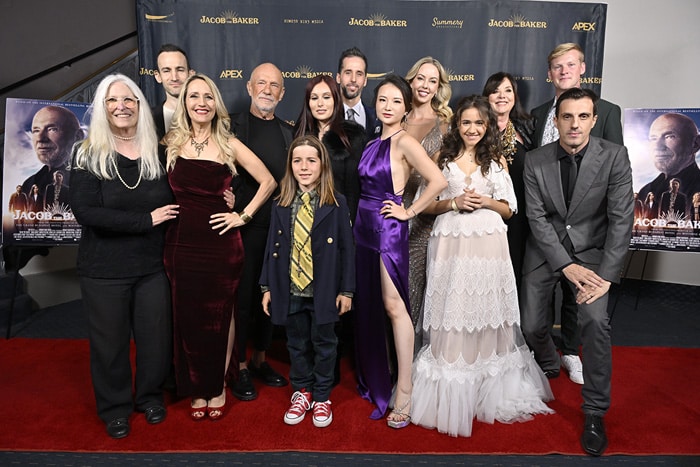
​​The cast and crew of feature film “Jacob the Baker” at the film’s November premiere in Beverly Hills. (Courtesy of Getty Images)

The world premiere of “Jacob the Baker” was recently held at the Saban Theatre.

The film had a recent theatrical run in Los Angeles at the Laemmle Encino and is currently available on Amazon Video.

“Jacob the Baker” stars and is based on the works of Noah benShea, the scholar, poet, philosopher, and Pulitzer Prize-nominated author. The film follows a young, skeptical reporter. Assigned to interview the author of a bestselling book series, she discovers the incredible story of how Jacob, a fictional character, provides help and hope to countless people around the world. Over the course of the interview, her own struggle comes to light, and she begins to question her preconceptions about the man she is interviewing, and whether she is making the right choices in her own life. The film, shot around the world, also follows the lives of people who are struggling with universal life issues, all of whom reach out to Jacob the Baker for help. One of those people is a former IDF soldier who is battling addiction.

The moving film features the music of award-winning composer Sharon Farber.

Wendy Kout wrote and co-produced the film. Gev Miron directed.

LA Jewish Film Fest Screening, Federation Education Summit, “Jacob the Baker” Premiere Read More »

Table for Five: Terumah

One verse, five voices. Edited by Nina Litvak and Salvador Litvak, the Accidental Talmudist

The Cherubim shall be with wings spread upward, sheltering the Cover with their wings with their faces towards one another; towards the Cover shall be the faces of the Cherubim.

– Ex. 25:20


Kira Sirote
Author of “Haftorah Unrolled,” Ra’anana, Israel

We’re used to thinking of Judaism as the oldest religion, but that’s really not the case. By the time we meet Avraham Avinu, civilization has everything it needs — money, bureaucracy, politics, law, and of course, religion. Egyptian religion had been around for over 1,000 years, and Mesopotamian religions even longer. We’re the newcomers, the rebels. The Torah references those religions, sometimes directly, and sometimes through what it doesn’t say, what is not there. 

Last week in Mishpatim, the Torah gave us laws that could have been copy-pasted from law books that were around in the time of Avraham Avinu. But only after editing them heavily: Some the Torah approves of and uses; some, it disapproves of and changes. Others, it erases entirely. The Torah is subversive, always judging the society around us, to see if it conforms with what is right in the eyes of Hashem. 

Those older religions would carry idols of their gods sitting on thrones. Some were resting upon winged creatures, others were protected by a winged creature. The Torah has us make a throne that is carried, with winged creatures hovering over it, facing the space where the idol ought to be. But there is no idol. 

The world wants us to fill in that space with whatever they worship, making it in their own image, with their own ever-changing values. But the throne that our Cherubim face is empty. His Presence — His judgment of what is right and wrong — fills the entire world. 


Rabbi Nolan Lebovitz
Valley Beth Shalom

What does it mean that we furnished atop our ark, our holiest vessel, two celestial beings facing one another? The 15th Century Italian Torah commentator Sforno believed that the Cherubim were an allusion to the angels referenced in the prophetic visions of Isaiah and Ezekiel. Perhaps the Cherubim are meant to remind us of the heavenly beings protecting the ark. 

On the other hand, perhaps the Cherubim are meant to point us to the possibility within ourselves. We are a tradition that values face-to-face relationships. By example, the Torah exalts the relationship between Moses and God by explaining that they communicated “face to face.” (Ex. 33, Deut. 34) 

We are a people who mark our ritual moments in community, surrounded by neighbors. As a people, we advocate for ourselves unmasked. As a family, we eat Shabbat dinner facing each other around a table. As partners, we express our love face to face in moments of intimacy. As individuals, we yearn for friendship. Each and every time that we approached the ark, the Cherubim emphasized that the Ten Commandments were meant to draw us closer together. We are to use the wisdom of our tradition to build relationships, to create profound transcendent moments of possibility. Any hope of fixing the world at large begins with focusing on our closest relationships. Any strategy of world peace begins with two neighbors face- to- face. The holy ark reminds us that we all possess the choice to live like Cherubim.


David Sacks
Happy Minyan of Los Angeles

The Ark of the Covenant isn’t just a beautiful vessel holding the tablets that G-d gave us at Mount Sinai, it is also a model of the heavens and the earth. We exist inside the ark, with the Torah that G-d gave us. Just like the ark has a cover, our world has a cover too, limiting our vision of everything beyond us. Above us are the angels. These are the golden angels above the ark. And above all that is Hashem. He exists dimensions beyond time and space, while at the same surrounding and filling all worlds including our own. 

If you were to climb a single letter of the Torah, it would be a thread of light taking you higher and higher, to dimension after dimension, until you reached its root in the mind of God. In each of these dimensions, the exact same Torah we have is learned by assemblies of angels. They see clearly that the Torah is more than a book … It is the fabric of the universe. This knowledge is engrained in our DNA. 

When God gave us the Torah, our souls flew out of our bodies. What did we see? That the Torah doesn’t just exist in this world. It is the structure of the heavens itself. My Rebbe Shlomo Carlebach put it even deeper. He said, the Torah is G-d’s prayers and dreams for the world. And when we keep it, we pray G-d’s prayers, and dream G-d’s dreams. 


Benjamin Elterman
Screenwriter, Essayist, Speechwriter at Mitzvahspeeches.com 

Rashi says the Cherubim on the Ark have faces like children. But in the book of Genesis after Adam and Eve are expelled from the Garden of Eden, a Cherub is placed to guard the entrance with the “flame of the rotating sword.” There, Rashi comments that the Cherubim are angels of destruction. So which are they? Innocent children? Or Hashem’s agents of destruction with fiery weaponry? 

In Rambam’s introduction to “The Guide for the Perplexed,” he discusses prophecy and inspiration. Regarding the lowest level of enlightenment, the people who are surrounded in darkness and are disconnected from Torah, he says even they receive an epiphany every now and then. He compares their insights to “the flame of the rotating sword.” Why would he compare the inspiration of a secular source to the weapon of the Cherub guarding the entrance to Eden? 

This flame of the Cherub is a metaphor for the illumination, specifically the wisdom of Torah (symbolized by the Tree of Life), which the Cherub guards. For those disconnected from Torah, they experience flashes of wisdom randomly (or *rotating*). However, that wisdom without the guidance of Torah can lead to destruction. If one seeks wisdom properly, by studying the Torah (and remember the Ark which the Cherubim sit upon, represents the Torah as well), a person’s inspiration and enlightenment will be far more regular, if not constant, and that wisdom will be sweet and pleasant like the face of a child.  


Rabbi Yoni Dahlen
Spiritual Leader/ Congregation Shaarey Zedek, Southfield Michigan

The most elusive aspect of Torah is defining exactly what Torah … well … is. Sages, archaeologists, and scholars have spent millennia arguing about the proper literary categorization of our sacred text with no ultimate consensus. Legal code? Myth? History? The answer to that question matters, because it creates the lens through which we see every letter, every detail of our lives. To me, the answer lies in this short but beautiful description of the cherubim. 

Judaism has a powerful understanding of holy creatures. Call them whatever you’d like – angels, messengers, spirits; they all represent the same concept, an existence that balances between heaven and earth, between the ineffable and the carnal. But what or who is considered to be part of this category is intentionally fluid. Because to elevate to that realm, that magical space of the in-between, is not about biology, it’s about humility. It’s about connectivity. 

Our Rabbis teach us that we become the cherubim. Not through ego or the journey of the self, but through seeing the other. Honestly and authentically seeing the other. Bowing our heads to shed our own importance so that we can look into the eyes of our fellow sparks of creation and see them, the entirety of them, the divine within them. The cherubim on the ark are not idols. They are not meant to be worshiped. They’re meant to inspire us, to remind us of who we are and who we are asked to be. Torah is the invitation to become angels. 

Table for Five: Terumah Read More »