fbpx

November 30, 2023

Historic Statesman, Who Advised Presidents, Henry Kissinger Dead at 100

Alan Dershowitz first met Henry Kissinger in the mid-1960s. “We were both professors at Harvard, and his son and my son were elementary school classmates,” Dershowitz, an attorney, commentator and Harvard Law School professor emeritus, told JNS.

The two remained friends until Kissinger’s death, at the age of 100, on Nov. 29.

Dershowitz told JNS that he and Kissinger sat next to each other in synagogue last year on Yom Kippur. “He said yizkor for his parents,” Dershowitz said, referring to the Jewish memorial service. “This year, he was too frail to come.”

Kissinger’s “pragmatism” and “sense of incremental benefits” influenced Dershowitz’s worldview, the attorney said.

“He was one of my strongest supporters. When I defended President [Donald] Trump in the Senate and a lot of people, particularly the Jewish community, attacked me, he supported me, defended me and called me and told me I had done the right thing,” Dershowitz said.

The two had long talks about Israel “about 1973 and whether he did the right thing or the wrong thing,” Dershowitz said.

“We’ve agreed and disagreed over the course of my lifetime—mostly agreed,” he added. “He always had an image for the future. He was never thinking about today or even tomorrow. He was always thinking about the day after tomorrow. He was a visionary and a brilliant man.”

Realpolitik

Heinz Alfred Kissinger was born on May 27, 1923 in Fürth, Germany, to a Jewish family. His father, Louis Kissinger, “was a teacher of geography and history in Fürth before fleeing with his family to the United States in 1938 as antisemitism increased under Hitler,” per a death notice for Louis in The New York Times on March 21, 1982 (“Father of Kissinger is dead.”) His mother Paula was a homemaker.

Kissinger fought in World War II, working as an interpreter, arresting Gestapo agents, helping in the liberation of the Ahlem concentration camp in Germany and earning a Bronze Star.

After the war, he made his mark at Harvard, writing the longest-ever undergraduate thesis—400 pages—provoking a new rule limiting paper lengths. He became a professor at the university, and ultimately, associate director of the schools’ government department and international affairs center.

He served simultaneously as U.S. secretary of state and national security advisor under U.S. Presidents Richard Nixon and Gerald Ford—the first and only time someone has held both roles at once, let alone doing it twice.

Kissinger is widely credited with crucially influencing Cold War affairs during this period, playing a key role in opening relations with China and numerous decisions in Vietnam and Third World conflicts. These have generated considerable acclaim and controversy.

He received the Nobel Peace Prize in 1973 for helping end the Vietnam War.

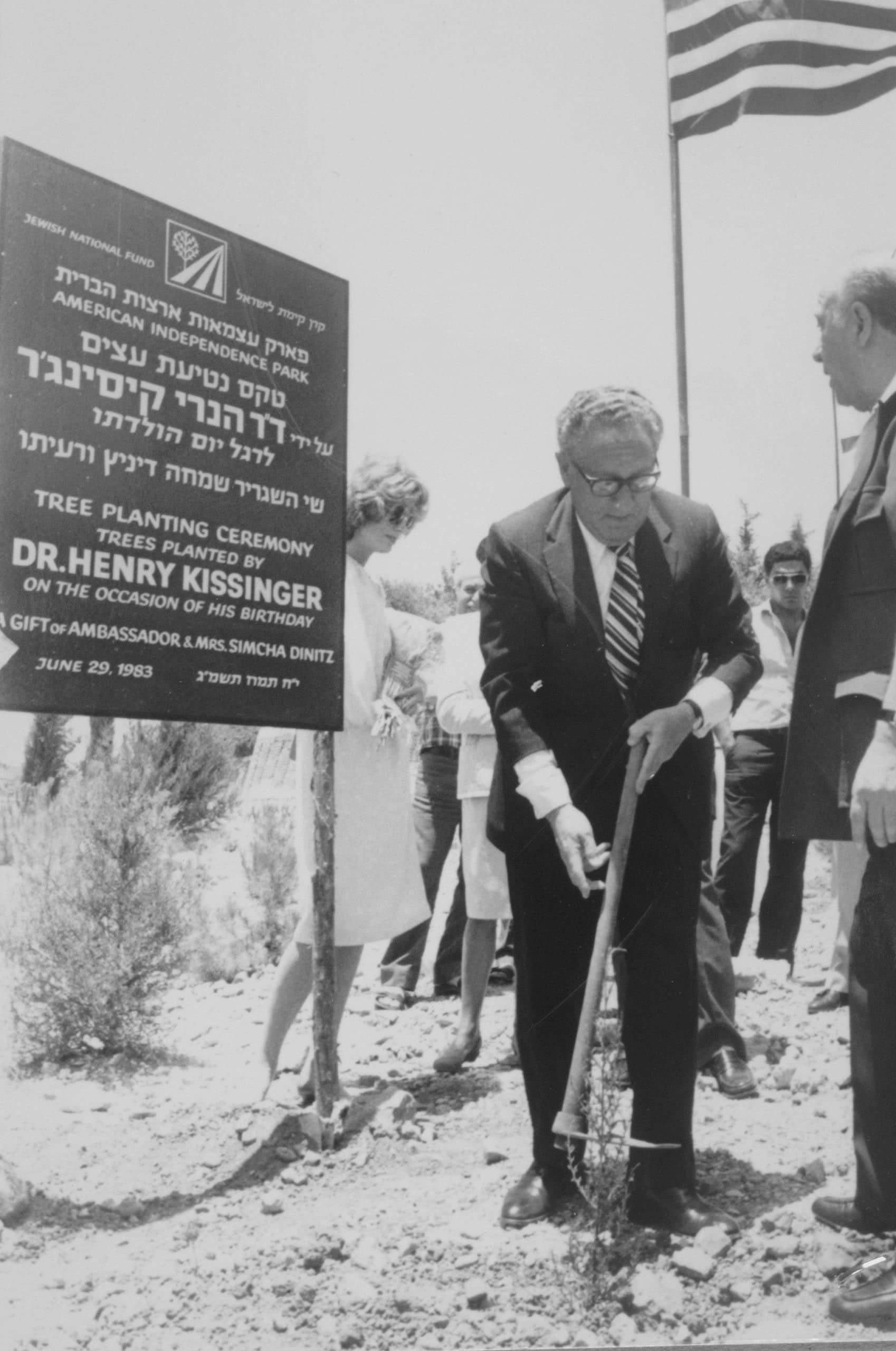
Henry Kissinger
Henry Kissinger plants a tree at Ness Harim near Jerusalem at a planting ceremony celebrating his birthday on June 29, 1983. Credit: Yossi Zamir/KKL-JNF.

Elder statesman

Following his retirement from government in 1977, Kissinger regularly wrote books on foreign policy and consulted widely with political leaders and diplomats.

His foreign-policy approach of “realpolitik,” which views international relations on the basis of self-interest rather than moral principles, continues to impact world affairs today.

Despite having lost family in the Holocaust, Kissinger was so committed to that pragmatic approach, that he once said: “If they put Jews into gas chambers in the Soviet Union, it is not an American concern. Maybe a humanitarian concern.”

Known for his wit, Kissinger also once said, “If it were not for the accident of my birth, I would be antisemitic. … Any people who has been persecuted for 2,000 years must be doing something wrong.”

Shortly before his death, Kissinger began writing about the potential threat of artificial intelligence.

“He was intrigued by artificial intelligence, and he actually understood it, which not too many people do,” Dershowitz told JNS. “He understood both the benefits and the risks. As he always said, every step forward has the potential for a half a step backwards, so he was always doing on the one hand, on the other hand evaluation.”

‘A giant, a titan’

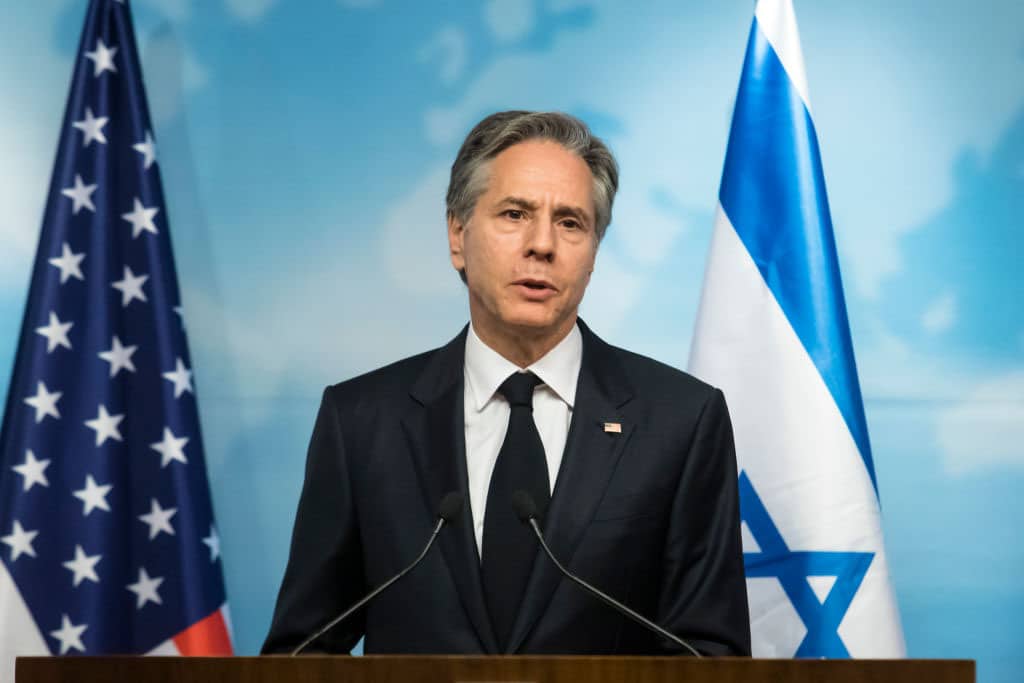
During a meeting with Israeli President Isaac Herzog in Tel Aviv on Thursday, U.S. Secretary of State Antony Blinken said that Kissinger “really set the standard for everyone who followed in this job.”

“I was very privileged to get his counsel many times, including as recently as about a month ago,” Blinken added. “He was extraordinarily generous with his wisdom and his advice. Few people were better students of history. Even fewer people did more to shape history than Henry Kissinger.”

Herzog told Blinken: “You are following in the footsteps of a giant, a titan—Dr. Henry Kissinger—who has left us peacefully tonight.”

“We are big admirers of Henry Kissinger, who laid down the foundations of so many great decisions of his and processes which he has led, which has brought results that we feel until today, peaceful results,” Herzog added. “He laid the cornerstone of the peace agreement, which were later signed with Egypt, and so many other processes around the world. I admired Henry Kissinger.”

Kissinger ended his last conversation with Herzog saying, “Mr. President, please know I’ve always loved and admired and supported the State of Israel,” and “so I always felt his love and compassion for Israel and his belief in the Jewish state,” Herzog said.

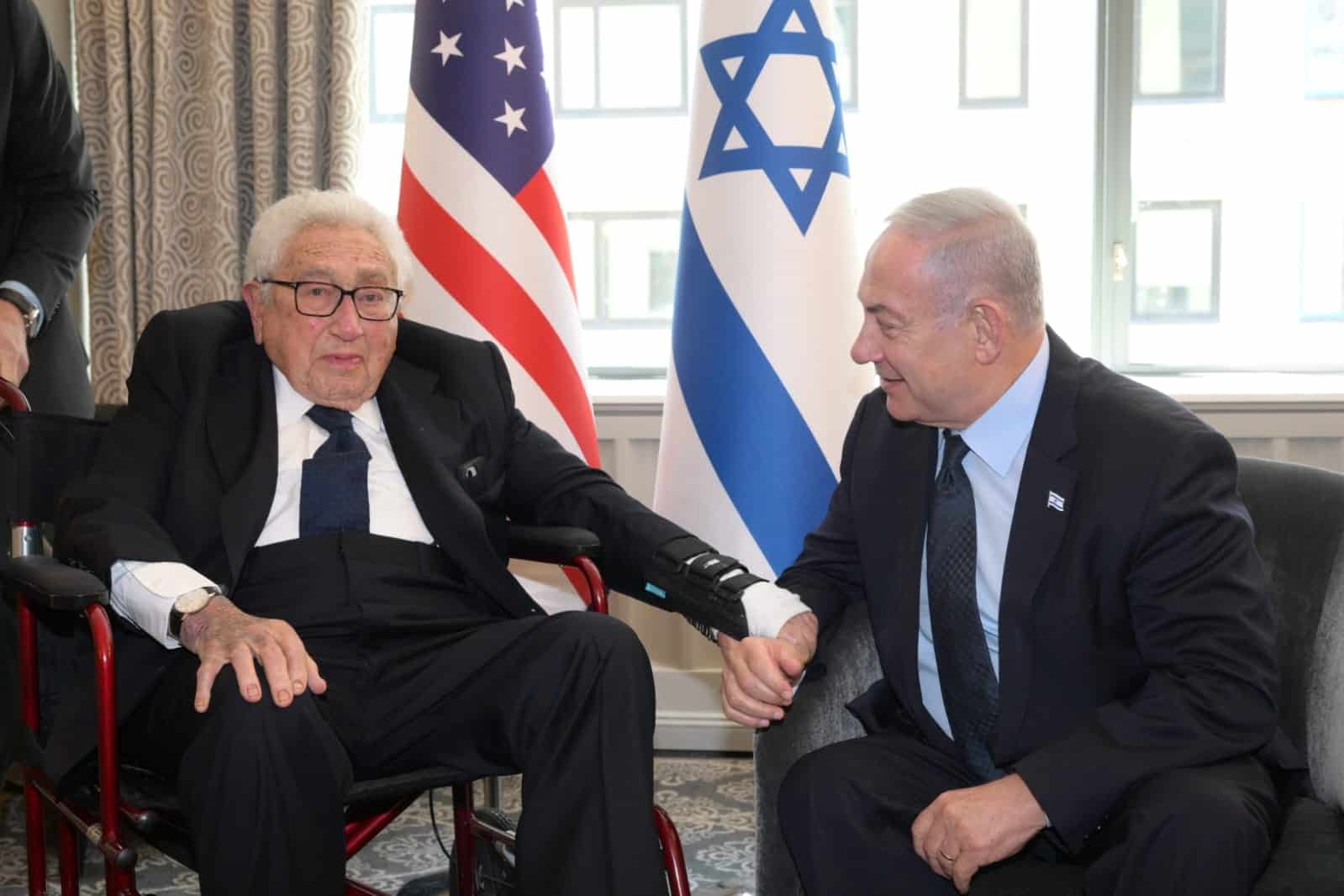
Netanyahu Kissinger
Israeli Prime Minister Benjamin Netanyahu (right) meets with Henry Kissinger, the former U.S. secretary of state, in New York City on Sept. 21, 2023. Credit: Avi Ohayon (GPO)

Ronald S. Lauder, president of the World Jewish Congress, said that as a Jewish refugee from Nazi Germany, Kissinger “intimately understood the freedoms that the United States symbolized during a pivotal era.”

Kissinger appeared at some of the WJC’s events, and the congress awarded him in 2014 with its Theodor Herzl Award. “We mourn the loss of a statesman, whose wisdom and friendship were a beacon of light,” Lauder added, noting that Kissinger’s “passing leaves a void in our world that will be profoundly felt.”

Michael Herzog, Israel’s ambassador to the United States, wrote that Kissinger’s “life and career were the embodiment of the American dream, as he rose from being a Jewish refugee from Nazi Germany to a giant, who shaped global and Middle Eastern geopolitics and left a lasting legacy.”

Herzog cited a letter Kissinger wrote to his younger brother, the Israeli president, that “to celebrate Israel’s 75th anniversary alongside my 100th is a particular gift.”

Danny Danon, a Knesset member and former Israeli ambassador to the United Nations, referred to Kissinger as “the legendary American secretary of state, a Jew and a mench.”

Dershowitz told JNS that he fondly recalls his lunches with Kissinger, whose favorite cuisine was French. “He loved good food. I know. I shared some,” Dershowitz said.

“He was not a religious Jew, and was not really a traditional Jew, but the Judaism was in his heart,” he said.

Historic Statesman, Who Advised Presidents, Henry Kissinger Dead at 100 Read More »

UC Berkeley Sued Over Alleged Failure of Improperly Handling Antisemitic Incidents

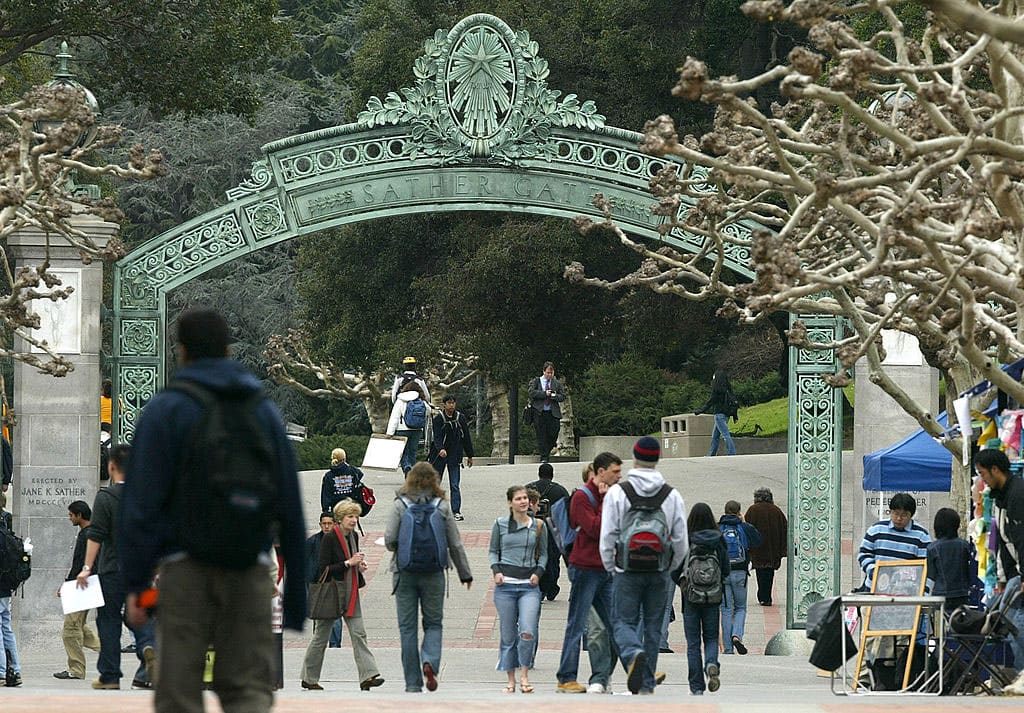
The Louis Brandeis Center for Human Rights Under Law announced on Tuesday morning that they are suing UC Berkeley, Berkeley School of Law, and the UC Regents over UC Berkeley’s alleged failure to properly handle antisemitism on campus since Oct. 7 and over Berkeley Law’s failure to take action against student groups that passed bylaws barring Zionist speakers from campus.

The lawsuit, which was obtained by the Journal, states that following the Hamas Oct. 7 massacre, “students at UC Berkeley celebrated this 21st century pogrom with resulting violence against Jewish students. For example, a Jewish undergraduate draped in an Israeli flag was set upon by two protesters, who struck him in the head with his own metal water bottle after he dropped it trying to evade them. The incident was caught on video and publicly reported.” The lawsuit also states that two students alleged that pro-Palestinian protesters disrupted a prayer gathering by Jewish students to “deal with the shock of the Hamas attack” and that pro-Palestinian rallies have blocked “the main entrance to campus.” Additionally, the students alleged that a lecturer ended class early so he could go “on an anti-Israel rant for 18 minutes, with roughly 1,000 freshman as his captive audience.”

“Both students stated that the school does so little to protect Jewish students, it feels as if the school were condoning antisemitism,” the lawsuit states. “They added that officials at the university display a ‘general disregard’ for Jewish students. Indeed, many Jewish students have reported feeling afraid to go to class during these rallies, which take place in Berkeley’s main throughfares — and for good reason. They have little confidence that UC will protect them from antisemitic mobs. On information and belief, following the Oct. 7 attacks, Chancellor Christ told some members of the Berkeley community that her public statement addressing the attacks was not as strong as she would have liked due to her concerns about violence on the campus.”

Another allegation in the lawsuit is that “a number of persons on campus (including Jewish faculty and staff) have also been receiving hate e-mails calling for their gassing and murder. Although these e-mails were reported to the University, it has failed to respond appropriately or in a timely matter.”

Dan Mogulof, assistant vice chancellor for executive communications in UC Berkeley’s Office of Communications and Public Affairs, told the Journal, “While we appreciate the concerns expressed by the Brandeis Center, UC Berkeley believes the claims made in the lawsuit are not consistent with the First Amendment of the Constitution, or the facts of what is actually happening on our campus. The university has long been committed to confronting antisemitism, and to supporting the needs and interests of its Jewish students, faculty, and staff. That commitment was strengthened in 2015, when the university established the Chancellor’s Committee on Jewish Student Life, and again in 2019 when a groundbreaking Antisemitism Education Initiative was launched on the campus. Since the horrific Hamas terror attack on Israel, the university’s administration has worked in close concert with the Initiative’s director and the Committee’s chairperson, and we have benefited from their guidance and input.”

Mogulof added that the university “does not have the legal right to stop demonstrations or expression that many would consider to be offensive. Those demonstrations and expression are protected by the Constitution of the United States. While censoring that expression is not an option, we do understand how upsetting and frightening some of the demonstrations have been for Jewish students, and the university is responding to their impact. We are offering counseling support, arranging academic adjustments for impacted students when possible, and have issued clear statements about the campus’s position, like this one.” The statement Mogulof referred to is a November 3 statement from UC Berkeley Chancellor Carol Christ where she addressed the effect the Israel-Hamas war has had for students on campus. “I have been deeply disturbed and saddened by the many messages I have received from students who have opposing views about the conflict, and similar fears for their safety and well-being on our campus — fears largely borne of condemnable, toxic expression that is particularly rife on social media, and has no place on our campus or in our discourse,” she said. Christ went on to say that she is “dismayed by and condemn[s] the harassment, threats, and doxxing that have targeted our Palestinian students and their supporters” and that she is also “appalled by and condemn[s] any condoning of or making excuses for terrorism, by stereotyping, threats, and the repetition of false, damaging tropes about the Jewish people. I reject calls for Israel’s elimination.”

Rabbi Gil Leeds of the Rohr Chabad Jewish Center at Berkeley was critical of Christ’s statement, contending that Christ issued a stronger statement in response to the 2017 Charlottesville riots. He pointed to how her statement then said in part that “planning is now underway for potentially controversial events on our campus this fall. Paired with our commitment to the First Amendment is an equally firm commitment to the safety of the members of our campus community and their guests. We believe deeply in the value and importance of non-violence, and we will make every effort to deter, remove, or apprehend those who seek to cause harm to others.”

“No such language is employed here,” Leeds said of Christ’s Nov. 3 statement.

He also addressed the part of her statement expressing concern over Palestinian students and supporters being doxed. “I don’t think they’re being doxxed because they’re wearing masks,” Leeds said, “I don’t even know if they’re students.” He added that the protesters have been “shutting down major thoroughfares and blocking people’s ability to pass through.”

Mogulof continued: “We are also continuously conveying to students that if they believe that they have been subjected to antisemitic harassment or discrimination, or believe that expression—whether it be written or spoken— is hindering their education, they must report that immediately to our Office for the Prevention of Harassment and Discrimination(OPHD). When that happens, they have been assured the campus will respond.” Asked by the Journal for the number of reports to the OPHD since Oct. 7, Mogulof replied that there has been “a large increase in reports of harassment, discrimination, and hate/bias incidents since Oct. 7, including allegations of antisemitism and Islamophobia. OPHD sends outreach to impacted parties with resources, rights, and options for resolution, including offers of supportive measures such as assistance with academics and safety concerns.”

He added “The overwhelming majority of these reports are about what is clearly First Amendment protected speech, so they are not actionable from a policy perspective, but we still provide support to any impacted students or employees. The handful of reports of behavior that would violate policy, such as harassment or discrimination, are being investigated and we will work with the impacted person to understand their preferred method of resolution. If we do not know the identity of the respondent or the respondent is not a member of the UC community, which is common, we can still work with the impacted person to remedy and prevent further acts of harm.”

The assistant vice chancellor also claimed that the allegations regarding the emails and that Jewish students are too scared to go to class because they can’t avoid pro-Palestinian rallies on campus are completely baseless. “To date the university has not received a single report of the sort of emails described. We have checked with numerous offices and this is the first anyone has heard of an allegation of that sort,” Mogulof said. “I can assure you that if we have — or if we do — we will respond strongly and quickly. Second, it is not possible to hold a rally anywhere on the Berkeley campus that blocks all alternative routes to a given destination.” Additionally, Mogulof claimed that the university has not received a report about a Jewish prayer gathering being disrupted.

Deena Margolies, an attorney for the Brandeis Center, maintained that they have “evidence to the contrary” regarding the emails. As for the routes, Margolies said that the students have told her that “on the days of some of the really big protests … they had to really go out of their way, and they had to walk through grassy, wooded areas” that were “well off the beaten path” to get to class, making some of them late to class or having to leave earlier than usual to get class. “Some of them were fearful to walk through the protests because there had been altercations,” Margolies said. “The university can deny all they want, it’s sad in and of itself that that is how they want to approach this instead of addressing the anti-Semitism and improving the campus for Jewish students, but we have evidence for everything presented in the lawsuit.”

Gregg Drinkwater, the program director of the Antisemitism Education Initiative (AEI), told the Journal that, compared to other universities across the country, UC Berkeley has been doing “relatively well” in terms of the campus climate since Oct. 7. “Yes, we’ve had issues, yes we’ve had incidents that have been dealt with or need to be dealt with, but I’m glad I’m not at Cornell. I’m glad I’m not at UC Santa Cruz. I’m glad I’m not at some of the other campuses where some of the incidents have been more frequent or more significant,” he said.

However, Drinkwater said that “the general narrative” he has heard from students, faculty and staff on campus is that “people are absolutely concerned around some of the ways that the war is being talked about, that Israel is being talked about, that Jews and their connection to Israel at war are being talked about.” “Different students are experiencing more concerning aspects of that and others less, their comparative experiences are going to be different,” he said. “But people are in general feeling a need and a desire for community spaces and places where they can talk about these issues.” Drinkwater added that there have been “various campus units stepping up since Oct. 7” in that regard.

Drinkwater argued that one area that the university could do better on is messaging. “The initial message into campus around the October 7 incidents was poor, and has improved since then,” he said. He also believes that the university could be “more proactive” with the “timing” of their responses to faculty members — mainly graduate student instructors — “who have been politicizing the classroom … There’s still a learning curve for some campus leadership on how best to support Jewish students and Israeli students,” he continued. “But they’re trying.” He claimed that he has not been met with any “resistance” from anyone in campus leadership when he has educated them on issues of antisemitism.

Leeds, on the other hand, argued that the campus climate was already at a “tipping point” even before Oct. 7 “to go far beyond that” to a level he has never seen in his 17 years on campus, pointing to the assault of a Jewish student during a pro-Palestinian rally for simply wearing an Israeli flag as an example. Leeds claimed that Israeli exchange students were told by their parents in Israel to “stay home … Students didn’t want to go out to class, told not to go out to class by their parents,” he said. “You would think the university would be doing something about that proactively. Students have been reporting it to them and corresponding with them and essentially begging them to intervene and be proactive, and the response has been lukewarm at best, and it’s disappointing for many students.”

The lawsuit also targets Berkeley Law for not taking action against student groups in the school who passed the bylaws barring Zionist speakers from coming to campus in August 2022, which consists of the bulk of the lawsuit. The lawsuit states that there are at least 23 student groups at Berkeley Law that have established these bylaws and that some of these groups are requiring support of the Boycott, Divestment and Sanctions (BDS) movement in order to obtain membership. The lawsuit also alleges that students have to partake in a “Palestine 101” training program in order to volunteer in “a number of Berkeley Law Legal Services organizations” that provide pro bono legal work; additionally, the lawsuit claims that the Berkeley Journal of Gender, Law and Justice bars “Zionists not only from speaking to its members but from publishing in its pages.”

According to the lawsuit, the plaintiffs are members of Jewish Americans for Fairness in Education (JAFE), which is part of the Brandeis Center. A couple of the members of JAFE are Berkeley Law professors who say that they have been unable to speak to these students groups as a result of their bylaws.

“Imagine, in this day and age, asking members of the LGBTQ community to remain ‘in the closet’ as a condition of membership in an authorized student group,” the lawsuit states. “No such imposition is required — or would be remotely tolerated — of other students, who remain free to participate fully in student organizations without disavowing or hiding any part of their identities.”

Regarding the lawsuit’s claims on Berkeley Law, Mogulof shared with the Journal a statement from Berkeley Law Dean Erwin Chemerinsky that read: “Berkeley Law is dedicated and works very hard to provide a conducive learning environment for our Jewish and all of our students.  The complaint filed by the Brandeis Center paints a picture of the Law School that is stunningly inaccurate and that ignores the First Amendment.  For example, student organizations have the First Amendment right to choose their speakers, including based on their viewpoint.  Although there is much that the campus can and does do to create an inclusive learning environment, it cannot stop speech even if it is offensive.”

UC Berkeley and Berkeley Law’s failure to take proper remedial actions in these circumstances amounted to a 14thamendment violation, as the Brandeis Center is alleging that UC Berkeley and Berkeley Law are not evenly enforcing the school’s policies and federal civil rights laws. The lawsuit requests that a judge institute injunctions requiring the university to “to enforce their Policy on Nondiscrimination and their all-comers policy on an evenhanded basis, ensuring that Jewish members of the Berkeley community are protected, with respect to their physical safety and otherwise, from discrimination on the basis of their Jewish identity, including those for whom Zionism is an integral part of that identity.” The Brandeis Center is also requesting injunctions requiring the university to stop “permitting registered student organizations to exclude Jews; funding any student organization that excludes Jews; and granting official recognition to any student organization that excludes Jews” and communicate “to the entire Berkeley community via broadcast e-mail or a similar medium that Berkeley will condemn, investigate, and punish any conduct that harasses members of the Jewish.”

“The antisemitism Berkeley’s Jewish students find themselves embroiled in today did not start on Oct. 7,” Kenneth L. Marcus, who heads the Brandeis Center and is an alumnus of Berkeley Law, said in a statement. “It is a direct result of Berkeley’s leadership repeatedly turning a blind eye to unfettered Jew-hatred. The school is quick to address other types of hatred, but why not anti-Semitism? Berkeley, once a beacon of free speech, civil rights, and equal treatment of persons regardless of race, religion, ethnicity, national origin, gender, and sexual preference, is heading down a very different and dangerous path from the one I proudly attended as a Jewish law student.”

Mogulof, however, argues that the university has already been taking the remedial measures outlined in the lawsuit; he contended that the university has “repeatedly sent the exact message” that the lawsuit calls for and that “we most certainly already have stringent policies that prohibit the exclusion of any student, or person based on their Jewish identity. We are not aware of a single reported incident of anyone at UC Berkeley having been excluded from a student organization based on their Jewish identity. As per policy, we would not recognize a student organization that excluded someone based on their Jewish identity… this must be differentiated  from our belief that student organizations cannot, as per the First Amendment, be compelled to invite speakers they do not wish to. Excluding someone from attending an event, or joining a group is different from not inviting someone to speak to that group. We would not and could not, for example, compel a Jewish student group to invite anti-Zionist speakers to their gatherings.”

UC Berkeley student Hannah Schlachter told the Journal, “My hope is that this lawsuit will bring systemic and cultural change at UC Berkeley. I’m appreciative of past efforts the university has made and their commitment to upholding free speech. At the same time, we are seeing that the university is not enforcing policy when there are issues affecting Jewish students. This, to me, is discrimination against a targeted group, not free speech.”

Another student, Danielle Sobkin, told the Journal, “This lawsuit against UC Berkeley is more than just a legal battle; it’s a cry for the fundamental change that is desperately needed on our campus. For too long, Jewish students at UC Berkeley have faced the challenges of antisemitism, which pervades both our academic and social environments. This persistent issue impacts us deeply, affecting our educational experiences and our sense of belonging. By taking this step, we aim to send a clear message to the university administration: our concerns are real, our voices need to be heard, and we are committed to fighting for a systematic transformation. We hope this lawsuit serves as a wake-up call, ushering in an era of greater understanding, respect, and inclusion for Jewish students at UC Berkeley.”

Both Schlachter and Sobkin are members of JAFE, but are not listed as plaintiffs in the lawsuit.

“We do understand how upsetting and frightening some of the demonstrations have been for Jewish students,” Mogulof told the Journal. “We do not dispute how the students cited in the lawsuit feel, or what they are personally experiencing. That is why we have gone to great lengths to respond to the needs and interests of our Jewish students who are expressing concern, dismay, and fear. That is why the Chancellor’s most recent message condemned all forms of antisemitic expression. And, that is why we will continue our efforts to educate students about the legal impossibility of censoring or punishing speech protected by the Constitution, no matter how offensive and disturbing it may be to some people.” However, Mogulof said the university “strongly” disputes allegations “that we have turned a blind eye to the impact and/or reports of antisemitic expression. The university is being accused of a failure to respond, yet we cannot respond to reports that were never made. All the university can do is reiterate our promise to students: If they believe they have been harassed or discriminated against because of their Jewish identity, the university will absolutely respond to their reporting of any and all incidents of that sort.”

Berkeley Hillel Executive Director Rabbi Adam Naftalin-Kelman told the Journal, “This administration has been proactive in supporting Jewish life on campus, and is working in partnership with Hillel. At the same time, I believe — and the campus has acknowledged — that there is more to do in order to support Jewish students’ experience on campus. A number of the details in the complaint are from last year, and many of those complaints have been remedied. As the central address for Jewish life on campus, I am grateful and appreciative that Hillel has been able to be a partner with and a source of guidance for helping the university to address the other aspects of the complaint that have not been remedied. Together, we want to continue to help make our campus a safer and more inclusive community for Jewish students.”

The UC regents has not responded to the Journal’s request for comment.

UC Berkeley Sued Over Alleged Failure of Improperly Handling Antisemitic Incidents Read More »

AJU Interview with Jake Cohen and Hanukkah Marble-Glazed Shortbread Cookies

On November 15, culinary creator and cookbook author Jake Cohen (“Jew-Ish”) sat down with American Jewish University (AJU) Vice President of Communications Michelle Starkman for a light-hearted and hunger-inducing conversation.

“Jake’s style is one of the most creative mashups of cuisines with big flavors,” Starkman said in her introduction. 

More than 600 people registered on AJU’s  open learning platform for this discussion of recipes from Cohen’s newest New York Times best selling cookbook, “I Could Nosh: Classic Jew-ish Recipes Revamped for Every Day.” Cohen also shared some of his backstory, inspiration for Jewish cuisine and a bunch of cooking tips. 

There’s nothing like a good nosh, which Cohen said, “is light-eating” but not necessarily a snack.

A nosh, he explains, is having something in the refrigerator that you can feed to guests at any time, whether or not they are actually hungry.

A nosh, he explains, is having something in the refrigerator that you can feed to guests at any time, whether or not they are actually hungry.

“When I think of a lot of the matriarchs of my family, of my husband’s family, it’s these large batch dishes that they just keep in the fridge and freezer so that they can heat you up a small bowl of something whenever you’re hungry,” Cohen said. “It’s a really broad term, but to me, it’s about the concept of everyday hospitality.”

While “I Could Nosh” is clearly a Jewish cookbook, Starkman and Cohen discussed how he has made food in the Jewish culture really accessible. “Especially being a place like New York or a country like America, where Jewish food has become so intertwined into the fabric of our culinary lexicon, anyone can enjoy it,” he said.  

Cohen spent time talking about his family, book-writing and recipe-creating process and his connection to Israel, as well as what inspires him and his mission to “inspire people to cook and do good for Jews.”

Starkman asked, “What advice would you give all of us?”

There are three things, he explained.

1. Patience is the one ingredient that’s missing in most kitchens. If you are waiting for your challah dough to double in size and it hasn’t doubled in an hour, you have to wait longer. 

“So much of cooking these are visual cues,” he said. “The times are guidelines, but not like law.” 

2. Salt. Most of the time people aren’t seasoning, because they are being too health-conscious. 

“There’s a big difference between going lighter on salt and not seasoning,” Cohen said. 

3. Relax. Cooking is not that deep and not that difficult. 

“People just add so much stress, and they run around their kitchen freaking out about entertaining or this or that,” he said. “It’s all going to be okay.”

Cohen adds, “Have fun with it.”

In cooking, being yourself is the most important ingredient.

For more recipes and inspiration, follow @jakecohen on Instagram and TikTok. 

Learn more about AJU’s events at Open.aju.edu. Watch the full conversation with Jake Cohen on AJU’s YouTube channel.

Jake Cohen’s Hanukkah Marble-Glazed Shortbread Cookies

“These are my response to Christmas cookies, since we can’t let the goyim have all the fun. There’s a larger conversation to be had about the holiday industrial complex and our part in hyping up Hanukkah like it’s Jewish Christmas, which no matter how delicious these cookies are, it’s not. But the story of the Maccabees is very much worth celebrating, allowing conversations about our history in overcoming oppression and in fighting for our right to exist. And as long as we’re talking about our past and how it impacts our present and future, we might as well nosh on some shortbreads shaped like Stars of David, menorahs, and dreidels. The wow factor is in the marbled glaze, which uses an easy technique of lightly swirling in food coloring before coating your cookies. They’re so good, Santa might even drop by while you light the menorah.” – Jake Cohen

Makes: about 2 dozen cookies
Prep Time: 30 minutes, plus chilling and setting time
Cook Time: 15 minutes

For the Dough
8 ounces (2 sticks) unsalted butter, at room temperature
3/4 cup (150g) granulated sugar
1 large egg
2 tsp vanilla extract
1 tsp almond extract
1 tsp kosher salt
21/2 cups (338g) all-purpose flour
1/4 tsp baking powder

For the Glaze
2 cups confectioners’ sugar
1/4 cup half-and-half
1 Tbsp vodka
1 tsp almond extract
1/2 tsp kosher salt
Blue food coloring

Directions

1. For the dough: In the bowl of a stand mixer fitted with the paddle attachment (though this dough can easily be made by hand), cream the butter and granulated sugar on medium speed until light and fluffy, 1 to 2 minutes. With the motor running, add the egg and mix until incorporated, stopping to scrape the sides of the bowl as needed. Add the vanilla and almond extracts with the salt and mix to incorporate.

2. Add the flour and baking powder and mix on low until a smooth dough forms. Transfer the dough between two sheets of parchment paper and roll out to 1/4 inch thick. Chill for 1 hour.

3. After 30 minutes of chilling, preheat the oven to 350°F. Line two sheet pans with parchment paper.

4. Remove the top sheet of parchment from the dough and cut out cookies using 21/2-inch Hanukkah cookie cutters. Carefully transfer the cookies to the prepared sheet pans, spacing them 1 inch apart from one another. Reroll the scraps between the parchment and repeat, chilling again as needed if the dough becomes too soft.

5. Bake, rotating the pans halfway through the cooking time, for 13 to 15 minutes, until the edges are lightly golden. Let cool completely on the pans.

6. Meanwhile, make the glaze: In a medium bowl, whisk the confectioners’ sugar, half-and-half, vodka, almond extract and salt until smooth. Drip a few drops of food coloring on top of the glaze, then swirl with the tip of a paring knife for a marbled effect. (For more distinct marbling for all the cookies, divide the glaze between two bowls before swirling in the food coloring.)

7. Dip the cooled cookies into the glaze, letting any excess drip off, then place on a wire rack to set for 15 minutes before serving (the vodka will evaporate, leaving a matte finish and no booze!). Store leftovers in an airtight container at room temperature for up to 5 days.

AJU Interview with Jake Cohen and Hanukkah Marble-Glazed Shortbread Cookies Read More »

What I Saw at the California Democratic Party Convention

The California Democratic Party (CDP) has long harbored anti-Israel and antisemitic extremists. I remember attending my first CDP Arab-American Caucus meeting in the early 1990s. Someone passed out copies of The Ugly Truth About the ADL, published by Lyndon LaRouche’s Executive Intelligence Review, where I learned that “The B’nai B’rith, a pivotal player in the British Freemasonic plot to destroy the Union, was implicated in Lincoln’s assassination!”

At that time a group of Jewish and non-Jewish party activists created Democrats for Israel. We squelched all anti-Israel resolutions and platform proposals, in part because the fanatics were a tiny minority.

Times have changed. In a March, 2022 Pew Research Center poll of some 10,400 people, 56% percent of folks aged 18-29 have a favorable view of Israel, down from 63% in 2019; but 61% view the Palestinians favorably. More important, the “progressive” wing of the Democratic Party has grown larger, and its illiberal ideology has become weirdly respectable. Many elements of this creed favor the Palestinian narrative:

  • It accords unearned prestige to victimhood; and the Palestinians have fashioned themselves as the most fashionable of victims, denying any responsibility for their situation.
  • It creates a hierarchy of victimhood based on race, sex and other immutable characteristics; and it insists that Palestinians are “people of color,” while all Israelis are “white” (or “people of pallor,” for those with a sense of humor).
  • It regards “settler-colonialism” as the most unforgiveable sin; and sees the return of the Jews to our homeland as a European invasion, while seeing the seventh-century Arab conquest of Palestine as—well, it doesn’t see that at all.

So fringe ideas, such as “Zionism is racism/settler-colonialism/apartheid,” are creeping toward the center of the party, especially among younger delegates. Thus, after the October 7 Hamas pogrom, I expected trouble at the November CDP convention in Sacramento. I was not disappointed.

It started Friday afternoon with an anti-Israel march outside the Convention Center, with such signs as, “Ceasefire Now,” “US is complicit in Genocide of Palestinians,” and “27,027 km—EVERY INCH, every Kilometer was, and will be PALESTINE.” (That was oddly specific on the kilometers, I thought.) There were no “Free the Hostages” signs, of course.

On Friday night hundreds attended the Progressive Caucus’ forum, “Understanding Trauma: Palestinian Humanity and Unraveling Antisemitism in the Face of Genocide.” Only anti-Zionists were on the panel, including the notorious Israel-hater Hatem Bazian of UC Berkeley; and Penny Rosenwasser of the remarkably-misnamed Jewish Voice for Peace. The presentation was a farrago of anti-Israel revisionism, including classics like: Palestinians have no problem with Jews or Judaism—just Zionism, which came from “racist Europe.” And Palestine was a peaceful, multiculture paradise before the Zionists came. All this and more was enthusiastically applauded.

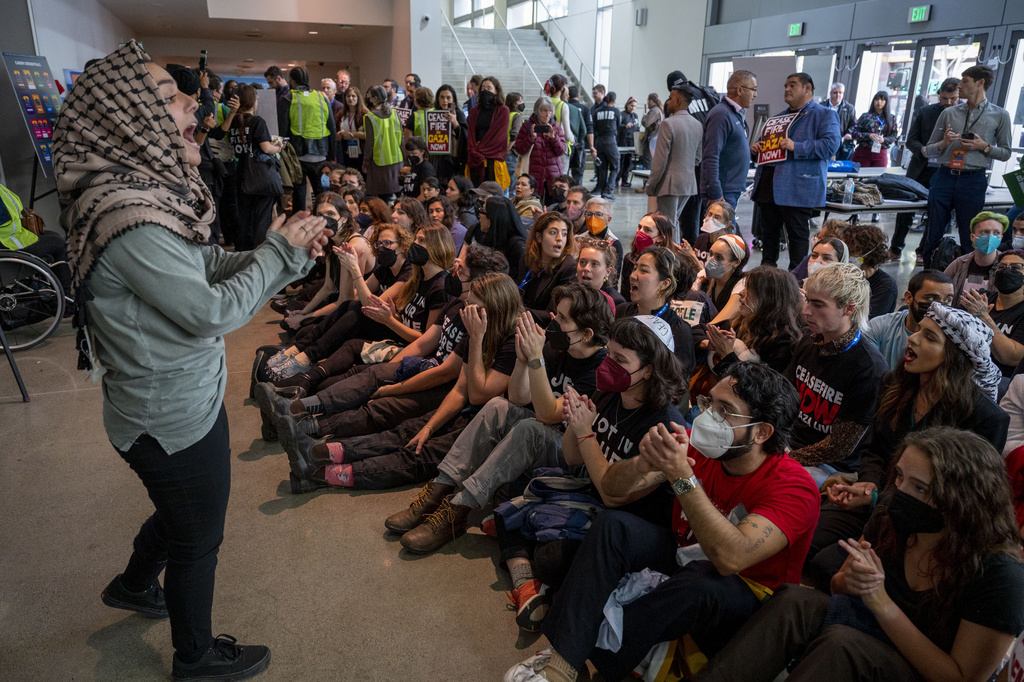
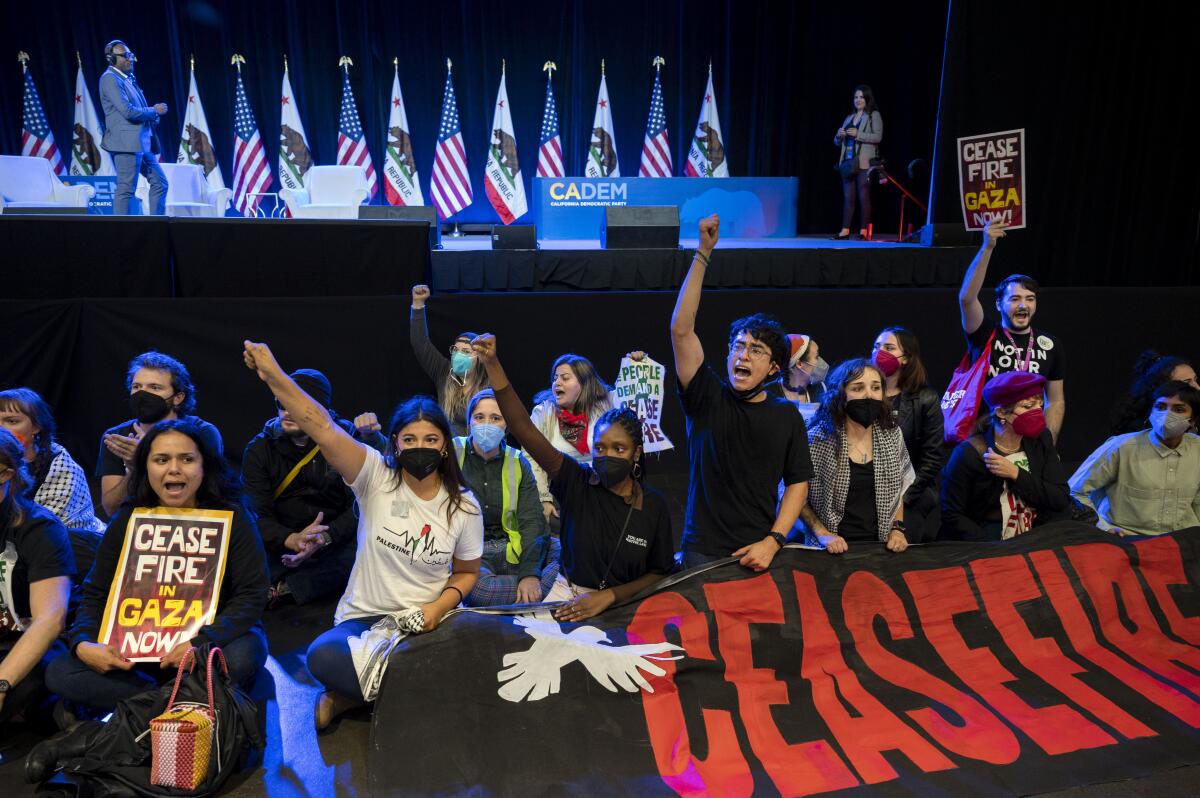
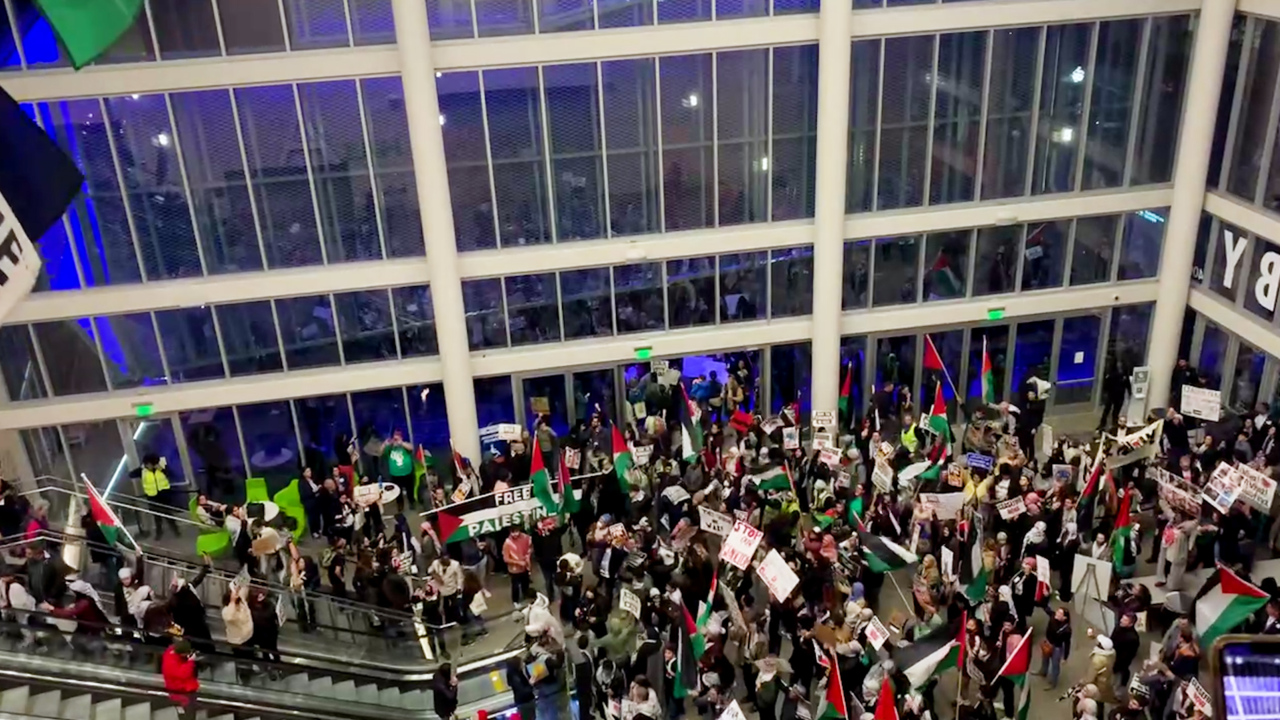
That was the warm-up for Saturday. A few hundred demonstrators sat down in the convention center, chanting, “Ceasefire now,” “Biden, Biden you can’t hide, we charge you with genocide,” and similar pleasantries. Eventually protesters skirmished with security personnel and pushed their way into the hall to disrupt a forum of U.S. Senate candidates. They permitted Barbara Lee to speak, because she favors a Gaza ceasefire. But they shouted down Adam Schiff and Katie Porter, who do not.

Maybe American political culture will recover its health before it’s too late. But Jews know, and worry: we’ve seen this movie before.

In the afternoon, Progressive Zionists of California, Democrats for Israel-California, the California Legislative Jewish Caucus and others held a Jewish Community Solidarity Rally in the rain. An interval of welcome, if damp, calm and harmony.

Saturday night traditionally sees the final round of caucus meetings and hospitality suites. For many delegates this is the highlight of the annual convention. But not this time. Around 6:00 a mob of protesters estimated at a thousand or more people banged on the Convention Center windows, overpowered security and swarmed into the building, chanting, pounding drums and waving Palestinian flags. Many Jewish delegates felt afraid and unsafe. Some hid in restrooms. The CDP emailed delegates: “Due to circumstances beyond our control, and for the safety and security of our delegates and convention participants, we are cancelling tonight’s caucus meetings, hospitality suites, and VoteFest taking place at the convention center.” Shut It Down for Palestine had come for the California Democratic Party.

A dozen events affecting thousands of delegates and guests from around California were cancelled, including the Democrats for Israel-California’s general meeting and its Ice Cream Social. DFI-CA scrambled and managed to reassemble in a nearby hotel. But what would have been a crowd of hundreds of delegates and candidates was reduced to around forty people.

And in what was a serious own goal, the rioters prevented the Arab-American Caucus from meeting and voting to support a ceasefire resolution.

How did the security breach happen? The protests were predictable, especially since something similar occurred at the Democratic National Committee in Washington DC earlier that week. The Sacramento Police Department told me: “The event at the convention center hired a private security company to provide interior event security. . . . We remained in contact with the interior event security throughout the night. Any questions regarding their actions, and decisions to cancel the remaining part of the evening should be directed to them. . . . No arrests were made, and there were no reports of vandalism.”

I emailed CDP Chair Rusty Hicks for comment on the security breakdown. He did not respond.

However it happened, it would have been better to call in the police and make arrests, rather than permit a mob to exercise a “heckler’s veto.” It should be too obvious to need saying, but evidently isn’t, that it is not “free speech” to shut down meetings, preventing delegates and guests from exercising their own free speech and free association rights.

California Penal Code section 403 is available in such circumstances. It states: “Every person who, without authority of law, willfully disturbs or breaks up any assembly or meeting that is not unlawful in its character . . .  is guilty of a misdemeanor.” It should be used more. It should have been used that Saturday.

Sunday morning Chair Hicks said that the protests violated the CDP Code of Conduct, and any delegates who participated would face unspecified consequences. The extent of the connections between the protesters and the delegates remains to be explored. (For instance, at least some of the “CEASEFIRE NOW” signs bore the CAIR logo. Hussam Ayloush is both the Executive Director of the Los Angeles office of CAIR and a member of the CDP Executive Board.)

What did the demonstrators hope to accomplish? True, they chanted, “In November we’ll remember,” an implicit threat not to vote for President Biden and other Democrats next year. But if Muslims and Progressives believe they will have better, happier lives, in a country more to their liking, if they tip the election to Trump (or whoever the Republicans nominate), I have a bridge to sell them. Or to put it less obliquely, if they believe that, they’re idiots.

It seems to me that trying to have any meaningful political impact was secondary to the feeling of belonging and purpose that comes from being in a mob; the fun of playing at being revolutionaries; the pleasure of showing contempt for “the establishment” (and “the Jews”); and the transgressive, childish joy of breaking rules (and windows).

The convention, although more—interesting? exciting?—than usual, was not a total loss. We approved a party platform that, as before, explicitly endorses Israel as a Jewish, democratic state, and supports the “two states for two peoples” solution to the Israel-Palestinian conflict. We held our endorsement caucuses for next year’s elections. The convention got its essential work done.

But the lengthening shadow of anti-Israel political mob violence is sobering. True, aside from a couple of security guards who received “minor injuries,” no one was physically hurt this time. And maybe American political culture will recover its health before it’s too late. But Jews know, and worry: we’ve seen this movie before.


Paul Kujawsky, an appellate attorney, is a former president of Democrats for Israel, Los Angeles and founding board member emeritus of Progressive Zionists of California.

What I Saw at the California Democratic Party Convention Read More »

A Moment in Time: “What’s on the Horizon?”

Dear all,

Like my father, of blessed memory, I have a love of aviation. Witnessing the grandeur of creation from 38,000 feet moves me deeply, and I never tire of it.

This photo was taken over Greenland last summer. As our plane chased the setting sun, I looked at the view and pondered, “What’s on the horizon?”

Yes, I wondered what awaited me back at Temple Akiba.

I thought about the next chapter in the life of our family.

I considered my (then) approaching birthday.

I could never have imagined what our world would face come October 7.

And I reflected on the important vs. unimportant stuff on my plate.

In any given moment in time, there is always something on the horizon.

Are we prepared?

Are we nimble in case we need to make a shift?

Are we open?

Are we grounded?

Once we reach the horizon, it’s gone – and a new one appears. That’s how life is. And so – are we ready, yet again?

And, perhaps most important, while chasing the horizon, do we allow ourselves to recognize that the journey can be extraordinary?

With love and Shalom,

Rabbi Zach Shapiro

A Moment in Time: “What’s on the Horizon?” Read More »

A Bisl Torah – Write the Book

I spent the last three days visiting Israel on a solidarity mission with the Jewish Federation of Greater Los Angeles and the Board of Rabbis. Through the gut wrenching experience of witnessing atrocities at Kfar Aza, learning about horrific ordeals endured by IDF soldiers at Shura Base where they identify and ready bodies for burial, and speaking with evacuees about their personal October 7th stories, it’s hard to leave Israel with a sense of optimism. For Israelis, it is a confusing time of betrayal and loss.

However, for a brief moment I was heartened by Dr. Shai Efrati, physician at Shamir Medical Center. Currently, the most vulnerable patients have been brought underground to a transformed hospital, once a gym. He looked at us and said, “We need to prepare for what’s coming next. We need to be the ones that write the book.”

In essence, this is what keeps the miracle of Israel alive. Israel doesn’t settle for others to write her narrative. October 7th is now known as the Dark Sabbath. But a darkness doesn’t define the people of Israel. The darkness won’t prevail.

The road ahead is long and convoluted. The trauma of October 7th comes with unpredictable aftershocks. But Israel has the opportunity to write the story that comes after. And we already know the ending: The Jewish people will continue to be a people of hope and a people of strength.

Israel, we are with you. We are one.

We’ll write this story together.

Shabbat Shalom


Rabbi Nicole Guzik is senior rabbi at Sinai Temple. She can be reached at her Facebook page at Rabbi Nicole Guzik or on Instagram @rabbiguzik. For more writings, visit Rabbi Guzik’s blog section from Sinai Temple’s website.

A Bisl Torah – Write the Book Read More »

Prickly Pear

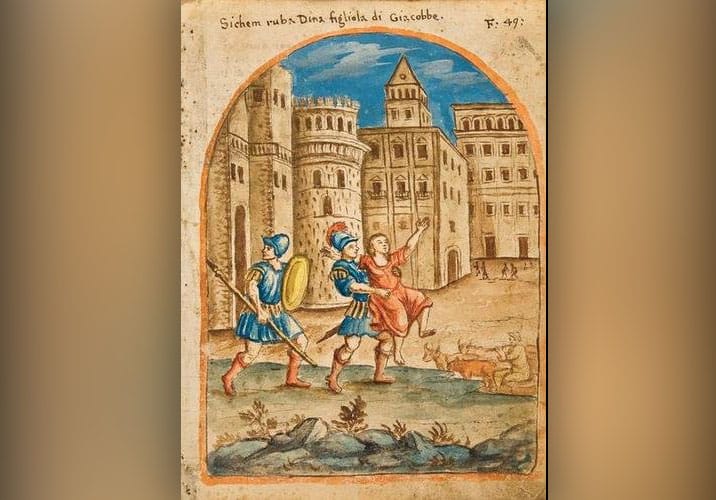
“There’s no miraculous escape,
Shechem’s synonymous with rape,”
they told their father, in his camp
where he sat sweating, hands cold, damp,
worried for his daughter Dinah….
days since last time he had seen her.
Left home, each leg in a stocking
sleek and black, while still more shocking
her sensuous curves, which unsubdued
proclaimed their shapely magnitude.
The wrap she wore was made of mink,
a Pepto-Bismol shade of pink;
conspicuous as Tower Eiffel
she wished to be, or Christmas trifle.

She’d said she only wished to stop
some minutes there, perhaps to shop
for some small trinkets as a gift
for Leah, since it might uplift
her mother’s spirits, but she then felt down
once living in that alien town,
signs not in Hebrew, Aramaic.

Her old town now seemed as Passaic
might seem to some Manhattanite
who likes to drink and dance all night,
and check the restaurants and bars,
then count his sheep in bed, or stars.

“Sure, find your mother something nice,”
he’d told her.  “Back in a trice!”
She’d said, and then put on a skirt
both short and tight, but not a word
came from his mouth, though he was scared…
for just about one child he cared,
(as he cared only for one wife)
young Joseph, (Benjamin was not
yet born) the son whom he had shared
with Rachel, joined as in a knot,
lady of her loving laird.

That’s how it started, all the strife
between the Jews and Arabs––Dinah,
being now Shechem’s new wife
could not prevent it. He was keener
on having a fling, Nablus affair
with any girl he found erotic,
anti-Israel prickly pear
enjoying what he found exotic.

Maybe she heard wedding bells,
but to party it takes two;
intermarriage rarely sells
and succeeds for very few.
Brothers knew this, she did not….
Jacob sat upon a fence.
If your daughter’s really hot
and you have some common sense
you will drive her to the store,
not let her walk there all alone.
“Should our sister be a whore?”
brothers asked him with a moan.

Was he bothered by the sabers
used to circumcise by neighbors
who after they had circumcised
themselves by brothers were “surprised”?
Didn’t he fear that all their pillage
wouldn’t harm them all in their small village,
since in real numbers they were few?
To understand him here’s a clue:
the next thing was that he removed
all the gods his sons had taken
from Shechem, which clearly proved
all the parties were mistaken:
father, since he sat on fences,
brothers, since they took strange gods
once they’d broken through defenses.

Peas unlike can’t share same pods,
and though, of course, boys will be boys,
apportioning for crimes the blame,
it’s hard to use mere equipoise
when sisters have been put to shame.


Gershon Hepner is a poet who has written over 25,000 poems on subjects ranging from music to literature, politics to Torah. He grew up in England and moved to Los Angeles in 1976. Using his varied interests and experiences, he has authored dozens of papers in medical and academic journals, and authored “Legal Friction: Law, Narrative, and Identity Politics in Biblical Israel.” He can be reached at gershonhepner@gmail.com.

Prickly Pear Read More »

This Place We Were Given – A poem for Parsha Vayishlach

And the land that I gave to Abraham and to Isaac, I will give to you and to your seed after you will I give the land. ~ Genesis 35:12

Look, I want to share this land we were given.
I really do. If my tent was any more open

we’d be outside right now wondering
where the roof and walls had gone.

This isn’t just a metaphor. I’ve wandered around
the property we were promised

bunches of times. You could spend hours
and still not make it from one side to the other

or see a single human. For such a tiny place
this promised land, there’s a whole lot of

space …

So as the different sides of our family
kept having kids and occupying different parts

of this land that keeps being given to us
in the oldest words on the oldest scrolls

you can understand the confusion about
who was there first. It may not have been us

since we were told to go there. But that was a
bunch of chapters ago and we’re just getting

set up to take a few hundred years leave of absence
most of which will be spent pining for

the old neighborhood …

Jacob had thirteen children.
Many of whom we still name our kids after

Many of whom, still live in that place we were shown
When you ask when we got there

I barely remember
It was so long ago.


Rick Lupert, a poet, songleader and graphic designer, is the author of 27 books including “God Wrestler: A Poem for Every Torah Portion.

This Place We Were Given – A poem for Parsha Vayishlach Read More »

The Democrats’ ‘Casablanca’ Moment

In the classic 1942 film, “Casablanca,” the delightfully corrupt police captain Louis Renault (Claude Rains) orders Rick Blaine’s (Humphrey Bogart) Café Américian closed to satisfy the demand of a petulant Nazi officer offended by patrons singing the French national anthem.  Rick demands to know the reason.  Renault replies with incredulity that he is “shocked, shocked to find gambling is going on in here!”  A moment later, the roulette dealer presents Renault with his night’s winnings.  Renault politely responds, “Oh thank you very much.”

I am reminded of this famous scene as we witness the histrionic street displays gripping America’s urban centers and college campuses in apparent support of Hamas.  The reaction of Democratic officialdom to their base’s uprising is what I call their “Casablanca” moment.

Since the Hamas-led rampage of Oct. 7, the sadistic details of which are still emerging, cities and campuses have pulsated with unadorned antisemitism.  Angered by President Biden’s perceived pro-Israel stance, these self-styled “progressives” have directed much of their ire towards their own party.  Here is a sampling:

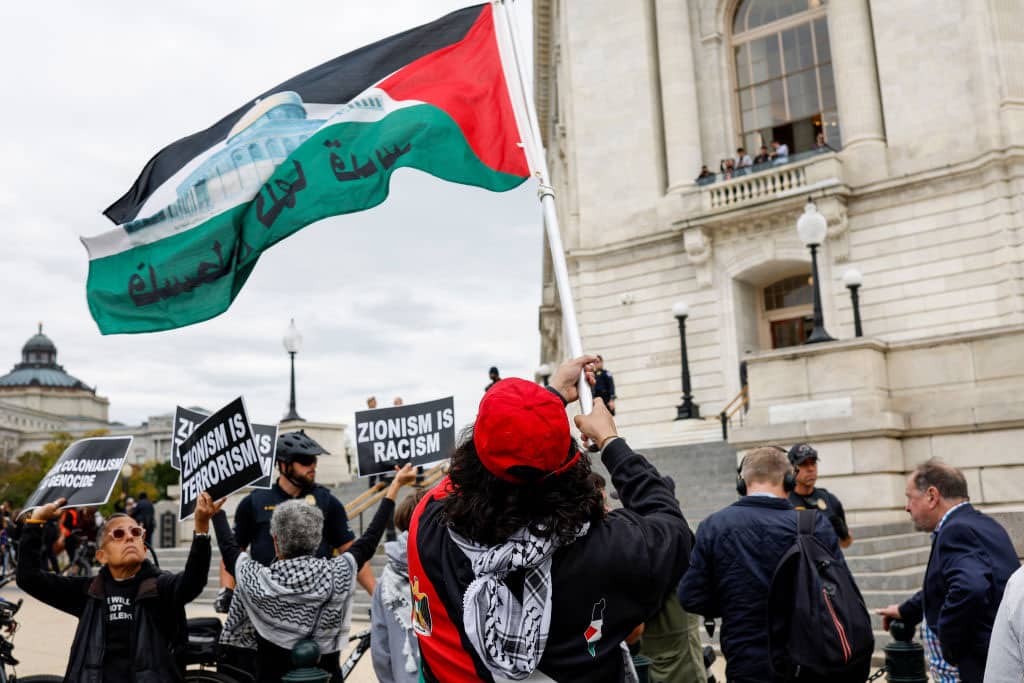
  • On October 18, hundreds stormed the U.S. Capitol rotunda chanting “Free Palestine,” leading to the arrest of 300 people including three for assaulting police officers.
  • Just three days before, 30 were arrested outside the White House.
  • On November 1, demonstrators gathered outside the State Department sporting signs with anti-Israel slogans like “Israel = Cancer of the Middle East.”
  • On Nov. 15, hundreds were arrested after violently attacking the headquarters of the Democratic National Committee and barricading legislators inside. According to the Capitol Police, one officer was slammed into a garage door, a female officer was punched in the face, and officers were pepper sprayed by demonstrators.  One video showed a demonstrator shouting “F— you!” repeatedly in a policeman’s face.
  • On Nov. 26, one of the busiest travel days of the year, 1,000 anti Israel demonstrators shut down the Manhattan Bridge in New York.Similar episodes played out at Macy’s Thanksgiving Day parade and the Rockefeller Christmas tree lighting.
  • Calla Walsh, a self-described “communist” who as a 16-year-old in 2020 was celebrated by the New York Times as part of a cadre of young Democratic activists, was arrested this month for wrecking a New Hampshire building housing an Israel-based company.

As Constitutional Law scholar Ilya Shapiro notes, much of this behavior is not free speech at all, but criminal conduct: Menacing, stalking, harassing, intimidating, threatening, defacing, vandalizing.  Many of the perpetrators are also masked, in violation of some state laws.  Ask yourself, why are they masked?  (Hint: It’s not COVID).

This is the politics of the street, the force of the mob. They are, as Bari Weiss describes them, cultural vandals.  They seek to destabilize and overturn American and Western order.

I have heard a common refrain since Oct. 7 from many liberal Jewish friends: “eye-opening,” “revealing,” a “gut punch.” But should it be?  Should these well-meaning people really be surprised?  Should the White House really be stunned by what it described as “extremely disturbing” and “grotesque” antisemitism in the ranks?

We have seen these cultural arsonists before.  In 2020, when indignation at the awful killing of George Floyd devolved in some places into violent riots.  This unrest was described by CNN as “mostly peaceful” and by Seattle Mayor Jenny Durkan as the “Summer of Love.”  Kamala Harris, soon to be nominated for Vice President, tweeted and drove millions of dollars to the Minnesota Freedom Fund, which bailed out violent rioters.  And she warned of the protests, “Everyone beware.  They’re not going to stop before election day in November, and they’re not going to stop after election day.”  Prominent Democratic figures encouraged harassment of conservatives in restaurants, airports, and their private homes.

Then, unlike now, there was political incentive to fan the flames: There was an election to be won, by any means necessary.  Donald Trump had to go.  But the guarantee of expediency is, eventually you have to pay the piper.  The mob unleashed in 2020 cannot be controlled in 2023.  It is turning on its erstwhile political sponsor, the Democratic Party.  And the antisemites in the base have shown their ugly face plainly.  They are, in the words of Senate Majority Leader Chuck Schumer (D-N.Y.), liberal Jews’ “fellow ideological travelers.”  Some BLM chapters were among the first to praise the Oct. 7 attack.  The #MeToo movement has been radio silent, ignoring the widespread reports and evidence of mass gang-raping and gruesome murders of Jewish girls.  Oxymoronic signs stating “Queers for Palestine” proliferate. I could go on.

Of course, once the politics of the mob are unleashed, it gains currency.  If Democrats are facing their “Casablanca”moment after October 7, Republicans faced it on January 6.  When Donald Trump called for roughing up opponents at rallies in 2016; when he refused to say he would support the GOP nominee if it wasn’t him; when it became clear that narcissism and one-way loyalty was his only value: Could Republicans who held their nose for him really be shocked when he unleashed his January 6 mob?

When you take this great nation for granted; when you assume its prosperity, power, and institutions will endure on autopilot; when you think you can trash Western values without consequence, do not be shocked when one day you have no country left to gamble with.


Mr. Tanenbaum is a Los Angeles native and an attorney residing in Maryland.  

The Democrats’ ‘Casablanca’ Moment Read More »

US, Israel To Iron Out Differences as Blinken Makes 3rd Trip to Region

As the end of the current cease-fire loomed over the Gaza Strip and tensions rose in Israel, US Secretary of State Antony Blinken arrived in the country on Thursday to try to reach an agreement to extend the truce between Israel and Hamas. This is Blinken’s third visit to the region since the war began with Hamas’ surprise attack on Israel on October 7.

Blinken first met with Israeli President Herzog just minutes after two Palestinians affiliated with Hamas attacked a Jerusalem bus stop with M-16s and a handgun. The attack saw three Israelis killed and several others wounded. Later, Blinken met with Israeli Prime Minister Benjamin Netanyahu in the capital.

The cease-fire, in place since last Friday, enabled the release of tens of Israeli hostages and other foreign nationals that terrorists in the Gaza Strip held hostage for over 50 days. In return, Israel allowed a steady flow of increased humanitarian aid to enter Gaza while also releasing Palestinian prisoners held in Israeli jails.

“This process is producing results,” said Blinken at the beginning of the meeting with Herzog. “It’s important, and we hope that it can continue.”

There are approximately 145 people still being held captive by Hamas and other terrorist organizations in Gaza. Some also hold American citizenship, adding to the pressure the US administration is applying to lengthen the cease-fire. The US is also putting pressure on Qatar, Hamas’ main backer and the broker of the current cease-fire.

Blinken also said he wanted to discuss the future of the Gaza Strip with the Israeli government despite Israel’s avoidance of dealing with the issue at this point.

“The United States firmly supports Israel and its right to defend itself and to try to ensure that October 7 never happens again,” he said. “At the same time, I look forward to detailed conversations … about the way ahead in Gaza.”

Israel has pushed back on attempts to discuss the future of the Gaza Strip, with officials saying they are concentrated on the war effort. However, if Israel is successful in removing Hamas from power as it seeks to do, it will not be able to avoid dealing with the matter.

The US and Israel have several points of contention regarding the war and its aftermath. These disagreements have been openly aired in recent days.

“These things should be ironed out behind closed doors,” said Professor Eytan Gilboa, an expert on the US at Bar-Ilan University and senior fellow at the Jerusalem Institute for Strategy and Security. “Discussing disagreements publicly is bad, it is a signal to Hamas that there are differences between the US and Israel which strengthens their position to refuse any offer they receive.”

But since the beginning of the war, Israel has received unprecedented support from the US and its president, Joe Biden.

So far, the US has supplied Israel with ammunition, replenished its air-defense rocket stock, and mobilized forces and aircraft closer to the region. Reports also indicate the use of US military drones over Gaza to assist Israel in locating hostages. In October, the US House of Representatives approved a massive $14 billion military aid package for Israel, in addition to the annual aid provided.

Moshe Roth, a member of Israel’s parliament, the Knesset, from the United Torah Judaism party, asserts that there are significantly more points of agreement than contention between Jerusalem and Washington.

“There is an understanding that the enemy is a common one,” Roth, a member of the Knesset Foreign Affairs and Defense Committee, told The Media Line. “This provides cover for most of the joint interests, which for both Israel and the US include the destruction of Hamas.”

Securing the hostages’ release has been a top priority for both Israel and the US. While Israel has vowed to resume the conflict once the cease-fire, potentially ending as early as Friday, concludes, the US is focused on securing as many hostages as possible, even if it impacts the war effort.

“In the US, the image of bringing hostages home is considered a victory that comes with great political credit,” stated Roth, who is an American Israeli. “In Israel, this is also important. But the difference now between the US and Israel is on what needs to be done right now. For Blinken the value of a cease-fire is greater than it is to Israel.”

The majority of Israeli public opinion favors removing Hamas’ control over Gaza. Despite a strong desire for all hostages’ release, there’s an understanding that this may be unattainable and that the offensive against Hamas must resume.

“The more time passes, there will be more voices in the US calling on Israel to stop the fighting,” said Roth.

The US is pressuring Qatar, a key mediator in the latest deal, to help secure the release of additional hostages.

“As part of its strategy, Hamas is holding on to the American hostages because it believes they are a greater asset,” said Gilboa. “In domestic American eyes, as long as there are American hostages, this is perceived as a failure of Biden’s foreign policy.”

“If American pressure on Qatar will not bring to their release, it will strengthen the Israeli demand to continue with the war effort,” he added.

Although the US agrees with Israel’s continued war on Hamas until its removal, the White House has reportedly requested Israel to avoid further displacement of Palestinians in the Gaza Strip. United Nations data indicates that nearly 1.8 million Gaza residents have been displaced following evacuation orders by the Israeli army.

Most displaced residents are now concentrated in the Gaza Strip’s south. Israel is expected to focus the next steps of its military campaign in the south, where it suspects the senior Hamas leadership and much of its military infrastructure are located.

“The US agrees to the resumption of the war, but under certain limitations,” said Gilboa. “They are asking Israel to make sure to minimize the loss of life of uninvolved civilians because they are considered Israel will lose the legitimacy for its military operation.”

A Reuters report on Thursday indicated that the US was urging Israel to confine combat zones in southern Gaza.

Differences are likely to emerge between the two allies.

“The future of the fighting will be the focal point of the differences of opinions,” said Roth. “Israel will be walking a fine line, with its military seeking more room to act in southern Gaza. A large number of civilian casualties will require Israel to use all of its political abilities to secure American support.”

The Gaza Health Ministry, run by Hamas, reports that over 15,000 Palestinians have been killed due to the Israeli offensive.

“Any scenario with a large number of civilian casualties will test Israel’s ability to convince the US,” added Roth.

From the war’s outset, the White House has consistently emphasized to Israel the critical importance of the war’s endgame in shaping its conduct. Although Blinken and other officials have expressed a desire for the Palestinian Authority (PA) to play a significant role in Gaza post-Hamas, Israel’s perspective differs.

“The PA does not look like it can or wants to take control of Gaza,” said Roth. “This is not just a technicality to Israel. The PA does not present itself as someone who wants to live alongside Israel and the US is aware of this.”

For many Israelis, including senior figures in the government, the discussion is premature, despite its necessity.

“Hamas needs to be dismantled before such a discussion,” said Gilboa. “The US has an obsession with the endgame of wars, but Israel would be smarter in laying out its conditions for the day after Gaza that will serve its goal, rather than flat-out rejecting any suggestion.”

Given their robust relationship and the US’s steadfast support for Israel during this crisis, it’s likely the two will reconcile any differences.

“We will not see a major collision,” Gilboa summarized. “Israel will do whatever it can to limit the differences because US support is critical for every aspect of the war.”

To read more articles from The Media Line, click here.


US, Israel To Iron Out Differences as Blinken Makes 3rd Trip to Region Read More »