fbpx

October 25, 2023

10 Head-Scratching Questions About Israel and Hamas

Don’t you just hate it when you’re trying to record (in Arabic) an anti-Israel propaganda video from southern Lebanon and keep being interrupted by an Iranian accomplice who’s speaking too loudly on the phone in Persian next to you?

I pondered this question and several others as I continued to wrestle with why I feel so irreparably broken; why the biggest massacre of Jews after the Holocaust occurred in my lifetime; and why I keep hearing so much Persian in videos from Lebanon and Gaza. Here are 10 questions we should all be asking ourselves and others about Israel, Hamas and this previously unimaginable war:

1. Why does one hear (presumably) Iranian men speaking Persian in various videos from Gaza and Lebanon lately? I can just imagine Hamas terrorists waving their arms at their Iranian partners in war crimes and scolding, “Shh! Be quiet or the Americans will hear you!” 

I’m not surprised that Iranian fighters are in southern Lebanon, but now, it seems that members of the powerful Iranian Revolutionary Guards Force (IRGC), are in Gaza, helping Hamas and Islamic Jihad. The Biden administration would be wise to watch these videos. Most of them give me the chills. But I had to laugh during one particular video posted by Hamas’s Telegram channel, because the Iranian man on a heated phone call in the background, nefarious as he is, sounded like one of my Persian uncles arguing on the phone with the cable company. 

2. Do most Americans know that Hamas met with Iranian security officials to plan the October 7 attack? In August, Hamas met Iranians to plan the attack by land, sea and air. According to The Wall Street Journal, Hamas again met with Iranian officials in Beirut on October 2nd. That’s when Iran gave Hamas the green light to proceed with its massacre a few days later. 

3. How could it be that one day after Hamas butchered Israelis en masse, nearly 40 rallies against Israel were held in these United States? Perhaps we were wrong to have expected Israel haters to wait until 1,400 Israelis were buried before marching against the world’s only Jewish state. But these racists have only doubled down, including in the U.S., where there have been standing-room crowds for “Sit-Ins for Palestine,” college student walkouts nationwide, demonstrators flooding Times Square, and thousands of open chants of “From the river to the sea, Palestine will be free!”, an inexcusable call for Jewish genocide, however poetic. 

It’s worth asking whether those who hate Israel are currently testing the waters to see how much they can get away with, especially in America, and how much fear they can instill in Jews and Zionists (think the recent “Day of Rage”). More than ever, Israel bashers are seeing how much they can shut down streets, universities and, worst of all, endanger the safety of Jews, especially Jewish students. Last week, over 300 people (mostly young Jews) were arrested after swarming the U.S. Capitol and illegally protesting against Israel in the Cannon building rotunda. Like every other Israel basher, they were testing the waters, too. And to their delight, they discovered how well they can swim. 

4. Why, in the words of Hen Mazzig, did the world argue for a full week over whether Hamas beheaded babies, but within a matter of minutes, tens of millions worldwide swallowed the lie that Israel bombed a hospital in Gaza? I’ve seen stories that cite one American source, one Israeli source, and two terrorist organizations. What kind of Western journalist relies on balanced information from the Gaza Health Ministry (Hamas)? The Al Ahli hospital explosion was caused by a misfire of Islamic Jihad rockets. But waiting on major news outlets (as well as certain U.S. representatives) to retract their blood libel charges is like waiting for seeds to sprout in a frozen wasteland of snow. Maybe something will eventually come to the surface, but even then, it probably won’t be worth the wait. 

Remember the powerful slogan from the #MeToo movement? It was “Believe women.” The slogan for the October 7th massacre and its aftermath of war seems to be, “Believe Jew haters.” 

5. In the same vein, shouldn’t we be asking why Rep. Rashida Tlaib (D.-Mich.), an American elected official, seems to believe Hamas more than she believes President Biden (or the House Intelligence Committee)? This is not how an American leader is supposed to act, especially on social media, where her accusations may directly result in violence against Jews in America, and beyond. Something is terribly wrong when a congresswoman seems to believe a terrorist organization more than she believes the Pentagon. 

6. Why was the media so quiet when the Iraqis bombed a hospital at the corner of our neighborhood in Tehran? It happened in 1988, when I was a child in Tehran during the Iran-Iraq War. I was irreparably scarred by that attack, because I overheard my parents discuss that the Iraqis hit the children’s wing of the hospital. It turns out the hospital strike barely made the news, whether in the Middle East or beyond. Why? Was it because people understood that Iran and Iraq were at war, and there would undoubtedly be collateral damage? Or was it because when Muslims target each other, no one seems to blink an eye, especially when Jews are not involved?

Of course, when Jews are accused of bombing a hospital, worldwide rage is instantaneous and merciless. There have been four times more casualties during the Syrian Civil War than all of the people killed on both sides of the Arab-Israeli conflict since the 1920s (the entire Arab-Israeli conflict, not only the Israeli-Palestinian conflict). Where are the campus marches against the Syrian regime? They’re non-existent, because all of the hatred, brainwashing and resources are being poured into “From the river to the sea.”

If the allegation that Palestinians have been ethnically cleansed by Israel is true, why were there roughly 700,000 Palestinians in 1948, and over 7 million Palestinians today? 

7. If the allegation that Palestinians have been ethnically cleansed by Israel is true, why were there roughly 700,000 Palestinians in 1948, and over 7 million Palestinians today? Something seems strange about this accusation. Doesn’t ethnic cleansing refer to a mass wiping out of communities, not an increase in them?

8. If 150,000 Jews lived in Iraq in 1948, why are there zero Jews in Iraq today? Why were there 140,000 Jews in Libya in the 1940s, but zero there today as well? Isn’t that evidence of a real ethnic cleansing? Before the Iranian Revolution of 1979, over 100,000 Jews lived in my former country. Since then, between 92-95 percent of them have escaped. How sad that Iran is home to the largest population of Jews in the Middle East after Israel, even though it has lost up to 95 percent of its Jewish population.

9. Did Vladimir Putin have the best birthday of his life? We know that Ismail Haniyeh and other Hamas leaders recently met with the Russians in Moscow. On October 7, Hamas offered Putin a deeply welcome birthday gift: a long-awaited diversion from Russia’s war in Ukraine. 

10. And finally, to the countless LGBTQ+ activists who are marching in anti-Israel rallies or displaying Palestinian flags in adult-only shops in cities such as San Francisco: If you’re gay in Gaza, they’ll throw you off the rooftop of a building. If you’re gay in Israel, they’ll throw you a parade.

You’re well aware of this, aren’t you?


Tabby Refael is an award-winning writer, speaker and weekly columnist for The Jewish Journal of Greater Los Angeles. Follow her on Instagram and X/Twitter @TabbyRefael

10 Head-Scratching Questions About Israel and Hamas Read More »

You Want to Fight the Enemy, First Get Our Own House in Order

The last two weeks have been horrendously difficult for the Jewish community. Since October 7, what some would call a new Holocaust as the carnage unfolded before our eyes. The images, almost too grotesque to comprehend, have traumatized us to our core. 

In the moment of unbearable pain, no one has understood our collective sadness and vulnerability better than our own Jewish brothers and sisters.

The pain has brought us closer in new ways. The term, “Ahavat Yisrael” (translation: Love one’s fellow Jews) is resurfacing and resonating more deeply than ever. The challenges that once divided us, seem to have faded or been sidebarred. 

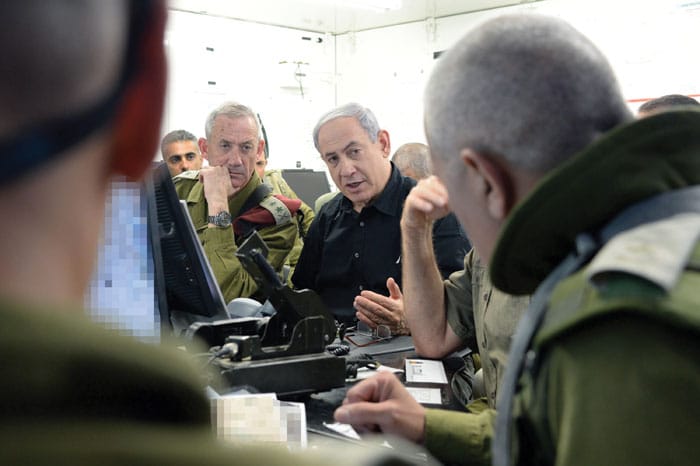
You see this on multiple levels: Bibi and Gantz forming a coalition government; Haredi Jews enlisting to serve in the IDF; liberals questioning the merits of a Palestinian state; conservatives applauding Biden’s trip to Israel. Friends and families who had parted ways because of partisanship suddenly are calling and checking in on one another, recognizing that their Jewish lives matter more than politics. And so, amid the incredible grief and infinite sadness there’s also glimmers of hope and unity. 

But I fear that this moment of unity might not last. It is still fragile and vulnerable to divisive forces. I believe we need to be intentional about protecting and maintaining it.

While our brothers and sisters are bearing guns to protect our homeland, we need to mobilize and protect our people. We can’t wait for anyone to save us – the lesson of the past two weeks is that we need to save ourselves. 

While our brothers and sisters are bearing guns to protect our homeland, we need to mobilize and protect our people. We can’t wait for anyone to save us – the lesson of the past two weeks is that we need to save ourselves. Here are some of my suggestions:

1. Seek both knowledge and information. It’s wonderful that many people who have never been involved in difficult conversations about Israel and the safety of Jews around the world are joining in the action. As we get active, let’s also get educated. The abundance of news, analysis, opinion and visual information on social media can dominate our time, giving us information but not enough knowledge. Let’s become better advocates for ourselves by being both informed and knowledgeable.

2. We need to remedy our weakness on social media. All of us see the haters and trolls who seem to dominate but we need to all set up accounts and actively engage the right content on social media. Many new users suffer from low followers and visibility. Let’s all follow each other, big and small, left and right. We can each reach a one million person following if one million of us join in unity. We can create a new robust voice on social media that can set trends, go viral, and change the public discourse. 

3. All Jewish organizations must engage. For decades since the Holocaust, the Jewish community leadership has invested in an infrastructure of Jewish communal organizations with a variety of missions. Today they need to all work on one mission: To protect Jewish life. All leaders and funders need to put egos aside and work on an all-inclusive strategy that engages every single organization and every single person who wants to be part of the solution.

4. Be the leader you want to see. If you don’t like the leadership you see, don’t just complain and shame — leap in and try to do a better job. The days of activism by criticism are over. In this “all hands on deck” moment, be part of the solution, not the problem. 

5. You feel weak in the heart, go to the synagogue. The endless stream of news and stories from Israel can be mentally engrossing and emotionally exhausting. It can draw you into a state of constant awareness paradoxically combined with paralysis and inaction. Prayer or meditation can help to calm the mind and reset your thinking. It can give you space to strategize, to reflect on your life and also to find your role in this crisis. There’s also strength in unity and solace when we are among each other. A robust synagogue life can reenergize the community and provide support for individuals. Torah offers the kind of haven that so many of us desperately need. 

6. Tikkun olam begins with you. Some Jews still may annoy you, but reach out and settle your problems. Life is too short and our challenges too immense. If you have a lingering problem with a Jewish friend or family member, one that you haven’t bothered solving before the annual window before Yom Kippur, muster up the courage and reach out now. You may agree to disagree with that person but letting go of your animosity will make you a better person, a step towards tikkun olam.

If you think this crisis can be resolved with  one party alone, you’re mistaken. We need allies wherever we can find them.

7. Reevaluate the merits of partisan politics. If you think this crisis can be resolved with one party alone, you’re mistaken. We need allies wherever we can find them. Consider a political reset and evaluate what matters at this moment. Don’t let the extremists on both sides distract you. In this time, all of us should spend less time quibbling about trifling politics and much more time focusing on solution-oriented policies. You can always go back to red shirts and blue shirts later.

8. Rethink your spending habits and donate wisely. Perhaps you saw images of young Israelis in fatigues going under the chuppah before reporting for duty. Simple weddings, guests in jeans and shorts. Embrace simplicity and invest in what you value that also lasts. Israel needs our support now and who knows, Jews around the world might face other crises in the weeks and months away. Hold off on the temptation of lavish weddings and luxury goods— at least for a while. Similarly, consider pulling your funds from organizations and institutions that are ignoring or equivocating the loss of Jewish life. 

9. Show gratitude: Although we feel lonely in this situation, there are many leaders and allies from within and outside of our community who are risking a lot to do the right thing. They’re making statements, sending money, and taking political gambles, endangering their lives while they do that. Let’s recognize their contributions and express our gratitude to them with a social media message, an email or a phone call. And treat your local police department to the delivery of nice home cooked meals!

10. Don’t lose hope. Remember that our ancestors have survived persecution for millennia and outlived their enemies. The days of social distancing and isolation are over, reach out and hold a friend’s hand and help the world.


Marjan Keypour Greenblatt is an Iranian-born human rights activist and the founder of StopFemicideIran.org.

You Want to Fight the Enemy, First Get Our Own House in Order Read More »

A New Politics of Unity

“Together we will win!” 

You see it all over the city — scrawled in spray paint on the side of a building or superimposed over an undulating Israeli flag on an LED panel at the train station. It is the official slogan of the war — Israel’s take on “Keep Calm and Carry On.”

In a time of national crisis, we are drawn to the language of unity — especially considering that the past 12 months have seen Israeli society disfigured by internal conflicts concerning the judicial reform legislation put forth by Netanyahu’s bizarre, anti-democratic coalition and opposed by a protest movement of unseen proportions. 

After October 7th, who can remember what all that fuss was about? We’ve been reminded — at the barrel of a gun — that we have other more serious problems. We are surrounded by enemies ready to kill, maim, kidnap, and defile. What’s more, those enemies have supporters in some of the most elite institutions of the western world who will cheer when Israelis are slaughtered and characterize Israel’s effort to defend itself as an act of genocide — casus belli for Hamas’ next attempt to exterminate Jews in their homes. 

So we proclaim that “together we will win,” while in the Knesset, Prime Minister Netanyahu and opposition leader Benny Gantz form a unity government. We realize now that a country with violent enemies living a hair’s breadth away from civilians cannot afford to be so divided. We don’t have the luxury to engage in the endless culture wars that characterize American politics. We don’t have the privilege to elect extremist clowns to the highest echelons of government to see how it goes. Nor do we, I might add, have the privilege to boycott and politicize the IDF, or to leverage Israel’s economy as a bargaining chip in a battle over proposed legislation. 

It’s not my intention to draw a moral equivalency between an anti-democratic legislative push and a pro-democracy protest movement. That said, as in a Mexican standoff, everyone must put down their weapons at the same time in order to deescalate. The war has provided the perfect pretense to do just this. The unity government has agreed not to deal with any nonemergency agenda items, i.e. judicial reform, while the protest movement has repurposed its activist networks to serve the war effort on the home front.

The wounds of the past year have not healed just because we have been attacked, and if we want “together we will win” to be more than just a wartime catchphrase, we will need to do more to cultivate unity in this country. 

Underneath the surface of these displays of detente, however, Israelis are still feeling angry, resentful, and eager to blame the current situation on the “other side.” The wounds of the past year have not healed just because we have been attacked, and if we want “together we will win” to be more than just a wartime catchphrase, we will need to do more to cultivate unity in this country. 

In 1948, at the dawn of the state of Israel’s existence, David Ben-Gurion made the decision to attack and sink a ship carrying Jews to Tel Aviv. That ship — the Altalena — was transporting weapons and supplies (as well as fighters) for the Irgun paramilitary organization. Ben-Gurion saw this ship as a threat to the newly formed IDF’s monopoly on the use of force. A state cannot be a patchwork of militias. It needs a unified structure.

Whatever one thinks of Ben-Gurion’s decision, the story should disabuse us of the notion that the pursuit of national unity is something pollyannaish and sentimental. Rather, it is a vital strategic interest that must be pursued with the same hardheadedness and realism as the pursuit of security objectives. Indeed, as we have learned, national unity is a security objective. 

And so we need a unity government, not as an emergency measure, but with the recognition that unity is what will shield us from future emergencies. We need a government for which the top priority is the rebuilding of social cohesion and good faith between citizens and their government. 

It’s hard to imagine how Netanyahu — the most divisive figure in Israeli politics — would have any role in such a government. He has shown himself to be a cynical partisan far too many times and his legal troubles are an ongoing conflict of interest. 

Nevertheless, every tribe of Israeli society — Arabs, Haredim, religious Zionists and secular Jews — must feel that such a government is their ally. This trust will be crucial for the second aspect of such a government’s work, which will be confronting the extremists in each tribe and ridding the country of the forces that threaten the state’s unity.

Just as Ben-Gurion took on the Irgun, the unity government must root out and lock up settler thugs terrorizing Palestinians in the West Bank as well as the “spiritual leaders” who incite them. Extremists like these stretch thin the country’s security resources making us more vulnerable to attack. So too must the state take on the violent crime organizations making life unbearable for Arab Israelis before entire regions of Israel become ungovernable cartel territory. 

Vigilante fanatics who assault their fellow citizens — whether they be Haredi students spitting on non-Orthodox worshippers in Jerusalem or secular protesters disrupting Yom Kippur prayers in Tel Aviv — should be treated as a threat to our ability to function and cooperate as a body politic.

As we heal from this devastating period in Israeli history, the indomitable forces of normalcy will carry us back into our routines, and nothing is more routine in Israel lately than civil strife. 

After all, the unity we feel today is fleeting. It is rooted in shock and sorrow and shared trauma. As we heal from this devastating period in Israeli history, the indomitable forces of normalcy will carry us back into our routines, and nothing is more routine in Israel lately than civil strife. 

That’s OK. We don’t need a sentimental unity. We don’t need to hold hands or to sing “Kumbaya.” What we need is a new politics of unity which can do more than sell us slogans.


Matthew Schultz is a Jewish Journal columnist and rabbinical student at Hebrew College. He is the author of the essay collection “What Came Before” (Tupelo, 2020) and lives in Boston and Jerusalem.  

A New Politics of Unity Read More »

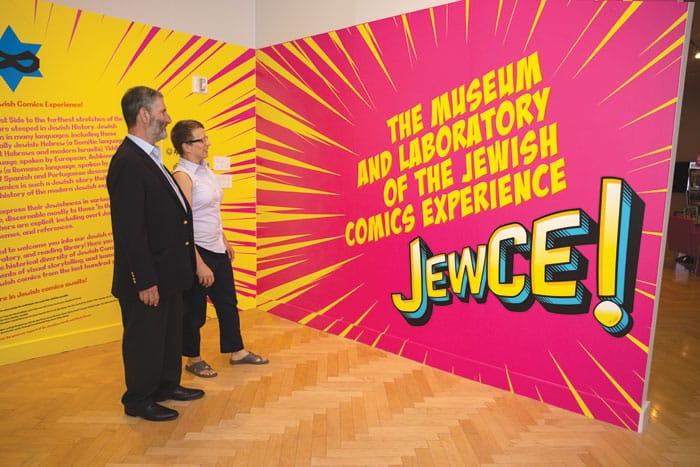
JewCE Showcases Jews’ Impact on the Comic Book Industry

Jews invented Superman, Spider-Man, Captain America, The Hulk, the Avengers and X-Men. Aside from the mainstream, Jews have contributed heavily to the indie comic book scene as well.

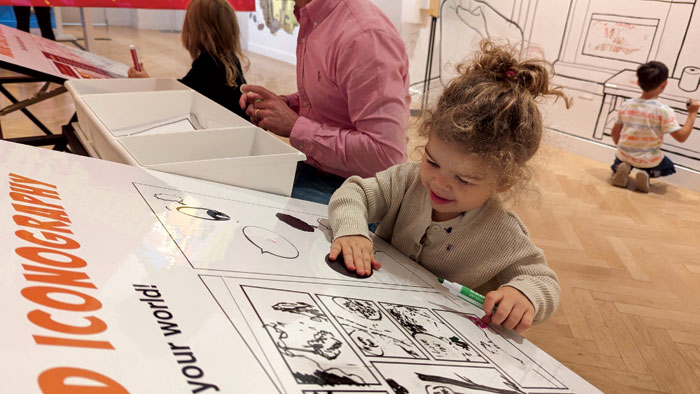
Now, the Jewish community’s contributions to comics is on display at the Center for Jewish History in New York City. This collection showcases Jewish culture, history and artistic expression through comic books, giving visitors a chance to learn about this topic as well as draw their own comics. 

On November 12, the museum will hold a convention with workshops and an awards ceremony featuring the biggest Jewish comic book creators of today – including Israelis. Some of the creators were supposed to fly in from Israel for the event, but now that’s uncertain. Co-curator Roy Schwartz, author of “Is Superman Circumcised? The Complete Jewish History of the World’s Greatest Hero,” was raised in Tel Aviv and now lives in New York, said that due to rising antisemitism, the exhibit has gained new meaning.

The recent events in Israel and the global tidal wave of antisemitism that’s followed have made the topic of JewCE more relevant than ever. – Roy Schwartz

“The recent events in Israel and the global tidal wave of antisemitism that’s followed have made the topic of JewCE more relevant than ever. In the 1930s and 40s, when forces of hate and insanity marched across borders and Jews were butchered wholesale while the world proved indifferent or hostile, young American Jews turned their fear, fury, frustration and faith into superheroes. They created symbols of life, hope and brotherly love. These characters have resonated worldwide, and now that history is repeating itself is the right time to tell the story of their creators.”

Photo by Miriam Moira

The workshops at JewCE include the “Jewish Roots of the Comic Industry,” “Jewish Folklore in Comics” and “From Strength to Strength: Jewish Superheroes Through the Ages.” The convention is emphasizing the diversity of modern Jewish comic book creators through its panel, “Breaking the Mainstream: Getting Past Ashkenormativity and Secularism in Comics,” presented by Arnon Shorr, a creator and filmmaker formerly based in Los Angeles. 

“In the early days of the industry, characters were coded, perhaps Jewish if you knew what to look for, but otherwise not identifiable,” said Dr. Miriam Mora, who came up with the idea for JewCE. “Then they were statedly Jewish, introducing a character as Jewish or mentioning their Jewish ancestry, but maintaining a level of ashkenormativity that gave the false impression that Jews all looked or behaved as acculturated, secular/non-practicing, white-presenting, Ashkenazi Americans.  Now we are seeing content emerging with Sephardi characters, Mizrachi characters, African American Jews, Asian Jews, Orthodox characters, etc.  It’s a whole new world of Jewish comics.”

One L.A.-based comic book creator, panelist and JewCE awards nominee Daniel Lobell, discusses his observant Judaism and Sephardic background in his “Fair Enough” comics book series. 

“It’s so exciting that Jewish comic book creators are being honored in this way, and it’s so long overdue,” he said. “Jewish people invented the comic book industry. It’s nice to see us finally celebrating that.”

Barbara Mendes, an LA-based painter and comic book artist, will be displaying her “Vayikra Mural,” which illuminates each of 859 verses in the Book of Leviticus, at the JewCE event. She also created “Queen of Cosmos Comix” (Red 5 Comics) and will be speaking on the panel about translating Jewish texts into the comics medium.  

“I believe in and create narrative art in paintings and comics which illuminate and extol the beauty, strength and endurance of Jewish texts and Jewish life,” Mendes said. “Jewish Learning is oceanic. My paintings offer an invigorating swim into their heart. Jewish values are world-founding – my comics series plays with cosmic truths amid our own world.”

The chair of the JewCE awards committee, comic and graphic novel writer and editor Danny Fingeroth, believes that comic books are a powerful method to get across important ideas. 

“Words and pictures, when created by skilled, inspired people, are a potent way to convey ideas and stories that can be understood and appreciated by a wide variety of people,” he said. “The hope is that awards such as the JewCEs will recognize some gifted creators and simultaneously raise general awareness about the nominated and winning works and creators.”

As for Schwartz, he’s looking back at the original Jewish superheroes for some inspiration during these difficult times – and hoping others can do the same. 

“JewCE examines how we’re represented and how we represent ourselves in comics, and we hope helps empower creators, Jews and non-Jews alike, to include and positively portray Jewish life, in all its diversity,” he said. “We also hope it gives visitors pride in knowing that our culture gave birth to Superman, Captain America and most other superheroes. It’s important that we find that strength in ourselves now.”

JewCE Showcases Jews’ Impact on the Comic Book Industry Read More »

Rosner’s Domain | Hamtana: As We Wait

Waiting is a difficult challenge. War – of course – is an even more difficult challenge. And still, waiting for war is not to be taken lightly. It is difficult for the soldiers, who must drill and prepare. It is difficult for the commanders, who must adhere to a routine and keep their soldiers in line. It is difficult for the citizens, who do not know what they are waiting for, and cannot get credible information, as the reasons for the delay are usually not the kind of reasons that can be disclosed to the public. It is difficult for the leadership that is under pressure from all directions to do something and explain itself.

Waiting periods in history have different characteristics: Waiting in 2023 is not the same as waiting in 1967. Still, examining what is similar between the days that passed since the beginning of the current crisis and the most memorable waiting-for-war period is an interesting exercise. 

The three weeks before the Six Day War of 1967 were called in Hebrew “Hamtana” —  waiting. What was Israel waiting for? All kinds of things. Quite a few of them concerned the American administration of President Lyndon Johnson. Here, there are also certain similarities. Much like Joe Biden, Johnson was a tough, rugged, Democratic president, with a lot of political experience. Much like Joe Biden, Johnson was an instinctive supporter of Israel. Much like Biden, he had many other considerations in addition to his support. He was worried about international legitimacy, about relations with other countries, about the implications on the Cold War, about domestic politics, about internal administration infighting. Like Biden, he delayed Israeli action by posing half requests, half demands, vague promises.

It is essential – Johnson wrote in a cable — that Israel does not take any preemptive military action, which would place upon it the responsibility of starting hostilities. The cable was delivered to the Prime Minister Levi Eshkol by the American Ambassador at the time, Walworth Barbour. Of course, Israel was not the aggressor. The Egyptians were the ones who initiated the crisis with an aggressive move of closing the Straits of Tiran, moving troops, kicking out U.N. observers. 

The Israeli government convened; an informal vote was tied: Nine ministers were in favor of a preemptive strike, nine ministers in favor of continuing to wait. What were they waiting for? They were waiting for the Americans. Johnson promised to do something about the closing of the waterways. “I have more confidence in the promises of the Americans than in our ability to break the Egyptian army,” then-Minister Moshe Haim Shapiro said. A statement that in retrospect sounds quite weird. Torn between the two camps — as Michael Oren described in his book, “Six Days of War” — was PM Eshkol. “The prime minister reviewed the disadvantages and advantages of the situation …” He did not trust Johnson’s promise but acknowledged the need for Israel “to ‘show Johnson that we are the good guys.”

Prime Minister Benjamin Netanyahu is also torn and pressured. Like Shapiro, his confidence in the military is limited. Like PM Eshkol, he has to work with a sympathetic American president, whose support comes with strings attached. Like another 1967 minister, Zalman Aran, maybe he too thinks that “the war can wait for later.” For those who were not privy to the deliberations, the 1967 waiting time was a difficult time. “The masses of citizens who were not involved in those power games were exposed to corrosive anxiety,” Oren wrote. They built shelters, dug trenches, filled sandbags. The feeling was “of an impending disaster,” perhaps as bad as “another Holocaust.”

Like Eshkol at his day, Netanyahu has a problem with the public. The source of his problem is different, but the result is similar: Rather low trust in the country’s leader at a critical moment, on the eve of war. A survey by the Jewish People’s Policy Institute that examined the level of trust in Netanyahu and in the IDF commanders shows that regardless of what the Prime Minister thinks of the officers, the public has much more trust in them than in him. In fact, only the supporters of two parties still put a lot of trust in him – Likud supporters and Shas supporters. And to be clear, there are far fewer Likud supporters in Israel today than there were two weeks ago.

IDF commanders have at least one thing that Netanyahu does not have – most of the public assumes that they do not have political motivations as they plan for the coming days of the war.

The level of trust in IDF commanders is high. Not as high as the trust in IDF soldiers – in whom almost all Jews in Israel have complete trust. Still, 75% express “fairly high” or “very high” confidence in the high command. This is more than double the trust in Netanyahu (32%). So perhaps it is Netanyahu’s luck that there are no commanders today with the temperament of General Ezer Weizman, who dared to hit the table and scream at Eshkol. And yet, if rumors and reports concerning a friction between him and the military command keep spreading, it is not at all certain that Netanyahu will be able to convince the public that he is in the right and the IDF is the one holding Israel back. True, there was an intelligence and operational failure of the IDF at the outset of the crisis, but its commanders have at least one thing that Netanyahu does not have – most of the public assumes that they do not have political motivations as they plan for the coming days of the war.

Something I wrote in Hebrew

As I presented numbers concerning the growing anxiety of U.S. Jews amid the support Hamas gets in campuses and on social media, I wrote the following paragraph – something that not all Jewish Israelis understand: Jews in Israel have a vital need to feel that their country is strong enough and solid enough to survive in a hostile and murderous region. Jews in America also have such a vital need. Although they do not live here, they shape their future while constantly corresponding with what is happening here. And so, what’s happening here is hard for them too. Not as hard as it is for us. Not as dangerous as it is for us. It doesn’t hurt them like it hurts us. And yet – it does hurt.

A week’s numbers

This is from a JPPI survey of Israelis on the second week of the crisis. The numbers represent the view of Jews in Israel (Arab trust in both the PM and the IDF is much lower). 

A reader’s response:

Mendy Effrati writes: “Israel must fight Hezbollah as well as Hamas.” My response: 1. That’s a good point. 2. Easier said than done.


Shmuel Rosner is senior political editor. For more analysis of Israeli and international politics, visit Rosner’s Domain at jewishjournal.com/rosnersdomain.

Rosner’s Domain | Hamtana: As We Wait Read More »

NYU Law Student Defends Statement Blaming Israel for Hamas Attack: “I Will Not Be Silent!”

New York University (NYU) Law student Ryna Workman issued a statement on October 16 defending her statement blaming Israel for the October 7 Hamas terror attack and called for a national walkout.

As previously reported by the Journal, Workman, who uses they/them pronouns sent out a newsletter earlier in the month saying that that they have “unwavering and absolute solidarity with Palestinians in their resistance against oppression toward liberation and self-determination.” “Israel bears full responsibility for this tremendous loss of life,” Workman wrote. “This regime of state-sanctioned violence created the conditions that made resistance necessary. I will not condemn Palestinian resistance.” Workman was the law school’s Student Bar Association (SBA) president at that time. After facing widespread backlash to the statement, the law firm Winston & Strawn rescinded a job offer to Workman and the student has been reportedly relieved of her duties as the SBA president.

“I’ve been getting a lot of backlash for the message I sent to my fellow NYU Law students where I voiced my support for the human rights of Palestinians,” Workman’s statement read, per The Daily Mail. “My message came across as insensitive to the suffering of Israelis during a time of crisis and that is not what I intended. When I step back to think about the situation, I cannot reconcile the fact that some of the loudest calls for acknowledgement of Israeli pain are ignoring the loss of Palestinian children in Gaza. And I am frightened that the far-right Israeli government is using this pain to justify their campaign of ethnic cleansing.” Workman proceeded to advocate for students to do a national walkout “to force our institutions to end support for Israeli occupation.”

The Daily Mail also noted that Workman’s statement, which was posted to Instagram, featured the caption, “I will not be silent!”

Also on October 16, Workman told The Intercept, “What’s been driving me is the resilience of Palestinians in this moment. The fact that they are still using their voice, that they are still standing strong, that they are still here, and that they are asking us to continue to speak out and show up for them through this and to not let this be their end.” Workman vowed to “continue to speak out for them and ask for these demands of an immediate ceasefire and this provision of this humanitarian assistance in a safe, secure, and timely fashion to the people of Gaza.”

Palestine Legal posted on X, formerly known as Twitter, that the legal organization has “spoken to people being fired from their jobs for sharing social media posts or signing statements that support Palestinian human rights, including the revocation of our client Ryna Workman’s job offer from corporate law firm Winston & Strawn, LLP.”

The Washington Square News (WSN), NYU’s student newspaper, reported on Thursday that the entire SBA resigned following Workman’s statement, which the board members said was due to concerns of “ongoing threats to student safety” and not believing the law school would properly administer hearings to remove Workman from their position as SBA president. WSN also reportedly obtained email from NYU Law School Dean Troy McKenzie informing Workman that they are “relieved from all duties and privileges” of SBA president and to “cease all communications with the student body using the title of Student Bar Association President and should not identify yourself as a representative of the student community or NYU School of Law.” McKenzie declined to comment to WSN.

Workman told WSN that the SBA resignations were due to people being “punished for speaking out for Palestinian human rights, whether that be doxxing, harassing or actions taken by their educational institution” and claimed that “the harassment campaign against me has targeted all facets of my identity: the fact that I am Black, the fact that I am queer, the fact that I am nonbinary.” “Regardless of how terrible my week has been, this attention on one student’s email to their fellow law students is entirely misplaced and a dangerous distraction,” they said. “We must stay focused on what really matters, and that is doing all we can to prevent furthering the genocide of Palestinians in Gaza.”

NYU Law Student Defends Statement Blaming Israel for Hamas Attack: “I Will Not Be Silent!” Read More »

Gaza Envelope Mapped

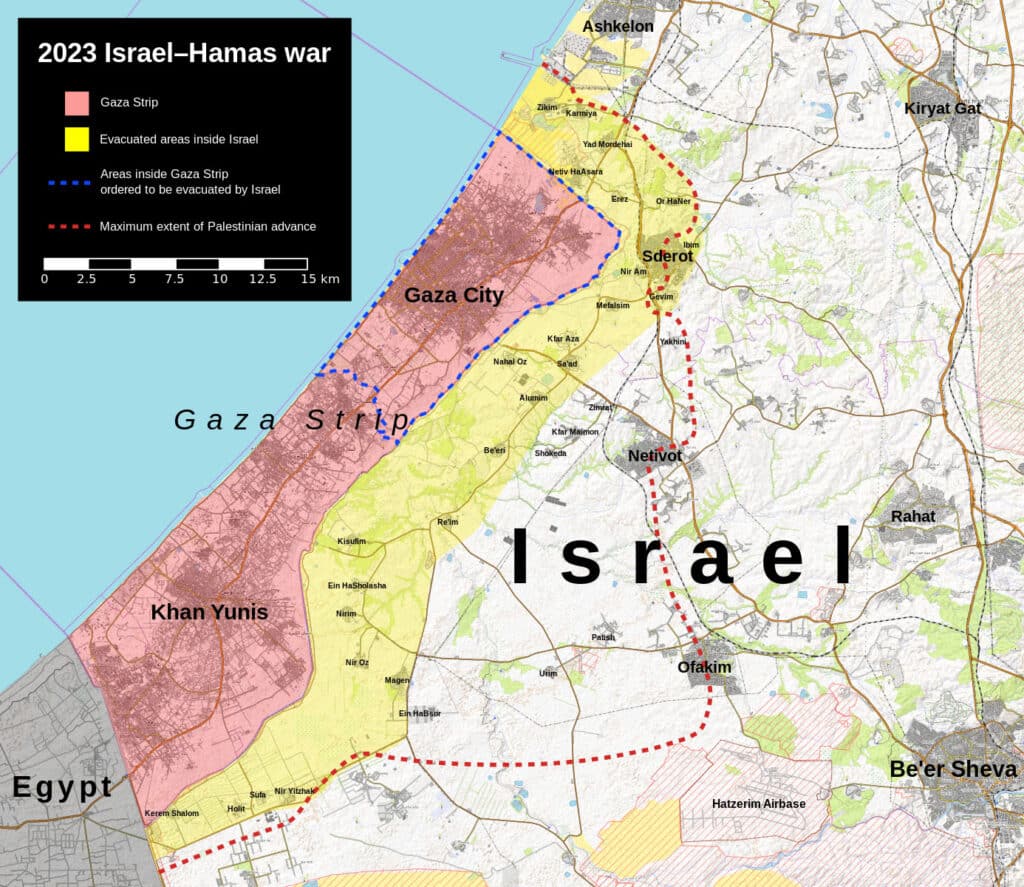
On October 7, Israelis woke up to their worst nightmare and faced a massive terror attack that Hamas had launched against the Jewish state. As a result, entire communities were ravaged. 

Aside from the over 2,200 rockets fired from Gaza into Israel that day, which targeted civilians in southern and central Israel, at 6:30 am, thousands of heavily armed terrorists from Hamas and other organizations tore down large parts of the Gaza security fence and infiltrated into Israeli territory. Their goal was to indiscriminately kill, rape, torture, massacre, and kidnap as many Israelis as they could. Currently, the Israeli death toll stands at 1,400.

Naturally, the Israeli communities in the Gaza envelope received the greatest hit and suffered unimaginable losses. During the assault, Hamas terrorists, who crossed the border via land, sea, and air, attacked dozens of communities and managed to take over 10 of them while murdering, torturing, and kidnapping any of its citizens that came into sight.

Simultaneously, the terror organization’s gunmen sieged a large music festival, the Nova Festival, with over 3,000 attendees, which was being held on the outskirts of one of the Israeli border towns, Kibbutz Reim. Terrifying stories of violence were reported by the survivors of this massacre in which at least 260 youngsters who had gathered to enjoy music, tragically lost their lives. Dozens of others were kidnapped from this festival and taken into Gaza, where they are still being held by Hamas.

Most of the Israeli communities that were attacked were kibbutzim and agricultural towns, many with only a few hundred people living in each. What characterizes these traditionally collective towns is the sense of community and importance attributed to human values.

Following the terror attack and with the eruption of the resultant war, about 60,000 people were evacuated from the Gaza envelope towns, which are now under heavy rocket fire and have become a closed military area until further notice.

Note: The following report shows the figures according to the data available as of October 23. The Israeli authorities are still scanning the area, dissecting what took place, finding additional bodies, and making efforts to identify them. The data will be updated as it becomes available. As mentioned, to date, the death toll stands at 1,400 people, and the Israeli government has notified the families of the 222 kidnapped. Hundreds are still missing, and their whereabouts are unknown.

Kibbutz Be’eri

This kibbutz is the biggest in its regional council with about 1,200 citizens. It is located less than 3 miles from the border with the Gaza Strip. Over 100 Hamas gunmen entered the kibbutz on Saturday morning, claiming the lives of at least 130 of the Be’eri residents, more than 10% of its population. The terrorists took over this kibbutz by forcing 50 of its residents into the communal dining room, where they were kept as hostages during the battle against Israeli security forces that persisted for over 18 hours. The kibbutz is totally destroyed, with most of its houses burned and torn down.

Kibbutz Kfar Aza

Kfar Aza is also an agricultural community with at least 800 residents. It lies about one mile away from the Gaza border. The dozens of heavily armed terrorists who intruded into this community murdered at least 70 of its citizens. Kfar Aza was the site that the foreign press was able to visit before the Israeli rescue team had concluded clearing the bodies. The reporters’ testimonies from here are heart-wrenching.

Kibbutz Nir Oz

This small community with a population of 400 people was one of the most affected by the terrorist attack. Nearly half of its population was killed, kidnapped, or are currently missing. According to The New York Times, 180 of its citizens were killed, and there are about 80 abducted. This was the home of the youngest child kidnapped by Hamas, a 9-month-old baby named Kfir Bibas, who was taken hostage with other five members of his family. Nir Oz is completely devastated; the houses were all burned and torn down.

Sderot

Sderot is one of the largest cities in the Gaza envelope area. It is located less than a mile from the border of the Gaza Strip and is home to a little over 30,000 people. Over 30 people were killed, and now 60% of the city’s residents have evacuated their homes and have moved to government-sponsored housing in other areas of the country.

Ofakim

This is a small city of about 36,000 residents, and it lies about 14 miles from the border with Gaza. On October 7, terrorists also reached this city and murdered at least 50 residents. During the assault, the terrorists took civilians hostages in their own homes.

Kibbutz Nahal Oz

This is a small farming community with some 450 residents of whom at least 35 of them are reported to have been murdered.

Kibbutz Kissufim

Kissufim has nearly 300 citizens. During the October 7 assaults, at least 16 people were murdered. Among the murdered were six foreign workers.

Kibbutz Reim

This is the closest community to the Nova Music Festival, which was attacked by the terrorists. Of the close to 400 kibbutz residents, five are reported to have been murdered, and another five were kidnapped by Hamas.

Kibbutz Nir Yitzhak

In this village of close to 650 people, four were killed and dozens are still missing.

Kibbutz Alumim

Alumim is a religious farming community of about 500 people. During the Hamas terror attack, over 20 farm workers from Thailand were murdered.

Additional affected towns

The kibbutz communities of Nirim, Nir Am, Ein HaShlosha, Sufa, Erez, Magen, Kerem Shalom, and Shlomit were also invaded by Hamas terrorists, leaving fatal casualties in all of them.

To read more articles from The Media Line, click here.

Gaza Envelope Mapped Read More »