fbpx

September 14, 2023

LAUSD Students Share Experiences of Antisemitism in ICAN Webinar

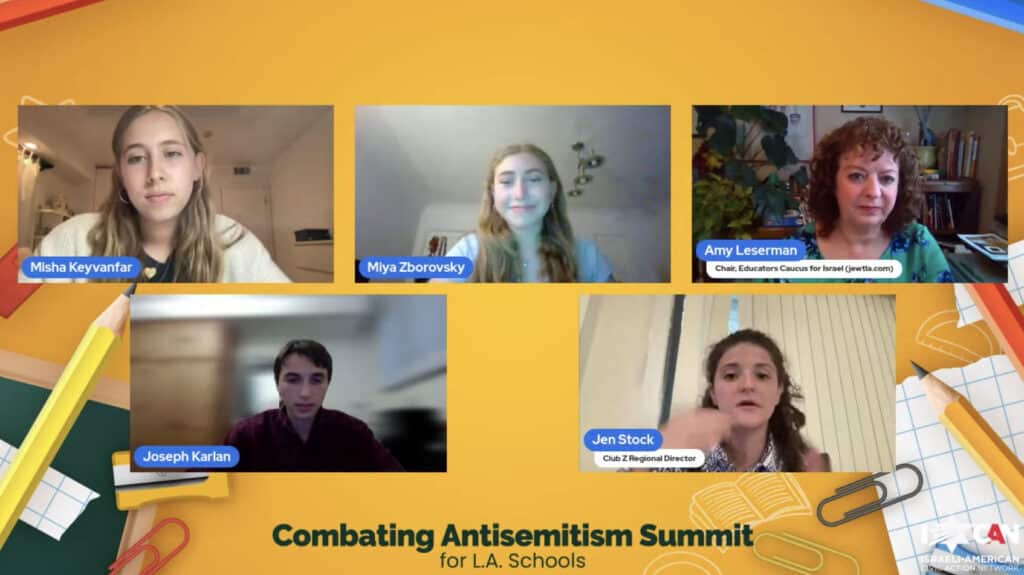
Various students in the Los Angeles Unified School District (LAUSD) shared their experiences of dealing with antisemitism in the district during an Israeli-American Civic Action Network (ICAN) webinar on Monday that featured two school board members.

The Student Hearing on Antisemitism in Los Angeles Schools webinar was part of ICAN’s Combating Antisemitism Summit and was done in collaboration with Club Z––which facilitated the students’ testimonies––as well as Educators for Israel and other organizations. The first student to provide testimony was Misha Keyvanfar, a sophomore at Palisades Charter High School, where she serves as the president of external affairs of the school’s Students Supporting Israel (SSI) chapter and president of the school’s Jewish Student Coalition. Keyvanfar recounted how, as a sixth grader, she saw a swastika drawn in the school bathroom and the following year, one of her classmates “insulted and belittled Jews as a whole” and called her “a yucky Jew.” “His voice was not alone,” Keyvanfar said. “In fact, it was amplified and multiplied throughout my LAUSD middle school and later high school years.”

So far in her high school career, Keyvanfar says that her best friend “was told to go back to the gas chambers” and a student asked Keyvanfar “if [she] liked showers.” Additionally, when “I Heart Israel” pins were being handed out on a campus club day, a student took a video of himself “aggressively stomping” on the pin; the video was posted with Arabic music that translated to “Kill the Jews,” Keyvanfar claimed. Other students shouted “F— the Jews” while doing Nazi salutes to a Jewish club, she alleged.

Keyvanfar also claims to have had dealt with antisemitism from school staff members, as one staff member from her high school allegedly said during a math class that “Kanye was right,” referencing rapper Kanye West’s antisemitic rants last year. In a sociology class, she had a teacher who taught about the world’s largest religions but “didn’t know anything” about Jews and didn’t care enough to do the research, so the teacher suggested that Keyvanfar should teach the class about Judaism, Keyvanfar claims.

But Keyvanfar says her school has taken positive action, as they required all staff to visit the Holocaust Remembrance Museum. “I wish for the New Year that we can come together to stop hatred against Jews as well as all other people in our school and beyond,” she added.

Joseph Karlan, a recent graduate from the same high school and a current student at UC Berkeley, claimed that a teacher prevented the school’s Jewish Student Union from participating in a program he was running because “Jews don’t experience discrimination in America.” Karlan also said he had teachers who ranted “about why they think Jews are always rich and successful doctors and lawyers” and even had one teacher who lauded Kanye West after the rapper praised Hitler. Karlan recounted one teacher who asked the class what the Jewish homeland is, and then said: “God help you if you f—ing say Israel, that’s only 80 years old.” When Karlan said the Jewish homeland is Judea, the teacher snapped at him, “Where the f— is Judea, Joey?” Karlan explained that Judea is where Israel is today, but the teacher rebuffed him. “That’s right, there hasn’t f—ing been one,” Karlan claimed she said.

Additionally, Karlan, who was co-president of the school’s SSI chapter, said that his club had “its material stolen or publicly defaced on campus.” Karlan also recalled an incident in which one student told another that he was “dripping Israel,” and the offending student said he meant that he was calling the other student a “dirty Jew.” Karlan claimed that the incident was reported to the school, but the offending student graduated without suffering any apparent consequences.

“Today, teachers and students think that they can target Israel all they want without repercussions since Israel is just some small country halfway across the globe,” Karlan said. “Well let me ask them: if Israel is really some small insignificant country, why is that teachers feel the need to bring it up when it is entirely irrelevant to class material? If some teachers insist that their gripes with Israel really have no connection to the Jews, then why do they ask their Jewish students in the room to respond when they delegitimize Israel? That’s because the rhetoric has changed but the antisemitism has not. It’s now teachers and students hating Israel instead of Jews.”

Karlan argued that the remedy for Jew-hatred is education, pointing out that he and other students met with the teacher who barred the Jewish Student Union from his program and together they educated the teacher, prompting the teacher to reverse course and later apologized for initially barring the club. Karlan said that the teacher also “thanked [him] for caring so much for my people.” Additionally, the Jewish student leaders at Karlan’s former high school hosted weekly educational sessions about the Jewish people and Israel, featuring various speakers including rabbis and Holocaust survivors. “In my high school, my Jewish peers know how to identify antisemitism and why it is wrong,” Karlan said. “But still, many of them grow tired of defending themselves since their teachers and administrators won’t listen to them. They feel hopeless.”

Karlen told LAUSD board members and school administrators that “we need your help fighting antisemitism in all its forms” and urged LAUSD to adopt the International Holocaust Remembrance Alliance (IHRA) definition of antisemitism. “Adoption of IHRA would show Jewish students that LAUSD stands with them and condemns antisemitism no matter how it manifests,” he argued.

The final student testimony was from Miya Zborovsky, a junior at the Los Angeles Center for Enriched Studies (LACES). Zborovsky, who serves as the vice president of her school’s Jewish Student Union, is the daughter of immigrants who fled antisemitism from the Soviet Union. Zborovsky explained that when she was in 8th grade during quarantine in the COVID-19 pandemic, her friends made antisemitic comments toward her because they believed that “I, a Jew, do not deserve a homeland.” Zborovsky also said that until the May 2021 Israel-Hamas conflict occurred, she never felt a need to post absolutely anything on social media until the rockets started flying” and she needed to address “misinformation” on social media about the conflict. Zborovsky recalled a friend of hers asking her for information about the conflict, who then proceeded to call Zborovsky “a colonizer and a pig who is not empathizing with Palestinian children who are being murdered on a daily basis.” Zborovsky said she attempted to persuade her friend that Hamas is to blame, but claims her friend didn’t want to listen.

“Based on the experiences of my friends, I realized that my experiences were not unique,” Zborovsky said.

She called for LAUSD “to be a safe space for all students” and urged the district to adopt IHRA, arguing that the district needs to teach that Jews are from Judea and that anti-Zionism is antisemitism. “We need to be able to foster conversations that stem from nonbiased education and empathy,” Zborovsky said.

Two LAUSD school board members, Nick Melvoin and Scott Schmerelson, listened to the students’ testimonies on the webinar. Melvoin called the testimonies “incredibly powerful” and “really hard to hear.” “When I was in high school despite experiencing some of this, I didn’t have the courage or the voice that you did,” he said. Melvoin pointed out that hate has been amplified on social media and asked the students how schools can help on this issue. The students replied that teachers need to be educated to inoculate themselves and their students from hate on social media.

Schmerelson told the students that there’s a “saying in LAUSD: if it’s not written down it didn’t happen” and that there are Incident System Tracking Accountability Reports (iSTARs) that can be filed when these incidents happen. “You will be surprised how quickly these things will stop happening because no one wants to be reported,” Schmerelson said. Keyvanfar replied that she has met with counselors and administrators about the antisemitic incidents she’s experienced and “they claim they’re having a meeting and discussing a punishment, and no punishment ever really comes through.” Zborovsky chimed in that she didn’t know that iSTAR existed until Schmerelson mentioned it, but that she has had experiences similar to Keyvanfar’s. Keyvanfar added that the iSTAR system hasn’t been “broadcasted to everyone.” Melvoin said that the feedback from the students has been helpful and pointed out that a new anonymous incident reporting app is available. He argued that when the reporting system “breaks down” it’s all on the victims to report incidents of hate, so there needs to be better training for teachers and staff on the matter. Karlan acknowledged the importance of iSTARs, but argued that the goal is to stop antisemitic incidents from happening altogether so there isn’t need to file an iSTAR in the first place.

Schmerelson said he was “personally hurt” to hear the various antisemitic incidents experienced by students and that he plans to follow up with the schools in his district (Schmerelson represents District 3, which covers various parts of the San Fernando Valley) and make these incidents “stop and it’s going to be reported.” “Principals who don’t report are going to be in big trouble too,” Schmerelson added.

Other speakers on the webinar included Educators Caucus for Israel Chair Amy Leserman, Kenter Canyon Elementary Charter School Principal Dr. Irina Sugar, Consul for Public Diplomacy at the Consulate General of Los Angeles Carmel Halevy and United Teachers Los Angeles Valley East Area Chair Scott Mandel. LAUSD School Board Member Kelly Gonez also gave a brief video message. ICAN CEO Dillon Hosier moderated the discussion.

LAUSD Students Share Experiences of Antisemitism in ICAN Webinar Read More »

Print Issue: This Is Not the End of the Synagogue | Sep 15, 2023

CLICK HERE FOR FULLSCREEN VERSION

Print Issue: This Is Not the End of the Synagogue | Sep 15, 2023 Read More »

Resilience Amidst the Ruins: A Valley Endures

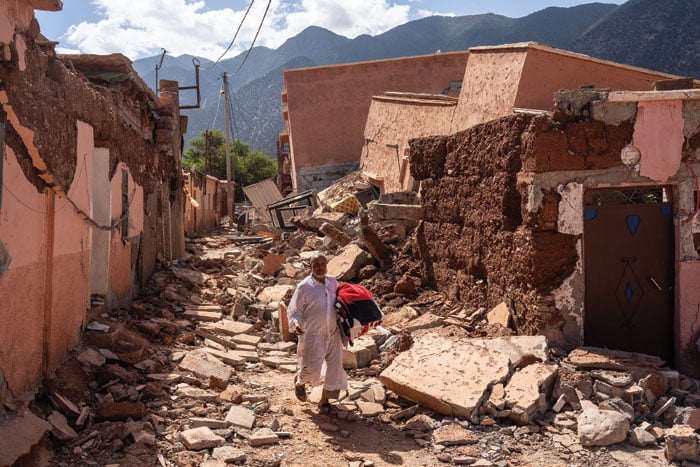
In the wake of the tragic, magnitude-6.8 Adassil earthquake in Morocco that killed more than 2,100 people, media attention has largely focused on the devastation in the old city of Marrakesh, one of Morocco’s four imperial capitals and a popular tourism destination.  But the epicenter of the quake lay to the east of this red-walled city, in the High-Atlas Mountains.  Death and destruction in and around the southern and northern slopes of these mountains and their numerous village communities—throughout the provinces of Taroudant, Chichaoua, Haouz, Ouarzazate and Marrakesh—was on a far greater scale than in the neighboring city of Marrakesh.  This is so not only because these rural regions were situated squarely on the quake’s fault line, but because Morocco’s infrastructure-building projects, especially roads, have largely passed them by.

Like many countries throughout the Mediterranean, Morocco is prone to earthquakes. In the northern Rif region near the Mediterranean Sea, earthquakes are a regular occurrence, including major quakes in February, 2004 and January, 2016. The oldest recorded and most devastating earthquakes occurred in Fez (in 1522 and 1624), Meknes (in 1755) and Tetouan (in 1909). The 1755 quake in Meknes killed thousands, destroyed the city, damaged the Roman site of Volubilis, and shook nearby Moulay Idris Zerhoun. 

Since Morocco became an independent state in 1956, the single most tragic earthquake was in 1960, in the coastal city of Agadir. The devastation occurred during the month of Ramadan, killed thousands of Moroccans, both Jews and Muslims and leveled the city.

At this time of crisis, we should honor the High Atlas Mountains’ culture and communities, and let its residents guide the rebuilding of their communities.

The culturally rich communities of the High Atlas Mountains exist in economies that are largely local, notwithstanding a rise of tourism in the region.  National and international tourists flock today to the High Atlas Mountains for its natural beauty.  There are towering heights, green valleys, winding rivers.  The region’s cultural beauty is also immensely rich.  This mountain zone is majority Amazigh [Berber], but also historically inhabited by other Muslims and Jews.  In the High Atlas Mountains, village-based, local economies support small communities of people who are in certain respects cut off from Morocco’s cosmopolitan urban centers and modern infrastructure networks.

As villagers await the state’s help, young and old residents are travelling from village to village, digging out rubble in search of the living and the dead.  

The seeming remoteness of the mountains, along with their majestic landscape, have long drawn Western tourists seeking serenity, natural beauty, and adventure.  European painters trekked these mountains to produce paintings that are today sold for millions of dollars.  “Mission Impossible, Rogue Nation” (2015) was filmed here. That film used the Atlas’ switchbacks as dramatic backdrop for a heart-thumping car chase. These same roads are largely destroyed by the recent earthquake. As villagers await the state’s help, young and old residents are travelling from village to village, digging out rubble in search of the living and the dead.  

One of our children’s favorite places to stay in Morocco is a hotel near the town of Ouirgane called Chez Momo. Surrounded by orchards of pomegranates and fields of olive trees, the hotel was originally built by Nfis River, until the government dammed that waterway to provide drinkable water for the Marrakesh Region.  Chez Momo then moved to a new location overlooking the reservoir. The owner, Mohamed, a local from the area, employs graduates of nearby University of Cadi Ayyad Marrakesh to staff his beautiful retreat.  We have kept in touch with Mohamed over the years and send friends and family to his gracious retreat. After the earthquake we reached out to him, only to learn that his employees lost relatives in the quake and that the hotel itself was badly damaged.

The villages of the High Atlas Mountains, including Ouirgane, Tnirte, and Talat n’ Yacoub, were at the epicenter of the earthquake of September 8, 2023.  The violent quake destroyed homes, killed entire families and, in cases, leveled entire villages. Homes there are made of simple earthen walls, and have been built without regard for national safety standards.  This is true partly because the Atlas Mountains have always existed as a semi-autonomous zone.  

Centuries of volcanic activity have sculpted the stunning geographical features that make up the landscape of the High Atlas Mountains, as have centuries of local culture.  Nestled below or overlooking traditional tribal or dynastic centers of power in the High Atlas Mountains, villages and hamlets dot the hills overlooking the Nfis and Tasaft Rivers. For centuries these hamlets (including Ouirgane, Adassil, Talat n’Yacoub, Tnirte, and Tafingoulte) have witnessed the rise and fall of the various dynasties and empires that ruled over North Africa and the Iberian Peninsula. This very valley is where Ibn Tumart established his mosque, Tin Mal, in the 12th century. From this historic site, the Almohad Caliphate gained power and wrested Marrakech from the Almoravid Dynasty in 1152. 

From the 10th century to at least the 17th century, the High Atlas Mountain trails served as a vital passage for Saharan caravans, which traveled from the Souss region in sub-Saharan Africa to coastal cities like Marrakech, ferrying coveted goods like gold, salt, beads, and shells—and even allowing for the spread of Islam. 

It was here, in the 19th century, that the Goundafa and Glaoua tribes engaged in fierce competition for power and tribal leadership.  Their struggle reflected Morocco’s own negotiation with the rising force of the French Empire, and with European imperialism writ large. 

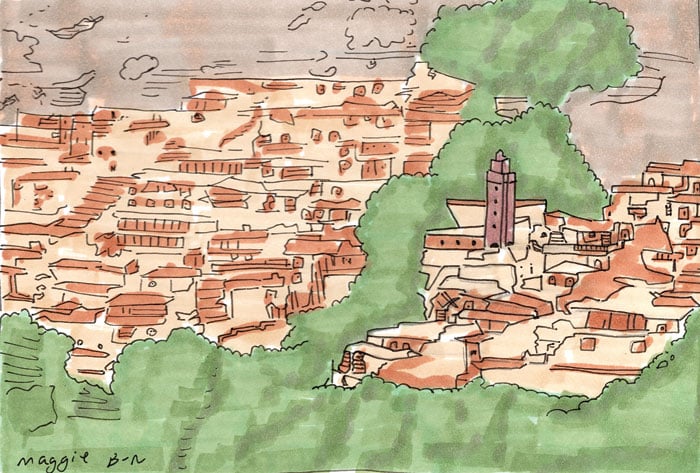
Illustrated by Majdouline Boum-Mendoza

The French protectorate that ruled Morocco from 1912 to 1956 completed a winding road through the High Atlas Mountains in 1929.  The absence of wide-scale passage through these mountains had safeguarded Amazigh independence for generations.  The French built its only road, connecting Marrakesh to Taroudant, with local labor, who worked under arduous conditions, for little or no pay.  It was a remarkable feat of civil engineering, and an expression of cultural dominance, too.  Yet despite the fact that the High Atlas Mountains can be more easily passed today, its villages remained cut off from the urban seats of power in Marrakesh.  

Jews were always a minority in this region, with Muslim Amazigh the majority.  Slowly, this population has adopted Arabized culture.  Today, local Amazigh families continue subsistence farming on mountain-side terraces painstakingly built and maintained over decades.  But their communities have also shifted to a touristic economy, embracing gastronomy, culture, and religious pilgrimage as a source of income.  

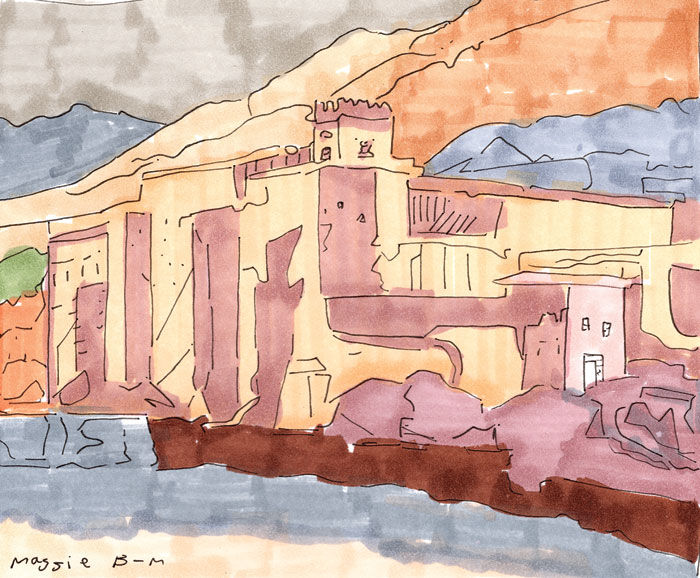
Some of this cultural tourism is propped up by Sir Richard Branson, the owner of Virgin Atlantic Airways, who acquired land in Kabah Tamdot in 1998 and built a lavish hotel there.  Branson uses a portion of his vast resources to support nearby communities, establishing carpet and craft workshops operated by locals. 

Illustrated by Majdouline Boum-Mendoza

Religious pilgrimage, too, boost the Atlas communities.  Though most of the Jewish residents of this region left by the 1960s for new homes, today, Jewish pilgrims from around the world flock to the mountain town of Ouirgane and other communities during Lag Ba’Omer, a Jewish holiday celebrated in the Hebrew month of Iyar.  They come by car and bus (on the last, vertiginous stretch) donkey to pray at the shrines of Jewish saints like Rabbi Haim Ben Diwan, son of the famous Rabbi Amram ben Diwan.

At this moment of crisis, the global community ought to mourn with this region, but also honor its history, culture, and future.  

As earthquakes radically reshape the geography, economy, and demography of the High Atlas Mountains, Amazigh and Arab communities will endure because of their local knowledge and their region’s spirit and resilience.  At this moment of crisis, the global community ought to mourn with this region, but also honor its history, culture, and future.  Morocco should invest in the infrastructure of the High Atlas Mountains responsibly, with an eye towards preserving its culture and fortifying local communities, traditions, and economies. 

The crisis in Morocco is in this way an opportunity.  If properly managed by locals, state actors, and conscientious visitors, a resilient local economy and responsible ecotourism can be built without forsaking highly localized economic or cultural identities.  

For centuries, independence and self-reliance have been sources of pride and endurance for the remote communities of the High Atlas Mountains. They have helped rural children, women, and men to survive the ebb and flow of dynasties, empires, and states, to weather global economic crises, even to survive the COVID-19 pandemic.  This resilience, paired with thoughtful infrastructure will help the communities of the High Atlas Mountains persevere through ruin.

To support Moroccan earthquake victims: GoFundMe organized byAomar Boum and Brahim El Guabligofundme.com/f/psjn9p-morocco-earthquake-relief


Aomar Boum is Professor and Maurice Amado Chair in Sephardic Studies in the Department of Anthropology at the University of California, Los Angeles.

Sarah Abrevaya Stein is Sady and Ludwig Kahn Director of the Alan D. Leve Center for Jewish Studies, and Viterbi Family Chair in Mediterranean Jewish Studies at UCLA.  

Majdouline Boum-Mendoza, who illustrated the images in this article, is starting her 8 grade at Brentwood School, Los Angeles.

Resilience Amidst the Ruins: A Valley Endures Read More »

Moroccan King Who Protected Jews from Nazis Recognized by Museum of Tolerance Jerusalem

No one had any idea that an earthquake would hit Morocco shortly after a memorable ceremony to honor the monarchy of Morocco on September 7th at the Museum of Tolerance Jerusalem (MOTJ). So the ceremony only featured solidarity and dignity.

André Azoulay, a Jewish advisor to King Mohammad VI of Morocco, received the The Torch of Abraham in the evening ceremony for his work in “the integration of tolerance among nations, Jerusalem to Rabat, Israel to Morocco.”

During his more than 30 years in diplomatic service in Morocco, Azoulay has been influential in creating interfaith dialogue between the country’s Jewish and Muslim communities. Azoulay oversees the preservation of Jewish heritage sites in Morocco, speaks at interfaith events such as the Muslim-Jewish Interfaith Coalition’s Conference and helped establish the historical and cultural center Bayt Dakira in 2020. Arabic for “House of Memory,” Bayt Dakira is a place to celebrate Jewish heritage in Morocco. Built around a synagogue, it’s located in Azoulay’s hometown of Essaouira, a coastal Moroccan port city which was once a thriving Jewish community until the 1950s.

“Every day, hundreds of visitors, hundreds of Moroccan children, students — Muslims, largely — they are sitting in the synagogue every weekend by the hundreds,” Azoulay said. “It’s more than emotion. It’s just a feeling that finally, it exists. And it’s easy to do so in so many places. And it’s a very, very marginal investment. But the return on this investment is so high.” 

Every fall since 2003, Azoulay also organizes the Atlantic Andalusia Festival which draws an interfaith crowd celebrating dance, music, food and arts from Jewish and Muslim communities from around the Mediterranean region. 

“You have thousands of Muslims coming from Morocco and from all over the world, thousands of Jews coming from Morocco, Israel, and from gathering to just enjoy being together,” Azoulay told the crowd at MOTJ. “Just tell me if anyone in the room could tell me if there is another country, another city, another place, whereby today you can have thousands of Jews and thousands of Muslim singing together, dancing together, I would say maybe kissing each other, but my wife don’t want me to say that. But in fact it’s a unique moment. And I invite all of you to come.”

Azoulay also spoke in his acceptance speech about the Israel-Palestinian conflict. 

“We have said very clearly that having a normal relation with the State of Israel is something which is a deep desire of Morocco to implement, to make it that as deep as possible, durable as possible. But it was also clearly said by His Majesty to pave the way for peace, Azoulay said. “Because we Moroccan Jews, we do care for the future of the children of Israel to be secure tomorrow, to be safe and to enjoy a normal life tomorrow. We do care also for the children of Palestine, for their future to enjoy safety, security, and to have a normal life. And I still consider after such a long journey for peace all along my life, challenges …that there is no plan B for the safety and the security of children of Israel tomorrow than peace with Palestinians, and there is no plan B for the Palestinians tomorrow for their children to be safe, to be secure, to have a different future than their parents, than having peace with Israel, living side by side.”

Azoulay was born to a Jewish family in Essaouira in 1941 and raised in Paris. He has been an advisor to the Monarchy since 1991, during the reign of King Hassan II, father of Mohammad VI.  On Tuesday, Azoulay received the Israeli Presidential Medal of Honor for 2023.

Rabbi Marvin Hier, who founded the Museum of Tolerance in Los Angeles in 1993, spoke about what the king’s grandfather, King Mohammad V, did to protect the Jews of Morocco during World War II. 

Rabbi Marvin Hier, who founded the Museum of Tolerance in Los Angeles in 1993, spoke about what the king’s grandfather, King Mohammad V, did to protect the Jews of Morocco during World War II. 

Rabbi Hier read from a letter sent by Israeli President Isaac Herzog in December 2022 to Mohammad VI, lauding his country for normalizing relations with Israel and praising the King for what his grandfather did for the Jews during his first reign over 60 years ago.  

“President Herzog wrote, “when millions of Jews faced the horrors of the Holocaust in the 20th century, King Mohammad V did everything in his power to protect them,’” Hier said to the audience. “‘Moroccan Jews recalled with pride, the affection, the memory of your grandfather, King Mohammad V, who was a brave protector and guardian of the Jews. However, it was during your rule, Your Majesty, after the Holocaust, that Jewish life in Morocco flourished when Jewish communal institutions, synagogues and cemeteries were renovated. And the Holocaust denial was absolutely denounced where you, Your Majesty played a critical role in building the foundations for peace, which our futures now depend upon.” 

Rabbi Hier read more from the letter, which highlighted that King Mohammad V insisted that Jewish property in Morocco, unlike Jewish property in neighboring Algeria, was never confiscated. The letter Hier read, also noted that even Pope Pius XI “sat on the throne of St. Peter in stony silence as trains crisscrossed Europe carrying millions of unsuspecting visitors, victims, Jews and non-Jews to the concentration camps and the gas chamber. Even though the Pope was one of the most informed leaders of what was happening in Europe, he never mustered the courage to publicly condemn Hitler like Muhammad V did in Morocco.” 

Mohammad V was born in 1909 in Fez, Morocco. His first reign was from 1927-1953, and then from 1955 until his death in 1961. His son and successor, King Hassan II, sought the consul of Azoulay beginning in 1991. When King Hassan II died in 1999, his son, King Mohammad VI took the throne.

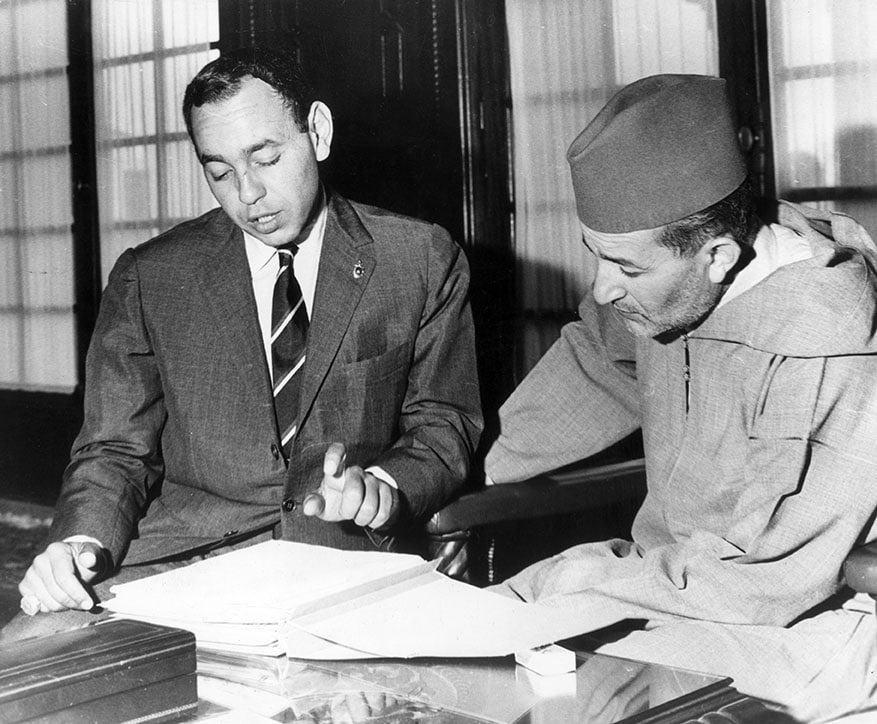
King Mohammed of Morocco sits with his son, the Crown Prince Moulay Hassan (Photo by Keystone/Getty Images)

Also speaking at the event were pairs of Jewish and Muslim officials who shared the podium together, taking turns speaking. They were Rabbi Shlomo Moshe Amar (Chief Rabbi of Jerusalem) and Imam Mohammed Amine Smaili (Professor Emeritus at Mohammed V University). Another pair that spoke was Avraham Elharar (Chairman of the Canadian Sephardi Organization) and Farid El Bacha (Acting President of Mohammed V University Rabat). There were also remarks by Jonathan Riss (Director of Operations, MOTJ) and Aaron Leibowitz (CEO, Sylvan Adams Family Foundation Israel), and a musical performance by Israeli musician Lior Elmaliach. The event was also attended by Australian philanthropist, business leader and Zionist activist Albert Dadon, who was born in Morocco and helped conceive the event.  

Morocco signed on to the Abraham Accords in 2020, which has led to a major increase in tourists from Israel as well as cooperation on many levels between the two countries.

Moroccan King Who Protected Jews from Nazis Recognized by Museum of Tolerance Jerusalem Read More »

The Road to Improvement

I’m a perfectionist, and part of being a perfectionist means that I set up lofty goals for myself that are often unattainable. And when I “fail,” I feel bad about myself. 

Here’s a recent example: I’ve been trying to wake up at 6:30 every morning to get on the treadmill and work out for 30 minutes. Sometimes I get to do it, and sometimes I don’t. If I go to bed too late, I hit “snooze” on my alarm. If my kids wake me up multiple times throughout the night, I’m too much of a zombie to get up at that time. Sometimes when I’m only a few minutes into my workout, my youngest will start crying and I’ll have to stop. 

Instead of being rational and saying, “life happens,” I put myself down for not getting up early enough to complete my workout or doing it later in the day, even though I have absolutely no time otherwise. I judge myself and talk to myself harshly. I say, “Kylie, you’re a failure.”

Going into the New Year, I’m working on not being perfect and creating unrealistic standards for myself. I’m working on saying that it’s OK to “mess up,” as long as I never stop striving to be better. If I’m trending in the right direction, that’s what matters.

During Rosh Hashanah and Yom Kippur, we are supposed to be introspective and find things about ourselves that we can work on. You are never supposed to say, “Everything about me is perfect, and there is nothing I need to change.” Everybody can improve in some way. There’s nothing wrong with being imperfect, but there is something wrong with giving up.

When we are doing teshuva, repentance, during the High Holy Days, Hashem doesn’t want us to say to ourselves, “I am terrible. I am beyond flawed, and I am not fixable.” When you do that, you’re not approaching self-improvement from a place of love. Even so-called “tough love” isn’t healthy. What leads to meaningful change is saying, “I am mostly good, but there are things I need to work on. I have a beautiful soul, and it’s time to reconnect with it.”

The truth is that there is no such thing as perfect. Sure, if I got up early and did find time to work out, this means I might lose out on sleep and be tired throughout the day. Or if I did get to bed early, I wouldn’t get to spend as much time with my husband, or my house might be dirty, or I wouldn’t be able to read a book before bed. Nothing would ever be perfect. 

Imperfection appears multiple times throughout the Torah. There’s a theory that the Torah starts with the letter “Bet” and not “Alef” because Hashem may have created a world prior to this one and decided to start over again. Hashem’s first two human creations, Adam and Chava, sinned on the first day they were in this world. The great matriarchs, patriarchs, prophets and leaders all had issues they needed to address. 

Having flaws and then overcoming them is a virtue. Coming from a low place and ascending to a higher one is much more commendable than being born perfect and never having to work on anything. 

This New Year, we can look to the 613 commandments found in the Torah to figure out how to better ourselves. And, we can rely on Hashem’s love to get us through whatever challenges we are facing.

During the High Holy Days and beyond, I’m focusing on improvement, not perfection, and I encourage you to do the same. If you come across roadblocks along the way, don’t let them stop you.  

During the High Holy Days and beyond, I’m focusing on improvement, not perfection, and I encourage you to do the same. If you come across roadblocks along the way, don’t let them stop you. Pray to Hashem to give you the strength to continue, and always strive for better. 

Do you have thoughts on perfectionism? Email me: Kylieol@JewishJournal.com.


Kylie Ora Lobell is the Community Editor of the Jewish Journal.

The Road to Improvement Read More »

Beyond the Victim Mentality

For many centuries and in many lands, Jews have been victims. Even now, when most Jews live in democratic countries where we enjoy equal rights, we still fret about antisemitism. The Jewish defense organizations constantly remind us of the increase in anti-Jewish propaganda on social media, of anti-Jewish and anti-Israel demonstrations, of physical attacks against Jews.

Although for the most part we feel safe and free, the “victim mentality” still haunts us.

The Jewish community has spent many millions of dollars to create Holocaust museums and memorials. It is praiseworthy and important to provide Holocaust education. But the downside is that we devote massive resources to emphasizing our victimhood. We like to think that the general public will feel more sympathy with us. And in many cases this may be correct.

But unless handled very well, Holocaust education can work against us. Unsympathetic people, not to mention outright antisemites, may view the Holocaust as an example of how Jews were slaughtered by the millions while the world did very little to stop the carnage. In a warped mindset, the Holocaust demonstrates that it’s okay to attack Jews. Even worse, the Jewish victims are blamed for having deserved to be massacred.

In the United States, Jewish spokespeople emphasize that Jews are perhaps 2% of the population but are victims of over 50% of hate crimes. The expectation is that people will be morally outraged to hear this information. Yet, neutral or unsympathetic people may draw another conclusion. If so many people are attacking Jews, it’s ok for us to do so also. Jews must deserve this treatment, otherwise why would they be singled out for so much antagonism?

We cannot ignore anti-Jewish and anti-Israel activity. We must do our best to defeat the haters.

But we need to get beyond the “victim mentality.” We need to do far more to foster a positive, confident and courageous Jewish people. We need to publicize and promote philo-Semitism. After all, vast numbers of non-Jews feel warmly about Jews, and are appreciative of the amazing contributions of Jews to education, science, medicine, law, the arts, social justice, government, literature etc. Many millions of Americans vote for and elect Jewish candidates to a wide range of offices. American Jews have exemplified the best aspects of the American dream. We are a hard-working, highly educated and socially responsible group.

While it is important to publicize anti-Jewish behaviors, we need to do far more to foster a positive, confident and courageous Jewish people. 

While it is important to publicize anti-Jewish behaviors, it is also important — even more important — to publicize philo-Jewish behaviors. Jewish defense organizations send out frequent press releases on antisemitic acts. They should be sending out (at least) an equal number of press releases highlighting philo-Semitic acts, calling attention to positive interactions between Jews and non-Jews. In order to offset bad trends, we need to encourage good trends.

When it comes to Israel, we are barraged by news about anti-Israel activity in colleges. The BDS movement receives an inordinate amount of news coverage, as do politicians who voice anti-Israel animus. We need a barrage of news about all the goodwill shown by millions of people toward Israel. The general public needs to know how much good Israel does, how its technology improves all our lives, how its agricultural advances help nations in Africa and Asia, how it promotes culture, the arts etc. Instead of always seeming to be on the defensive, we ought to confidently let the world know of the incredible achievements of the tiny State of Israel and how it has managed to become a world leader in so many fields. This can be done in a sensitive and thoughtful way, without bragging and without undue self-congratulations.

Our Jewish organizations and each individual Jew can play a role in overcoming the “victim mentality.” While fighting against all forms of antisemitism and anti-Zionism, we also need to project a positive and confident self-image. Opinion leaders — Jewish and non-Jewish — can mobilize to move society in a positive and respectful direction.

The “victim mentality” reinforces our victimhood. Let’s look beyond this; let’s develop a positive, confident mentality. We can do this … and it will make a vast difference for the better.


Rabbi Marc D. Angel is Director of the Institute for Jewish Ideas and Ideals, jewishideas.org

Beyond the Victim Mentality Read More »

Netzah Yehuda Battalion Honored at FIDF Event

On Sunday, Aug. 27, Friends of the Israel Defense Forces (FIDF) joined over 130 community members at the Nahal Haredi Reception honoring Haradi soldiers and the Netzah Yehuda Battalion.  

“The biennial FIDF fundraiser for Nahal Haredi holds immense significance within the Los Angeles community,” Jenna Griffin, executive director of FIDF, western region Los Angeles, told the Journal. “Nahal Haredi allows these soldiers to serve in the army while respecting their religious observance, and the funds raised at the event serve as a crucial source of support to address the unique challenges these soldiers face.” 

Hosted by Debbie and Naty Saidoff and led by FIDF Chairman Emeritus Peter Weintraub, the event honored FIDF Western Region Founder Leo David for his visionary leadership and decades of support for Israel’s soldiers.

“This occasion not only exemplifies our unwavering commitment to these dedicated defenders of Israel but also stands as a living testament to the visionary foundation laid by Leo David,” Griffin said. “Through his indomitable spirit and dedication, our chapter stands strong, united by a shared purpose: to stand by those who stand for us.”

David Hager, national and local FIDF board member, was granted the President’s Award for his exemplary work with Netzah Yehuda earlier this year. He chaired the event with his wife Judy, alongside the Saidoffs.

Hager was one of the founders of the Netzah Yehuda Association. For more than 20 years, he has devoted his time to incorporating Haredi courses in the Israel Defense Forces (IDF). This has ensured the integration of graduates into Israeli society. 

Hager was one of the founders of the Netzah Yehuda Association. For more than 20 years, he has devoted his time to incorporating Haredi courses in the Israel Defense Forces (IDF). This has ensured the integration of graduates into Israeli society. 

David Hager received the award earlier this year from President Isaac Herzog for his work promoting military service for Haredi men.

Social and cultural challenges have left many in the Haredi community facing hardships, creating wide financial disparities and affecting the economic stability of Israel.  Thousands of Haredi veterans owe their success in all areas of life to Hager, the first non-resident of Israel to receive the award.

“In these days of polarization and the deepening of the Israeli internal rift, the integration of Haredi soldiers into the IDF signifies more than just their participation,” said Hager. “Their service enriches the military’s capabilities, enhances unity and exemplifies the nation’s commitment to inclusivity and shared responsibility for its defense.”

During the event, Sergeant Yishai Berendt spoke about his meaningful service in Netzah Yehuda, after which his parents, who hail from North Carolina, surprised him on stage. 

According to FIDF, the touching reunion symbolized the profound significance of unwavering support and unity for the soldiers. Family, friends and community play a vital role in the lives of these dedicated soldiers and reinforce their commitment to protecting and defending their homeland.

“FIDF is an organization with a noble mission: to provide unwavering support to the brave men and women who protect Israel,” Griffin said. “It unites people from various backgrounds and beliefs under the common cause of ensuring that those who protect Israel can fulfill their duties with the knowledge that there is an incredible network of supporters that stand firmly behind them.”

FIDF was established in 1981 by a group of Holocaust survivors as a not-for-profit organization. Its mission is to transform the lives of the young men and women of the IDF, supporting those who protect Israel and Jews worldwide through empowering educational, financial, well-being and cultural initiatives. FIDF, which supports soldiers before, during and after their service, as well as families of fallen soldiers and wounded veterans. 

There are 25 FIDF chapters throughout the United States.

The organization is gearing up for its November 2nd event, where it will pay tribute to Israel’s soldiers and commemorate 75 years of courage and strength. 

“The unwavering support generously extended by the Los Angeles community to FIDF has been nothing short of inspiring,” Griffin said. “We have complete confidence that this evening will stand as a powerful testament of unity for these valiant soldiers.”

Netzah Yehuda Battalion Honored at FIDF Event Read More »

Our Emergency Mission to Morocco

We landed in Marrakesh just a day-and-a-half after the earthquake struck. The 24 hours prior were a whirlwind of planning and logistics. Dozens of colleagues worked to secure flights, visas, accommodation, safety considerations and more. And within 38 hours of the earthquake, we were on the ground.

Our first task was to connect with local partners. Walking into an emergency situation, you can never know what to expect. No one knows better than the locals what they need, why, and where it’s needed. It is these collaborations that also help us figure out how to get the supplies to the places they are needed. 

Monday morning, we started our day by visiting the Mellah – the traditionally Jewish quarter in the historic part of the city. While the full effects of the earthquake were less visible in the newer parts of Marrakesh, here you could see – and feel – the impact. 

Hundreds of people were sleeping in the city square. Often with nothing but a piece of cardboard to lie on. Some had lost their homes. Others were too scared to return, fearing that aftershocks could cause their houses to collapse. 

We saw rubble in the streets, outer bricks that had fallen off the facades, and paths formed through the small alleyways where people pushed the rubble to the side. We visited the ancient Jewish cemetery, which saw a wall crumble.

In the Mellah we met with Jewish community leaders to ask what they needed to help survivors not only endure, but endure with dignity: Blankets, hygiene supplies, and other essentials. We bought supplies to distribute later. It’s always best to buy locally after disasters. That way, we can also support the local economy and businesses that have been impacted by this emergency. 

The most deeply impacted communities were the rural villages up in the mountains. Together with local partners, we headed toward El Haouz district in the High Atlas Mountains. This region, made up of small villages nestled into the mountains, was the worst affected. The mud-brick homes common to the area are deeply vulnerable to earthquakes.

Driving up into the mountains, the scale soon became clear. In this breathtakingly beautiful, but sparsely populated region, we passed village after village. Each one showing damage. Debris and fallen rocks reduced the already narrow, dusty roads down to single-lane for much of the journey. Along the roads, you could see makeshift tents, where families who have lost their homes gathered.

The first things we brought — at the request of our partners — were blankets and hygiene supplies. During the day, it’s sweltering hot. But once the sun goes down, the cool desert mountain air brings a chill. For people sleeping rough, after everything they’ve already endured, basic comfort is key. Hygiene items — things we so frequently take for granted like soap, toothpaste and baby wipes — can not only help people maintain their sense of dignity, but also prevent the spread of diseases, stemming off a secondary crisis.

Amid all the destruction, it’s incredibly moving to see the response of local people who have mobilized to help. The roads were clogged with car after car coming to deliver supplies in the affected area. These local efforts need to be harnessed to bring what’s needed where it’s needed most.

The human impact is clear. After the search and rescue teams have concluded their work, there will still be a long road to recovery. Mental health needs will only grow as people cope with the loss of their loved ones and homes. With so many people exposed to the elements, we must think about the needs for shelter, health care, and sanitation.

On Tuesday, half of our team returned to the mountains to continue assessing the needs there. Not just the immediate needs, but also thinking forward to what will help these communities rebuild. The other half of our team remained in Marrakesh to meet with local organizations and build the foundations and partnerships necessary to make a deep and lasting impact.

IsraAID’s mission has always been to not only help communities recover after disasters, but to support them as they build resilience and become better prepared for future challenges. Our global team includes experts in mental health and psychosocial protection, water sanitation and hygiene, public health, and education. As we better understand the needs on the ground, and as we listen to the community and let them lead us, we can use this expertise to empower our local partners. 

This is IsraAID’s 100th emergency response. In my five years with the organization, I’ve been on many missions, from Mozambique to Ukraine, and each one is unique and presents its own challenges. In every emergency, however, it is so important to work hand in hand with grassroots organizations who know their community. I’m proud to be here now, doing this work and helping wherever we’re needed.


Ethan Schwartz is Director of Communications at IsraAID.

Our Emergency Mission to Morocco Read More »

What Does it Mean to Be ‘Truly Jewish’?

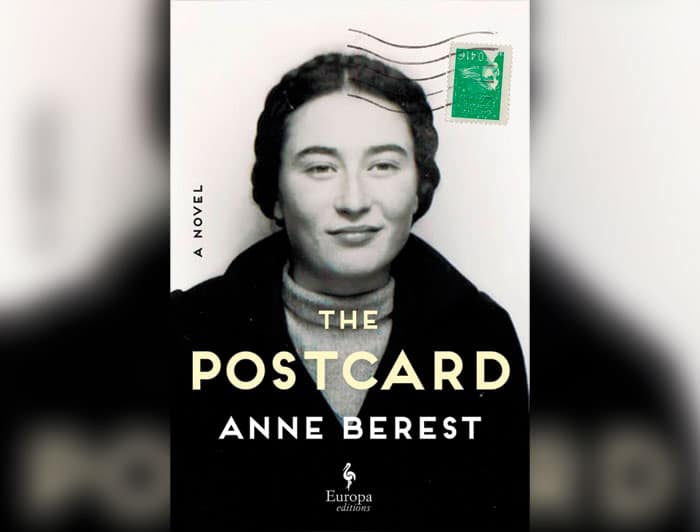
Anne Berest’s great-grandparents, along with her grandmother’s sister and brother, were taken from their home in France in 1942 and murdered in Auschwitz. Their names were Ephraïm, Emma, Noémie and Jacques. One day, in the 21st century, these names show up on a postcard at the home of Anne’s mother, addressed to Anne’s dead grandmother. The postcard has no signature; the sender is unknown. These are historical facts and also the basis of Berest’s novel, or work of autofiction, “The Postcard.” 

Is Anne being taunted? Is this a moment like the ones the thinly fictionalized narrator experienced as a child, when, for instance, a swastika was painted on her house one night? Or when she lost her coveted place as the teacher’s pet after her class was assigned the making of a family tree and Anne included the word “Auschwitz” on hers far too many times? Or when the school chose her and a boy, the two Jewish pupils, to be decapitated in a play about the French Revolution? In other words, is the postcard a modern act of antisemitism?

We read of love, lost and found; of big dreams; of great achievements. But, throughout, we know how it all ends: in Auschwitz.

In the novel, Berest uses the arrival of the postcard to tell the story of her ancestors. The first half of the book beautifully and grippingly follows the lives of Ephraïm and Emma Rabinovitch and their children Myriam (Anne’s grandmother, the only survivor), Noémie and Jacques. It is, in Anne’s mother’s words, “a blended story,” made of known fact, theories and stories. The narrative takes us from Moscow to Riga, through Lithuania, Poland, Hungary and Romania, across the Black Sea and the Mediterranean to Haifa and then Migdal before the Rabinovitches settle in France. We read of love, lost and found; of big dreams; of great achievements. But, throughout, we know how it all ends: In Auschwitz.

The second half of the novel returns us to the contemporary era and to the search for information. Berest uses the novel not only to tell the story of her family but also to try to understand what it means to be Jewish. Anne remembers Jewish girls in her 10th-grade class saying they couldn’t participate in a tournament because it was Yom Kippur, which makes her realize that she might be “Jewish,” but she doesn’t belong to a community. Not a Jewish community, anyway. “I feel like the only thing I truly belong to is my mother’s pain,” she says. “That’s my community.”

Despite generations of secularism — there is a thematic questioning of the protection assimilation offers — even Anne’s daughter needs to negotiate her Jewishness. “I don’t think they like Jews very much at school,” she tells her mother. Anne is unsure how to react. “I didn’t want to make a big deal out of it,” she says at a Seder to which she’s been invited — her first. “If you were truly Jewish, you wouldn’t take it so lightly,” she’s told.

At the end, however, Anne is convinced that while she might not understand what it means to be “truly Jewish” (or, for that matter, “not truly Jewish”), she does understand what it means to inherit the intergenerational trauma so prevalent in the children and grandchildren of Holocaust survivors.

Berest has a colorful family history, full of talented and storied members. Her great-grandfather was the French avant-garde painter Francis Picabia. Her great-grandmother, Gabrièle Buffet-Picabia was the lover of Marcel Duchamp, as well as an influential art critic, writer and organizer in the French Resistance.

“The Postcard” isn’t about these famous family members, and as such, feels like a departure for Berest, who previously wrote a book about her great-grandmother with her sister Claire (in addition to “Gabriële,” Berest wrote about another well-known figure, the French writer Françoise Sagan, in “Sagan, Paris 1954”). “The Postcard” is about ordinary people, Jews, who were forced to move from place to place, but never managed to outrun the antisemitism that ultimately led to their demise. 

As for the mystery that opens the novel, it is not a great mystery. The answer is there, throughout, if you’re looking for it. But this book is not a mystery novel, and the revelation doesn’t need to be a surprise; the poignant explanation is enough.


Karen E. H. Skinazi, Ph.D, is Associate Professor of Literature and Culture and the director of Liberal Arts at the University of Bristol (UK) and the author of Women of Valor: Orthodox Jewish Troll Fighters, Crime Writers, and Rock Stars in Contemporary Literature and Culture.

What Does it Mean to Be ‘Truly Jewish’? Read More »

Rabbis of LA | Rabbi Kalman Topp: Man of Chizuk

Long before he came to the Orthodox community of Beth Jacob in Beverly Hills in 2009, Rabbi Kalman Topp had a different career plan. He was intrigued by the business world, especially finance. Chinuch, educating Jewish children, also appealed. When he went to college, he believed he could follow both paths. “My first interest really was chinuch,” Rabbi Topp said, “teaching in a high school, together with business. I would be half-time teaching and half in the business world. The dream I had with my wife Jordana was to make it to Israel eventually.” By the time he graduated from New York University’s business school and was ordained, however, his plans had changed.

The middle child in what he called a Modern Orthodox home in Kew Gardens Hills, Queens, the rabbinate was not young Kalman’s dream. He thought about being a sports or business agent. “We had a religious home with a deep commitment to Torah, tradition and also modernity.” His father — an ordained rabbi — was a psychologist. his mother was a public school teacher. After high school, he studied in Israel for two years at Yeshiva Har Etzion in Israel, or Gush, as Americans call it.  “That,” Rabbi Topp said, “is when I became inspired to dedicate at least some of my career to Torah, to teaching Torah.”

Topp was still figuring out his career when a rabbinic position became available at the Albert Einstein College of Medicine in the Bronx. “A couple of friends who were there suggested I apply for the position. It is more of a student community, very diverse, and that is when I decided, ‘Hey, let me go for that.’ And that was how my journey in the rabbinate began.” 

Even after smicha (ordination), Topps plan really was not the rabbinate. “I was more focused on Jewish education, being a rebbe in a school, in the United States, or a rebbe and Torah teacher in Israel.” But once he was in the world of the rabbinate, he discovered he really enjoyed it. 

After three years at the Einstein Medical College, where he sometimes received mail addressed to “Rabbi Albert Einstein,” he moved on to Young Israel of Woodmere, Long Island, as an associate rabbi.  In his late 20s, the rabbi and rebbetzin “made a decision to be in America and raise a family, have a meaningful, joyful life, but also to lead a community.

“From the beginning of my time in the rabbinate, I wanted to have the opportunity to utilize my energies to make an impact, to lead a community, to guide and counsel people, to have opportunities for chesed (kindness, compassion),” Rabbi Topp said. “I discovered early in the rabbinate that the rabbi of a shul has so many opportunities to do chesed.”

“You can give chizuk in many different ways,” he said, “through teaching, counseling, programming. Our job is to help anyone who walks through our doors to navigate life. 

One of his favorite responsibilities as a rabbi is providing chizuk (providing emotional or spiritual support). “You can give chizuk in many different ways,” he said, “through teaching, counseling, programming. Our job is to help anyone who walks through our doors to navigate life. This is a central role that goes back to forever.” One thing that has changed, he said, is that it is more important now than 30 years ago to give people a sense of meaning, an anchor, stability, inspiration and guidance about how to live in a meaningful way.

After eight years on Long Island as a second in command, Topp focused on his immediate future. “I was looking to lead a community,” he said. “When Beth Jacob Congregation, one of the prominent, well-known, respected, significant congregations in the United States, became available, moving made sense for us.” Topp and his wife, Jordana, a Brooklyn native, made the move.  “We were New Yorkers until making aliyah to Los Angeles,” he said, which triggered a hearty laugh.

“Our dream still is we want to make aliyah in the future,” Rabbi Topp said. “Every Jew should want to make aliyah.” But, he said, “our decision for the last 20-plus years has been that our family is happy. We are uniquely situated to make a difference for the Jewish community and the Jewish people in ways that maybe we couldn’t do in Israel.” 

Focusing on the two main professional experiences of his life, Rabbi Topp described Los Angeles as “a large community but smaller than New York, which leads to a certain sense of cohesiveness and diversity. In New York, there tends to be more homogeneity.”  But, he said, “we want everyone who walks through our doors to feel comfortable, to feel welcomed, to feel they have a place here, no matter their level of observance or Jewish knowledge.”

Fast Takes with Rabbi Kalman Topp

Jewish Journal: Outside of Israel, what is the favorite place you have traveled?

Rabbi Topp: Yosemite National Park.

Jewish Journal: What lesson would you like your six children to take into their adult lives?

Rabbi Topp: Within our mesorah (tradition) and halachic tradition, that they have sufficient confidence to blaze their own path and make their own unique impact on Am Yisroel.

Jewish Journal: Outside of Jewish texts, the best book you have read?

Rabbi Topp: Viktor Frankel’s “Man’s Search for Meaning.”

Rabbis of LA | Rabbi Kalman Topp: Man of Chizuk Read More »