fbpx

August 31, 2023

Thinking the Unthinkable: The Unmaking of the American Jewish Experience

American democracy is in trouble. Democratic governments here and elsewhere are being tested and challenged. Liberalism as a political and moral ideology based on the rights of the individual, the centrality of liberty, and the consent of the governed is particularly under attack, as political nationalism and authoritarianism expand their presence. In part, the downsizing and questioning of democracies emerged as a result of a number of factors, including the impact of the pandemic, the collective economic and social grievances of various classes of citizens, a growing uncertainty about America, an expanding credibility gap in connection with leaders, and a corresponding loss of trust in the capacity of democratic governments to perform.

What does all of this mean for America’s Jews? As I’ve written previously, a level of unsettledness defines this nation’s Jews, creating an internal debate involving many of us: As we have shift from a period of American liberalism to a time of political populism, deep fissures are dividing Americans in general and Jews in particular. Jewish political differences may never have been more pronounced, as Jews debate and disagree over what defines their vision for America and how they understand their self-interests in this new political reality.

Today, a new type of angst exists among America’s Jews. It is taking place amidst the rise of a new American nationalism, framed by a nativist populism, an emerging neo-isolationism and a dramatic spike in antisemitism. A portion of this unsettled condition has been driven by external threats that I have described elsewhere, encompassing antisemitic rhetoric and behavior and growing political divisions within this nation. This contemporary state of anxiety is framed around an assault that Jews are experiencing in connection with their love affair with America, reminding one how deeply invested Jews have been in this society.
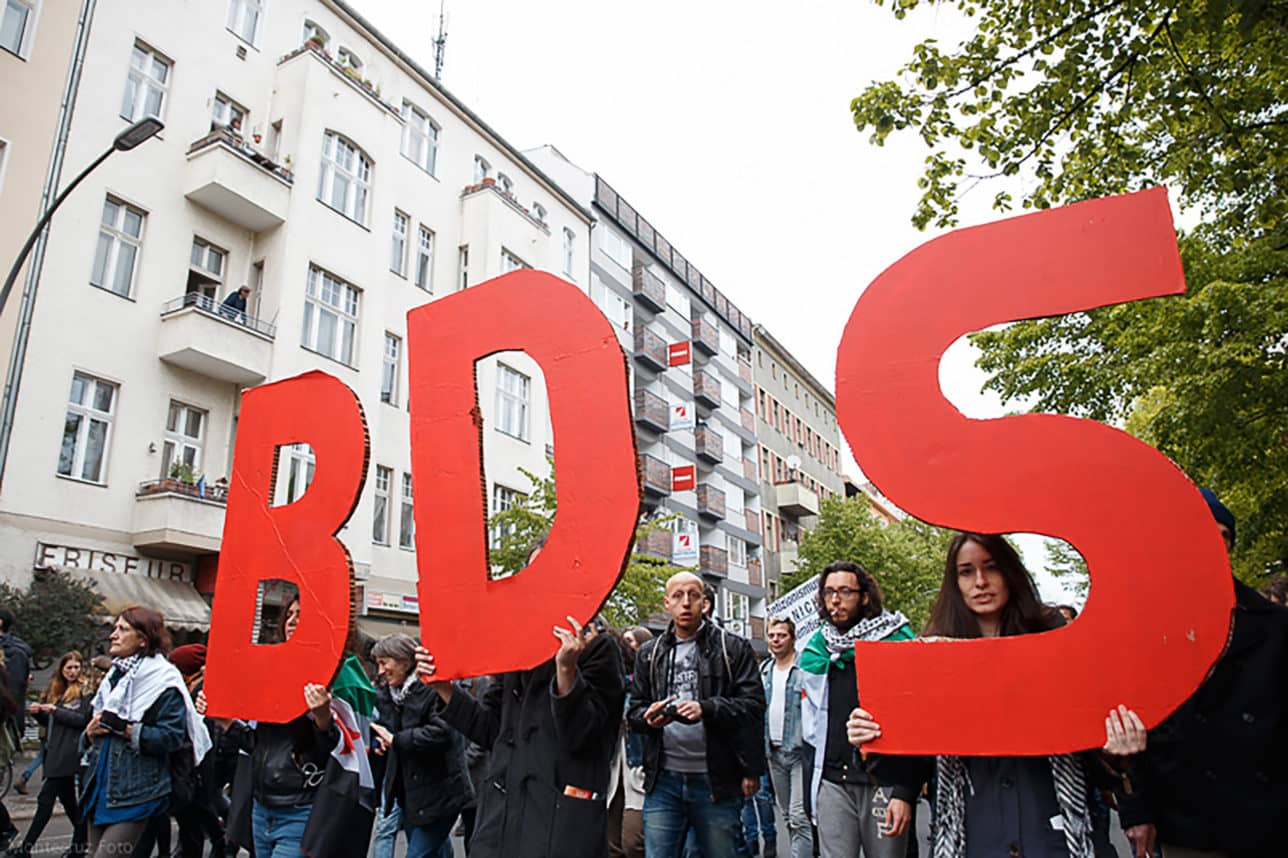
Montecruz Foto (2017) Creative Commons: Attribution Share Alike
www.montecruzfoto.org

American Jewish Political Thought

Jews have understood that their American journey has been tied to certain set of civic and human rights principles that has served this nation and, more directly, represented Jewish Americans’ interests. Among these core ideas that have shaped what I call the Jewish Contract with America are the civic values introduced by community organizer, Walter Lurie in his 1982 “Strategies for Survival”:

  • To promote equality of opportunity, without regard to race, religion, ancestry or sex.
  • To secure freedom of thought, opinion, and association.
  • To ensure freedom of religion and separation of church and state.
  • To encourage constructive and supportive relationships among all communities.
  • To marshal public opinion on behalf of justice and freedom for all peoples.

As the value of truth is torn apart and as social media spills out an array of false sentiments, the undermining of political ideals and values core to Jewish sensibilities adds another dimension to the undoing of confidence in this nation. A rational mindset framed this base of thinking, namely that if the government delivered on its promises then this nation’s citizens would in turn believe in and be supportive of these institutions. Since 1970, however, the levels of trust in government have declined, creating in part this current crisis of confidence in our governing bodies and with our political leadership.

Today, some of the principles that framed the liberal perspective are being challenged and/or being reframed. This raises for some Jews deep concerns about the focus and future of American democracy. At this moment, our society is confronted by an organized effort to legislate and litigate over the rights and choices of individuals regarding their personal behaviors and sexual orientation, to impose progressive cultural beliefs in connection with our historic experience, to break down the “wall of separation” between state and religion, and to limit the opportunities to assist minorities.

The New Political Paradigm

The democratic liberal tradition that has framed American political thinking for the past 75 years is beginning to fray, and in its place various competing ideological measures are emerging, refocusing this democracy in new directions. Jews are being identified with this particular brand of American liberalism, with its focus on civil and economic justice, commitment to diversity and multiculturalism, and its emphasis on promoting global democratic values. If in the end Jews are seen as the embodiment of this particular American storyline, then witnessing the unraveling of that liberal canon is becoming particularly challenging.  

The democratic liberal tradition that has framed American political thinking for the past 75 years is beginning to fray, and in its place various competing ideological measures are emerging…

When the cultural and political norms of a society are altered, critics of the status quo see such transformational expressions as an opportunity to advance their standing by introducing competing agendas, while established political players believe such a critique to be not only undermining the greater good but also potentially detrimental to their status. Part of what is unfolding at this moment is a reframing of what those without power are seeking to affirm. In this equation, groups aspiring to achieve influence and access are articulating their grievances, often directed to those whom they perceive as being in control of the instruments of government. As these outliers share their aspirations, their goal is to reshape the political marketplace. It would appear that in this scenario Jews are being politically targeted.

Where normally, such criticisms emerge most likely from one sector of the political arena, at this moment this critique is being generated from multiple players. From the extreme right, one hears an assertion that the American narrative has been lost or appropriated. Here “Whiteness,” Christian values, and Constitutionalism are dominant themes as the extreme right seeks to reframe what is perceived as the “authentic” American story. In this scenario, Jews are defined as  “pretenders” seeking to claim the mantle of power by imposing their values and liberal beliefs on this society. They are seen by their opponents as seeking to acquire “whiteness” and in turn, to “replace” the existing white establishment with their allies.

On the left, “progressive” voices are asserting the need to revisit the flawed American experiment: racially, economically and politically. Elements on the political left have specifically rejected a Jewish presence, labeling Jews as “Zionists,” identifying them as being “white” and powerful, and as a result, no longer able to lay claim to their minority position. Those who embrace intersectionality politics hold to the principle that all minorities, with the exception of the Jews, can rightfully claim their victimhood credentials, whereas Jews have forfeited their place in this constellation as they are no longer identified as victims of this political order.

In the mindsets of these emerging voices, a fundamental reset is required to undo the existing power structure and current structure that controls and gives definition to the society. In both cases, the existing political scenario is identified as a failed proposition.

Jews and their liberal expressions are seen as “problematic” by those on both ends of these political spectrum. After all, Jews have thrived and benefitted within the context of the post-Second World War American liberal culture. Further, American Jewry is perceived as politically influential and economically powerful. Yet, beyond the realities of American Jewish success, there is a deeper and more foreboding concern. In an environment of political division and economic uncertainty and in a period of social media influence, there exists an acceleration of antisemitic tropes and beliefs that further feeds and supports the negative notion of Jewish “control” and cultural dominance.

Foreign Policy and America’s Jews

Two perspectives are playing out with regard to U.S. foreign policy. Jews find themselves being equated with being part of an elite state network, increasingly identified as being aligned with a white, colonialist and oppressive regime (Israel) and are seen as defenders of the existing American power structure. Israel is targeted as an appendage of what some describe as a failed and problematic foreign policy too focused on a post-Second World War construct. The new international realities, according to these critics of U.S. diplomacy, must consider the changing balance of power and the political and economic aspirations of third world nations, while simultaneously failing to address the inequities of the existing globalist model fostered by Washington and its Western allies.

Mario Tama/Getty Images

A second reading involving U.S. foreign policy argues that America must disconnect from its international involvements. This isolationist argument, fostered by some on the political right as well as certain voices on the left, suggests that this nation needs to reinvest its resources in its people, foregoing its global connections, or at least narrowing our focus to contend with legitimate enemies of this society. A correlary response here involves an anti-immigrant orientation, where the U.S. will need to rethink its policies on welcoming foreigners into this country.

Final Reflections

Accompanying this assault on America and its political identity is a correlary attack on globalism. Jews, in turn, are frequently identified as “globalists” holding to a belief in the idea that global economic, cultural integration aligns with America’s democratic vision.

The growing sentiment among many in the body politic is to accept conspiratorial ideas and theories, which further distorts the political realities of the moment. The disconnect between reality and belief creates a further weakening in this nation’s ability to engage in a shared discourse. The undermining of the American political conversation adds another dimension to the growing state of anxiety facing this nation’s Jews. Remembering the Nazis’s ability to effectively introduce and employ the “big lie” serves as a stark lesson that when a society operates outside the boundaries of truth, it is possible to literally upend the norms of a nation, leading to the destruction of Jews and others.

The collective character of these emerging political challenges may test America’s Jews as never before. The unfolding of these ideas, beliefs and movements raises increasing concerns for America’s Jews and brings forward a growing discussion about the Jewish future within the American context. 


Dr. Steven Windmueller is an Emeritus Professor of Jewish Communal Studies at the Jack H. Skirball Campus of HUC-JIR, Los Angeles. His writings can be found on his website, www.thewindreport.com.


Thinking the Unthinkable: The Unmaking of the American Jewish Experience Read More »

UC Berkeley on AEPi Shellfish Incident: “Similar Vandalism … May Have Occurred at Multiple Fraternities”

UC Berkeley has released an update stating that the Alpha Epsilon Pi (AEPi) fraternity house may not have been the only house targeted with shellfish over the weekend, though the investigation remains ongoing.

The AEPi chapter posted a statement to social media on Sunday stating that “a group of six individuals” put the shellfish on the front door and then threw it “into the house and onto the front porch, also scattering it around the premises.” “By singling out AEPi, the Jewish fraternity, and deliberately employing non-kosher food, this act of vandalism goes beyond mere destruction; it represents a calculated decision to target Jewish students within the campus community,” they added. Berkeley police told The Jewish News of Northern California (The J) that they are investigating the incident as a hate crime.


View this post on Instagram


A post shared by ALPHA EPSILON PI (@cal.aepi)

But UC Berkeley Assistant Vice Chancellor Dan Mogulof told the Journal that “new details have emerged that suggest a recent incident at UC Berkeley might not have been targeted specifically at the Jewish fraternity, and that similar vandalism (the deposit of shellfish) may have occurred at multiple fraternities. However, the incident is still under investigation and all details have yet to emerge.” “Regardless of the chain of events, the members of the Jewish fraternity were very understandably upset to see what appeared to be a targeted attack on their Jewish religious and cultural traditions,” Mogoluf continued. “UC Berkeley campus leadership has taken this issue very seriously and has been in regular communication with key stakeholders on campus and at the fraternity about next steps and how best to move forward.”

“To be clear, regardless of the facts as they unfold, we understand that the members of AEPi experienced this as an antisemitic attack and in conversations that have been had with AEPi leaders, that sense of harm was very evident,” he added. “When dealing with the emotional and social fallout from incidents of bias and bigotry, intent can be distinct from impact.”

Dr. Gregg Drinkwater, program director of UC Berkeley’s Center for Jewish Studies’ Antisemitism Education Initiative, similarly told the Journal that “the campus officials engaged with the response on this incident have been made aware that shellfish may also have been dumped at one or more additional fraternity houses” but acknowledged that “the investigation is still ongoing, so we need to respect the process of the police and campus officials.” “Campus leadership is focused here on the impact on AEPi members and the campus community,” Drinkwater added. “Given the current national climate and the disturbing uptick in antisemitism in recent years, when the AEPi members found an expressly non-kosher food littered around their Jewish fraternity house on Shabbat, they experienced it as antisemitism. Campus leadership has been clear on the importance of supporting the needs of those impacted by this incident, regardless of what the final investigation determines around intent.”

The Berkeley AEPi house released an update on August 31 saying that “it has become known that at least one other fraternity was similarly vandalized though not because of antisemitism. While we can’t imagine the rationale for this, we are gratified to know that AEPi may not have been specifically singled out because of our commitment to being Jewish. Ignorance, however, does not excuse antisemitism and this event has contributed to an environment in which Jewish students are concerned for their safety and being discriminated against.”

The AEPi house added that “at least some of the people who perpetrated this act have come forward to our chapter’s leadership and apologized for their actions. We welcome this act of contrition and look forward to working with them and the entire Berkeley community to use this moment as a catalyst for good.” The AEPi house will be hosting an event to raise money for the Anti-Defamation League and AEPi Response Antisemitism Center.

Jadon Gershon-Friedberg, president of the Berkeley AEPi chapter, told The J that one of their members noticed six people coming to the house with a bucket shortly before 1 a.m. on August 26. Gershon-Friedberg also told The J that there were “claws by the side of the house and by the door. We found a fish tail and head in someone’s room. It was absolutely disgusting.”

UPDATE: Berkeley police told The J on Thursday that they have concluded “that a hate crime did not occur” because “multiple fraternities had shellfish dumped in their yards on the early morning of August 26th. We want to reiterate that our department did not take this investigation lightly and confirmed through further investigation that the involved students did, in fact, not target Alpha Epsilon Pi.”

UC Berkeley on AEPi Shellfish Incident: “Similar Vandalism … May Have Occurred at Multiple Fraternities” Read More »

From Nuclear Bombs to Frail Bones: New Study Highlights Promise of Israeli Cell Therapy for Blood Disorders

An Israeli biotech company’s innovative cell therapy shows growing promise as a breakthrough treatment for medical disorders at home and at war, including radiation poisoning in the wake of a nuclear bomb or disaster.

Peer-reviewed research published in Nature BMT this month showed the efficacy of Pluri Inc.’s cell therapy in treating patients recovering from bone marrow transplants. The promising results follow the company’s announcement in July of a major U.S. government contract to develop the same cell product, PLX-R18, as a medical countermeasure for acute radiation syndrome – more commonly known as nuclear radiation poisoning.

The ARS research project is being conducted with the U.S. Department of Defense and funded by the National Institute of Allergy and Infectious Diseases.

Nitsan Halevy

Nitsan Halevy, Pluri’s chief medical officer, said the new findings lend further validation to the “potent potential” of PLX-R18 as a wide-ranging cell therapy for blood-related disorders including hematopoietic ARS.

“The publication of these findings in the esteemed Nature BMT journal, along with the backing of NIAID, significantly bolsters our H-ARS program and advances us toward the goal of marketing authorization,” Halevy said. “As a groundbreaking, first-in-class solution, PLX-R18’s capacity to augment hematopoietic system recovery and effectively manage diverse cytopenia holds immense promise.”

In the study, Pluri’s PLX-R18 cell therapy successfully promoted increased blood counts in patients recovering from hematopoietic cell transplantation (HCT), or bone marrow transplants. The increased blood counts continued for as long as 12 months after just two applications – as opposed to the current standard of care that requires frequent and ongoing treatment – and reduced the need for patients to receive blood transfusions.

PLX-R18 has already received Orphan Drug Designation from the U.S. Food and Drug Administration for the treatment of graft failure, incomplete recovery following HCT, and acute radiation syndrome. The ARS application in particular has gained attention in Washington, D.C., where members of Congress and the Biden administration are closely monitoring Russian nuclear threats and looking to improve U.S. readiness for a potential attack or accident.

If successful, the joint research project with DOD could validate PLX-R18 as the first cost-effective, scalable treatment for ARS in the event of a wide-ranging nuclear disaster. Under the three-year government contract, Pluri and DOD aim to develop the cell therapy as a medical countermeasure that could be acquired for the U.S. Strategic National Stockpile.

Georgijevic/Getty Images

The contract was announced last month on the heels of rising nuclear threats from Russian President Vladimir Putin and as skirmishes in Ukraine inched closer to European nuclear power plants. In general, medical countermeasures have failed to keep pace with nuclear weapons that are exponentially more powerful than the atomic bombs used in World War II.

Based in Haifa, Pluri is seen as one of Israel’s most innovative companies and a proven pioneer in cell replication technology.

After establishing its expertise in advancing novel medical treatments, the company recently expanded to other corners of the life sciences landscape, including cultivated foods, ag-tech and biologics. Pluri received a major biotech award in 2022 when the wide-ranging applications of its 3D cell expansion platform were recognized as the industry’s cell technology innovation of the year.

From Nuclear Bombs to Frail Bones: New Study Highlights Promise of Israeli Cell Therapy for Blood Disorders Read More »

Can I Get an Amen! – A poem for Parsha Ki Tavo

Cursed be he who does not uphold the words of this Torah, to fulfill them.
And all the people shall say, ‘Amen!’
          Deuteronomy 27:26

Shout it from one of the mountains:

Cursed is the person who worships
the television over the human.

Cursed is the person who forgets
what their parents did for them.

Cursed is the person who builds
a swimming people on their
neighbor’s property.

Cursed is the person who
disenfranchises the less able
by not building them possibilities.

Cursed is the person who
removes context from
the words of others.

Cursed is the person who is
naughty with anyone they
shouldn’t be naughty with.

Cursed is the person who
waves their arms around
like a bully when they think
no one is watching.

Cursed is the person who
lets the law slide for
personal gain.

Cursed is the person who
crosses any of the lines of
common sense on purpose.

Shout it from the other mountain:

Heading here, or away?
We’ve got you.
You’re blessed.

Can I get an Amen!


Rick Lupert, a poet, songleader and graphic designer, is the author of 27 books including “God Wrestler: A Poem for Every Torah Portion.

Can I Get an Amen! – A poem for Parsha Ki Tavo Read More »

Meet Gene Segal, the Animal Whisperer and Jewish MacGyver

A few years ago, our tortoise, Hershel, escaped from our yard. A friend gave us Hershel when his son, whom Hershel belonged to, went off to college. We put Hershel in the yard with our other tortoise, Mr. Tenenbaum, who was older and much bigger.

One day, while going outside to feed my two favorite reptiles, I couldn’t find Hershel. I searched everywhere for him. My husband Daniel and I had lost Mr. Tenenbaum a few times in the past, figuring out that tortoises are expert escape artists. We thought our enclosure would hold Hershel in, but we found out via Google that they are great at burrowing. We weren’t used to that, as Mr. Tenenbaum is a South American red-footed tortoise that doesn’t burrow. 

Daniel and I checked for Hershel under every object in our yard. We walked around the neighborhood for hours, looking under cars and in people’s gardens. We put up signs with his picture and posted them up for five days straight. 

I was so worried about our little guy. How was he going to survive in the world? Would we ever get him back? I prayed constantly for Hashem to bring him home. 

On the sixth day, I put up flyers again, sticking one on a pole a block down from our home. 

Then, an hour later, I got a call.

“I think I found your tortoise,” the man on the other end said. 

“I’ll be right there!” I yelled.  

When I ran to the address this man provided me, I realized it was where Gene Segal lived. Daniel and I had met Gene a few years back, when a mutual friend brought him to our house for Pesach seder. We ended up having him back the following Pesach, but we hadn’t been in touch since I knocked on Gene’s door, and he opened it with Hershel in his hands. I was so happy that I teared up.

Kylie with her tortoise

“Thank you!” I said. “Where was he?” 

“You’re not going to believe this,” Gene said.

Gene then described how one morning, he got into his car and was about to reverse and leave. But something told him to check under his tire. He’d never done that before, but he had a feeling that something was there. 

Lo and behold, when he checked, Hershel was right there. If Gene had backed up, he would have killed Hershel. 

Upon hearing this, I said, “Obviously, Hashem wants us to reconnect and become friends.”

Since that day three years ago, Daniel and I have become closer with Gene, an interesting man with many talents and a great friend. 

We call Gene the Jewish MacGyver, or the JewGyver, because he can fix anything. When my husband’s mobile recording studio The Podcast Bus got a broken tire on a highway, Gene calmly drove it to a safe spot and fixed it with ease. You see, Gene has his own school bus, which was formerly owned by a church in Georgia. He fixed all the mechanical issues the bus had and added custom lighting and audio, transforming it into a party bus he rents out. He’s also building a house in Crestline from scratch – doing all the electrical, gas, plumbing, flooring and drywall on his own – and he can fix mechanical issues on pretty much any vehicle.

“I can do pretty much everything on any car possible,” Gene told me. 

Gene, a Russian Jew, was born in Moscow and moved to the United States with his mom in 1979. HIAS got them a visa to go from the Soviet Union to Israel, and then they came to Los Angeles. It was imperative for them to get out because his mom faced discrimination in her workplace for being Jewish.

“My mom shielded me from antisemitism,” Gene said. “I was very young when we left.” 

Gene presumes, however, that his grandfather was killed for being Jewish. Stalin’s government called him an “enemy of the state” for traveling west to study bookkeeping in Romania, though Gene believes he was persecuted because of antisemitism. 

“After Stalin’s regime ended, my grandmother got a letter clearing my grandfather’s name and an explanation that he died while in captivity,” he said. “They got some token compensation.”

Like many immigrants, Gene worked hard and got his electrical engineering degree at UC Irvine. In 1995, he became a self-taught mechanic because of the independence it afforded him. 

“I don’t have to be in that uncomfortable space thinking about whether or not a service person is taking advantage of me,” he said.

These days, along with working on his Crestline home and vehicles, Gene also runs a cat rescue in West LA called Furry Friends Foundation. 

These days, along with working on his Crestline home and vehicles, Gene also runs a cat rescue in West LA called Furry Friends Foundation. He rescues cats from death row at kill shelters, vaccinates them and gives them the medicine and socialization they need. At any time, he has dozens of cats in his care. 

“I’ve pulled cats from death row the morning they were supposed to die and adopted them,” he said. “They were mislabeled as aggressive when they weren’t, really. They all ended up being super friendly and affectionate cats.” 

In his spare time, Gene gets outdoors with his loyal dog Chewy. He hikes, camps, bicycles and attends music festivals, and is looking for someone who would like to go on adventures with him.

“I would welcome a similar-minded woman in my life to travel the journey together,” he said. 

Though our friend Gene isn’t a religious Jew, he enjoys coming over for Shabbat dinner to say hi to his old friend Hershel, and he strives to live according to Jewish values. 

“I try to live by basic principles of doing the right thing, being good to others, being responsible and contributing good to the world,” he said. “I enjoy life to its fullest, because I believe the Creator has put us here to learn and enrich ourselves in a positive way.” 

I’m honored to know Gene, and so glad that our tortoise escaped that day and ended up reconnecting us with our friend.

Meet Gene Segal, the Animal Whisperer and Jewish MacGyver Read More »

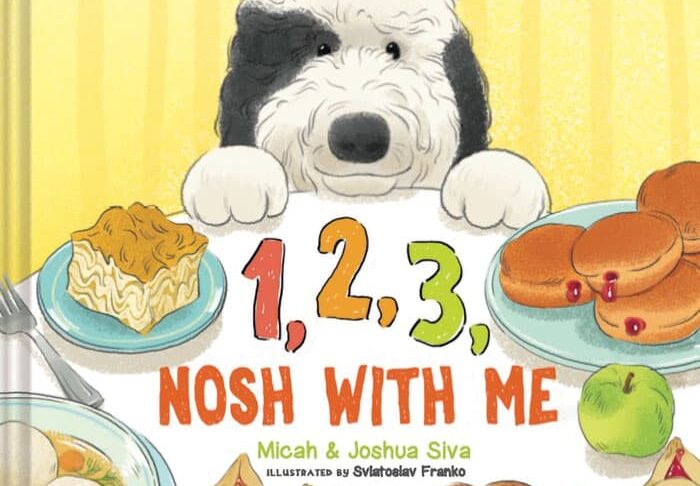
“1, 2, 3 Nosh with Me” Introduces and Celebrates Jewish Food

A counting book that’s a fun exploration of Jewish foods? Yes, please!

“1, 2, 3, Nosh with Me,” by spouses Micah and Joshua Siva, is a beautiful resource for families who want to celebrate Jewish food, while educating their young children. “If there’s one thing that we can connect on its food,” Micah Siva told the Journal. “[The book] has been really well received by using food as a medium for talking about Jewish culture.”

The Sivas came up with the idea for “1, 2, 3, Nosh with Me” during COVID. They were looking for a book about Jewish food to gift to Micah’s newly pregnant sister and brother-in-law. As the only Jewish aunt and uncle (Micah’s brother-in-law is not Jewish), they wanted to find something meaningful to send. And, since Micah works in the Jewish food space, the food aspect was also important. “We also wanted to find a book that was not super-focused on one holiday and not focused on the religious aspects, but more of the cultural aspects of Judaism,” Micah said. “We knew that was a better fit for my sister’s family.”

When the Sivas couldn’t find something that spoke to them, they decided to make it themselves. After all, Micah is a trained chef, registered dietitian, recipe writer and food photographer. A lifelong lover of Jewish food, Joshua serves as taste tester and dishwasher, when he isn’t working his day job.

The couple hired Ukrainian artist Sviatoslav Franko to do the illustrations and had self-published the book. A few months later, the head of The Collective Book Studio reached out and said she would love to include the book as a part of their collection. “We were so excited because we figured that there are other people like ourselves, who grew up in a secular household [or] secular community, or looking for gifts for Jewish or interfaith couples,” Micah said. Traditional publishing would get it into more homes.

“1, 2, 3, Nosh with Me,” follows Buckwheat, an illustrated version of the Siva’s dog, as he counts through various Jewish treats, including matzah balls, hamantaschen, kugels and knishes. The book starts with one golden challah to celebrate Shabbat and concludes with ten crispy latkes served by candlelight on Hanukkah. 

Note: Micah’s recipe for applesauce, which is the perfect accompaniment for latkes, is in the sidebar.

At the end of the book, readers will find Micah’s trusted challah recipe, with illustrated instructions for how to make a braid and how to make a coil, along with creative ideas for toppings.  

Micah Siva
Hannah Lozano Photography

Micah says the response has been really positive. The fact that the main character is their dog is an added bonus. “We’ve given samples of the book to friends in the Bay area, and we see them, and then their kids meet Buckwheat, they are so excited,” she said. “They think they’ve met a celebrity.”

When asked how she kept the food in the book to ten items, Micah said it was hard. There were so many options. “We must have had a list of 50 different foods that we wanted to include,” she said. “Then we realized that 50 is a little too high for a child to get to … so we stopped at 10.” 

Micah said it was a lot of fun to revisit some of the foods that they love the most. They also deliberately choose foods that people would be more likely to recognize, whether they items you would find in a Jewish Deli or on the average Jewish table. That way, “families who didn’t grow up with these foods could relate to it as well,” she said. 

The audience for the book is zero to six years of age, Micah explains, so it’s perfect for Jewish couples with young children and also grandparents. “We’re also noticing that people in interfaith relationships or people who are just curious about Judaism or want to have different representations on their bookshelf are interested in the book as well, which I think is fantastic,” she said. Adds Micah, People want to have “something that was more cultural in nature while still being respectful to the religious aspect of Judaism.”

“I want people to talk about Jewish food and think about it in a different way … that doesn’t necessarily feel like it has to be what my Bubbe would have made.”- Michah Siva

Micah wants Jewish food to feel modern, accessible and exciting. “1, 2, 3, Nosh with Me” certainly does that. “I want people to talk about Jewish food and think about it in a different way,” she said. “That doesn’t necessarily feel like it has to be what my Bubbe would have made.”

While the dietitian in Micah focuses on vegetable-forward dishes, she also makes all the treats you might find in a traditional Jewish household. “There’s so much joy and feeling and love and emotion when it comes to Jewish food,” she said. “It feeds my soul; [Jewish food] makes me feel like I’m connected.” 

“1, 2, 3, Nosh With Me” comes out September 5.


Jamie Grill/Getty Images

Simple Applesauce
Makes: 2 cups

Ingredients:
4 medium apples (I like to use
Granny Smith)
¾ cup water
½ tsp ground cinnamon
Optional:
¼ cup sugar
½ tsp freshly grated ginger
1 pod star anise
1 tsp vanilla extract

Peel the apples, if you prefer. Core and roughly chop them.
Combine the apples, water and cinnamon in a saucepan. Add the sugar and any additional spices, if using. Cover and cook over medium heat until softened, 15 to 20 minutes.
Let cool. Mash with a potato masher or fork, or blend with an immersion blender.
Store in an airtight container in the refrigerator for up to 5 days.

“1, 2, 3 Nosh with Me” Introduces and Celebrates Jewish Food Read More »

StandWithUs Training, AJU Hire, Westside JCC Rebrands

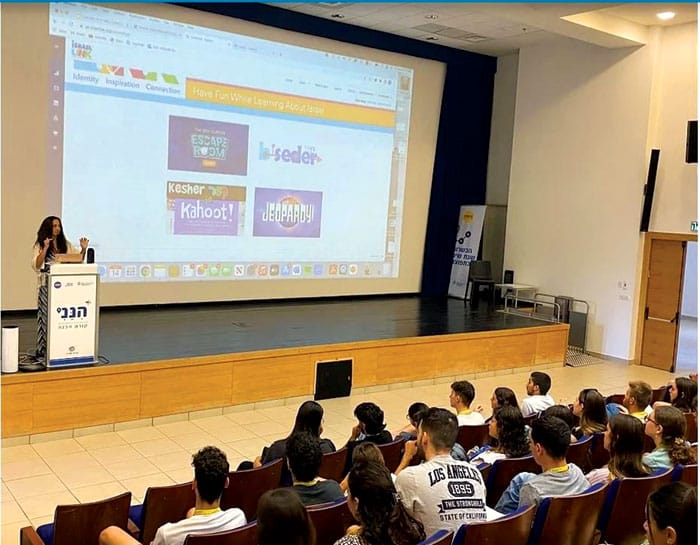
IsraelLINK, StandWithUs’ signature middle school curriculum, and the Jewish Agency for Israel (JAFI) are partnering on a new venture in which The Jewish Agency’s ShinShinim (Israeli emissaries) present the IsraelLINK curriculum as part of their year of service.

Israeli high school graduates, the ShinShinim will work with Jewish communities throughout the United States and the world prior to joining the Israel Defense Forces (IDF) or becoming part of Shirut Leumi, a volunteer position in Israel in lieu of army service.

Both organizations — StandWithUs and the Jewish Agency for Israel — recently completed a six-month pilot program with IsraelLINK Educational Specialist Michelle Geft, who is spearheading it.

“I am so excited to be working with the ShinShinim,” Geft said.

Mina Rush, national director of middle school education and programming at StandWithUs, described the collaboration with The Jewish Agency as a “dream come true.”

IsraelLINK, an initiative of the middle school department of StandWithUs, provides students with authentic and meaningful experiences that foster a strong connection to Israel and Jewish identity.


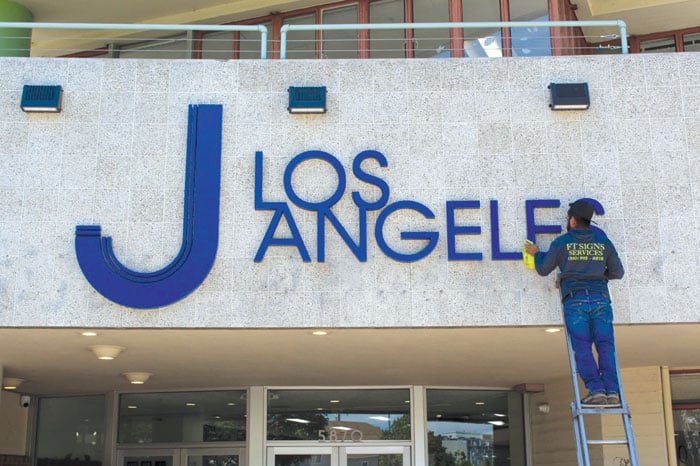
New signage is installed at J Los Angeles, formerly known as the Westside JCC, at the center’s facility on Olympic Boulevard. Photo courtesy of J Los Angeles

The Westside Jewish Community Center (Westside JCC) has undergone a rebranding, developing a new name and identity. Going forward, the organization will be known as J Los Angeles.

“Westside JCC is more than a neighborhood community center – and not at all located on the west side of Los Angeles. This is why we have taken the bold step to develop a new name and new identity, one that expresses the profound connection with our beloved city and community members who have always been a part of us,” the organization said in a statement.

The Westside JCC opened in 1954 and was so named because it was the furthest west of the newly built JCCs – replacing the Soto Michigan JCC in Boyle Heights. What was once imagined as a neighborhood community center now serves a much wider L.A. population, however. The day camp, aquatics, teen, and Israel experience programs draw participants from all over the greater Los Angeles area.

“‘J Los Angeles speaks to who we are today and where we are going,” J Los Angeles Executive Director Brian Greene told the Journal. “It is bold statement about our place in the community. The new J Los Angeles brand is inspirational and aspirational. It makes a statement to our board, to our staff and to our community that we will be a part of shaping the L.A. Jewish future.”

“The staff at the J has done a tremendous job bringing this transformation to fruition,” J Los Angeles Board President Tony Regenstreif said. “Over the last few years, the programming at the J has been renewed and expanded and it was time for the name to catch up with that change.  Plus — we’re not even on the Westside!”


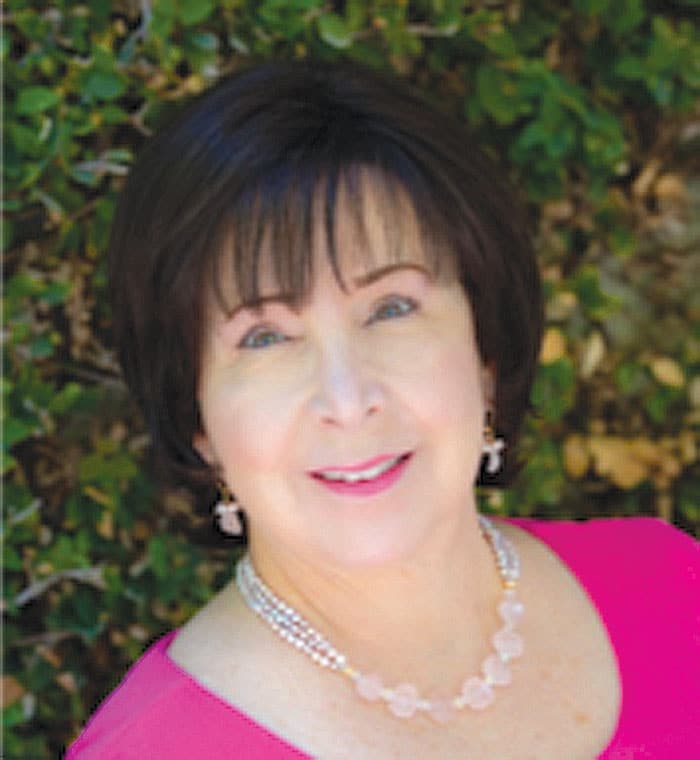
AJU’s Suzy Bookbinder. Courtesy of American Jewish University

American Jewish University (AJU) has named Suzy Bookbinder its vice president for advancement and chief development officer.

In this role, Bookbinder will work closely with AJU’s president, board and senior leadership to advance the university’s philanthropic goals and continue to foster a relationship of service and partnership with the community.

An accomplished fundraising professional with more than three decades of experience, Bookbinder recently served as the executive philanthropy consultant at anti-genocide organization Jewish World Watch and previously held positions at Hillel International as the director of donor relations; Jewish Family Service of Los Angeles as the chief development officer; and de Toledo High School as the chief advancement officer

“American Jewish University holds a significant and ongoing role in my life and the lives of many others. The university serves as a lifelong institution that embraces individuals at all points of their Jewish journey,” Bookbinder said in a statement. “My goal is to enlighten potential supporters and donors, fostering in them the same passion for AJU that existing community members hold.”

AJU President Jeffrey Herbst expressed excitement about Bookbinder joining AJU’s leadership team, saying, “Suzy Bookbinder is an accomplished fundraiser with a strong understanding of the Los Angeles Jewish community, and we are delighted to see her bring this expertise, leadership, and problem-solving skills to her new role as AJU’s Vice President for Advancement and Chief Development Officer.”

StandWithUs Training, AJU Hire, Westside JCC Rebrands Read More »

Make a Crayon Flower Vase for a Teacher Appreciation Gift

If you’ve run out of ideas for teacher appreciation gifts, here’s something that’s super easy to put together and yet will still show how much you appreciate the teacher. 

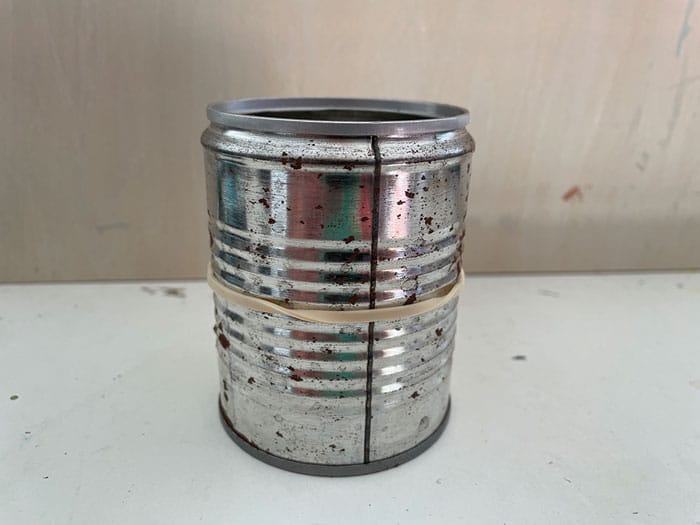
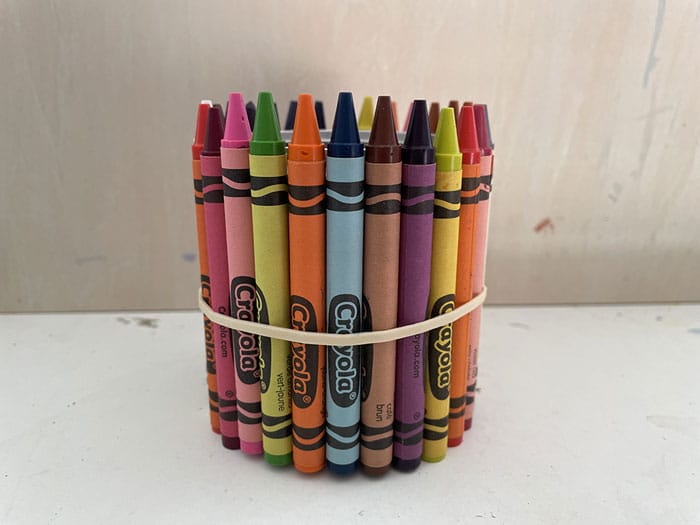
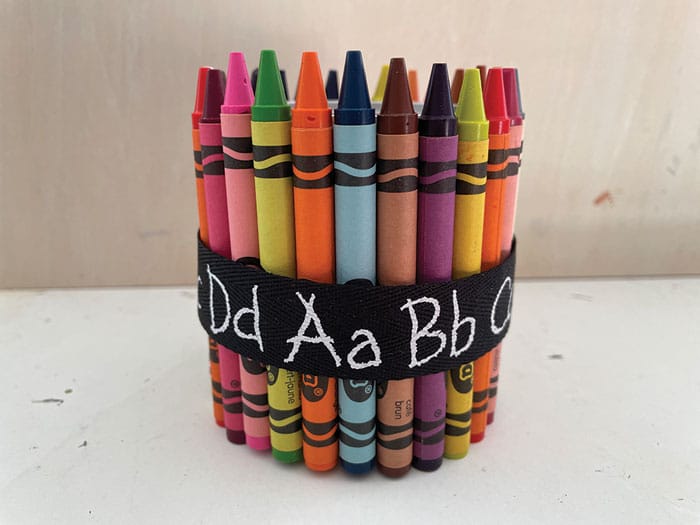
Colorful crayons wrap around a recycled can, held in place by a rubber band, which is then covered up by a ribbon. The container can be used as a vase for fresh or artificial flowers, or it can make handy desk storage for pencils and other school supplies. 

What you’ll need:

8 1/2-ounce metal can
Rubber band
Crayons
Ribbon

1. Wash and dry an 8 1/2-ounce metal can. This is the small can that contains vegetables and fruit. Place a rubber band around the middle. Be careful, as the rim of some cans can be sharp.

2. Insert crayons between the rubber band and the can, going all the way around until you’ve surrounded the can with crayons. 

3. Hide the rubber band with a decorative ribbon. I found this alphabet ribbon at Michael’s. Then fill the container with real or artificial flowers.


Jonathan Fong is the author of “Flowers That Wow” and “Parties That Wow,” and host of “Style With a Smile” on YouTube. You can see more of his do-it-yourself projects at jonathanfongstyle.com.

Make a Crayon Flower Vase for a Teacher Appreciation Gift Read More »

A Patriarch of Mexico City’s Jewish Community Models Commitment to Lifelong Learning

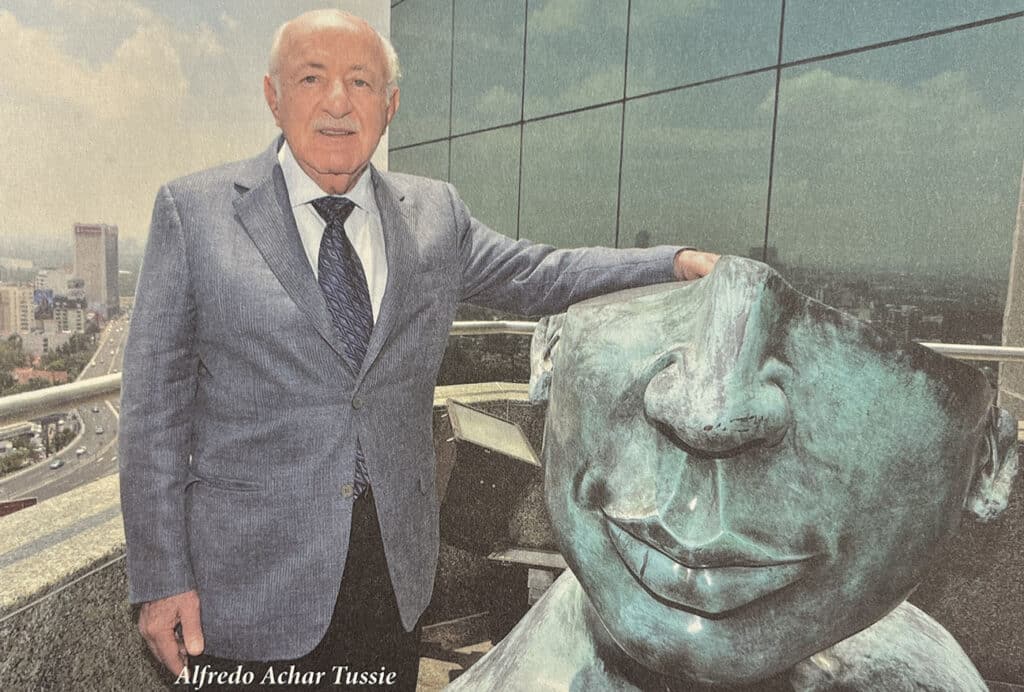
When discussing his education, Don Alfredo Achar Tussie likes to tell his friends and family, “I studied at the university of life.”

In May, Achar, a significant business leader and lifelong advocate for the Mexican Jewish community, received one of the country’s highest academic honors.

This time, it wasn’t from the university of life.

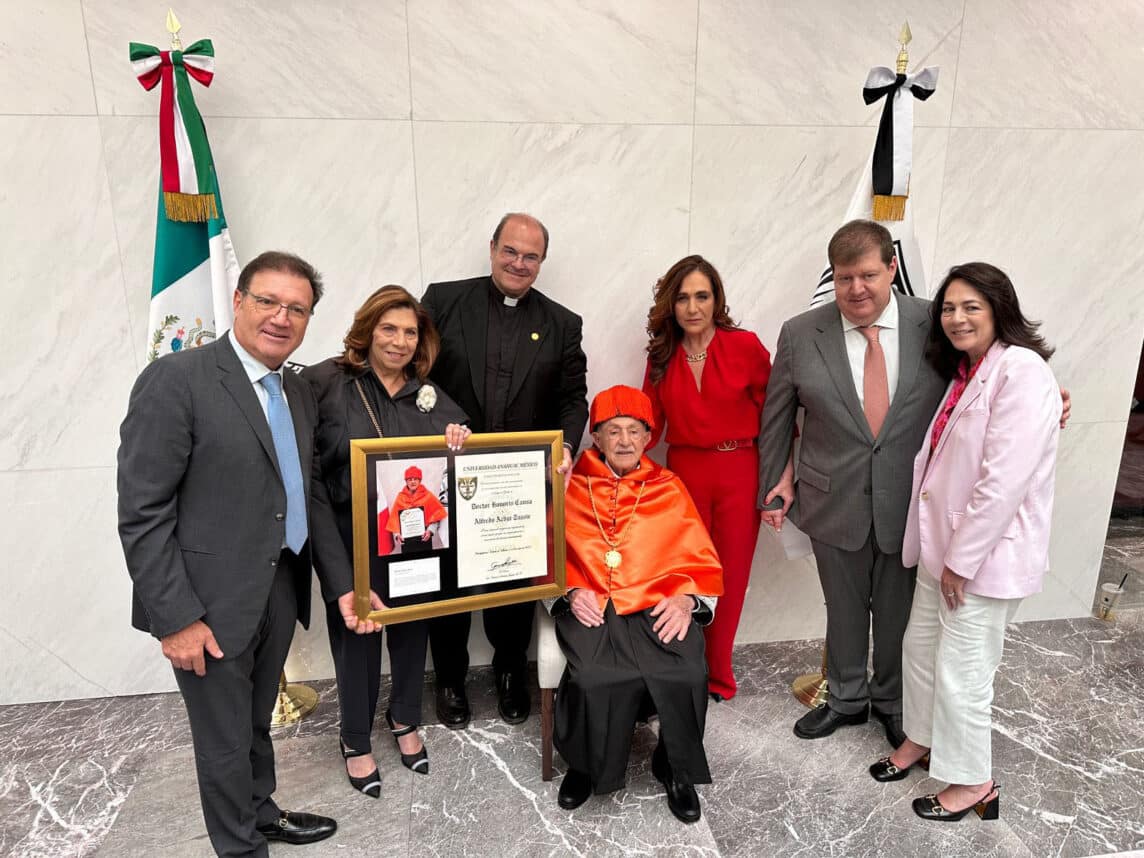
Achar, 82, was awarded an honorary doctorate from Anáhuac University. The university recognized Achar for promoting socially responsible business practices, advocating for the end of poverty and supporting the Mexican Jewish population.

During a ceremony at the university’s campus, Achar received a standing ovation as he approached the stage. He used his moment in the spotlight to impart onto the audience some of the many lessons he’s learned across his decades of experience in business and philanthropy.

Surrounded by his family, Don Alfredo Achar Tussie is awarded an honorary doctorate degree at Anáhuac University in recognition of his work as a business leader and philanthropist. Photo courtesy of Marcos Achar.

“I need to send a message to young people…The most important thing is education,” he said. “An education provides us with the tools to face the challenges that we will find in life. Remember that education represents the greatest value and is the key to personal and professional growth.”

For Achar, learning has been a lifelong process. Educational opportunities were scarce during his childhood. He attended only a few years of elementary school; at age 13, he went to work. He cleaned shelves and swept floors but had a vision of something greater.

In 1953, Achar’s older brothers established the company COMEX, a painting and hardware brand based in Mexico City. Achar would spend decades growing COMEX, establishing locations around Mexico and employing nearly 3,000 people. He served as the head of several departments and eventually as chief executive and executive president. COMEX operates a concession model that now has some 750 store owners across the country—employing approximately 13,000 individuals.

Even as COMEX grew into one of Mexico’s largest companies, Achar remained focused on more than just the bottom line. “For me, owning a successful business would not make sense if it were not accompanied by social justice,” said Achar in his acceptance speech.

Committed to advancing social development in Mexico and Latin America, Achar formed social programs that incentivized the creation of small businesses and supported young people in continuing their studies. In 1995, Achar led a group of entrepreneurs to found PRO Empleo Productive Foundation to combat unemployment in Mexico. The Foundation has helped more than 18,000 people with finding employment.

“I have always thought that Mexico has such a diversity of problems that it is impossible for the government alone to solve them. To find solutions, it is essential that organized civil society participate alongside the government in solving the country’s greatest shortcomings,” he said.

Throughout his distinguished career, Achar and his wife Paz Levy have also been advocates for Mexico’s Jewish community.

Mexico contains the 14th largest Jewish population in the world. An estimated 45,000 Jews live across the country, and Mexico City—the largest city in North America—is home to a thriving Jewish community. Visitors can come across synagogues and Jewish community centers while strolling the antique streets of the city’s Polanco and Colonia Roma neighborhoods. In fact, Mexico City voters recently elected the city’s first Jewish mayor, Claudia Sheinbaum.

Achar and his family have played a significant role—across generations—in the development of this community.

In the early 20th century, Achar’s family immigrated to Mexico City from Syria as part of a wave of Jewish migration from the tumult of the late Ottoman Empire to safety in Latin America. The Mexican Jewish community today includes Ashkenazi, Sephardi and Levantine Jews. Achar, who is Sephardic, is among the first generation of 20th-century Jewish immigrants to be born in Mexico.

As the youngest of 11 siblings, Achar is called “the glue that keeps the whole family together,” by his grandson, Alfredo Amkie. He is also the glue, said Amkie, of Mexico City’s Jewish community.

For decades, Achar has served in leadership positions within Jewish organizations and sought ways to advocate for Jews across Mexico. In the 1990s, Achar served as the president of the Central Committee of the Jewish Community of Mexico.  In 1997, he founded Activa A.C. Foundation in the wake of Mexico’s economic crisis. The foundation advised members of the Jewish community on how to find jobs and improve their careers.

Achar’s family has taken inspiration from his service to his community and to the Jewish people.

Achar travels often to Los Angeles, which is where his grandson, filmmaker Alfredo Achar, now lives.

“My grandfather is a force of nature, one of my biggest inspirations,” said Achar’s grandson. “At 82, he still has that spark and boundless energy, and so much to share and teach others. He has always given me and his whole family his utmost and unconditional support.”

“Mr. Achar’s extensive knowledge is priceless,” said his nephew, Joseph Harari, in an interview with the Jewish Journal. “He communicates this with simplicity and humility. His remarkable and unexpected sense of humor makes the time spent with him an absolute pleasure, so does his gratitude towards life.”

Gratitude was a theme Achar emphasized repeatedly in his acceptance speech at Anáhuac University.

“Always remember that success is not only about money and fame, but also about finding happiness,” said Achar in his speech. “That is something only you can define for yourself. So, follow your dreams and study everything you can. Work very hard and remember that everything is possible if you dream it.”

A Patriarch of Mexico City’s Jewish Community Models Commitment to Lifelong Learning Read More »

An American College Grad Finds Himself in the Israeli Army

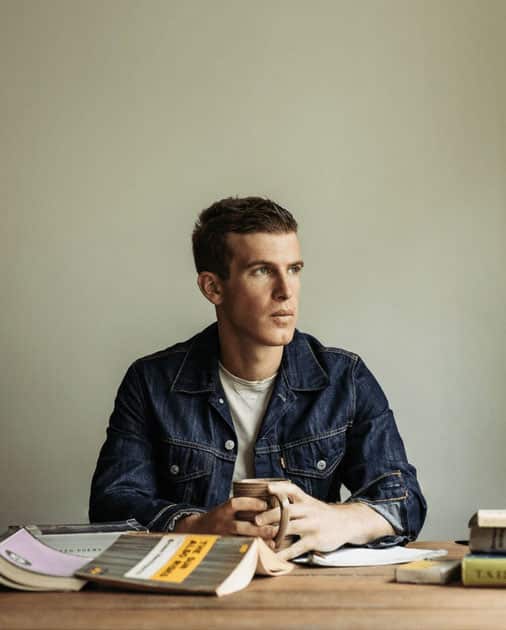
Many American Jews have long considered Israel a nice place to visit – but they wouldn’t want to live there. As Israel flourishes, outscoring America on the international happiness index, the reasons for this reluctance keep vanishing. But military service remains one of Israeli life’s most daunting elements. Few American Jews would trade their student IDs for IDF dogtags – even fewer would consider serving post-college with a bunch of 18-year-old Israelis. Ben Bastomski’s willingness to make that leap – after graduating from Brown University – provides the central dramatic tension in his charming, compelling memoir, just published by Delphinium Books, “As Figs in Autumn.”

Unlike many military memoirs, rather than ending tragically, this book begins in death. In February 2010, a drunk driver near the Brown campus killed the author’s childhood friend, Avi Schaefer. Avi and Ben had just reunited months earlier, three years after Avi began serving as a lone soldier with his twin brother Yoav, in the Israel Defense Forces, Tzahal, before enrolling at Brown.

The irony of surviving three years in Israel’s counterterrorism unit only to be run over by a car in college, intensified the heartbreak. So, to honor his 21-year-old friend, after graduating Ben also enlisted as a lone soldier. This profound act of forever-friendship left most people in Ben’s life thinking he was nuts. And, as the book demonstrates, this young, sensitive idealist had no idea what he was getting into.

His memoir explores the many differences between Israeli and American life in general, along with the peculiarities of IDF service itself.  It’s also a useful primer for lone soldiers-to-be, or any prospective recruits. You learn tricks of the trade, like keeping “Johnson’s baby power on hand” for long marches, and the realities of army life, like the fact that you can taste the difference when the army cook actually cares about the soldiers – having been sidelined from combat by injury.

The title “As Figs in Autumn,” captures the book’s harmonious and interlocking sensibility. As still happens, even in high-tech, ever-modernizing Israel, various Israelis “adopt” Ben in old-school fashion. The first, Eli, a “family friend twice removed who had not ever known my name, took me in and gave me warmth, light, and shelter befitting a native son.”

Before Ben enlists, Eli reads him a Hebrew poem, “A Man in His Life,” translating it into English spontaneously. The majestic poet Yehuda Amichai envisions each man dying “as figs die in autumn, shriveled and full of himself and sweet, the leaves growing dry on the ground, the bare branches already pointing to the place where there’s time for everything.” Amichai – and through his book, Ben – challenge us to think about how we can make our little time on Earth most meaningful.

This first-time author has a keen eye for detail and tells a good story. He also loves language. Ben’s foreign ear, for example, delights in the linguistic overlap between “neshek,” Hebrew for weapon, and “neshika,” kiss.

“The two,” he writes, “are attached at the hip, a mere molecular twist apart. When I discovered this twinning in the thralls of basic [training], it was perverse to the ear—but by the time I had surrendered my rifle, it was an unvarnished truth.” Beyond appreciating the irony, Ben, who became a trained sharpshooter, teaches non-Israelis every Israeli soldier’s prime directive: that misplacing your weapon is “among the more contemptible atrocities a Tzahal soldier may commit.”

Ben peppers the text with everyday Israeli expressions and that bizarre argot, Tzahal-speak, a barrage of idioms and acronyms. Providing that insider’s guide, experientially, emotionally, and linguistically, this glimpse into this alternate universe is what makes the book most compelling.

I never served in the IDF, but my four children have. When they were drafted, I knew they would be risking life and limb for their country and our people.  I also appreciated the contrast between the absolute freedom and relatively-low stakes of my own academic life, and the many ways they uncomplainingly sacrificed their privacy, their autonomy, and that devil-may-care insouciance that can be so enriching during young adulthood.

Ben most appreciates that stretch – after serving. “I was free now,” he writes, “entitled not just to live my life as I wished, but to keep it.” Upon being discharged, this seems “the surest difference between soldier and citizen. To be sure, a citizen’s profession may impose myriad restrictions or even hazards to his life—but only the soldier waives the lawful right to have his. Soldierhood, at bottom, is a candidacy for death on behalf of the citizen, to whom he has allowed a mortgage on his very breath.”

That insight leads to his thought-provoking definition of a demobilized soldier as someone being “returned” to “his life’s full possession.”

As a father, I discovered another, unexpected dimension to the high costs our kids pay for having the persistent enemies we do. What I didn’t realize until I witnessed it was just how crushing it can be to be a line worker at such a tender age in what I now think of as “IDF Inc.”

Armies are complex bureaucracies. Military life involves being managed second-by-second, often by kids themselves, and far too often by petty tyrants of all ages. The “chain of command” is an apt phrase. Shelving your freedom, your creativity, your individuality, while kowtowing to superiors, is hard for anyone. It’s especially trying for an American volunteer parachuting into this foreign culture and accepting this unexpected, alternative, burden, with minimal preparation – even as many friends back home continue to indulge their every whim.

Fortunately, in most cases the resulting character-building payoffs more than compensate for what you surrender in career-development and personal comfort. And, as this book proves, all the sweat and stress and strain doesn’t prevent soldiers, including Ben, from having plenty of fun with their band of brothers every time they’re on leave.

This book also uncovers the secret to what Israelis call “sherut mashmaooti” (a meaningful service)– it’s your fellow soldiers. Blessed, occasionally, by wise and reasonable commanders, while always cocooned by supportive and fun-loving comrades, Ben builds a new family-in-arms. Having a common mission and certain shared values helps. But the key is in the chemistry they develop amid their intertwined fate, morning, noon, and night.

This otherwise clear, philosophical and captivating book concludes somewhat ambiguously. The talented author makes it into Harvard Law School. But, torn, he bursts into tears one day during Civil Procedure class, and fears becoming a “colorless and flaccid” big-time partner enslaved to “dry” work and super-rich clients quibbling over pocket-change to them. He ends the book with a return visit to Israel.

The Author’s Note says that Ben “moved to Santa Monica, CA to practice law after graduating from Harvard Law School in 2015. In the years since, Ben has become an accomplished civil litigator, while pursuing a parallel career as a fashion model with a Los Angeles talent agency. He has recently returned to live in Israel.”

I wasn’t looking for a cliche Zionist ending, but perhaps a little more closure. Whether or not Ben moved to Israel or decided to stay in America, we, the readers, and the story itself, would have loved to hear more about why he did what he did. With the “do I or don’t I” make Aliyah question hovering throughout the book, leaving it unresolved or unexplained leaves us wanting more.

Of course, finishing a 244-page memoir by a rookie author, and hungering for more, exposes this “complaint” as a great compliment. At this moment, with so many lonely, alienated, drifting young people, living in angry, mistrustful, polarizing democracies, this book is a welcome balm. It’s an ode to friendship, community, and common purpose. It’s a chronicle of character, trust, patriotism, and unity. It exudes love of the land, of the Jewish state, of the Jewish people, and of humanity. All of that makes “As Figs in Autumn” a timeless celebration of Zionism and Israeliness at their best – wherever the author chooses to live.


Gil Troy is the editor of the new three-volume set Theodor Herzl: Zionist Writings, the inaugural publication of The Library of the Jewish People (www.theljp.org).  

An American College Grad Finds Himself in the Israeli Army Read More »