fbpx

August 24, 2023

Newsom Warns Schools Not to Adopt Ethnic Studies Curriculum Promoting “Bias, Bigotry, or Discrimination”

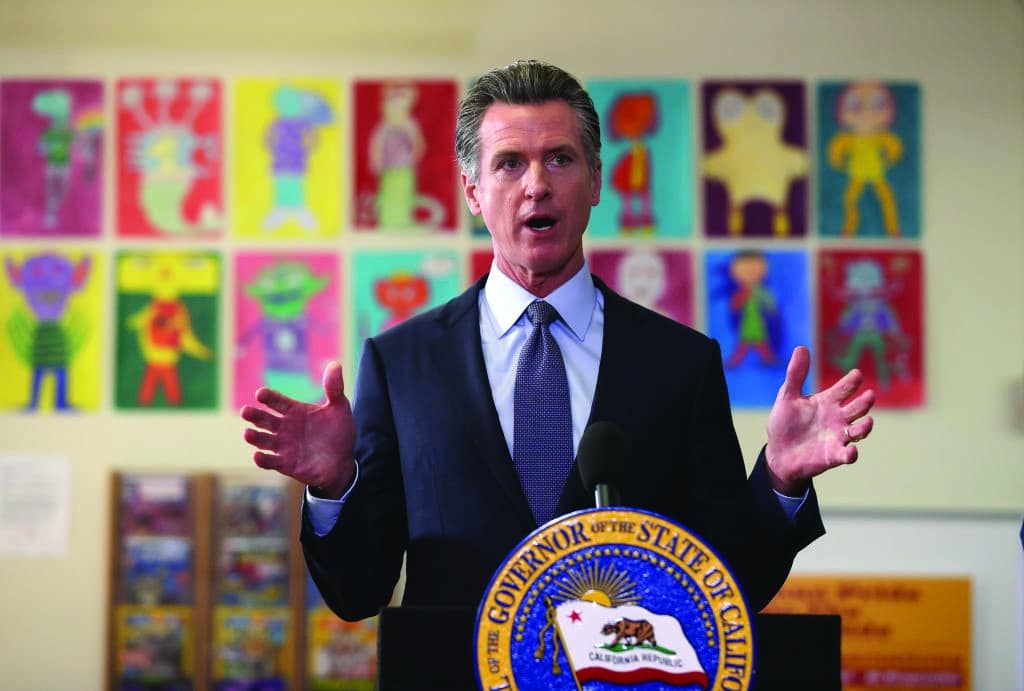
California Governor Gavin Newsom (D) issued a letter on Wednesday warning schools not to adopt any ethnic studies curriculum that promotes “bias, bigotry or discrimination.”

The full letter, authored by Newsom Education Policy Adviser Brooks Allen, stated that the Ethnic Studies Model Curriculum “is grounded in the foundational curricular areas of the ethnic studies tradition––African American Studies, Native American Studies, Asian/Pacific Islander American Studies, and Latinx American Studies. The focus on the experiences of these four disciplines provides an opportunity for students to learn of the histories, cultures, struggles, and contributions to American society of these historically marginalized peoples.” Additionally, the curriculum “includes lesson plans on many communities, including Filipino Americans, Jewish Americans, Arab Americans, Sikh Americans, Armenian Americans and others,” Allen wrote.

Allen, who is also the executive director of the State Board of Education, noted that under AB 101, schools will be required to offer a semester-long ethnic studies course to students in 9th-12th grade starting in the 2025-26 academic year and then such courses will be a graduation requirement in the 2029-30 academic year. But AB 101 also states that any ethnic studies curriculum adopted by schools cannot “reflect or promote, directly or indirectly, any bias, bigotry, or discrimination against any person or group of persons on the basis of any category.” “Vendors have begun promoting curriculum for [local education agencies] to use for ethnic studies courses. We have been advised, however, that some vendors are offering materials that may not meet the requirements of AB 101,” Allen wrote, arguing that was particularly true regarding the requirement that the curriculum can’t promote “bias, bigotry or discrimination.”

“Accordingly, before any curriculum or instructional materials for ethnic studies courses are selected, we strongly encourage you to closely scrutinize them to ensure that they meet the above requirements,” wrote Allen.

Jewish groups praised the letter. “We appreciate the commitment that Governor Newsom and the State Board of Education have shown to ensure fair and equitable treatment for Jewish—and all students—in our K-12 public schools,” Jewish Community Relations Council (JCRC) Bay Area said in a statement, adding that the letter came “after advocacy by a statewide Jewish coalition led by the Jewish Public Affairs Committee of California (JPAC) on the enforcement of important guardrails included in AB 101, which made ethnic studies a graduation requirement in California. Over the summer, leaders from JCRC Bay Area, JPAC [Jewish Public Affairs Committee of California], and our partners met with the Governor’s office to discuss how some districts, in their implementation of new ethnic studies curriculums, are working with independent contractors and organizations that promote bias against Jews, Judaism, and Israel.”

JPAC Executive Director David Bocarsly said in a statement, “We thank Governor Newsom and the State Board of Education for delivering yet again with this letter. The Governor has been a consistent ally to the Jewish community, particularly throughout the Ethnic Studies Model Curriculum (ESMC) development process. There is still a lot of work ahead to implement robust ethnic studies courses across California’s schools that are also free from antisemitism and anti-Zionism. This is a major step in the right direction, and we know the Governor will continue to work with us in this effort.”

Anti-Defamation League (ADL) Western Division Vice President Robert Trestan also said in a statement, “This is a welcome important first step and we will continue working with the Governor’s Office, Attorney General, and [the California Department of Education] to find remedies in ensuring that Districts develop a pedagogically sound Ethnic Studies course that is free of antisemitism and anti-Israel animus. ​We encourage districts to take the letter and guidance it provides seriously.​”

The American Jewish Committee (AJC) said in a statement, “The steps announced by Governor Newsom to tackle hate crimes are both welcome and needed, especially when bias attacks against religious and ethnic groups are increasing. AJC also supports the governor’s call for ethnic studies courses that are taught in a non-discriminatory fashion using the curriculum adopted by California in 2021 that focuses on the history, culture and many contributions of historically marginalized groups to the fabric of American society. We urge the state and local school districts to unequivocally reject Liberated Ethnic Studies instructional materials that are guided by political ideology rather than an historical foundation and are riddled with bias and antisemitism. They should have no place in California classrooms.”

StandWithUs CEO and Co-Founder Roz Rothstein said in a statement to the Journal, “We are grateful to the Governor’s office for reminding districts of their responsibility to keep bigotry out of the classroom. We hope this will be followed by additional efforts to prevent ethnic studies courses from being exploited by extremists who seek to institutionalize antisemitism and other forms of bias in California’s public education system. Additionally, we urge all schools to proactively teach their students about Jews, including their struggles and their contributions to American society. Ignorance is what allows hatred to spread, and the best antidote is more and better education.”

L. Rachel Lerman, vice chair and general counsel at the Louis D. Brandeis Center for Human Rights Under Law, also said in a statement to the Journal, “Despite efforts by the Governor and California legislators, a handful of California school districts have begun including blatantly antisemitic materials in their ethnic studies’ curricula. This is incredibly dangerous, and we very much appreciate the Governor’s office stepping in here. We have been working with the Jewish community in many of these districts as well as alerting schools to the legal consequences of using such bigoted and illegal materials in the classroom, and we will continue to do so.”

AMCHA Initiative Director Tammi Rossman-Benjamin, on the other hand, argued in a statement to the Journal, “While we appreciate Governor Newsom’s letter, instead of dancing around it, he should explicitly acknowledge the elephant in the room: School districts are adopting anti-Jewish and anti-Zionist curricula and contracting with consultants who vehemently believe anti-Jewish and anti-Zionist sentiments are part and parcel of ethnic studies. Moreover, Governor Newsom leaves out the bill’s most explicit guardrail: Ethnic studies courses should not include portions of the initial draft curriculum rejected by the Instructional Quality Commission due to concerns of bias, bigotry, and discrimination. Governor Newsom’s letter serves to dilute, rather than reinforce, AB 101’s guardrails and will only confuse school districts about what, exactly, must be guarded against.” But, in Rossman-Benjamin’s view, the letter does have “one silver lining.” “The letter states the bill ‘anticipates … ethnic studies will be required,’ instead of saying it ‘mandates’ or ‘requires’ students take ethnic studies. This is important,” she said. “It suggests AB 101 may actually not yet be operative, since the bill itself stipulates it is ‘operative only upon an appropriation of funds by the Legislature,’ which has not yet happened. California legislators control the purse strings and they should refuse to appropriate any funds toward AB 101 until they can guarantee antisemitic curricula will not be brought into any classrooms.”

Allen’s letter was part of a series of actions taken by Newsom to combat hate, which also included sending $91.4 million in grants to 173 organizations to provide aid to survivors of hate as well implement measures to prevent acts of hate. Newsom also announced a “CA vs Hate” media campaign.

“An attack on any of our communities is an attack on everything we stand for as Californians,” Newsom said in a statement. “As hate-fueled rhetoric drives increasing acts of bigotry and violence, California is taking action to protect those who are targeted just for being who they are. We’re bolstering our support for victims and anti-hate programs and tackling ignorance and intolerance through education to prevent hate from taking hold in our communities.”

Newsom Warns Schools Not to Adopt Ethnic Studies Curriculum Promoting “Bias, Bigotry, or Discrimination” Read More »

Free Lemons! – A poem for Parsha Ki Teitzei

When you enter your neighbor’s vineyard, you may eat as many grapes as you desire, until you are sated …
          Deuteronomy 23:25

In a famous The Simpsons episode
(famous to me because I remember it)
Homer is turned away from the

all you can eat buffet after the restaurant
realizes they weren’t prepared for
his appetite. He says, as he’s

dragged out of the dining room
long after the restaurant has closed
but the sign said ‘all you can eat.’

Can you imagine if we took advantage
of what was promised? We could
wander into our neighbor’s yard

and eat all we want. (While on
the premises…it’s very specific
that we can’t cart anything away.)

Is this limited only to food or are
anyone’s nearby possessions fair game?
Can I head to the neighbors

and enjoy all the streaming content
I want? How about their underwear?
(If I promise to only wear it

on the property?) Is our very concept
of ownership at question? Or,
better yet, shouldn’t it be?

Especially when so many have
so little. I keep hearing that
billionaires could end poverty

without changing their lifestyles?
Why don’t they? I read another article
which explains why the don’t.

But I prefer the message of the first one.
I’ve got a lemon tree
in my back yard.

It gives me more than I need.
The gates are unlocked.
Have at it.


Rick Lupert, a poet, songleader and graphic designer, is the author of 27 books including “God Wrestler: A Poem for Every Torah Portion.”

Free Lemons! – A poem for Parsha Ki Teitzei Read More »

A Bisl Torah – Hearing the Call

Many of us look forward to Rosh Hashana to hear the blasts of the shofar. The shofar’s blasts, a set of notes that often connote brokenness, awaken us to crying. Our internal cries and the cries of those within our community and around the world. Writes Rabbi Shimon Apisdorf, “The call of the shofar is the sound that wakes us up so that we will make a choice for clarity, for awareness, for a fully constructive and purposeful life.”

But what happens when we don’t blow the shofar? This year, Rosh Hashana falls on Shabbat. According to Jewish law, we don’t blow the shofar on Shabbat. Come to services on the second day of Rosh Hashana, you will see the familiar ram’s horn and hear a tekiah. But not on Friday evening or Saturday morning. How do we celebrate Rosh Hashana without one of the most central images, sounds and experiences?

Simple. When you cannot hear the shofar, be the shofar. As it is said in Pirkei Avot, “In a place where there are no men, strive to be a man.” What does it mean to be a shofar? Where we see brokenness, let us not merely recognize pain but also be willing to act as a comforter. Where we see abuse, let us not close our eyes to the injustice experienced by others. Where we see opportunities to be a light unto others, let us not expect someone else to provide the match. Being a shofar is raising our hand to be called upon as God’s messenger, God’s partner, God’s amplifier of goodness.

We rarely hear the actual shofar. The days of Elul and Rosh Hashana and end of Yom Kippur are yet but a reminder of what we should already know. There is an alarm clock within each of us ready to ring. The question is whether we will silence the alarm or heed its call.

Shabbat Shalom


Rabbi Nicole Guzik is senior rabbi at Sinai Temple. She can be reached at her Facebook page at Rabbi Nicole Guzik or on Instagram @rabbiguzik. For more writings, visit Rabbi Guzik’s blog section from Sinai Temple’s website.

A Bisl Torah – Hearing the Call Read More »

A Moment in Time: Still Small Voice

Dear all,

With the fires in Maui, coupled with the hurricane and the earthquake in Southern California, I am reminded of Elijah’s spiritual encounter in 1 Kings:

“Then God said, “Go out, and stand on the mountain before Adonai.” And behold, Adonai passed by, and a great and strong wind tore into the mountains and broke the rocks in pieces before Adonai, but Adonai was not in the wind; and after the wind an earthquake, but Adonai was not in the earthquake; 12 and after the earthquake a fire, but Adonai was not in the fire; and after the fire [a] still small voice.” (I Kings 19: 11-13)

The fire, hurricane, the earthquake – these have nothing to do with God.

How humans respond to the still small voice…. In any given moment in time, THAT has everything to do with God.

With love and shalom,

Rabbi Zach Shapiro

A Moment in Time: Still Small Voice Read More »

Republican Debate Gets Heated on Topics of Ukraine, Israel

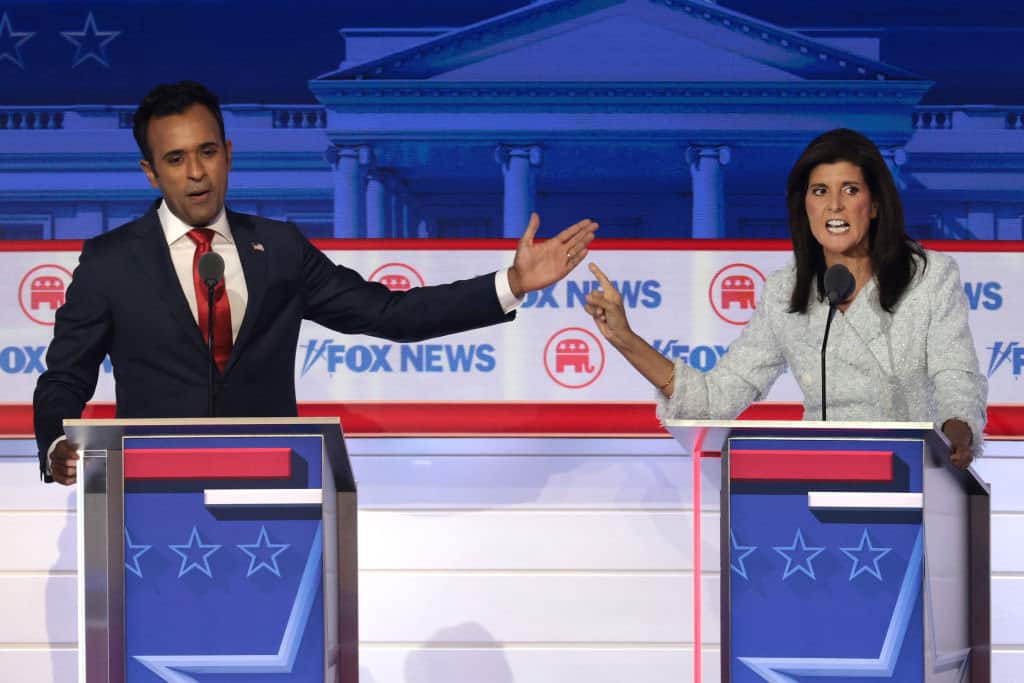
One of the most heated exchanges between the eight candidates at the Republican Presidential Primary debate on Wednesday was between former South Carolina Governor Nikki Haley and businessman and entrepreneur Vivek Ramaswamy.

Their pointed clash on foreign policy touched on a number of issues in a span of two minutes, particularly Ukraine and Israel.

Ramaswamy was the only candidate who raised his hand when asked who, if elected President, would not support more U.S. funding for Ukraine. On August 9th, Ramaswamy appeared on the “Stay Free with Russell Brand” podcast, where he advocated phasing out U.S. financial aid for Israel:

“I want to get Israel to the place where it is negotiated back into the infrastructure of the rest of the Middle East,” Ramaswamy said. “We should not be worried about holding one nation or one region hostage over one particular question relating to Palestine. Go to Abraham Accords 2.0. That’s good for Israel, it’s good for the rest of the Middle East, it’s good for us such that, come 2028, that additional aid won’t be necessary in order to still have the kind of stability that we’d actually have in the Middle East, by having Israel more integrated in with its partners.”

Haley’s last government job was as United States Ambassador to the United Nations in the Trump Administration from 2017-2018. She has been on record as a staunch supporter of the U.S.-Israel relationship. And Haley has also called out the claim from Florida Governor Ron DeSantis that the War in Ukraine is merely a “territorial dispute.”

It all came to a head a little over two hours into the August 23rd Republican Primary Debate, when Haley took a foreign policy question from co-moderator and Fox News host Martha MacCallum.

MacCallum asked, “You have said of Governor DeSantis that you didn’t appreciate it when he initially called it a ‘territorial dispute.’ Why?” 

Haley responded, “First of all, the American President needs to have moral clarity. They need to know the difference between right and wrong. They need to know the difference between good and evil. When you look at the situation with Russia and Ukraine, here you have a pro-American country that was invaded by a thug. So when you want to talk about what has been given to Ukraine, less than 3.5% of our defense budget has been given to Ukraine. If you look at the percentages per GDP, 11 of the European countries have given more than the U.S. But what’s really important is go back to when China and Russia held hands, shook hands before the Olympics and named themselves unlimited partners. A win for Russia is a win for China. We have to know that Ukraine is the first line of defense for us.”

Haley then took a swipe at Ramaswamy.

“And the problem that Vivek doesn’t understand is [Vivek] wants to hand Ukraine to Russia,” Haley said. “He wants to let China eat Taiwan. He wants to go and stop funding Israel. You don’t do that to friends. What you do instead is you have the backs of your friends. Ukraine is the front line of defense. Putin has said if Russia … once Russia takes Ukraine, Poland and the Baltics are next, that’s a World War. We’re trying to prevent war. Look at what Putin did today. He killed (Wagner Group leader Yevgeny) Prigozhin. When I was at the U.N., the Russian ambassador suddenly died. This guy is a murderer and you are choosing a murderer over a pro-American country.”

As applause broke out, a load of crosstalk and finger pointing escalated between the two.

Ramaswamy told Haley, “Governor, I wish you well in your future career on the boards of Lockheed and Raytheon.” She replied that she is not on the boards of the two companies.

“But the fact of the matter” he told her, “Boeing came off.”

Haley asked the biotech entrepreneur, “But you want to go and defund Israel? … You want to give Taiwan to China? You want to give Ukraine to Russia? He will make America less safe.”

Ramaswamy called Haley’s comments “the false lies of a professional politician.” He continued, “There you have it. So the reality is …” 

Haley interrupted him, adding emphatically, “Under your watch, you will make America less safe. You have no foreign policy experience and it shows.”

Ramaswamy, who repeatedly claimed the other candidates were bought and sold by Super PACS, said, “the foreign policy experience of the other candidates shows in the fruitless wars we’ve gotten into. You have to address that. So our relationship with Israel will never be stronger than by the end of my first term. But it’s not a client relationship, it’s a friendship. And you know what friends do? Friends help each other stand on their own two feet. So I will lead Abraham Accords 2.0. I will partner with Israel to make sure Iran never is nuclear armed. But you know what I love about Israel — and I’ve been there probably, in the last ten years, more than most people on this stage. You know what I love about them? I love their border policies. I love their tough on crime policies. I love that they have a national identity and an Iron Dome to protect their homeland. And so yes, I want to learn from the friends that we’re supporting, and what puzzles me…”

Haley interrupted, “you want to cut the aid off.”

Undeterred, Ramaswamy continued, “we have to learn from those and apply those to protect our homeland, Nikki. That is the answer…”

Haley responded, “It’s not that Israel needs America, America needs Israel. They are the frontline defense to Iran.”

The debate raged on for another hour. It should also be noted that Arkansas Governor Asa Hutchinson wore a lapel pin with the flags of Israel and the United States. During his two terms as Governor, Hutchinson visited Israel four times and has often praised the value of their relationship with the United States.

Other participants in the debate were North Dakota Governor Doug Burgum, former New Jersey Governor Chris Christie, Florida Governor Ron DeSantis, former Vice President Mike Pence, and U.S. Senator Tim Scott of South Carolina. Former President Donald Trump chose not to attend the debate. An Emerson College poll from August 16-17th shows that Trump leads the field with a massive 56% support of surveyed voters. The same poll showed DeSantis and Ramaswamy tied at 10%, Pence at 3%, Haley at 2%, Christie at 3%, and Hutchinson and Burgum both at 1%.


This was the first Republican debate of the 2024 presidential campaign. The debate took place at the Fiserv Forum in Milwaukee, Wisconsin, home of the NBA’s Milwaukee Bucks. The Republican National Convention will be held in Milwaukee. Wisconsin voted for the Democratic candidate in eight of the last nine Presidential elections—the state was carried by former president Trump in 2016.  Since 2000, four of the last six Presidential elections in Wisconsin were decided by less than 2% of the vote. President Barack Obama was the last candidate to win Wisconsin by a sizable margin, in 2008 and 2012.

The first test for the Republican candidates is on January 15, 2024 with the Iowa Caucus. The first Democratic primary will be in South Carolina on February 3, 2024. California’s Presidential Primary Election is on March 5, 2024.

The next Republican debate is scheduled to be held at the Ronald Reagan Presidential Library in Simi Valley September 27th.

Republican Debate Gets Heated on Topics of Ukraine, Israel Read More »

Bite Into the ‘Bonjour Chai’ Podcast with Avi Finegold

Rabbi Avi Finegold loves coming up with new and interesting ways to present Judaism to the world. As the founder of the Montreal-based adult education initiative, Jewish Living Lab, Finegold has anchored the weekly “Bonjour Chai” podcast since its debut in March 2021.

“I love podcasts,” Finegold told the Journal. “I’ve always listened to them.”

At the beginning of the pandemic, a podcast was an easy way to reach people – and it’s proven to still be a great way to communicate with an audience.

“You can prepare a class and [it’s] a smashing success to get 20 people to show up to an event on a Tuesday night,” Finegold said. ”If I put out a podcast and 100 people listen to it, by podcast standards it’s [not great], but that’s five times as many people.”

A cornerstone project of the Canadian Jewish News, “Bonjour Chai” is co-hosted by Finegold and Phoebe Maltz Bovy, who was born and raised in New York and now lives in Toronto.

On the podcast, Finegold and Bovy share their takes on Jewish culture, society, parenting, politics, fashion, food and religion. With more than 110 episodes, some feature guests from across Canada and beyond, while others are the two of them talking about meaningful, Jewish topics.


“I find that we get to ask questions that I know people are asking themselves [and] each other, but not hearing [the answers] in a large communal setting,” Finegold said. “I’m the voice of so many of these [listeners], and that’s a big responsibility.”

Finegold, whose wife, Rachel Kohl Finegold, is also a rabbi, has been teaching Jews and Judaism for nearly 20 years.

“We tried once to have a pulpit … at the same time,” Finegold said. ”I was at one synagogue and she was at the other, and it was just too much. The logistics of it was a nightmare.”

He added, “I really liked the idea of having the entrepreneurial piece of being a rabbi, doing classes in unconditional settings, doing life cycles for people that aren’t otherwise members of synagogues … That became a big part of my rabbinic work.”

Finegold also produces podcasts for others, including “Verses,” which his wife co-hosts . On each episode they select a song from Broadway and match it with a selection from the Tanakh.

“It’s a lot of fun, and it’s a super niche podcast,” he said.

While you have to really be into both Broadway and Jewish text study to be able to deconstruct them, there’s an incredible community of people who listen to it.

“I realized that my energy was just so much better suited towards creating programs …  and podcasts like that,” he said.

“Bonjour Chai,” which has become Canada’s leading Jewish podcast, is not just for Canadians, but there is a Canadian slant.

“It’s become almost like an op-ed page,” Finegold said. “I have a co-host [who is] very secular, so we come from very different backgrounds. …

We look at what’s going on in the world, and we sometimes call out something that we don’t like or whatever it might be. And to me that’s a form of community building just as much as creating a class.”

Established in 1960, the Canadian Jewish News (CJN) is a not-for-profit, award-winning media organization. Their sister podcast, “The CJN Daily,” is 15 minutes long and comes out four times a week.

“It’s just like a brief news bit of what’s important that you need to know,” Finegold said. “And we’re the opinion page.”

Other CJN podcasts include “Menschwarmers,” billed as the world’s most popular Jewish sports podcast, and “Culturally Jewish,” where actors David Sklar and Ilana Zackon schmooze with creative Jews of all disciplines.

“Podcasting is an incredibly important medium for the future,” Finegold said. “Even though there’s so many podcasts out there… many quality ones still have yet to be born.”

Check out Avi Finegold’s conversation with Debra Eckerling on the Taste Buds with Deb podcast:

Bite Into the ‘Bonjour Chai’ Podcast with Avi Finegold Read More »

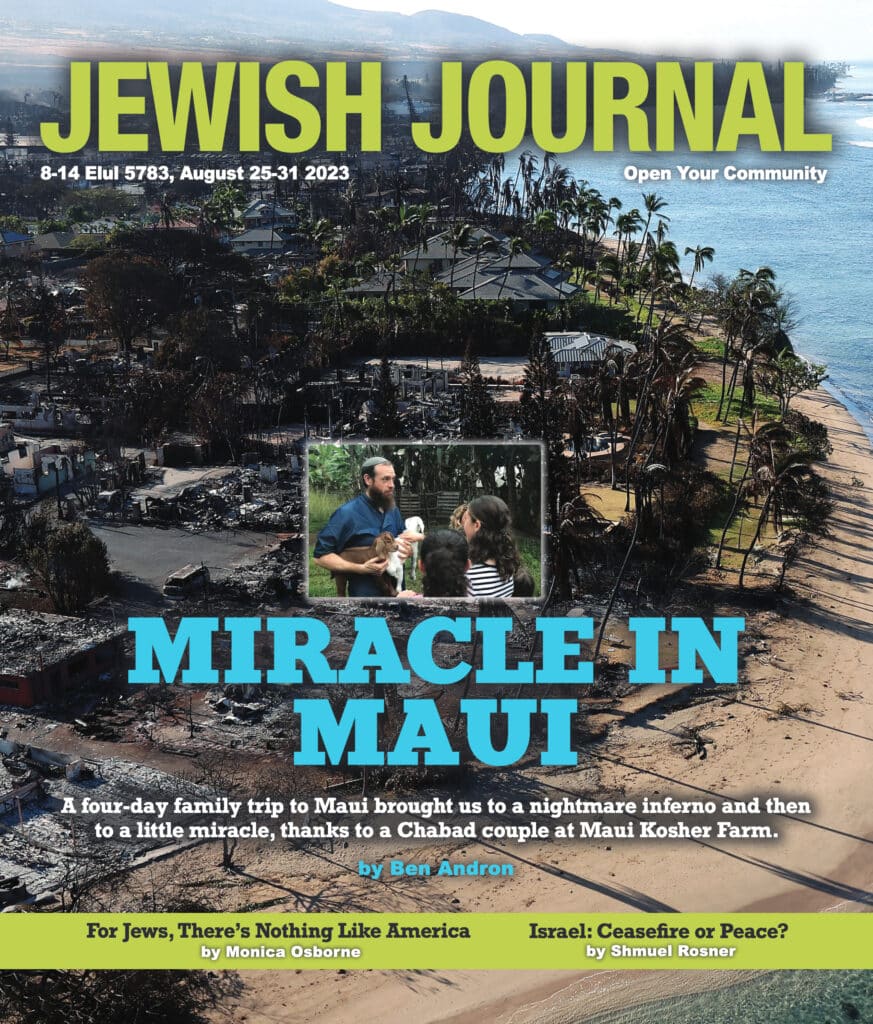
Print Issue: Miracle in Maui | Aug 25, 2023

CLICK HERE FOR FULLSCREEN VERSION

Print Issue: Miracle in Maui | Aug 25, 2023 Read More »

Inferno, Incompetence, and a Maui Miracle

Day after day, as residents of Lahaina on the island of Maui were caught in the deadliest U.S. wildfire in over a century, I kept looking for some hopeful news about emergency efforts and rescue missions. I didn’t see much.

Hawaii has a decades-old system of sirens, including 80 on the island of Maui that are tested monthly. But public safety employees reportedly failed to activate the sirens during the Lahaina wildfire.

Hawaii Gov. Josh Green said he wished sirens would have alerted residents to evacuate as the wildfire quickly spread through Lahaina, calling the response by the island’s now former emergency chief “utterly unsatisfactory to the world.”

As reported on the Cato Institute website, other aspects of the government’s response to the wildfire have come in for criticism. Firefighters initially controlled the blaze but reportedly left the scene before confirming it had been fully extinguished. The government apparently provided insufficient water to fight the fire as it expanded. After the fire, police reportedly prevented residents from returning to their homes to look for relatives, pets, and needed possessions.

Maui resident Allisen Medina told the Daily Mail on Aug. 18, “People have been doing their own recovery. One hundred percent not enough is being done so people are doing it themselves. The government relief organizations – they’re not doing anything.”

“We have the right to know what’s going on,” she added. “FEMA came here to help with the recovery [process] but we don’t see them.”

Perhaps the words that shook me the most were “the runway wasn’t cratered.” They were uttered by resident Dennis Mullen on the day President Biden visited the disaster zone, 13 days after the tragedy that killed at least 114 people, with more than 1000 people still unaccounted for.

“Any number of military aircraft, planes and helicopters could have flown in here,” Mullen told the New York Post. “To leave a town that was just devastated shut down was just ridiculous. The runway wasn’t cratered.”

It’s always frustrating to see our government fail our people during natural disasters. I felt the same way when President George W. Bush dragged his feet during Hurricane Katrina. It’s not just frustrating. It can be infuriating.

So, you can imagine my surprise when I heard the story of Los Angeles resident Ben Andron’s family trip to Maui right before the wildfire hit.

“Tuesday, August 8th, we woke up in our beautiful Ka’anapali villa (just a few miles north of Lahaina) to find the power out and the most intense wind pounding against the windows,” Andron writes in this week’s cover story. “Traffic was very intense with road closures and detours … We lost count of how many downed power lines we passed.”

Andron called his story “Miracle in Maui” because he came across Rabbi Mendel Zirkind and his wife Chana, a Chabad couple who moved to the area six years ago. During that time, they managed to create a little Jewish oasis called Maui Kosher Farm.

Andron called his story “Miracle in Maui” because he came across Rabbi Mendel Zirkind and his wife Chana, a Chabad couple who moved to the area six years ago. During that time, they managed to create a little Jewish oasis called Maui Kosher Farm.

As you’ll read in Andron’s story, it is that farm that became his family’s miracle in Maui.

“Their mission was to create a Jewish anchor in a region devoid of one: to provide kosher food to locals and tourists who need it, to help the largely-unaffiliated Jews of Maui get closer to their roots and to help Jews from all over connect to the land in this beautiful paradise,” is how Andron describes this unlikely Jewish center in the midst of nature.

The problem is that it wasn’t easy getting there. Andron recalls a text from the rabbi that read as follows: “We’re right after the 10th speed bump on Malaihi Rd. If you don’t count the speed bumps and follow GPS you will get lost in the mountains.”

There’s something special about a rabbi who studies Torah for years, and then one day, the most important thing in his life is to tell a Jew visiting from Los Angeles that if he doesn’t count the speed bumps and follow GPS, he’ll get “lost in the mountains.”

There’s something special about a rabbi who studies Torah for years, and then one day, the most important thing in his life is to tell a Jew visiting from Los Angeles that if he doesn’t count the speed bumps and follow GPS, he’ll get “lost in the mountains.”

My heart aches at the many lives lost and traumatized in the Maui tragedy. And yet, there’s also room in my heart for gratitude at the kind and competent people who built Maui Kosher Farm, perhaps not knowing that one day, that farm would be the center of a Jewish miracle.

Inferno, Incompetence, and a Maui Miracle Read More »

Creative Aging: Why I Need to Apologize

13th in a series.

If I could go back in time, I’d have to apologize. 

And now is the time. It’s the Hebrew month of Elul, just before Rosh Hashanah, when we are supposed to be reassessing everything. 

I apologize for my combative hubris over many years when family members and friends often became irritated with my youthful (defined as up till the age of 60) extreme liberal beliefs. They told me I would moderate as I aged. Their thinking irritated me, as well as the predictions about how I would change.  

They were right. 

Today, among my intellectual and emotional challenges is the consistent weighing of my reactions and thoughts in the political and social justice arenas. What do I still embrace? What do I let go? What do I now let in? How open am I to different thinking? 

Recently, I had some substantive conversations with Jewish organizations considered right wing. When I asked them about being labeled as right-wing organizations, each one told me they don’t define themselves that way. Just because they are fighting antisemitism, the delegitimization of Israel and terrorism, they explained, does not make them a right-wing organization. They are fighting on behalf of the rights of the Jewish people. After all my years active with left wing organizations, I believe that if I was to ask those groups if they are left wing, they would proudly stand up saying, “Hell, yes,” flashing that badge on and off. 

It was a real awakening.

Life was more comfortable when I defined myself as left and others as right, when I was certain of what I thought and advocated, when my box was well-fortified and I breathed the air deep inside it. It was easier when I could dismiss everything that didn’t fit, labeling it as unjust. I surrounded myself with people who thought similarly and we were all there to reaffirm for one another that we were the ones on the right path. It was exciting when we could demonize our detractors as enemies, arming ourselves with words, articles, speeches and ideas for the righteous battle.

Today, I have little tolerance for those who identify as right or left, both talking like they hold an absolute truth on either side. Who holds truth in opinions? No one.

Today, I have little tolerance for those who identify as right or left, both talking like they hold an absolute truth on either side. 

Who holds truth in opinions? No one. An opinion is not a truth. It’s … an opinion. Even from the most respected and praiseworthy thinkers. That’s very different than who tells lies. Lies can actually be substantiated as lies.

If there is anything we learn from studying Jewish texts, raising the question — the exploration — is everything. Even holy. Answers are relative and debatable. Yet, how secure are we to ask questions about our deepest held beliefs? To question our most revered teachers, writers, politicians and religious leaders? Alive and dead. 

After all my questioning, I find I still hold to some of my old opinions. And believe in some new ones. 

Donald Trump is disastrous for America. Abortion is a woman’s right. Racism is an evil. There needs to be a Palestinian state. Israel’s democracy protests are extraordinary. There is a right to question Israel’s policies. Trans people have rights. Climate change is real. I like Democrats Mazie Hirono (Hawaii) and Jamie Raskin (Md.). 

Does all that make me left? 

I also believe that many of the recent methodologies to root out racism tend towards being revenge tactics, racism itself. After having taught in a university, I believe DEI infantilizes and weakens the very people it means to strengthen, and has become more of the bottom line than education itself. I believe that antisemitism in America, both on the extreme right and the extreme left, are equally dangerous to the Jewish community, just the same way these extremes are equally dangerous to America. I believe much of the criticism of Israel stems from antisemitism. I don’t want to be intimidated by pronoun culture. I don’t think that kids below the age of 18 should be getting hormone treatments for transition.  I think Republicans Adam Kinzinger and Will Hurd are smart guys. 

Does all that make me right? 

What do these labels mean? What does adhering to them say? 

The questions are everything. 

To all those who told me so, it’s Elul and I apologize.


Gary Wexler woke up one morning and found he had morphed into an old Jewish guy.

Creative Aging: Why I Need to Apologize Read More »

Moses Was No Imposter; I Bet Neither Are You

A 2021 report from the American Psychological Association (APA) contains some disheartening news: “Up to 82% of people face feelings of imposter phenomenon, struggling with the sense they haven’t earned what they’ve achieved and are a fraud. These feelings can contribute to increased anxiety and depression, less risk-taking in careers, and career burnout.”  Eighty-two percent!

Moses would have fit right into contemporary American society. When he was enlisted to play what was one of the most important roles in Jewish history, he wanted no part of it. “Who am I that I should go to Pharaoh and free the Israelites from Egypt?”  Even after G-d’s assurance that “I will be with you,” Moses tried to convince the Lord that he had the wrong man.  After all, Moses reported, “I have never been good with words … I am slow of speech and slow of tongue.” So, “Please O my lord, make someone else Your agent.” 

Moses seems to have suffered from “Imposter Syndrome,” some 3,300 years before that term was even coined.  While it led him to “less risk-taking” in his “career,” in the end, he got the job done.  G-d had seen something in Moses that Moses hadn’t seen in himself.

When you have some success, don’t brush it off as inconsequential – take the time to applaud yourself. You might just end up feeling that while there are imposters in the room, you aren’t one of them.

The APA study goes on to suggest ways to conquer imposter feelings. For one, take stock of the facts. There was probably a very good reason why you were offered new responsibilities.  You likely deserve it, whether you acknowledge it or not. And when you have some success, don’t brush it off as inconsequential – take the time to applaud yourself. You might just end up feeling that while there are imposters in the room, you aren’t one of them.

That reminds me of one of my favorite (perhaps apocryphal) Harry Truman stories.  When Truman, who never graduated from college, was elected senator in 1934, he was trying to dig out from debts incurred from a failed haberdashery store.  As a result of his modest background, he was filled with dread the day he first stepped into the Senate Chamber. But he quickly recovered.  When he looked around at his fellow senators during his first senate session, he thought to himself “What am I doing here?”  Six months later he looked around and thought “What are they doing here?” 

A friend of mine, a successful television executive, suffered from imposter feelings early in her career. She used her degree in broadcast journalism to get a job as a news writer and on-air reporter in several local markets. One day, her producer told her that she was “too Jewish” to be in front of the camera.  She was furious, but agreed that her greatest strengths were behind the scenes. Her big break was being hired to produce a talk show.  The network decided to raise the host’s national stature, and my friend was a member of the production team that flew to New York City for a meeting with the top brass.  She was petrified, feeling completely out of her league.  But once the discussion began she presented her ideas, which the executives loved.  She says that her imposter syndrome disappeared that day.  She realized that she deserved to be in that room, and she celebrated her success.  The APA would have been proud.

As for Moses, it wasn’t all smooth sailing.  Losing his temper cost him the opportunity to enter the Promised Land. Nonetheless, he turned out to be the extraordinarily effective leader that G-d had envisioned.  

The Torah concludes with a beautiful tribute: “Never again did there arise in Israel a prophet like Moses – whom the Lord singled out, face to face, for the various signs and portents that the Lord sent him to display in the land of Egypt, against Pharaoh and all his courtiers and his whole country, and for the great might and awesome power that Moses displayed before all Israel.”

Who could possibly ask for a more glowing obituary than that!  

Moses wasn’t an imposter after all.  And I bet neither are you.


Morton Schapiro is the former President of Williams College and Northwestern University.  His most recent book (with Gary Saul Morson) is “Minds Wide Shut: How the New Fundamentalisms Divide Us.”

Moses Was No Imposter; I Bet Neither Are You Read More »