Across the Atlantic and all of Europe, in the architecturally and culturally resplendent center of Azerbaijan’s capital city of Baku, a new project is underway in what is perhaps the most posh neighborhood in town. Directly beside Baku’s Synagogue for the Mountain Jewish Community, a ten acre plot of prime real estate has been donated and publicly designated for the upcoming development of a cutting-edge Jewish Cultural Center. Announced earlier this month and expected to unveil in late 2024, this entire project and the parcel that it will call home, has been initiated and funded by the state at the instruction of Azerbaijan’s President Ilham Aliyev.
With plans to provide a variety of frequent classes for youth, adults, families and seniors alike, including the study of Torah, and both Hebrew and Juhuri, the ancient language of Azerbaijan’s Mountainous Jewish community, the center will include a kosher restaurant and social, meeting and event venues. For the approximately 30,000 Jews residing in Azerbaijan, and the ever growing confluence of Israeli and world travelers visiting Baku every year, the upcoming Jewish Cultural Center will be a living touchstone of national Jewish identity; an unbridled action of acceptance and celebration of Jewish life in Azerbaijan.
Distinctive in the entire world, Azerbaijan, a 96% majority-Muslim nation, approaches its Jewish community in ways that we can only dream of in the US and Europe, and many other places in the world. Yet this is far from new. For nearly two milenia, since the destruction of the second temple in Jerusalem and the accompanying exile, Jews have called Azerbaijan home. In the 18th century, Fatali Khan, the regional leader of Quba, granted the land directly adjacent to his protective fortress, as an all-Jewish town, in order to provide immediate and lasting protection to the Jewish populace. Today, this Jewish town, known as Red Town, just a two-hour drive from Baku, remains one of the very few all-Jewish towns in the world; famous for its deep red rooftops, remarkably beautiful synagogues and homes.
For over 30 years since Azerbaijan reestablished its independence from the Soviet Union, the Republic has also fully recognized and celebrated the other home to its Jewish residents; Israel. Azerbaijan’s strong alliance with Israel goes far beyond strategy and mutual trade and security goals; it speaks to a long abiding vision of understanding and proactive mitigation for the challenges and myriad nuances of the collective Jewish reality.
In 2014, Azerbaijan became the first and so far the only majority-Muslim nation to host the exhibition “People, Book, Land: the 3,500 Year Relationship of the Jewish People with the Holy Land”, curated by Simon Wiesenthal Center International and cosponsored by UNESCO. Imagine a majority-Muslim nation hosting a permanent exhibition spelling out that Israel is the ancestral homeland to Jewish people. But one only needs to visit Baku to see it in person.
Antisemitism doesn’t exist anywhere within the carefully protected Republic of Azerbaijan, where the most lauded national virtue is multicultural and multi-faith acceptance and appreciation.
But virulent antisemitism surely exists nearby, in neighboring nations like Iran, Russia and Armenia, and throughout regions across the east and in Africa, and even the United States and Europe. And in this crucial backdrop of today, the upcoming Jewish cultural center is not only a gift to the Jewish residents and visitors of Azerbaijan, but a message to the rest of the world. An exemplar of what it means to actively appreciate and elevate a minority community, with no expense spared.
For decades, the Azerbaijani government has funded and championed Jewish infrastructural development, particularly in Baku, including the restoration and building of a multitude of synagogues, such as the Mountain Jewish Synagogue, which was fully built and financed by the state; a prominent Chabad day school and a state of the art mikveh. And even outside of Azerbaijan, the government has initiated funding for the restoration of synagogues as far as San Jose, California, and for decades has donated natural gas each and every winter, to keep every church and synagogue in nearby Georgia warm.
Where nearby there is antisemitism, in Azerbaijan there is a new kosher eatery, flourishing synagogues and schools, Jewish presence in all facets of government, business, and daily life. Across nationwide classrooms, Muslim, Christian and Jewish alike, a robust Holocaust educational curriculum is studied, including Azerbaijan’s own history during the time, when 400,000 Azerbaijanis perished fighting the Nazi regime, and Azerbaijan stood as a safe haven for 10,000 Jewish refugees from Europe throughout and after the war.
Israel’s former Minister of Communications, Ayoob Kara wrote earlier this year, that “Azerbaijan is the only country where synagogues remain unlocked at night. It is one of the few places in the world where religious Jews feel free to walk the streets in religious garb without fear of harassment.”
And next year, upon the completion of this magnificent project, Azerbaijan will continue to stand out in the world as an unparalleled friend and thriving haven to the local and global Jewish community.
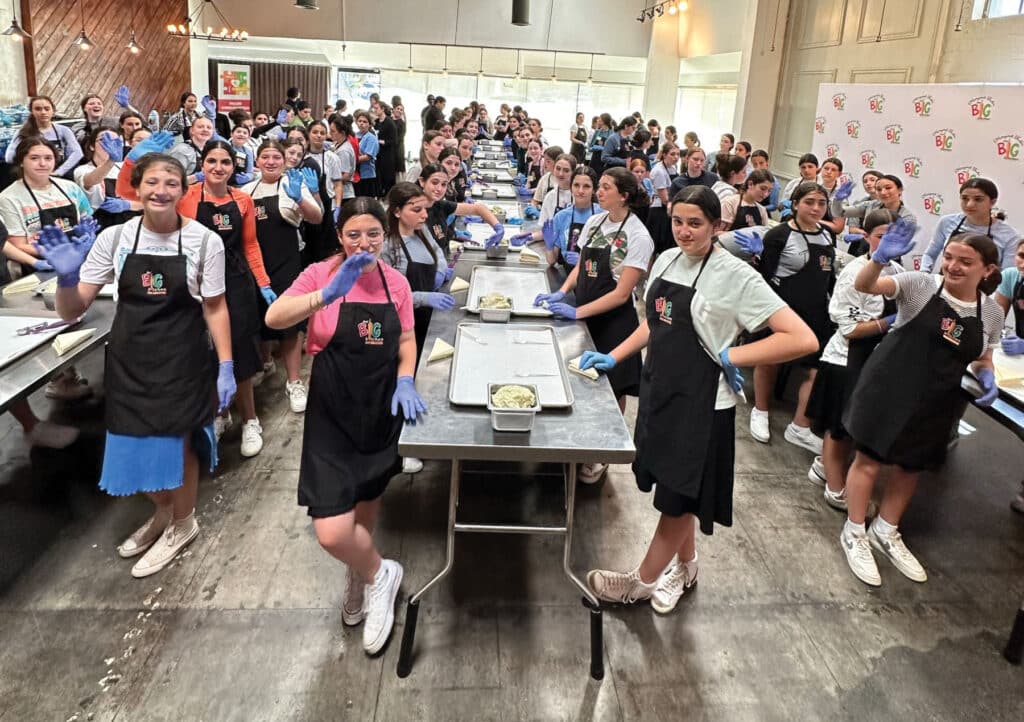
The atmosphere of Our Big Kitchen on Pico Boulevard is one of joy, energy and purpose. Each week, hundreds of volunteers come to this space to help prepare anywhere from 2,500 and 3,000 kosher meals.
Yossi and Chaya Segalmen
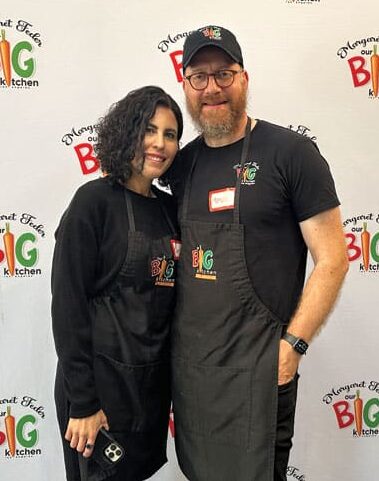
Founded by Yossi and Chaya Segelman, Our Big Kitchen Los Angeles (OBKLA) does more than provide homemade meals to Angelenos in need. It has created an environment where people of all ages can come together to volunteer, bond and get a dose of the kind of joy that only comes from helping others. “What’s incredible is the impact it’s having not only on the recipients, but also on the volunteers,” executive director Yossi Segelman told the Journal.
Every Sunday, OBKLA hosts an open session where up to 70 volunteers come together to make 300 meals. Throughout the week, other groups come in, including corporate organizations doing social responsibility and team building; schools, student groups and synagogues participating in philanthropy or families celebrating a b’nai mitzvah or other rite of passage.
Since moving into their space on Pico as Margaret Feder Our Big Kitchen in June 2022, the organization has prepared more than 57,000 meals and nearly 81,000 cookies; around 12,000 volunteers have spent 24,000 hours with them.
OBKLA currently partners with 31 charities who distribute the meals. Organizations range from Tomchei Shabbos, Wisdom Circle Senior Support and Kol Israel Soup Kitchen to Union Rescue Mission, Anchor DTLA and Student MOJO. “What we’ve essentially done is empower local organizations to be able to deliver, in addition to the food cards or the repurposed food, these beautiful, fresh meals for free,” Yossi said.
“Our goal is to feed people with dignity, and hopefully lift their spirits.” – Chaya Segelman
Their tagline – Meals, Love, Unity, Community – really encompasses OBKLA’s mission: To provide quality meals, made with love, to inspire unity and community. “Our goal is to feed people with dignity,” program manager Chaya Segelman told the Journal.“And hopefully lift their spirits.” A lot of the people who suffer from food insecurity receive donations from the food bank, or repurposed, leftover or industrial food. For many, OBKLA provides the first time in a long time that They’ve eaten a beautiful, home-cooked meal. “Some of them are so far removed from being in a home environment,” Chaya said. “Eating this [meal] brings back that warmth; it makes them feel that connection again to their past and a bit of hope to the future.”
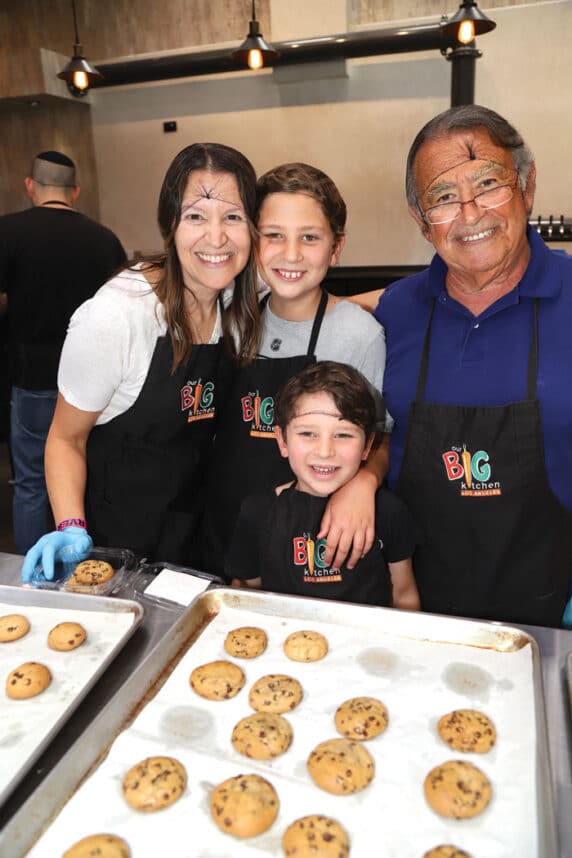
These low-cost, volunteer-driven, chef-inspired meals use fresh ingredients and are made with a lot of love. “Our most popular meal is meatballs in a chunky vegetable sauce over rice,” Chaya said. “Every session we bake over 600 chocolate cookies, because nothing makes people feel more loved than a homemade chocolate chip cookie.”Adds Yossi, “It’s a very, very moving, intentional experience. And the recipients feel that.”
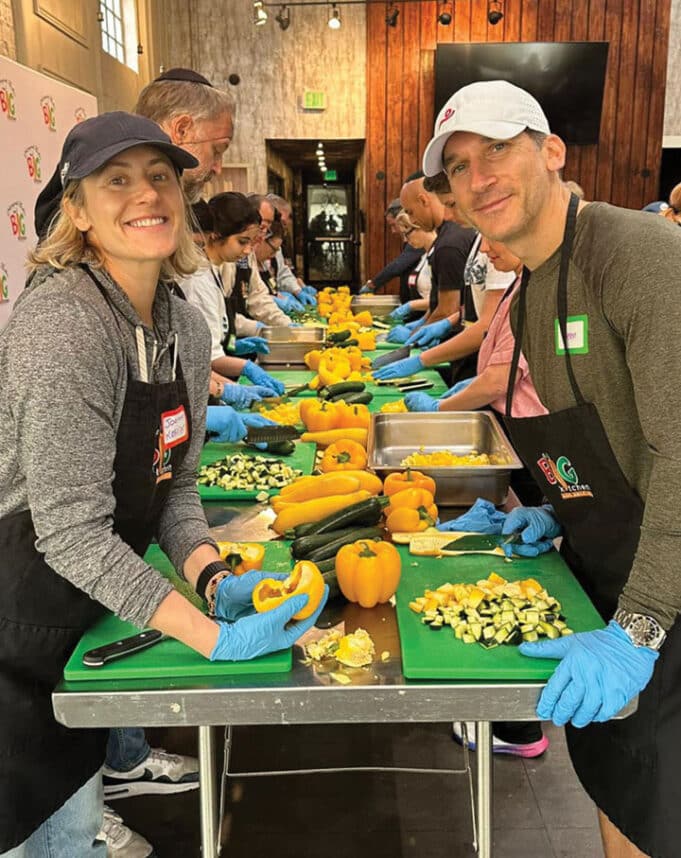
At OBKLA, people from all walks of life, all backgrounds within the Jewish community and beyond, prepare beautiful meals together. “We used to say our community was 5 to 85, but we had a 99-year-old Holocaust survivor come in, so it truly is any age group,” Yossi said. Families come with their kids to volunteer together. They sometimes have three generations — kids, parents and grandparents — working together. “The beautiful thing is everyone is doing absolutely the same thing,” Yossi said. “They’re all chopping the vegetables, they’re all rolling the meatballs, they’re all shaping the cookies, they’re all cleaning up; there’s no hierarchy in volunteering.” He adds, “And there’s a beautiful spirit of unity.”
In addition to the more than 10,000 volunteers who have come by to help, the OBKLA community has 65 core volunteers, called OBKLA ambassadors, who help run the sessions. “We can run multiple sessions a day because we have these people who know exactly what needs to be done,” Yossi said. “They welcome everyone with joy, they give you aprons, they sign people in on our ipads, they show people what to do. They walk through the entire process, and then they clean up.”
“I signed up to volunteer at an evening session and after that first experience, I was hooked …If you can help feed one person, why not help feed a community?” – OBKLA ambassador Evie Kraft
OBKLA Ambassador Evie Kraft is an empty nester who got involved after reading in a local paper about the work they were doing. “I signed up to volunteer at an evening session and after that first experience, I was hooked,” Kraft told the Journal. “If you can help feed one person, why not help feed a community?” Her favorite part is the fun-filled atmosphere of the sessions combined with the communal purpose of making a difference. OBKLA also has 87 young leaders (8th grade through high school students). “They’re given responsibility and take initiative over it,” Chaya said. “And the way that they’re able to be in the leadership role really does something for them. They’re amazing.”
OBKLA recently received a three-year grant from the Jewish Community Foundation to fund their Community Youth Initiative. This is to inspire volunteerism in people ages 11 to 26.
This, Yossi explained, enables thousands of youth to volunteer in the kitchen, strengthening their connections with their Jewish identities through meaningful and purposeful group opportunities.
“I really liked OBK because I got to make food for hungry people,” 12-year-old Oz Gasslin said after volunteering. “When it came time to package the meals I worked again … with the person across the table from me, Mia, who was I think in kindergarten or first grade, and that was really fun.”
How OBKLA Started
OBKLA was inspired by Australia Our Big Kitchen, which was started in 2005 by Rabbi Doctor Dovid Slavin and Laya Slavin. Laya was a hairdresser making wigs for women going through cancer treatment; every person she was treating would walk out with a dish. “They started getting volunteers together to prepare beautiful, nutritious meals for families in need,” Yossi, one of OBK Australia’s original directors, said. “From there it grew into creating hundreds of thousands of meals, welcoming tens of thousands of volunteers and supporting more than 60 charities.”
When the Segelmans moved to the United States in August 2012 for Yossi’s work, they always had it in mind to start something here. In May 2019 they registered the name, Our Big Kitchen.
Shortly after COVID hit, in April 2020 a friend sent Yossi a message: “Are you going to be defined by COVID or will you define COVID to do something meaningful during that time?”
Shortly after COVID hit, in April 2020 a friend sent Yossi a message: “Are you going to be defined by COVID or will you define COVID to do something meaningful during that time?”
The Segelmans started by packing healthy snack boxes in their garage. Their son, a student at Santa Monica College, had a subscription snack box side hustle called AP Munch; the snack companies he worked with sent over treats for these care packages. “We took the logo from Australia Our Big Kitchen, added his logo for AP Munch, and had literally palettes of these healthy snack boxes that were being delivered to Kaiser, Cedars, the local hospitals, local fire stations, first responders,” Yossi said. Chaya added, “Then it started going to some families in need, people who couldn’t pay their supermarket bills or buy snacks for the kids.”Before they knew it, every single fire station, police station, hospital in the L.A. area, all the way up to Malibu and beyond, were getting these snack boxes.
In August 2020, they moved the operation to North La Brea Avenue, where Chaya’s brother, David Leeder of Leeder Catering, had a shuttered restaurant and catering space.“We started with six volunteers: family members and one chef,” Yossi said. “It started with about 150 meals. They went to 200 meals, generally once a week.”
Things really took off after they opened an Instagram account in October 2020. People (including donors) started reaching out, asking how they could get involved. “Before we knew it, we had over 1,000 volunteers, thousands of meals made, and we were bursting out of our location,” Yossi said. When they started, Chaya thought it was going to be a “cute family project,” she said. “We were blown away by the generosity of the LA community.”
Margaret Feder
In June 2022, the Feder Family gifted OBKLA a 4,600 square foot space on Pico, as a tribute to the strength and resilience of their matriarch, Margaret Feder, who passed away in April 2019. “Margaret has a beautiful story, that’s a really big part of our neshama, the soul of what we do,” Yossi said.
At the age of 14, Margaret Feder worked in the kitchen at Auschwitz for 16 hours a day, and smuggled out food scraps in her skirt, which she shared with her sister and some others. It’s how she survived.
At the age of 14, Feder worked in the kitchen at Auschwitz for 16 hours a day, and smuggled out food scraps in her skirt, which she shared with her sister and some others. It’s how she survived. Afterward, Feder moved to Israel, where she got married, and then South America; she eventually ended up in the Los Angeles area, where she and her husband had been involved in numerous philanthropic efforts. “Her motto in life was, ‘Life is beautiful,’” Yossi said. “The message there was no matter where you come from, and the challenges [you face], focus on the beautiful things in life.” Margaret, Yossi said, was known for being a phenomenal hostess. “Even if one person was to dine with her, she would set up this beautiful elegant table and make them feel like a million dollars.”
“We are proud to have our mother Margaret Feder’s name associated with OBKLA, which represents at its core human dignity, which dignity was stolen from her during her years at Auschwitz,” the Feder family told the Journal. “It feels right during these divisive times to be involving ourselves with an organization that bridges the divides and represents and services the community at large. The respect and synergy of our volunteers, ambassadors, recipients and donors is very unique to OBKLA. The Segelmans are very grateful to the Feder family for underwriting the beautiful space. “We wouldn’t be able to do what we do without them,” Yossi said.
OBKLA operates Sunday to Friday, and they are closed for Shabbat. Yossi said roughly three quarters of their revenue comes from philanthropy — individual donors, foundations, and an annual crowdfunding campaign. Another 20% to 25% is generated by way of people sponsoring sessions (it’s a donation) and people renting it out as an event space.
How It Works
Each two-hour meal-prep session is a fast-paced, no-phones bonding experience, whether it’s a group of familiar faces or people about to become friends. It’s a bright environment with fast paced music playing in the background.
After everyone walks into the kitchen, they put on an apron, hair net and name tag, and register via iPad. Then they put on gloves, and they find their station; they have three stations usually set up with the raw ingredients. For instance, for the adults they’ll have a chopping station for all the fresh vegetables. And, if they are preparing meatballs that day, there will be two stations of kids scooping them out.
While they are not a religious organization, all OBKLA meals are strictly kosher. Plus, they start each session with an acknowledgment. “We tell the story of Margaret Feder,” Yossi said. “[Then we say] ‘Let’s just pause for a moment and reflect how lucky we are, how grateful we should all be, that we are in a society and a time and place that allows us to be on the giving side.” Yossi, Chaya or whoever is leading the session continues with something like, “Life is like a wheel. You may find yourself needing to be on the receiving end. Know that there are organizations, such as ours, and people, such as you, out there that make the world a better place.”
After the orientation, the chef comes out and instructs everyone on how to prepare food. “We do all the raw food prep,” Chaya said. “Then we take it back to the kitchen, and the chef starts cooking it.”Volunteers prepare all the packaging for the food, and then start scooping, rolling and shaping the cookie dough. After a five-minute break, volunteers come back and watch another short video to get them back in the zone and remind them of their impact.
The next step is to start packaging the food, assembly-line style. By the time the meals are packed, the cookies have come out of the oven. “Everyone has to taste one for quality control just to make sure it’s good enough to send out, which they all really enjoy,” Chaya said. “And then we pack the cookies.” At the end of the session, everyone gathers once again. “We want to take the amazing, beautiful energy of giving and connection, and we tell everyone to take a pack of these cookies and in the next 24 hours pay it forward,” Chaya said.
“If I really have to look at what is the number one achievement in the last year, yes we made a lot of meals,” Yossi said. “Thousands of people were engaged and communicated with each other and connected over food.”
To learn more about OBKLA and/or to volunteer, go to OBKLA.org.
Preheat oven to 450°F. (Turn on the convection mode, if possible.)
Mix all the ingredients together and form into approximately 3 dozen meatballs.
Place meatballs on a foil-covered sheet-pan. Bake for around 15 minutes.
The meatballs should be nicely browned and when cut in half just cooked through.
Chocolate Chip Cookies
Yields 24 cookies
Ingredients
1/2 cup brown sugar
1/2 cup white granulated sugar
1/4 lb margarine
1 egg
1 1/4 tsp warm water
1 1/4 tsp vanilla extract
1/2 tsp baking soda
1/4 tsp salt
1 1/2 cup all-purpose flour
3/4 cup semi-sweet chocolate chips
Instructions
Preheat oven to 350°F.
Place the two sugars in a stand mixer.
Soften the margarine and add to the sugar. Beat until creamy.
Mix the vanilla, warm water, salt and baking powder together.
Add water mixture and the egg; beat to mix.
Add the flour and beat together until mostly mixed, then add the chocolate chips and finish beating until just mixed. Portion cookies onto parchment-covered sheet trays.
Bake the cookies in the preheated oven for around 10 to 12 minutes rotating the trays halfway through.