fbpx

July 5, 2023

Lior Lev Sercarz: Being Spice King, “A Middle Eastern Pantry” and Hummus Tahina

Want to elevate your cooking? Use great spices.

“It would be very sad for me to cook without spices,” Spice King Lior Lev Sercarz told the Journal. Chef Sercarz is owner of La Boîte in New York City and co-founder of the Galilee Culinary Institute.

Israel-born and France-trained, Sercarz moved to the United States in 2002; he opened La Boîte in 2006. For the last 16 years or so, he has been getting people excited about using spices. Spices come as singles and blends, some are less complicated others are more so.

“They bring a third dimension to your food,” he said.

Spices are ingredients. Just as you would buy good produce and proteins, you need to seek out quality spices to incorporate into your cooking.

When shopping, he suggests:

  • Look at the color of the spice. If it’s uniform and there are no specks of other colors, it’s good.
  • If a package says that it’s a whole spice, it should be whole and not part powder and part whole.
  • Buy small packages to begin with, so you can taste the product, get familiar with it and know if you like it
  • Try a couple of different suppliers until you find ones you like.

“Then when you bring that spice into your kitchen, open it up, taste it, smell it,” he said. “It needs to have a good scent and a great flavor. If it’s kind of mild and tasteless or odorless, then don’t buy it again from that particular producer or company.”

Be sure to try out the spices you already own. “You are going to add them to your food; it’s important to know what they’re going to do to your dish,” he said.

Sercarz is the author of four cookbooks, including “The Art of Blending,” “The Spice Companion” and “Mastering Spice.”

His latest, “A Middle Eastern Pantry,” brings Sercarz back to his roots. It goes behind the scenes of that cooking world, showcasing the growers, farmers and bakers, and the “art form” of a pantry.

“A lot of us don’t even have a pantry in our homes because we for some mysterious reason look at canned food or preserved food as lesser than fresh food,” he said.

Sercarz wanted to highlight this amazing region, where the pantry items are still used on a daily basis.

“There’s a tradition of capturing product at their peak, and fermenting, drying, canning [and] pickling them, so that they’re available year-round, when these produce actually are not in season,” he said.

Sercarz’s versions and vision of traditional recipes fill the book. “I’d like to get people excited about cooking these interpretations of traditional recipes,” he said.

For a taste of “A Middle Eastern Pantry,” Sercarz’s recipes for Sumac Onion Salad and Hummus Tahina are below. They are two of his favorites.

“A bowl of hummus with some onions on the side [and] a warm pita bread with some olive oil  makes me very, very happy,” he said. “I don’t need a whole lot more in my life.”

Sometimes the simplest foods really are the best ones.

“Some preparation takes a little bit longer,” he said. “But it’s not necessarily about the complexity of it or having a lot of different ingredients … [Sometimes] the most simple piece of produce, fish or meat that’s simply seasoned and grilled, baked or cooked is a happy place.”

Learn more about Lior Lev Sircarz, La Boîte, Galilee Culinary Institute and “A Middle Eastern Pantry.”

For the full conversation, listen to the podcast:

Watch the interview:


Sumac Onion Salad

Serves 6

1 large red onion, halved and very thinly sliced lengthwise

2 tablespoons extra-virgin olive oil

1 tablespoon freshly squeezed lemon juice

1 tablespoon pomegranate molasses

1 tablespoon ground sumac (9 grams)

½ teaspoon fine sea salt (3 grams)

½ teaspoon freshly ground black pepper (1 gram)

¼ cup roughly chopped fresh flat parsley leaves

¼ cup fresh pomegranate arils

Fill a large bowl with ice water. Soak the onion slices for 1 hour to crisp them up. Drain well and blot dry with paper towels, being careful not to damage the delicate slices.

Meanwhile, in a small bowl, whisk together the oil, lemon juice, pomegranate molasses, sumac, salt and pepper to combine well. Set aside to allow the spices to bloom while the onion soaks.

Transfer the drained onion slices to a clean bowl. Add the dressing, parsley, and pomegranate arils, toss and serve.

Hummus Tahina

Makes 2 cups

1½ cups cooked chickpeas or canned, preferably organic, rinsed and drained

½ cup tahini

½ cup ice water

1 tablespoon freshly squeezed lemon juice

¼ teaspoon ground cumin (0.5 grams), plus more to taste

Salt

2 tablespoons Tahini Sauce (recipe follows), or more to taste, for serving

Extra-virgin olive oil, for serving

Paprika, for garnish (optional)

In a food processor, combine the chickpeas, tahini, ice water, lemon juice, cumin and a pinch of salt.

Process until completely smooth. Taste and adjust the seasoning with more salt and/or cumin if necessary.

To serve, spoon some or all of the hummus into a serving bowl. Spread and swoosh the hummus to the sides, creating a well in the center. Spoon as much of the tahini sauce in the center as you like. Drizzle with oil and dust with more cumin and/or paprika (if using).

Tahini Sauce

Makes 1 cup

Ice

½ cup tahini

1 lemon, halved

Salt

In a measuring cup with a spout, mix ½ cup water with a handful of ice and stir until very cold.

Remove the ice.

In a bowl, whisk together the tahini and juice of ½ lemon. Slowly drizzle in the water, whisking constantly, until the mixture is creamy and smooth. (If the sauce breaks, make another batch of ice water and add a few drops at a time until the sauce comes together.) Taste and season with salt and more lemon juice, if you like.

* * *


Reprinted with permission from “A Middle Eastern Pantry: Essential Ingredients for Classic and Contemporary Recipes: A Cookbook.” Copyright c 2023 by Lior Lev Sercarz. Photography copyright c 2023 by Dan Perez.Published by Clarkson Potter, an imprint of Penguin Random House.


Debra Eckerling is a writer for the Jewish Journal and the host of “Taste Buds with Deb.Subscribe on YouTube or your favorite podcast platform. Email Debra: tastebuds@jewishjournal.com.

Lior Lev Sercarz: Being Spice King, “A Middle Eastern Pantry” and Hummus Tahina Read More »

Tipping is Not a City in China

Years ago, I read a terrific book by Mark L. Brenner called “Tipping for Success,” or in Yiddish, “the Schmear.” Brenner taught me that if you want the parking valet to get your car fast, tip them when you pull up. If you want it out front, peel off a $20 bill.

Gail Stocker, a woman who booked my stand-up comedy, once told me how important it is to over-tip service people. She said, “if, at the end of my life, I calculate I over-tipped $10,000, so what?” You can make so many people so happy by giving them a little extra. People need money, and a little extra can go a long way. 

Dennis Prager has a rule: “If they touch it, I tip them.” When on an airport shuttle, if the driver helps me with my bags, I’ll sit on the shuttle with bills popping out of my hand to remind everyone else to tip. If I’m with someone who is paying for my meal and I don’t think they tipped enough, without embarrassing them, if I can secretly drop some cash on the table, I’ll do it. On my last trip to the hospital, I handed out a couple of fifties and a box of chocolates to a few of the nurses. My care went up a few notches, and I had access to unlimited Jell-O.  The mail carrier, gardener, manicurist, doorman — all get Christmas or Hanukkah tips.

There are certain people you never tip. You never say to airline pilots, “Here’s a hundred for getting us in early” or to a surgeon, “Good job with the gallbladder.” 

There are certain people you never tip. You never say to airline pilots, “Here’s a hundred for getting us in early” or to a surgeon, “Good job with the gallbladder.” 

At birth, God gifted us certain sensitivities and the potential to develop and refine them. Part of our mission is to nurture and expand that inborn gift. By being aware of others’ needs through tipping, we can expand that gift.

I love tipping. It makes me feel good, and I know it might immediately be helpful to the person receiving it. Some people have the rap, “It’s their job. They get paid.” That’s true, you’re right.  But so what?

For me, I have a need to tip, and I don’t care what my deep psychological reason might be for tossing a couple of extra bucks to total strangers. I’d rather give out a handful of fives and tens than $300 an hour to a shrink to find out why I need to tip. I’d rather find out why I need to give a shrink the three hundred. 

A while back, I was in Dallas, and I went into a salad place and ordered one to go. I asked the kid making the salad if he’d been busy. His answer was, “It’s been dead quiet.” I immediately felt bad for him, knowing that meant no tips coming in. He bagged my lunch, rang me up, and thanked me. I paid with my credit card and then handed him a fiver in cash. Five extra dollars for an eight-dollar salad. You would have thought I handed him a thousand dollars. My salad tasted better knowing that kid was a bit happier. 

And even though it’s not tipping, if someone helps me and if I don’t buy on the spot, I find out if they work on commission. If they do and I decide to buy later, I come back, and if they’re off that day, I leave a message to make sure they get their commission.

I’m not talking about handing out 50s and 100s, unless of course, you can afford it and want to. I know people who do hand out hundreds. I love watching the face of the person who gets a $100 tip. For most of us, though, an extra shekel or two is all it takes to tip the scale in a good direction. 

Rabbi Yisroel Belsky said on Torah.Org, “The Talmud says the tip is mandatory for those whose entire income comes from the tip – such as the innkeepers in Jerusalem.” So, you see that giving a tip is an obligation in such cases. This is a Halacha (Jewish law) that the Gemara (Talmud) states clearly. Tipping is not just a nice way to behave. And where it’s not mandatory, it’s a darn nice thing to do.


Mark Schiff is a comedian, actor and writer, and host of the ‘You Don’t Know Schiff’ podcast. His new book is “Why Not? Lessons on Comedy, Courage and Chutzpah.”

Tipping is Not a City in China Read More »

Rosner’s Domain | The Danger of Disobedience: A Sober Analysis

Libraries of political theory contain many volumes on the morality and usefulness of draft dodging and civil disobedience. But Israel does not have the luxury to engage in a scholarly discussion. Israel must deal with a concrete challenge: an attempt to sabotage government policies by using the threat of disobedience. Many hundreds of reserve officers warn — again — that passing a judicial overhaul that will severely reduce the courts’ ability to curb ministerial power will be a cause for them to no longer report for duty. Under these circumstances, we’ll try a few cautionary notes that might help clarify a complex issue.

The key angle: A country without rules cannot exist. Israel must have rules. On the other hand, in certain moments, there is justification to oppose the rules, and also break them. In a dictatorship it is fitting to oppose the government and the rules. It is not always practical (because the government has power), but it is certainly morally appropriate. In what other circumstances is it appropriate to disobey? This is the current debate. It’s not theoretical; it’s about Israel’s current reality. Is what we see in the judicial overhaul a slide to dictatorship (in such case it would be appropriate to break some rules), or are they merely standard moves, as significant as they might seem, of a legitimate government within the framework of legitimate politics (then disobedience must be condemned).

Subjective difficulty: who even determines when it is appropriate to be in violation of the rules? The answer is: every man and woman. Naturally, the government will never recognize the need to violate its rules. So the fact that the members of the coalition cry foul amid the threat of disobedience is to be expected. But what we are saying here reflects a problematic situation: Disobedience stems from the conscience of those who disobey. Yet everyone has a different conscience, and the result is that everyone can decide when it’s time to break the rules. This is a recipe for anarchy. But this obstacle cannot be removed, because it is at the heart of the discussion about disobedience. 

The danger: Disobedience is intended to hinder the government from implementing policies. Once a society becomes used to disobedience, it will not be able to realize any plans of any government. A government that wants to impose taxes will face a threat of disobedience. A government that wants to reduce taxes will also face a threat of disobedience. Those who currently use disobedience as a tool act on one of three assumptions: They assume that they will never be in power, and therefore will always be in a position of having to stop someone else from doing things and never in the position of wanting to do things;  they assume that only they, and not the other camp, can effectively use disobedience; or they assume that when they have the power to rule, their opponents will decide to follow the rules even though they did not follow the rules. The first assumption is defeatist, the second is arrogant, the third is naive.

Moral argument: Let’s say you’re an intelligence officer, and let’s say you believe that the country is already on its way to becoming a dictatorship, and let’s say that because of this you believe that you must dodge a call of duty. And let’s assume that your position is important, and that you contribute to Israel’s security. What are you actually saying? You’re saying, “I will not serve, but I will continue to be secure thanks to others who serve.” They will volunteer and sacrifice, and you will have security. This is an immoral act. 

Moral rebuttal: The moral argument against disobedience would have been a good argument, had the State of Israel insisted that all citizens serve. But it doesn’t. While The PM demanded that we “all stand together,” his government was moving forward with a plan that would exempt a very large group — the ultra-Orthodox — from the obligation to stand.

The story of disobedience in 2023 Israel is not a theoretical seminar. It’s a dangerous clash of power and will.

What do we do: the answer could seem outrageous but it still holds true. The Israeli government has a duty to soberly assess the situation. If it can overcome the challenge of disobedience without having to pay a very heavy price – then the government should disregard the threat. But if the government thinks that the price of disobedience will be more than the benefit of implementing its plans – then it needs to yield. The question of who is right, or what is fair, is not important. The story of disobedience in 2023 Israel is not a theoretical seminar. It’s a dangerous clash of power and will.

Something I wrote in Hebrew

Israeli novelists decided to boycott the literary prizes that the Ministry of Culture because they disprove of the prize committee in which the three new members are vocal supporters of the Netanyahu government. I was not convinced that their argument was valid.

It is impossible to enjoy the patronage of a government, without politics being involved. If you want the Minister of Culture to hand out grants and prizes to support literature (I’m not convinced this is desirable, but that’s another debate), you have to take into account that the minister is a politician … had he appointed his horse to a committee, Caligula style, it could have been argued that the appointment is improper, and therefore the prize should be boycotted. But that’s not what happened. The minister appointed reasonable candidates to the committee.

A week’s numbers

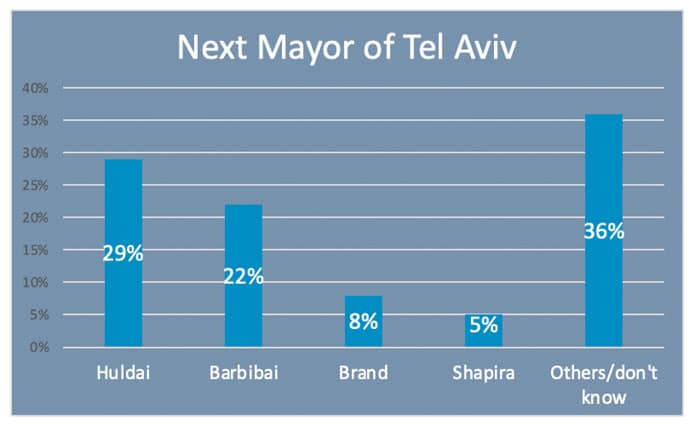
Municipal elections are coming to your neighborhood in the fall (if you’re an Israeli), and a fascinating battle is shaping up between Tel Aviv Mayor Ron Huldai  (who has held the job for 24 years) and former Yesh Atid Minister Orna Barbibai (Ch.12 poll). 

A reader’s response:

Alex Rubin asks: “Is it true that Bibi is going to China before coming to Washington? That would be a disgrace”. My response: Mr. Netanyahu would gladly come to Washington, but he cannot hold himself hostage and postpone all other plans until an invitation to Washington is extended.   


Shmuel Rosner is senior political editor. For more analysis of Israeli and international politics, visit Rosner’s Domain at jewishjournal.com/rosnersdomain.

Rosner’s Domain | The Danger of Disobedience: A Sober Analysis Read More »

Jews and Affirmative Action

For most of this year, we have been paying a tremendous amount of attention to the Israeli judicial system. But last week, the U.S. Supreme Court reminded us why it’s a good idea to keep an eye on this country’s courts too.

While Chief Justice John Roberts and his colleagues did not set off a nuclear explosion at the level of last year’s overturn of Roe v. Wade, they did issue a series of decisions that continued to upend the nation’s political, policy and cultural landscape. The Court announced landmark rulings on LGBTQ rights, religious accommodations in the workplace, President Biden’s student loan forgiveness program, and most notably, the death knell for racial preferences in college admissions.

The end of affirmative action has received the overwhelming majority of public and media attention over the last several days. But it has also received a noteworthy – and complicated – response from the Jewish community, given the changing nature of our own relationship with the issue of quotas over the years. For the first decades of the 20th century, Jews were systematically excluded from most competitive institutions of higher learning, leading many Jewish organizations to oppose racial quotas when the Court first considered the issue back in the 1970’s. 

But by the early 21st century, Jewish opinion on the issue had begun to shift. Whether the change reflects a broader move politically leftward, an effort to strengthen ties with other minority communities, or simply the faded memories of the harsh discrimination directed toward young Jewish students in years past, the American Jewish community is now more likely than the overall U.S. population to support race-based preferences. While some conservative-leaning Jewish organizations praised the Court for its ruling last week, several of the most notable of the nation’s Jewish groups, including the Anti-Defamation League and the American Jewish Committee, strongly criticized the decision.

Over the years, Jewish representation at Ivy League schools and other elite universities has declined. Some of that drop has been the increased use of racial preferences to admit students from underrepresented communities, but a great deal has also been due to the marked growth in the number of students from various Asian Pacific communities. It’s worth noting that the more high-profile of the two affirmative action cases that the Court decided last week focused on the treatment of Asian Pacific students in the interview process. Most statistical analyses demonstrate that the greatest beneficiaries of the Court’s ruling will be applicants of Asian heritage, far more than white or Jewish students.

In his book “Why We’re Polarized,” New York Times columnist Ezra Klein argues that voters tend to make policy and political decisions for two different reasons. Klein cites research that demonstrates how we make political decisions not only based on how a particular policy impacts our lives but also how we take a position based on how we want to be perceived by others. Think of this as the distinction between practical decision-making as opposed to expressive decision-making (my terminology, not Klein’s).

When the Supreme Court first confronted this subject in 1978, the memories of overt discrimination against Jewish applicants were still fresh, and so opposition to quotas among Jewish voters was primarily a practical decision. But 45 years later, even during a resurgence of anti-Semitism in American society, such explicit prejudice from the guardians of this country’s temples of higher education appears a much more remote threat than in our grandparents’ time.

The question is whether those American Jews who support affirmative action on principle will set aside their expressive positions when the education of their own daughters and sons is on the line.

But the most committed defenders of racial preferences have now prioritized the elimination of legacy admissions as a way of opening more opportunities for minority students. If the children of alumni and faculty are less likely to gain admission, the impact on Jewish students would be considerable. The question is whether those American Jews who support affirmative action on principle will set aside their expressive positions when the education of their own daughters and sons is on the line. 

Affirmative action is dead, but the debate over alternatives to replace it is far from over.  Let’s see how the Jewish community responds when the impact hits closer to home.


Dan Schnur is the U.S. Politics Editor for the Jewish Journal. He teaches courses in politics, communications, and leadership at UC Berkeley, USC and Pepperdine. He hosts the monthly webinar “The Dan Schnur Political Report” for the Los Angeles World Affairs Council & Town Hall. Follow Dan’s work at www.danschnurpolitics.com

Jews and Affirmative Action Read More »

Why is the Media Ignoring “The Sound of Freedom,” a Film About the Child Sex Trade that Did Better Than “Indiana Jones”?

Does the mainstream media have something against Christian-friendly entertainment companies that specialize in “wholesome” content?

How else to explain the virtual blackout of “The Sound of Freedom,” a thriller that exposes the child sex trade and grossed around $11 million on its July 4th opening? According to Yahoo, its per screen average was nearly twice that of “Indiana Jones and the Dial of Destiny”—with about $4,400 in 2,634 theaters compared to about $2,543 in 4,600 theaters for “Indiana.”

Because the cause of the child sex trade is close to my heart, I’ve been looking for any sign of coverage from mainstream outlets like The New York Times, Washington Post, CNN, Hollywood Reporter, etc. Except for Variety, I keep coming up empty. As I wrote yesterday, The Times reviewed 65 films in June, but “Freedom” wasn’t on the list. The film isn’t even listed on the website of review aggregator Metacritic, which usually lists pretty much every release.

What’s going on? How can such an important film that is also doing well be iced out?

The short answer is that the burden of proof is not on the film. It’s on the media companies. It’s one thing to review a movie and pan it. But to totally ignore it?

I run a Jewish paper. I saw “Freedom” and loved it. I found the story both heart-wrenching and riveting. I don’t care where good stuff comes from. I don’t care that “Freedom” is distributed by the Provo, Utah-based Angel Studios, which supports Christian-friendly content, or that the marketing included block sales to churches, or that the star of the film, Jim Caviezel, played Jesus in “The Passion of the Christ.”

The millions of abused children who are suffering in silence deserve that we make a lot of noise on their behalf.

I care about the 2 million children who are trafficked every year worldwide. I care that The Department of Homeland Security estimates that child trafficking has an annual global profit of $150 billion, more than the illegal arms trade. I care that the United States is the number one consumer and producer of child abuse content.

The Journal will continue to track media coverage. We will continue to cover the movie and the cause, and we hope that other media outlets and social justice activists will follow. The millions of abused children who are suffering in silence deserve that we make a lot of noise on their behalf.

Why is the Media Ignoring “The Sound of Freedom,” a Film About the Child Sex Trade that Did Better Than “Indiana Jones”? Read More »

A Jewish Leader at Just the Right Time

This week marks the 65th yahrzeit of the leader of one of the most important Jewish boycott movements in history. Long forgotten but deeply deserving of remembrance, J. George Fredman was part of the national leadership in the American Jewish community only briefly—but at exactly the right moment, when the community needed him most.

Born and raised in northern New Jersey, Fredman graduated from New York Law School in 1916, shortly before the United States entered World War One. He enlisted in the Quartermaster Corps, ultimately rising to second lieutenant.

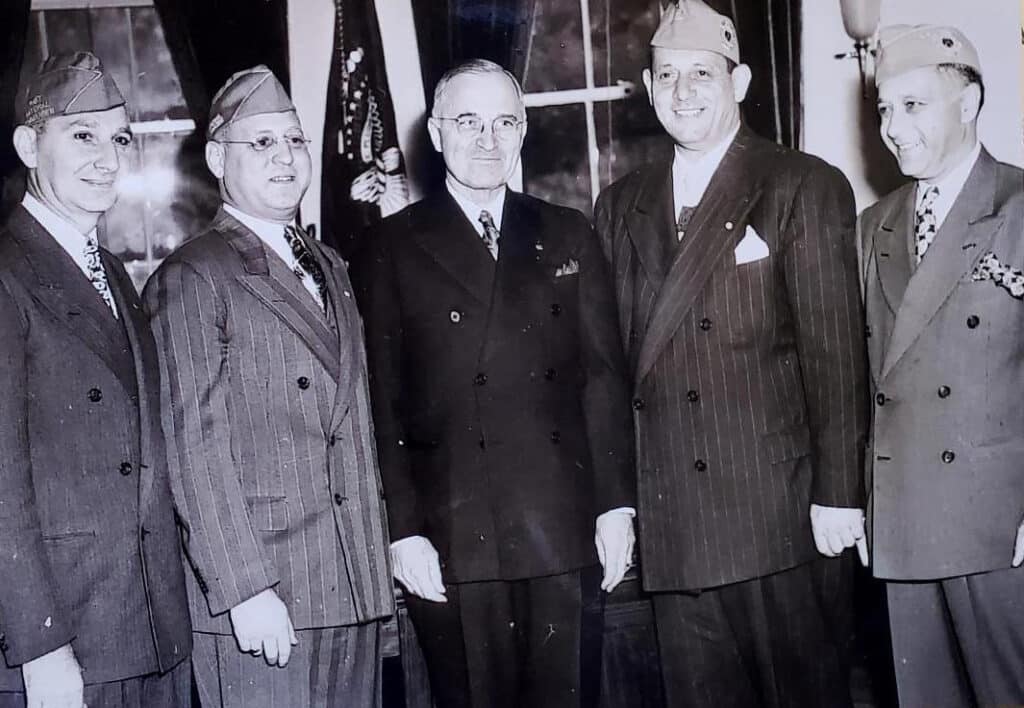
Intensely proud of his service to his country, Fredman joined the Jewish War Veterans of America and gradually rose through its ranks. When he was elected national commander in September 1932, the danger of the Nazis ruling Germany still seemed remote. The major issues discussed at that year’s JWV convention were repealing prohibition and a government bonus for veterans.

Hitler’s rise to power the following year found mainstream American Jewish leaders confused and divided. The American Jewish Committee and B’nai B’rith argued that public protests would only make things worse. Even the American Jewish Congress, which usually was more outspoken than the others, hesitated to act. It was left to J. George Fredman to organize the first major American Jewish demonstration against the Nazi regime.

On March 23, 1933, more than 20,000 Jewish war veterans and their supporters gathered in lower Manhattan. There a group of cantors, bearing a Torah scroll, assembled on a balcony overlooking the crowd and chanted the “El Maleh Rachamim” prayer in memory of Jews who had been murdered during the early days of Hitler’s reign. Then the protesters marched across town to City Hall, where Fredman, one of the keynote speakers, called for a boycott of German goods.

The boycott proposal was the subject of considerable controversy. The president of the American Jewish Committee claimed a boycott would “kill the Jews of Germany.” B’nai B’rith denounced the boycott proposal as “little short of madness.” It called for “a dignified silence, silence with suffering [which] may become more potent than emotion.”

Rabbi Stephen S. Wise, leader of the American Jewish Congress, initially opposed the boycott and blocked a pro-boycott resolution that Fredman introduced at a meeting of Jewish leaders in March. Wise was deeply loyal to President Roosevelt and opposed boycotting because it did not have “the sanction of our government.”

The Roosevelt administration favored friendly trade and diplomatic relations with the Hitler regime. Secretary of State Cordell Hull warned that “a racial or political boycott” of Germany would be damaging to American interests. The administration quietly undermined the anti-Nazi boycott movement by permitting German goods to be labeled as having been made in a particular city or province, so they could be stamped with a local (and thus unrecognizable) name rather than “Made in Germany.”

Fredman’s impassioned speeches in the spring and summer of 1933 mobilized widespread Jewish public support for the boycott and put Rabbi Wise on the defensive. “Pussyfooting must cease and American Jewry must take steps to vigorously combat the Nazi persecutors,” Fredman declared at one event. This escalation of grassroots pressure played a major role in forcing Wise and the AJCongress to finally embrace the boycott in late August.

In the years to follow, the AJCongress—especially its Women’s Division—took over the leadership of the boycott movement and transformed it into an organized and effective campaign. Fredman’s pioneering role was eventually forgotten. Rabbi Wise, in his autobiography, even claimed that “the American Jewish Congress launched the boycott.”

When Fredman’s one-year term as head of the Jewish War Veterans was approaching its conclusion in the summer of 1933, his colleagues pressed him to accept another term, but Fredman chose to step aside and give someone else a chance. How often do you hear of a Jewish leader nowadays declining to serve again?

Even after stepping down as national commander, Fredman remained a potent force in JWV activism. In 1941, he helped persuade the authorities to shut down Camp Nordland, a two hundred-acre site that the German American Bund used for pro-Nazi rallies and paramilitary training in Andover Township, NJ.

Fredman also served as editor of the JWV’s magazine, The Jewish Veteran; coauthored (with Louis A. Falk) the book “Jews in American Wars” (1943); and edited “Framework of Democracy,” a booklet of key American documents that was widely distributed to chapters of the Boy Scouts and other groups promoting good citizenship.

Monument in J. George Fredman Park, in North Bergen, NJ.

Today, J. George Fredman Park, situated on JFK Boulevard in North Bergen, NJ, stands as humble testimony to Fredman’s contributions to America and American Jewry. A monument features a replica artillery piece, symbolizing his military service, and a plaque reads, “J. George Fredman: Veteran- Lawyer – Author / A Dedicated American.”

“Those words sum up Uncle George’s life and legacy,” his nephew, Art Fredman, told me. “In his brief but crucial service as a national Jewish leader, and in his lifetime of devotion to America and American Jewry, he exemplified the highest qualities that all Americans cherish. He spoke out when too many others were silent or afraid.”


Dr. Medoff is founding director of The David S. Wyman Institute for Holocaust Studies and author of more than 20 books about Jewish history and the Holocaust.

A Jewish Leader at Just the Right Time Read More »

“Don’t Touch Me!”: Rabbi Shmuley’s Heated Exchange with Amsterdam Anti-Israel Protesters

Rabbi Shmuley Boteach posted an Instagram video on the morning of June 30 showing a heated exchange between him and a group of anti-Israel protesters in central Amsterdam.

The video begins with Boteach showing viewers an anti-Israel display with Palestinian flags in the middle of a public square that has “all the blood libels: we Jews are murderers, killers,” Boteach says, adding that “this is one of the things that stokes antisemitism.” The display had various signs accusing Israel of apartheid, supporting the Boycott, Divestment and Sanctions movement, accusing Israel of murdering Palestinian journalist Shireen Abu Akleh and even one sign saying, “Israel is a lying machine Palestine has a right to resist!” An audio recording that says “apartheid is dispossession” can be heard playing in the background. “This is just all pure lies,” Boteach says to the camera.

Boteach then approaches a man wearing a hat with a “Free Palestine!” button on it and a shirt saying “Bank of Palestine on it.” “You kind of hate Israel huh?” Boteach says to the man. Boteach then says: “I’m Jewish, I love Israel. I wish every Arab had the same freedoms as Israel.” The man then appears to call Israel a “criminal state.” “It’s not just Israel, Jews everywhere are criminals. They’re all killers,” Boteach sarcastically responded. “Jews have been killing, drinking Christian blood for thousands of years, they killed Jesus.” Boteach then told the man, “You hate Israel because it’s Jewish, because you hate Jews. We get it.” “Shame on you,” the man replies as he shakes his head.

A crowd then forms around Boteach as he continues to argue with the man. A man wearing a black hat starts asking another man in the crowd, “I’ve been to Gaza, have you been? … have you seen the little kids? Because you didn’t see it so you don’t talk about it.” “You know he’s speaking very aggressively,” Boteach says, before he suddenly says to the man in the black hat: “Don’t touch me. Do not touch me! Do not put a hand on me! Apologize for that now … don’t touch me ever, got it? I’m not afraid of you.” “I’m not afraid of you too,” the man in the black hat replies, telling Boteach to “move away from me.” “Terrorist,” Boteach says as he points at the man in the black hat and walks away. “They think I’m afraid of them.”

The man in the black hat then follows Boteach and says to him, “You’re a terrorist man, attacking these people.” “I’m American by the way,” Boteach replies. The man in the black hat then appears to say, “Oh you’re American Jewish.” “Here we go, American Jews,” Boteach says. “Let’s say it: it’s not about Israel, it’s about Jews, you hate Jews we know that.” The man in the black hat then asks Boteach if he’s a Zionist; Boteach replies that he loves Israel. The man then says, “You love money. Do you love money?” Boteach then bursts out laughing. “I love money. Jews love money … you believe this?” Boteach says, before adding: “They killed a hundred thousand Jews in the Holocaust here in the Netherlands, they want to finish off the rest,” as Boteach points to the man in the black hat.

Eventually, Boteach walks away and says to the man in the black hat, “Just keep your hands off me; you’re a violent man.” The man then replies: “You don’t even see me violent. Please let me be violent!” “I will never fear you ever,” Boteach responds. “Jews are not afraid of people like you.”

The video concludes with Boteach saying to the camera, “The lesson is, you never fear these people. You see immediately he doesn’t hate Israel, he hates Jews. Immediately he says, ‘Jews love money, Jews love this.’ That’s the essence of them … they hate Israel because they hate Jews.”


View this post on Instagram


A post shared by Shmuley Boteach (@rabbishmuley)

“Don’t Touch Me!”: Rabbi Shmuley’s Heated Exchange with Amsterdam Anti-Israel Protesters Read More »

Antisemitic Hate Crime Events Rose 24.3% in CA in 2022, Report Says

The California Attorney General’s yearly hate crimes report found that antisemitic hate crime events rose 24.3% from 2021 to 2022.

The total number of antisemitic hate crimes in 2022 in California was 189; the year before it was 151. The total number of hate crimes overall in 2022 was at 2,120, a 20.2% increase in hate crimes from the year before (1,763). The highest increase was hate crime events against those based on sexual orientation at 29%, while the largest number of hate crime events were anti-Black hate crime events at 652, a 27.1% increase from the year before. The only hate crime event to see a decrease was anti-Asian hate crime events, which declined by 43.3% from the year before.

“The alarming increases in crimes committed against Black, LGBTQ+ and Jewish people for the second year in a row illustrates the need for our communities to join together unified against hate,” Attorney General Rob Bonta (D) said in a statement. “It takes all of us working together to combat extremism and foster a safe and inclusive environment for all Californians. Now, more than ever, it is critical that we stand united — there is no place for hate in California.”

Anti-Defamation League Western Division Vice President Robert Trestan said in a statement, “There’s no doubt that the state of California has a problem with hate. It is time for our state leaders to recognize that hate of all kinds and extremism poses a growing and dangerous threat to all Californians.”

Antisemitic Hate Crime Events Rose 24.3% in CA in 2022, Report Says Read More »