“It’s never too late to start over. We hear stories all the time of people later in life going back to school for something completely new and different...You get one life, but many chances.”
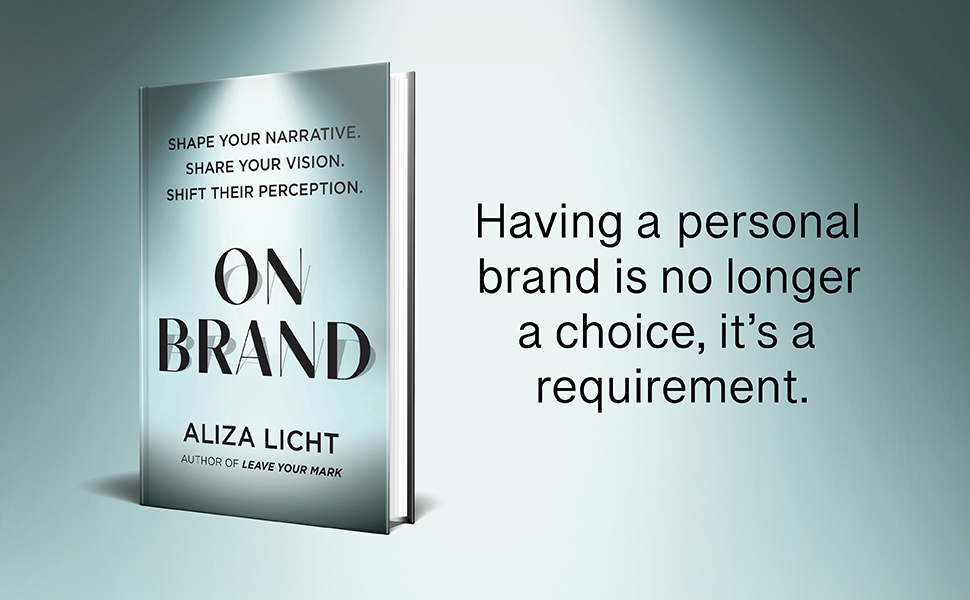
Both of Aliza’s books train you to be a publicist for YOURSELF! I learned so much from reading them. I changed my social media bios immediately after reading her suggestions. Her actionable steps helped me so much. Remember, no one will care about your book, your project, your job as much as YOU do –so learn to be the best Chief Brand Office of YOU that you can!
Aliza says: “You are your best PR person.” Keep planting seeds and growing your brand on your carefully crafted social media, your newsletter and perhaps even your own podcast.
Remember: “Don’t wait for someone to shine a light on your. Make your own SPOTlight (strategically).”
FROM OUR INTERVIEW
Lisa Niver:
Good morning. This is Lisa Niver from We Said Go Travel and I am so, so honored and excited to have the amazing, incredible author Aliza Licht here with me today.
Aliza Licht:
Lisa I am so honored to be here. Thank you so much for inviting me on your show.
Lisa Niver:
You are so welcome. I don’t know that everyone knows about both your books! You have so much going on. We want to talk about both books because they’re both incredible, but will you tell people a little bit about the whole history of the DKNY PR Girl and the millions of followers and the red lipstick. Tell us a little bit, in case people don’t know — how did this happen for you, that you were the fashion voice of Twitter for so long?
Aliza Licht:
H everyone. I started my career in the fashion industry in magazine editorial back in the day, but fun fact, I was pre-med in college and thought I would graduate to be a plastic surgeon. I majored in neurobiology and physiology and then gave it all up to work in fashion. I spent a few years in editorial and then moved over to Donna Karan corporate PR in the late ‘90s. And honestly, I did traditional PR for many years. I ultimately spent 17 years with Donna Karan working in communications. On the tail of the career, the last six years, we started doing social media.
READ OUR ENTIRE INTERVIEW ON WE SAID GO TRAVEL
When it comes to producing “mockumentaries,” Monica Levinson has an enviable track record — at the top of her resume are 2006’s “Borat,” 2009’s “Bruno” and 2020’s “Borat Subsequent Moviefilm.”
And now, Levinson is taking on real life with “The Stories of Us,” an intimate look at her Jewish family.
In 2008, she traveled back home to interview her family members about the family history. She is seen by her family as the “sentimental” one who tells stories for a living, but Levinson has an impeccable memory, and so do her family members. The film opens with Levinson telling her earliest memory.
“When I was seven years old, I went to my first year of summer camp.” When some of the kids there found out I was Jewish, they asked to feel my horns. My family taught me that it’s important to seek out and communicate with people who aren’t just like us. So we can get to know them, and they can get to know us.”
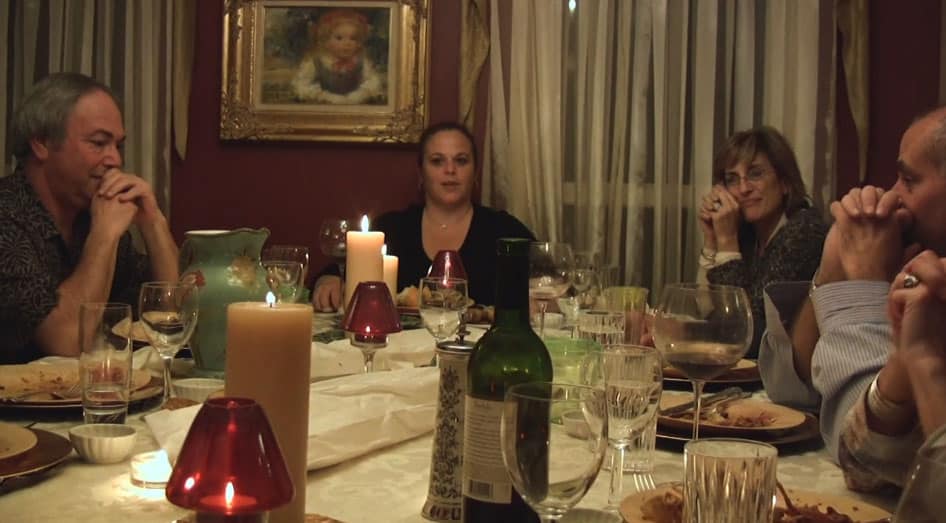
So the documentary begins It’s followed by Levinson’s extended Jewish family having Thanksgiving dinner in the Washington, D.C. suburb of Rockville, Maryland in 2008.
A resident of Los Angeles, Levinson was the only family member at the table who had to fly on an airplane to attend.
Her original plan was not to distribute the footage for people outside of the family, let alone film festivals. The original plan was to film the family dinners as merely a family scrapbook for the next generation. After that first Thanksgiving dinner, Levinson put the tapes away and forgot about them. Nine years later, she was at her Uncle Herbie’s 85th birthday party. He asked Levinson “where are those tapes? What are you going to do with it?”
She responded, “I’ll show you something before you’re 86.” Levinson went home, looked at the footage and realized she missed half the family. So in 2017, she borrowed a fancy new camera and went back to Rockville to interview more of the family.
By this point, a new generation of the family was being born as members of the oldest living generation were passing away.
It’s co-directed and co-produced with Levinson’s longtime friend and filmmaker Steven Hentges.
Levinson and Hentges describe the documentary as a “cinematic love letter to her family” offering a slice-of-life glimpse at their humorous and heartwarming connection, while “reminding us that we all have more in common than we think. We all tell stories around the dinner table.”
And critics are loving it. “The Stories of Us” has won several awards, including Best Jewish American Film Award at the American Jewish Film Festival, Best Editing of a Documentary at London’s 2022 Film Fest International, and Exceptional Merit in Human Spirit and Religion/Faith at the Docs Without Borders Festival. It was also a featured title in the The Jewish Experience Showcase at the Annapolis Film Festival.
While reality television thrives on casting erratic nutcases who are ready to choke each other at the drop of a fork, that’s not the case in “The Stories of Us.” There is cross talk and laughter from the other side of the table that interrupts stories. There’s all kinds of noise that normally would be edited out. But that is part of the allure of “The Stories of Us.” It feels authentic. There are tears, there’s laughter, headshakingand some stories that make family members cringe. But all in all, “The Stories of Us” is a depiction of a family that will take viewers back to their own family dinners, and not just the Jewish ones.
“The Stories of Us” is funny and poignant, an hour-and-a-half reminder to document the good times with the people you love, especially if you only see them in person a handful of times per year.
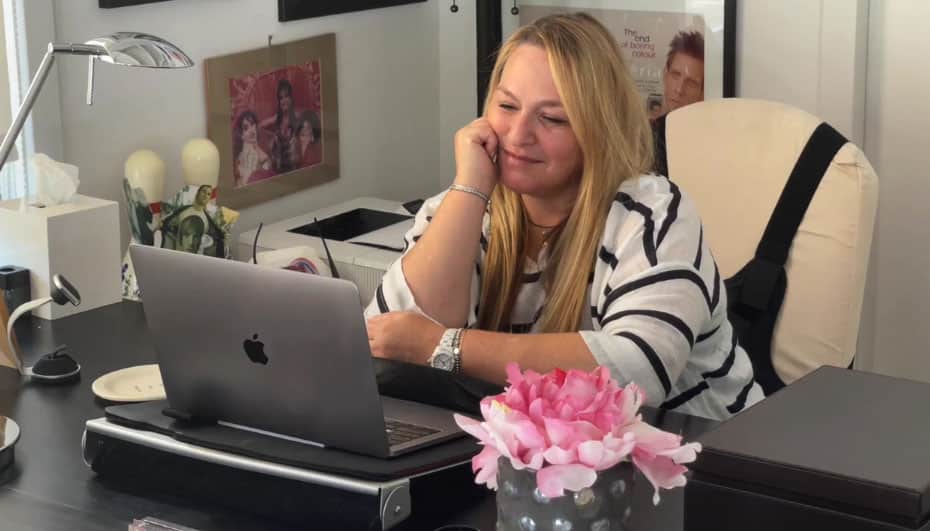
Director and producer Monica Levinson
The Journal spoke with Monica Levinson and co-director and producer Steven Hentges about “The Stories of Us.”
JEWISH JOURNAL:Did you ever feel any alienation from your family since you’re the only one that lives three timezones away?
MONICA LEVINSON: They are always very supportive of me. And I did go home an inordinate amount of time. Everybody always was like, wow, you’re traveling home all the time. So I was home for two weeks in November. And Aunt Mary and Uncle Harvey, they were like, ‘oh, so when are you coming home again?’ And I was like, ‘I don’t have my plans yet or when I’m coming home, but I’ll be there at some point soon!’”
JJ: Steven, after editing the film, what was it like finally meeting Monica’s entire extended family?
STEVEN HENTGES: I had already met Monica’s immediate family: the mom, Mel, and Francine and Suzanne and Stephanie before, and Evan and the husbands and the kids. But I hadn’t met the extended family. And it was weird because I spent so much time in 2017 cutting what was just going to be for the family. I spent days, weeks working on it, and you start to feel like you know these people. Then [Monica] had an open house when she moved to her new house. And I walk in and there’s Uncle Herbie and I walked up to Uncle Herbie so excited because I felt like I knew him and I said ‘Hello!’ But I realized he doesn’t know who the hell I am, yet I feel this connection. But he was just like, ‘Okay.’ He was very nice.
JJ: There’s so many people in the world who don’t know any Jewish people. Who is the target audience?
ML: People have been responding, people that I know or don’t know through social media — they write to us about it. My friend, one of the Teamster captain coordinators that I’ve worked with over the years, and he happened to watch it. He’s not a Jewish man, but he truly related to it. He said it made him cry and he felt like he was at the table and he loves that we made it. It was such a nice response. There’s a lot of people that will see their own families in it. A colleague called to say that she watched it yesterday and she said, ‘I felt like I saw my own family.’ She was saying that she saw those pictures. She was like, ‘that could have been my family.’ The audience is anybody that’s looking for something positive — a positive story about family. And I think that’s where Steven and I got to this place in 2021, which was that we were so bummed out when we see content right now. Everything is sad, everything is dark. It was literally ‘Ted Lasso’ that made us have a happy moment. It just makes you feel good! And I’m like, ‘maybe this is our own version of putting something positive out in the world.’
“The audience is anybody that’s looking for something positive — a positive story about family.”-Monica Levinson
SH: “It’s something that if you can make somebody else go, ‘Hey, no matter what background or religion or culture they come from, I want to talk and get to know more about my family and start to ask those questions.’ Then along the way, when we were already figuring out what we were going to do, when Monica mentioned to me the horn story, I was like, well there’s our opening. That’s kind of how we framed this. She just started telling me all these stories. We took long walks and I kept recording her.
JJ: Was everybody at the dinner table on board? Did you make them sign releases?
ML: I had everybody sign. I’m a producer by trade and obviously I produced two “Borats” and a “Brüno.”
I’ve also done three “Borat” specials for Amazon. And one was a documentary. So I obviously have releases. I used my dear friend Russell Smith, who was the lawyer for Sacha forever. I knew his forms and he helped us, looked at the footage, but everybody signed — no problem!
JJ: When you recorded in 2008 and 2017, and the family knew there were going to be cameras recording them, did your family dress differently or act any differently than usual?
ML: Some of the original stuff was just like, ‘here’s my answer, here’s my answer.’ And nobody was talking. Then once we got to my aunt and uncle and my parents, everybody was kind of talking over each other.
SH: At that point [when production first began in 2008], they didn’t know what it was going to be, nobody did. It was just going to be an oral history for the family. I think had they known the endgame, I don’t think it would’ve been the same. I think there was something magical. While obviously it’s not the way you would normally shoot documentary interviews— with just everybody at the table. It actually worked in a weird way because it created the crosstalk and the conversation. And because everybody at the table was family, there were no walls or boundaries. It was just an open, honest, unfiltered conversation
JJ: Looking back at making this film, what were some of the more cathartic moments?
ML: We all get along. Two things that were really good for me to see personally was my Aunt Ellen. I loved my Aunt Ellen. I was very close to my Aunt Ellen, but she did separate from the family a bit when my uncle died, when her husband died. And to have had that conversation with her, I’m super grateful because I was able to ask her questions. She was very honest. Even my cousin says, ‘this is beginning to sound a lot like therapy.’ And she’s like, ‘you know what it is, it’s really nice to be able to have this conversation.’ That meant a lot to me. And it meant a lot to my family to see her have an answer to why she backed away a little bit. It was because it was too much of a reminder that my uncle was missing. It was also just really nice to honor my cousin Mark who died in a car accident and have that moment where we were all able to reminisce and also talk about how amazing my aunt and uncle were to really say, ‘we need to enjoy life and keep living.’ So those were two moments for me that were super cathartic.
Also, just being able to talk to my aunt and uncle and my parents about what it is that they want for us and how to keep us going. And then also for me seeing all of the future generations. We made sure that our little fragments of ‘what qualities do you bring to the family? What are your favorite memories? Or ‘what’s your favorite holiday?’ Those questions were intentionally just for the younger generations and making sure that, so that they had a voice about to show what the older generation imparted on us.
“Just being able to talk to my aunt and uncle and my parents about what it is that they want for us and how to keep us going. And then also for me seeing all of the future generations. We made sure that our little fragments of ‘what qualities do you bring to the family? What are your favorite memories? Or ‘what’s your favorite holiday?’” -Monica Levinson
“The Stories of Us” can be streamed on Apple TV, Amazon Prime Video, Google Play, YouTube, Tubi TV and Vudu.
On the Thursday, April 13, double-episode of “Grey’s Anatomy,” Todd Shotz was able to combine his two passions: Jewish education and the entertainment industry.
Shotz, who founded the personalized Jewish educational company Hebrew Helpers in 2005, has been a part of 22 films, including “The Grotto,” “Lazy Eye” and “Latter Day Jew,” as either a producer or production executive.
Working on “Grey’s Anatomy” has been a joy for Shotz, as well as a dream project. He has seen every episode of the 19-season show.
“I was just smiling all the time,” Shotz told the Journal.
Shotz’ stint on “Grey’s Anatomy” as both Jewish technical advisor and the role of “rabbi” is the latest in a new category of Jewish-related projects.
Shotz’ stint on “Grey’s Anatomy” as both Jewish technical advisor and the role of “rabbi” is the latest in a new category of Jewish-related projects. Last year, he was the consulting producer on the Emmy-nominated series, “Recipe for Change” (the episode was entitled “Standing Up to Anti-Semitism”). He has served as Jewish technical advisor on other film and TV projects, including Netflix’s “You People.”
“I love getting to do this type of work with such talented people,” Shotz said. “It is so important for all cultures and backgrounds to be accurately represented, and I feel honored to do my part.”
In “Shadow of Your Love,” 13-year-old patient Grayson Friedman (Colin O’Brien) is panicking about his dark, loud, claustrophobic medical scan. When Dr. Levi Schmitt (Jake Borelli) suggests he sing something to take his mind off of it, Grayson starts practicing the torah portion for his upcoming bar mitzvah.
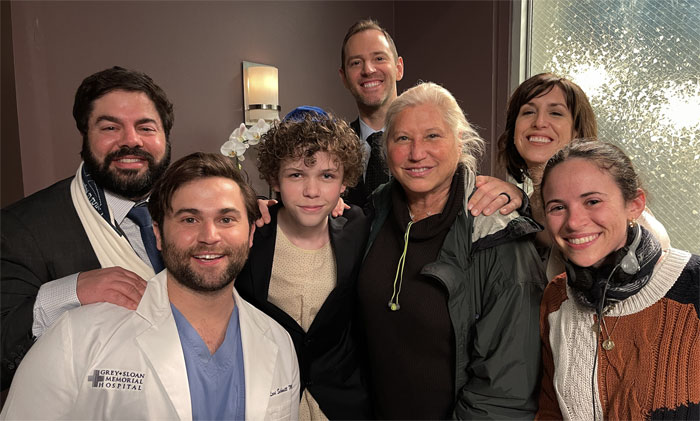
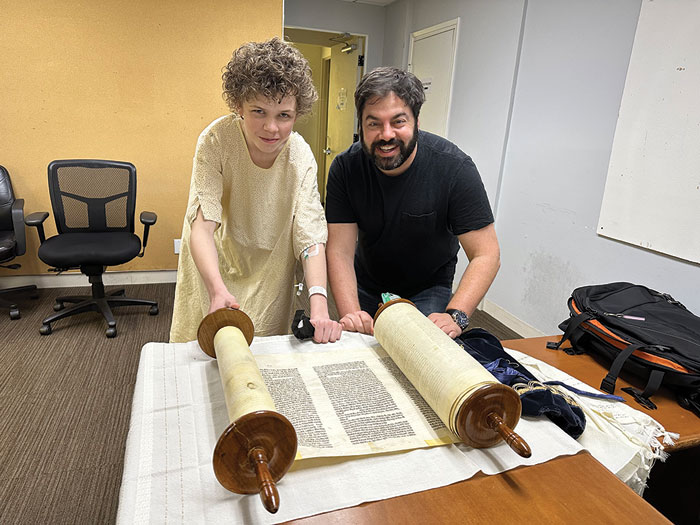
Colin O’Brien and Todd Shotz (Photo courtesy Todd Shotz
“He’s in the CT scan in this darkened room, and he’s singing in Hebrew,” Shotz said. “Grey’s” wanted to get it right. They actually reached out to Shotz before the actor was cast.
Shotz coached O’Brien, who is 14, via Zoom the day before the shoot; he became instant friends with him and his mother, Christine.
When O’Brien said he had never seen a Torah scroll, Shotz offered to bring his travel Torah to the set. “It even counted as a part of his educational time,” Shotz said.
During that shoot day, Shotz was asked to join a production meeting about the next episode, “Mama Who Bore Me,” in which Grayson would have his Bar Mitzvah service in the hospital chapel.
Shotz’s one-day gig turned into two months of consulting and collaborating.
“Writer Alyssa Jacobson and director Linda Klein included me so much to make sure the service and the party felt authentic,” Shotz said.
Shotz brought the Torah, the reading podium, candy for throwing, tallitot and prayer books. He basically threw a Hebrew Helpers Bar Mitzvah at “Grey-Sloan Memorial.”
Side Note: Jamie Denbo is a co-executive producer on “Grey’s,” and Hebrew Helpers worked with both of her kids on their b’nai mitzvah. “It was just a wonderful coincidence,” Shotz said.
Shotz loved watching the episodes in their entirety when they aired.
“As I only saw a couple of scenes prior to this evening’s broadcast, I was so drawn into the overall storyline of Grayson Friedman,” Shotz said. “Colin did such a beautiful job. I loved seeing the throughline of what his character was going through. It made the bar mitzvah scene all the more powerful.”
A TV show as a window into other experiences and cultures. When it’s presented authentically, it has the power to build bridges.
Whether it’s the medicine on in the show or other cultures being represented, “Grey’s Anatomy” strives to create familiarity with the audience.
While neither Borelli nor O’Brien is Jewish, O’Brien also plays a Jewish character (the lead) on Apple TV+’s “Dear Edward.”
Shotz said the actors were very detailed and dedicated to getting the Hebrew right and representing well the Jewish characters that they were playing.
“I also think that in my experience when someone who did not grow up with Jewish background plays a Jewish character, the time they spend researching and investing in that Jewish person’s story and culture often makes them feel a great connection to us,” Shotz said.
Shotz’s friendship with the O’Briens has continued. While they were still in LA, he took them to the megillah reading for Purim at Valley Beth Shalom. Plus, Shotz has started teaching Colin Hebrew via Zoom.
“He is intrigued by the language and wants to learn how to read,”” Shotz said. “Life is really cool sometimes.”
Episodes of “Grey’s Anatomy” are available to stream on Hulu.
In recognition of Yom HaShoah, the Federal Inter-Agency Holocaust Remembrance Program held its 30th annual memorial event at the Great Hall iof the Robert F. Kennedy Building, the headquarters of the United States Department of Justice (DOJ).
“The Federal Inter-Agency Holocaust Remembrance Program started at the U.S. Department of Education in 1994,” according to the program’s website. “Comprised of dozens of federal agencies, its mission is to educate federal employees, students and the public about the Holocaust through the stories of survivors, who show what can happen if prejudice, hate and intolerance against any individual or group of people go unchallenged.”
This year’s event, titled “Ray of Hope,” featured a discussion between Holocaust survivors Peter Gorog and Emanuel (Manny) Mandel.
Gorog survived the Budapest ghetto with his mother before being liberated by the Soviet Army in January 1945. He came to the U.S. in 1980 and went on to have a successful career in public service, having worked for the DOJ, Department of Defense and NASA.
Gorog’s concluding words were about what he tells students when he shows them a photo of Jews in Budapest being herded away as the townspeople looked on and did nothing.
“I tell the students and the audience that one thing you cannot be: you cannot be a bystander when you see hatred, when you see discrimination — regardless of who,” Gorog said. “You just cannot stay silent because the 6 million could not have been killed without having so many bystanders who did absolutely nothing to prevent the Holocaust.”
Mandel grew up in Hungary, where his father was cantor at the Rumbach Street Synagogue and one of the four chief cantors in Budapest. Deported to Bergen-Belsen, the family was separated Manny and his mother were reunited with Manny’s father in 1945 in Israel (then the British Mandate of Palestine). Mandel’s family eventually settled Philadelphia. He recently retired as a practicing psychotherapist in Maryland.
Mandel lamented the pervasive casual ignorance of history he sees.
“We do not know our history,” Mandel said. “It’s amazing to me, and this is just a little side part — I’m a volunteer at the Holocaust Museum. And sometimes I spend time at the information desk and that’s where people come and ask lots of questions, and I tend to ask them questions as well. Important questions like, ‘where are you from?’ They can usually answer that, but not much beyond that. ‘There’s nothing really west of the Mississippi, west of the Hudson River in New York.’ Our knowledge of history, our knowledge of geography, generally speaking — no insult to anybody here — is abysmal. Now, if you don’t learn history, you don’t know where you came from, and if you don’t know where you came from, it’s very difficult to decide where you’re going.”
Attorney General Merrick Garland shared a story of how the Holocaust impacted his family. Before World War I, Garland’s grandmother and two of her siblings came to America seeking refuge from religious persecution. But there were two siblings of Garland’s grandmother who stayed behind. They would be murdered in the Holocaust.
Garland’s mother-in-law fled to the United States in 1938 when the Nazis invaded Austria.
“Through our work, we are sending a clear message that this Justice Department will not allow illegal acts of hatred to go unchecked or unchallenged. As Americans, we also share an obligation – an obligation to remember the horrors of the Holocaust and to listen to the stories of the survivors.” -Attorney General Merrick Garland
“The protection of law — the Rule of Law — is the foundation of our system of government. It is also one of the most powerful tools in the fight against hate. All of us know about the disturbing rise in antisemitism in this country. Indeed, hate crimes against Jews comprised the majority of religion-related hate incidents reported in 2021. The Justice Department is doing everything in our power to combat the rise in hate-fueled acts and threats of violence. We are aggressively enforcing hate crime statutes. We have increased our capacity to investigate hate crimes and hate incidents. And we are working with state and local governments to do the same. We do this because we all know what happens when hate is allowed to take root. We do this to ensure that a tragedy like the Holocaust never happens again. And we do this because it is part of this Department’s historical inheritance.”
Garland then regaled the story of how In 1945, U.S. Supreme Court Justice Robert H. Jackson served as the Chief Prosecutor at the International Military Tribunal at Nuremberg.
Justice Jackson is known for his strongly-worded opening remarks at the trials of Nazi war criminals.
An excerpt:
“But none of these men before you acted in minor parts. Each of them was entrusted with broad discretion and exercised great power. Their responsibility is correspondingly great and may not be shifted to that fictional being, “the State,” which cannot be produced for trial, cannot testify, and cannot be sentenced.” —U.S. Supreme Court Justice Robert H. Jackson, 1945
There were also remarks by Kristen Clarke, the Assistant Attorney General Civil Rights Division, as well as Eli Rosenbaum, Counselor for War Crimes Accountability at the DOJ. Rosenbaum spent nearly 40 years prosecuting Nazis as the head of the Office of Special Investigations. He also moderated the discussion between Gorog and Mandel.
The 90-minute event concluded with a candle lighting and a closing charge by Doernberg. Seven electronic candles were set up — six for each million of the Jews murdered, and one representing hope and those who helped save Jews from being murdered. Before the candle lighting began, Doernberg asked for all survivors and descendants of survivors in the room to stand. Several dozen stood to be recognized.
“Because of your survival, your descendants have the duty to make an impact.” -Wendy Doernberg, the chair of the Federal Inter-Agency Holocaust Remembrance Committee.
“The Nazis wanted to extinguish your flames against all odds,” Doernberg said. “You are here with us. As we look around and think of those joining us from afar, each of you is a miracle. Survivors such as Michael Taylor, who is 100 years old and watching from New Jersey. Michael, you are a part of the resistance and helped to save many people. Others of you dedicated your lives to the American public or those around you. You helped us explore outer space. You provided mental health treatment. Because of your survival, your descendants have the duty to make an impact. My hope for us as the descendants is that we emulate those like the recently departed Judy Heumann. She was the daughter of two parents who escaped the Nazis and her parents refused to allow their child to be mistreated because she had a disability. She was often called the ‘Mother of the Disability Rights Movement’ and she served in several federal positions throughout her illustrious career. Her impact continues throughout the government and around the world. To our survivors: May you, your descendants and all those you have impacted continue to be a positive change.”
Whether under some illusion of tribal invincibility, or perhaps simply obtuse to the realities around them, it doesn’t require any special clairvoyance to realize that the world is burning and too many American Jews are standing around fiddling with violins — and I mean the bouncy, and not mournful kind.
Antisemitic hate crimes are spiking globally, no matter who gathers the data. Jews remain the world’s favorite moving target. And for this reason, an alarming number of European Jews are on the move, having already decamped for safer ground. The Jews of the Middle East, Persian Gulf and North Africa — around 800,000 of them — are long gone. Most went to Israel, but others moved to France and a few other European nations.
You want to know the result of this? Are you sitting? Some believe that by 2048 European nations with rich Jewish histories will be without actual Jews. That’s right. Empty synagogues will be converted into movie theaters, which has been done in Poland for decades. Jewish museums will be reconfigured to memorialize Jewish dinosaurs.
Some believe that by 2048 European nations with rich Jewish histories will be without actual Jews.
As for those Jews who will remain situated in relative safety — those in Israel and America — don’t be surprised if even in safe havens, wearing a yarmulke or Star of David serves as a bullseye. For Israelis, the danger that surrounds them has only worsened, given Iran’s lunatic proxies (Hezbollah, Hamas, Islamic Jihad) nuclear ambitions and eliminationist trash talk. For American Jews, showing up to shul might become a game of Russian roulette, and campus life is no longer especially collegial.
Meanwhile, the Palestinians still won’t renounce violence—even if they’re reduced to only guns, knives, and automobiles. A fair-minded person can draw but one conclusion: Palestinians are far less interested in a country of their own than they are in seeing the end of the Jewish one. The implacable Right of Return foreshadows a Jew-less land to which they will return.
The latest Ramadan-Passover crossover skirmishes between Arabs and Jews saw the IDF conduct counterterrorism raids in the West Bank, rockets launched from Gaza, Syria, and Lebanon, and Israel’s retaliatory airstrikes.
Meanwhile, on the ground, the casualties were especially heart wrenching. On the second day of Passover, the Dee Family, formerly from the United Kingdom, lost three of its members — two daughters and the mother — when a Palestinian militant opened fire on them while in their car.
The Iron Dome doesn’t shield everything. An Italian tourist lost his life when a jihadist rammed into him while strolling on the Tel Aviv boardwalk. Don’t expect to see the Palestinian Authority or Hamas issue a formal apology to Italian diplomats. For these groups, everyone in Israel, or who supports Jews elsewhere, is fair game, as we learned from the murder of the Christian-American Taylor Force.
As for Europe, enmity toward Jews has spread into nations that opened their borders to Muslims fleeing the civil war in Syria. A great humanitarian gesture, but one that resulted in dead European Jews. Must I even mention the irony? On the very same continent where nearly 80 years earlier six million Jews were annihilated, today there is a new army ready to finish the job.
Germany, out of all the European nations, became a welcoming and compassionate sanctuary for a new strain of antisemitism. If there is one nation that should be recruiting philosemites, it’s Germany. How paradoxical that Hitler’s most enduring henchmen are wearing keffiyehs rather than jackboots, and pledging their allegiance by reciting “Allahu Akbar” instead of “Heil Hitler.”
Think I’m kidding about this overall European crisis? Twenty percent of Norwegian Jews have left its two largest cities. In France, the cities of Grenoble, Nice and Toulouse have lost half of their Jewish population. Denmark has lost a quarter of its Jews. They are predicting that within twenty years, Belgium will be emptied of Jews.
The chairman of the Jewish community in the German state of Brandenburg stated, “I don’t want to live in a country whose chancellor brings in millions of antisemitic Muslims who attack Jews and Jewish institutions in Germany. … where you can’t wear a kippah on the street. … Jews are hiding in Bonn, Potsdam, Bochum and the rest of the country.” England’s chairman of the Jewish National Fund recently declared, “Jews have no future in the UK.”
And putting aside the fate of Jews, the spread of Sharia law and jihadism throughout the mosques and madrassas of Europe portends neither a pluralistic nor democratic future.
As for American Jewry, it’s really a tale of two realities: The vast majority of Jews in the United States know next to nothing about the fate of their coreligionists around the world. Part of the reason is that for the most part, most live in modern shtetls that have been spared the synagogue shootings in Pittsburgh and Poway, and the street violence in New York, Los Angeles and Miami. Still others are not openly Jewish enough, or who have assimilated so seamlessly, to attract any attention.
Another reason for this apparent ignorance is that in an age of woke politics, it’s politically incorrect to point out the moral failings of persons of color. Being labeled an Islamophobe is one notch below racist. This latest iteration of Jew-hatred is one that dare not speak its name — radical Islam’s war against Jews. Neo-Nazis are fair game; Islamists are a protected class.
This latest iteration of Jew-hatred is one that dare not speak its name — radical Islam’s war against Jews. Neo-Nazis are fair game; Islamists are a protected class.
Jewish life has become cheap, even though Jewish existence itself is the epitome of human scarcity. A speck of a minority everywhere around the world — and in most places, virtually nonexistent. And, yet, nowadays Jews can disappear with little or no affinity . There’s a casualness about dead Jews, a numbness, yet never a crisis.
I have come back to this subject many times. Here, here, here, here, here, here, here, here, here, here, here, here, here, here, and various places elsewhere. It may seem like beating a dead horse, but all in the service of averting more dead Jews.
Thane Rosenbaum is a novelist, essayist, law professor and Distinguished University Professor at Touro University, where he directs the Forum on Life, Culture & Society. He is the legal analyst for CBS News Radio. His most recent book is titled “Saving Free Speech … From Itself.”
Richard Crossman, a member of Britain’s House of Commons at the time of Israel’s establishment, said: “Nations new to freedom are usually excited by it and talk about how thankful they are for what they have gained. The Israelis are not grateful for their liberties. They grumble all the time, revealing how rooted their nation is in the idea of freedom.”
As the holiday of Pesach comes to close, the next day of festivities to which we look forward in Israel is Yom Ha’atzmaut, Independence Day, which is reliably a time of ecstatic pride in our nation and its survival. This will be my first Yom Ha’atzmaut as an Israeli citizen, having made Aliyah only eight months ago, and therefore one would expect, as I originally did, that I’d be looking forward to the commemoration, to the new feelings of belonging amidst the celebrations. Yet as the spring season in Israel promises new problems, and as political turmoil intensifies, polarizing not only the country but my own group of friends, my thoughts have become more complicated.
Feeling especially anxious this past week, I wrote on social media that Yom Ha’atzmaut this year will feel, for me, somewhat akin to the Fourth of July in the United States during the Trump era, when my sense of national pride was contingent upon rejecting the competing visions of other Americans. This, at the time, made sense to me. I began to write an opinion piece about how this upcoming Independence Day, I planned to wave the Israeli flag and sing Hatikvah as a statement of my own Zionism, defined in contrast to the Zionisms of other Jews.
The response was swift. One comment under my tweet read: “Honestly this bothered me so much … people came here and gave up everything, their lives, you show up at 30 (sic) and want to reclaim something from people who suffered to give you your right to be here.” Another read: “Sorry, I like a lot of what you write but you’re too divisive here. Many Israelis on all sides of the political spectrum have given their lives to be a part of Israel. Who love it. This ‘we’ talk doesn’t help. Even with differences, we ALL own the flag.” Yet another commenter said: “Hey Blake. We are one country. Cut the us versus them crap. You should have left that in the US.”
I’d be lying if I said that I was unprepared for this criticism. Since arriving in Israel, I have not been able to stay silent about Israel’s political strife, and my opinions very clearly align with one camp. As a consequence, a routine accusation from many who once vocally agreed with me has been that I am failing to recognize the perspectives of other Israelis, living in parts of the country other than Tel Aviv, with differing religious practices and life experiences that have shaped their beliefs.This is probably true, and I certainly have a lot to learn in my brand new country, and yet still, I have not yet found a way to pretend that nothing of interest is happening outside my Hebrew classes. While thinking deeply about this dilemma one afternoon, the Richard Crossman quote with which I opened this piece flashed across my computer screen, and some revelations have since come to light.
Crossman first nods to the truism that for societies all around the world that are new to the experience of self-determination, whatever fractures may exist between them do indeed fall by the wayside before the almost religious experience of freedom. Eastern European nations like Poland, only recently freed from foreign occupation, often display notably jingoistic unity to the rest of the world. Arab and African states that no longer serve imperialist demands crack down on formation during independence days, broadcasting military parades and promises of fealty to leaders and soldiers.
It is not a coincidence that countries with shorter histories of home-rule are more likely to descend into illiberal regimes. When cohesion is prioritized over diversity, justified with the warning that “our enemies want us divided” (however true this may be), there is little room for healthy dissent.
Israel has not faced disaster since its inception, while the same cannot be said to gasps of national sovereignty around the world that have risen and fallen since Israel’s establishment.
The Israeli people, though sovereignty is still new to us, and though we know more than most the consequences of nothaving sovereignty, nevertheless do not follow this model. For two thousand years the Jewish people have defined themselves by the rifts in our ranks, the petty squabbles that characterized life in the shtetl, the disputes of the first Zionist Congresses, and the constant tug of war between ideas in Israel that leaves many unhappy regardless of whether things go their way. We are a hyper-educated people, acutely aware, due to our history, of which way the winds of politics are blowing, and subsequently acutely critical when things feel unjust. We are not, and have never been, a nation obedient to authority. At the time of Israel’s establishment, it was unconscionable to install a government that would not give everyone a voice and a vote. Unlike other nations that can be threatened more easily into subservience, Ben-Gurion understood this to be a plan for disaster for the Jews. Israel has not faced disaster since its inception, while the same cannot be said to gasps of national sovereignty around the world that have risen and fallen since Israel’s establishment.
Since reading Crossman’s observation that Israelis are “always grumbling,” because the concept of freedom of expression is something well-established and valued, I have begun to understand the comments on my social media posts differently. Now I wonder: Is there anything more Israeli than holding grievances against other Israelis for not having the same vision of the Jewish state as you? Is there anything more Jewish than complaining about other Jews, with whom you bicker over how to be Jewish in the modern world? These divisions, given how the upcoming Independence Day will be the 75th without interruptions, appear to define and strengthen us far more than they threaten to break us apart.
Israelis will recognize the fault lines in our impossible country, call them what they are, but use them to find sturdier footing.
However, I will concede that there has been a small deviation from my initial expectations for Yom Ha’atzmaut. If at first I anticipated that Israelis would run into their corners for the celebration, taking pride in the flag and in the anthem as an expression of their specific interpretation of Zionism, and if I then wondered if I was wrong, if the day was truly a nonpartisan, nonpolitical display of unity, I now realize that both realities are in fact incorrect. Israelis will not jettison their convictions about how the state should operate when it comes time to remember its birth. However, neither will Israelis use resentment and division as fuel to promote any exclusive version of independence, as I did while living in the United States. Instead, extraordinarily, Israelis will recognize the fault lines in our impossible country, call them what they are, but use them to find sturdier footing.
Blake Flayton is the New Media Director and Columnist for the Jewish Journal.