fbpx

April 11, 2023

From Trotsky to Torah: An Unlikely Journey

For a time while I was a kid, I used to pray to Anne Frank. I wouldn’t kneel beside my bed or speak aloud, both because I felt silly and because I shared a room with my sister, but under cover of darkness I would lie beneath my bright quilted bedspread, close my eyes, lace my hands across my chest and silently send her my most fervent thoughts. God was remote, indifferent to my miseries and hopes. It seemed right somehow to supplant Him with Anne Frank, who I felt certain had His ear in heaven if she wasn’t a deity herself.

I felt entitled to claim a special connection with Anne, as I called her. Not only was she a girl about my age (even if she wrote like a vastly older, wiser, smarter one), but she was a Dutch Jew, just like my mother. If my grandparents, Oma and Opa, hadn’t got themselves and my mother out of the Netherlands during World War II, my mother would probably have shared Anne’s fate and I wouldn’t be here. In my mind Anne and my mother were fused, but since I harbored an outsized adolescent rejection of my mother, I removed her from the picture and inserted myself. Anne was my alter-ego, who allowed me to be something else—something more—than the impossibly fortunate California girl I was.

It was a new thought for me, this being Jewish. A short time earlier I’d had a school project—interview someone who had an experience with war—and decided to interview Oma. I screwed up my courage—she could be sharp-tongued—got her on the phone and learned that she and Opa had left the Netherlands so they wouldn’t be sent to concentration camps—“You know, like Sophie’s Choice,” she prodded. I was indignant: I knew about the Holocaust. I’d been shattered to learn about it in school and went on to read Anne Frank’s diary on my own. What I didn’t know was that the Holocaust had anything to do with my family. 

In subsequent years I tried getting Oma to tell me more, but she refused to speak. My mother seemed embarrassed to say she didn’t know more than I did: her parents never wanted to talk about it. I learned from others about Opa’s father and sister who were murdered in Auschwitz, notice I seemed to have a lot of relatives in Israel. Still, even as I prayed to Anne Frank feeling she was me somehow, my Jewishness was like an easily dismissible rumor. It was too incongruent with my life of Christmas and Disneyland, shopping malls and a vaguely intuited emptiness.

I eventually stopped praying to Anne and became an atheist, like the rest of my family. I spent high school lunchtimes haranguing anyone who’d debate me that there is no God, then took my opinionated, sublimation-prone self to Berkeley. I became a radical anti-apartheid activist, then joined a much more radical, Trotskyist organization. Not being a half-measures sort of person, I stayed with them for about twenty-five years.

I became a radical anti-apartheid activist, then joined a much more radical, Trotskyist organization. Not being a half-measures sort of person, I stayed with them for about twenty-five years.

In the party I found much that was good, including some of the most selfless, intelligent, funny, critically-minded people I have ever known. I found a precious sense of belonging and meaning. And I found the comfort of clarity between good and evil, progress and reaction. Enemies abounded, but none was so compelling as the preternaturally sinister, powerful, reactionary “Zionists.” As I’ve written elsewhere, I swam in a sea of antisemitism for years and didn’t notice the water was filthy.

After quitting the party in 2016, I was desperate to understand how I accepted so many hateful beliefs and, more broadly, what I believed. I returned to school, wrote my master’s on antisemitism and the left, then continued reading, writing and generally obsessing about antisemitism. But I was increasingly bothered. Antisemitism is hatred against Jews, but who are these people? I knew something about Jew-hatred now, but nothing about Jews, themselves—only as victims. I sensed something that could enrich my life, which had been the beating heart of my mother’s family generations ago. I wanted to seek a connection to those ghostly Jews—to honor not only their sufferings and deaths, but their joys and lives.

I wanted to seek a connection to those ghostly Jews—to honor not only their sufferings and deaths, but their joys and lives.

So I’ve set out not only to learn, but to open my heart. There’s so much turmoil in the world these days, such hatred and just plain craziness that sometimes it feels impossible, and even indulgent, to seek stillness. Yet every Friday I light Shabbat candles, say kiddush, gaze at the flickering flame. I don’t know what I believe. I have a sense of coming home, however—tempestuous as it can be—and that’s more than enough. Am Yisrael chai.


Kathleen Hayes is the author of ”Antisemitism and the Left: A Memoir.”

From Trotsky to Torah: An Unlikely Journey Read More »

Moving Beyond Israel’s Leadership Crisis

The Hebrew Bible (Ta’nach) devotes a great deal of attention to the complexities of leadership, the successes that qualified leaders can bring, and the national disasters that accompany failed figures. In presenting Moses and Joshua, followed by the portrayals of a series of flawed tribal strongmen (and women, as in the case of Deborah) in the Book of Judges, and then Shaul, David, Solomon and the split into two kingdoms, the biblical narrative is a valuable source for exploring different leadership characteristics and their implications. 

These assessments and discussions are essential in every generation, and particularly in the current crisis that has brought Israel to the brink of civil conflict.  And they remind us that beyond the specific issues of judicial reform, in order to end today’s dysfunction, we need leaders who focus on the national interest and are able to unite different groups and find common ground.  

In the Jewish tradition, Moses is the archetypal leader, who, under God’s tutelage, brought the Israelites from slavery to freedom and then 40 years in the desert. The portrayal of Moses is multilayered, beginning with a unique backstory – saved from Pharaoh’s brutal infanticide by the Egyptian ruler’s daughter, raised in the royal palace, but still able to identify with the enslaved Israelites. Although hot-headed in killing a brutal taskmaster, which forces him to escape to the desert, Moses is also painfully modest, repeating excuses when God tells him to return to Egypt, confront Pharaoh and lead the people out of bondage. A successful leader, then as now, must be a convincing orator but Moses stutters and God has to send his brother Aaron as spokesman. 

Gradually, Moses masters the job. In the desert, his speeches become cogent and powerful, and he acquires confidence and charisma, leading military operations against attackers, and putting down the revolt of Korach and his allies, who sought power for its own sake. At the same time, throughout the portrayal, Moses remains human, with imperfections and mistakes – such as striking the rock in anger when the people complained (not the first time) about being thirsty. For this, he paid a high price, when God precluded him from entering the promised land. 

In modern western democracies, including Israel, leaders are not chosen by divine intervention (at least not visibly). Instead, they must run campaigns in order to secure their positions, and this usually comes with a significant ego and sense of self-importance — qualities far removed from the reluctance and modesty displayed by Moses. To generate the headlines and social media buzz necessary to get elected, they need teams of spinners and influencers, and this costs money which must be raised, usually from wealthy patrons, who have their own interests. 

But none of these factors justify corruption or eliminate the need for humility, at least off stage. Leaders who lose touch with the citizens, or treat them with disdain, isolate themselves from the general public, and lose legitimacy. A successful leader must also have qualified experts and advisors (as distinct from career politician-supporters and yes-men or women), and be able to listen to and act on their analysis. One of the most significant moments in the Biblical narrative shortly after the Exodus takes place when Moses becomes overwhelmed with the demands on his time from the people. At this point, his father-in-law, Jethro the Midianite leader and management guru, advises him on setting up a hierarchical legal structure, which is immediately accepted and implemented.  

Leaders who lose touch with the citizens, or treat them with disdain, isolate themselves from the general public, and lose legitimacy. 

In modern Israel’s first decades, our leaders fit most of these criteria. Ben-Gurion and Begin were modest — neither led ostentatious lives, both eschewed the trappings of power and access to wealth, and stayed focused, for the most part, on the shared goals of the Jewish nation-state and its citizens. They were careful to not allow family members to benefit from their privileged positions and did not isolate themselves from the general public. They sought out and listened to different views and analyses before making fateful decisions. When responding to criticism, they usually demonstrated respect. (Ben-Gurion’s boycott of Begin and his Herut faction until 1967 was an exception.)  

In recent decades, these essential leadership elements have faded, at significant cost. Many of today’s political classes ignore professional experts on critical national issues, because their analyses are inconvenient. As in the times of the Judges, our government is composed primarily of sectoral leaders who are oblivious to the wider national implications of their narrow and divisive agendas. 

It is now the norm for leaders from different parties to use their positions and power in order to seek personal gain – a feature predicted by Samuel when the people demanded the appointment of a king “like the other nations.” The prophet warned them “He will take your sons and appoint them as his charioteers and horsemen … and your best fruits and vineyards and olives,” and this described many of the rulers that followed. Today, corruption takes different forms, but the results are similar. In contrast, the Bible gives us a standard set by Abraham, who told the King of Sdom “I will not accept even a thread, or a strap of a sandal … lest you should say, ‘I have made Abram rich,’” and by Samuel, who proclaimed “Whose ox or donkey have I taken? Whom have I cheated or oppressed? From whose hand have I accepted a bribe and closed my eyes?” How many of Israel’s leaders today could come close to their records?   

It is now the norm for leaders from different parties to use their positions and power in order to seek personal gain – a feature predicted by Samuel when the people demanded the appointment of a king “like the other nations.”

Corruption, oversized egos, narrow horizons, manipulative and divisive policies, and misplaced priorities are some of the characteristics of what passes for leadership, as a divided Israel approaches the 75th anniversary of the rebirth of Jewish sovereignty in our homeland. This would be an appropriate occasion for voters from all sectors to demand much more from candidates and leaders.


Gerald M. Steinberg is an emeritus professor of political science at Bar-Ilan University and president of NGO Monitor.

Moving Beyond Israel’s Leadership Crisis Read More »

Justice, Justice, He Pursued: In Memory of Ben Ferencz

Together we offer this loving tribute in memory of Benjamin Berrel Ferencz, the last surviving prosecutor from the post-World War Two Nuremberg trials, who passed away this week at the age of 103 years old. We do so as mutual admirers of Ben Ferencz, whose pursuit of justice for victims of the Holocaust as a young prosecutor at Nuremberg in 1947, and whose lifelong pursuit of global human rights through the rule of law, make him an exemplary role model for the Jewish people, and for all of humanity.

Born in Transylvania in 1920, Berrel came to the United States with his family as a baby. Here in the U.S., Berrel became Benjamin. He grew up in poverty in New York City, and from a young age he knew he wanted to be a lawyer and devote his life to the pursuit of justice. 

In 1940, at the young age of 20, he graduated City College of New York with a BA in Social Sciences. He was accepted to Harvard Law School, where he studied from 1940-1943. 

During his studies at Harvard, he was a research assistant to Professor Sheldon Glueck, who was publishing articles and writing a book calling for the prosecution of Nazis as war criminals. So it was, that two Jewish legal minds at Harvard—a teacher and a student—started to speak about bringing Nazis to justice for the crimes they were committing. It was a mere four years later, in 1947, when the young student, Ben Ferencz, pursued that noble path at Nuremberg.

Ferencz reached Europe as a United States artillery soldier, but the young legal scholar soon realized that he was not cut out for combat. There was a greater task for him in store, one that would put his brilliant legal skills to work in the name of justice. He was transferred to the Judge Advocate’s Section of General Patton’s Third Army, and was assigned to the newest branch: investigating German war crimes.

During the last stage of the war, Ferencz busied himself collecting evidence of crimes committed in German concentration camps. On a map, he kept track of the locations where the Americans had discovered such camps. He visited the camps himself, and was witness to the stacks of emaciated corpses and other evidence of atrocities. He was shocked at what he saw, and throughout his life, whenever he spoke about this traumatic experience, he broke down into tears. “My mind would not accept what my eyes saw.” he said. “I had peered into Hell.”

After the war, Ferencz returned to the United States. By recommendation from his former mentor at Harvard, Professor Sheldon Glueck, Ben was invited to the Pentagon. There he learned that the army was urgently looking for lawyers experienced in trying war criminals. Ferencz, who had never risen beyond sergeant, was asked to return to Germany in the rank of colonel, to assist in persecuting war criminals.

On September 29, 1947, 24 high ranking officers of the Einsatzgruppen, responsible for the murder of over one million Jews, stood trial in the court room in Nuremberg, in what the press called “the biggest murder trial in history.” All eyes were focused on a young, short but very confident and determined 27-year-old prosecutor, who delivered his now famous opening remarks before the judge. Here is an excerpt of those monumental words:

“May it please your Honors: It is with sorrow and with hope that we here disclose the deliberate slaughter of more than a million innocent and defenseless men, women, and children. This was the tragic fulfillment of a program of intolerance and arrogance. Vengeance is not our goal, nor do we seek merely a just retribution. We ask this Court to affirm by international penal action man’s right to live in peace and dignity regardless of his race or creed. The case we present is a plea of humanity to law. Genocide, the extermination of whole categories of human beings, was a foremost instrument of the Nazi doctrine. We charge more than murder, for we cannot shut our eyes to a fact ominous and full of foreboding for all of mankind. Not since men abandoned tribal loyalties has any state challenged the right of whole peoples to exist. And not since medieval times have governments marked men for death because of race or faith. Now comes this Nazi doctrine of a master race, an arrogance blended from tribal conceit and a boundless contempt for man himself. It is an idea whose toleration endangers all men. It is, as we have charged, a crime against humanity. The conscience of humanity is the foundation of all law. We seek here a judgment expressing that conscience and reaffirming under law the basic rights of man.”

The bold young prosecutor stared evil straight into the eye, and through the law, Ferencz succeeded in bringing these murderers to justice. He was, in the end, a combat soldier, except his battlefield was the courtroom, and his only weapon was the law.

The bold young prosecutor stared evil straight into the eye, and through the law, Ferencz succeeded in bringing these murderers to justice.

In his memoirs, Ferencz wrote that he hoped the trial “might somehow help to deter the repetition of such horrors in the future. I was determined to do whatever I could to help lay a foundation for a more humane world.” 

In the final sentence of his opening speech in Nuremberg, he called the defendants “the cruel executioners whose terror wrote the blackest page in human history. If these men be immune, then law has lost its meaning and man must live in fear.”

Indeed, he would go on to devote his life to making sure that law would never lose its meaning. He taught and practiced international and human rights law, lectured passionately all over the world, fought legal battles for Holocaust restitution and reparations, was ultimately responsible for the establishment of the International Criminal Court where war criminals could be tried for their crimes, and donated millions of dollars from his personal investments to institutions and law schools to promote, uphold and practice human rights law. He always remained positive, upbeat and humble, and his famous “three most important things in life were: never give up, never give up, and never give up.”

One of us—Michael, the professor of law and scholar in Holocaust studies and International Human Rights law—was privileged to know Ben personally, as a respected mentor and as a dear friend. Ben lectured in my “Holocaust, Genocide and the Law” seminars at Chapman University Law School, was a featured speaker at a conference I chaired on the Nuremberg Trials, and his photo even graced the cover of one of my books, “Forgotten Trials of the Holocaust.” During Covid, we spoke regularly on Zoom, and I was privileged to maintain a close relationship with him and his family.

The rabbi among us, Daniel, wonders why we never hear the name “Ben Ferencz” in Jewish schools, or even at Yom Hashoah ceremonies. 

The rabbi among us, Daniel, wonders why we never hear the name “Ben Ferencz” in Jewish schools, or even at Yom Hashoah ceremonies. With Ferencz’s passing, I believe it is time for his name to become part of our Jewish world, as his life embodied the highest Jewish values of “Tzedek and Mishpat” (“Justice and Law”). This coming Yom Hashoah should be dedicated to him.

Ben Ferencz passed away on Passover of this year, and the comparison with another “lawgiver,” Moses, is not far-fetched. In the Book of Deuteronomy, Moses articulates his immortal words calling for our lifelong pursuit of justice: “Tzedek, tzedek tirdof … justice, justice, you shall pursue.”

From the courtroom in Nuremberg and throughout his long life, justice, justice, Ben pursued.

His legacy is now ours to carry forward.

Rest in peace, Ben Ferencz, and thank you for all that you have done to make our world a better place.


Michael Bayzler is Professor of Law and the 1939 Society Scholar in Holocaust and Human Rights Studies at Chapman University’s Fowler School of Law.

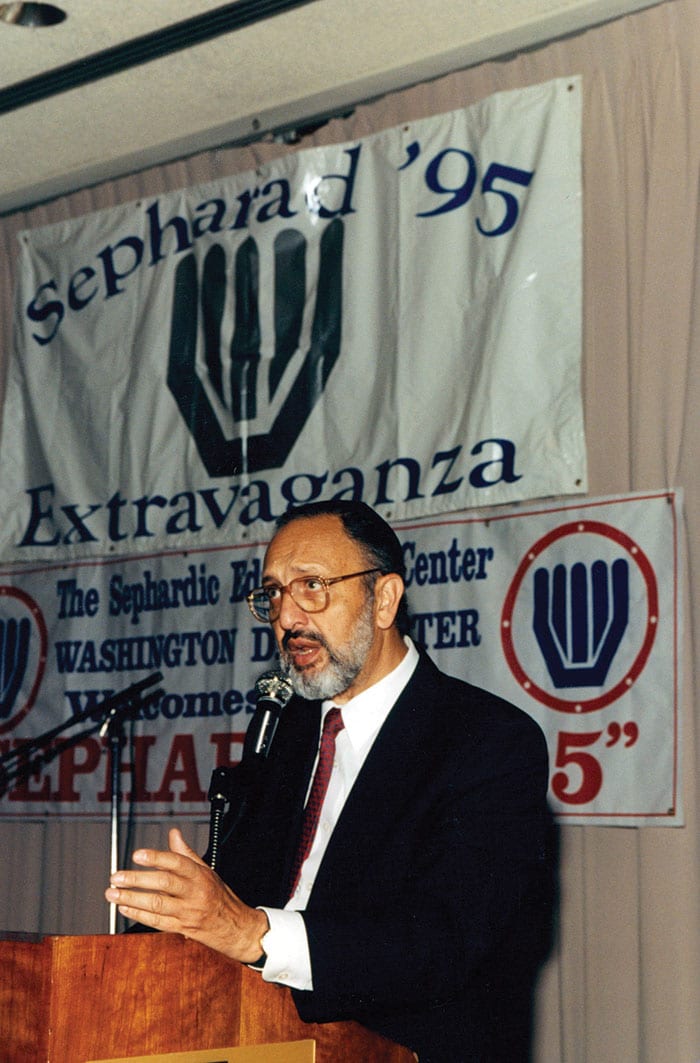
Daniel Bouskila is the Director of the Sephardic Educational Center and the rabbi of Westwood Village Synagogue

Justice, Justice, He Pursued: In Memory of Ben Ferencz Read More »

Mimouna: In My Mind I’ve Gone to Marrakech

Tirbah u’tissad — may you prosper and succeed! This Judeo-Arabic blessing is the manner in which North African Jews greet one another just moments after Passover formally ends, on the night we call “Mimouna.”

For many Jews, the night Passover ends is typically the night to “turn over the kitchen” from Passover dishes back to chametz. For North African Jews, it’s a night when we turn over our homes from Passover to Mimouna, a joyous family and community-oriented cultural celebration that’s all about blessings, smiles and sweets.

Mimouna is all about blessings. In Arabic, the word mimoun means “mazal”; it’s a night when we bless each other and pray for “mazal” in our lives. Because Passover is the anniversary of our deliverance from slavery to freedom, we conclude Passover with an expression of belief — which in Hebrew is emunah (sounds like Mimouna) — that God will continue to bless and protect us beyond Passover. We kick off the night with a long, festive, beautifully chanted havdalahthat not only “distinguishes between Passover and weekday,” but also features blessings for health, prosperity, happiness and safety. We recite this havdalah around a colorful table adorned with symbols of blessing. A bowl of flour filled with gold coins represents livelihood and sustenance. Branches of greenery symbolize a successful agricultural spring season, and a fish represents fertility and plentitude. We chant piyuttim (religious poems) in Moroccan-Andalusian tunes, with lyrics such as ‘arbah ya hai ul’jina’ — bless my brother with wealth.

Mimouna is all about smiles. There are no formal invitations to Mimouna. It’s an open-door evening, and everyone – neighbors, family, friends and friends of friends — stops by to kiss each other on both cheeks and greet each other with festive blessings. The mood induces happiness and smiles. The table is colorful, and so are the clothes we wear. The women wear long, elaborately embroidered dresses called kaftan, and the men wear embroidered shirts or long robes called jalabiya. The sounds of Andalusian music fill the room, and as things warm up, so does the hand clapping and dancing. Shot glasses of mahya (the Moroccan name for arak) are passed around. My father told me that mahya means mayim hayyim — the water of life. This water certainly livens things up.

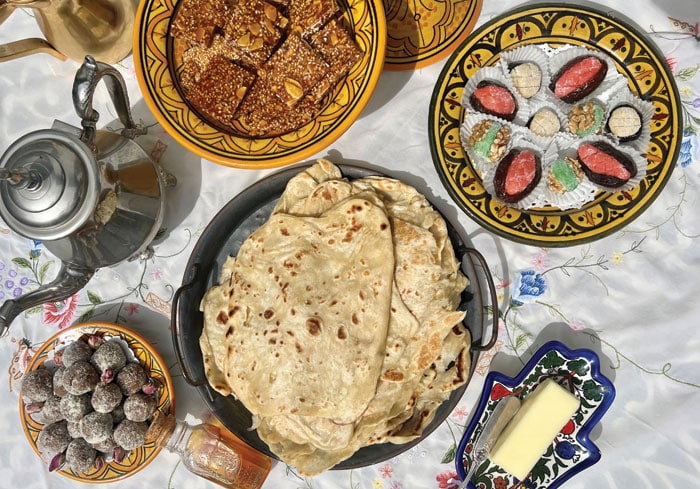
Mimouna is all about sweets. There are two “mandatory Mimouna foods” that everyone must eat. The first is a date filled with butter and honey. The host of the Mimouna welcomes you with this delicacy, accompanied by the greeting “Tirbah u’tissad.” Eating this indulgent combination of sweets symbolizes the sweetness of prosperity and success. Then there is moufletta, the piece de resistance of any authentic Mimouna. Moufletta is a thin, tortilla-style crepe fried in oil and served hot with butter, honey or jam. It’s our first post-Passover chametz, and — appropriately for Mimouna — it’s sweet! Some additional features of a Mimouna table include fresh and dried fruits, marzipan pastries, sesame cookies rolled in honey, a variety of jams and jellies, buttermilk and Moroccan tea with nana (fresh mint). Other than moufletta, which is either purchased before Passover and sold with the other chametz, or purchased after havdalah that very night, the remainder of the pastries are not chametz, and are often prepared during Hol Hamoed of Passover.

I was born into a French-speaking North African Sephardic home. My father was from Marrakech, my mother from Algeria. I was raised in a small apartment in West Hollywood and have never been to these countries. Other than my family, our building was all Ashkenazi Jews, many of them Holocaust survivors. From them, I learned about the Shoah, and from my family, they learned about Mimouna. With my mother beautifully dressed in her kaftan and my father greeting everyone with “Tirbah u’tissad,” our little apartment in West Hollywood somehow expanded to welcome more than 100 guests, who came in and out throughout the night. All of our neighbors, our friends from school, our extended family — everyone wanted to come to our Mimouna. Everyone wanted that date and blessing from my father, and the two kisses on both cheeks and moufletta from my mother. The table, the blessings, the foods and the music — it was as if we were in Marrakech, not West Hollywood.

James Taylor sings, “In my mind I’ve gone to Carolina.” On Mimouna night, I sing “In my mind I’ve gone to Marrakech.”

Tirbah u’tissad!

Mimouna: In My Mind I’ve Gone to Marrakech Read More »

When Passover Ends, the Magic of Mimouna Begins

Editor’s note: Because the next issue of the Journal doesn’t come out until the day after Passover, we’re including this story on a Sephardic tradition for the last night of the holiday.

Rabbi Benito Garzon

This week we hand our column over to Rabbi Benito Garzon who proclaims the wonders of the North African Mimouna. In 1970’s, he became famous throughout Spain as an educator extraordinaire. He was a true inspiration in teaching Judaism and he even taught Jewish philosophy to Queen Sophia of Spain. In 1979, he met Dr Jose Nessim, the founder of the Sephardic Educational Center, who appointed him the first Director of Education of the SEC in Jerusalem. For the next 30 years, he wowed young and old alike. He led hundreds of teens on the SEC Israel trips, he mesmerized the participants of the annual SEC Young Adult Conventions that took place in the 1980’s and 90’s throughout North and South America, and impressed the many adults who came to his classes on his visits to LA, Mexico, Miami, and South America. Now in retirement and living in Ra’anana, Israel with his wife Annie, Rabbi Garzon continues to participate in the SEC Metivta Rabbinical program in Jerusalem every year and organizes programs and classes in his community in Israel. Rabbi Garzon is the epitome of charm and our Sephardic brand of “Judaism with a Smile”.

—Sharon and Rachel

“Morocco, the beautiful country where I was born, is full of colors, aromas and flavors that embellish life, and ancient customs that fill it with divine and human meaning.

Mimouna is a feast and celebration that takes place at the end of Pesach, and friends and family gather around a table laden with delicacies.

The Mimouna festival (or “Timimouna” as it was known in Tetuan where I was born) is perhaps the best example. Indeed, this celebration which we Jews of Moroccan origin celebrate, shows the depth of our roots and the beauty of our heritage. Mimouna is a feast and celebration that takes place at the end of Pesach, and friends and family gather around a table laden with delicacies.

Dressed in festive clothes, the women in kaftans and the men in white “djellabas” and red “tarboush” (fez) that proclaim our origins, everyone is eager to eat moufletas and other delicacies that are offered in abundance.

Have you forgotten Moroccan hospitality? Have you ever seen Moroccans sitting around a table on Shabbat or on a holiday without inviting some neighbors or friends? Never! So, to welcome them properly, the door of the family home is wide open and will remain so all night. The guests will admire and then taste the many dishes generously offered by the hostess. Be careful, though! You might upset her if you refuse to try something, claiming that you don’t want to get fat. So promise yourself to start the diet tomorrow (it won’t be the first time you do it), and make your hosts happy! 

How can you refuse this beautiful almond tart with a Spanish name… “Masapan“! Or lettuce dipped in honey to forget the bitter herb we were forced to swallow on Pesach, to make us feel the bitterness of the slavery from which we have just celebrated our liberation. All that is behind us.

Tonight, only tea and very sweet! No black coffee on the table but white milk and white eggs, the foods that sing of life. No sad colors. Tonight, everything must be a sign of joy and prosperity, of fertility and abundance. Like the bowl of flour in the center of the table, decorated with green leaves that herald spring. Or like the dough you see decorated with gold coins, a sign of success, and which will be used to make the Moufletas, the delicious soft pancakes that we will share, filled with butter and honey.

And here and there, all kinds of jams, not forgetting the popular pastries that take us back to our childhood memories, in other words, to our Moroccan roots, which are still alive: “corne de gazelle” and “marronchino” cookies, dates or figs stuffed with walnuts, almonds, “fijuelas” and  “chebakia” (fried dough dipped in honey), “briouat” with almonds, “al’halwa” (sesame brittle)?

But… where do all these foods come from that we were forbidden to eat, or even to possess during Pesach? And what about that fresh fish, the promise of fertility, and these ears of barley which, spanning 20 centuries, evoke the Omer offering in the Temple of Jerusalem?

If you are asking yourself these questions, it is because you were not born here in Morocco. Imagine that it was our Muslim neighbors and friends who made sure that tonight we did not lack this food, or that it was the peasants who offered it to us as we left the Synagogue, even though they knew that we could not pay because until the stars came out we were forbidden to carry money. “Tjalles gadda”….You will pay tomorrow….”Mbarek el eid”…May the feast be blessed!

With this festival, we ignored the borders that some erect to divide us, we children of the same God celebrate together our common divine origin, singing the same melodies in Hebrew or Moroccan Arabic, laughing at the same funny stories of “Joha”, or quoting those popular sayings full of wisdom, many of which have their origin in the book of “Mishleh”, the Proverbs of Kiing Solomon, which the older generation read and meditate on: ¨Mishle Shlomo ben David, melekh Israel….” while the younger ones celebrate Mimouna with joy.

Historians, ethnologists and other scholars are trying to discover the origin of Mimouna. What for? We Moroccan Jews know that its origin is in our hearts and in our collective memory, where the best of us was born. Isn’t that so?

I don’t know if you know it, but we Moroccan Jews have the happy habit of associating God in all our joyous occasions. Ah, yes! Historians, ethnologists and other scholars are trying to discover the origin of Mimouna. What for? We Moroccan Jews know that its origin is in our hearts and in our collective memory, where the best of us was born. Isn’t that so?

And ask around you what beautiful expression in Arabic we pray to God to grant us a happy Mimouna. And when you have discovered it, make it heard, proclaim it, in Morocco, in Israel, in France, in Argentina, in the United States or in Canada, or wherever you are gathered to spread the light of fraternity, that magic light of Mimouna that the world needs so much today. (Of course, it is “Tirbah U’tsad!”).

– Rabbi Benito Garzon

As described by Rabbi Garzon, Moufleta is the food that we eat after Passover. In Morocco, the ingredients were brought to our homes by our Muslim neighbors. They knew the Jewish holidays as much as they knew their own. 

We hope you have a chance to feel the joy and celebrate with hot, fluffy Moufletas with butter and honey. “Tirbah!!”

—Rachel

Sephardic Spice Girls Moufleta

4 ½ cups all-purpose flour
2 cups lukewarm water
¼ teaspoon yeast (optional)
¼ teaspoon salt
2 tablespoons oil, plus 1/2 cup oil (avocado or vegetable)
Butter, honey or Nutella, for serving

Sift flour and salt into a large bowl and make a well in the center. Add the yeast and slowly add water.
Mix the dough by hand until it is sticky but not smooth.
Pour 2 tablespoons of oil over the dough, cover with a towel and let rest for 30 minutes.
Divide the dough into golf ball-sized balls and set on a baking sheet.
Pour 1/2 cup oil over the balls, then turn balls over to completely cover with oil and let the dough rest an additional 15 minutes.
Lightly oil the counter and stretch each dough ball as thinly as possible.
Heat a nonstick frying pan and oil the surface by using a paper towel dipped in oil.
Place dough in the hot pan. When the dough is golden and bubbles a little, flip and place another piece of dough on top.
Continue to flip every few minutes, adding an additional piece of dough each time.
Remove the moufleta from the pan when there are 4 or 6 pieces of dough in the stack. Then start a new stack.
Traditionally served with sweet butter and honey but kids love it with Nutella.
Makes about 3 dozen.


Sharon Gomperts and Rachel Emquies Sheff have been friends since high school. The Sephardic Spice Girls project has grown from their collaboration on events for the Sephardic Educational Center in Jerusalem. Follow them on Instagram @sephardicspicegirls and on Facebook at Sephardic Spice SEC Food. Website sephardicspicegirls.com/full-recipes.

When Passover Ends, the Magic of Mimouna Begins Read More »

Montreal Jews Lived Their Exodus

Well here we are after two Seders, stuffed to the gills, exhausted from schlepping the chairs, cooking the meals and setting the table, broke from the high cost of kosher brisket and turkey, and constipated from eating too much matzah. Unfortunately, many of us in Montréal encountered another challenge for this year’s Pesach celebrations. On Wednesday morning, as the briskets and lambs were going into the oven, the salade cuite and chicken soup were bubbling on the stove top, and some last minute matzah ball mix and potato starch purchases were being made at the local grocery store, the sky turned dark, the wind started howling and a mixture of hail, ice pellets and freezing rain starting falling from the heavens.

As we watched from our windows, it looked like one of the ten plagues was being repeated right on our front lawns. Passover is a time to remember the passage from Egypt, and before the Hebrews were allowed to leave, G-d had to convince Pharaoh and the Egyptian masses that he really was all-powerful and he could throw anything at them to get them to change their minds. In modern times we tend to forget the power of G-d and nature. We take for granted that the lights will go on, our gadgets will give us instant communication with friends and family, the microwave will beep and hot water will spurt from our showers. 

The April 5th ice storm proved us wrong again. As the tree branches became coated with layers of freezing rain, they started to bend and break, taking with them the power lines, cables and telephone wires. All of a sudden many homes turned dark, cell phones, WiFi and landlines didn’t function and furnaces became cold. As the day turned to evening, this time the plague of darkness was being experienced by many souls, not just the Egyptians.  

So perhaps these “plagues” of hail and darkness were a blessing in disguise. It taught us to appreciate what we have and not to take our freedoms for granted. 

How would the Jews of Montréal celebrate their Passover Seder? Some took the simple approach. They lit candles, recited the prayers, ate gelfilte fish and maybe some cold turkey or sliced brisket. Others had to make alternate arrangements. Given the situation, it looked like the power would be off for quite a while. The streets were strewn with downed branches and live electric wires were sizzling on the sidewalks. But in all that there was a ray of hope. Certain households managed to make it through the storm without losing a single kilowatt. These homes became a beacon of faith for those on the wrong end of the grid. 

So some families had to do what the Jews of Egypt did some three thousand years ago. They hastily packed their partially cooked lambs, vegetables, briskets, salad cuite, boxes of shmura matzah, kosher wine, and Rolly –Poly cakes and headed off into the wilderness to find a friend or relative with the lights on in their kitchen. Gingerly stepping over downed branches and around sparking wires, slipping and sliding on the icy pavement and using flashlights to guide them through the darkened streets, they wandered just like our ancestors until they reached the “Promised Land”, a home with a functioning furnace, a pre-heated oven and a lit Seder Table. Room was made, extra chairs brought up, tables were extended, and cultures were mixed. It was not unusual to see salad cuite sharing the same table as gefilte fish and truffles complimenting carrot tsimmis. 

As the wind continued to blow and rain continued to fall, inside the “safe” houses, the spirit was high. Families and friends that would not normally meet during the holiday, as well as some strangers who managed to find a seat at the Seder table were singing “Dayenu,” ducking under the Seder plate for Babeluya, and answering the Four Questions. Four cups of wine (and maybe a few more cups) were consumed, and many homes offered a sleep-over for their guests. 

So perhaps these “plagues” of hail and darkness were a blessing in disguise. It taught us to appreciate what we have and not to take our freedoms for granted. It gave us the incentive to share with others, to open our homes and overcome challenges.


Paul J. Starr is a recently retired systems analyst who has lived his entire life in Montréal, Canada. On Sunday mornings he is “living the dream,” hosting a two-hour Internet radio show featuring music from the 50s and 60s called “Judy’s Diner.”

Montreal Jews Lived Their Exodus Read More »

you-dont-know-schiff

Tom Mabe – Part 2

This week Mark and Lowell continue the conversation with the fabulous, funny friend Tom Mabe.

Tom Mabe is a hysterical comedian, but even more impressive, he can declare himself a “prankster” on his taxes. Tom’s original and brilliant pranks have earned him more than a billion views on social media (yes, you read that correctly, a billion!).

Tom was nice enough to join Mark and Lowell at the “studio” (we use that term lovingly for Mark’s office) for a great conversation on “You Don’t Know Schiff.”

If you enjoy the podcast, please head over to Apple Podcasts and leave us a review and a 5-Star rating. It really makes a difference and we really appreciate it!

And don’t just take our word on how funny Tom’s videos are. Be sure to check out Tom on his website and on his social media:

Tom’s Website: tommabe.com
Tom’s Facebook: facebook.com/tommabecomedy
Tom’s Instagram: instagram.com/tommabe/?hl=en
Tom’s Youtube: youtube.com/user/Mabeinamerica

Your hosts:
markschiff.com
Twitter: @markschiff
Instagram: markschiff1
 

Lowell Benjamin
Twitter: @lowellcbenjamin
Instagram: @lowellcbenjamin


Tom Mabe – Part 2 Read More »