fbpx

March 24, 2023

Pesach-Jewish easter. Feast in Passover. Matzah in gift leather chest with souvenir apples and roses

Freedom, Liberty and Humor – Comments Before Passover 2023

Freedom, Liberty and Comedy at Passover.
Comments before Passover 2023 (Coinciding with Torah portion VaYikra)


We are approaching Passover, the first night falling on the evening of April 5th, in about a week and a half. I would like to focus on Passover themes these next two Shabbatot. In this Shabbat thought, I would like to focus on the freedom to tell jokes.


The most widespread understanding of freedom, a core Passover theme, is liberty, to say and do what you want, up to the border of harming others. This liberty includes telling jokes.


The other side of freedom is the freedom from inner forces that seem intent on harming others and ourselves. In Judaism, working on inner freedom from destructive forces is almost as important as proclaiming liberty throughout the land.


Maybe we shouldn’t tell jokes at other people’s expense, when telling these jokes comes from an inner destructive force to cause others emotional harm. Then why is joke telling, especially the joke telling at the heart of Yiddish culture, so significant? Why do we Jews tell so many jokes about ourselves?


We can see that on the border between freedom as moral duty and freedom as liberty is comedy – sometimes rooted in the liberty to offend.  Offensive behavior meant purely to harm or upset others is frowned upon, morally speaking. But what about comedy and satire, irony in general? The best comedy, satire and irony, often takes us to the deepest contradictions in the human condition. Jokes and comedy can pierce the veil of the shadow. Every joke has some kind of victim, fall guy or straightman for the joke to work. Turn that frown upside down.


Comedy exposes the uneasy contours of the unconscious. I love jokes about “Freudian slips.” Some of my favorite poems are the deep ones. Some of my other favorites are those that elicit laughter rooted in pain. An inside joke that one soul tells another.


At a recent Friday night Shabbat Table and Teaching, I asked the assembled who our greatest philosophers are today. By acclaim, those in attendance cited “comedians.” It was a sincere question, and I was delighted with the answer. (It took us a while to get to the Dalai Lama as the greatest philosopher today, a name that did not meet with much excitement.  I will stick with comedians. I only know one joke about the Dalai Lama.)


Why are comedians the greatest philosphers?  The best ones disrupt complacent thoughts, make us face complexity in thinking. Poking fun exposes incongruities. Laughter is our appreciation at inner tensions being revealed and exposed. Uneasy laughter is the most revelatory. One way our community got through the COVID shutdowns and all the fallout from that, was to tell one liner jokes, puns and hinky-pinkies at the end of our Friday night gatherings. There were moments of great brilliance, and constant moments of laughter that helped us get through a dark time.


I would add that laughing at and along with comedians is way easier and more enjoyable to most people like me than studying actual philosophy, e.g. trudging through Kant or Hegel. I haven’t encounted any jokes in either. The only exceptions among philosophers that come to mind are Socrates and Nietzche. Many Socratic dialgues are comedy sketches. Nietzche is often a wry comedy show. His aphorisms are some of the best jokes written.


My favorite comedians are in the line from George Carlin to Dave Chappelle. I’ll even include Key and Peele.  Some people say they find these comedians to be offensive. Yes, that is part of the beauty. This offensiveness creates a moral quandary for me. Is doing comedy and telling jokes, especially dark comedy and piercing jokes, a freedom or a duty?


Comedians joke because they must, like muscians and dancers. The best comedy, the most artful, however, lies right on the line of offending and doing a service for humankind. How do we know? One thing every tyrant, every fascist regime does is suppress comedy. No making fun of those in power. Telling jokes can be a kind of spiritual resistance. Every time someone says, “that’s not funny” when I know it is funny, I think, “I am glad this person is not in power.”  The freedom to humorously take a jab at someone in fun is a sign of a thriving democracy. The public (not the Twitter mob or the outrage industry) will eventually find the line over which folks should not step. I think it is a duty to poke fun at those who try to arrogate moral superioty to themselves. They are asking for it.


Most people don’t know that a core part of the Haggadah is rabbinic comedy, admittedly not the most accessible comedy, but comedy nonetheless. Hint: this comedy sketch is found in the part of the Haggadah that everyone skips.


Should comedy and jokes be a required part of every Seder, as part of our liberty/freedom discussion? I am uneasy with that question. I am a comedy snob. I much prefer Monty Python to Benny Hill. I’ve seen every Monty Python, and I couldn’t take more than 30 seconds of Benny Hill. If you are a Benny Hill fan and this offends you, chill.


Some jokes take us to the truth within. Some jokes are just salacious and muck stirring. Which ones are which should be one of the Four Questions.


Here is another question. Why do I find the following joke so funny? I tell it to myself often and chuckle. My wife asks, “What are you laughing about?” I start to answer and she says, “Okay, I retract the question.” She’s heard it enough. Every guest to our house is eventually subjected to this joke. Everybody who came to those Friday night gatherings heard it at least twice.


A guy is walking down Wall Street. He hears a rustle above. He looks up and sees a guy pitch out of a 14th floor window, hit the ground and stand right up. The pedestrian is astonished and asks, “What just happened?” The guy who fell from the window says, “I don’t know. I just got here.”


Maybe that is the answer to every deep question, questions beyond the standard Four Questions, for example:


“Does God exist?”


“I don’t know. I just got here.”


Freedom, Liberty and Humor – Comments Before Passover 2023 Read More »

YULA Boy’s Basketball Team Advances To Sarachek Semifinals

UCLA might have been eliminated from this year’s NCAA tournament, but at the Sarachek Tournament, the most prestigious tournament for Jewish high school basketball teams, No. 6 seed YULA Boys showed a flair for the dramatic, rallying from a nine-point deficit to beat No. 3 North Shore 47-46, advancing to the Tier I Semifinals.

After the buzzer sounded, YULA fans stormed the court at Yeshiva University’s Max Stern Athletic Center.

Trailing 36-27 with 7:30 remaining in the game, the YULA Panthers clamped down on the Lions with tight defense and clutch shooting.

Junior forward Yishai Rosenblatt nailed a corner three from the left side, was fouled and hit the free throw. Sophomore guard/forward Yoni Holender hit a three-pointer from the right corner to cut the deficit to two points, with North Shore leading 38-36 with 5:29 remaining. On the next possession, Holender thought he hit a three that would give his team the lead, but a foul was called on a teammate for a moving screen. A layup from junior guard Josh Barak made it a one-point game.

North Shore would go up by four in a wild sequence where forward David Orbach, a senior, hit a layup and was fouled, but after he pumped his fist and stared at a YULA player, he was given a technical foul for taunting. Though Orbach hit his free throw, on the next possession, YULA sophomore guard/forward Alex Gabbay hit two clutch free throws. Junior guard Judah Robin hit two of three free throws to tie the game, 42-42. Holender hit a three to put YULA up 45-42. After a free throw by North Shore, Robin hit two more foul shots to make it 47-43.

In the final seconds of the game, North Shore’s Jonah Carmili hit a three to make it a 47-46. He intercepted YULA’s inbounds pass, but he passed to a teammate who airballed a three at the buzzer.

North Shore Hebrew Academy, from Great Neck, New York, winners of the Metropolitan Yeshiva High School Athletic League Championship, came into the game with an unblemished 14-0 league record.

A key to the victory was Barak, who sacrificed his body to draw charges on consecutive plays in the final minute.“We kind of felt the whole game that we were better than them,” he said on the macslive.com broadcast. “We knew we would start getting buckets like we always do.”

YULA beat Maimonides 49-38 in the Tier 1 qualifier on Thursday. Their next game is Sunday, March 26, against the No. 2 seed, Valley Torah.

YULA Boy’s Basketball Team Advances To Sarachek Semifinals Read More »

What Power Corrupts

What are the psychological effects of being a prison guard? This was the primary objective of the controversial Stanford Prison Study, which took place in August 1971. The lead investigator, Philip Zimbardo, recruited 24 undergraduate students to volunteer for the study; the group was divided evenly into “guards” and “prisoners,” and they were meant to conform to that role.

Ultimately, what unfolded was extremely disturbing. The “guards” quickly became drunk with power, and began to exhibit increasing sadism towards their “prisoners.” What was intended to be a two-week study had to be cut short, and was ended on day six.

Zimbardo offered this summary of his study: Everyone and everything in the prison was defined by power. To be a guard who did not take advantage of this institutionally sanctioned use of power was to appear “weak,”…. Using Erich Fromm’s definition of sadism, as ‘the wish for absolute control over another living being,’ all of the mock guards at one time or another during this study behaved sadistically toward the prisoners.

In a matter of days, a group of ordinary university students were transformed by a simulation; the illusion of dominance turned them into brutes. The very system that gives leaders power also pressures those who wield it to use it. In other words, power corrupts.

Zimbardo’s study has many critics, including many who considered the study to be unethical. But the intuition that power corrupts is well accepted, and there are many examples, too numerous to count, of this being the case. And the question is: why does power corrupt?

There are several answers offered. Perhaps, as in the case of Macbeth, ambition becomes a compulsion. The slightest taste of power leaves one hungering for more and more, which launches an endless spiral that devours one’s soul. Or perhaps it is actually an illusion; it is not so much that power corrupts, but rather that the corrupt are drawn to power.

An unusual verse in Leviticus (4:22) leads several commentaries to offer their own understanding of how power corrupts. It says “that a king has sinned, and done something unintentionally against any of the commandments of the Lord his God….he shall bring as his offering a kid of the goats, a male without blemish.”

Four types of sin-offerings are mentioned in this chapter: that of the High Priest, the Sanhedrin along with the entire community, the king, and of individuals.

The unusual language before the king’s sin-offering catches the attention of the commentaries. The three other offerings are introduced with the Hebrew word “im,” “if.” In other words, these people may do what is right, and avoid sin; they only have to bring a sacrifice “if” they sin. But the King’s sin-offering begins with the word “asher,” “that.” This implies that there is no doubt or question: the King will certainly sin.

Two commentaries, Rabbeinu Bachya and Rabbi Ovadiah Seforno, offer the following explanation: power will make a king arrogant. Success and comfort can confuse one’s moral compass; and without humility, a powerful person can begin to think that they are omnipotent. One can predict with certainty that the king will sin because the power he holds will corrupt him.

Rabbeinu Bachya notes that for this reason the Torah legislates clear limits on the King’s wealth and stature, and requires him to carry a Torah scroll at all times. This will ensure “that his heart may not be lifted above his brethren, that he may not turn aside from the commandment to the right or to the left…” (Deuteronomy 17:21.) Unbridled political power is a recipe for decadence and decay, and for this reason, the Torah limits the power of the king.

These are the most common, and most obvious, explanations for why power corrupts. Arrogance and ambition can erode one’s conscience, and then the unethical becomes an expedient way of preserving power.

But what is of greater importance is that power doesn’t just undermine one’s character; it undermines one’s judgment.

Rashi, based on the Talmud (Horayot 10b), offers a poetic reading of this verse. He re-reads the Hebrew word “asher,” “that,” as implying “ashrei,” “happy,” and says: “happy is the generation whose king takes care to bring an atonement sacrifice…”

This Rashi offers two important lessons. The first is that a king doesn’t diminish their stature by admitting their mistake; on the contrary, by seeking atonement, they become a true role model. The Talmud here emphasizes that “if a king brings a sin-offering, certainly the common man will do so as well.” Elsewhere, the Talmud explains that King David, by admitting his sin with Batsheva, becomes the role model of repentance (Moed Katan 16b.) One can be a role model by having the courage to confess one’s mistakes.

The second lesson of Rashi is even more critical. The full quotation of Rashi is “happy is the generation whose king takes care to bring an atonement sacrifice even for an inadvertent act of his; how much the more certain is it that he will do penance for his wilful sins.”

This Rashi is puzzling. To rephrase it, it says that the generation should be happy that the king is meticulous about small sins, because then we know he will be careful about large sins as well. It is difficult to understand why this is a further reason for happiness; what is exceptional is that the king cares even about small sins!

The answer lies in why a king might avoid bringing a sacrifice for a small, unintentional sin. It is easy for someone in power to justify hiding a minor transgression. They are public figures, and it might make sense to keep things quiet, both to avoid controversy as well as unnecessary shame and embarrassment. Small sins are small enough to overlook with a clean conscience.

But this is precisely what Rashi is teaching us; that those who ignore small sins will soon be comfortable with large ones. “One transgression leads to another” (Pirkei Avot 4:2,) and a king who can rationalize one sin will quickly rationalize another. This will contaminate one’s judgment, and give them a false sense of reality. As time goes on, it gets even worse; what was once unthinkable is now readily embraced.

Power can certainly corrupt the soul; what Rashi reminds us is that it can corrupt one’s mind as well.

All too often, a tyrant’s undoing will lie in their inability to accept that they made a mistake. They will reject good advice, and demand to hear only positive news, even if there is none. Having twisted their minds with endless rationalizations, they no longer can see reality clearly. They will make mistakes in the cabinet and on the battlefield, and even in the doctor’s office. And over time, these misjudgments will eventually cause their ruin.

But until that happens, those drunk with power can cause enormous destruction. Rashi is correct when he says “happy is the generation whose king admits his mistakes.”


Rabbi Chaim Steinmetz is the Senior Rabbi of Congregation Kehilath Jeshurun in New York.

What Power Corrupts Read More »

L'dor V'dor with shanni and david Podcast

Unpacking the Crisis in Israel and Brainstorming Solutions

Why is the crisis in Israel so deep and unprecedented? Why is it getting worse? Why is Israel quickly approaching a constitutional crisis? And who and what can stop it? Shanni and David discuss the issue on everyone’s lips– but don’t worry, they also talk about the upcoming Season 4 of their favorite show, “Succession.” Shabbat shalom!

Follow David Suissa on FacebookTwitter and Instagram & Shanni Suissa on InstagramTwitter and TikTok.

Listen to the full episode on any of your favorite podcast platforms!

Unpacking the Crisis in Israel and Brainstorming Solutions Read More »

On the Evolution of the “Jewish American Princess”

March is Women’s History Month, providing an opportunity to reflect on the many accomplishments of women over the past century. In considering the history of Jewish-American women in particular, it’s useful to note the stereotypes of these women that have often materialized in art, film and literature. Whether it’s the overbearing Jewish mother or the pejorative “Jewish American Princess”—often less lovingly referred to as “JAP”—being stereotyped seemed to come with Jewish womanhood in America. But the “Jewish American Princess” has evolved over the decades, and for that reason deserves reappraisal.

Many say that the concept of a spoiled, rich girl of Jewish descent holding out for a good marriage first entered the American cultural consciousness with Herman Wouk’s 1955 novel “Marjorie Morningstar.” The original term for a materialistic, young Jewish woman bred by indulgent parents who’d experienced rapid upward mobility was “a Shirley,” first sneered by Gene Kelly as Marjorie’s artistic (broke) love interest in the film version of the story. While the book and film differ, both seemed to imply how injurious Jewish parents’ priorities were to their daughters’ decision-making, to girls pursuing their own paths to maturation. Daughters seemed resigned to obeying their parents’ desires rather than pursuing their own.

The image of the indulged, vain Jewish girl was further expanded in Philip Roth’s 1959 novella “Goodbye Columbus” with the character of Brenda Patimkin. Both works suggest that these entitled daughters weren’t born that way. They were instead bred to be this way by another cliché of the ’60s-’80s, the indulgent, nouveau riche, adoring Jewish daddy, played to the hilt by Everett Sloan in the movie version of “Marjorie Morningstar”; by Jack Klugman in the screen version of “Goodbye, Columbus”; by Sam Wanamaker in the comedy film “Private Benjamin” (1980); and made indelible by Jerry Orbach in “Dirty Dancing” (1987).

Similarly, with Goldie Hawn as “Private Benjamin” and Jennifer Grey as “Baby” in “Dirty Dancing,” infantilized girls eventually wrench themselves from their controlling fathers’ favor and values as they evolve into wholesome compassion and healthy class consciousness. The implication is that it was actually those nouveau riche Jewish-American kings, slaving away in their own struggling businesses, defying the hard times of their youth, who, with the encouragement of their wives, turned their assimilated sugar daughters into display cases of prosperity.

Straightening their teeth, noses and hair in pricy procedures, Jewish daddies prepared their darlings to attract and marry Jewish men of as many letters and dollars as possible. Daughters were encouraged by their negatively depicted Jewish mothers to have a sham career as a means to secure a husband. That career, of course, was to be dropped like a hot potato knish in order to beget grandchildren as quickly as possible before, God forbid, somebody died.

In 1982 I remember being gifted with the novelty book “The Jewish American Princess Handbook,” which takes affectionate ownership of all cultural cliches prior to publication and presents these petulant prisoners of indulgence for popular consumption. The book, created by two Jewish women, pulls together apt photos and stories derived from the burgeoning tristate Jewish culture of Connecticut, New Jersey and New York, and especially the Long Island suburbs. And they do so to great comic effect.

“We’re not spoiled, just selective,” is the book’s defiant declaration, as it highlights the specific choices of habitat, jewelry, wardrobe and boyfriends of young Jewish women and their families.

But the indulgences young “JAPs” relished in their innocence have been exceeded by non-Jewish women. When Madonna sang her shameless hit songs “Material Girl” and “Like a Virgin” in 1984, the audacity of a young woman feeling that good about her body, sexuality and adornments came to brazen prominence. As the new millennium came upon us, so did Paris Hilton, Nicole Richie, Gwyneth Paltrow, Ivanka Trump and other daddy’s little rich girls who disdained humility and modesty in their vanity and entitlement.

And since the 2014 cancellation of “Princesses: Long Island,” the cruel Bravo reality show depicting Long Island’s Jewish “princesses” as hateful harridans, the negative taint of  the term “princesses” has shifted. In terms of pampered, privileged young women, the Kardashians and Jenners have inspired new coinages of special “princesses,” as have the fictitious Featheringtons of the hit show “Bridgerton,” created by Shonda (not Jewish) Rhimes. The audacious, self-confident influencers of today including Beyoncé, Cardi B, Megan Thee Stallion, Lizzo and others show little need for big daddies.

I posit that these current, confident queens, as well as the many stellar drag queens, owe a debt of thanks to the confidence of Jewish American Princesses of yore.

I posit that these current, confident queens, as well as the many stellar drag queens, owe a debt of thanks to the confidence of Jewish American Princesses of yore. Proudly Jewish women of this century like Tiffany Haddish (“Blackmitzfah”), Amy Shumer (“Snatched” costarring Goldie Hawn as her Jewish mother), Lena Dunham (“Girls”), Rachel Bloom of “Crazy Ex-Girlfriend” (in her “Jap Rap Battle”), and Ilana Glazer (“Broad City”) have forged distinctive new versions of Jewish women today.

More recently, strong, solo Jewish mothers, such as the one played by Tovah Feldshuh in “Crazy Ex-Girlfriend,” have drowned out the babying Jewish daddies of yore. Recent attempts to reclaim the “JAP” designation of the 1960s through late ’80s seem off the mark, as these modern girls are street smart, independent, unprotected and unreservedly sexual—so different an iteration of the “JAP” as to seem unrelated to the princesses of my youth.

Confident, self-realized women of all faiths and hues are now celebrated. Those prior princesses, whom I envied in my underprivileged youth, have evolved into the socially conscious, highly confident Jewish women of today.

As leaders in the arts (Annie Liebowitz, Fran Liebowitz), in law (RBG, Elena Kagan), in science (Vera Rubin who discovered “dark matter”; Rosalind Franklin who revealed the molecular structures of DNA), and in politics (Bella Abzug, Dianne Feinstein), they are exceptionally intelligent, philanthropic, humane and self-confident, never to be mistaken for any show-off daddy’s girls.

Once demeaned, the Jewish American Princesses of my childhood initiated a positive paradigm shift for young females everywhere. Once oppressed and silenced by a culture that privileges the experiences and opinions of men, women universally see the necessity of thriving, independent of the approval and support of men.

And the pendulum has yet to come to rest.


Melanie Chartoff has acted on Broadway and television.

On the Evolution of the “Jewish American Princess” Read More »

Bibi, Take Control of Your Government

To read more articles from The Media Line, click here.

As the holy month of Ramadan commences, the recent controversial remarks made by Israeli Finance Minister Bezalel Smotrich, denying the existence of a Palestinian people, and his speech behind a map showing Jordan as part of the Land of Israel, have sparked a surge of outrage among Arab countries with peace treaties with Israel. There has been a rise of voices calling to terminate these agreements and expel Israeli ambassadors from respective countries. Alternatively, some have proposed downgrading diplomatic relations with Israel and avoiding meetings with high-ranking officials, such as ministers and Knesset members.

The Jordanian parliament has passed a resolution calling for the expulsion of the Israeli ambassador from the kingdom. However, the approval of King Abdullah II is required for this resolution to take effect, and it is currently uncertain whether the king will grant his consent due to his busy schedule.

The United Arab Emirates has expressed its concerns regarding the statements made by Smotrich and Ben Gvir, as well as their intention to ascend the Temple Mount. To convey their position to Israel, the Emirates sent a senior adviser to President Mohammed bin Zayed to Jerusalem. The adviser made it clear that the UAE does not accept the words of senior members of the Israeli government and expressed surprise at Prime Minister Binyamin Netanyahu’s silence in response to statements that could potentially harm relations with important Arab countries.

Egypt has also taken a stance on cancellation of the disengagement law in the West Bank and sent a harsh message to Netanyahu through its president. The message conveyed Egypt’s concerns about the announcement made by Netanyahu’s office after cancellation of the law was approved, particularly regarding Smotrich’s words, which asserted that Jews have a historical right to the whole Land of Israel.

Revoking the West Bank disengagement a day after the Sharm el-Sheikh summit was viewed by Egypt with great severity. Cairo perceived the move as a disrespectful gesture toward its efforts, together with Amman, to achieve stability in the region.

Additionally, while expressing gratitude to Israeli President Isaac Herzog for his warm wishes for the month of Ramadan, the king of Morocco clarified that he had no interest in engaging in dialogue with Netanyahu. Furthermore, he denied Herzog’s request to visit his country at the end of Ramadan.

Israel’s current political standing in relation to Arab countries and friendly Islamic countries is at a low. Most leaders are reluctant to take calls from Netanyahu, and a considerable number of countries refuse to host Foreign Minister Eli Cohen for official visits. These countries claim that Cohen’s statements in Hebrew differ from his statements in Arabic and English on his official social media accounts, which has led to concerns regarding his credibility.

Furthermore, several countries have instructed their foreign ministries to lower the level of official meetings with Israel and instead focus on maintaining existing security and economic committees that handle commercial affairs and business relationships.

The recent developments suggest that senior Israeli officials’ statements are not well-considered and lack coordination with the Prime Minister’s Office. This has put Israeli emissaries in an awkward position, as their attempts to mitigate the situation have been unsuccessful. It appears that the lack of a cohesive and coordinated message from the Israeli government has created confusion and frustration among its partners in the international community.

Senior Arab officials have revealed that Jordan is currently leading an effort to coordinate the positions of Arab and Islamic countries that have diplomatic ties with Israel. The objective of this coordination is to impose a boycott on Israeli government ministers and officials until the Israeli government clarifies its stance on the Palestinian issue and demonstrates its commitment to respecting peace agreements and international commitments it has signed.

The United Arab Emirates has expressed deep concern over Israeli ministers’ recent statements that deny any possibility of dialogue and understanding, particularly remarks made by the finance minister regarding the erasure of the village of Huwara and the nonexistence of a Palestinian people. The Emiratis also condemn any actions that threaten the status quo in Jerusalem, particularly those led by Ben-Gvir. While the UAE recently established the House of Abraham in Abu Dhabi as a symbol of interfaith understanding, it has faced criticism from other Islamic nations. It sees these Israeli actions as a betrayal of the spirit of the Abraham Accords, which are based on acceptance of the other and dialogue between religions in the Middle East.

The Israeli prime minister would be wise to heed the Emiratis when they call on Israel to reconsider its approach and respect the principles of peaceful coexistence and mutual respect between all peoples and religions.


Majdi Halabi is a senior reporter at Elaph.com who specializes in the Arabian Gulf and Israeli affairs.

Bibi, Take Control of Your Government Read More »

‘Gun Is on the Table’: Both Sides of Overhaul Clash Say Constitutional Crisis Coming

In a country that is deeply divided, where attending anti-government protests has become a weekly ritual for many, at least one idea still unites the right and left: Israel appears to be hurtling toward a constitutional crisis.

The crisis — which Prime Minister Benjamin Netanyahu termed a “governmental breakdown” during a recent visit to Germany — would flow from legislation Netanyahu is pushing that would overhaul Israel’s judiciary.

The proposal — which proponents claim is needed to rein in over-zealous courts but critics say threatens Israel’s democratic character — would increase the coalition’s control over the appointment of Supreme Court judges, and would enable the Knesset to override court decisions with a simple majority.

A constitutional crisis occurs when a country faces an unsolvable dispute between competing branches of government. Countries have recovered from constitutional crises in the past — the United States has had several over the centuries, including multiple ones related to the leadup to the Civil War and its aftermath — but the process can be difficult, and mistrust long-lasting.

In Israel’s case, what happens if the Knesset passes the judicial legislation, the Supreme Court strikes it down, and the Knesset doesn’t abide by that decision? Does the court or Knesset hold final authority?

However that question is answered, just getting to that point would represent a dramatic breakdown in a 75-year-old democracy. “The very idea that the government might not comply, might ignore the Supreme Court’s decision, would be an unprecedented crisis,” said Michal Saliternik, a law professor at Netanya Academic College.

Demonstrators carry a massive Declaration of Independence during a rally in Tel Aviv to protest the Israeli government’s planned overhaul of the judicial system, on February 18, 2023. (Tomer Neuberg/Flash90)

In that dangerous moment, some Israelis see opportunity. In a perhaps ironic twist, Israel is on the precipice of a constitutional crisis but doesn’t actually have a constitution. It’s a risky bet, but a battle between the court and the coalition, said international law scholar Tamar Megiddo, might just force Israel into the long and arduous process of writing a governing document and figuring out how to balance the country’s competing authorities.

“The entire constitutional system here is held together by duct tape,” said Megiddo, who teaches at the College of Law and Business outside Tel Aviv.

“It’s ridiculous. We have no protection of our constitutional regime, no protection of our separation of powers, no protection of checks and balances and no protection of human rights. The only reason this functioned for the past 75 years is because there was good faith.”

She added, “I think a lot of people view the current constitutional moment, or the realistically likely constitutional crisis, as also an opportunity for fixing everything that’s broken in the system.”

When asked how a clash between the government and courts could come to a head, those scholars and others all individually sketched out versions of the same scenario: The government passes a law giving itself control over judicial appointments, the court strikes down the law — and the government appoints new judges anyway. When those judges arrive for their first day of work, should the security guards let them in? Who should the guards obey — the government that appointed the judges, or the courts that declared their appointment illegal?

While that question is being debated, the courts may not be able to hear cases at all.

“At the end of the day, the state needs to function,” Saliternik said. “The courts have work to do. If the judges can’t enter their chambers, it will definitely impact everyone. It’ll be like a third-world country in which institutions don’t function.”

Yisrael Beytenu MK Yulia Malinovsky (right) and Yesh Atid MK Vladimir Beliak (left) remonstrate with Knesset Constitution, Law, and Justice Committee Chair MK Simcha Rothman, March 1, 2023. (Yonatan Sindel/Flash90)

The law on judicial appointments may be passed next week, and for rank-and-file Israelis, both Saliternik and Megiddo said, this question would hardly be theoretical. If Israel’s system of government descends into crisis, it could lead to a downgrade in the country’s credit rating and an economic downturn that ordinary citizens feel in their pockets.

And given how invested Israelis have become in the face of the judicial reform — protesting in the streets by the hundreds of thousands — it’s unlikely they’ll ignore what ensues if and when it passes. President Isaac Herzog, who has a reputation for congeniality, gave a pained speech last week warning of the potential for civil war.

“If the court issues a ruling and the government does not comply, then the Israeli public will say, ‘This is the ultimate proof that this is not a democracy anymore,’” Saliternik said. “I say this with trepidation, but if there’s an open battle between the Supreme Court and the Knesset, it could result in street violence.”

Megiddo said that even the possibility of such a crisis has normalized tactics that were once on the fringe, such as refusal to perform military service, a duty seen as sacrosanct across much of Jewish Israeli society.

Defense Minister Yoav Gallant reportedly warned that the possibility of mass refusal to serve could cause him to leave his post. On Tuesday, a group of military reservists said they plan to recruit tens of thousands more who will pledge to shirk reserve duty if the legislation goes through.

“People who refuse service were considered, in the Israeli public, to be a very extreme minority, and now it’s mainstream to say that people won’t serve the military for a dictatorship,” Megiddo said. “It’s unbelievable how mainstream saying that at the moment is, and that has long-term impact.”

Both supporters and opponents of the legislation in the Knesset are treating a constitutional crisis as a real possibility. The only thing they disagree about is who will be to blame — and both sides appear to be raising the stakes, vowing either to disobey government decisions, or disregard the court.

Leader of the National Unity Party MK Benny Gantz speaks during a faction meeting at the Knesset, March 20, 2023. (Erik Marmor/Flash90)

“The security situation is troubling,” said former defense minister Benny Gantz, an opponent of Netanyahu, in a speech last week referencing escalating violence between Israelis and Palestinians, and urging Netanyahu to pause the court legislation. “Don’t drag us into an irresponsible constitutional crisis during a security crisis.”

Netanyahu’s allies, unsurprisingly, say it is the opponents of the reform — and the justices of the court themselves — who would be responsible for a constitutional crisis, should the court strike down the law.

Striking down the reform legislation would be a “doomsday weapon,” wrote Dror Eydar, a columnist for the pro-Netanyahu tabloid Israel Hayom, in a piece titled “Inviting a constitutional crisis.”

“This striking down would constitute a coup d’etat,” Eydar wrote.

Another column four days later in the same publication, however, urged a compromise on the judicial reform in order to avert a constitutional crisis. That piece was written by Miriam Adelson, whose husband Sheldon — the late billionaire philanthropist — founded and funded the paper.

Finance Minister Bezalel Smotrich, left, speaks at a press conference in the Knesset in Jerusalem on March 21, 2023, alongside Constitution Committee head Simcha Rothman. (Yonatan Sindel/Flash90)

Netanyahu’s coalition members are still worried enough about the prospect of a constitutional crisis that they’ve agreed to what they refer to as a “softening” of one piece of the legislation. Instead of giving the coalition total control over Supreme Court appointments, the new text of the bill would let the coalition control its first two judicial appointments.

“There’s no doubt that the change we made prevents any real claim that can create a constitutional crisis,” said Justice Minister Yariv Levin, who is spearheading the legislation, on Israeli tv on Monday.

But then he threw down the gauntlet: If the court still overturns the law, Levin said, “That would cross every red line. We definitely wouldn’t accept it.”

Responding to that claim, Yair Lapid, the leader of the opposition, said that if the government disobeys the court, citizens should disobey the government.

“That’s it, the masks are off. The gun is on the table,” Lapid tweeted. “The real prime minister, Yariv Levin, is drawing us into total chaos and a constitutional crisis we won’t be able to come back from. If the justice minister is calling on the government not to obey the law, why should the citizens of Israel obey the government?”

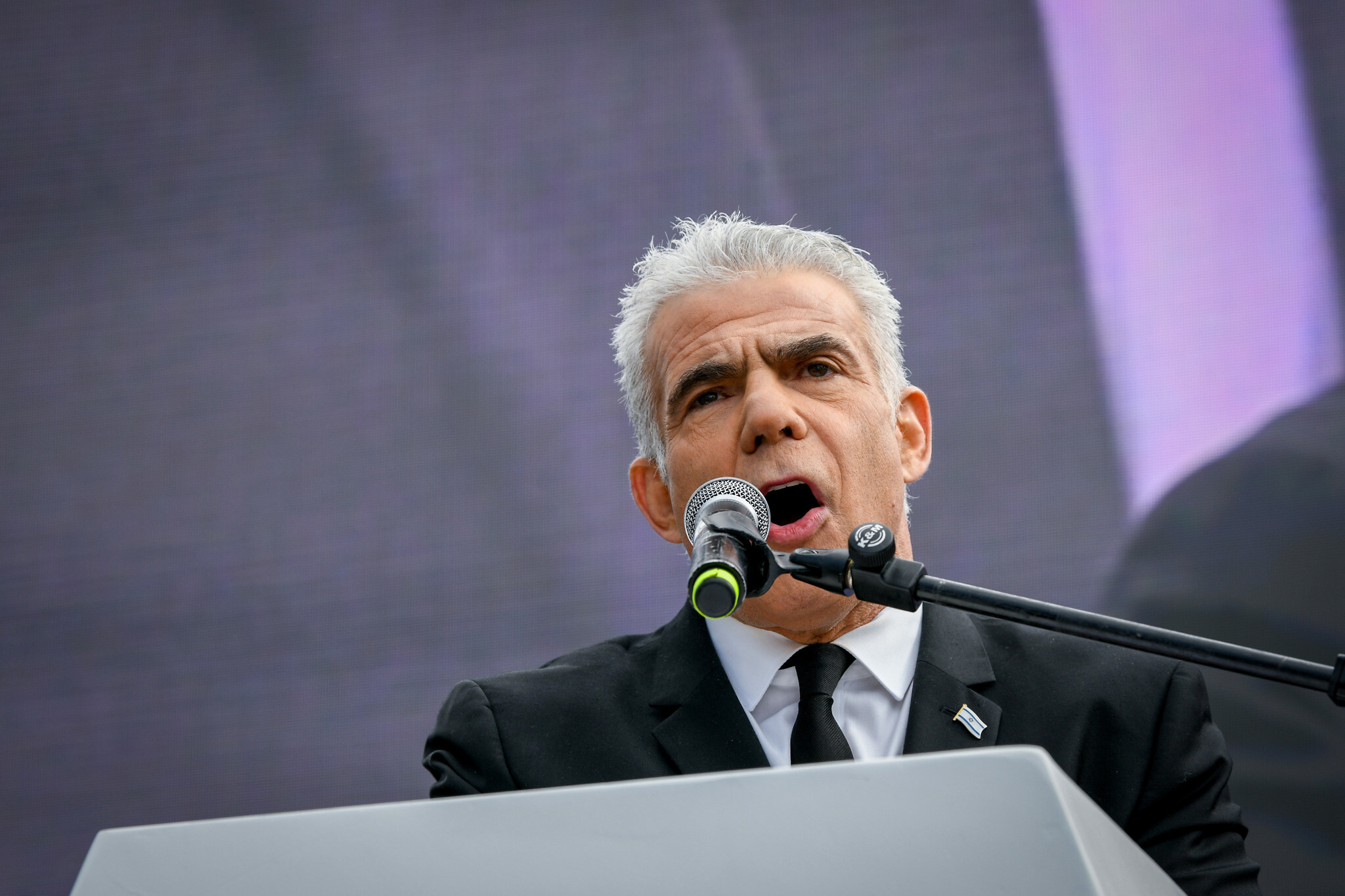
Opposition leader Yair Lapid speaks at a protest against the judicial overhaul, February 13, 2023. (Arie Leib Abrams/Flash90)

Another Likud lawmaker, Economy Minister Nir Barkat, said he would respect the court’s ruling if it struck the law down. But in any case, the Likud bill doesn’t appear to be a promising avenue toward compromise.

“This isn’t softening and compromise, this is Hungary and Poland on steroids,” Labor party chair Merav Michaeli said on a radio program on Monday, referring to countries where the government has increased its control over the court system. “From the start, I said we can’t negotiate with them.”

A predecessor of Michaeli’s in the Labor party has also taken a hard line and — unlike the many voices who worry about a clash of government authorities — has suggested that he would prefer a constitutional crisis to compromise. Ehud Barak, a former Israeli prime minister, said that a constitutional crisis would force senior Israeli military commanders to take sides — and expressed confidence that they would choose to obey the courts.

“It would be a severe constitutional crisis,” Barak said in a speech last month. “That’s when the test of the gatekeepers and defenders of sovereignty would arrive: The head of the Shin Bet, the police commissioner, the chief of staff and the head of the Mossad. I’m convinced that they understand that in a democracy, the only choice is to recognize the supremacy of law and the Supreme Court.”

Economy Minister Nir Barkat arrives for a meeting at the Prime Minister’s Office in Jerusalem, January 3, 2023. (Yonatan Sindel/Flash90)

The mounting threats by military reservists, and comments by former military commanders opposing the court reform, may indicate that the military will opt to follow the court. But Saliternik hopes that’s a choice Israeli forces won’t have to confront.

“This is something that has never happened in Israel,” she said. “It’s so very hard to think about. I very much hope that that government will get a hold of itself and act responsibly.”

‘Gun Is on the Table’: Both Sides of Overhaul Clash Say Constitutional Crisis Coming Read More »

In the Midst of Israel’s Civil Nightmare, I Want No Part of “Being Right”

It’s extraordinary to think that as Israel burns in rage over the judicial overhaul, as the society is torn apart like never before, as 500,000 Israelis continue to hit the streets in protest and even the Defense Minister shows signs of rebelling, and as our enemies are celebrating our unprecedented division, many Jews on the right can’t bring themselves to say: “OK, enough. We can’t afford a civil war. The government should just pause the reforms and negotiate.”

Why can’t they utter those simple words? Because their minds are flooded with one thought: They’re 100 percent sure that they’re 100 percent right.

This is what the intoxicating feeling of being right can do even to people who love Israel—make them ignore the raging forest fire that has engulfed Israeli society.

Instead of pouring water on the blaze, they spew their usual talking points bashing the left and urge the locomotive of judicial overhaul to keep charging ahead. In this view, anyone who disagrees with them—even hard-core Zionists who have fought for their country—is 100 percent wrong. There is no give. There is no middle ground.

But let’s grant, for the sake of discussion, that those pro-overhaul voices are indeed 100 percent right, which is why they’re digging in their heels. That would be like seeing your children in a horrible fight and instead of calling for a ceasefire, you escalate the fight by taking sides based on who you think “is right.” What kind of victory is that?

In the midst of a family fight that is spinning out of control, who the hell cares who’s right and who’s wrong? Confronted by such destructive ugliness, all one should care about is calming things down and reminding both sides that they’re still one family.

Let’s not kid ourselves: The Jews of Israel, just like the Jews of America, have never been very good at acting like one big family. We’ve been fighting and arguing for as long as I can remember.

What is happening now in Israel, however, is not just fighting and arguing. The provocative judicial overhaul is the equivalent of writing a Constitution for the whole country, which unilaterally establishes the fundamental rules of how power will be shared. The governing coalition decided that a tiny majority in the Knesset gave them the power to do all that.

In the face of this legal revolution, a significant segment of the population is rising up and demanding to be heard. This includes President Isaac Herzog, who advanced a good-faith proposal to negotiate a fair compromise and was rejected out of hand.

But let’s go back to my key point: Let’s grant that Herzog is 100 percent wrong and those pushing for the overhaul are 100 percent right. Are those supporters happy to see Israeli society tear itself apart? As they watch their country burn, are they comforted by thinking about how right they are?

As they watch their country burn, are they comforted by thinking about how right they are?

I don’t know about you, but when I see my brethren in Israel at each other’s throats, I find zero consolation in “being right.”

This new government, in fact, is so sure of itself that when it realized it had started a national fire, it poured oil on the flames, and there’s no indication it will stop any time soon.

If that’s what being right does to people, I want to be wrong all day long.

In the Midst of Israel’s Civil Nightmare, I Want No Part of “Being Right” Read More »