fbpx

February 9, 2023

Making a Kosher Valentine’s Day Brunch

Nothing says Valentine’s Day like a thoughtful and tasty brunch.

“I’ve made many romantic meals for my wife on numerous celebratory occasions, but I reserve Valentine’s Day for my heart-shaped foods,” chef Jeff Frymer told the Journal. “Maybe it’s a bit corny but hey, that’s how I roll.”

Heart Shaped Spinach Omelet

1 medium russet potato – peeled and
medium chopped
2 large handfuls fresh baby spinach
(about 2 oz.)
½ medium yellow onion, medium chopped
1 medium tomato, medium chopped
3 eggs, whisked in a large bowl, add a few
shakes salt
2 tablespoons crumbled feta cheese
2 pats butter, drizzle of olive oil
Salt, pepper, thyme, cayenne pepper,
lemon juice

Sauté potatoes and onions in butter and olive oil on medium-low heat in a nonstick pan until the potatoes are soft and onions have slightly browned (about 10 minutes).
Add spinach, tomato, and thyme. Cover and continue to cook for another 4-5 minutes until spinach is wilted.
Pour mixture into the bowl of eggs. Add feta cheese, and combine all ingredients well.
Return to the pan and cook the mixture evenly, until it stiffens just enough to hold a heart shape (about 2 minutes). Then cover and cook for another 2 – 3 minutes to help solidify.
Slide heart-omelet onto a plate by gently using a large spatula while tilting pan. If you have some accidental breakage, no worries. It’s easy enough to push back into shape if necessary. Add pepper to taste.
Add a little fruit to the plate such as apple wedges with a sprinkle of cinnamon, slices of strawberry or blueberries, whatever your preference.

Another option? Make a Fruit Pizza. It’s pretty, elegant and refreshing.

“The crust makes it thin and crisp, and the colors of the fruit make it ultra vivid,” Debby Segura, a designer, gourmet cook and cooking teacher, told the Journal. “I like to think of my Fruit Pizza as a cross between a crafts project and a dessert. Happily, the love and creativity that goes into this treat really shows.”

Fruit Pizza

Crust:
One ready made pie crust, or
1¼ cups all purpose flour
A pinch of salt
½ cup cold unsalted margarine, cut into
small pieces
4 tablespoons ice water
1 large egg beaten with 1 tablespoon water

Topping:
2 cups thinly sliced fresh fruit (plums,
nectarines, strawberries, white or
yellow peaches)
1/3 cup sugar
2 teaspoons cornstarch or potato starch
1 cup fresh blueberries
Turbinado sugar
3 tablespoons red currant or apple jelly or
apricot jam

In a large bowl, combine the flour, salt and margarine, and using your fingers, combine thoroughly. The biggest pieces should be about the size of peas. Add the ice water and combine to form a ball of dough. Wrap in plastic wrap and refrigerate. Allow the dough to rest for at least half an hour, or up to 3 days.
When you are ready to bake, preheat the oven to 375°F. On a floured surface, lightly roll out the dough into a thin, 12 to 15 inch round and place on a baking parchment on the pizza pan.
In a large bowl, sprinkle the sliced fruits with the sugar and starch. Toss gently to coat.
Decoratively arrange the fruit slices and blueberries on top of the crust, and turn whatever crust remains on the outer edge of your pizza toward the fruit to form a border.
Use the beaten egg and water to paint the border. Sprinkle the border and fruit slices lightly with the turbinado sugar.
Bake the pizza until the fruit juices begin to bubble and the border of the crust is golden brown, about 30-35 minutes. Cool the pizza on a rack.
Heat the jelly or jam and, using a pastry brush, gently paint the fruit to give it a shine.
And if your meal isn’t sweet enough, why not add a fresh, gooey, homemade babka to the mix?

“Some find a dozen roses romantic, but I’d take a Pecan Honeybuns Babka any day.” – Debby Segura

“Some find a dozen roses romantic, but I’d take a Pecan Honeybuns Babka any day,” Segura said. “Just place the soft, sugar-cinnamon filled spirals of dough in an angel food or tube pan and watch them rise. Bake them and your whole house will smell heavenly.”

Pecan Honeybuns Babka

Dough:
4 ½ cups bread flour
1/3 cup sugar
1 ½ tablespoon Rapid Rise (Instant) Yeast
1 teaspoon Kosher salt
1 teaspoon vanilla extract
1 cup warm water
1/3 cup oil (or softened butter)
1 egg
1 teaspoon vanilla extract

Filling:
¾ cup light brown sugar
1 tablespoon cinnamon

Topping:
½ cup honey
2 tablespoons canola oil
1 ½ cup chopped pecan pieces

To make the dough, place flour, sugar, yeast and salt in a large mixing bowl or the work bowl of a large (11 to 14 cup) food processor.
Combine the water, oil, egg and vanilla extract to equal 1 7/8 cup. Add the liquid to the dry ingredients, mixing until smooth. Turn the dough onto a lightly floured surface and knead until smooth and elastic; about 10 minutes by hand, 60 seconds by food processor. Place the dough in a large, greased bowl and then turn the dough over so it is greased side up.
Cover loosely with plastic wrap and let rise until doubled in bulk, about 1 to 1 ½ hours. The dough is ready if an indentation remains when touched. Punch down the dough and divide the dough in half.
Roll out the first piece of dough into a narrow, 18” long rectangle. Cover the rectangle with half of the cinnamon mixture and drizzle with a quarter of the filling.

Starting with the long side side, tightly roll up the dough, pinching the length of the dough closed. Repeat with the other half of the dough. Cut each roll into 10 slices. Grease an angel food cake pan with non-stick cooking spray and arrange the slices in the prepared pan.

Preheat the oven to 350 degrees and position a rack at the bottom third of the oven. Paint the top of the dough with an egg wash (1 egg yolk whisked together with 1 teaspoon water). Place the pan(s) in the oven and lower the temperature to 325 and bake for 45 minutes. Remove the pan(s) from the oven and drizzle the tops of the loaves with the topping. Bake for 15 minutes more.

Cool for at least 25 minutes before removing from the pan. Serve warm.

Happy Valentine’s Day

Making a Kosher Valentine’s Day Brunch Read More »

Known for ‘Get’ Orthodox Punk Rock Group The Groggers Releases Their Most Controversial Video Yet

When it comes to making controversial Jewish music videos, The Groggers take the cake.

Los Angeles resident and lead singer L.E. Staiman heard a friend complain about being self conscious before going into the water of the mikvah because he felt his lack of size did matter. This was a thought that Staiman said he recently had when a friend confided that his lack of size did matter when it came to self-image before disrobing for the ritual bath. Staiman decided to act out the role of his friend in the new music video “Tiniest Man In The Mikvah.”

“I was in Israel over Sukkot and people were asking me whether there was going to be another video,” Staiman told The Journal. “People had an itch for it. We haven’t put one out in seven or eight years, so we threw some ideas around and this seemed to work.”

The video starts with a cameo by veteran comedian Elon Gold as a therapist leading a support group that at first appears to be for guys who’ve had their hearts broken. He asks Staiman’s character (Eli) if he wants to share.

In the chorus, Staiman sings that he “got the short end of the stick” and leaves his shorts on when he takes a dip.

Staiman, 34, said his father told him the video was “in poor taste” but shared it with some business associates, anyway.

Guitarist Ari Friedman, 36, who lives in Baltimore, said he took preventative action.

“I told my wife’s family to marry everyone off before the video comes out Wednesday,” he said. “I didn’t want to hurt anyone’s chance for a shiitach.”

The Groggers, who took their name from the noise making device used on Purim when Haman’s name is chanted, made noise with their video “Get” in 2010. The punchy chorus “Ya gotta get, get, get, get give her a get,” or a rabbinically recognized divorce, had not before been a topic for a music video for a popular group.

“We definitely did it tongue-incheek,” Staiman said. “But in all seriousness, it’s a problem and men should give their wives who want a divorce the freedom to be free and go on.”

Both said they are admirers of Gold and enjoyed his performance on HBO’s “Curb Your Enthusiasm.”

“If Larry David wanted to go to the mikvah, I’d definitely go with him,” Staiman said.

Like many other pop/punk bands, the Groggers push the envelope to stand out. “If you look at a lot of Orthodox Jewish music, a lot of it is boring and the same, and we always wanted to put out something different,” Staiman said. Sometimes, you gotta shock people. Sometimes you have to be outrageous. Sometimes, you gotta poke the bear.”

He added that the group’s next video will be more controversial.

“A lot of people hope their music appeals to everybody,” Staiman said. “You could say our music is for nobody, or really a small niche of people who know Orthodoxy and love wild songs that have a great sense of humor.”

Haven’t seen this word before, but given the context, could he mean “shidduch”?

Known for ‘Get’ Orthodox Punk Rock Group The Groggers Releases Their Most Controversial Video Yet Read More »

A Comedic Hunger For Yunger

About a year ago, Stefanie Yunger did a set at Stand Up NY. She impressed club owner Dani Zoldan, who invited her to perform at The Chosen Comedy Festival at The Orpheum Theater on February 14.

“She was very funny, and I could see she was really talented and someone to watch,” Zoldan told the Journal.

Elon Gold, who will host the event with Modi Rosenfeld, also had high praise.

“If you’re asking me who is someone that can break out, that is maybe under people’s radar, that really is great and has the brains, the beauty and the ability to pull observational humor into her act, it’s Stefanie Yunger,” Gold told the Journal.

“I’ve done it all,” Yunger told the Journal. She’s been a buyer at a fitness boutique, she’s walked dogs, she was an assistant to an interior designer and a dance fitness instructor.

“But you die a little inside when you aren’t doing your true passion. My mom has been very supportive, encouraging me to do what I love. I’ve done acting, improv, writing and I love to create sketches and also love to be on stage.”

She’s made short videos where she plays both a person ordering real milk in LA and the shocked worker who can’t deal with that and offers options,  as well as a few videos where, on command, she switches to 10 different accents.

Yunger said she loves the flexibility involved in making videos that allows her to tap into her creativity. But with her experience in theater, she enjoys being on stage as well.

“Stand up is its own medium and it’s a different beast,” Yunger said. “You can use some of the same concepts you find funny but it’s a different structure and delivery.”

She said Gold, who found her through her online videos, gave her good advice that she will be using when she takes the stage.

“One of the things he told me is that stand up is not storytime,” she said. “You have to talk about things in a creative way and be economical and precise with your words.”

“I’m pretty chill in real life,” she said. “I have gone out with my friends wearing a wig. I got kicked out of a club once, but thankfully I was wearing a wig, so I still go back to that place often. My dream is to be on a  great, long-running show and to create long form content for TV and film as well.”

Originally from Chicago and of Ukrainian descent, Younger splits her time between Los Angeles and Miami. She speaks Russian and English fluently and also speaks Spanish and Hebrew, the latter picked up while living in Tel Aviv for almost four years.

She said Israelis are a strong-willed people and cited an example of someone who tried to ask her out. “I was walking by and I smiled at a guy through a window,’ she recalled. “He came out and said ‘Hello, so you want to go to dinner?’ I didn’t know him or why he even thought I wanted to, so I said no. So he asked. ‘Why not? You smiled at me! Life is short. Come with me one time!’  Israelis are persistent. If you tell them you have a boyfriend, they ask why you weren’t engaged. If you tell them you’re engaged, they ask why the schmuck didn’t marry you yet. If you tell them you’re married, they ask where your husband is and that they would never let you walk alone. It’s hysterical. It was always harmless, but the character study I got from living there was priceless.”

She was honored to be chosen for The Chosen Comedy Festival, and is amped for her performance.

“I’m a little bit nervous as it’s a great event with so many talented people and I’m really excited,” she said.

“I’m nervous and excited and might throw up, but I can’t wait!,” she said.

A Comedic Hunger For Yunger Read More »

Can a Jewish Cop Solve a Crazy Case?

He’s handsome, mysterious and says he is meant to do mitzvahs, or good deeds. He’s an NYPD officer with a strange ability to get people to confess their crimes. NYPD Officer Avraham Avraham, known as “Avi” in the Peacock show “The Calling,” is on the case of a missing teenage boy named Vincent Conte. We learn Avraham was motivated to be a police officer due to the unsolved murder of his own father.

If this teen was killed, who did it? Was it his writing tutor, who seems suspicious? Was it the wife of his writing tutor who seems like she is hiding something, or a homeless man who used to be the boy’s teacher and is believed to have had Nazi sympathies? What about his father and mother, who have their own quirks? Could his sister be involved? Does Avraham have some powers that help him see the truth and know when suspects are lying? 

The first four episodes are captivating. Jeff Wilbusch, who plays Avi and was once a Satmar Hasid who lived for some time in Germany, plays his role like someone who clearly knows how to take down a bad guy, both physically and mentally.

Jeff Wilbusch, who plays Avi and was once a Satmar Hasid, plays his role like someone who clearly knows how to take down a bad guy, both physically and mentally.

Jewish religious rituals are fully integrated. We see him pray while wearing tefillin and a tallit and say Hebrew prayers over a dead man. There’s a synagogue scene that seems to come out of nowhere (is it Simchat Torah?). At one point, we hear him sing along to “Am Yisrael Chai” from a distance.

The third episode includes the inevitable surprise when Avi realizes he has great chemistry with the non-Jewish Juliana Canfield, who plays Janine, a cop who becomes his partner.

“The Talmud says it’s forbidden for a teacher to reject a student, so halachically speaking, if I ask, you kind of have to teach me,” Janine cleverly tells him, mispronouncing the term that refers to Jewish law.

Noel Fisher, who many know as the violent Mickey Milkovich from “Shameless,” plays Zach Miller, the writing tutor who is trying to write a novel of his own. It becomes a bit surreal when his character writes poetry instead of toting a gun, but Fisher knows how to pull off the contradiction. And his anger, of course, eventually comes out.

Steven Pasquale and Stephanie Szostak are impressive as the couple whose son has gone missing, and so is Anabelle Dexter-Jon as Dania, who will invariably throw in red herrings into the story arc.

Created by David E. Kelly and based on the series of novels by Dror Mishani, the production gives Wilbusch an opportunity to further his career success. 

Wilbusch’s other roles include Israeli negotiator Uri Savir in “Oslo,” and Moishe in Netflix’s “Unorthodox.” He also plays Victor, a young businessman who must decide if he should take the law into his own hands in the Menemsha Film, “Schächten.” It’s clear that we haven’t heard the last of this crazy cop. 

Can a Jewish Cop Solve a Crazy Case? Read More »

Guardrails – A poem for Parsha Yitro

Beware of ascending the mountain or touching its edge;
whoever touches the mountain shall surely be put to death.
-Exodus 19:12

They put guardrails in in all the places
so we won’t fall off all the things.

It is our nature to go the very edge and
gaze upon the vastness.

If a place in a place has a thing with stairs
or an elevator that takes you to the highest spot

surely I will go up it. That’s just how I am.
Have you been to the Grand Canyon?

It’s got Grand in the name, so you know.
Back before guardrails were a thing

all we had were the mightiest words
to tell us how far we could go.

And if we dared to go further that would be
as far as we ever went. It was serious.

Think of the Speaker of the words as
holy guardrails. We may not see the Speaker

perhaps because of a thick smoke or fog.
Perhaps because seeing Them is more

than our fragile eyes can contain.
But our ears hear Their words and all

we can do is not touch the mountain.
What are the forbidden mountains

of the latest millennia? Are we hearing
the words that tell us to avoid them?

Are we listening and obeying
as we should?


God Wrestler: a poem for every Torah Portion by Rick LupertLos Angeles poet Rick Lupert created the Poetry Super Highway (an online publication and resource for poets), and hosted the Cobalt Cafe weekly poetry reading for almost 21 years. He’s authored 26 collections of poetry, including “God Wrestler: A Poem for Every Torah Portion“, “I’m a Jew, Are You” (Jewish themed poems) and “Feeding Holy Cats” (Poetry written while a staff member on the first Birthright Israel trip), and most recently “I Am Not Writing a Book of Poems in Hawaii” (Poems written in Hawaii – Ain’t Got No Press, August 2022) and edited the anthologies “Ekphrastia Gone Wild”, “A Poet’s Haggadah”, and “The Night Goes on All Night.” He writes the daily web comic “Cat and Banana” with fellow Los Angeles poet Brendan Constantine. He’s widely published and reads his poetry wherever they let him.

Guardrails – A poem for Parsha Yitro Read More »

Rabbi in Antakya, Turkey: Community “Virtually Gone”

Rabbi Mendy Chitrik, who chairs the Alliance of Rabbis in Islamic States, described the fallout from the earthquake that hit Turkey and Syria on February 6 as “total devastation” and that the city of Antakya’s 2,000-year-old Jewish community is “virtually gone.”

Photo by Rabbi Mendy Chitrik

Speaking to the Journal via WhatsApp, Chitrik said that about half the buildings in Antakya, located in southern Turkey, have been decimated by the earthquake. “Lots of confusion, very quiet, many people buried under the rubble,” Chitrik said. “No happy endings.”

“Lots of confusion, very quiet, many people buried under the rubble,” Chitrik said. “No happy endings.”

Describing the city as being in “total shock,” Chitrik said he had never seen anything like this in Antakya before, and he hoped to “never see anything like that again.”

“It will take [a] long time for its recovery.”

Chitrik and the rest of the Jewish community were able to rescue two Torah scrolls from a local synagogue. “The synagogue was falling and had cracks through the roof and the walls, and figured we’d better take the 500, 600 year-old Torah scrolls to safety, so we moved them out of the city.” He added that it would “take time to refix and rebuild the synagogue.”

Photo by Rabbi Mendy Chitrik

“As a city that has such a rich and long Jewish history, I’m not very sure how quick it will be for elderly Jews who lived here to return to that city,” Chitrik said. Chitrik had tweeted in 2021 that there were only 14 Jews left in the city, per The Jerusalem Post.

According to the Post, all of the Jews in the city had been accounted except for two, who have gone missing. “We have a team on the ground that is going through inch by inch centimeter by centimeter trying to recover either their remains or, if there be a miracle, having them alive, but as time goes by that hope is diminishing,” Chitrik said. The death toll has surpassed 20,000 thus far from the earthquake.

Antakya has received help from the Israelis and the Jewish community worldwide, as Chitrik said the Israelis sent groups of 450 volunteer doctors, nurses and search-and-rescue workers, which he described as “really, really wonderful.” He called the global Jewish community’s response “wonderful” as well. “There’s always a need for funds to rebuild, funds for search-and-rescue but also funds for helping out Jews and non-Jews who are here,” Chitrik said, “and I think the fact that Jews are able to extend their hands and open their hearts to a Muslim population that is poor and needy in this part of Turkey, it’s really a sign of tolerance, co-existence, and it’s planting seeds of [a] bright future for Jews and Muslims together.”

Antakya has received help from the Israelis and the Jewish community worldwide, as Chitrik said the Israelis sent groups of 450 volunteer doctors, nurses and search-and-rescue workers

Chitrik added that while the events of the earthquake are not in our hands, what is in our hands is being able to pray together, help each other and hope. But hope “depends on us making that hope into reality,” he said. “We have to help each other during times of crisis.”

Rabbi in Antakya, Turkey: Community “Virtually Gone” Read More »

Hope for a Brighter Future at Pali High

It is not news that the virus of antisemitism is again spreading rapidly. Our Jewish community has long been used to hearing about antisemitism on college campuses and in popular culture with bad actors like Kanye West. Unfortunately, high schools are no longer immune to the antisemitism that continuously seeps in from the rest of the world.

Despite the current idealism of tolerance and acceptance for all minority student groups, it is clear that Jewish students aren’t afforded the same courtesy. Many Jewish students are now scared to openly wear the Star of David in public. When they do, some of their peers bully them with ancient slurs and antisemitic tropes. When they report these incidents they are often ignored by school administrators, and most Jewish students won’t even make a claim for fear of retribution.

One public high school in Los Angeles is proving that they can live up to their values of inclusivity and acceptance and is taking a stand against antisemitism: Palisades Charter High School, my high school.

Pali High’s campus has been defaced with swastikas and hateful graffiti more than once in the past year alone. Swastikas were etched in the restrooms and on school desks. A teacher denied Jewish students access to a program because, in his words, Jews “don’t experience discrimination in America.” He wasn’t joking, just remarkably uninformed. Other teachers share their personal feelings about “Jewish privilege” during class time. Israel is defamed by teachers, and Jewish students hesitate to speak up to defend their ancestral homeland. The Students Supporting Israel club had its materials stolen and publicly defaced. Last fall, a Jewish student was told by another student “you’re dripping from Israel, you dirty Jew.” And a teacher told a Jewish student that “Kanye was right,” alluding to the deeply antisemitic and Hitler-praising comments that Kanye had released via Twitter. As co-President of the Jewish Student Union and co-President of the Students Supporting Israel club, I am exposed to all of this.

Jewish student leaders met regularly to determine what could be done to change the increasingly hostile climate on our campus.

Jewish student leaders met regularly to determine what could be done to change the increasingly hostile climate on our campus. A courageous and supportive teacher and faculty advisor, Mr. Michael Mashbaum, arranged for a meeting with the high school’s principal, Dr. Pamela Magee, and discussed with her the antisemitic incidents on campus. Dr. Magee shared her genuine concern for what Jewish students were facing, and said she was motivated to take action. She agreed to implement training for all of the 130 Pali High faculty and staff by the Simon Wiesenthal Center, which in turn immediately agreed to provide the necessary specialized education about antisemitism, discrimination, intolerance and the Holocaust. During the first Pali High teachers’ professional development day of 2023 in early January, an educator from the Wiesenthal Center visited the school to provide training. This may be the first of its kind in the entire Los Angeles public school system.

Unfortunately, antisemitism on campus did not end with that one session. A Pali High teacher just recently began a class lecturing about why “the Jews” are always “wealthy” and “successful.” More action needed to be taken.

To achieve lasting results, Dr. Magee agreed to send teachers and staff in small cohorts to the Wiesenthal Center’s Museum of Tolerance on Pico Boulevard to receive additional in-depth training. Because our public high school might not be able to afford the bus transportation costs for such an undertaking, Mr. Mashbaum and I pitched Pali High’s Booster Club to fund the costs and $5,100 was approved.

In a follow-up meeting with Dr. Magee, she asked what else might be done to protect Jewish students on campus, so I presented her with a detailed letter explaining the importance of the IHRA Working Definition of Antisemitism and urging the Pali High administration to adopt it. The letter was signed not only by all the Jewish student groups on campus, but it was co-signed by presidents of Latinx Student Union, Middle Eastern Student Union, South Asian Student Union, and Persian Student Union, along with over a hundred individual Pali High students.

We hope that Pali High will continue to fight antisemitism and protect Jewish students, and build a brighter future for all.


Joseph J. Karlan is a Senior at Palisades Charter High School.

Hope for a Brighter Future at Pali High Read More »

ABA Passes Resolution Condemning Antisemitism But Omits IHRA

The American Bar Association (ABA) passed a resolution on February 6 that condemned antisemitism but omitted the International Holocaust Remembrance Alliance (IHRA) definition of antisemitism, Jewish News Syndicate (JNS) reported.

The resolution stated that the ABA “should take a leadership role in opposing antisemitism, both in the United States and around the world,” including the denunciation of all instances of antisemitism and advocating governments and social media companies to take action against antisemitism. A provision adopting IHRA was removed; according to The Jerusalem Post, Human Rights Watch, Jewish Voice for Peace, the American Civil Liberties Union, Americans for Peace Now and Palestine Legal had been among the organizations urging the ABA to reject IHRA.

Anti-Defamation League (ADL) Civil Rights Vice President Steven M. Freeman wrote in a February 1 letter to the ABA that the ADL applauded the resolution as “admirable” but is “disappointed” that the resolution doesn’t include IHRA. Freeman argued that IHRA is important in being able to identify antisemitism since it “has consistently taken the form of a totalizing conspiracy theory, adaptable to societies fears and anxieties, and their cynical weaponization, over time.” “The IHRA Working Definition does not undermine free speech or prohibit criticism of Israel,” Freeman said.

The American Jewish Committee (AJC) said in a statement, “AJC appreciates that the American Bar Association adopted a resolution to condemn antisemitism and commit the ABA toward taking a leadership role in fighting anti-Jewish hatred. It is an important statement at a time when antisemitism has risen to alarming levels in this country. At the same time, AJC is disappointed the resolution omits the widely recognized definition of antisemitism from the International Holocaust Remembrance Alliance, which provides clear guidance on what is antisemitism and what it is not. Some ABA members claimed the IHRA definition inhibits free speech because it considers all criticism of Israel antisemitic. That is false. Even a cursory reading of the definition would disprove that.”

The Simon Wiesenthal Center tweeted that the omission of IHRA from the resolution “will only enable more hatred from Jew and Israel haters and give cover to university bureaucrats and others to dodge their responsibility to hold bigots accountable.”

The Jewish Federations of North America also said that while they lauded the resolution they were “disappointed” it didn’t include IHRA. “We look forward to continuing our engagement with ABA leadership – and across the legal community – to use IHRA to fully implement this resolution opposing and educating ABA members on antisemitism,” they added.

Human rights attorney and International Legal Forum CEO Arsen Ostrovsky said in a statement, “Although we acknowledge ABA’s condemnation of antisemitism, which is at record highs across America, such proclamation, in the absence of a recognized source offering guidance as to that which actually constitutes antisemitism, is no more than a symbolical statement of intent. Moreover, it affords the opportunity for those who seek to masquerade their antisemitism behind a façade of anti-Zionism or vilification of Israel, to do so.” He argued that IHRA is “the most widely endorsed and respected definition of antisemitism in the world, which has been adopted by over 35 countries, multilateral organizations & hundreds of civil society institutions” and that it’s “willfully misleading” to say that IHRA is used to censor criticism of Israel. “On the contrary, makes it explicitly clear that ‘criticism of Israel similar to that leveled against any other country cannot be regarded as antisemitic,’” Ostrovsky said. “However, IHRA also rightfully recognizes that modern antisemitism can manifest itself in the application of double standards to Israel, denying Jewish people the right to self-determination and other examples, such as drawing comparisons of contemporary Israeli policy to that of the Nazis.” He concluded the statement by urging the ABA to “revisit this issue at the next possible occasion.”

ABA Passes Resolution Condemning Antisemitism But Omits IHRA Read More »

Print Issue: Hasidic Jew | February 10, 2023

CLICK HERE FOR FULLSCREEN VERSION

Print Issue: Hasidic Jew | February 10, 2023 Read More »

Glickl: The 17th-Century Memoirist You’ve Got to Read

In 1691, an extraordinary Jewish woman named Glikl bas Leyb began writing her memoirs. Newly widowed at age 46, her goal was both to heal “a deeply grieving heart” and to provide moral and spiritual lessons for her children. Glikl intended her writing to be exclusively for her family, but her remarkable narrative became a treasured literary and historical record for the rest of us. 

Glikl referred to her memoirs only as “dos vos ich shrayb” (“this that I am writing”), with no actual title, because “regular” people did not publish memoirs in that era. She had a wonderful gift for storytelling, and her advanced literacy was not surprising in this early modern period, when Jewish women wrote letters and literary compositions and consumed a thriving literature of mussar (self-improvement) works written for them. Still, Glikl’s memoirs are utterly different from anything published until then in Yiddish or Hebrew.

Glikl first gained fame through “The Memoirs of Gluckel of Hameln,” published in 1977 by Schocken Books. While widely read, this was a severely edited version that omitted much of the historical context, including many references to God’s involvement in her family’s lives, and fables and stories that Glikl included as moral and spiritual lessons. 

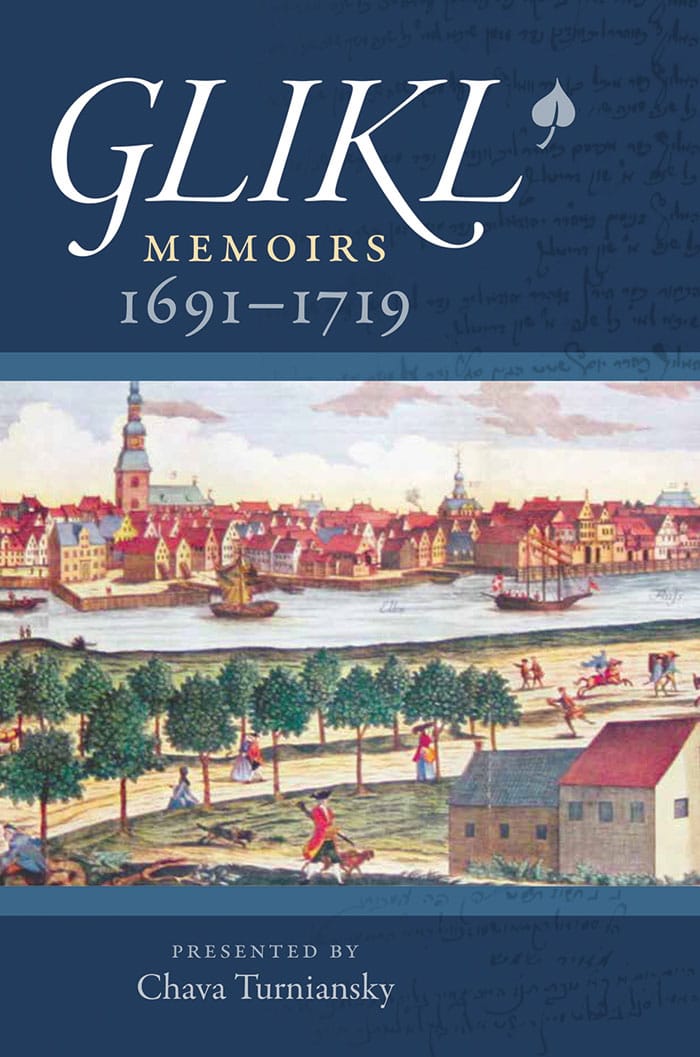
But in 2019, Brandeis University Press published Glikl Memoirs: “1691-1719,” a fully restored version of the memoirs that does an infinitely better job of conveying the author’s lively literary style. Translated by Sara Friedman, it also includes an introduction by Chava Turniansky, professor emerita of Yiddish literature at the Hebrew University of Jerusalem, whose annotations confirm the historical circumstances around the events and people Glikl writes about, including the constant dangers plaguing Jews in that era. 

Glikl was a woman of exceptional storytelling talent, and given the timelessness of her concerns and the timelessness of antisemitism, it is uncannily easy to relate to many of her life’s challenges, joys and sorrows.

Glikl was born in Hamburg to an upper-class Jewish family, betrothed at 12 and married at 14. Despite having 14 children, 13 of whom lived to early adulthood, she was a full partner with her husband Chaim in their business of buying and selling precious gems and pearls as well as money lending. Glikl’s shrewd analyses of business deals earned her husband’s total trust in her judgement. On his deathbed, he stated, “My wife is in charge of everything.”

While some aspects of Glikl’s life are unimaginable to a modern reader, others are timeless. She worries about her husband’s health and safety when he travels for business and strategizes with him about how to recoup financial losses from a business deal gone bad. She grieves over the losses of some of her children, and tries to provide guidance to a naïve son who continually makes poor choices and requires frequent bailing out. She writes, “It is true that even during my husband’s lifetime we had worries here and there because of the pain of bringing up children; some of these can be told, others cannot or should not be told.” She reminisces about an earlier time when “life in those days was so much happier than it is today, although people did not possess even half of what they have nowadays — may they enjoy it and prosper.”

As a widow with eight young children still at home, Glikl became the family’s sole support, and attended commercial fairs throughout the region, buying, selling, and trading. With acute business acumen, she bought a failing, debt-ridden fabric business from one of her sons and made it flourish. She writes unabashedly about business dealings, profits and losses and her knowledge of other families’ financial affairs. 

For example, when writing about one shidduch (marriage) negotiation, Glikl records “. . . my future in-law, the distinguished Reb Moshe, thought he could squeeze a little more out of me. But when he saw he could squeeze nothing more out of me . . . the wedding took place in mid-Tammuz, as respectable and splendid an affair as we Jews can manage. Prominent householders from all over the country attended the wedding.” 

Glikl’s memoirs provide a fascinating window into late 17th-century European Jewish history and underscore the fragility of Jewish existence at the time: capricious decrees by local officials, spontaneous violence, random abuse, onerous taxes, and sudden expulsions. She recalls her father hiding 10 refugees who had fled Poland during the notorious Chmielnicki massacres in 1648-49 — at great personal risk. He sheltered and cared for them in their attic, despite their carrying infectious disease. Glikl and Chaim sent their 4-year old daughter into hiding with a maid for many weeks when women of the community (Glikl calls them “such big cowards”) were convinced the child had the plague. Any suspicion that a Jewish home contained plague would guarantee their immediate expulsion.  Glikl never believed it and was eventually proven correct:

“Indeed, the child was healthy and well, gamboling around the field like a young ram. We said to the Hanoverians: ‘What was the point of your nonsense? You see that our little girl is healthy and well, thank God, and presents no danger whatsoever. . . Let the poor child come back here.’” 

Antisemitism was a fact of life, and Jewish victims of crimes could never expect justice from the authorities. Glikl writes of a young widow named Rivka, who set out to prove that her husband had been murdered by a gentile who robbed him. It was an extraordinarily dangerous undertaking. The local authorities warned the community, “Beware, if you do not find the body, you are all lost, you know the rabble here in Hamburg. We won’t be able to stop them.” Fortunately, Rivka’s sleuthing paid off. When she writes about these never-ending dangers that Jews lived with, or cries in distress over the endless plight of the Jewish people, we are Glikl, too.

Glikl writes colorfully about the characters and dramas in her long life, from personal dramas involving her family and community intrigues as well as business successes and reversals. Traveling was dangerous — bandits were ever on the road — but she tirelessly set out for the commercial fairs to keep her business and family afloat. It is amusing to read of her boasts about her deal-making abilities.

Glikl was a woman of exceptional storytelling talent, and given the timelessness of her concerns and the timelessness of antisemitism, it is uncannily easy to relate to many of her life’s challenges, joys and sorrows. Nearly three hundred years after her death in 1724, Glikl has become an unlikely but well-deserved literary celebrity.


Judy Gruen’s most recent book is The Skeptic and the Rabbi: Falling in Love With Faith. 

Glickl: The 17th-Century Memoirist You’ve Got to Read Read More »