fbpx

February 2, 2023

Satirical Semite: It’s Complicated

Dating has become even more complicated in 2023. The apps have ever-more specific questions, including “Do you like dogs?” (no) and “Are you vaccinated?” (yes). I want to add “Can you provide a signed letter stating a clean bill of health from your psychiatrist?” (Maybe. It depends who’s asking.) 

In the last six months I have discovered a new trend where people do not share their last names. I’ve experienced this three times in succession, and it’s just weird. The week after one date, someone then came to my flat for a Shabbat dinner with eight other people, and still wouldn’t reveal her name. Another joined me on a date at a bar in Camden, London, we had a couple of phone conversations and sent various text messages, but she still refused to reveal who she was, explaining, “It’s very personal information. When I meet someone I also don’t share my home address or my bank details.” The next day she also texted, “I should have mentioned — I have three kids.” With so much going on, it’s easy to forget to mention these little details.

To stay ahead of the trend, I am no longer going to reveal my first name but replace it with a Shakespeare monologue, or an unpronounceable symbol like The Artist Formerly Known as Prince. 

Chat-up lines are passé, but why not just quote Shakespeare? “O Romeo, Romeo, wherefore art thou Romeo?/ Deny thy father and refuse thy name … O! Be some other name: / What’s in a name? that which we call a rose / By any other name would smell so sweet / … / Romeo, doff thy name;/ And for that name, which is no part of thee, / Take all myself.”

The weirdest date happened in London. She wouldn’t reveal her last name, wouldn’t share her phone number (which made it hard to plan the date), forgot her purse (I was paying anyway), but then revealed that she knew exactly who I was, and had attended my workshops and performances at the Limmud educational conference. The dynamic felt unbalanced, and perhaps I should have continued the conversation using mime and physical theater, so as to level the playing field. She then shared how she had stopped going to Limmud “because there weren’t enough sessions about the Holocaust.” It really turned into a fun evening.

Understandably, some people don’t want to share their name because they don’t want to be stalked on social media. Personally I am very happy to be stalked because I can always use the followers. 

Then there is the question of politics. Two years ago, dating profiles in Los Angeles used to read, “You can only date me if you didn’t vote for HIM,” but it’s now more complicated. Here is a brief guide:

You must support Kamala, Joe, Hilary or Bernie (if dating in Los Angeles), De Santis or Trump (if dating in Miami), Newsom (if dating in San Francisco) and Cuomo (if dating in New York). You must have voted against Brexit (if dating in England). The last four are pretty easy to remember: must hate England (if dating in Scotland), must hate England (if dating in Ireland), must hate England (if dating in the EU), must hate England (if dating in the U.S. on July 4th), and must hate England (if dating Harry or Meghan).

It looked like it was going well until she said, “So what are you looking for? I have a friend I could set you up with.”

During a recent Shabbat dinner at a singles event in Miami, I had a great 90-minute conversation with a lovely woman. It looked like it was going well until she said, “So what are you looking for? I have a friend I could set you up with.” Burn! I asked what she was looking for, and it was someone taller than her, since she is 5 feet 10 inches tall. Although with high heels, that night she was 6 feet 2 inches, which makes it even harder within the Jewish dating pool. As my friend Brandon said, “I’m 5-foot Jewish.” Moving forward, I am going to buy platform shoes.

I wish the majority of this article was fictional, but it’s not. I would also like to say that the names have been changed to protect the innocent, but I never knew the names in the first place.

On we go.


www.marcusjfreed and on social @marcusjfreed 

Satirical Semite: It’s Complicated Read More »
A New Textbook Changes the Way We Look at U.S. Antisemitism

Israel B. Bitton is dissatisfied with the way antisemitism–in particular, anti-Jewish hate crimes in New York City–is being handled by some major Jewish organizations. Bitton is the son of a Moroccan Jew who led a synagogue in New York City attended predominantly by Mizrahi and Black Jews. However, his background and friendships did not prevent him from being terrified and confused during the 1991 Crown Heights riots, when his father and brother were viciously attacked by an antisemitic mob. A near-death experience during his service in the Israel Defense Forces along the Lebanese border further shaped his mood–something new had to be done. Bitton became the executive director of Americans Against Antisemitism, an organization founded by Dov Hikind, a former member of the New York State Assembly. “The organization was founded in 2019 because antisemitic hate crimes in New York City and around the country were increasing at an alarming rate and we felt the Jewish organizational response was tardy and lethargic,” Bitton told JNS. “As an upstart startup nonprofit, our goal from the outset was first and foremost to raise awareness but also to find ways to make a real and tangible difference without duplicating efforts of others—something we’ve aimed to do by continuously studying antisemitism as a living virus.” 

After completing his service in the IDF and going to university, Bitton was inspired to write a book about Jewish history in the Middle East, from ancient times all the way through the conflict with the Palestinians. In the end, however, he decided to put this project aside in favor of a new book. 

“I had no intention of writing a book on antisemitism. That changed after Dov Hikind, founder of Americans Against Antisemitism, returned from a speaking engagement to well-educated yeshivah students surprised by how little they knew about the subject and how many faulty assumptions they were relying on,” he said. “A light went off inside my head. Education is always the answer to ignorant hate, but all the more so young Jews need to be aware of the dangers they face whether they like it or not. I realized that while there were some educational resources available, like curricula that aim to universalize antisemitism as just another form of racism, there was nothing available designed and written specifically for Jews. That is, not as a passive history, but as an active guide that can help Jews decode Jew-hatred and mitigate its dangers. Of course, it’s written with a general audience in mind, but the audience for whom this project was spurred and tailored are Jewish youth, high school and college students, because it is they, more than most other Jews, who are thrust onto the proverbial frontlines of antisemitism and forced to reckon with invective for which they ought to be better prepared to encounter. Getting the book to young Jews, therefore, has been our highest priority, though it’s no less relevant to or needed by the general public.”

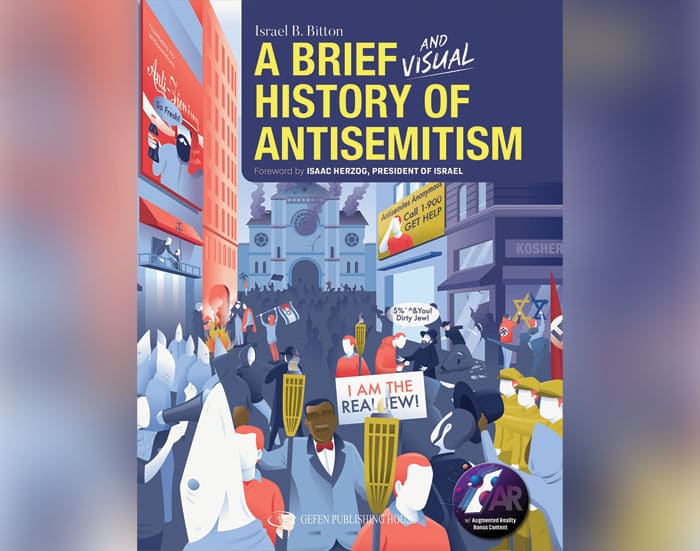
With his background in visual design, Bitton was able to include attention-grabbing illustrations and an Augmented Reality feature in the textbook, which will appeal to younger audiences.

From the middle of 2020, at the height of the coronavirus pandemic, until 2022, Bitton began work on his textbook, “A Brief and Visual History of Antisemitism. The book, which includes a forward from Israeli President Isaac Herzog, has won praise from numerous Israeli politicians and well-known Zionist activists, including former Anti-Defamation League head Abraham H. Foxman, Ambassador Gilad Erdan and writer Thane Rosenbaum. It is quickly making its way through American Jewish activist circles. With his background in visual design, Bitton was able to include attention-grabbing illustrations and an Augmented Reality feature in the textbook, which will appeal to younger audiences. This AR feature means that readers can use an app to scan barcodes in the book and gain access to short videos and talks on subjects covered throughout.

Although many books covering antisemitism are widely available and read, Bitton felt something was missing in the field.

Although many books covering antisemitism are widely available and read, Bitton felt something was missing in the field. A number of them, he told me, were not completely up to date with modern manifestations of antisemitism. Others weren’t as wide in breadth, covering the different modes of antisemitism—whether Christian ultranationalist, Islamist, or far left—in one publication. “Very simply, treating antisemitism as its own curricular subject is a relative novelty in educational circles so although scholars have been writing about modern antisemitism for more than a century, I did not come across any antisemitism textbook (not to be confused with Holocaust textbooks wherein antisemitism is treated). So there was a clear opportunity to fill in that gap which became all the more glaring as 2019 progressed into 2020 and anti-Jewish violence made the necessity for educational materials increasingly obvious,” noted Bitton. 

He is still recovering from the long and exhausting process of writing the book, and has not yet pursued writing another. However, Bitton has been busy working with Americans Against Antisemitism, including a new report on antisemitic hate crimes in New York City and the response, or lack thereof, from elected officials and the police. He presented many of his findings at Cambridge University, at a conference hosted by the Institute for the Study of Global Antisemitism Policy (ISGAP). The findings showed what Bitton and others have long already known—that Jews make up the vast majority of hate crime victims in the Big Apple. The report, however, shows that most of the perpetrators are non-white and that many of them are never convicted, or given lenient charges. 

“Nationally, most anti-Jewish attacks tend to be committed by white persons against property,” Bitton noted. “In New York City, however, most attacks are assaults against persons committed by other minorities. Nationally, attacks on Jewish persons tend to be premeditated and target obvious Jewish landmarks like synagogues with heavy firepower. But in New York City, most anti-Jewish attacks are unplanned random outbursts of violent rage against random Jewish targets (which is why the increased visibility of Orthodox Jews makes them prime ‘last-minute’ targets). And whereas nationally, attacks target Jews of all denominations, in New York City, the likelihood that the victim of an anti-Jewish assault is Orthodox is north of 90%.” 

Because most of the focus on combating antisemitism in the U.S. has been centered on challenging far-right white supremacist groups, it is hard for public officials, scholars and Jewish organizations to figure out how to respond to this phenomenon, according to Bitton. However, he believes change is on the way. He encourages people to speak up against antisemitism and educate themselves, as well as reach out to his organization. Bitton is also regularly in contact with elected officials in New York, even meeting some of them at his house. “I met with Mayor Adams in my home before he was elected to discuss his approach in dealing with anti-Jewish violence and it was very clear that he would be responsive to the issue, which he has been. Ultimately, antisemitism is not a problem to be solved by a single individual or Jews alone, but just as it takes a village to raise a child it takes an entire city to stamp out social hatred and unwarranted violence. And that’s really where there’s work to be done, at the intercommunal level, because every day that animus between Blacks and Jews persists is a great travesty and antithetical to everything for which Blacks and Jews (and Black Jews) hope and pray.”


Dmitri Shufutinsky is an IDF veteran (lone soldier through Garin Tzabar) currently living in Israel, and a junior research fellow with the Institute for the Study of Global Antisemitism Policy (ISGAP). He has written for The Forward, The Times of Israel, Jewish News Syndicate, The Jerusalem Post, and Begin-Sadat Center for Strategic Studies, among others. 

A New Textbook Changes the Way We Look at U.S. Antisemitism Read More »

Moshiach as Metaphor

Jewish tradition teaches that the Messiah (Moshiach) will be a warrior and that the reign of peace he will usher in will be preceded by war. What does this belief imply? Why the need for this saving figure? What is he — or she (remember the warrior Deborah) — saving us from? Why is war necessary for the fulfillment of this prophecy of ultimate peace? 

A cursory look at world history in general, and Jewish history in particular, bears witness to the desperate need for a world of peace and tranquillity despite its elusive nature.

The question is whether we have learned anything from our tragic past and murderous history — whether we have realized that the need for peace outweighs the desire for violence and warfare. Certainly enshrined in our institutions and religious celebrations are great ambitions and noble sentiments, but are they fulfilled in any meaningful fashion?

Peace is what Moshiach is supposed to bring. But peace cannot exist amid friction, conflict, hatred, divisions and selfishness. Peace requires openness, generosity, caring and unity.

Peace is what Moshiach is supposed to bring. But peace cannot exist amid friction, conflict, hatred, divisions and selfishness. Peace requires openness, generosity, caring and unity.

In times of dangerous division, great leaders gave voice to the message of unity as being essential for survival. Winston Churchill wrote, “When there is no enemy within, the enemies outside cannot hurt you.” Martin Luther King Jr. proclaimed that “We must learn to live together as brothers or perish together as fools.” But human history has shown itself to be the repudiation of these ideals.

In the Torah, the Flood is brought to destroy the world as a punishment for violence. It is not idol worship that angers God, as one might expect, but rather the violence between men that He cannot endure. The point is that it is what we inflict on one another that destroys the world. It’s a lack of concern for others, an absence of social harmony that makes the world unlivable.

Ancient Israel fell twice, once to the Babylonians and once to the Romans. The Babylonian exile lasted 70 years and the Roman exile 2,000 years. King Solomon built the first Temple. The death of King Solomon and the splitting of the kingdom into Judea and Israel ultimately led to the destruction of the first Temple. Divided and weakened, the Jews were vulnerable. Millennia before Abraham Lincoln’s warning that a house divided cannot stand, the Jews proved his point. 

The second, more punishing exile, occurred after the Roman conquest. We learn, from the historian Josephus, that the Jews in Jerusalem had stockpiles that might have outlasted the Roman siege, but Jewish factional divisions were so intense that one group burned the others’ stockpiles. And so, the Jewish state was lost again.

Today’s Israel, a remedy for 2,000 years of expulsions, pogroms and the Holocaust, and most importantly a return of the Jews to their ancestral homeland, has 31 political parties for 9 million citizens. Not exactly the unity that one would have hoped for. It is even more striking to discover that at the beginning of the return, the Yishuv, established in the early 1900s, had 31 parties as well — for only 100,000 inhabitants!

Substantial differences in outlook and policy constitute a serious challenge, but there have been occasions in the past when they were overcome for the common good. Franklin Roosevelt said that “Human kindness never weakened the fiber of free people. A free nation does not have to be cruel to be tough.” 

And yet, despite great achievements and demonstrable success, we lapse into old tribal habits of distrust, lust for political power and brutish antagonism. Not just in Israel but everywhere. The tragedy is that it does not have to be this way.

Jews are taught to pray for the coming of the Moshiach. But what if the Moshiach is not a person waiting for us to merit redemption, but rather a metaphor for the world we ourselves need to create through our own acts of kindness and caring, an embodiment of our best selves? 

Jews are taught to pray for the coming of the Moshiach. But what if the Moshiach is not a person waiting for us to merit redemption, but rather a metaphor for the world we ourselves need to create through our own acts of kindness and caring, an embodiment of our best selves? Perhaps it is what we do in anticipation of the Moshiach’s coming that matters more than the actual arrival.

Another metaphor comes to mind: Jacob wrestling the angel. Jacob retreats in fear of his brother Esau when he is confronted by an angel. They struggle and the angel cannot defeat Jacob because Jacob asserts himself and has confidence in his mission. As a result of Jacob’s newborn self, the angel declares that his name will no longer be Jacob, but he will be called Israel. The Torah is unparalleled in its poetic portrayal of humankind, its shortcomings and its potential. The physical struggle is really an internal one: a struggle for identity, meaning and purpose, becoming not a single fearful person, but one capable of being the father of twelve tribes, the progenitor of an eternal nation. 

If the world’s tragic history is to be overcome and a world of peace to be created, there must be an internal struggle of all people to face our demons, our negative emotions and dark thoughts, to rise to be what we can be, what we must be, if we want to survive. That may be the “war” that our tradition teaches: not a battle between people but within each of us. 

The inner Moshiach in every one of us awaits.


Dr. Paul Socken is Distinguished Professor Emeritus and founder of the Jewish Studies program at the University of Waterloo.

Moshiach as Metaphor Read More »

Table for Five: Beshalach

One verse, five voices. Edited by Salvador Litvak, the Accidental Talmudist

And Moses took with him the bones of Joseph, who had exacted an oath from the children of Israel, saying, “God will be sure to take notice of you: then you shall carry up my bones from here with you.” – Exodus 13:19


Rabbi Ariel Margulies & Chana Margulies
chanamargulies.org, Author of “Jumping in Puddles”

This verse comes immediately after learning we aren’t taking the shortcut to the Holy Land, but rather a 40-year soul trek. There is an intrinsic connection between bringing Joseph’s bones and being successful in the spiritually parched desert. The Bal Shem Tov shares the mystical concept of the 42 journeys in the desert, the 42 soul journeys in our life. 

To take on these challenges meaningfully and allow them to strengthen us, we need to tap into the power that Joseph gives us as part of our spiritual inheritance. 

Yosef (Joseph) means to add. When Joseph was born, the Torah states, “she called him Yosef, saying, “May G-d add (Yosef) for me another son.” The word another, “the other,” in Hebrew (achar) has a connotation of negativity, something separate that conceals G-dliness. Yosef gives us the ability to turn the “other” into a son. To transform darkness into light. To reveal G-d’s essence within the concealment. 

We needed to take Joseph’s bones. Bones is the same word as essence. The secret to transformation is revealing your essence, the part of you that is always attached to G-d’s love and light. How? By knowing “Ein Od Milvado.” There is nothing outside of G-d’s unity. Truthfully the “otherness” is also G-d, albeit in a state of concealment. The spiritual darkness is an invitation to transform darkness into light, and negativity into a source of strength for ourselves and Am Yisrael. Based on teachings of the Lubavitcher Rebbe. 


Rabbi David Eliezrie
President, Rabbinical Council of Orange County

The Jews were headed from slavery to a dangerous trek towards freedom. Many dangers stood in their way. Enemies like Pharaoh and Amalek who wanted to annihilate them. Spiritual tests from Balak, the Midianites, and doubtful Jews who created the Golden Calf. 

Joseph represents a successful strategy in balancing two opposites: he engaged the world while retaining his fidelity to the ideals of his father Yaakov. Joseph was the viceroy of the superpower of the time, but he still retained his Jewish identity. To the Jews leaving Egypt he was a symbol of striking a balance between modernity and tradition. 

Some argue today that the only way to ensure Jewish continuity is to withdraw from the broader society. Others attempt to fuse Western culture into Judaism. The first is an act of insecurity, the second one of capitulation. The third way is engagement: remain true to your values while engaging the world around you. Joseph personified this balance. 

The Torah uses the word “Ezem” which means “essence” to describe Joseph’s remains. Hasidic thought says this wording is intentional. Joseph retained his spiritual essence as he dealt with the world. The presence of his “essence” would remind Jews that they too could confront the world and remain true to their ideals. Through the long ordeal the bones of Joseph would be the reminder that they could persevere in any environment. 


Rabbi Yoni Dahlen
Congregation Shaarey Zedek — Metro Detroit

The central pillar of Jewish life is memory. From the foundations of our legal system to the communal and personal tradition of custom and interpretation, the obligation of “zachor,” to remember, serves as the headwaters from which the rivers of tradition flow. More often than not, memory functions as a blessing. It provides us with the tools to help us navigate the complexities and uncertainties of life. To remember is to tether ourselves to something rooted and strong. But I said, “more often than not,” because, of course, there are exceptions.

One of our greatest challenges is to responsibly navigate the inheritance of our memory. To sift through layers of sediment accumulated over thousands of years in order to collect the pieces of memory that hold value and to discard or carefully regulate those that don’t. To separate the flesh from the bones. To choose life. And to propagate hope even when we are presented with fear, trauma, and despair. 

Our task is not to carry the bones of our ancestors, but rather to carry with us the spirit, the heart, the remains that allow us to grow, even when (especially when!) the prospect of that growth seems daunting … even terrifying. Bones … guilt, pain, regret … these are not birthrights, and it should not be incumbent on our children to carry them for us. But flesh, heart, spirit … love. These are heirlooms worthy of Torah. These are the things we must pass on. These are the things the generations will carry.


Rabbi Avraham Greenstein
AJRCA Professor of Hebrew

This verse reminds us that Joseph had foreseen the prolonged exile of the Children of Israel in Egypt. Joseph makes a prophetic promise after his father’s death that God will not allow Israel’s stay in Egypt to last indefinitely. Rather, God will take notice (“pakod pakadti”) and return the children of Israel to the land of Israel (Gen 50:25). When the time comes for redemption, God speaks Joseph’s same words to Moses at the burning bush. God declares that He has taken notice (“pakod pakadti”) of the suffering of His people, and that He will lift them up out of Egypt (Ex 3:16-17).

We see that Moses not only fulfills Joseph’s promise of exodus, but he also fulfills the oath that Joseph’s bones take part in that exodus. It is not coincidence that Moses the redeemer was the one to gather up Joseph’s bones during the exodus. It suggests that the mitzvah of fulfilling Joseph’s oath is what facilitated the redemption itself. It is as if Joseph’s merit to be buried in the land of Israel carried the nation of Israel along in making their way to the Promised Land to bury him there. In fact, the Midrash relates that the sea only split because Joseph’s bones were accompanying the children of Israel. 

This facet of the redemption teaches us something important: Whenever we seek personal redemption, to be free from constraint and oppression, we must take a mitzvah with us to carry us to where we need to be.


Rabbi Lori Shapiro
Open Temple

Ever wonder what happened to the rest of Joseph’s body? 

You’ve got to love Ibn Ezra’s graphic answer, reminding us that Torah emphasizes “the bones of” as “all of the flesh and skin breeds worms and putrefies, and after a few years only the bones remain.” What are we to make of this final image of Joseph, mere verses before the miraculous parting of the sea? Perhaps the shift of focus from Exodus into the Genesis narrative is more than just an editor’s “call back” for story cohesion and theological continuity, but a “camera pan out” into the broadest range of our human experience: Yea, we are but dust and ashes, and regardless of this truth, we are worthy of the greatest miracle in our Biblical imagination — redemption. This vivid illustration of the human experience — from a graphic portrayal embodying death to spiritual transcendence — is a Biblical antidepressant for anyone experiencing existential angst: Indeed, we will all end up meals for maggots; but, in the meantime, look out for miracles, as they are nourishment for the soul. 


Table for Five: Beshalach Read More »

Journalist Yair Rosenberg Releases Traditional Shabbat Songs With Fresh Melodies

As a journalist for The Atlantic, Yair Rosenberg is known for his writing about politics, culture, and religion. He’s written for Tablet; his newsletter Deep Shtetl has a significant following; and of course, he has been quoted a litany of times in the Jewish Journal.

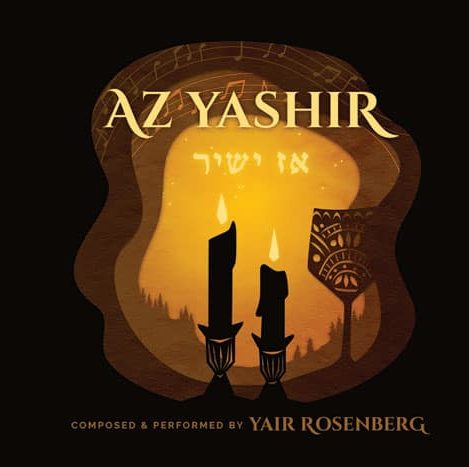
But now Rosenberg is being recognized for his talent in music. His latest release is a ten-song album titled “Az Yashir: Songs for Shabbat.” The 10 songs on the album are programmed in the order they are sung on Shabbat. 

The album features eight original compositions and two new adaptations, with an array of influences from Irish folk music to bluegrass to EDM. There are also hints of influence from one of his favorite film composers, the late James Horner, who wrote the original scores for “Titanic,” “Braveheart,” and “Legends of the Fall.” The melody on “V’Shamru” is adapted from a song by the Mormon acapella group, Eclipse, and the melody on “Anim Zemirot” is a traditional melody that originates with Chabad. 

Rosenberg’s sound is authentic, the mixing is sophisticated, and the heart is all there to set the mood for Shabbat. The lyrics are centuries old in some cases, but paired with new melodies, instrumentation, and arrangements.

“You have these classics — ‘Shalom Aleichem,’ ‘Lechah Dodi’ — why do I choose these? Why did I do an album that’s all Shabbat songs? Because they’re the sort of songs that most people are likely to know,” Rosenberg told the Journal. “Whether you’re at a synagogue or you’re in summer camp or you’re in school or you’re at your Shabbat table, it would be easy to sing and easy to pick up and learn. And as you listen to it, you may get some stuck in your head, even if you don’t understand what they mean. It’s because they’re designed that way, like folk music. It’s designed to be relatively easy to pick up and sing. And a lot of choices were made to make it easier for people to do.”

The lyric videos for Rosenberg’s music have already racked up thousands of views on YouTube, and the tracks from “Az Yashir” have found their way to Shabbat playlists on Spotify. 

Although the album is new, Jewish music-making spans three generations in Rosenberg’s family. His grandfather, Rabbi Israel David Rosenberg, was a Hasidic composer who escaped the Holocaust through Shanghai with several Yeshiva students.

“They were the people who got visas from this Japanese diplomat named Chiune Sugihara, who saved thousands of Jews this way — he went against orders, gave them visas,” Rosenberg said of his grandfather. During the remainder of World War II while in Shanghai, his grandfather composed the song “Shira HaGeulah,” which became his most famous composition. The song, translated into English as “Song of Redemption,” can still be heard at Jewish services around the world today. 

Rosenberg recalled that as a kid, he would always sing in shul, especially since his own father, Moshe Rosenberg, was then — and remains today — a Rabbi at Congregation Etz Chaim in Queens.

“I never learned to play an instrument, and I don’t read music,” Rosenberg said. “I had a vague notion of what some of the notes are and things like that, but I’ve never been trained to do those things. And so I would compose melodies in my head, but I didn’t do anything with them because I didn’t really know if there was a way to share or record them when you don’t have those other skills. And that was how [the music] sat for a very long time, until about seven years ago.”

The turning point for Rosenberg came in 2015 when he was accepted into a fellowship in Israel that funded creative projects. There, for the very first time, he found his way to a recording studio. That’s when he set out to turn three particular melodies into songs. That day in Tel Aviv, along with several musicians, Rosenberg recorded all three songs live. Those three recordings are now on the new album: “Lechah Dodi,” “Menucha V’Simcha,” and “Yedid Nefesh.”

Back in the U.S., Rosenberg took his music to the next level by pairing up with producer Charles Newman of New York record label Mother West.

“He has been in the general music industry for decades, but he had not been doing Jewish music,” Rosenberg said of Newman. “And the reason I wanted to work with him is because I wanted to work with somebody who understood Jewish music. Charles is Jewish and he understands where these songs come from and also wasn’t part of the Jewish music world, so that [the music] wouldn’t sound like things you’ve heard before.” 

Newman produced “Az Yashir” and released it on Mother West in the fall of 2022. 

Still working as a journalist, Rosenberg remains keenly aware of when a new melody forms in his head and quickly records it into the voice memos app on his phone.

“Music comes when it wants to come, it doesn’t come on a schedule. So I will weirdly pull out my phone in strange situations and just start singing into it, even if there are people around. Because you’re not going to remember it otherwise.”

“Music comes when it wants to come, it doesn’t come on a schedule,” Rosenberg said. “If you don’t play instruments, you can’t sit down and riff on a keyboard. So I will weirdly pull out my phone in strange situations and just start singing into it, even if there are people around. Because you’re not going to remember it otherwise.”

He continues to be published in some of the top newspapers in the world, including The New York Times and Wall Street Journal. He doesn’t expect his album “Az Yashir” to turn him into a rock star or wedding singer, but that was never the goal.

“I made these melodies to give people new, contemporary tunes that they could use very easily to enlighten their Jewish lives, to enrich their Jewish lives.” 

“I made these melodies to give people new, contemporary tunes that they could use very easily to enlighten their Jewish lives, to enrich their Jewish lives,” Rosenberg said. “And I’m hoping that the more people will discover the music, the more people will find that the music can play a role in their community and in their lives.”

You can listen to Yair Rosenberg’s album, “Az Yashir: Songs for Shabbat,” on Spotify, Apple Music and, Amazon Music. For sheet music, contact him via his website, www.YairRosenberg.com

Journalist Yair Rosenberg Releases Traditional Shabbat Songs With Fresh Melodies Read More »