fbpx

January 26, 2023

A Family Love of Gefilte Fish

For 101-year-old Florence Bernstein, lovingly known as Flossie, gefilte fish is a family tradition. 

When she was a child, she remembers the carp swimming in the bathtub – that’s where fresh fish lived before it was time to cook them – and having homemade gefilte fish for Shabbat every week.

“I have this memory,” Bernstein told the Journal. “My mother sat on a stool and the bowl was in her lap, and she chopped and chopped and chopped until it was fine enough to make balls. There was something about my mother chopping fish … I felt safe.”

The last few years, Bernstein and her family have gathered before Passover and Rosh Hashanah at her eldest daughter’s home to make a large batch of gefilte fish. They use Bernstein’s mother’s 100-year-old aluminum pots for the endeavor, and sometimes keep the younger family members out of school for the occasion.

“What I treasure most is the fact that I have this continuity with my children and grandchildren.” – Florence Bernstein

“What I treasure most is the fact that I have this continuity with my children and grandchildren,” Bernstein said. “There’s this link that I hope would be carried on.”

Bernstein, who lives in Los Angeles, grew up in Detroit. She was first generation; three siblings were born in Poland, she and her brother were born in the United States. Growing up, her family celebrated Shabbat and holidays with traditional foods. The imprint of anticipating, preparing holiday meals and eating together as a family made an impression. Like her love of gefilte fish, it is something she has passed on to her children, grandchildren and great-grandchildren. 

When the Journal met with Bernstein via Zoom to hear about her gefilte connection, her family joined in. Her daughters, Ellen Pearlman and Laura Perloff; son, Barry Bernstein; eldest granddaughter, Sarah Seban and eldest great-granddaughter Sophia Seban wanted to be part of this conversation.
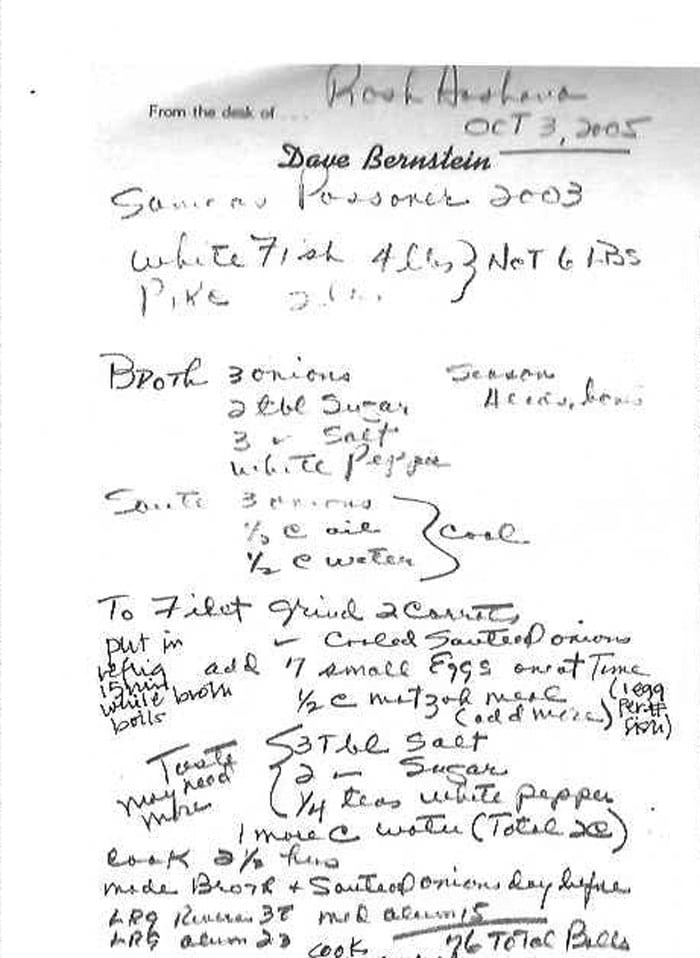
Bernstein’s hand-written recipe

“Gefilte fish is an acquired taste formed from Flossie’s skill and enthusiasm,” Pearlman said. “The process is personal to our mother. She keeps the recipe ‘close to the vest’ and, like a marathon, it takes endurance, dedication, preparation and a sense of community.”

Bernstein’s gefilte fish recipe dates back to the 1960s. It has been altered over the years … and on receipts and fish packing paper there are notes and adjustments for next time. 

“My gefilte fish is not just my mother’s recipe, which she never wrote down,” Bernstein said. “But I have bits and pieces from friends [and] a neighbor.”

According to Pearlman, the first written recipe from the upstairs neighbor notes, “My first attempt to make gefilte fish. Mrs. Katev’s recipe was the closest in texture and flavor to my mother’s … but I kept changing it til I felt it was getting even closer!”

“Gefilte fish was the clarion call for Rosh Hashanah and Passover,” middle child Laura Perloff told the Journal. “The ordering of the fish, the day of cooking, the tasting, setting the table for guests and finally the holiday.”

Pearlman said they get together for dinner the night before Rosh Hashanah and sample the gefilte fish. 

“Our family has about 80 people for lunch on Rosh Hashanah day,” she said. “A taco stand caters the lunch. The gefilte fish competes with the ceviche and always wins out.”

Bernstein notes that everybody gets exactly one carrot slice on their gefilte fish.

Somewhere in the 1990’s Perloff decided she needed to learn to make her mother’s recipe. She, her husband, Gregg and two sons had lived in Northern California since 1974, and missed many holiday gatherings due to distance and work. 

“After our children were born, I felt a need to establish what our Jewish home would be like. Making gefilte fish felt like a good way to connect with Flossie and the Jewish holiday. Flossie’s instructions were very exacting.” 

Perloff needed to convince the local fishmonger to give her fish with “no eyes, no fins and no tails” in addition to lots of heads, collars and bones for the broth. 
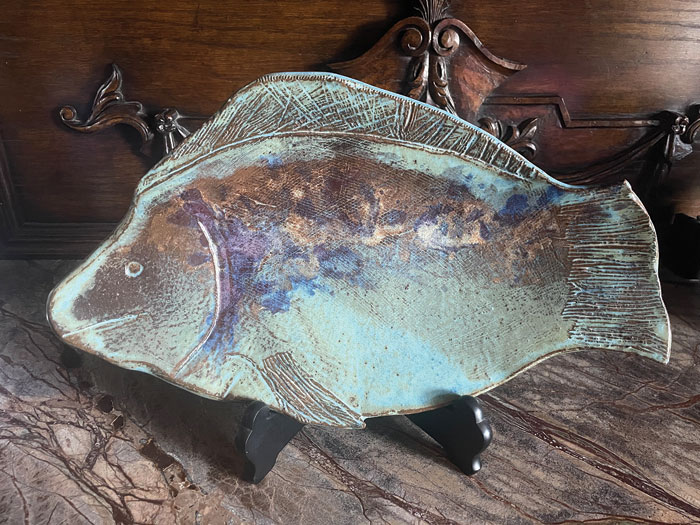
Bernstein’s fish platter

“It was a labor of love and gave me insight into Flossie and the holiday preparations,” she said. “Gregg gave me the best compliment possible, ‘It tasted just like Flossie’s gefilte fish!’”

Bernstein thinks everybody should make homemade gefilte fish at least once. “I personally feel a closeness,” she said. “It’s almost a love affair in making the gefilte fish.”

Pearlman recalled that as her mother dropped eggs into the recipe, one at a time, she would tell the egg to blend nicely.

When asked about her connection to gefilte fish, Bernstein said, “It’s the Jewishness. It’s not religious. It’s tradition.”

Bernstein’s love for gefilte fish goes beyond making it, eating it and sucking the bones while the broth is cooking. She is also a ceramicist who makes beautiful fish-shaped platters upon which she presents her gefilte fish.

“When I throw a slab of clay down, somehow it is always elongated, which makes it a fish,” she said. “From there I can do what I want with the tail. I can poke an eye in.”

Bernstein loves everything about gefilte fish: the taste, the texture, the family bonding while making it. And a comfort knowing her recipe will live on. 

“For us it’s a give-‘n’-take process filled with laughter, lunch and endearments,” Pearlman said. “Flossie is a fine hands-on coach, is deeply appreciative of her legacy and seems content knowing her [gefilte fish] is still the best!”

A Family Love of Gefilte Fish Read More »

Catching Up With a Convert in Progress

Ever wonder how people who were not born into Jewish families find Judaism? As a middle-aged single man, Steve (who would rather remain anonymous until his conversion is complete), is pretty sure his first encounter was not accidental.

One Saturday morning in 2019, still mourning the death of his Polish-Ukrainian mother a year earlier, he took a walk through his Hollywood-adjacent neighborhood in search of relief. He encountered a large stately building that he thought might have been a synagogue. It was Hollywood Temple Beth El.

“I think God brought me there for a reason.” – Steve

Keep in mind that Steve was born with a strong streak of shyness. “I think God brought me there for a reason,” he said. “It was no mistake when I walked through the door for the first time. A man named Simon met me at the door. I tried to stutter something out. When he said ‘We’ve been waiting for you,’ all I could do was laugh.” Simon invited Steve to step inside.  

“I had never been in a synagogue,” Steve said.  “I didn’t know what to do. But when everybody stood up, I did. And when they sat down, I did, too. I was just trying to get the gist of it.”

Steve described how he happened upon the 100-year-old shul. “When I moved into the neighborhood, I noticed there were a lot of synagogues,” he said. “I wanted to go to one. This was the first one I saw. It jumped out at me. I didn’t know anything about Judaism.  I was born Methodist.”

Why a synagogue? “It just called me,” he said.

The quiet but emotional Steve, then in his early 40s, needed (and sought) relief from the pain of his mother’s death. 

“I did not want to go into a church,” he said. “I felt I needed something deeper. I really don’t know what it was. 

At Hollywood Temple Beth El, he had an emotional response. “I started crying,” he said. “I had no idea why.” After three years of fairly regular attendance at the synagogue – though he moves around – Steve said, “I dearly love these people.”

In the beginning, a clash of emotions danced across his mind. “Am I crazy?” he would ask himself. When he was walking home after his first Shabbat service, he passed a rabbi sitting on a bench. Steve recalled the rabbi’s opening question: “What is your Jewish name?”  “I told him that I am not Jewish,” Steve said. “He questioned me. ‘Are you sure?’ he asked. He said, ’I think you are Jewish.’” Steve said the persistent rabbi kept questioning him. “I kept saying ‘I don’t have a Jewish name’ and he kept saying ‘I think you are Jewish.’ I said ‘No, trust me. I am Italian.’ It was a funny conversation.”

As one who had grown up as a churchgoing Christian, Steve said that he “had an emotional response to reading more and more of the Torah. And here I am three years later.”

Reflecting later, Steve said, “I thought maybe I was meant to go back to the synagogue.” As one who had grown up as a churchgoing Christian, Steve said that he “had an emotional response to reading more and more of the Torah. And here I am three years later.”

In his terminology, though, “I still haven’t officially converted,” he said. He identifies two reasons.  “If I do convert, it will be Orthodox, and because my mom was Ukrainian-Polish, I had this thought that if I searched for her, maybe I will find Jewish ancestry and I will not have to convert,” he said.

Jewishly speaking, Steve’s footsteps have weaved rather than followed a straight line. “I have gone from Conservative (Hollywood Temple Beth El) to Chabad, where they have been super nice,” he said. “I have been to the Shul on the Beach in Venice,” where he encountered Rabbi Shalom Rubanowitz, who has been trying to deepen Steve’s well of knowledge. In addition to Shabbat services and informal Torah study, Steve is a student in Rubanowitz’s online parsha (weekly Torah portion) class. He also learns with Rabbi Joshua Katzan of Mishkon Tephilo in Venice. Elizabeth Danziger is in the same Parsha class. For decades, she, her husband Alan and their children have been members of the Shul on the Beach (also known as the Pacific Jewish Center). She said that Steve is “a sincere seeker, perhaps needing a bit more grounding and self-reflection, but definitely committed to his community and to improving his connection to Judaism.”

Steve described Shabbat with Chabad as “more intense, more traditional than my Conservative experiences. I have come to realize that traditional is what I am. In my soul, I am a much more traditional Orthodox person. When I convert, I think I will be Orthodox.”

The instinctively reticent Steve laughed aloud when he was asked if anyone in the community has been urging him to convert. “On the contrary, people have told me not to, and that has made me want to convert even more,” he said. “They tell me, ‘If you want to come for services, fine. We will give you cholent. Be comfortable.’”

He called it a complete reversal of his lifetime experiences. “In the world of Christianity,” Steve said, “they try to convert everybody. This is such a breath of fresh air.”

A decade ago, Steve moved here from the Jersey community near Lakewood, where he attended Methodist services. Drawn here originally by an opportunity to work in the film industry, he is now employed by a tech company, in charge of facility operations. Steve said he prays to his mother “all the time.” He is confident she would approve of him being on a path to Judaism. “She wanted me to be religious but she didn’t push it,” he said. 

Where is he in his journey?

“I believe wholeheartedly in the Jewish faith,” Steve said. “I just haven’t converted yet.”

Catching Up With a Convert in Progress Read More »

The Veil of Deception: George Santos

I often find that two opposite emotional states motivate me to write. One is being in the expansive, most positive of places, sharing not only to enlighten but to help enhance another. The other is from a darker place, one of frustration, demoralization or just plain anger. 

Over these last few weeks, I’ve been residing in the latter. The figure of George Santos has taken hold of me, and I find myself incredulous that someone with his personality and character exists. So many of us, who have worked hard to create a place for ourselves in society, to do the good work we are meant to do and hopefully build a reputation of honesty and integrity, find it hard to resolve the idea that one can cheat, deceive or manipulate their way through life to such an extent that they leave a trail of battered souls. None of us is perfect; we make mistakes and even have our shadow side revealed at times. But with some inner examination, awareness and redirection, we rise to a higher level by continuing the good work to make the world a better place. 

But I ask myself, how is it that someone so disordered has successfully deceived so many and finds himself in a position of power to determine the future of many of us? The list of this man’s deceptions keeps growing as we learn of past indiscretions from those who have engaged with him over the years. Of course, the most heartbreaking accusation is stealing money from a homeless veteran whose dog was dying. How low do you have to go to use someone so deprived and suffering to enhance your petty schemes and bank account? Shouldn’t the ACLU offer legal services to sue Mr. Santos and retrieve the money this vet so rightly deserves? 

Theft by deception can be considered a misdemeanor or even a felony with punishment in jail or at least a monetary fine. 

We certainly know why the Republicans want to keep his vote, but to ignore his unlawful and horrific behavior is beyond acceptable. It is reprehensible. After having a president who lied reportedly thousands of times, it is no surprise that there are others who will repeat such behavior and know they can get away with it. 

In studying Torah, we find the personality of Jacob, whose Hebrew name is Ya-akov, spelled “yudekev,” two parts, each reflecting a different character. Ekev means a heel, the bottom, the lowest part of our physical being, while the yud represents G-d, G-d’s name and character, which is above, the highest of intentions. There are some who even call Jacob a trickster because of his manipulative behavior and robbing his brother of the blessing to which he was entitled. Jacob, however, faced his shadow side. He struggled and overcame his past and recreated a new future, being gifted with a new name. This reflected his new self, Yisrael, willing to struggle with the dark side and bring new light into his life. It is a lesson that we can all change; we can enhance our lives by revaluating our journey and shifting when we go astray. George Santos, or whatever his real name is, is a heel, the lowest of human beings with the ugliest of intentions — cheating the poor, deceiving Jews by using the Holocaust as a veil of deception and stealing from those who were close to him. His lack of self-awareness and ability to even apologize for some of his transgressions reflects how limited a man he is. What are we teaching our children when we permit such a deranged human being to serve in our government?

One can only hope that such a charlatan, and those who put a wall around him, will eventually face judgment day, if not in this world then hopefully in the next. 

The frustration with those who permit and share in such deceit and dishonor is overwhelming at times. We know that those who do nothing are as responsible as those who are perpetrators. One can only hope that such a charlatan, and those who put a wall around him, will eventually face judgment day, if not in this world then hopefully in the next.


Eva Robbins is a rabbi, cantor, artist and the author of “Spiritual Surgery: A Journey of Healing Mind, Body and Spirit.”

The Veil of Deception: George Santos Read More »

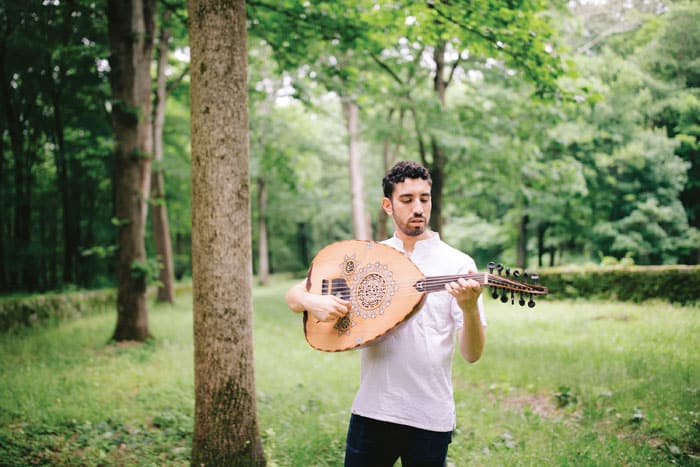
Musician Yoni Avi Battat Combines Arabic, Yiddish, and Hebrew on Debut Album “Fragments”

As an accomplished violinist, Yoni Avi Battat has performed around the world. He has toured as an actor and violinist with the Tony Award-winning musical “The Band’s Visit” and performs with his Yiddish Jazz band, Two Shekel Swing. 

While growing up in Woodbridge, Connecticut, Battat sensed something missing from the layers of identities of his ancestors. On the surface, he connected to the Israeli roots of his father who grew up in Jerusalem. Battat’s mother came from Polish ancestry, so she was Ashkenazi, like most of their community. Battat had little to no connection  with his paternal grandfather’s Iraqi-Jewish roots. But a trip to Israel with his grandfather set Battat on a journey of connecting with and questioning his belonging to each identity as he immersed himself in Arabic music.

The album’s nine songs show a meditative reverence for those before him and a love of the music that eluded him for the first half of his life.

And now on his debut album, “Fragments,” Battat showcases his talent and passion for Arabic music, while including lyrics in Arabic, Yiddish, Hebrew, and English. The new album is a culmination of more than 12 years exploring all of those identities to connect more deeply with the music of his Iraqi-Jewish ancestry. The album’s nine songs show a meditative reverence for those before him and a love of the music that eluded him for the first half of his life.

Battat spoke with the Journal about the new album. 

What were the challenges that kept you from finishing the album? 

“Every time I went to put pen to paper, I was really hit with this deep sense of imposter syndrome of feeling not enough, for having come into this music and into this work as a latecomer. I feel a lot of regret that I didn’t grow up in an Iraqi community, that I didn’t speak Arabic from a young age, that I had to learn this music and this tradition that I’ve come to love and respect so much as if I’m an outsider.” 

What did you do to get over the imposter syndrome you felt?

“By embracing that sense of fragmentedness, by embracing the fact that it’s okay that I don’t speak Arabic like a native speaker, and it’s okay that I’m coming into this tradition, even though I see so many other amazing musicians doing it who have grown up in it. I also still have something to say as someone who didn’t grow up in it. And despite the fact that I feel so distant in a lot of ways from my ancestry, that’s part of the human experience. Fragmentation is part of the human experience. Once I was able to harness that instead of it being a roadblock for me, I was really able to release this album.”

To you, what does it mean to be Fragmented?

“We’re all fragmented in some way, especially for people that have had integration in their story in the last couple generations. We live in a society that is so interconnected and is so global and people are often moving to places so far from where their ancestors grew up. So many of us are fragmented in that way, just geographically removed from the places of their ancestry. That’s just one level. 

“On another level: memory. I feel like there’s so much that I wish I could ask my grandparents that I can’t because they’re not alive anymore. And when they were alive, we had a great relationship and I have wonderful memories of them, but I didn’t know then what I know now. I wasn’t curious about the things I’m curious about now. So that’s another level of fragmentation for me. 

“It’s also just the content. I don’t speak Arabic. I’m coming to my own ancestral language (which my ancestors spoke for 2,000 years) as an outsider. I’m learning it, but so many layers removed from it.” 

Was there a specific moment that began your connection with Arabic music?

“When I was 16, I took a trip to Israel with my family and with my [paternal] grandfather, who was still alive then. And on that trip, he took me to a Middle Eastern music center where he wanted me to get a taste for the music. He knew I was a good musician. I started playing violin when I was 4 years old, so I was already an experienced musician by then. He said, ‘oh, you should also learn Arabic music.’ I said, okay, great. He took me, and I learned for the first time about microtonal music — this amazing, beautiful, and rich system of modes that have notes that don’t exist in Western music. As a musician, intellectually it really appealed to me. It was really exciting to think about this whole system that I’d been raised in, of Western classical music being turned on its head, and the idea of intonation and the idea of expressiveness.

“I heard a little bit from my dad while growing up — he played a little bit of Israeli Mizrahi pop music, which is not the same as what I was learning that day. I also heard my grandfather singing in synagogue sometimes, but I went to a Chabad synagogue growing up. I didn’t really have any connection to Iraqi-Jewish practice or prayer.”

“If you imagine the keys of a piano, white keys and black keys are next to each other. There are notes in Arab music that are between those two [white and black] notes.“

What does that mean, “non-existent notes”?

“If you imagine the keys of a piano, white keys and black keys are next to each other. There are notes in Arab music that are between those two [white and black] notes. We have this concept in Western music that there’s 12 notes per octave. Instead of just half-steps in Arabic music, we actually have quarter-steps, and we have certain modes that specifically and intentionally use what (to our Western ears) would sound out of tune.”

Tell us about the musical instrument, the oud.

“On that trip to Israel, my grandfather bought me an oud. And I started casually experimenting with it, but not really having much formal training. But then again, 12 years ago, I was in college at Brandeis, there was a Middle Eastern music ensemble that I was able to participate in, which was a really special opportunity and a temporary thing that they were doing. So I started singing in Arabic. I started playing the oud, I started playing Arabic violin.”

Tell us about the lyrics on the album.

“The album mostly uses texts from existing sources that are historically and thematically significant to me. Each song pulls from a different text. The first song, “Water and Air,” uses a text by Anwar Shaul, who was in one of the last waves of Jews to leave Iraq. Most Jews left in the early 1950s, but Anwar Shaul stayed through the 1970s. He was a journalist and writer, and he represented Iraq in a delegation — an international delegation — of Arab writers or Arabic writers. And in that delegation, he recited this poem, which I use as the text for this first song, which pretty much says how much he loves his country and his homeland, and how much he identifies with the Arab culture of his homeland and how his mouth proudly speaks the Arabic language. And to me, it felt like a poignant way to start the album, because he talks about how in his youth, he grew up on the banks of the Tigris and the Euphrates. And for me, I’m so far removed from that. I can’t even go there if I want to.”

Yoni Battat’s album “Fragmented” is available on Spotify and Apple Music. For translations and more, visit his website: www.yonibattat.com

Musician Yoni Avi Battat Combines Arabic, Yiddish, and Hebrew on Debut Album “Fragments” Read More »

Print Issue: The Jews Who Never Left | January 27, 2023

CLICK HERE FOR FULLSCREEN VERSION

Print Issue: The Jews Who Never Left | January 27, 2023 Read More »

Rabbis of LA | Rabbi Moshe Greenwald: Serving Jews Downtown Through all the Ups and Downs

When Rabbi Moshe Greenwald was 17 years old, he went to the annual Chabad kinus (gathering) of all the Chabad shluchim (emissaries) from around the world. Though he grew up as the son of shluchim in Long Beach, California, it was at that conference that he knew he wanted to become one, too.

“The decision was very clear to me,” he said. “I was hit very hard by the energy in the room and the sense of mission, purpose and passion for what they do. These were people that collectively were doing something incredibly great, and I wanted to be apart of it.”

Greenwald, who met the Lubavitcher Rebbe Menachem Mendel Schneerson before his death in 1994, wanted to carry on the Rebbe’s legacy. The quick meeting he had with the Rebbe still impacts him to this day. 

“I received dollars and wine from him,” said Greenwald. “I had a short encounter, but I still remember that I felt a deep sense of connection. The Rebbe looked at me in the eyes and I felt like I was the only person he was focusing on right then. It was a very real experience.” 

After Greenwald got married in 2005, he and his wife Rivky were looking for places where they could become shluchim. They decided to open up their Chabad House of Downtown Los Angeles, and since 2007, they’ve been serving that community. 

While they were building momentum – sometimes hosting hundreds of people at their parties for Jewish holidays or Shabbat dinners – COVID set everything back.

“We had a grand opening in our new building in Purim of 2020,” Greenwald said. “And then we were forced to close for over a year.”

During the pandemic, the homeless and drug problem downtown got worse. The riots in the summer of 2020 didn’t help. Many people, including the Chabad congregants, moved out of downtown or LA altogether. 

Today, Greenwald and his wife are hosting less people. But, he has used this time to turn to his spirituality and focus on his personal growth.

“It hasn’t been the easiest journey, but it’s one where I can honestly say I’ve come to accept because I know Hashem is running the world,” he said. “I’m not leaving or running away or giving up.” 

The work is just too meaningful for Greenwald to turn away from. There have been so many people who come to his Chabad house who know nothing about their Judaism. Overtime, they become more involved and eventually start to observe more of the traditions. 

Some people who came to the Chabad house didn’t see the value in carrying on the Jewish tradition. But after a while, they started to change their minds.

“I’ve done weddings for people who didn’t care about having a Jewish wedding three or four years prior,” he said. “Then, I was under the chuppah with them. I don’t take it for granted. There is something miraculous about that.”  

The rabbi has also been at the bedside of people who were in the hospital and needed a chaplain – he’s the unofficial chaplain in a few hospitals downtown. 

“There is something deeply spiritual about saying the Shema with them and their families, holding their hand as their neshama (soul) leaves them,” Greenwald said. “It’s very profound. It alters me every time for the better.”

There are no other shuls or rabbis in the downtown area aside from the Chabad house. Though it has been harder to serve the community over the past few years, Greenwald keeps the classic Jewish teaching of “Everything God does is for the best,” which Rabbi Akiva said, in mind. 

“It’s fine and dandy to be an optimist when it’s all sunshine and rainbows,” Greenwald said. “When the going gets tough, we have to dig deep. ‘Everything God does is for the best’ is something I tell myself daily.” 

It’s all part of human experience. And, it doesn’t detract Greenwald from his life’s mission.

“I want to live authentically,” he said. “I want to be the best version of myself – the best husband, father, rabbi, shaliach, Jew and human being I can be.”

Fast Takes with Moshe Greenwald

Jewish Journal: What’s your favorite Jewish food?

Moshe Greenwald: I like the weird stuff like pickled herring and p’tcha. I go for all of it.

JJ: What superpower would you like to have?

MG: I’d want to fly. I love traveling. I was able to travel to many countries when I was younger. Obviously, Israel is a special place, and every time I go there it’s deeply nourishing. In Israel itself, I love the Old City. There’s nothing like it. 

JJ: Whom would you want to meet from Jewish history?

MG: Rabbi Akiva. I’m a huge fan of his on so many levels. He had complete humility and was so perseverant. Nothing held him back. 


Rabbis of LA | Rabbi Moshe Greenwald: Serving Jews Downtown Through all the Ups and Downs Read More »

A Tuscan Tale and A White Bean & Kale Soup

Tall cypresses and lavender bushes framed the weathered stone walls and the massive wooden front door of the Tuscan villa. Perched atop a hill, the panoramic views of the surrounding countryside were spectacular. And in the distance, on another hill, was the jagged skyline of San Gimignano.

Alan and I, his brother Larry and sister-in-law Ingrid had rented this house that UK Prime Minister Tony Blair vacationed in every summer. (There were even holiday photos of Tony and Cherie in the front hallway).

The old house was exactly as you would imagine — high ceilings with thick wooden beams and tiled floors, heavy antique furniture and walls covered in Catholic iconography. 

On our first morning we drove to San Gimignano. We ventured behind the massive stone walls that were built to fortify and protect the city and we stepped back in time to 14th century Italy. A powerful banking center, San Gimignano once boasted 72 tall towers, an expression of wealth and power. Then the Black Plague arrived and half the population was decimated. The remaining residents abandoned the city for the countryside. Soon the region was dominated by the city of Florence. The powerful Medici family were patrons of renaissance art and architecture, rendering the gothic architecture of San Gimignano passé. Today this perfectly preserved medieval town is a jewel of the Tuscan landscape.

We climbed to the top of one of the 14 surviving towers and saw the astonishing view. We stood in the Piazza della Cisterna and saw the cistern that provided water for the pilgrims on their way to Rome. 

Then Alan and Larry thought it would be a fabulous idea to visit the Museo della Tortura, which displays the gruesome torture devices used during the Middle Ages, mostly by the Inquisition. In retrospect, I probably shouldn’t have read the historical novel “The Last Kabbalist of Lisbon” on the plane ride over. It’s about the Jews in Portugal trying to escape the Inquisition, so my imagination was running wild. 

Then we stopped at a charming little outdoor cafe in a cobblestone alley and indulged in the most delicious cioccolata calda con pane. It’s a drink made of melted chocolate, sugar and hot milk served with a side of the thickest, whitest, natural cream. We’re not really sure if it’s a drink or a dessert. But we know for certain that it’s heaven in a cup. 

It was time to think about dinner, so we shopped at an Italian market. The wonders are hard to describe — the many cheeses and yogurts, the breads and pastry and the beautiful fresh produce. We bought dried anchovies and sardines and lots of olives. We bought fresh basil and broccolini, dried sage and oregano. And lots of olive oil and pasta and chocolate, of course. 

We drove back to that incredible villa and prepared a perfect Italian meal. 

The memory of those wonderful flavors still lingers after two decades. Recently, a friend sent me dried bay leaf and oregano from her garden. These are the quintessential flavors of Tuscan cuisine, so I was inspired to make a big pot of Tuscan White Bean Soup.

My mother and grandmother both made Lubiah Soup, white beans, onion and garlic in a tomato broth. But this Tuscan soup recipe takes it to the next level. 

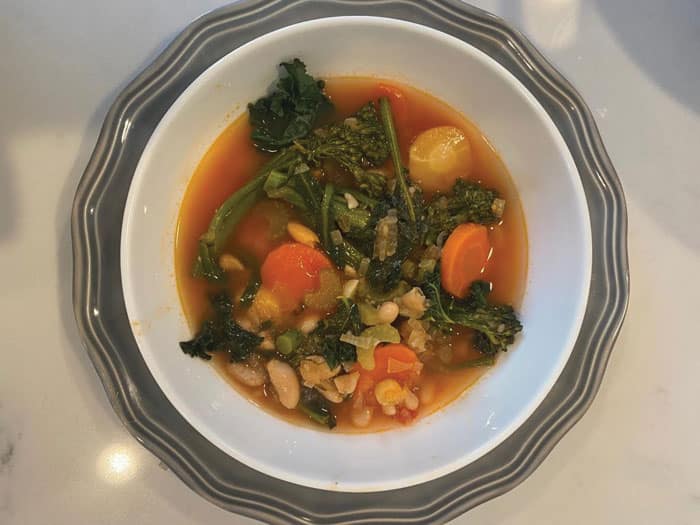
My mother and grandmother both made Lubiah Soup, white beans, onion and garlic in a tomato broth. But this Tuscan soup recipe takes it to the next level. The list of ingredients makes my heart sing — onion, garlic, celery, carrots, parsnip, diced tomatoes, bay leaf and oregano, broccolini and kale. Not to mention cannellini beans. 

My big pot of soup was a huge hit with my guests and family. And on Saturday morning, my daughter Alexandra ate the very last bowl, cold!

—Sharon

Soups are one of my favorite things to make and bean soups are a staple in my house. I love to throw a lot of vegetables in the pot. Adding beans makes the soup a hearty, complete meal. This recipe has cannellini beans but any white bean will work. 

Make sure you take a little time to sauté the onions in olive oil, and to soften the celery, the carrots and the parsnip, so that they release their flavor. But add the kale and broccolini at the last minute so they stay an attractive bright green. 

We hope you have this incredibly healthy soup simmering in your pot soon. 

—Rachel 

Photo by Alexandra Gomperts

Tuscan Bean Soup

1 large onion, finely chopped
4 celery stalks, finely chopped
6 garlic cloves, minced
1 teaspoon kosher salt
2 medium carrots, sliced
1 parsnip, sliced
3 bay leaves
2 teaspoons fresh oregano
1 teaspoon freshly ground black pepper
4 cups vegetable broth
1 15 oz can organic diced tomatoes
2 15 oz cans white cannellini beans
10 oz organic broccolini, cut in half
2 cups organic kale, stems removed

  • Warm olive oil in a heavy stock pot over medium heat. Add onions and sauté for 3 to 5 minutes until translucent.
  • Add the celery, garlic and salt and sauté for 3 to 5 minutes.
  • Add the carrots and allow to soften, about 5 minutes.
  • Add the parsnip, bay leaf, oregano and black pepper and sauté.
  • Pour in the vegetable broth, stir well and bring to a boil.
  • Add the diced tomatoes and the cannellini beans, cover pot and allow to simmer for 20 minutes.
  • About 10 minutes before serving, add the broccolini and kale.

Rachel Sheff and Sharon Gomperts have been friends since high school. They love cooking and sharing recipes. They have collaborated on Sephardic Educational Center projects and community cooking classes. Follow them on Instagram @sephardicspicegirls and on Facebook at Sephardic Spice SEC Food.

A Tuscan Tale and A White Bean & Kale Soup Read More »

Table for Five: Bo

One verse, five voices. Edited by Salvador Litvak, the Accidental Talmudist

The Lord spoke to Moses and Aaron in the land of Egypt: This month shall mark for you the beginning of the months; it shall be the first of the months of the year for you. – Exodus 12:1-2


Judy Gruen
Author, “The Skeptic and the Rabbi: Falling in Love With Faith.”

We’ve all seen at least 100 variations of the call, “30 Days to a New You!” It is a truth universally acknowledged through self-help books, articles, and training programs that if you want to develop a new habit, retrain your brain to think differently or make any other lasting change, doing it for 30 days usually hits the sweet spot. 

Hebrew is psychologically insightful. The word “chodesh” means both “month” and “new,” suggesting that a new month (which not coincidentally is 30 days) is more than a calendar event. By emphasizing — twice — that “this month shall be for you the beginning of months,” God tells us that each time we see that sliver of a new moon, we have the opportunity for personal renewal. 

As Rabbi Samson Raphael Hirsch writes, “Each time the new moon appears, it shall remind you to affect your own free-willed renewal. And as I renew you, and you renew yourselves, you shall move, like the moon, through the darkened skies of the nations and, wherever you go, proclaim the message of “chidush” (renewal), the teaching of God, the free-willed Creator of all things, Who makes us free. Through Him alone can we become truly free in both body and soul.” 

So, the next time you look up at the night sky and see that slim crescent of the new moon, ask yourself, what will you do with this new beginning? 


Rabbi Shlomo Yaffe
Congregation Bnai Torah

The Hebrew word for “Month” in this verse is “Chodesh” which actually means “Renewal”. This refers to the institution of the Jewish calendar which uses the New Moon to begin each month. All dates in Judaism are lunar dates. 

Another word used in Biblical Hebrew for the lunar month is “Yareach” meaning Moon — e.g. the entire cycle of the moon which is the span of a month. Why is the emphasis here, as the Jewish people is being created with the Exodus — specifically on the “New Moon” rather than the month as a whole? 

The Torah is teaching us that just as the month always begins with the renewal of the moon’s light after a period of its disappearance, so too Judaism always allows for a new beginning unencumbered by the burdens of the past. The Jewish people leave hundreds of years of degradation and slavery behind to reach Sinai and receive the Torah — the loftiest statement of human potential — in a mere 50 days! 

This is possible through the power G-d gives us to be “New” — to find the light and power within to attain our ultimate potential notwithstanding how many attempts to do so have failed. The verse may be read as follows “This renewal is yours” — the capacity to attain all you can in your Judaism belongs to you, right now, no matter your past. The Torah is eternal and this potential is there for all time, for all of us, at every stage of our lives.


Lt. (res) Yoni Troy
Counselor, Beit-Hatzayar School for at-risk youth

Although this verse seems disconnected from the general story, it serves an important role. 

Wars are particularly difficult psychologically, because they make so many feel so helpless. This extreme situation highlights how temporary life is: people die, buildings are destroyed, systems collapse. One particularly effective tool is to assert control wherever possible. In the army, the most routine discipline, from keeping your shirt tucked in to shining your shoes, helps, as ridiculous as that sounds in the field. These simple tasks give soldiers a feeling of familiarity — and control. 

In addition, we officers learned that one way to help soldiers overwhelmed by shellshock is to give them simple tasks — guard that area, go pass a message here.

In Bo, God does not give the people of Israel a temporary goal, like the Passover sacrifice, but a monthly goal to watch over the moon. This, ultimately, daily ritual, which never changes, would help the Jews reassert control — in Egypt, in the desert, and throughout so many other trying periods. 

Even more important, this verse begins the process wherein G-d relinquishes his direct involvement and begins to give us responsibility. We start going from a world of total dependence on divine intervention into the more proactive world we live in today. 

We no longer experience open miracles. Instead, we hold the responsibility for ourselves and our world. We have the choice to build the world and make it a better place or — G-d forbid — allow the opposite to happen.


Rabbi Eva Robbins
Co-rabbi N’vay Shalom, Faculty AJRCA

The Me’Or Eynaim, a Chassidic commentator, points out that in the land of Egypt the Israelites had lost all awareness and connections to the G-d of their forefathers and therefore were incapable of making a choice of any kind. In the midst of this land, filled with idols and controlled by one man, Pharaoh, was where they needed to confront the beginning of change, the understanding that this would be the first of many moments in their life when they would have the opportunity to renew and restore themselves and their relationship with the Divine. 

Our pasuk has three powerful words, Chodesh which means to make new, renewal, to restore, and the ‘moon;’ Rosh meaning head, a chief, and beginning, and Shanah, which means to change or be altered, be different, to shine brightly, as well as ‘year.’ 

Most simply we read, “This will be the first of months, the first month of the year.” Alternatively, let’s read it as “This renewal, for you, is a beginning of renewals; it will be to you the first (of many) restorations that will repeat (in your life).” It is a metaphor for a deeper meaning that in the most restricted and painful times of our life there will be opportunities for renewal and restoration. That in that moment of oppressive darkness that often surrounds us and fills our lives, we can expand our awareness and choose to bring in a bright light and connection with HaShem. That is the most liberating of moments. 


Rabbi Chaim Singer-Frankes
Multifaith Chaplain, Kaiser Medical Center, Panorama City

In the Talmud, Rosh Hashanah 2a, Nissan 1 is named as the new year for kings. Our verses herald not only a new month, they also portend a complete reset of history. Not just trading one king for another but a new beginning. Heretofore, the earthly king had been a Pharaoh in an Egyptian society and economy wrought by Joseph, where all wealth is extracted from the serfdom and all power concentrated in the palace. God lays the groundwork for a new order, new rules, new sacrifices, new leadership, and a path toward the birth of a new just and holy nation — Israel. 

God consigns these tasks to his most loyal servants, Moshe and Aharon, and this is a substantial and profound point in our parsha. To sharpen that point, an 18th century Hasidic sage, the Maggid of Kozhnitz, quotes Midrash Shemot Rabbah, offering a parable of a King who says to his son, “Until this point, I have been the keeper of all the wealth of my kingdom. From this point forward it is under your purview …” to do good. Contemplating our verses through this lens, God is entrusting “the keys” to his kingdom on earth to the people of Israel, led by Moshe and Aharon. Visualize Hashem saying, “Not only am I ending the reign of this despot, I’m also not choosing a new earthly dictator. Instead, I am restarting history by giving them a communal task and furnishing them with two guiding counselors: a shepherd and a priest.”


Table for Five: Bo Read More »

Let’s Not Forget About the ‘OG Jews’

have so many friends who identify with the portrait of the “New Jew” that Karol Markowicz draws in her piece for RealClearBooks. The phenomenon she describes is that of traditionally liberal Jews who are being forced to reckon with what has become of their political home on the American Left, where they either no longer feel comfortable, or are made to feel unwelcome. This challenge has followed them into many of their Jewish institutions, especially their synagogues, some of which have transformed into centers of the most extreme liberal political ideas. These places have become inhospitable as well, especially for those who love Israel, leaving many feeling homeless. 

This lurch to the left has produced such overt antisemitism and anti-Israel sentiment that Jews can no longer ignore what has happened, and many don’t want to. For some, the response has been to reassert their Jewish and Zionist identities with new energy, and to seek new spaces where their sensibilities are honored. It can be frustrating at first to find those spaces in precincts traditionally associated with the Right. But after a while, the frustration wears off, and a kind of comfort, if not permanent residency, sets in. As these “New Jews” lean into their new identities and the environments that support them more openly and proudly, there are potential “realignment” implications for the long term, as Markowicz points out, both in American politics and in American Jewish life. 

The ”New Jews” aren’t entirely new, of course. The story of a successful, fully integrated diaspora community that is forced to face the reality that others might not see them the way they like to see themselves, is actually an old one. Throughout our history there has always been a certain percentage of Jews that reacts to this kind of confrontation with a deepening, defiant commitment to Jewish identity. That reaction often expresses itself as a proud, Jewish doubling down, publicly displayed, to send a message to the antisemites that they will be denied their victory. These are the “New Jews” Markowicz describes in America today, and they are a welcome bunch of feisty activists. And there are too few of them.

But while these “New Jews” seem to be getting all the attention, I resist over-celebrating them, even though I love them. Perhaps the reticence is my lingering resentment over the contributions they made to the system they now see poses a threat to us all. It takes a certain amount of humility and courage to acknowledge that you helped create the destructive threat you now want to help take down. Credit is due. But it would have been better not to create it at all.

The destructive threat is identity politics. Many Jews embraced it because it seemed born of a compassionate, liberal impulse for “justice.” Leadership reinforced that narrative, and a lot of good people propped up a very bad idea that would have terrible consequences.

But all along, there were Jews among us who weren’t contributors to the mess in which we now find ourselves — the ones who could see where this was headed well before any wake-up call was required. Markowitz notes that not all American Jews have been politically and culturally of the Left. They weren’t primed to welcome the new order. In fact, many were perfectly positioned to reject it.

For the Sephardim, the Russians, the Orthodox, the Mizrachim and the politically conservative Jews in the United States, Ilhan Omar was not a shock, but, rather, the logical result of the threat that had been unleashed through identity politics.

For the Sephardim, the Russians, the Orthodox, the Mizrachim and the politically conservative Jews in the United States, Ilhan Omar (D-Minn.) was not a shock, but, rather, the logical outcome once the threat had been unleashed through identity politics. These were the Jews who had been chased out of Aleppo and Iran, and down the streets in Brooklyn. They were imprisoned by Communists, and canceled by universities across the country long before Congress decided to keep an antisemite on the Foreign Relations Committee. They had a view of the dangerous trends inside the Democratic Party that those committed to the party for three generations were unable, or unwilling, to appreciate. They tried to warn us.

While most of American Jewry floated along in a dreamlike haze of social action pseudo-religion and dangerously and naively attached itself wholly to one political party, these old-fashioned communities of “OG Jews” stood apart. 

These are the “OG Jews”, the “original gangsters” (an internet slang to describe an extraordinary person) whose old-school attitudes and personal experiences made them acutely sensitive to the old story of the Jewish diaspora and how it always unfolds, even in the United States. While most of American Jewry floated along in a dreamlike haze of social action pseudo-religion and dangerously and naively attached itself wholly to one political party, these old-fashioned communities of “OG Jews” stood apart. 

They made sure we still mattered to the other major American political party. They saw the dangers of the rising Marxist wing of the Democratic party and its penetration into academia, the media and popular culture, and they waved the red flag. Words like “collectivism,” “intersectionality,” and “socialism” made their skin crawl. Racial division was something to defeat, not exploit. “OG Jews” cautioned us about Oslo and the Iran Deal and BLM. Their rabbis preached Torah in their sermons rather than Tikkun Olam. They lived Jewish lives when most other Jews didn’t, and fought battles for Israel that others weren’t aware were happening — yet.

The “OG Jews” have earned respect. For years they didn’t get enough of it. Many in mainstream Jewish circles viewed them as outsiders with outdated ideas that didn’t comport with where the community thought it was heading. But that was then, and this is now.

The “OG Jews” have earned respect. For years they didn’t get enough of it. Many in mainstream Jewish circles viewed them as outsiders with outdated ideas that didn’t comport with where the community thought it was heading. But that was then, and this is now, and if the “New Jews” are telling us anything, it is that the “OG” have been vindicated on several fronts. 

The “New Jew” is shocked by the dishonesty of The New York Times, but the “OG Jew” canceled her subscription 25 years ago. The “New Jew” joined his temple because its brand of universal Jewish values mirrored his liberal ones. Now he flees his rabbi’s hostility toward Israel from the pulpit and, to his own astonishment, he finds himself encouraging his son to seek out the Chabad house on campus that the “OG Jew” helped to build. 

American rapper Ice-T released an album in 1991 titled “O.G. Original Gangster,” which popularized the expression. The lyrics in the record’s title song tell us exactly who the OG is and why he earned his title:

“I aint no super hero / I aint no Marvel Comic
But when it comes to game I’m atomic
At droppin’ it straight / Point blank and untwisted
No imagination needed / ‘cause I lived it
This aint no f-ing joke / This s-t is real to me
“I’m Ice-T / O.G.”

I can almost hear Dennis Prager, Caroline Glick, Anne Bayefsky and all the other “OG Jews” singing along. In another universe, one might hear these lyrics and imagine the late Charles Krauthammer having dictated them to Ice-T, but in better grammar and with more humility.

The “New Jew” is having an allergic reaction to the American identity-politics toxin unleashed by the Left (and its attendant outbreak of antisemitism), and rightly so. But one worries that when the rash goes away, so too will the new passion for Jewish identity and the receptivity to political reevaluation. This is a moment to appreciate and learn from the “OG Jews” who were open Zionists and committed Jews even when it was safe to wear a kippah on the streets of LA. They knew there was a repeating pattern of Jewish instability in the diaspora and recognized the warning signs. Learning from those who saw, decades ago, what you came to see just yesterday is the best way to make sure you never get caught off guard again.

I think of Bari Weiss as the most publicly recognized “New Jew.” It isn’t clear that she would necessarily define herself that way, but every “New Jew” I know reads her and reposts her work as if she is their North Star. Weiss famously left her job at The New York Times when the woke wave became intolerable. Her book on antisemitism generated an audience of American Jews for a conversation they weren’t having, and might not have had were it delivered by a different messenger. This is a serious contribution. For that, and for other important work railing against cancel culture and the Left’s war on academic freedom, she has become rather famous in Jewish circles and beyond.

That is a good thing, but I lament that even more Jews don’t know the work of Professor Ruth Wisse, the revered Jewish scholar, Harvard Professor Emerita, and writer, who, in educated Jewish circles and among those on the right, is as looming a “Jewish celebrity” as one can become. In her decades’ long career, she not only wrote about antisemitism but defined it brilliantly as, “the organization of politics against the Jews.” Thus, she framed for American Jewry the way in which to overcome its willful partisan blindness, and to investigate the Jew hatred that actually plagued it. The gift of that insight was overlooked by most American Jews who found it uncomfortable, until the overwhelming truth of it forced them to become the kinds of “New Jews” who had no choice but to accept it. 

I think of Professor Wisse as the poster-child for the OG generation of Jews in America. All the Bari Weiss fans out there would do well to become Ruth Wisse fans as well. Her accumulated wisdom over time is exactly what impassioned “New Jews” need to hear. Had they read Wisse years ago perhaps they would have become “New Jews” a lot sooner.

The truth is, we need the new and the old. There are too few Jews who care at all. 

The truth is, we need the new and the old. There are too few Jews who care at all. But the “New Jews” should remember to acknowledge the “OG Jews” who arrived at the same conclusions years ago, even without Apartheid Week on campus to shock them into their senses. Whatever they knew then, and the “New Jews” know now, should help prepare everyone for the next turn of events and for the arrival of the next batch of “New Jews” it creates.


Rebecca Sugar is a writer living in New York. Her column, The Cocktail Party Contrarian, appears every other Friday in The New York Sun.

Let’s Not Forget About the ‘OG Jews’ Read More »

A Message to Those Who Have Stopped Praying for Israel: Don’t

Rabbi Jeremy Kalmanofsky, of New York City’s Ansche Chesed, made waves recently by declaring to the Forward that, following the inauguration of the new Israeli government, he would suspend the reading of the traditional prayer for the State of Israel. 

I feel Kalmanofsky’s pain and, incidentally, I decry the moral panic that his statements unleashed. Those crying foul at his statements willfully forget that during the Oslo process, many on the Orthodox right did exactly the same: either refraining from reciting that prayer entirely or altering the words reshit tzmichat geulatenu (the beginning of the sprouting of our redemption). 

But I also believe that Rabbi Kalmanofsky is wrong. Profoundly so. 

The new cabinet includes racists, criminals and homophobes, and is indeed led by a man who, many fear, will do anything to stay in power and avoid facing justice. But that is precisely why we cannot stop praying for Israel!

A careful, line-by-line look at the beautiful text of the prayer for the State of Israel, as written by Rabbi Yitzhak Halevi Hertzog and edited by Nobel prize winner S.Y. Agnon, will show why we not only need to keep reciting it, but that it’s the perfect prayer for this troubled time. 

A careful, line-by-line look at the beautiful text of the prayer for the State of Israel, as written by Rabbi Yitzhak Halevi Hertzog and edited by Nobel prize winner S.Y. Agnon, will show why we not only need to keep reciting it, but that it’s the perfect prayer for this troubled time. 

“Our father in Heaven,
Rock-fortress and redeemer of Yisra’el —
bless the State of Israel,
the initial blossoming of our redemption.”

The redactors of the prayer say, right from the onset, that Israel is not a finished project. It’s a beginning; it’s not perfect, but perfectible; it’s not a destination, but the beginning of a common journey. It’s the “initial blossom” of a redemption for which we yearned for two thousand years. The road to redemption is winding, convoluted, has dead ends, and detours. But to stop the march is to abandon the hope of realizing our dreams. Who said it would be easy? What nation hasn’t endured bad governments or bad policies? And still Zionism sees itself, intrinsically, as a work in progress that needs our active participation and commitment. 

“Shield her beneath the wings of your lovingkindness;
spread over her your Sukkah of peace;
send your light and your truth.
to its leaders, officers, and counselors,
and correct them with your good counsel.”

When the prayer talks about Israeli leaders, it does not claim that they’re perfect. Rather the opposite. It begs God to send them God’s truth and correct them with God’s counsel. An assumption in the text suggests our leaders must see the light of truth and amend their misguided views through divine intervention. Do we not agree that Benjamin Netanyahu and his cabinet of horror need all the light and correction that God can provide? To that end, we can still hope for the country of peace, covered by a canopy of lovingkindness. 

“Strengthen the defenders of our Holy Land;
grant them, our God, salvation
and crown them with victory.
Establish peace in the land,
and everlasting joy for her inhabitants.”

Our enemies, those that seek to destroy us, don’t care who sits in the Israeli cabinet. Their hatred and their desire to eliminate us existed before Itamar Ben-Gvir, and didn’t necessitate the “excuse” of an extreme government to unleash violence against us. The soldiers of the IDF, a true people’s army and our defenders, are not guarding their government, but their homes. Through their effort and bravery, we are undeservingly privileged to, if we so choose, live in a sovereign, free, Jewish state. Their victory simply means that Israelis — Jews and non-Jews alike — won’t die. Not praying for the IDF to be victorious is like hoping for a Hamas victory, or for an Iranian takeover. We know what would happen to Jews (and to all Israelis) if that were to pass. 

But when we pray for victory, the prayer is very clear about what it wants that victory to bring: not conquest, domination, riches, or power, but “peace and everlasting joy for her inhabitants.” The prayer doesn’t say “joy for Jews,” but for all of the land’s inhabitants; all of them, Jews, Muslim, Christian, and others. The text is a slap in the face to the dystopic, discriminatory dreams of Bezazel Smotrich and Ben-Gvir. 

“Remember our brethren, the whole house of Yisra’el,
in all the lands of their dispersion.
Speedily bring them to Tsiyon, your city,”

The prayer asks for all of us, the house of Israel, wherever we are in the world. It hopes for a harmonious relation, a sacred covenant between all Jews — those living in Israel and those in the Diaspora. It’s an admonition to those in the cabinet that seek to ignore the concerns and aspirations of Diaspora Jews. It is a chastisement for those that seek to delegitimize us.  

The prayer closes with a message of universal harmony.

“Shine forth in your glorious majesty
over all the inhabitants of your world.”

The realization of our national aspirations doesn’t only seek to benefit the Jews. It’s a step in a process of universal redemption; something that, we hope, will make all of humanity better, more peaceful, and just. From the beginning of our existence as a people, our fate was linked with that of the entire human race. Abraham’s journey aims not only to serve his family, but to, “bless all the families of the Earth.” Israel is part of the dialectic of particularism and universalism that Judaism bequeathed the world. 

So this prayer is my prayer; it’s what’s going to give me strength and hope while this coalition threatens the Israel I love. Ceasing to recite this prayer would be a symbol of disengagement, and I can’t — and won’t — disengage from Israel. Israel is not a foreign entity; it’s part of me. You don’t walk away from yourself. Israel is not for me a consumer good that I replace with another; a service that I abandon when it’s not up to my standards. And how facile and cowardly to abandon the fight from the comfort of our armchairs while Israelis take to the street and defend their democracy and their values.

Saying or not saying this prayer is a metaphor for the attitude we’ll take facing these challenging times. It determines whether we look at Israel as a common Jewish project or as a country on probation that we can only love as long as it satisfies us. 

I’m not abandoning the double fight that animates me always: the internal one for the character of my homeland and the external one against those that seek to destroy it. Our enemies will use this government as an excuse to claim that Israel is intrinsically illegitimate. We shouldn’t let them. Did anybody say that America as a country should cease to exist because it elected Donald Trump? Are we boycotting Italian restaurants because the neofascists are in power in Italy? Are we hearing a demand to bring Hungary back to the Austrian Empire because of Viktor Orbán?

My call to Rabbi Kalmanofsky and others that are flirting with hopelessness is to move from despair to engagement and to say this prayer with renewed fervor. But not to limit themselves to prayer.

My call to Rabbi Kalmanofsky and others that are flirting with hopelessness is to move from despair to engagement and to say this prayer with renewed fervor. But not to limit themselves to prayer. Reach out to Israelis that need you. Commit and double down on your engagement with the Israel you love. Don’t let the extremists own the field. Don’t judge Israel from a perch of moral self-righteousness, but from the messiness of our shared space. As in that Hasidic story that says that you can only rescue somebody who’s in a muddy ditch if you descend to the mud yourself and get as dirty as he is. 

Above all, dear Jeremy, understand that what happens there reflects you too. Your fate and Israel’s are inextricably linked. Don’t give succor to those who hate us, because it’s not the bad things of Israel that they hate, but the good ones. 

Understand that, as the prayer says, Israel is not a destination but a journey in which we all participate. As the Hebrew song says: a beginning that doesn’t end.


Andres Spokoiny is President & CEO of Jewish Funders Network (@jfunders), bringing Jewish philanthropists together to maximize their impact. 

A Message to Those Who Have Stopped Praying for Israel: Don’t Read More »