fbpx

January 26, 2023

Genesis Prize – aka the ‘Jewish Nobel’ – to Recognize Jewish Activists Defending Ukraine

The prestigious Genesis Prize – also known as the “Jewish Nobel Prize” – will be awarded this year to those working to defend Ukraine’s independence while alleviating the suffering of the people there, according to Genesis Prize Foundation leaders. 

In a January 11 statement, Genesis Prize Foundation Trustee Natan Sharansky and Foundation Founder/Chairman Stan Polovets said the prize selection committee was departing from its usual custom of recognizing a single Jewish individual. 

Genesis Prize Foundation Trustee Natan Sharansky. Courtesy of the Genesis Prize Foundation

“Instead, the Committee has elected to announce a collective award to Jewish activists and NGOs who were inspired by the brave citizens of Ukraine and their courageous president, Volodymyr Zelensky, and chose to act on their Jewish values by standing up for freedom, human dignity and justice,” they said. 

The selection committee called on “others — Jews and non-Jews — to get involved in … Ukraine’s struggle for independence and help overcome the humanitarian crisis that has resulted from the war.” 

Since February of 2022, Ukraine has defended itself against an unprovoked invasion from neighboring Russia, resulting in death, displacement and the upheaval of the global economic system, impacting tens of millions of people worldwide. 

The Genesis Prize Foundation, conceived 10 years ago with a $100 million endowment from five Russian philanthropists, is a global philanthropic initiative focused on enhancing Jewish identity. Winners of the annual prize receive $1 million, though to date all laureates have opted to donate the prize money to philanthropic causes of their choice. 

“Since inception in 2013, The Genesis Prize has leveraged the annual $1 million award into philanthropic initiatives totaling $45 million,” according to the prize’s website. 

Previous winners have included actors Michael Douglas and Natalie Portman; filmmaker Steven Spielberg; former New York City Mayor Michael Bloomberg; and businessman and philanthropist Robert Kraft.

2022 Genesis Prize Laureate Albert Bourla. Courtesy of the Genesis Prize Foundation


In 2022, the Genesis Prize recognized Pfizer Chairman and CEO Albert Bourla for his leadership in developing the COVID-19 vaccine. He welcomed the foundation’s decision to recognize multiple groups dedicated to defending Ukraine.

“Jewish tradition teaches us about the sanctity of human life and the importance of repairing the world,” Bourla said. “As last year’s Laureate, I am honored to pass the torch of the Genesis Prize to such an inspiring group of Jewish activists and organizations committed to saving and improving the lives of brave Ukrainian citizens.”

Rabbi Marvin Hier, founder of the Simon Wiesenthal Center, is an advisory board member at the Genesis Prize who was involved in this year’s decision to recognize Jewish activists and non-governmental organizations. 

It was an easy decision, he said.

“For over a year now the entire world has been shocked by what Putin’s Russia has done to the people of Ukraine — bombing hospitals, orphanages and schools.  Not since the Holocaust have we seen such inhumanity.” – Rabbi Marvin Hier

“For over a year now the entire world has been shocked by what Putin’s Russia has done to the people of Ukraine — bombing hospitals, orphanages and schools.  Not since the Holocaust have we seen such inhumanity. As a member of the Genesis Prize Foundation Advisory Board, I am proud that the annual prize this year was awarded to all Jewish activists and NGOs standing up for Ukraine,” Hier told the Journal. “As Simon Wiesenthal warned the world, ‘Freedom is not a gift from heaven, it is something you have to fight for each and every day.’”

Throughout the year, the Genesis Prize Foundation will shine a spotlight on individuals and non-governmental groups working to support the besieged country while making grants to NGOs dedicated to alleviating the suffering there.

 “It gives me great pride to see so many Jewish individuals and organizations around the world working to help Ukraine,” Sharansky said. “This conflict is a clear-cut battle between good and evil, and it is imperative that we, as Jews, take a clear moral stand. This year’s award celebrates those who have made this principled choice and are acting on it.”

Genesis Prize – aka the ‘Jewish Nobel’ – to Recognize Jewish Activists Defending Ukraine Read More »
Big Sunday Volunteer Day; New JBBBSLA, Jewish Caucus Leadership

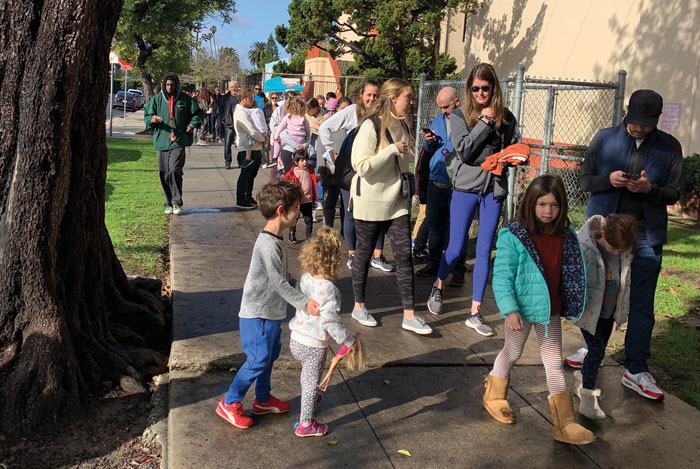
Nonprofit organization Big Sunday provides thousands of local social service opportunities for volunteers every year, and on Martin Luther King Jr. Day the group stayed true to its mission: Hundreds of people turned out at 24th Street Elementary in South Los Angeles, on Jan. 16, for Big Sunday’s 11th Annual MLK Day Clothing Drive and Community Breakfast. 

Volunteers assembled bags of clothing for those in need, applied fresh coats of paint to the elementary school’s hallway walls and decorated greeting cards for recipients of the bags of new winter clothing. While people stuffed new sweatshirts, beanies and gloves into shopping bags, a spirited funk band performed on the school’s auditorium stage. The upbeat music, along with the free coffee and donuts, boosted the energy of volunteers.

Hurrying around the school’s hallways, bursting with folks donning T-shirts printed with the Big Sunday logo, was David Levinson, the organization’s founder and executive director. 

“We’re so glad to be able to host our MLK Day event in person for the first time since 2020!” Levinson said before the event. “We’re on rain or shine, which seems appropriate since these past few years have brought us all good times and tough times. And what better time to celebrate our differences while finding common ground than on MLK Day?”

Big Sunday, a nonpolitical, nondenominational organization, began in 1999 as the tikkun olam project of Temple Israel of Hollywood. Over the years, it has grown from an organization that facilities volunteer projects one weekend a year to a mobilizer of more than 2,000 social service opportunities all-year long. 


Jewish Big Brothers Big Sisters of Los Angeles President Sanford “Sandy” Sigal. Courtesy of JBBBSLA

Jewish Big Brothers Big Sisters of Los Angeles (JBBBSLA) has named Sanford “Sandy” Sigal the organization’s new board president.

Sigal has been active on the JBBBSLA board for nearly 20 years. As a child, he attended Camp Bob Waldorf, an overnight camp owned and operated by JBBBSLA, which he credited with teaching him mentorship, inclusivity and a love of camping and horseback riding. 

“We are thrilled to have Sandy take on this important role as our new Board President,” JBBBSLA CEO Cari Uslan said. “His passion, personal connection, and dedication to our organization will be invaluable as we continue to grow and serve more youth in need.” 

Sigal, who has been an entrepreneur in the real estate industry for more than 40 years, is looking forward to serving in the leadership role at JBBBSLA.

“It is an incredible honor to be named President of Jewish Big Brothers Big Sisters,” he said. “When I was 7-years-old and my mom needed a place for her young son to be nurtured in a positive environment, with positive role models, Jewish Big Brothers Big Sisters found me a home in Camp Bob Waldorf. To be involved with the organization that changed my life over 50 years ago and help lead it today is the honor of a lifetime.” 


Assemblymember Jesse Gabriel, the recently named co-chair of the California Legislative Jewish Caucus. Courtesy of the office of Jesse Gabriel

The California Legislative Jewish Caucus has elected local State Assemblymember Jesse Gabriel (D-Encino) and State Senator Scott Wiener (D-San Francisco) as co-chairs of the caucus and State Senator Josh Becker (D-Menlo Park) as vice chair. 

They assume their roles immediately, according to a Jan. 6 announcement. 

“I am tremendously proud of the work the Jewish Caucus has done to protect and strengthen our community and to repair the world,” Gabriel said. “Thanks to our collective efforts, we passed major hate crimes legislation, expanded Holocaust education, and secured nearly $250 million to fund top Jewish community priorities. We also collaborated closely with the other diversity caucuses to fight hate and bigotry and to uplift vulnerable Californians of all faiths and backgrounds. I look forward to partnering with my colleagues to continue this important work.” 

The California Legislative Jewish Caucus is a Jewish voice for justice, equality and progress statewide. Caucus membership currently totals 18 legislators, including Senators Ben Allen of Santa Monica and Henry Stern of Calabasas. 

Big Sunday Volunteer Day; New JBBBSLA, Jewish Caucus Leadership Read More »

A Moment in Time: “Measuring Up”

Dear all,

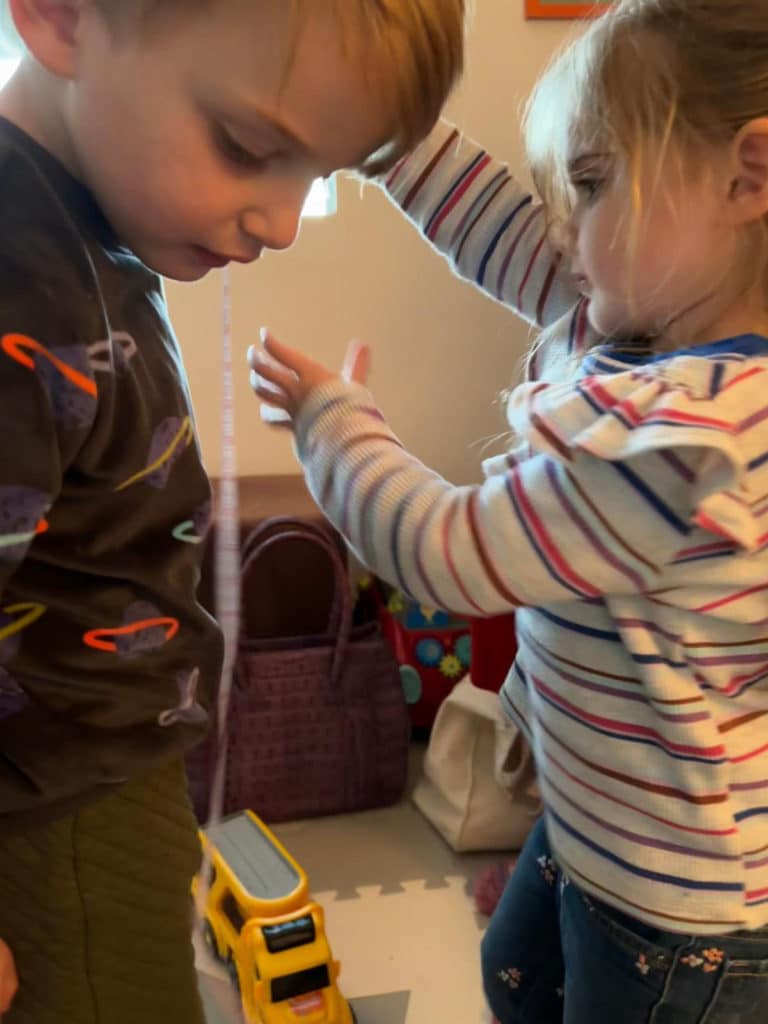
Maya and Eli got hold of a tape measurer this week. (I think they raided Grandma’s purse …..). We showed them how to measure their height, and they had loads of fun.

As we recorded their numbers, I thought about the challenges we often put upon ourselves. While it’s important to set goals and expectations, all too often we measure our own worth against arbitrary comparisons.

Will I be as great as ….?

Am I as wise as …..?

Do I sing as well as ….?

Is my writing as profound as ….?

Are my goals as visionary as ….?

You know what? If we trying to measure up to others, we will lose.

Yes! We should set standards. And yes! We should try to reach farther and deeper. But we can only do so if we take a sacred moment in time to ask ourselves, “Am I being me?” Because at the end of the day, the person you should measure up to …. is you.


With love and shalom,

Rabbi Zach Shapiro

A Moment in Time: “Measuring Up” Read More »

Tornados Can’t Stop Texas’ Largest Holocaust Education Event

Concert pianist and performer Mona Golabek performed a powerful live show for tens of thousand students and teachers on Wednesday, January 25th in Texas as part of a Holocaust Remembrance Week education program.

Golabek appeared in person at Meyerland Performing and Visual Arts Middle School in Houston, with over 50,000 students streaming virtually from school districts in Austin, Dallas, Fort Worth, El Paso and San Antonio. Even with vicious thunderstorms and tornadoes ripping through the Lone Star state this week, the events were able to go on as planned.

The performance featured stories of Holocaust survival as told through music by the Grammy-nominated performer Golabek.

She alternated between playing and speaking from behind a piano to the wide-eyed middle and high school audience. Golabek would then abruptly halt the music, rise to her feet and speak words that heightened the tension of the story. The subject was her mother Lisa Jura’s inspiring story of survival as a teenage Austrian Jewish refugee during World War II.

“My mother’s story is all about how the music saved her life and gave her the strength to survive,” Golabek told the Journal before a show in Los Angeles in 2021. “Any time there was pain or uncertainty or darkness, she would escape into the music. She told me when Kristallnacht took place and she saw through a window her father being beaten and made to wash the streets, my grandma was so desperate, she went into the room where the piano was and she played ‘Clair de Lune’ by [Claude] Debussy in an effort to calm my mother.”

Golabek is well-aware that her presentation of the story and lessons of the Holocaust is likely the first time many of the middle school-aged audiences have heard about it. Her stage presence is dynamic and her storytelling abilities are captivating. And on top of that, Golabek is also a gifted pianist — taught by her mother Lisa.

“Remember, one person has the power to make a difference. One story — your story — can change the world.” — Mona Golabek

USC Shoah Foundation, Golabek’s Hold On To Your Music Foundation and Willesden READ for Texas were at the center of the massive Holocaust Education Event. One of the hallmarks of Golabek’s foundation is creating educational events based on her book about her mother’s experience, “The Children of Willesden Lane: Beyond the Kindertransport: A Memoir of Music, Love, and Survival.” Participating schools were supplied with free copies of the book, and students were encouraged to create projects including essays, poetry and short films around its universal themes. The program culminated with the live theatrical performance that Golabek showcased throughout Texas yesterday.

Act One of the performance began with a haunting, eerie piano solo. Golabek narrated, “It’s Vienna, 1938, a Friday afternoon. Lisa Jura is 14 years old and like every Friday afternoon, she’s preparing for the most important hour of the week: her piano lesson.” Sound effects of streets and trollies play as Golabek immerses the crowd into her mother’s pre-War life along the Danube River.

As the show continued, Golabek regaled the frightening sight that her mother saw while looking out of her window during what became known as Kristallnacht.

“On November 9, 1938, Lisa’s father didn’t come home at all,” Golabek said in the show. “Gangs of Nazis roamed the city; they smashed the windows of Jewish businesses and Jewish homes. They burned books and Torah scrolls. Lisa stood by the window waiting for her Papa. Then she saw him. The Nazis were beating him. They were forcing him down on his knees, making him scrub the filthy pavement while they laughed and yelled, ‘Juden Schwein’ — Jewish pig.”

The story continued, with Golabek highlighting that during the Holocaust, there were ordinary people around parts of Europe who stood up for the Jews.

“Far away in England, Jews and Christians alike, sensing tragedy, pressured their government to allow transports of thousands of Jewish children to come out from Germany, Austria, Czechoslovakia and come all the way to England,” Golabek said to the audience, introducing the story of her mother on the children’s rescue operation, Kindertransport.

Several other organizations came together to make this event happen on a massive scale across the second most populous state in the U.S.

One of those organizations is Echoes & Reflections — a partnership between USC Shoah Foundation, The Anti-Defamation League (ADL), and Yad Vashem — which helps teachers and students to “understand, process, and navigate the world through the events of the Holocaust.” Over the last 18 years, Echos & Reflections has been to over 18,000 schools in the U.S.

Additional organizations that came together to make the event a success include the Holocaust Museum Houston, ADL Texas, Jewish Federation of Greater Houston, Holocaust Museum Houston, the Texas Holocaust, Genocide & Antisemitism Advisory Commission, The Morton H. Meyerson Family Foundation, the Milton and Tamar Maltz Family Foundation and Holocaust survivor Helen Zell. Discovery Education produced the virtual portion of the event to inform as many students across Texas as possible.

TRAILER FOR GOLABEK’S LIVE PERFORMANCE

Out of nearly 30 million residents, there are only about 100,000 Jews in all of Texas. But in 2019, Texas State Government passed SB 1828, which assigns the Texas Holocaust, Genocide, and Antisemitism Advisory Commission the task of approving resources that can be used in the classroom. Golabek’s book is one of the approved resources.

The participating school districts include Alief Independent School District (Houston), Houston Independent School District, the Austin Independent School District, the Dallas Independent School District, the Fort Worth Independent School District, the Northside Independent School District (San Antonio), the El Paso Independent School District and the Ysleta Independent School District (El Paso).

“Mona, your mother’s story and your performance of it are so powerful, it literally gave me chills,” Sophie, a middle school student , told Golabek after the performance

One student asked Golabek during the question and answer session why it’s important to study history and learn from the past.

“Doesn’t history repeat itself?” Golabek responded. “Aren’t we seeing today the chaos and the division in our world which harkens back to Lisa’s story?”

Another student, Chris, asked “how can students like me stand up to hate in my community?”

“Remember, one person has the power to make a difference. One story —your story — can change the world,” Golbeck replied. “When we look at our world today, the chaos, the fighting, social media pressure, pressure from your peers, in your schools … but deep down you know what is right and wrong inside your heart, inside your soul. So take that first step and stand up for what’s right in your world. I promise you if you dig deep inside and find that courage, you will make a difference.”

Tornados Can’t Stop Texas’ Largest Holocaust Education Event Read More »

Why Is It So Hard for Me to Watch Fauda? It’s the News

There’s a line of dialogue in the eighth episode of Season 4 of Fauda, the hugely popular Netflix series that shows in excruciating detail the violence and torment behind the Israeli-Palestinian conflict, that jumps off the screen.

As an Israeli commando team discovers a basement hideout of a Palestinian terror cell, replete with multiple missiles in preparation for a major attack on Israel, a female member of the commando team says:

“These f**kers don’t play around.”

If you wanted to summarize 75 years of Jewish anxiety about Israel’s neighborhood—through countless wars and suicide bombers and missile attacks—those five words pretty much nail it: Terrorists “don’t play around.”

It is that stark reality that prevents me from fully enjoying this new season, which is as intense and exhilarating as ever.

The show is simply too close for comfort.

This was brought home to me this week when I read about a fierce firefight between the IDF and Palestinians in the Jenin refugee camp, only the latest episode in Israel’s continuous efforts to quell a year-long wave of terrorism. The words from Fauda hover hauntingly above these news stories—these guys “don’t play around.”

The irony is that even with fictional characters and storytelling, Fauda brings me closer to a violent reality and a human complexity I can never appreciate in a news report. This is the power of film. You get all the texture. You smell the alleyways. You feel the fear. Through close-ups of faces, you see the human drama and torment in each of the characters, Israeli and Palestinian. The show really revolves around life— how to save it, extinguish it, value it, rescue it, spit on it or honor it.

Because Fauda is so realistic— everything from the locations to the dialogue to the accents to the violence feel eerily authentic— it has a mind bending effect. You can’t tell “fake real” from “real real.” For all we know, an episode of Fauda might as well be a dramatization of a news story from yesterday’s paper.

So a death in Fauda feels like a real death. A blunder feels like a real blunder. An act of cruelty feels like a real act of cruelty. There’s a scene in episode 9 that made me choke up, when a terrorist breaks down realizing the pain he has inflicted on his mother. It’s all too real. Fauda is fiction with non-fiction written all over it.

Ultimately, though, it is the quality of the show that wins out.

Ultimately, though, it is the quality of the show that wins out. The acting and directing and pacing are so sharp they supersede any anxiety triggered by the blurring of the lines. In other words, my anxiety is still there, but I know I can never stop watching.

These Fauda people don’t play around.

Why Is It So Hard for Me to Watch Fauda? It’s the News Read More »

Steps to Freedom – A poem for Parsha Bo

…and He will see the blood on the lintel and on the two doorposts, and the Lord will pass over the entrance, and He will not permit the destroyer to enter your houses to smite [you]
-Exodus 12:23

Step one: learn what a lintel is.
Apologize on behalf of its more
famous cousin, the doorpost.

Step two: Find the blood you need.
It is not where you normally keep your blood.
This batch comes from a sheep.

Apologize to the sheep.
Step three: Learn what hyssop is.
I’ve covered it here before –

Long ago. Maybe you had different eyes then?
Hyssop is bushy and aromatic, like a
tea you’re going to want to keep contained.

Step three: pretend it’s just a
home improvement project as you paint the front door
with the hyssop and the blood.

Wave to your neighbors as if there
is nothing unusual about this.
Odds are your neighbors will be painting too.

Step four: Stay inside tonight. Draw the shades.
It’s going to get weird tonight and you don’t want
to see what’s going on out there.

You’ve been given the secret code,
the all access pass to live another day,
The Holy Holy is on your team tonight.

Step five: pray this does the trick.
The blood on the door isn’t going to
improve the resale value, and you’re

going to have to get out quick.


God Wrestler: a poem for every Torah Portion by Rick LupertLos Angeles poet Rick Lupert created the Poetry Super Highway (an online publication and resource for poets), and hosted the Cobalt Cafe weekly poetry reading for almost 21 years. He’s authored 26 collections of poetry, including “God Wrestler: A Poem for Every Torah Portion“, “I’m a Jew, Are You” (Jewish themed poems) and “Feeding Holy Cats” (Poetry written while a staff member on the first Birthright Israel trip), and most recently “I Am Not Writing a Book of Poems in Hawaii” (Poems written in Hawaii – Ain’t Got No Press, August 2022) and edited the anthologies “Ekphrastia Gone Wild”, “A Poet’s Haggadah”, and “The Night Goes on All Night.” He writes the daily web comic “Cat and Banana” with fellow Los Angeles poet Brendan Constantine. He’s widely published and reads his poetry wherever they let him.

Steps to Freedom – A poem for Parsha Bo Read More »

A Bird by Any Other Name

Birdwatching is a hobby with the quality of homework. One could say of it, as Mark Twain allegedly said of golf, that it is “a good walk spoiled.” Rather than gazing at nature, one stalks it. Rather than looking at birds impressionistically as a poet might, one stares with the intensity of an ornithologist, eager to identify, or, if this is not possible, to make note of the creature’s size and markings, so that it can be identified later with the use of a guide.

The goal is not merely to admire the birds, though this is part of it, but also—and crucially—to learn their names. They are not just pigeons, but laughing doves. They are not just hummingbirds, but Palestine sunbirds. They are yellow-vented bulbuls, Smyrna kingfishers, and Eurasian jays.

The popularity of the saying that “a rose by any other name would smell as sweet” can likely be attributed to the fact that this Shakespeare quote deeply confirms our intuitions about what names are and how they work. In our common understanding, names describe reality but do not constitute reality. They are practical, and sometimes beautiful—but they are not the thing itself.

Jewish thought comes with a different set of assumptions about names, which are rooted in an entirely different theory of language. God is referred to as “the one who spoke and the world came into being,” a reference to the fact that the universe itself is conceived of as work of language. According to the midrash, God’s first creation was the Hebrew alphabet, which He then used to build everything else. Letters, not atoms, are the basic element of Jewish cosmology.

Mystics are the physicists of this lettered universe—those who, like Bezalel from the book of Exodus, know “how to join the letters with which heaven and earth were created” (BT Berachot 55a). Known as Baalei Shem (masters of the Name), they would make use of esoteric divine names to effect physical changes in the world. If one were to ask a Baal Shem, he would tell you that a rose, if you called it “garbage,” would eventually start to stink. To this day, if one is sick or otherwise afflicted, Jewish mystics in this tradition may prescribe a name change as a remedy.

Something similar is at work with birdwatching. As my bird vocabulary expands, the phenomenological world around me grows and deepens. Presumably there were always Smyrna kingfishers and Palestine sunbirds in my neighborhood, but until I learned their names, I didn’t notice. Having a name for something is often what allows us to see it. In this sense, we too speak the world around us into creation.

In the Torah it is written that God “counts the stars” and “calls each one by name” (Psalms 147:4). God is, therefore, a Baal Shem in and of Himself, but despite all this, there are times when names fall short. This is the case in the book of Judges, when Manoach, after an extraordinary divine visitation, is chastised by an angel for asking its name.

Apparently, some things in heaven and earth lie beyond the grasp of words—at least as far as human language is concerned.

Names are holy and names are powerful, but there is also a place for silence, for wordlessness, for the ineffable. God has many names, but God is ultimately beyond all names. So too, in a certain sense, is the world around us. Thus we should be wary lest we, like Manoach, attempt to use names to tame reality rather than enter into relationship with it.

Names are holy and names are powerful, but there is also a place for silence, for wordlessness, for the ineffable.

In the book of Exodus, when Moses asks for God’s name, God replies cryptically: “I will be what I will be” (Exodus 3:14). In other words, don’t think you can put me in some tidy box, don’t flatten me, and don’t use my name as a defense against the inchoate power of this moment.

It’s advice that I should take. The other night, while walking through a park and talking on the phone, my words were blunted by the sudden realization of a massive something cutting through the air above my head.

I gasped. On the other end of the phone I could hear my friend asking what had happened, but I was too entranced to respond. The elegant winged creature landed on a tree bough and surveyed its new surroundings. Looking down from the tree, its gaze met mine as I stared up—grasping for words that I could not find.

A split second later, of course, I found them.

What I had seen was an owl.

I couldn’t help but wonder—what kind?


Matthew Schultz is the author of the essay collection “What Came Before” (2020). He is a rabbinical student at Hebrew College in Newton, Massachusetts.

A Bird by Any Other Name Read More »

Hitler On Trial In Amazon Show

“Are you a Jew?” a woman asks threateningly with a knife ready to possibly end the life of a store owner.

That tension-filled opening of “Hunters: Season 2” follows a major twist where Al Pacino’s Meyer Offerman turned out to be far different than the person he seemed to be in the climax of the first season.  Logan Lerman, who is fantastic, this time fully bearded with long hair, is Jonah Heidelbaum who cannot simply give in to his desire for revenge, or he will sacrifice the mission. As he is preparing to shoot Nazi Biff Simpson (Dylan Baker) in the head, Simpson pleads with him and offers up information he doubts can be true.

Written skillfully by David Weil, the eight episodes features a bizarre trial where Hitler is defended by a Jewish lawyer and decides to take the stand in his own defense.

“Growing up as a Jewish person, I was filled with such fury that Adolf Hitler was never brought to justice,” writer David Weil told The Journal via e-mail. “My grandmother, Sara Weil, was a survivor. And so Hitler was not only the world’s villain, but in a very personal way, he was the villain of my grandmother’s story. And so, I include him in this series specifically so that our Hunters could bring him to justice. Though this part of our series is fictional, I hope that audiences will feel a sense of catharsis in seeing this play out.”

The best episode of the season is the penultimate one, mostly taking place inside a house. It’s quite off the wall as three SS men come to the house where an elderly couple are living. The husband is supposed to be a German hero and he and wife are asked if they are hiding Jews in the home. In what appears to be a nod to the opening scene of Quentin Tarantino’s “Inglorious Basterds,” the episode is a masterstroke and credit must be given to Weil for being so unconventional. It could stand on its own without the other episodes. There is a bit of a Rod Serling twist which makes it meaningful. Robert Towers and Marcia Rodd are wonderfully creepy as Herr and Frau Hansom who dance for seemingly no reason, have trouble hearing and have a specially designed house. According to Weil, he wanted to lay a tapestry of stories and this episode provides the origin story of Zev, who is a young boy in this episode.

While Adolf Eichmann stood trial in Israel and was executed, it is hard to believe that even if somehow Hiter had escaped and been caught that nobody would have ripped him to shreds before he could have ever stood trial.

Pacino is on point with his schemes and Jennifer Jason Leigh, as Chava, gives an inspiring performance. Jerrika Hinton is spot on as Millie Morris, the American agent who does the unthinkable.

While some may balk at depictions of Hitler and say it is a waste of time, it is important to remember that as much as Hitler was a monster, he was a manipulative man of flesh and blood that was able to garner the support of his country.

While some may balk at depictions of Hitler and say it is a waste of time, it is important to remember that as much as Hitler was a monster, he was a manipulative man of flesh and blood that was able to garner the support of his country.

What makes the series a bit more potent now is that with a rise in antisemitic attacks, there is likely an increase in revenge fantasy. Just as Holocaust survivors have guilt for making it out alive when their friends and family did not, there are people who feel guilty for having an easier life than their grandparents. I wish I could have been a Nazi hunter. Even though this is a fantastical show, it never hurts to see a Nazi get a cleaver to the head.

There is quite a bit of violence in the show, but it is done in a way that makes sense. Udo Kier is effectively menacing at Hitler, when he tells his lawyer to “knock em dead” but could be tougher at other times, even though this is supposed to be more than 30 years after the end of World War II. It’s a great touch that the prosecutor against Hitler is a Black Jew.

Weil takes way more risk in the second season, and he mostly succeeds.

“I felt a great deal of pressure to honor these incredible characters and to give the audience a new and thrilling journey to partake in,” Weil wrote. “But more than that, I felt so inspired by the fans’ reaction to Season One and wanted to ensure a story that delivered on what people loved about the first season but also gave them something new, as well.”

The only head scratcher comes when Lerman’s character explains to a romantic interest why he has to kill Nazis.

“I can’t marry a murderer!” Emily Rudd says, as Clara, which is hard to believe, considering she should understand context, even if it is not in line with the law.

If there is a third season, who would the Hunters go after? Unfortunately, there are a number of choices. Perhaps Gustav Wagner, a deputy commander of Sobibor, where an estimated 200,000- 250,000 Jews were murdered. Wagner was on leave during the successful revolt at the death camp in October of 1943. Wagner fled to Brazil and was found dead with a knife in his chest in October, 1980.

Whether it was suicide, or he was hunted, we may never know.

Hitler On Trial In Amazon Show Read More »

A Bisl Torah – Striking a Match

This past Sunday was my Nana’s unveiling. It was a small group, intimate and meaningful. In the days leading up to the ceremony, memories of Nana began to wash over me. Nana was superstitious and believed in signs. She firmly believed the soul could be revealed in the here and now. Just after she died, flowers bloomed in my garden; the first was a yellow rose. Yellow roses were her favorite. Once, when I was driving, I saw a shop sign that read, Nana Jackie. Clear indications that I am meant to feel her presence. But in the past few months, as I have been missing her more and more, it’s been harder and harder to pinpoint where and how she is reaching me from the world beyond.

Until this past Shabbat.

I began lighting the Shabbat candles. I took out my matches and realized the striker, the area where you strike the match and produce a flame, was out. Looking around, I saw the matches from my parents’ wedding. On the matches was a line indicating where people should sit, their table # and a space for a guest’s name. And oddly, the matchbook had my Nana and Papa’s names. I had yet to see this matchbook, but it was sitting on my shelf, waiting to be found.

I took my match, struck that striker, and of course, procured a flame. But I didn’t just produce the flames for Shabbat candles. I knew Nana was telling me what I needed to hear. That when our soulful fires need some tending and nurturing, our loved ones are close by to help us relight our match. Whether the signs are near or far, she was reminding me, the souls beyond the grave are closer than we think.

May the holy fire of our loved ones reignite our fire within.

Shabbat Shalom


Rabbi Nicole Guzik is a rabbi at Sinai Temple. She can be reached at her Facebook page at Rabbi Nicole Guzik or on Instagram @rabbiguzik. For more writings, visit Rabbi Guzik’s blog section from Sinai Temple’s website.

A Bisl Torah – Striking a Match Read More »

Out of the Jewish Closet


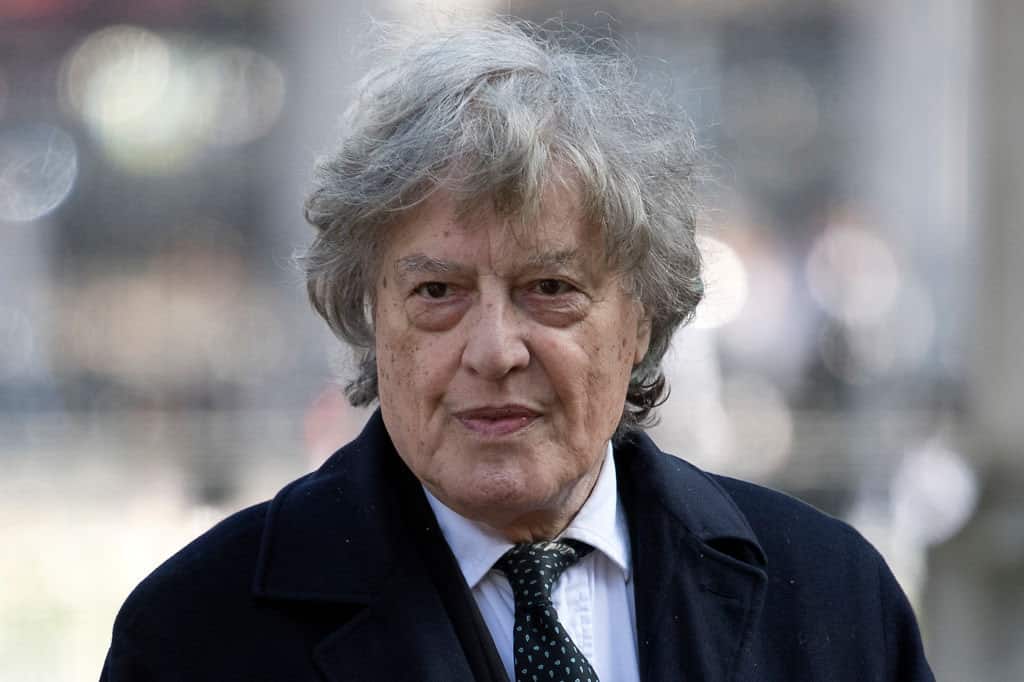
Tom Stoppard’s discovery of his Jewish identity late in life has made me think
that maybe in his first play, Rosencrantz and Guildenstern are Dead, he identified with Rosencrantz
whose identity as Jew was cleverly concealed by him as by the Bard, a link

with Stoppard, whose non-Jewish name would not have saved him from dying in the Jewish Totentanz

if he had not been able to escape from what fomented in a far more rotten state
than Denmark, permeated by pernicious anti-Jewish hate,
while if Leopoldstadt had been Tom’s first play, written outside the Jewish closet, he’d have been regarded
as a Jewish playwright, not discriminated against, perhaps, but disregarded.

In “Tom Stoppard and the Failure of ‘Diasporism,’” Commentary, January, 2023, Howard Husock, discussing Tom Stoppard’s play Leopoldstadt, writes:

Leopoldstadt’s invocation of a potential Jewish state at the play’s beginning, and Israel’s existence at its end, as the tiny remnant of the Merz and Jacobowicz families gathers in the once-grand apartment of assimilation in 1955, mark it as one of the most profoundly Zionist documents of our time…..’

It is a reflection of the durability and power of anti-Semitism that, even if the playwright had uncovered the facts of his own Jewish past in 1955 the way his young British character does, rather than in the 1980s, he would have risked a great deal by writing Leopoldstadt as a young man in the wake of his career-making success with Rosencrantz and Guildenstern Are Dead in 1966. He likely would have become known as a Jewish, rather than a British, playwright—a dramatist making a special pleading due to the tragedy visited upon his own family. No, it was his established reputation as the greatest living English dramatist that has enabled this unlikely production—among other things, Leopoldstadt has a cast of 38, the largest any play on Broadway has seen in generations.

Gershon Hepner is a poet who has written over 25,000 poems on subjects ranging from music to literature, politics to Torah. He grew up in England and moved to Los Angeles in 1976. Using his varied interests and experiences, he has authored dozens of papers in medical and academic journals, and authored “Legal Friction: Law, Narrative, and Identity Politics in Biblical Israel.” He can be reached at gershonhepner@gmail.com.

Out of the Jewish Closet Read More »