fbpx

January 20, 2023

IAC National Summit Day One: Speakers Preach Unity Amidst Judicial Crisis in Israel

As the 2023 the Israeli-American Council (IAC) National Summit convened for the first day of its three-day conference on January 19, the theme among the speakers was unity amidst Israel’s current judicial crisis.

The conference, which is taking place at the Fairmont Hotel in Austin, TX, began its first main plenary with IAC Founding and current CEO Shoham Nicolet saying that “Israel is still searching for a golden path” as a democracy. Nicolet said that even when the “temperature of these battles rise” in a democracy, it’s important for the Jewish and Israeli-American communities to “respect, trust, support, [and] love with no conditions Israel, its people and its democracy.” Nicolet said that the various conference sessions will “allow these exchanges and ideas” to debate the current political situation in Israel.

In a similar vein, Israeli President Isaac Herzog told the conference via video recording that the “unbreakable bond” between the United States and Israel “goes beyond particular parties or particular moments.” Herzog acknowledged that after the most recent election in Israel, “questions were raised by many of our friends around the world and in the United States” regarding whether Israel will still continue to stand for “democracy, liberty and equality.” Herzog declared that Israel “democracy is strong,” saying that the differing voices among the branches of Israeli government simply reflect “the greatness of our democracy.” Herzog added that the “rule of law” and “freedom of speech” are “pillars of our Jewish and democratic state.”

“Israel will never compromise on its defining principles,” Herzog proclaimed, telling conference attendees: “We rely on all of you to be bridges of dialogue and ambassadors of goodwill.”

Israeli Minister of Diaspora Affairs and Social Equality Amichai Chikli also spoke during the main plenary and was asked about the concerns from American Jewish leaders about the current Netanyahu government. “We were very honest with our agenda and it is our responsibility to follow this agenda,” Chikili replied. However, he did say that the government is listening to Jewish leaders and cares about their concerns regarding the current government.

The current government was not the only subject of conversation during the plenary. Israeli Special Envoy for Combating Antisemitism and Delegitimization of Israel Noa Tishby focused on the issue of antisemitism, saying that the recent tirades from rapper Kanye West resulted in his social media following doubling, which shows that antisemitism is an “addiction” that the world hasn’t been able to get rid of yet. While she acknowledged that criticism of Israel isn’t antisemitic, Tishby argued that anti-Israel activists don’t care about Israeli government policy, as to them, Israel’s very existence is illegitimate. She also pointed out that the “diverse” nature of Israel’s prior coalition government should have been a boon for pro-Israel activists, yet nothing really changed in the pro-Israel activism sphere.

Chikli discussed his perspective that the current challenge in the U.S. is being able to “keeping Jewish identity strong and alive,” as “Jewish identity is getting weaker” in the country. “Zionist identity is being attacked seriously by the [Boycott, Divestment, and Sanctions movement] and other organizations and states sometimes that try to delegitimize our rights as a people,” Chikili said. He called upon the Israeli-American community to explain to American Jews the “challenges” of being an Israeli and to help fight antisemitism in the country.

Chikli was also asked about the possible cancellation of Israel’s grandfather clause, which allows for anyone with at least one Jewish grandparent to immigrate to Israel provided that they don’t practice another religion. “Israel will always remain safe haven for Jews everywhere on Earth,” he replied, adding that the government is taking steps for “to help the Jewish community to help themselves.” He went onto highlight the fact that in 1990, 93% of olim came from former Soviet Union states; that number declined to 40% in 2002 and 8% in 2020. “We have an issue here,” Chikli said, adding that “we need Israel to be a strong Jewish state.”

Other speakers included Mark Wilf, President and CEO of the Minnesota Vikings, and Adam Neumann, former CEO and Co-Founder of WeWork.

IAC National Summit Day One: Speakers Preach Unity Amidst Judicial Crisis in Israel Read More »
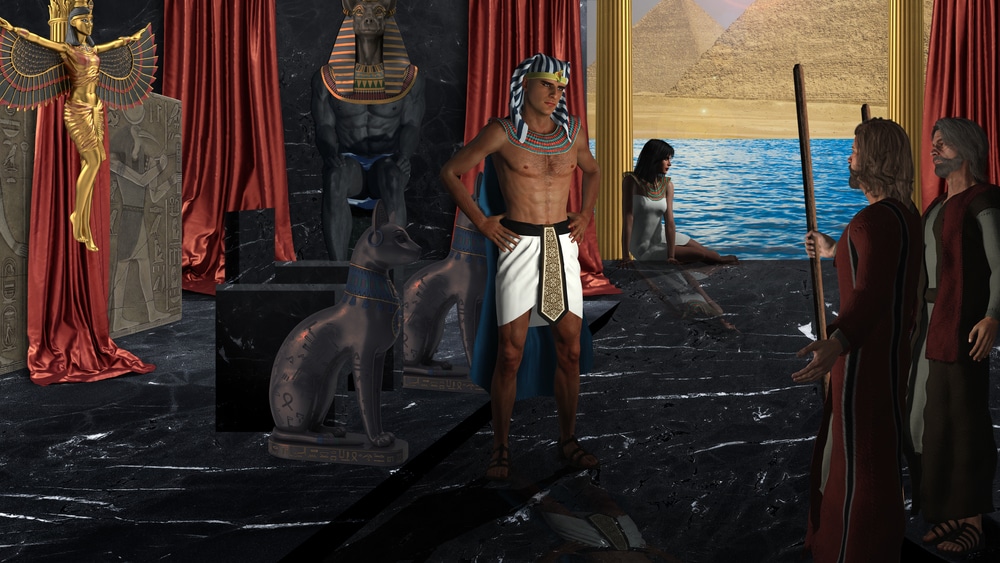
Thoughts on Torah Portion Va-eira – “The Strands and the Cord”

Thoughts on Torah Portion Va-eira

The Strands and the Cord

Throughout her discussion of this week’s Torah portion, Va-eira (“I appeared”) in her The Particulars of Rapture, Avivah Zornberg draws fascinating parallels among three main protagonists – Moses, Pharaoh and the Israelites, starting with last week’s Torah portion, Shemot.


Look at Exodus chapter 3:2 from last week’s Torah portion. Etched in the memory of the reader is this: “An angel of God appeared to him (Moses) in the heart of the fire within the bush, and he (Moses) saw that the bush was aflame but not consumed. Moses said (to himself), ‘I shall turn aside and look upon this great sight, why the bush is not consumed.’ ”


God’s voice replaces the appearance of the angel and calls out to Moses. God sets out the ground around the bush as holy. God identifies God’s self. Moses hides his face, “For he was (too) awestruck to gaze toward God.” After a lengthy introduction, God gives Moses his mission, “I shall send you to Pharaoh, and you shall take my people Israel out of Egypt.”


The reader typically is awestruck by the appearance of the Angel in the heart of the fire, and the Voice of God being revealed to Moses. From that voice comes Moses’s life’s purpose. In God’s commanding Moses to lead the people out of Egypt, all the strands of Moses’s painful past are tied into a cord. The fugitive from justice will lead an exodus of slaves and deliver harsh justice to Pharaoh and his minions.


At least, that is what sticks in my mind when I recall the story. I don’t remember right away Moses’s getting over his awe rather quickly, saying in response to God, “But why me?” It was a complaint, not a question. Moses’s response takes the air right out the story.


In the Midrash that Zornberg presents in this week’s Torah portion, a protracted days long argument followed the call of Moses, Moses insistently choosing, for one reason or another, not to accept the mission. God, unlike the IMF, doesn’t say, “this mission, should you choose to accept it . . .” God had already said “yes” for Moses. God just wanted to reason with Moses and get him to say “yes” himself.


In the end, Moses hears everything God said, but demurs. “No one will believe this.” God promises to take care of the people’s disbelief, predicting the miracles in this week’s Torah portion. Moses changes tactics. Despite his eloquent arguments against God presented in the Midrash, Moses says (in Exodus 4:10), apparently without a shred of irony, “We’ve been talking for three days now. You know I am not good at speaking.” God says, in all caps, “GO! I WILL BE WITH YOUR MOUTH AND TELL YOU WHAT TO SAY.” Just follow the script!


Moses responds dismissively, effectively saying, “Yeah, whatever, fine. Send anybody you want.” God’s wrath finally burns against Moses and God seems to make an offer that Moses can’t refuse. Moses starts his mission, halfheartedly, it turns out.


Moses tells the people what happened, and they actually believe him (Exodus 4:29-30). The text is not being entirely straightforward with us, the readers. The people believe that what Moses told them did happen, but it turns out that it just didn’t mean that much to them. They turned out to be like Moses, denying the mission, refusing to hear.


Pharoah is presented as an odd parallel to Moses and the Israelites. Pharaoh hears everything, including the warning of the plagues and the sword. Pharoah answers, in similar fashion to that odd positive-negative in use today, “Yeah, no.” Pharaoh takes out his own wrath on the Israelites, who lose faith in Moses fairly quickly. “May God judge you! It’s all gotten worse!”  Moses, the people and Pharaoh, and even God, start to look like each other.


What a bizarre story! The heart of the fire, the voice of the Eternal One, the promise of freedom all dramatically unravel in the verses that follow the call of Moses at the Burning Bush.


Refusal. Insolence. Denial. Half-heartedness. Wrath. Faith gained and abandoned. Blaming. Pain and suffering. Fear. Something was troubled way down in Egypt land.


And then, peeking out from this story, are verses that echo to us from the book of Genesis, from the story of Rebecca and her pain in her troubled pregnancy. She goes to seek of God in her pain, and says, in Hebrew words almost impossible to translate, (Genesis 25:22), “Im ken, lamah zeh anokhi,” “If thus, why do I exist?” The answer that there two nations struggling in her womb does not bode well. The troubled pregnancy augers further unraveling.


At the end of last week’s Torah portion, capping the entire unraveling at the beginning of the Exodus, Moses says to God (Exodus 5:22), “Why have you done evil to this people and why did you send me (lamah zeh shelachtani)?” “Lamah zeh?” “Why?”


This subtle reference to the pregnancy of Rebecca has us re-ask all our questions of last week’s Torah portion in a different tone, “Why does this story exist?” Why does God choose such an unfit servant? Why does God redeem an unfit people? Why is Pharaoh impervious to truth? Why do things go so terribly wrong? Why doesn’t God matter? These questions are only sharpened in this week’s Torah portion.


With this reference to the pregnancy of Rebecca, we know the answer: Because this is the way things are. Each part of the story stands for parts of our inner lives, our lives with others, and our lives with God. There is trouble in the womb of consciousness. The pregnancy is painful, birthing produces woe. Things fall apart and then fall apart some more. When you are in the midst of things falling apart, you ask why. But once the strands form a cord, you know. Cords come from strands.


There are those moments. When the brothers reconcile in Egypt. When the waters break at the Sea of Reeds. When the people go to Mt Sinai, where Moses saw the angel in the heart of the fire. The people saw it, too, for just a moment. If only our gaze could hold the appearance of the angel in the heart of the fire. If only our minds could hold the voice of God. If only our purpose could resolutely guide the path before us.


That’s not the way things are. We must continuously take the strands at the margins of life and form them into cords. It’s our mission, our purpose.

Thoughts on Torah Portion Va-eira – “The Strands and the Cord” Read More »

Reading Into Retirement

When I started thinking about retirement, I turned to books for an idea of what to expect. I picked up books by female nomads who left their comfortable homes to wander the world. I read books by women who were experts on everything—from thinning their thighs, to managing finances, getting along with in-laws, and cooking for one. Yes, I even read books about how 70 is the new 40—otherwise known as science fiction.

In between reading, I talked with my friends about what was coming up next but mostly they wanted to avoid looking ahead further than their next trip. Until I attended a lunch with a group of senior academics. When the subject turned to future plans, one serene sixty-something said she knew exactly what she would be doing. In fact, she had tried it out on a recent sabbatical and it was divine. She could hardly wait.

“I plan on reading a book a day,” the esteemed English teacher said confidently. She certainly had no interest in trying out the latest lunch spot or learning pickleball. Nor did she want to climb mountains in Tibet or master Mah Jong. All she wanted was to soak in a tub up to her ears in bubbles, and read whatever she wanted—every day for the rest of her life. I assumed she would come out to eat.

She did not care about anybody’s literary opinions nor did she care to kowtow to a group schedule. The idea of a book club was anathema to her. I understood. When I first moved to Los Angeles and I needed to make friends, back in the ’80s, female networking/book groups were all the rage, so I joined one. Between the kvelling about children, remodels and husbands plus the stress of preparing a knockout pot luck dish, I was too exhausted to keep it up each month. Later, I heard that the book club hired a referee—an English lit grad student whose job was to keep the discussions on track. But I had already bowed out, a loser at schmoozing.

In truth, I’ve never been a joiner. My lifelong reading habit is rooted in a desire to escape and imagine.

In truth, I’ve never been a joiner. My lifelong reading habit is rooted in a desire to escape and imagine. For this I vant to be alone. My addiction started in second grade, when my mother took me to the public library in New York to get a borrowing card. Soon enough I started methodically working my way through the shelves, gobbling everything I could read. By the time I was in junior high, all I wanted was to sit in my room and read. Long before ear buds and texting I had found the perfect way to shut out my chaotic household. I may have been the only kid in the Bronx whose parents begged her to put down the books and go make some noise. Needless to say, choosing a major in college was easy. Endless reading lists, and smart-sounding discussions about practically nothing? I was born an English major.

Getting back to my search for insights on aging, there are very few contemporary novels that take place in the transition to retirement that provide a pleasant escape. Even the smartest women get morose as they age. Tough feminists like Simone de Beauvoir and my favorite depressive Joan Didion tackle the subject with brutal honesty. One writer I found, Carolyn Heilbrun, whose “The Last Gift of Time: Life Beyond Sixty,” inspired me in my fifties, left me feeling duped ten years later when I learned that she had committed suicide in her seventies. So much for self-help!

I have found exactly one book that consistently lifts my spirits while making light of circling the void. Written by a real life “agony aunt,” a British advice columnist named Virginia Ironside, the book is a first person fictional account of a cranky, sarcastic London divorcée who unapologetically embraces the joys of retirement—no more chasing men, setting alarm clocks, or pressing her bunions into high heels.

No! I Don’t Want to Join a Book Club!” is a quick, trashy read that doesn’t offer advice or sugar-coat aging. It has been sitting on my nightstand for the last ten years—ready whenever I need a quick chuckle before attempting to fall asleep.


Los Angeles food writer Helene Siegel is the author of 40 cookbooks, including the “Totally Cookbook” series and “Pure Chocolate.” She runs the Pastry Session blog.

Reading Into Retirement Read More »

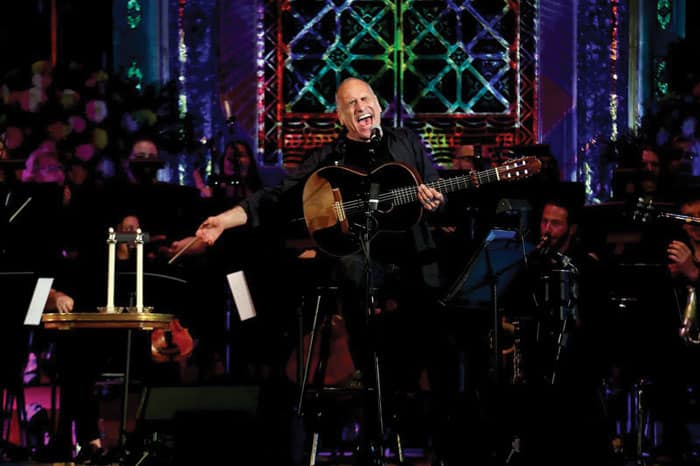
David Broza Says Peace Can Happen

In the cannon of Jewish music, one of the most famous songs is David Broza’s “Yihye Tov” which can be translated as “It Will Be Good” or “Things Will Get Better.”

But things are not as good as we would like them to be. There is not a whiff of a word on how Israelis and Palestinians will make peace. And in America, numbers show alarming rates of antisemitic attacks. But Broza, 67, never loses hope. He reflected recently on the enduring legacy of his powerful track, the present and the future.

“It’s my most emotional song and I’ve played it for years all over the world and it still casts a spell,” Broza told The Journal. “I’ve performed it since 1977. I’ve performed it in war zones, schools, arenas and many places. The song is where I planted my flag.”

Broza said the desire to use music to spur positivity, help others and bridge the gap between different people who may oppose each other, notably Israelis and Palestinians, has always been a part of him.

“I got it from my mother’s milk when she was breastfeeding me,” Broza said. “My father had a sport club for the handicapped and my grandfather was involved in conflict resolution and founded ‘Neve Shalom,’ the peace settlement.”

Asked about rises in antisemitism and attacks in New York and Los Angeles, Broza said it is troubling but not surprising.

“There is always an evolution of things,” Broza said. “Antisemitism is awful, and we should speak out against it and fight against it. We have always had people who hate us. We see that the Jewish people have come together and are strong. From the pogroms to the Holocaust, we have an obligation to remember history and learn from it. But today, we have strength and should be inspired by it. We should not look at the situation like all is lost. This is not the time of the Turkish empire. We are living in different times.”

Broza was the subject of a 2014 documentary, “East Jerusalem/West Jerusalem,” that is available on Amazon Prime and chronicles the eight days he recorded the song and album of the same name in East Jerusalem. It includes collaborations with such artists as Wyclef Jean and Mira Awad. It shows Broza traveling to the Shuafat Refugee Camp, and he says that while any political solution will be difficult, it is important for individuals to take the steps to connect and have empathy for one another.

Broza said he is aware that those who still speak about peace prospects can be naive, but said The Abraham Accords serve as evidence that the unexpected can happen.

Broza said he is aware that those who still speak about peace prospects can be naive, but said The Abraham Accords serve as evidence that the unexpected can happen.

“That was a positive thing that people said could never happen,” Broza said. “Of course, that is not the same as peace between Israelis and Palestinians. But it shows that nobody is a prophet. I think there can be peace. I don’t know if it will be 10 years or 50 years, I wish there would be peace yesterday. In this new generation, it would make sense for people to look around and see peace is happening with other countries and realize that enough blood has been spilled. There were mistakes in the past. Everybody knows that. The question is, what can be done for the future?”

Broza said he hoped that people all over the world would also fight against racism and hate of all kinds.

He started a nonprofit called One Million Guitars to provide guitars to students in underprivileged areas which has given out guitars to Israeli and Arab children as well as students in 43 states in America. At a minimum, he hopes it will give them a sense of confidence that people care about them, and if some wind up starting a musical act in New York or in Hollywood, all the better, in his eyes.

Broza said his experience as an Israeli soldier in the Lebanon War in 1982 shook him. “It didn’t at all impact my ability to function, but it definitely stressed me and had an impact on me,” he said.

Broza added that peace should not be viewed as a fairy tale. “I think it is important to push for peace even at a time when people will say it’s pragmatic to expect that result, Broza said. “I think it’s pragmatic when there have been so many years without it.”

Born in Haifa, Broza, who has also lived in Spain and the United States, said it is important to be positive, while not ignoring problems that need to be fixed. Broza won a medal of honor from King Juan Carlos of Spain in 2009. With more than 30 albums to his credit, including songs in Hebrew, English and Spanish, Broza, also known for the iconic love song, “Mitachat Lashamayim  or “Under The Sky” plans to keep on performing and recording.

“I’m 67, I feel good, and I love connecting with audiences,” Broza said.

David Broza Says Peace Can Happen Read More »

Loolwa Khazzoom: Dancing with Pain to Heal

There’s power in dance. It’s good for mental, physical and spiritual health. But like religion, dancing sometimes requires a leap of faith.

“It is through the doing that we become,” Jewish Iraqi American writer, activist and musician Loolwa Khazzoom told the Journal. “We don’t feel spiritual, then pray. We pray, and through that act, we feel spiritual. Similarly, the last thing you want to do when you’re in excruciating pain is to dance. But if you dance, the pain subsides. Na’aseh v’nishma. We will do, then we will listen.”

Khazzoom created Dancing with Pain®, an innovative method for healing from chronic pain, so others could benefit from her experience and discovery. 

In 1997, Khazzoom was in a hit-and-run, head-on car collision. She initially suffered acute back pain and, due to medical negligence, went from bad to worse. She suffered from calcified and degenerated discs in every section of her spine, along with arthritis in both hips, a dislocated right shoulder, a torn meniscus in her right knee and various injuries in her ankles and wrists. 

Over the course of the next decade, she ended up alternately bedridden, housebound and wheelchair-bound. Prior to the accident, Khazzoom was athletic, regularly jogging 12 miles and swimming six miles at a time.

“I rejected the surgery, and allowed myself the time and determination to figure out something else — another option that was not yet visible, but which I deeply sensed must be possible,” she said.

A series of serendipitous experiences led Khazzoom to an epiphany: by reconceptualizing dance as more than leaps, twirls and fancy footwork, she could use it to heal herself. 

Khazzoom started “dancing” with whatever part of her body was not in pain. Initially, this was only her arms. Within as little as an hour, she would go from limping to leaping. In the beginning, she would wake up with a pain level of about seven or eight. After dancing, the pain would go down to a two or three xz. But the next day the pain would return. Yet, she was grateful that she had something to temper the pain each day. 

Over the years, she continued her daily dance practice, and the healing gradually snuck up on her. One morning in 2009, she woke up feeling great. It was her first pain-free day in years. Not long after, she had a pain-free week then a pain-free month. Soon, she was mostly pain-free, with only occasional setbacks. Within a few years from that turning point, she reclaimed her body and her life. 

Khazzoom started teaching Dancing with Pain classes in 2008, which are now available online.

So, how does it work?

“You dance from whatever position makes you feel best, whether lying down, sitting or standing,” she said. 

For those suffering from excruciating pain throughout their body, these movements can just be in the imagination and tiny physical motions. 

The core principle, Khazzoom explained, is that you don’t say, “I can’t,” but rather, ask, “How can I?” 

“You move in whatever ways the body is able to do with comfort and ease, to music that inspires, soothes or energizes you,” she said. 

Repeating this practice over time strengthens and amplifies the results. 

“Over the course of about five years of this practice, I went from being bedridden to being able to bike 30 miles at a shot,” she said.

More advanced students learn to dance from and with pain. 

“In the first case, you channel the energy of the pain, so that it essentially is recycled to heal itself, similar to how a runner can channel anger to fuel a powerful workout,” Khazzoom said. “In the second case, you imagine the pain as a dance partner, and can have a lot of fun with that.” 

For example, by making goofy faces, it reduces your pain’s hold on the psyche, and puts you in control of your perception and experience of pain.

“While I did not consciously apply Jewish values in the development of this dance methodology, I see parallels of how Jews approach matters,” Khazzoom said. “We turn to music, story and food — all powerful forms of artistic self-expression — to cope with our collective pain. We elevate and transform through Jewish art.” 

When God chose to give us the Torah, Khazzoom said, “We were the only nation who did not first ask what was in it. A portal opens when we commit ourselves, and our reality can change in a nanosecond. In this way, Dancing with Pain® is a profoundly mystical experience.”

5 Steps for Dancing with Pain at Home

  1. Turn On Music. Put on music that inspires, soothes or energies you. You can be lying down, crumpled up in bed from pain or in a foul mood in your wheelchair. Just put that music on.
  2. Close Your Eyes and Scan Your Body. Say “hello” to the places in pain, so they feel acknowledged, and then move on. Also, look for the places in your body that are not in pain. For now, that might only be in your imagination, but it matters for your physical transformation.
  3. Drink in the Music. Actively invite the music to permeate your body. Imagine it as a warm, soothing mist. Actively direct it to the places in your body that are not in pain. Again, that can be in your imagination. 
  4. Allow the Music to Dance You. That is not a typo. Invite the music to step into the driver’s seat of your body. Allow your body to respond to the music organically. How does it make you feel? How does that feeling want to move in your body?
    Be gentle with yourself; no pressure. It’s totally okay to lie perfectly still, simply experiencing the sound. At some point, your body is likely to begin moving in natural response to the music. 
  5. When you Move, Stay Aware of Your Sensations. You have many body parts to move, and many directions in which you can move: up and down, side to side, in circular motions. The movements can be tiny or big. This is your dance. There is no right or wrong way to do it. Just move in ways that feel good. If at any time you feel pain, stop. 

The dance should always — and only — feel good. If it doesn’t feel good when you move your body, dance in your imagination. Allow the process of healing to unfold on its own time.

Loolwa Khazzoom: Dancing with Pain to Heal Read More »

Hen Mazzig on ‘The Wrong Kind of Jew’

As a social media influencer, Mizrahi activist, pro-Israel educator, and member of the LGBTQ community, Hen Mazzig carries around many different identities. Because of that, he is in constant “teacher” mode as he tries to dispel many preconceived ideas about who he is to Jews and non-Jews alike. That cultural kaleidoscope forms the basis of his recent book, “The Wrong Kind of Jew: A Mizrahi Manifesto,” published by Wicked Son Books. 

It all came to a head back in October 2016, when Mazzig was a guest speaker at University College London (UCL). He was greeted by protesters who shouted anti-Israel slogans to drown out his speech. The event was so raucous, the police were called to escort the pro-Palestinian demonstrators away from the event. 

The incident had such an impact on Mazzig, it made him rethink everything he was doing in his pro-Israel outreach work. The protesters called him all kinds of names. It didn’t seem to matter that Mazzig’s time in the army was spent working with Palestinians to help bring humanitarian aid and infrastructure like roads and hospitals to Palestinian civilians as part of the Oslo Accords.

“In the beginning, when I was attacked, I was very worried,” Mazzig told the Journal. “And I started looking inward. And I said, ‘Okay, what am I doing wrong? What am I speaking about that they don’t like to hear? How can I fix it?’ And I realized that it’s not about what I say. It’s about who I am.”

The worst part for Mazzig was that he felt outnumbered and defenseless. Then, he figured, he cannot be the only Jew who feels this way when faced with not only antisemitism on campus, but a distortion of who he is as a Jew and Israeli. That was when the germ of an idea started to develop that would eventually become the Tel Aviv Institute, which focuses on social-media-driven strategies to fight antisemitism. 

Taking a fighting stance is something that Mazzig is used to since he has had to struggle through many public and private battles in his 31 years. As a Mizrahi Jew, an Israeli, and a member of the LGBTQ community, Mazzig has pushed back against his status as what he calls “the wrong kind of Jew.” His book outlines his family background and struggles for acceptance and takes on preconceived notions about who he is. He said he hopes his book helps to educate Jews and non-Jews alike about the diversity within world Jewry and in Israel.

First, there is his Mizrahi identity and his fight to define it both outside the Jewish community and within it. And he has no problem airing Israeli problems in a public forum as long as its aim is to improve the country and its historical mistreatment of Mizrahi Jews.

“I do think that there is a value to showing people that Jews also struggle with several issues like other communities do, and I don’t think that I took the Jewish community to task in a way that is demeaning,” Mazzig said.

“Mizrahi Jews are now the majority of Jews in Israel. We don’t know the numbers in America because there hasn’t been a serious study in recent years on that. But if they’re saying 20 or 25 percent, we’re a significant part of the community. And I do think that it’s important that we be seen and heard and that our community see us as worthy of attention.”

His Mizrahi identity also helped Mazzig navigate through his LGBTQ identity.

“I’m ‘wrong’ because I don’t fit stereotypes of what being Jewish is, and what being Israeli is or what beings Mizrahi means,” he said. “And I felt that it really gave me a lot of tools in dealing with my identity coming out of the closet.” In his book, Mazzig talks about “coming out twice” — once as a Mizrahi Jew and again as LGBTQ. 

This brings us back to one of the reasons he helped launch the Tel Aviv Institute. If he was going to constantly correct people about who he is and what he believes, maybe there’s a more scientific, data-driven way to do it.

“What we do is empower people to strengthen their Jewish identity. The whole book is about that.“

“What we do is empower people to strengthen their Jewish identity,” he said. “The whole book is about that. It’s about how I struggled with finding my identity and how coming out as who I am — be it gay, Jewish, Mizrahi, Israeli — the more proud I was, the more people were drawn to it, and the more successful I became. And that’s what we’re doing in those laboratories. We tell them that they need to be proud of their Jewish identity.”

By “laboratories,” Mazzig means the workshops he holds for social-media influencers on how to use their microphone to craft positive, data-driven tweets, Instagram posts, TikTok videos, and other methods of responding to antisemites online. Mazzig cofounded the institute with Dr. Ron Katz, who has a Ph.D. in rhetoric and propaganda from the University of California, Berkeley. “So perfect for the work that we’re doing,” Mazzig said.

At these laboratories, they emphasize the futility of online anger or just straight-out calling people antisemitic. “It doesn’t change anyone’s mind,” Mazzig said. Instead, they work on countering antisemitism with a more positive tone.

“We have a photographer from Vogue magazine, we have actors from Hollywood, we have a chef, we have people that are from different backgrounds that are doing different sorts of work on social media, and we give them the tools to speak about their Jewish identity.” 

“We have a photographer from Vogue magazine, we have actors from Hollywood, we have a chef, we have people that are from different backgrounds that are doing different sorts of work on social media, and we give them the tools to speak about their Jewish identity,” Mazzig said, although he declined to name the influencers he’s working with.

“The tone that we’re using is leading with kindness. And we find that this sort of tone is opening up conversations between people,” Mazzig said. “We shouldn’t stop calling out antisemitism, we shouldn’t say that Jews have no right to live in Jerusalem, we can speak about all these things. But by just changing the tone and making it less aggressive and more open and kind it goes a long way. And it’s not just what we feel, it’s what we know, by the data that we’ve collected.”

Much of the data comes from Dr. Matthias J. Becker, a postdoc researcher at the Center for Research on Antisemitism at the Technical University in Berlin. In a three-year project called “Decoding Antisemitism,” he and his team of nine researchers measure responses through an AI-enabled algorithm to see what is effective. 

The influencers fall in a kind of sweet spot of between 50,000 and 100,000 social media followers. Any bigger than that, and they are less effective in convincing people to think about antisemitism. The Tel Aviv Institute has cultivated relationships with over 120 influencers from around the world and plans to conduct more laboratories in the coming year. 

Mazzig is proud that he fulfilled a promise he made to himself back in 2016, when he was surrounded by a hostile crowd at UCL — that he would never again be unprepared to fight antisemitism in a smart, effective way.

“It’s a group of Jewish Avengers,” Mazzig said of the influencers. “Each one of them has their own superpower.”

Hen Mazzig on ‘The Wrong Kind of Jew’ Read More »

Jewish Deaf Support and the Right to Community

The Talmud, written in late antiquity, became the halakhic source of Jewish law and theology. But it wasn’t perfect. Its authors assumed deaf people were incapable of learning Jewish culture, so they were excused from following the commandments and therefore exempt from religious obligations. As the centuries passed, synagogues ignored the needs of deaf Jews.

Centuries later, I’ve experienced this same disregard. Thirty years ago, I awoke one morning to a profound silence caused by a virus. Severe hearing loss cut me off from my normal connection to my family, community and congregation at Temple Judea in Tarzana, California.

Until modern times, deaf Jewish young men were not encouraged to become bar mitzvah, and if they were, they would be called up to the bimah to read only a small passage. Our access to Jewish communal life was restricted. For centuries, deaf Jews were classified with minors and idiots and were not permitted to enter transactions requiring responsibility and independence. In the eye of classic Jewish law, deaf people were regarded as mentally incompetent.

After my hearing loss, I stayed at my synagogue because I wanted my daughters to attend the temple’s excellent Hebrew school and bat mitzvah programs—even though I couldn’t understand a word coming from the bimah. But when I learned about Temple Beth Solomon of the Deaf (TBS), the world’s first synagogue for the deaf, located in Northridge, California at Temple Ahavat Shalom, I began attending monthly Shabbat services there and quickly made friends. I kept in contact with community members during the pandemic, and when the world opened again, Friday night services resumed. Around the same time, our 90-year-old president of 30 years resigned his post and passed the torch to me.

As temple president, I soon became aware of the Jewish Deaf Congress, a national resource center, rooted in Judaism and the deaf experience, with the goal of life-long Jewish learning and discovery. It’s an organization that presses for inclusivity of the deaf into regular synagogue life. I learned more about the organization and was invited to their yearly retreat that was held October 7-9, 2022 at the Pearlstone Conference and Retreat Center, in Reisterstown, Maryland.

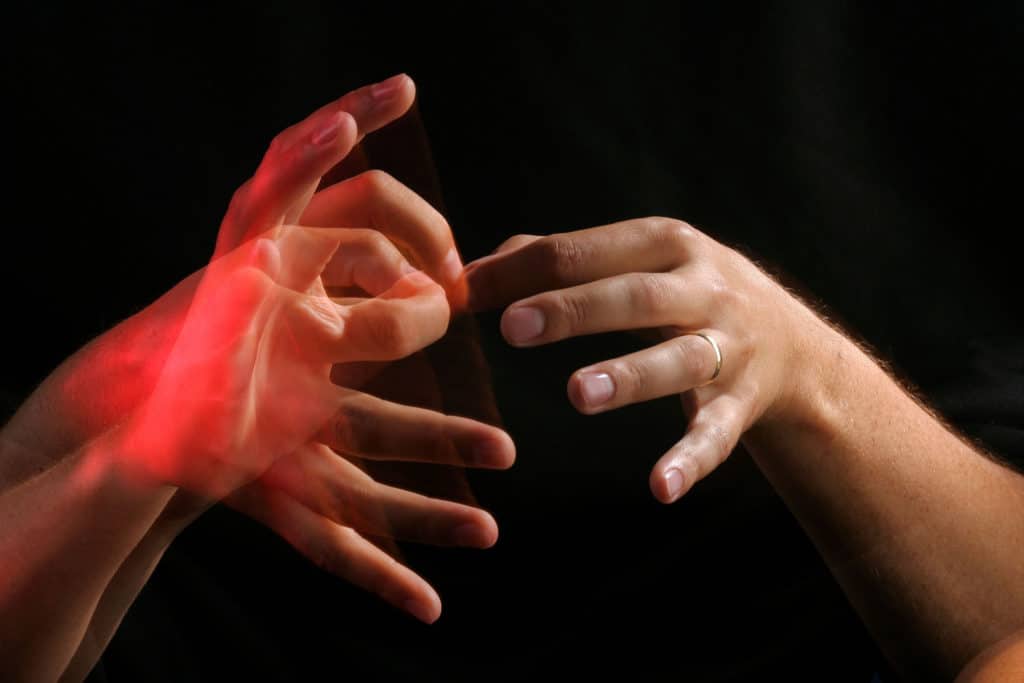
On the first evening of the retreat, at Shabbat services, I was given the honor of reciting the Shema in American Sign Language (ASL). At the bimah I introduced myself and before signing the prayer said, “I’m late deafened. I started learning ASL in my late 40s, so please sign slowly.”

Everyone at the event was kind, helpful and patient—some of the sweetest people I have ever met. And not just to me. Ruth, a 97-year-old deaf Holocaust survivor, was catered to by almost everyone because they were concerned about her comfort. Leana, a 45-year-old deaf woman confined to a wheelchair, had ideas to share. Unfortunately, a decade ago she was in an auto accident, turning a vibrant young woman into a paraplegic. She had difficulty moving her hands, but everyone in our group guessed at her signs until understanding miraculously coalesced in the minds of the best signers. Even though Leana’s contribution took a long time to achieve, everyone considered her ideas to be as important as the woman who signed at light speed.

At one discussion group, a question was asked: What does the JDC do for outreach? After my hearing loss I didn’t know who to turn to. I suggested they need to do more to help the late deafened, hearing loss occurring after childhood. Our group leader listened and accepted my suggestion.

One theme of the conference was Jewish values, the center of which is kindness. As one speaker suggested, “We need to use our strength to make other people stronger.” To do this requires staying focused with compassionate accountability. For me, as president of my shul, it means staying after services and engaging with congregants to uncover their ideas.  

“We need to use our strength to make other people stronger.”

Hillel Goldberg, ASL and Shabbat Services Coordinator, explained, “The JDC provides a model for the Deaf Jewish community, providing signs for Hebrew prayer.” It also serves Jewish deaf, deafblind, deaf disabled, hard of hearing, and late deafened and their families no matter their religious affiliation. They are an essential part of Klal Yisrael—the worldwide community of Jewry. Their core guiding values include inclusivity and embracing Jewish tradition and history while using ASL or Israeli Sign Language as the means for communication. They focus on bringing Jewish spirituality to light as they move forward to grow and preserve Jewish heritage.

The JDC is run and operated by deaf Jews who are far from stupid. Its membership includes businesspeople, a movie producer, inspirational presenters, writers, teachers and health care professionals. It also includes me. King Jordon, the first deaf president of Gallaudet University, a university for the deaf in Washington, D.C., once said, “Deaf people can do anything but hear.” The authors of the Talmud were wrong about the deaf. We are very capable of learning Jewish culture and should be included in synagogue life.

Technology has advanced exponentially since the early days of rabbinic Judaism. Back then rabbis decided deaf Jews could not be involved in Jewish life. Though the Talmud may provide insight into Jewish law, it failed miserably in its understanding of deaf Jews. All Jews, even the ones who can’t hear, have the right to learn Jewish culture, follow the commandments and feel the embrace of their community. Thanks to organizations like the Jewish Deaf Congress, this dream is becoming a reality.

Jewish Deaf Support and the Right to Community Read More »

Table for Five: Vaera

One verse, five voices. Edited by Salvador Litvak, the Accidental Talmudist

The hail was very heavy — fire flashing in the midst of the hail — such as had not fallen in the land of Egypt since it had become a nation. – Exodus 9:24


Bracha Goetz
Author of 41 Jewish Children’s Books

The Zohar, which contains mystical Jewish wisdom from the Kabbalah, explains that each of the 10 plagues sent to the Egyptians came to teach important lessons. This seventh plague of heavy hail had fire flashing in the midst of it. This unusual hail was sent not only as retribution to the Egyptians. What message of hope did it contain for the Jewish slaves trapped there? 

You may feel cold and icy after years of pain, but know that there is still a flame always flashing deep within. How will you be able to chip away at the ice and let it eventually melt away to reach the warmth that remains pure and vibrant inside? 

Torah provides what is needed to melt the icy ego and feel the warmth of life pulsating with gratitude. Each mitzvah comes to chip away at egotistical coldness. Each mitzvah ignites us to care for others, recognize the source of abundant goodness, and rejoice in our blessings. 

The Torah’s guidelines kindle kindness in our world. As the Jewish people emerged from slavery, they would soon be ready to receive the holy wisdom that would spark the flame of the “pintele yid.” This flicker of fire is still patiently present — and as vibrantly ablaze as ever — within every one of us today too, no matter what we’ve each individually and collectively experienced. 

May we all stoke the flames of deep gratitude that let our souls shine!


Rabbi David Block
Head of School, Shalhevet High School

The spectacle of fire inside ice was terrifying and wondrous — but it was just that, a spectacle. Was it necessary? It’s clear from the p’sukim that the fire-hail did not cause any more physical damage than solid-ice-hail would have. So why the fire inside the ice? 

When I think of the Barad, I can’t help but imagine another time in which a fire was contained inside something, a fire that didn’t consume the object in which it burned, just as the fire of Barad didn’t consume its icy enclosure: the Burning Bush. But what might this hail have to do with the Burning Bush? 

God’s Presence “always appears as fire” (R. S. R. Hirsch, Shemos 3:2). And, according to R. Hirsch, the fire inside the bush was to symbolize the transcendent message of the Midrash: “There is no place in this world devoid of God’s presence — even a bush.” Perhaps, then, the fire inside the hail symbolized God’s presence, too. Even more, perhaps it symbolized the attribute of God upon which this whole narrative is built (Shemos 6:3): the Creator God, the God of love. Yes, God’s power must sometimes be felt. Sometimes things must be torn down. But, even in those moments, even amidst the suffering, God is there with us. When God’s fire could have raged unbounded against Egypt, when the narrative could have ended right there with Egypt’s destruction — even then, God’s fire didn’t consume. The fire remained tame — as a spectacle — inside the ice. God is there, always, waiting for us to notice, ready for us to return. It’s precisely what Egypt needed to learn.


Rabbi Josh Warshawsky
Musician and Composer

Human beings are creatures of habit. Fyodor Dostoevsky wrote in “The House of the Dead,” “Man is a creature that can get accustomed to anything, and I think that is the best definition of him.” Some allow themselves to settle into such a monotonous routine that they walk through life like zombies. And yet, this characteristic means that even in the harshest conditions humans find ways to persevere and to survive. 

At the same time, illumination flashes in the most surprising places. We never know when or where it might strike. This fiery hail is an oxymoron and an impossibility in and of itself — fire within rain. It was something so unheard of, so strange, that it served as a lightbulb of sorts for the Egyptians. They had forgotten who they were as a nation: founded as a land of beauty and hope and bounty along the Nile, welcome to strangers and suffering peoples in need during times of trouble and famine. 

After seven (a number of completion!) plagues, a flash of illumination within the hail wakes them up and shakes them to their foundation. Before the next plague, the courtiers speak up for the first time, finally asking Pharaoh to come to his senses and let the people go before Egypt is completely lost. This act is a flash of hope of a better tomorrow for the Israelites. This Shabbat, what will serve as a flashpoint for you? What needs changing in your routine or our collective psyche?


Rabbi Chanan Gordon
Prominent Inspirational Speaker

The meforshim in the Torah are at pains to point out that the 10 plagues were not only for the sake of Pharaoh, but were intended as life lesson for the Jewish people for eternity, i.e.  to appreciate who G-d is, and His omnipotent power. 

Each plague revealed some facet of Hashem’s Mastery. The plague of hail, which included, “fire flaming amid the hail” (Exodus: 9:24) showed that whereas the pagan pantheon had a different god for each natural force, the one G-d of the Jewish People controlled all, even competing forces. 

As the hail destroyed the trees of Egypt, Pharaoh begged Moses to pray that there be no more hail, and promised to let the Israelites go (Exodus 9:27-28). The midrash says that when Moses prayed for the hail to cease, the hailstones that were on the way down were suspended in midair. The fact that fire could coexist with water in the hailstones, as well as the fact that the hailstones stopped falling in midair should be a reminder to all of us that nature, like everything else, is controlled by Hashem. 

The Talmud teaches us that “each person must see himself as if he personally came out of Egypt.” Our lives are filled with messages from Hashem, designed to teach us His ways and draw us near. He has a plan, and we have the choice: To fit in, or to be cut out. The choice is clear if we only open our eyes.


David Brandes
Writer/Producer www.thequarrelmovie.com

You might think that by the time the seventh plague finished terrorizing the Egyptian people with a violent celestial assault, Pharaoh would come to his senses and realize that the God of Moses was a superior force. Time to let the Hebrews go and save whatever face Pharaoh had left. 

Yet the next morning, Pharaoh hardened his heart and reneged on his promise to Moses to let the Hebrews go. This raises the question: how could any human not capitulate to the God of such overwhelming might? 

The answer is that Pharaoh was no ordinary human. In ancient Egypt Pharaohs were considered gods chosen to lead the people and maintain order. It was a kind of supreme narcissism supported by the law of the land. The people believed Pharaoh was god and Pharaoh reciprocally believed himself to be god. Psychologists refer to this condition as collusion delusion. 

If Pharaoh had admitted defeat it would have been a far greater tragedy than just losing face. It would have undermined Pharaoh’s legitimacy and his deity. To sustain his sense of self, Pharaoh must have believed that he was locked in a personal struggle with another God like himself. It was a battle of the deities. So, when the sun rose the next morning, the battle was rejoined by Pharaoh without hesitation. His royal narcissism led him to ultimate defeat, shame and death. 

Is there a message in all of this for comrade Putin?

This interpretation focuses on the beginning of the verse: a new generation will arise. It must. That is the way of the world. Our challenge is both for the older generation to recognize that a time comes to make way for the younger generation, and for the younger generation, as they take on the mantle of leadership, to step up and learn from those who came before them. Even as they innovate, will they remember the crucial lessons and precedents of the past?


Table for Five: Vaera Read More »

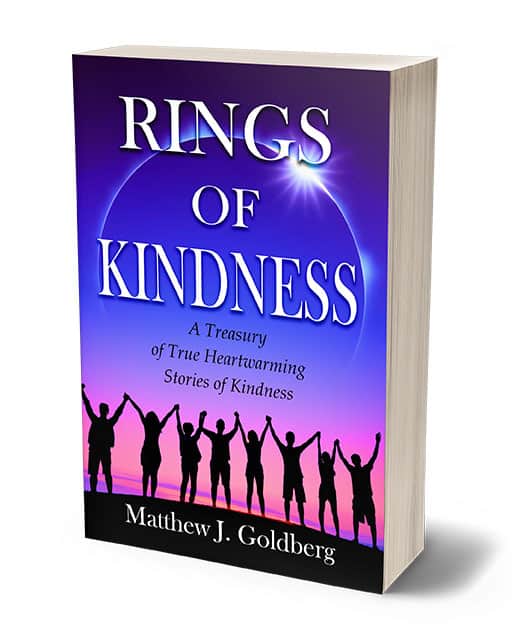
Kindness Received Highlighted in “Rings of Kindness”

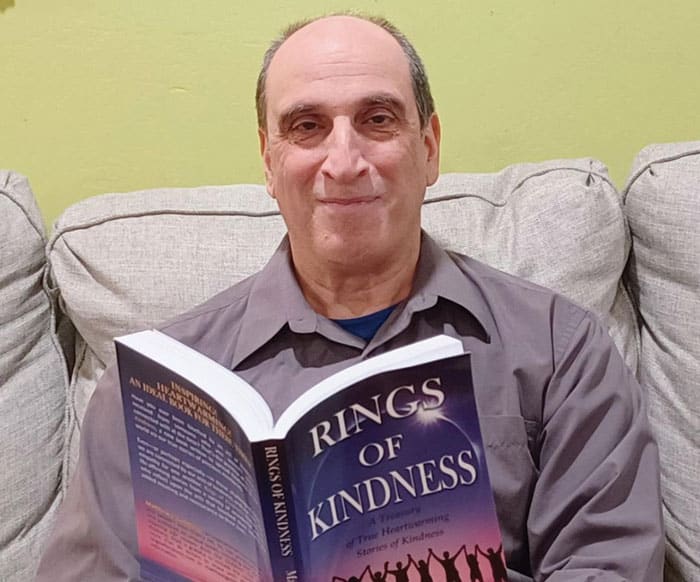
“We’re surrounded by kind people,” author Matthew J. Goldberg told the Journal. “We don’t necessarily meet [them].”

During the first fall of the pandemic, Goldberg lost his wedding ring. In November 2020 he was taking a walk with his wife, son and dog, when he saw a sign, “Ring Found.” 

“It was found by the nicest people in the world who happened to be walking their dogs,” Goldberg told the Journal. “They were as happy for me to be reunited with my ring as I was. It was fortuitous good luck, but it was also their kindness.” 

Goldberg, who lives in Cherry Hill, New Jersey, wrote up the story and posted it on his township’s Facebook page. It got a huge reaction, including someone who suggested it would be good for a book. Goldberg had already published an eclectic mix of books, focusing on everything from the joy and humor of parenthood to the agony and ecstasy of being a Philadelphia sports fan. He considered what a project like that would look like.

About two years later, it finally came to fruition.

“Rings of Kindness” is a compilation of true stories of acts of kindness received, as written by Goldberg and more than 80 contributing writers. These acts of kindness — some small and others quite heroic — made a difference in the lives of each of the writers who shared them. 

Contributors range in age from high school students to senior citizens, and about 20 of the writers are based in Los Angeles. Their stories took place in schools, subway stations and stadiums, during concerts and the horrors of The Holocaust. 

“I really think that we can spread kindness through our stories of kindness,” Goldberg said. “I decided the parameters should be acts of kindness from someone we weren’t closely connected with at the time: not a family member, not a significant other, not a close friend. If friendships or romances developed, so be it.” 

While “Rings of Kindness” is non-denominational and written for a wide-ranging readership, Goldberg, who is also a long time Jewish educator, believes this book will especially resonate with Jewish audiences.

“Not only are many of the contributing writers Jewish, but a common element of these stories is empathy — and perhaps, less about tzedakah and more about chesed — extending acts of loving kindness, inspired by empathy.” – Matthew J. Goldberg

“Not only are many of the contributing writers Jewish, but a common element of these stories is empathy — and perhaps, less about tzedakah and more about chesed — extending acts of loving kindness, inspired by empathy,” Goldberg said. “I’m giving a talk in an adult education class at the JCC, and it’ll be great to hear how they react to the stories.”

While Goldberg managed to gather a few stories in the early stages of this project, it wasn’t until he connected with producer/writer/actor Wendy Hammers that it started to move forward.

Wendy Hammers (Photo by Bader Howar)

“It was a creative shitach,” Hammers told the Journal.

Hammers is also from New Jersey, and her parents, who lived there until they passed recently, met Goldberg at a book fair in Collingswood. 

“They struck up a conversation, as Jewish parents do,” she said. “They said, ‘Oh, you should know my daughter. She’s fabulous. She lives in Los Angeles.” Hammer said although her parents were big film buffs, they didn’t really know how business in Los Angeles actually worked.  “My dad would literally say something like, ‘Steven Spielberg seems very nice. He’s Jewish. You’re Jewish. You should call him. I’m sure he’d be happy to hear from you.’” 

While it doesn’t usually work that way, this time it did.

Goldberg called Hammers, and asked if she’d like to be part of the book. Hammer, who also teaches writing, replied, “yes,” and asked if she could share the opportunity with her students. 

“I believe the most Jewish part of me is that I have a real, strong need to connect people and create community, which I do through my storytelling series, ‘Tasty Words,’” she said, “And which I do with my classes and, hopefully, in my life.”

Hammers started “Tasty Words” 21 years ago as a way to tell her stories and create a place where she and her friends could go on stage and share what’s going on around them. “Tasty Words” — which has had hundreds of shows and thousands of performers — is also a podcast.  

On January 29, the 20 L.A.-based storytellers will be sharing their stories at Hammers’ “Tasty Words” salon show, which starts at 3:30 pm, and takes place in a private room at La Puglia in Santa Monica. Goldberg, who has never been to LA, will be joining the event. 

“Connecting with Wendy was, and still is, a great blessing,” Goldberg said. “It was wonderful that she took to the project and got so many people involved with it.”

One of Hammers’ students, L.A. filmmaker and education advocate Harri James-O’Kelley, said, “It means the world to me to share my story in a book that is filled with kindness, and mitzvot.” James-O’Kelley’s story is about the random act of kindness that is an organ donation that saved her daughter’s life.

“I wrote my story during the holiest of times between Rosh Hashanah and Yom Kippur,” she said. It was so perfect to be writing about gratitude and kindness, and the gift of life.”

Goldberg said that kindness starts with empathy for others, increasing joy, lessening pain and sharing experiences.  “There’s certainly the sense of tikkun olam – of repairing the world – together,” he said. “It just ties in.” Hammers added, “Part of the way we repair the world is with storytelling. We share our stories so that people know they’re not alone. It makes the world a sweeter, smaller place.”

To learn more about the January 29 event and “Rings of Kindness,” go to TastyWords.com or MatthewJGoldberg.com.

Kindness Received Highlighted in “Rings of Kindness” Read More »