The family of Marvin Jubas is saddened to announce his passing at the age of 93. He was surrounded by family in the penthouse home he loved in Santa Monica overlooking the Pacific Ocean.
Funeral Services will be held at 2:00 pm Thursday January 19, 2023, at Mount Sinai Memorial Park located at 5950 Forest Lawn Drive, Los Angeles, CA 90069.
Born in the Boyle Heights community of Los Angeles, Marvin graduated from Fairfax High School, UC Berkely and UCLA Law School. Marvin was the Founder and Managing Partner of Spensley, Horn and Jubas where he specialized in intellectual property law. He was later counsel at Freeman, Freeman & Smiley. For many years Marvin was also the managing partner of a mobile home park business and a successful investor in many ventures.
Marvin was a pillar in Jewish and community life in Los Angeles having been motivated by his philanthropic parents Rose and Si. A partial list of his leadership involvement included past president of the Guardians, chair of the Legal Division of Israel Bonds, past board member of the Jewish Federation of Greater Los Angeles (recipient of the Maimonides Torch of Justice Award), past president of Brentwood Country Club, a Trustee of the UCLA Foundation, Friends of Hebrew University, Israel Tennis Centers, and the Los Angeles Jewish Community Foundation.
Marvin’s concern for advancement in health is demonstrated by his active participation at the Charles R. Drew University of Medicine and Science, Cedars Sinai Medical Center, and his twenty years as a member of the Board of D.A.R.E.
In the arts, Marvin was a distinguished donor of the L.A. Music Center and President’s Circle of the L.A. County Art Museum. As a classical music lover, he was a director emeritus of the Maestro Foundation, major donor if the Harmony Project, and, as a jazz devotee, he was a past board member of the Friends of Jazz at UCLA.
The Jubas Family Foundation will continue to support the charities closest to Marvin’s heart.
Marvin was a legendary storyteller and often recounted events surrounding his experience as former boxer, college debater, his fishing expeditions and world travels including visits to over 100 countries including his beloved Israel over 15 times. He was a self-described “gym rat” and avid tennis player.
Marvin was married to Fern Gloria Jubas for 55 years before her passing in 2007. Fern was a loving mother and grandmother who supported Marvin in all his professional and philanthropic endeavors. Marvin and Fern were also a legendary dance couple having won innumerable contests.
In 2008 Mavin met and married Jacqueline Davis Jubas who was also recently widowed. Together they pursued their joint love of art, travel, music, and philanthropy until Jackie’s untimely passing in 2013.
A third angel entered Marvin’s life when he married Janet Wald Jubas in 2014. Janet is an amazingly loving and caring person who was dedicated to Marvin for the last eight years of his life.
Marvin’s boundless intelligence, physical prowess and numerous passions were only surpassed by his ability to connect with everyone around him. He was a loving son, husband, father, brother, grandfather, uncle, mentor, business partner, friend, and philanthropist.
Marvin is survived by his beloved wife Janet Wald Jubas and her children Evin Wald (Robert Blicharski)
and Arthur Wald (Adam Sanford), children Howard Jubas (Susan Timmel) and Andrea Heisser (Kurt), brother Gary Jubas (Jo), grandchildren Carrie Jubas, Erin Jubas, Zachary Heisser, Tessa Pedersen, Jessica Timmel, Tion Timmel and Wesley Timmel.
May Marvin’s Memory be for a Blessing
In lieu of flowers, the family asks Contributions in Marvin’s memory be made to the Harmony Project
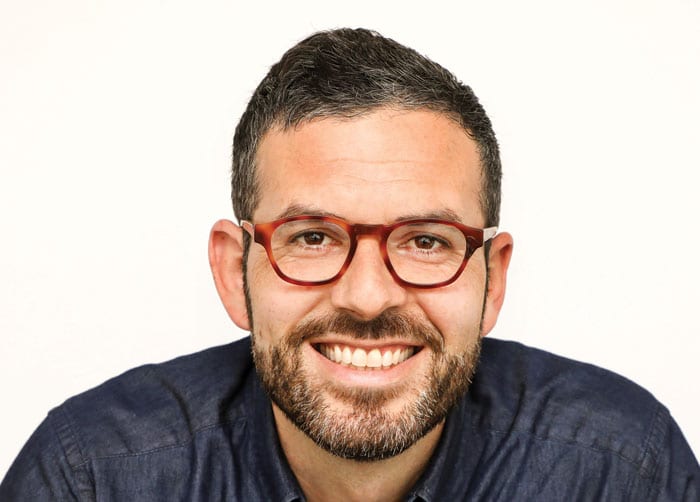
Rabbi David Kasher, associate rabbi at IKAR, is a self-described “Torah nerd.” For five years, he kept up a weekly parsha blog and became totally immersed in Torah commentary. He had books open all over the house and was writing late into the night.
“It was a glorious experience,” Kasher said. “But it was also exhausting.”
During this time, the rabbi started working at IKAR and couldn’t keep up with the same pace of writing. Still, he had an audience, and he wanted to continue to provide them with Torah teachings. He began to wonder if he could turn his project into a book.
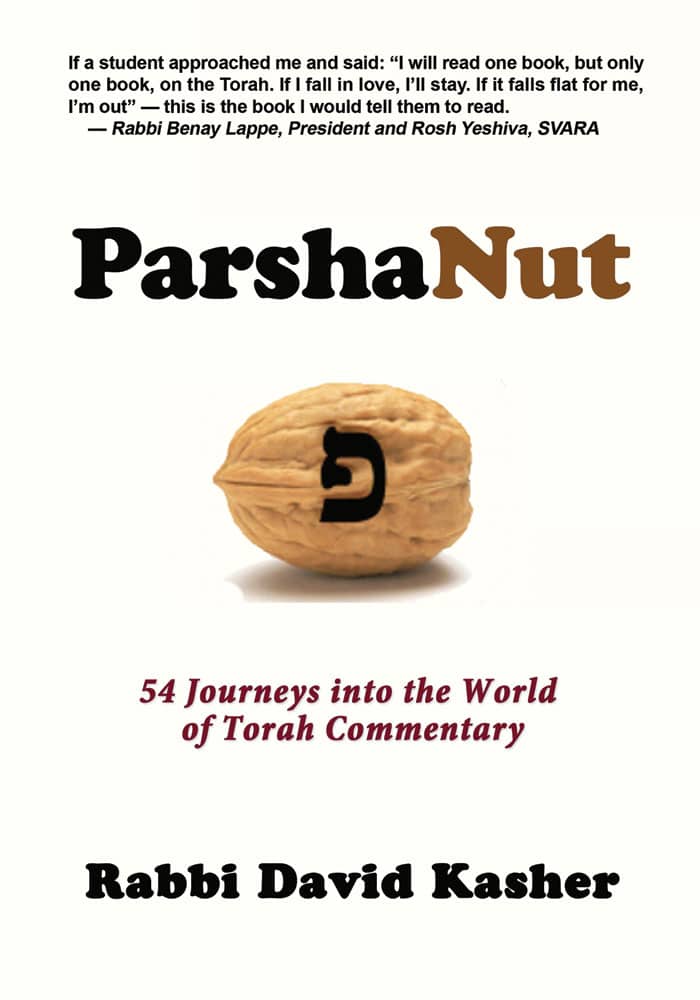
Now, he’s accomplished that dream, and has released his first book, “ParshaNut: 54 Journeys into the World of Torah Commentary.” Based on his blog, the book contains 54 essays exploring the vast genre of Jewish literature called parshanut, or Torah commentary.
Kasher decided to write his book because while many Jews read the parsha every week in synagogue, he believes that fewer people are familiar with the long tradition of writing commentary on the Torah.
“It’s this tradition that I fell especially in love with during my yeshiva days, and so I wanted to shine a light on it for those who might not have had the opportunity to encounter it before,” he said. “In that sense, I really saw myself as following in the footsteps of Nechama Leibowitz, one of the great Torah teachers of the 20th century, who brought about a revival in the study of parshanut.”
Kasher, who received ordination from Yeshivat Chovevei Torah, grew up with a mother who was secular and a father who was very religious.
“When I was with my father, I saw Judaism in practice around me, but I never really understood where it all came from,” he said. “It wasn’t until my father passed away, in my early twenties, that I decided I had to figure out what exactly Judaism was and what it meant to me.”
The rabbi went to a yeshiva in Israel to seek out answers. The culture of Torah study there was what captured his heart.
“It was learning the commentary of Rashi that first set me on fire for the Torah.”
“It was learning the commentary of Rashi that first set me on fire for the Torah,” he said. “I remember reading an interpretation of his that created a whole new narrative from an extra letter in a word, and thinking, ‘Wait, you can do all this with just one letter?’ It was a lesson I never forgot: that part of the rabbinic project was to find meaning in everything.”
Along with publishing his book, Kasher teaches a weekly Parsha class on Thursdays at noon via Zoom. He studies the Torah with study partners, who tune in.
“Nothing beats studying together in chevruta with others,” he said. “That’s when the material really comes alive.”
Kasher is continuing his parsha class – and a weekly Mishnah class on Mondays – with IKAR, even though he’s resigning from his associate rabbi position in June to work full-time at the Hadar Institute, a Jewish community building and learning organization funded by UJA-Federation.
“I’ve been really privileged to be able to do that at IKAR, a community full of brilliant and passionate learners who are thirsty for Torah,” Kasher said. “I’m especially excited to be based here in Los Angeles, where the Jewish community is already so strong and vibrant in so many ways, and is ripe for more Jewish learning opportunities. My dream is to help make this city one of the great centers of Torah study in the world.”
When people pick up “ParshaNut,” Kasher hopes he can provide them with an opportunity to learn Torah – and inspire them to do it regularly.
“I wanted to showcase the masters of Torah interpretation throughout history, and to show what a magnificent tradition we have inherited,” he said. “Some of the most brilliant minds throughout Jewish history devoted themselves to understanding this beautiful and complicated book, and to be able to witness their dazzling achievements is a thrilling experience — and one that I hope will help people fall in love with Torah study.”
We are living in an era in which clear, rigorous thinking is in decline. The evidence is all around us. The Internet and the explosion of social media have expanded access to information exponentially but have also made it harder to discern what is reliable from what is not. Scams, which have always existed, now reach more people more quickly, making it even harder to know whom we can trust. Political polarization has led to more ideologically-driven discourse — and at a much higher decibel level — at the expense of careful, reasoned and balanced debate. Finally, our natural tendency to believe information that confirms what we already believe and to ignore information that challenges us, what psychologists call “confirmation bias,” has become more engrained as people on both sides of the political spectrum retreat into their respective bubbles.
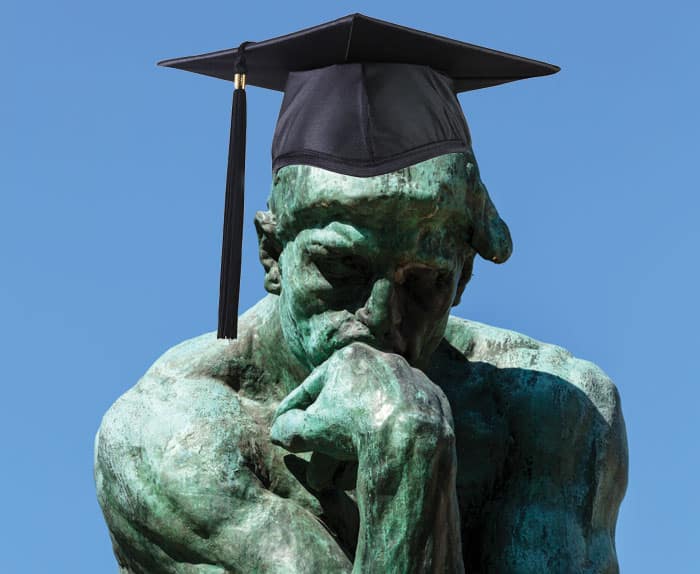
There are no simple solutions to this problem. But surely one important component of any response is to strengthen the teaching of critical thinking skills within our institutions of higher education. It is there that scholars devote their lives to creating, refining and disseminating knowledge, and training young minds to do the same. Indeed, the mission statements of virtually every college and university in the country include language about fostering “critical thinking” and “lifelong learning.” If we as a society need help learning how to think more rigorously, colleges will need to play a central role.
Based on my work as a faculty member and academic advisor over the past 40 years, I have identified four essential critical thinking skills that colleges attempt to foster in students.
1. Exploring context. Everything we read and all the information we encounter comes from someplace. We can’t understand or evaluate that information without attending to the context — historical, intellectual and/or cultural — that produced it. Sometimes this is as simple as asking what questions this author was trying to answer; other times it requires seeking out other information that we need in order to properly contextualize the ideas or data with which we’re presented.
2. Comparing alternatives. Any view presented to us is only one among many possible views. We need to compare them to determine whether this view (or theory, or interpretation) is preferable to the alternatives. Only by looking at things comparatively can we assess whether a particular position is distinctive or significant.
3. Weighing evidence. A position (or solution, or argument) is persuasive only to the extent that it is backed by evidence. What counts as evidence, how much is needed to “prove” a point, and how to interpret it are all legitimate matters for academic debate. But carefully weighing the strength and applicability of evidence is perhaps the hallmark of critical thinking.
4. Considering implications and new applications. We always need to ask where any conclusion leads in order to determine its ultimate significance. If we know this, then what else would we expect to be true, and why does this matter? Following an idea to its logical conclusion, seeing its practical implications, and exploring the ways in which it might apply in other settings enable us to assess its value.
Developing these skills or habits of mind is at the very heart of a college education. And while they manifest themselves differently in different disciplines, they are employed in the study of every subject taught in the academy. Consider a few examples:
Louis Newman
History students investigating the differences in health outcomes between wealthy and poor communities must consider the context of their respective access to healthy food, medical information and support services.
Public policy students evaluating the effectiveness of a proposed change in speed limits on automobile accidents must consider alternative safety measures.
Medical students deciding whether a new cancer drug is effective need to weigh the evidence available from clinical trials.
Business students debating whether JetBlue should be allowed to acquire Spirit Airlines must examine the deal’s implications for competition in the air travel industry.
Virtually every college assignment provides opportunities for students to hone their skills at thinking about context, alternatives, evidence and implications — frequently two or more of these things at once.
Virtually every college assignment provides opportunities for students to hone their skills at thinking about context, alternatives, evidence and implications — frequently two or more of these things at once. And these are precisely the skills they need to critically assess information they will encounter for the rest of their lives. Armed with these skills they will more naturally ask: Where does this information come from? What alternative explanations might there be for this event? What sort of evidence is being provided to support this view, and how strong is it? And what are the implications of believing this to be true? There can be little doubt that consistently asking such questions will lead students to think more clearly, analyze information more carefully, engage with the views of others more deeply, and examine their own assumptions more honestly. Not surprisingly, research confirms that people with higher levels of education are less likely to believe in conspiracy theories. (That said, using our critical thinking skills, we know that that only demonstrates correlation, not causation.)
Of course, these skills will be familiar to anyone exposed to a traditional Jewish education. Starting from an early age, Jewish children learning to study the Torah with Rashi’s commentary are trained to ask, “Ma kasheh l’Rashi?” What is Rashi’s question, and what problem in the biblical text prompted his interpretation? The careful, critical reading of texts, which is the hallmark of a classical Jewish education, requires the very same skills that college education fosters.
Talmudic study, which traditionally constituted the core of rabbinic education (and, in varying degrees, does to this day), gives students endless opportunities to practice the four critical thinking skills identified above. The rabbis in the Talmud are forever asking:
What is the context of this sage’s view? What circumstances surrounded his ruling in this case?
How does one rabbi’s view differ from another’s? Why did subsequent generations of rabbis favor one over the other?
What evidence can we adduce to support this rabbi’s interpretation of the law?
What are the implications of a particular rabbi’s position on this matter for his views on other questions?
Because these and similar questions fill every page of the Talmud, those trained in Talmudic dialectics were naturally inclined to develop a probing, critical mindset. It has often been suggested, only half-jokingly, that a disproportionate number of Jews are drawn to study law because it so closely resembles talmudic reasoning. Again, if we think critically about the matter, I don’t know that there is hard, persuasive evidence for this. But it is not at all far-fetched to suggest that these habits of mind, reinforced over many centuries, embedded themselves deeply in Jewish culture and shaped the intellectual life even of Jews who never opened the Talmud.
In American society, college education can play a role comparable to that played by textual study in traditional Jewish communities. But for that to happen, colleges will need to emphasize critical thinking more explicitly and consistently than they currently do. For despite their stated commitment to producing graduates who are critical thinkers, colleges rarely identify these skills for their students and directly instruct them in how to practice them. It is simply assumed that, insofar as these skills are embedded in nearly all college work, students will internalize them as they move through the curriculum and complete their graduation requirements. Unfortunately, it isn’t that simple.
While assessing any student’s mastery of critical thinking skills is a complex undertaking, there is strong evidence that many college students are not getting it.
While assessing any student’s mastery of critical thinking skills is a complex undertaking, there is strong evidence that many college students are not getting it. More than a decade ago, Richard Arum and Josipa Roksa published a study, based on scores from the Collegiate Learning Assessment (CLA), showing that most college students made only modest gains in critical thinking during their first two years in college. Their findings, published in “Academically Adrift: Limited Learning on College Campuses” (University of Chicago Press, 2011), became the subject of extended debate among faculty and administrators. More recent studies have also raised concerns. Sam Wineburg, a professor of education at Stanford University, has co-authored a series of studies demonstrating that college students (including very high-achieving Stanford students) perform poorly when asked to evaluate the reliability of information they found on the Internet.
These conclusions are confirmed by my conversations with many students and faculty colleagues at a wide range of schools across the country. Faculty, for their part, believe their job is to teach the material in their area of expertise; introducing students to general principles of critical thinking is beyond the scope of their responsibility. Students may or may not internalize these principles in the course of their education, but even those who do often struggle in the process, frustrated that they don’t understand what their professors expect of them. All of them stand to benefit when these skills are singled out and introduced at the outset of their college careers, and then reinforced repeatedly in subsequent courses.
This shift would not be difficult to implement. Faculty, who certainly want their students to excel, can make explicit for students the critical thinking skills required to tackle their assignments. They can craft their feedback on students’ work to highlight which of these skills they demonstrated and which ones need to be developed further. When they respond to students’ comments in class they can identify the critical thinking moves that students employ at key junctures in class discussion. In short, every student should be encouraged to focus explicitly on what these key critical thinking skills are, how they’re being developed in each course they take, and how they will be valuable to them both in college and after they graduate. Students should expect nothing less, and colleges should be held accountable for making good on the learning outcomes enshrined in their mission statements.
The ability to think critically is foundational to our way of life. The freedoms that we treasure and have fought so hard to secure must be exercised responsibly.
It is no exaggeration to say that the future of our civic life and our democratic system depends on this. We need voters who can analyze the context of ballot propositions; doctors who can compare alternative diagnoses and treatments; jurors who can fairly evaluate the evidence in a case; and entrepreneurs who can consider the implications of how consumers use their products. The ability to think critically is foundational to our way of life. The freedoms that we treasure and have fought so hard to secure must be exercised responsibly. And that requires that we hold ourselves and one another to commonly accepted standards of rational discourse, honest and open inquiry, and critical, respectful judgment.
As I have argued, colleges, given their distinctive mission, have a unique and essential role to play in fostering those commitments by inculcating habits of critical thinking in our students. Their mission, in the words of Brandeis University’s motto, is “Truth, even unto its innermost parts.” It is a motto that we would all do well to adopt, individually and collectively. The stakes — for students, for higher education and ultimately for our country — could not be higher.
Louis E. Newman is the former Dean of Academic Advising and Vice Provost for Undergraduate Education at Stanford University, as well as the John M. and Elizabeth W. Musser Professor of Religious Studies, Emeritus, at Carleton College. He is also the author of the forthcoming book, “Thinking Critically in College: The Essential Handbook for Student Success” (Radius Book Group).
Selections from“Thinking Critically in College: The Essential Handbook for Student Success”
(forthcoming, Radius Book Group)
What Are Disciplines, and Why Do They Matter?
Imagine that you walk into a large room full of people engaged in lively intellectual conversation. As you make your way around the room, you eavesdrop on the various exchanges that are happening simultaneously, sometimes among small groups, sometimes just between two individuals. You begin to notice that all the conversations seem to focus on a fairly small number of topics and that pieces of the discussion happening in different parts of the room seem to relate to one another. It’s as if all of these mini-conversations intersect, so that as you move between them, you hear echoes of what others have said in other small circles. Sometimes these conversations are very congenial; other times people are engaged in heated arguments with one another.
As you spend more time there, you discover that people sometimes refer to conversation partners who left the room, perhaps many years ago, but whose comments and questions continue to be discussed by those who remain. Sometimes new people enter the room and join in, repeating points that others have made before, adding or taking issue with what their predecessors have said, explaining why this or that piece of conversation matters to them (or doesn’t). You stay in the room for many weeks, trying to make sense of who has talked with whom, who agrees with whom, and which topics are debated. Gradually, you come to feel that you have a pretty good grasp of what this intellectual conversation is all about, though there may still be fine points that elude you.
When you’ve heard enough of this conversation, you may leave and walk down the hall to another large room, where another extended, interconnected set of conversations are happening — except this time, the topics are all different. The people in this room have a different vocabulary, focus on different ideas, and argue about different issues. But in every other respect, this conversation mirrors the one taking place just down the hall. Each of these larger “conversation halls” is a collection of people with similar interests but with diverse ways of thinking and talking about those topics.
In college, learning isn’t only about being introduced to established knowledge — the things about which scholars largely agree. It is also about entering the messy conversations about what is true and how we know it.
Each of these conversation halls is a discipline, and in college, you’ll be walking between rooms like this all the time. Think of a discipline as a field of study defined by the subject matter under investigation but also by the questions being asked and the ways in which those questions are explored. In college, learning isn’t only about being introduced to established knowledge — the things about which scholars largely agree. It is also about entering the messy conversations about what is true and how we know it. In those conversations, scholars exchange ideas about what new evidence is significant and why, what theories best explain the phenomena they study and when they need to be revised, and even what words to use to describe their subject matter. Thinking of your college education in this way will enable you to do a number of things:
You will appreciate that every course is an opportunity to think about how a certain field of knowledge is constructed.
You will be focused not only on the content of the course but on the different questions that generated this material, as well as on the different theories represented by different readings on the syllabus.
You will ask yourself where your professors stand within the debates that have defined this discipline, which side they have taken, and why (you might even ask them directly!).
You will begin to see how disciplines differ from one another, not only in the subjects they focus on but also in the methods they use to study those subjects.
In short, you will be able to orient yourself more quickly to the new disciplines you will be exposed to in college.
Writing Is a Process of Refining Your Thinking
In writing this book, I faced several obstacles. I tried to synthesize the most important insights from teaching and advising students for 40 years. I attempted to summarize succinctly the work of scholars in a number of fields, such as critical thinking, writing, and quantitative reasoning, in which I myself am not an expert. I needed to open to the (sometimes contradictory) advice of colleagues and students and then to decide what I thought the book needed to address in detail, what topics I could mention in passing, and what issues were simply outside the scope of what I could incorporate. I also needed to select examples and provide exercises that would illustrate the points I wanted to make. And I struggled to determine the best order of the chapters and the “Advice for the Road Ahead” pieces to ensure that the book flowed smoothly, without presuming that you would read this book from cover to cover.
While these challenges are unique in some respects to my experience and goals for this project, in other ways they are common to every writing project, whether you’re a first-year college student or a senior faculty member. Writing is always about deciding what we think about a topic, which of those thoughts are worth sharing, and how best to share them, given the audience we’re trying to reach. Rarely are the answers to these things immediately obvious. We work our way toward answers slowly, often laboriously, in fits and starts. We start off in one direction and then change course; we frequently change our minds about what we think just in the process of trying to write it down. We get feedback on a draft and discover that something we thought was clear actually isn’t, which sends us back to the drawing board. This is what makes writing difficult and sometimes frustrating. But it also underscores just how much writing and revising (repeatedly) are essential to our own thinking process. In my case, it means that the book you are reading today is vastly different from the one I began working on years ago.
Here’s the main point: writing well is not only a matter of creating a final product that captures our understanding of a topic accurately and effectively. Writing is also a process of making sense of things, of discerning what you know and deciding how to organize your thoughts. Writing is not just something you do after you have finished thinking about a subject; it is integral to your thinking itself.
All the knowledge in the world won’t do you much good if you can’t communicate it effectively. And while there are many modes of communication — images, charts and graphs, mathematical formulae, artistic media — the most common form of academic communication for most disciplines remains prose, or ordinary descriptive language (like this chapter). In addition to speaking, it is also the form of communication that you will use most often throughout your life to communicate your ideas, plans, and goals. This is why most colleges require a writing course, or some other way to assess and improve your writing skills.
The Final Frontier
College is at least as much about the habits of mind you acquire as it is about the subjects you study. If you talk to college graduates, you will likely discover that decades after graduation the information they learned is out of date and the particulars of what they studied (their major or concentration) are not what they remember and value most. Instead, they will tell you that what they learned was a way of thinking, communicating, and collaborating that has served them in ways they never anticipated when they were in college. In fact, corporate leaders regularly report that what they look for in potential employees is less the expertise they bring or the content knowledge they have than their ability to think clearly and to communicate effectively. That’s because employers know that these skills are transferable and broadly applicable to any work situation or project to which you might be assigned. And unlike concrete skills and bodies of knowledge that become outdated, these skills are endlessly relevant. Knowing how to think well is an asset that never loses its value.
Many students think of college in an instrumental way — it will get you where you want to go, to a secure job or to graduate school. It’s as if a college education were a plane ticket to the destination of your choice. And certainly there’s nothing wrong with using your college education to get you to a specific goal. But few students who think of their education this way have considered this: a plane ticket is a single-use item, and it is good for just one destination. When you arrive, the ticket has served its purpose and is now useless, obsolete. That’s why we throw away used plane tickets after we arrive.
But I encourage you instead to think of your college education as a passport, which can be used again and again. When it expires, it can be renewed. And it can take you to any destination. It even has within it the record of all the places you have visited, the stops on your journey where you have had meaningful experiences. That’s why many people hold onto their old passportslong after they have been replaced by newer ones. Your college education is your passport, which will take you to destinations you haven’t been to or even heard of, or maybe to places that don’t even exist yet.
Once you acquire the critical-thinking skills college gives you, you will find it nearly impossible not to use them. Wherever you go, you will take your mind with you.
But there is a sense in which your college education is even more powerful than your passport. After all, it’s possible to have a passport but never use it. You can opt to just stay home and avoid any of the challenges (and forgo any of the benefits) that come from international travel. But this is where the metaphor of education as travel reaches its limit. Once you acquire the critical-thinking skills college gives you, you will find it nearly impossible not to use them. Wherever you go, you will take your mind with you. And your mind will forever be shaped by the habits of thought and tools of analysis college teaches you.
It is common knowledge that our world is changing at an unprecedented pace. We simply cannot know what new challenges we will face in another generation or two. But notwithstanding this uncertainty, there is one thing we can be certain of: facing those challenges will require people who have the skills to think about complex problems in rigorous and creative ways. For precisely this reason, college is undoubtedly one of the best investments you can possibly make in your future. It is also an excellent investment in the future of our world, for we will never exhaust our need for people who are adept at thinking critically.
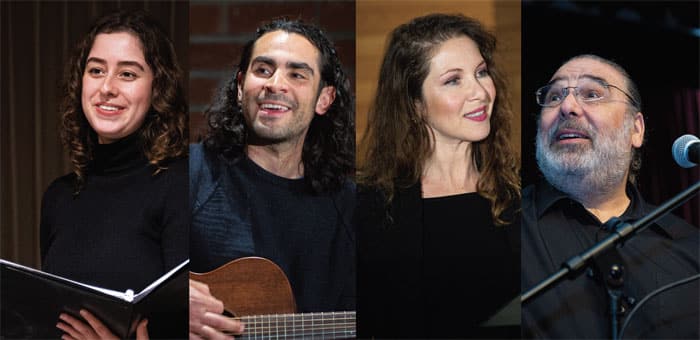
The Holocaust has had a massive impact on future generations. And no one knows that better than the children and grandchildren of its survivors. In “Remembrance of Things Present,” the latest Salon Theatre production from The Braid, the stories of descendants of Holocaust survivors are being brought to life.
This curated collection of stories of heroism, healing and hope is directed by Susan Morgenstern. The cast includes Lisa Cirincione, Michael Naishtut and Rick Zieff, plus writer Jordan Bielsky and two other descendants of Holocaust survivors, Lisa Ann Grant and Yahm Steinberg.
“These stories shed a different light on the Holocaust. It’s not only their stories, it’s ours as well,” Grant told the Journal. An Abby Freeman Artist-in-Residence with The Braid, Grant has done several productions with them over the years. Originally from New York City, she has appeared on and off Broadway and on television, among other work.
Grant said her parents were lucky in that their immediate family survived the war, but her grandparents lost siblings and parents.
“My parents raised my sister and I to have gratitude and appreciation for life and to not take anything for granted,” Grant said. “Each and every day truly is a gift. They were so lucky to have survived the war and I am so lucky to be here because of that … It’s a miracle. Their experiences shaped who I am and I am so grateful that in spite of all they have been through their attitude is positive and they managed to always go to the light.”
This is Jordan Bielsky’s third production with The Braid (he previously participated in “Star Spangled Sabra” and “I Want To Go Home.”)
His grandfather, Tuvia Bielski, was the leader of the largest armed resistance of Jews by Jews during the Holocaust. “He and his siblings led an armed resistance and community in the forest of Eastern Poland,” Bielsky told the Journal. “I grew up with the stories of their heroism woven into my DNA. It’s been a huge part of my identity when thinking about my place in the world and my community.”
Bielsky, a writer and actor who now lives in Los Feliz, has been in numerous television shows and films, including a small cameo in “Defiance,” the film about his grandparents and their heroism during The Holocaust.
When asked why it’s so important to share these stories, Bielsky said it’s because so many people did not have the chance to do so.
When asked why it’s so important to share these stories, Bielsky said it’s because so many people did not have the chance to do so.
“It’s our responsibility to bear witness to the atrocities committed against so many that led to the heroism of those who brought us here today,” he said. “With the rising tide of antisemitism in the U.S. and around the world, it’s important for people to know that Jews fight back. Every Jew on the planet today is the descendent of warriors who refused to succumb to the enormous weight of generations of brutality and discrimination.”
Deborah Moses’ mother survived by joining the French Resistance, leaving her family behind. Her grandparents, aunt and approximately 60 relatives were deported and died in the camps.
“I have found that even American Jews don’t often understand the Holocaust,” Moses, who is Executive Director of Temple Isaiah in Los Angeles, told the Journal. “They understand it as an event rather than a time period of systematic oppression leading to incarceration and deportation with the goal of total elimination of all Jews throughout the world. It is important to understand that to ensure it never happens again to us or to any group of people.”
Moses hopes people see these stories as a lesson regarding all of humankind, rather than a reason to segregate more and only care about themselves.
“Antisemitism, racism, misogyny, anti-Muslim/Islam and anti GBLTQ+ hate is stronger than ever and more dangerous than ever,” Moses said. “While there are signs of hope, those that hate are well organized and funded and we cannot let history continue to repeat itself.”
Playwright Marc Littman’s contribution, “Chasing Holocaust Ghosts Down Route 66,” was inspired by a true personal American migration story.
“In the summer of 1963, my father rolled the dice and uprooted my mother, two sisters, our dog and three puppies and crammed us in a dilapidated American Rambler car to trek down Route 66 from Detroit so he could be together with my Aunt Freda in Los Angeles, the sole other survivor of his family,” Littman said. “My story highlights the tug of love’s heartstrings and family.”
His late father, Jacob Littman, was a German Holocaust survivor from Berlin whose parents, brother and many relatives were murdered by the Nazis.
Littman said, “Like my father, I feel I have a leak in the heart because I never met my grandparents and uncle. I also harbor a deep sense of justice.”
The terrible wrongs committed by the Nazis and their collaborators has compelled him to write several plays — “God’s Train to Auschwitz” and “Not My Father’s Son” — sounding the alarm about the surge of antisemitism in the United States and the Holocaust.
“I see the dangerous parallels between what transpired under the Nazis and the rise of White Supremacy in America today. I know my father would be both outraged and terrified if he were alive,” he said. “Because history does repeat itself, Jews and others must be forever vigilant. I’m hoping The Braid’s remembrance show can goad audiences to be more proactive in protecting our right to be free and live in tolerance.”
“Through The Braid’s storytelling we are educating in a unique way about this incredibly dark period of our history and how children and grandchildren deal in their own way in the aftermath of the Holocaust,” Grant said. “As survivors pass away their stories are what’s left behind. And we, their children, have a responsibility to keep their flame alive.”
“Remembrance of Things Present” will be performed in Torrance Jan. 22, Santa Monica Jan. 24, at Temple Isaiah in West L.A. on Jan. 25 and Valley Beth Shalom in Encino Jan. 26. It can also b be seenlive on Zoom January 22 – February 6 and onstage in New York City on April 20. For tickets, visit the-braid.org/remembrance.


 “It’s this tradition that I fell especially in love with during my yeshiva days, and so I wanted to shine a light on it for those who might not have had the opportunity to encounter it before,” he said. “In that sense, I really saw myself as following in the footsteps of Nechama Leibowitz, one of the great Torah teachers of the 20th century, who brought about a revival in the study of parshanut.”