You must see that it’s wrong that following the Shoah
there can only be no
poetry,
because to save from Flood all living beings, Noah
used wood God caused to grow
into a Noah tree,
the one from which to make an Ark God grew wood
so that all forms of life
were not destroyed,
its wood the unforbidden fruit from which Old Noah understood
how with his wife
to fill the world, no void—
like the forbidden fruit our parents had consumed
from the knowledge tree—
leading to survival
of all the forms of life which would have otherwise been doomed
for their misanthopology,
without the Ark’s archival.
In his essay ”Cultural Criticism and Society” (1949), Theodore Adorno wrote that ”after Auschwitz, to write a poem is barbaric.”
In an obituary of Gerald Stein in the 11/1/22 NYT (“Gerald Stern, Poet of Wistfulness, Anger and Humor, Dies at 97)”, Neil Genzlinger writes that Stein said in a video discussing “The Dancing,” from his collection “Paradise Poems” (1984):
“We remember the famous words that after the Holocaust, after Shoah, there can be no poetry,” he said. “The alternative is, after Shoah there can be only poetry.”
Gershon Hepner is a poet who has written over 25,000 poems on subjects ranging from music to literature, politics to Torah. He grew up in England and moved to Los Angeles in 1976. Using his varied interests and experiences, he has authored dozens of papers in medical and academic journals, and authored “Legal Friction: Law, Narrative, and Identity Politics in Biblical Israel.” He can be reached at gershonhepner@gmail.com.
On the strength of her earlier novels, including “Harem,” “Courtesan,” “The Last Romanovs” and “Scent of Butterflies,” Dora Levy Mossanen has been hailed as “an Isabel Allende of Persia.” Born in Israel, raised in Iran, and a prominent figure in literary Los Angeles, she uses her superb skills as a storyteller to introduce us to believable and compelling men and women who happen to live in exotic times and places.
Her latest novel is “Love and War in the Jewish Quarter” (Post Hill Press), which leaves behind Tehran as we see it every night on CNN and carries us back to the place as it existed during the Second World War. Iran is not a combat zone, but it is still a place where travel permits for Palestine, then a British mandate, are the currency of life and death for refugees from Eastern Europe who have managed to reach Tehran. And, then as now, the Jewish population is always at risk.
Here we meet a Jewish dentist named Soleiman Yaran, who makes his way through the Alley of Seven Synagogues in order to make a house call on his most latest and most privileged patient—Fawzia, the Queen of Persia, a daughter of King Fuad of Egypt and wife of Shah Mohammad Reza Pahlavi. They speak to each other in French, the preferred language of the Persian royal court, but Soleiman is aware that his Jewishness renders him najes, ritually impure, under Islamic language.
“May I have Your Majesty’s permission to check your teeth without gloves?” he asks.
Thus does the author allow us to glimpse the risks and stresses of a life lived between two worlds, the Jewish Quarter and the imperial palace. Propaganda leaflets, both Soviet and Nazi, and German radio broadcasts that call Hitler “the Shiite Messiah” are inescapable. The official residence of the governor general, where Solomon makes another house call, includes two opium factories to process the harvest of his vast poppy fields and package it for export. Unlike the Queen, as Soleiman quickly discovers, the governor general is an uncompromising Jew-hater who seeks to convert him to Islam.
Indeed, the sheer abundance of observed detail, both rich and strange, enlivens and enriches “Love and War in the Jewish Quarter.” Soleiman, for example, knows that an opium-user is at risk of death if treated with Novocaine and experiments on himself to come up with a safe alternative consisting of opium, lady slippers, oak bark, tea tree oil, wild indigo, extract of dates and molasses, “and the sweet stevia rebaudiana plant to eliminate the bitter taste.” And he uses the pain reliever in place of Novocaine to treat the governor general for a toothache.
His wife Ruby, by contrast, places her faith in Soleiman’s aunt, Shamsi the Midwife, who treats her for infertility with a concoction “made of a breed of half-fish, which cost its weight in gold, had to be dried in the sun, then pounded with a single pearl and two grams of pulverized turquoise to bribe Sheitan the devil into unlocking Ruby’s womb.” She rubs salt on Ruby’s belly to stave off the Angel of Death. And she expresses her own opinion of the hateful governor general in “a string of silent curses—black plagues, puss-filled boils and runny bowels.”
The heartbeat of Mossanen’s new novel is a deeply affecting tale of love and loss that cannot be neatly summarized in a book review without robbing the reader of the shocks and surprises to be found in the book. Suffice it to say that the story moves from Ruby to her ill-starred daughter, Neda, and then to a young woman named Velvet, whose misfortune it was to enter an arranged marriage with the governor general. Velvet regards her husband’s Jewish dentist as “a foreign dignitary from a mysterious world,” as we are told, and Soleiman himself looks on Velvet as a “forbidden woman, the thought of whom has been stalking him.”
Perhaps the best way to hint at the feats of magic that Mossenen performs in “Love and War in the Jewish Quarter” is to pause on the remarkable character called Tulip, a eunuch on the household staff of the governor general. He is a figure out of a fairytale, dressed in a turban, a red-and-gold kaftan, a bejeweled sash and a coat decorated with tiny bells, and yet Soleiman describes him as “the voice of reason in that dreary mansion.”
For reasons and in ways that will amaze, it is Tulip who plays a crucial role in the many and vexing affairs of the heart that will keep the reader from putting down the book until the very last sentence, where all is finally revealed.
Dora Levy Mossanen will discuss and sign copies of “Love and War in the Jewish Quarter” at Diesel bookstore in the Brentwood Country Mart, 225 26th Street, Suite #33, Santa Monica, CA 90402, at 3:00 p.m. on Sunday, November 13, 2022.
A Black Iranian, a Pakistani Muslim, and a Brooklyn Jew walk into a comedy club.
No, that’s not the setup for a joke. Rather, it was the lineup on Monday night at the Laugh Factory for the “Comedy for Peace” event in honor of Sharaka, a global interfaith organization dedicated to achieving peace in the Middle East. The event was part of a Sharaka speaking tour in partnership with the Consulates General of Israel to Los Angeles and Atlanta, and was sponsored by the Adam and Gila Milstein Family Foundation.
Founded three years ago by Israeli comedian Erik Angel, “Comedy for Peace” advertises a show where Muslim and Jewish stand-up comedians perform side-by-side in a “no politics, just laughs” night of humor. And for the crowd on hand Monday, the comedians delivered laughs from start to finish, including during a brief Q&A after the performances.
Throughout the show, comedians on the bill regularly promoted unity and stressed the importance of laughing as a form of understanding. “Jews and Arabs are family,” mused Angel, a recent immigrant to New York. “Fights over land, heritage, real estate. What is more family than that?”
Comedian Tehran Von Gasri, a Black Iranian with Mizrahi Jewish heritage, effortlessly opened the show with punchline after punchline about his Birthright trip, his Bar Mitzvah, and hosting a show sponsored by the Israeli Consulate.
“That’s why they have extra security,” Von Grasi said. “When I walked in, I searched myself.”
Zara Khan, a Los Angeles based Pakstani Muslim comedian and mental health advocate, talked about arranged marriage, dating as a Muslim woman, and coping with mental illness. Setting up a joke, Khan said she thinks mental illness is a lot like marijuana, before delivering the punchline: “It’s something you used to hide, and now everyone has it.”
Riffing off the classic trope about overbearing mothers—something she said both Arabs and Jews can relate to—Khan quipped during the post-show Q&A about how she started her career as an engineer, then became a therapist, before moving into stand-up comedy. “The bar is just going lower and lower,” she cracked.
Steve Marshall, a Jewish-American comedian, actor and writer based in New York, closed the show with big laughs without hardly even taking the stage. Marshall spent the majority of his nearly 20-minute microphone-free routine weaving throughout the crowd and interacting with audience members at their tables.
“It’s amazing that I’m a Jewish man making Jewish women happy,” he joked as the crowd erupted.
Marshall also had attendees in stitches over pre-planned musings about anxiety, babies on airplanes, and how his Jewish family would withhold taxes from his allowance. Responding to those wondering how much his parents would give him, Marshall asked, “Take home or gross?”
Before exiting the stage, Marshall re-emphasized the evening’s theme of unity and urged those in attendance to not make assumptions about others.
The night concluded with a Q&A moderated by Bahrain-based Fatema Alharbi, who serves as Sharaka’s Gulf Affairs Director.
“After the Abraham Accords were signed, the past two years seemed like a dream to me,” she said ahead of showtime.
Overall, Alharbi sees the considerable impact that the peace treaty has had, not just at a governmental level, but at a human level as well.
“[The signing of the Abraham Accords] is changing people’s lives in the region and helping bring people together no matter their religion and beliefs,” she said. “This is the reality we want to share with the world about the new Middle East.”
Sharaka, which means “partnership” in Arabic, started operations in 2020, shortly after the Abraham Accords, a landmark set of diplomatic agreements between the UAE, Bahrian and Israel, were signed on the White House lawn.
“As a Moroccan-Muslim woman, I live in a society that always promoted tolerance, coexistence values and interfaith respect,” said Ibtissame Ezzaoui, the youngest Parliament member in Morocco’s history and also a member of Sharaka’s delegation. “I want to share this model and help build strong people-to-people relations across the region.”
Both Alharbia and Ezzaoui, along with the rest of the delegation, are optimistic about a new era of relations in the Middle East and hope for a constructive, prosperous, and sustainable common future leading to a lasting peace.
In addition to attending the evening’s Comedy for Peace event, Sharaka members visited the Museum of Tolerance and spoke at the Pacific Council on Global Affairs.
When Elisha Wiesel, son of Nobel laureate Elie Wiesel, addressed the United Nations over video on International Holocaust Remembrance Day, he reminded the world’s largest diplomatic body of three anniversaries that coincided with his speech.
The Jan. 27, 2022, address came just one day before the anniversary of the death of Elisha Wiesel’s grandfather, a major event in Elie Wiesel’s novel Night. The address also came on the anniversary of the liberation of Auschwitz of by Soviet troops.
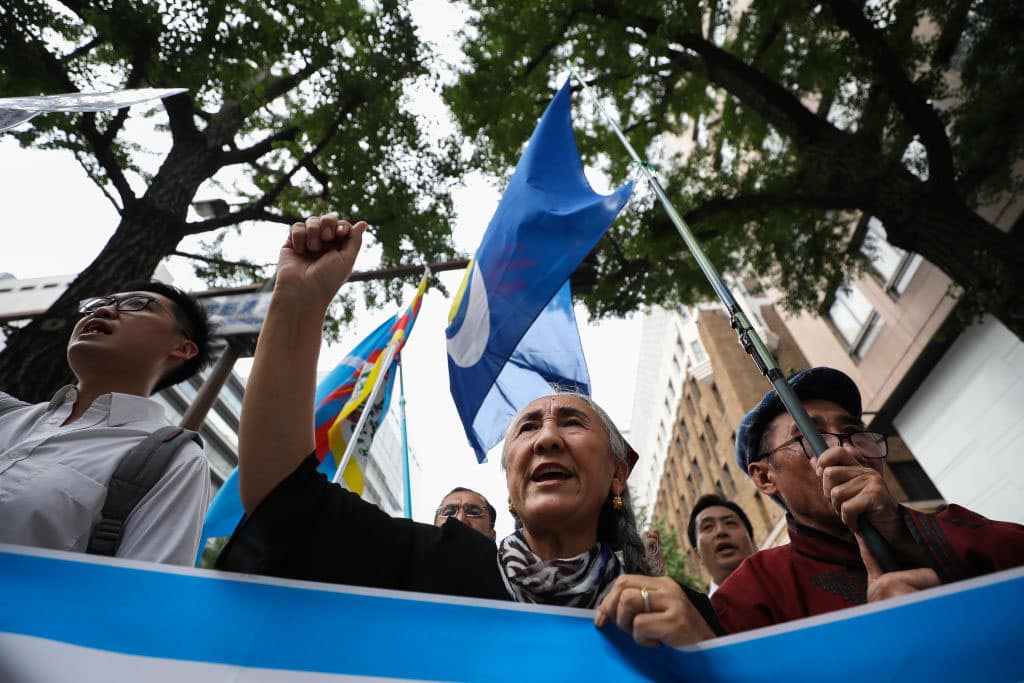
While Wiesel used the address to call attention to both events, he also used his moment on the international stage to bring awareness to a contemporary plight: the genocide of Uyghur Muslims in China. The timing was central, with the Winter Olympics set to begin in Beijing in just one week.
Wiesel closed his address by urging the UN to invoke the genocide obligations convention and launch an investigation into China’s practices toward the Uyghurs, a Muslim minority in the Xinjiang Province of northeast China that has allegedly been subjected to a range of atrocities. The United States has declared the crisis a genocide in January 2021.
“My father firmly believed that his faith required him to fight hatred and oppression everywhere, in places like Cambodia, Darfur, Rwanda, and Bosnia. Are we brave enough to follow?” Wiesel asked in the speech. “China, which sits on the Human Rights Council, inflicts mass internment, forced labor and forced sterilization on the Uyghur people.”
“I have met with Uyghur dissidents, and I believe their testimony. Will we pretend nothing is wrong?” Wiesel continued.
The Elie Wiesel Foundation has sought to support human rights in Xingang and in regions around the world—from Myanmar to Afghanistan to Sudan—in which people are suffering, according to Elisha Wiesel.
The Foundation announced in October a new initiative to advance human rights around the world that it says will help it to invest further in this mission. Under this new strategy, the organization will partner with innovative human rights organizations and act as a “megaphone to champion their cause[s],” according to the foundation.
The Foundation will also continue to issue grants to organizations that “embody Nobel Peace Prize winner Elie Wiesel’s legacy as an educator and activist,” according to a press release from the organization. Many of the Foundation’s activist grants will focus on programs that support the rights of Uyghurs in Xingjian.
“The values my father stood for–combatting indifference, educating youth, calling out injustice, and defending human rights–continue to be the moral bedrock of the Elie Wiesel Foundation,” said Elisha Wiesel in a press release. “We are so excited to announce our new grantmaking program to provide nonprofits that embody those values with the resources to achieve lasting impactful change.
These grants, the Foundation said, will range from $50,000 to $200,000. Applicants must be nonprofit organizations that can demonstrate realistic plans for carrying out campaigns to bolster human rights around the world.
To support this new initiative, the Elie Wiesel Foundation announced the creation of two new advisory boards, which will focus on the Uyghur crisis and on moral education, respectively.
The Uyghur Crisis advisory board will include Natan Sharansky, a human rights activist and lawyer who spent nine years in a Soviet prison as a refusenik in the 1970s and 1980s. Sharansky served as deputy prime minister of Israel and has received both the Congressional Gold Medal and the Presidential Medal of Freedom.
The Uyghur Crisis advisory board also includes Mark Hetfield, president and CEO of HIAS, and Gulhumar Haitiwaji, the daughter of a Uyghur woman who survived a reeducation camp.
Mayim Bialik, neuroscientist, “Big Bang Theory” actress, “Jeopardy!” host and mental health advocate, will join the moral education advisory board. Bialik is joined by Dr. Mehnaz Afridi, professor of religious studies and director of the Holocaust, Genocide, and Interfaith Education Center at Manhattan College, and Sarah Idan, former Miss Iraq and CEO of Humanity Forward.
Elie Wiesel established the eponymous foundation in 1986 after winning the Nobel Prize. Under his leadership, it funded several humanitarian programs in Israel, including the Beit Tzipora Centers and the Darfurian Refugee Program.
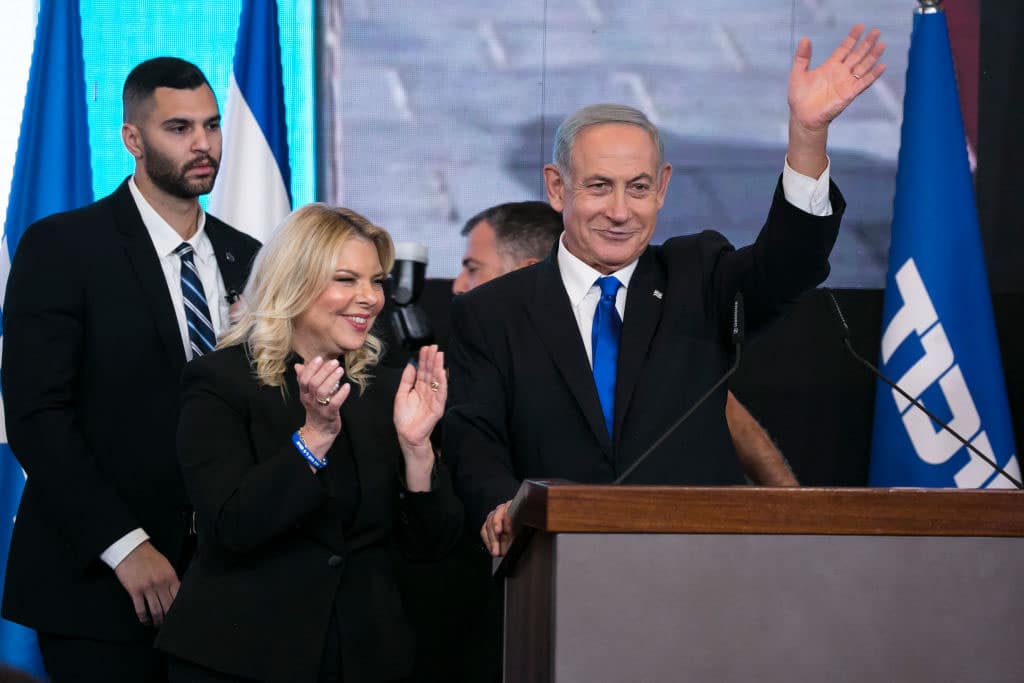
The majority of votes from Israel’s national election have been tallied, and Israel appears to be barreling toward a right-wing government headed by former Prime Minister Binyamin Netanyahu.
Exit polls immediately published as the vote ended late Tuesday showed Netanyahu on a secure path to victory. For Israel’s longest-serving prime minister, it is also a political comeback after over a year as head of the opposition.
As the hours passed, the gap between the right-wing bloc and the opposing bloc grew, allowing Netanyahu to achieve a stable majority. After the fifth election in less than four years, the result could mean Israel has been extricated from its lengthy political paralysis. The right-wing bloc likely will be able to secure a majority of the 120 seats in the parliament, or Knesset.
It is expected to be the most right-wing government the country has ever seen, made up of an alliance with far-right, ultra-religious parties.
Netanyahu’s Likud party is projected to have a little over 30 seats. The left-of-center Yesh Atid party, Likud’s main opponent, is expected to have from 22 to 24 seats.
“There will not be a situation in which Binyamin Netanyahu will not be prime minister,” said Roni Rimon, a strategic adviser and partner at the public relations firm Rimon Cohen & Co. “This is a victory for the right-wing bloc led by Netanyahu.”
The Likud party did not grow from the last election, held in March 2021, but the bloc is expected to grow by a few seats.
“This may not be a mathematical drama, but it is a big political one,” said Rimon.
The deadlock between the two blocs has been the root cause of the political paralysis in the country.
In the Israeli political system, no one political party has been able to form a government without putting together a coalition. Despite what appears to be a clear path to power for Netanyahu, there still could be weeks of tough deliberations and political strong-arming.
The main cause of growth in the right-wing bloc can be attributed to the rise of the ultra-nationalist Religious Zionism party, an alliance led by Bezalel Smotrich and Itamar Ben-Gvir. The party is expected to have 14 or 15 seats and likely will be Netanyahu’s main coalition partner.
Tuesday’s vote was largely about Netanyahu and his ability to run the country. On trial on several charges of corruption, Netanyahu, his opponents believe, is not fit to lead until cleared by the courts. But the Likud party chief and former prime minister, who denies all wrongdoing, is supported by a large bloc undeterred by his legal woes.
Netanyahu’s opponents hoped the trial would weaken support for him.
“Netanyahu proved he is still relevant, but Ben-Gvir even more so,” said Yonatan Freeman, from the Department of Political Science at the Hebrew University of Jerusalem. “Both have a strong support base. No one, not even from within the Likud, will be able to circumvent Netanyahu now.”
From the beginning of the most recent campaign, Ben-Gvir has been the star of the election. With sweeping support, the right-wing bloc is the biggest winner of the campaign.
Both ultra-Orthodox parties, Shas and United Torah Judaism, increased their power, further strengthening the bloc.
Netanyahu’s trial was not the only factor impacting results. Recent security events, which have rattled the feeling of personal security among many Israelis, further pushed voters to the right. Tensions between Jews and Arabs within Israel have been high since violent infighting last year.
The Religious Zionism party leaders have a history of extreme anti-Arab rhetoric and staunch opposition to any concessions toward the Palestinians. Ben-Gvir, who has announced he is seeking the public security ministerial portfolio, promised to “reassert ownership of this state,” after the exit polls were published.
“We are witnessing the bolstering of the extreme right,” said Eran Vigoda-Gadot, a professor of public administration at the University of Haifa. “The strengthening of extreme elements on either side show a growing polarization in society.”
The growth also came after over a year in which most of the right wing sat in the opposition.
“When power was taken from the right and the Likud, it served as a motivator for Likud supporters to go out and vote,” said Rimon.
Official results will be presented next week to Israel’s president, Isaac Herzog. The current totals do not include 500,000 double-envelope ballots, which Central Elections Committee representatives began counting on Wednesday afternoon. The double envelopes contain the ballots cast by soldiers, prisoners, and diplomats. People with disabilities and people in isolation due to COVID-19 infections also cast double-envelope ballots.
Throughout the election campaign, Yesh Atid, led by caretaker Prime Minister Yair Lapid, had an uphill battle against the right-wing bloc.
“The Israeli right has the younger demographic in its favor,” said Rimon, “Lapid and the left had basically nothing to do to defeat this; he had no chance.”
The appeal of the Religious Zionism party to new voters and the younger population proved solid in the balloting. In recent years, Israelis have increasingly leaned right.
“The election results are a reflection of Israeli society at this point in time,” according to Rimon.
“Nobody expected him to win,” Vigoda-Gadot said of Lapid. “He failed to manage a successful campaign and read the political map, but he will bounce back.”
Lapid’s outgoing government is an unlikely marriage of a myriad of parties ranging from the left to the right. Almost all of the parties that participated in the government took a major hit in yesterday’s election.
Yesh Atid is expected to grow significantly in the final tally and so is the National Unity party led by Benny Gantz. The United Arab List (Ra’am), the Arab party that made history by joining Lapid’s coalition, also slightly increased its power.
However, on the losing side are several parties including the once mighty Labor party, which is teetering on the edge of the threshold needed to enter parliament. It likely will end up with just the four seats needed to do so, a far cry from the days when it was the leader or a key building block of many coalition governments.
Meretz, the farthest left among the Zionist parties, likely will not cross the threshold.
Still, these scenarios could change once all the votes are counted and verified.
The greater drama occurred in the Arab vote, chiefly represented by three predominantly Arab parties in this election. The splits within the Arab community were exposed and took a heavy toll on the final vote tally. The Palestinian nationalist Balad party is expected to find itself outside of the Knesset. When previously united as the Joint List, the predominantly Arab parties managed to maximize their representation.
“The Arab leadership is very divided and did not convince their audiences to go out and vote for them,” said Vigoda-Gadot.
“Many in the Arab public feel hopeless and also indifferent,” according to Rimon. While Arab voter turnout was higher than expected, it was much lower than the turnout among the general population.
Another political loser of this election is outgoing Interior Minister Ayelet Shaked. Once considered a possible contender for the premiership, she ran alone as the head of the right-wing Jewish Home party and crashed with little public support. Her failure could be seen as punishment for partnering with Lapid against the Netanyahu bloc in the outgoing government.
Once official results are in, Herzog likely will task Netanyahu, the leader of the largest party, with building a coalition.
A sloppily dressed man called out, and walked quickly in my direction. I looked around to see which rabbi he was talking to and then, frighteningly, I realized he was addressing me.
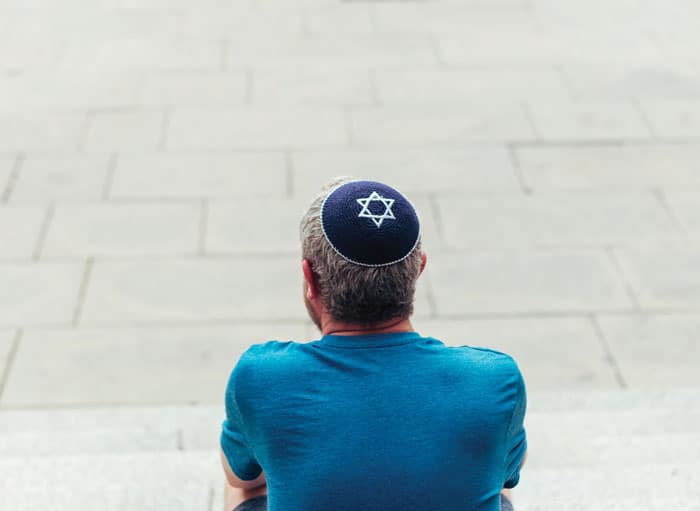
Let me describe the situation. I am at a Westfield Mall, standing at the counter of a Nespresso store buying sleeves of coffee pods. I’m wearing torn up jeans, a t-shirt and flip-flops. The only thing that betrays my faith is a kippah and tzitzit strings hanging by my side.
The man approaches me intensely. “Rabbi, I need help. I’m in a terrible place. I need more meaning in my life. And I don’t know how to be happy. How can I be more happy?”
My immediate instinct was to say, “Sorry pal, I’m not a rabbi.” Thankfully, I didn’t offer up such a weak and pathetic response. Instead, I paused and considered his request. And really, what is a rabbi? A spiritual leader? Sure. Mostly, a rabbi is a teacher. Here was an opportunity to step up and be both.
I looked at the man patiently and contemplatively. I really took the moment and was present with him. Instantly, he relaxed and looked at me gratefully. It seemed like nobody had really looked at him or listened to him for quite some time. I smiled gently, “Believe it or not, you’re in the perfect place. You are exactly where you are supposed to be.” I swear, I saw him gulp. “The Jewish belief is that G-d runs the world. That means that everything happens exactly the way it is supposed to. You are in the perfect place. You have a unique and essential purpose, so you don’t have to worry about meaning. You still have to do your part, but it is not your job to worry about the results. That is up to G-d.”
I checked myself. I did not want to sound evangelical. Nevertheless I asked tenuously, “Do you believe in G-d?” He nodded emphatically. I then asked, “Do you trust G-d?” This was a question he had not anticipated. “That is the key. If you want to be happy, trust in G-d. If you want to be more spiritual, trust in G-d. If you are worried about meaning in life, trust in G-d. You don’t have to worry about the things you cannot control, that’s beyond your pay-grade. Just do your part and trust that it will work out the way it is supposed to work out.” Was I sounding like a Sunday morning preacher? I got embarrassed and almost backed away from my words until the man heaved with relief and then held me for what seemed like a long time. “Rabbi, you can’t imagine what you have done for me.”
And then he was gone.
My friend David Sacks recently said to me, “G-d has 3 three answers: Yes. Not yet. And, I’ve got something better.” What a relief it is to trust that things are working exactly as they are supposed to. How much better than to be obsessed with success, results and things that are squarely out of our control. That only leads to tension, fear and anger. The Gemara calls anger an act of avodah zarah (idol worship). If you get angry, it means that you don’t believe that things are happening the way they are supposed to. It means you don’t believe that G-d runs the world. If you did, it would be absurd to be angry because clearly what is happening is exactly as it should be.
Looking back, I am proud I didn’t shy away from the opportunity. For those precious seconds, that man endowed my life with meaning and purpose. But then, I wonder if it was audacious for me to teach something I don’t do particularly well. Trust in G-d? It’s a daily effort for me. But maybe that is part of teaching. Nobody expects me to be perfect but me. That is my ego out of control.
Truly, that man gave me much more than he took. In that moment, I stepped up and trusted G-d. Maybe he was a malach, a messenger, there to give the lesson to me.
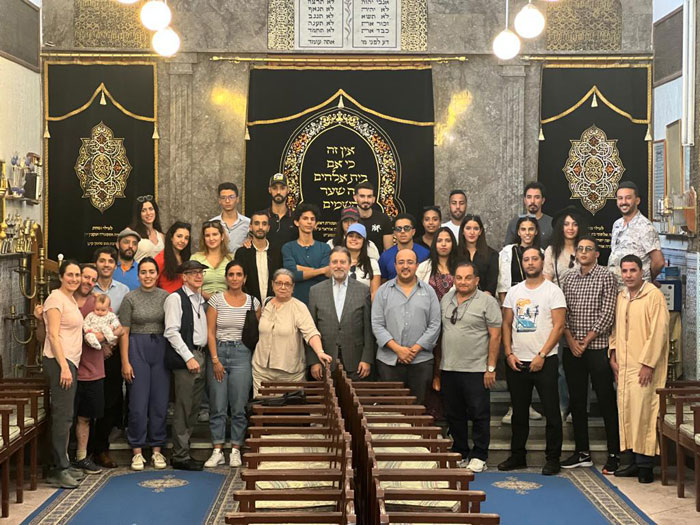
(The Media Line) The fruits of the rapprochement between Israel and swathes of the Arab world continued to ripen this week, with Morocco becoming the first-ever Muslim country to inaugurate a synagogue at one of its universities.
The thaw in relations between the Jewish state and countries in the region resumed two years ago with the signing of the Abraham Accords between Israel and Bahrain and the UAE – the first treaty of its kind since Israel and Jordan signed a peace deal in 1994.
Israel and Morocco agreed to establish diplomatic relations in December 2020, two months after the Abraham Accords were signed. The new synagogue at the Mohammed VI Polytechnic University (UM6P) symbolizes the ongoing embrace of the Jewish world by the North African country.
The inauguration of the synagogue comes in no small part thanks to the efforts of Mimouna Association, a Muslim-founded Moroccan nonprofit organization that aims to promote the country’s Jewish heritage, and the American Sephardi Federation, which has offices in the kingdom and the United Arab Emirates.
The event was attended by Rabbi Elie Abadie, the senior rabbi of the Jewish Council of the Emirates in the UAE; Magda Haroun, the president of the Egyptian Jewish Community; and Jacky Kadoch, the president of the Jewish community of Marrakech-Essaouira. Guests also included representatives from Mimouna Association and other Moroccan Jewish and non-Jewish leaders.
The synagogue is called Beit Allah, “like the House of God,” Mimouna Association founder and president El Mehdi Boudra, told The Media Line.
Boudra said that not only was a synagogue built on a campus in the Arab world for the first time ever, but it was also constructed directly next to a new mosque – “with only a wall between them” – as an example of Moroccan coexistence in action.
“It’s not a big synagogue but it can have a minyan[the quorum of 10 men required for public Jewish prayer services], and the Torah scrolls and all the religious articles were donated by the Jewish communities of Fez and Marrakech,” he said.
Boudra believes that Jewish culture plays a major role in Morocco’s history and identity and that the synagogue has the full blessing of the king. Moroccan Crown Prince Moulay Hassan bin Mohammed, he pointed out, attends the Rabat branch of UM6P.
“Moroccan Judaism is really a part of Moroccan society for 2,000 years. Morocco is also a Jewish land and we celebrate the diversity of Morocco traditionally,” he said.
“King Mohammed VI has restored 167 Jewish cemeteries around Morocco in the last 10 years. He restored more than 20 synagogues around Morocco, and he restored the mellah, the former Jewish neighborhood.”
He sees the inauguration as a celebration for the entire Jewish community of Morocco.
“The president of the Jewish community of Marrakech gave a mezuzah, we have [placed] it on the door of the synagogue and they made the first prayer in presence of Jewish people from the city of Marrakesh and Fez,” he said, adding that there were also guests from the UAE and the United States as well as Muslim students and participants.
“It was not a big ceremony, but it was a meaningful ceremony. And within the synagogue, its purpose is not only religion but it’s also an important place for Muslim students to know about Judaism,” Boudra told The Media Line.
“Mimouna Association has offered a touch screen to the synagogue and to the university so students can come … and learn about Judaism, about Moroccan Judaism, about Jews in Morocco. So it’s also a source of information for those students,” he said.
Boudra also paid tribute to the people he said were the driving force behind this synagogue – Mostafa Terrab, CEO of the OCPGroup and adviser to King Mohammed VI, who first came up with the idea; UM6P President Hicham El Habti; and the director of the university’s Institute of Biological Sciences, Prof. Gabriel Malka, who is a Moroccan Jew.
“The significance of opening a synagogue at the university in Morocco, especially one that is named after His Majesty the King, is of great import,” Rabbi Abadie told The Media Line. “It gives recognition of the Jewish community and Judaism as part and parcel of the Moroccan population and academic institutions.”
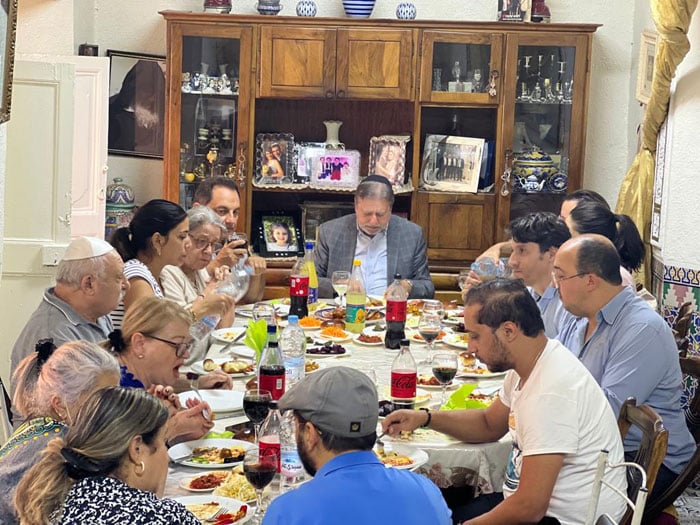
Bahrainis, Egyptians, Emiratis, Moroccans, and Israelis around the same table for kosher lunch in the mellah of Marrakesh, Morocco. (Courtesy of Mimouna Association/American Sephardi Federation)
According to Rabbi Abadie, “The synagogue will be used as a place of prayers, lectures and gathering for the Jewish students in particular and for all students who would like to participate in these events and activities.”
Jason Guberman, the executive director at American Sephardi Federation, told The Media Line that the synagogue was built by the university itself.
He said that while the school currently does not have any Jews enrolled, it has “recently concluded several research partnerships with Israeli institutions and anticipates an influx of Jewish students.”
Guberman also highlighted the fact that “a Moroccan Jew, Prof. Gabriel Malka, serves as the director of the UM6P Institute of Biological Sciences and was instrumental in the synagogue project.”
Magda Haroun, president of the Egyptian Jewish Community in Cairo, told The Media Line that she attended the opening of the synagogue because the Moroccan experience is a unique one. Haroun said that she was very impressed by the event.
“I hope one day this is repeated in other countries; not only the opening of a synagogue in King Mohammed VI Polytechnic University, but the acceptance of the other is very specific to Morocco.”
Haroun said she hopes that the inauguration is something that is shared by other countries in the region. She told The Media Line that she wants to learn from the Moroccans, especially the work done by Mimouna Association, and discover how they deal with coexistence, young people and Jewish-Arab interaction.
“The fact that there is a synagogue next to a mosque, means they have a component of society that gives the young people who have no opportunity to visit a synagogue this experience,” Haroun said, adding that a small synagogue in a university is a kind of acceptance of the differences of the other.
Hanoun was born in Alexandria but lives and works in Cairo. While there are only a handful of Jews left there, she believes that Egypt was never empty of Jews.
“Moses went out of Egypt, [but] it can’t be the end of Jews in Egypt,” she said.
Jacky Kadosh, president of the Marrakech Jewish Community, is joined by Rabbi Dr. Elie Abadie and others (including El Mehdi Boudra of Mimouna Association and Zhor Rehihil of the Casablanca Jewish Museum) to install the Beit Allah Synagogue’s mezuzah, Mohammed VI Polytechnic University, Benguérir, Morocco
As Guberman mentioned, this is not the first outreach by UM6P in the wake of the agreement with Israel. In March, the university signed an agreement with the Technion – Israel Institute of Technology based in Haifa, to advance academic cooperation between the two schools.
“Today we are signing a piece of paper but what is more important is what stands behind it – the mutual desire for cooperation, which will lead to student and faculty exchange from both institutions,” UM6P President Hicham El Habti said at the signing ceremony held at the Technion.
“We are part of a historic era, and we must continue to strengthen ties between Morocco and Israel,” he said.
I moved to Los Angeles in 1990, at the tail end of Tom Bradley’s extended tenure as mayor. Since then, I have watched his four successors — Richard Riordan, James Hahn, Antonio Villaraigosa and Eric Garcetti — each grapple with the most essential and frustrating aspect of that office: the utter lack of power possessed by the mayor of Los Angeles.
That is an exaggeration. LA’s top elected officeholder does appoint large numbers of city commissioners and other senior local government employees, and maintains a significant influence over the municipal budget. But the city’s founders deliberately set up a weak-mayor system of government that distributes responsibility to many different stakeholders, so mayors here have much less statutory authority than their colleagues in most of the nation’s other largest cities.
A successful L.A. leader’s greatest power comes from their effective use of the public platform to educate, motivate and leverage voter sentiment.
A successful L.A. leader’s greatest power instead comes from their effective use of the public platform that comes with their office to educate, motivate and leverage voter sentiment in support of their goals. That backing can then pressure the City Council, the County Supervisors and the region’s congressional and legislative delegations. But it requires the skill to commandeer the media’s cameras and microphones to reach the people of the city and lead them forward.
Riordan and Villaraigosa both used the bully pulpit zealously, relentlessly and occasionally annoyingly. But their ceaseless efforts to communicate with the public ultimately paid off, and both men ultimately accomplished many of their objectives. Garcetti has sought the spotlight less constantly, but achieved his greatest successes when his public presence was most noticeable. And Hahn struggled, never finding a way to convince Los Angeles voters or their platoons of elected representatives to follow him.
In the final days of this year’s mayoral campaign, it appears that neither Karen Bass or Rick Caruso has yet mastered the art of mass public persuasion. Both are saying the right things, emphasizing the most notable aspects of their respective biographies and laying out multi-point plans on crime, homelessness, and other issues. But neither has broken through to the voters in a compelling or captivating way, even at a time when the city thirsts for new leadership and anguishes over how to move forward.
This is not intended as a criticism of either candidate. Both have accomplished admirable successes in their careers and both have the potential to be excellent mayors (albeit in extraordinarily different ways). But neither has ever been forced to rely on a public megaphone as their primary communications tool: both are still in the process of learning that skill.
Bass has compiled a commendable series of legislative accomplishments over her years in Sacramento and Washington, but she has been most successful as a behind-the-scenes negotiator rather than as an out-front speechifier. Caruso has built an estimable business empire that has often relied on developing public support, but his best work was also usually a result of one-on-one conversations and small group meetings. Both have achieved their goals just outside the public spotlight rather than at the center of it.
Those are not necessarily flaws. It’s entirely possible that one of them will be able to pressure reluctant Council members to support their agendas in less demonstrative ways. But doing so without the cudgel of public opinion is much more difficult.
It’s also entirely possible that the winner will grow into this role. Riordan was painfully shy before moving from the private sector into elective office. Villaraigosa’s legislative history in Sacramento and City Hall relied more on private negotiations behind closed doors than electrifying stemwinders from the podium. But both stepped up once they took office.
There is a constitutional requirement that we elect a mayor every four years. But there is no similar requirement that we elect an inspirational figure to stir our souls. I have spent this year watching Bass and Caruso trying out their public voices — with mixed results. I’ll cast my ballot for the candidate who I think is more likely to learn to use that bully pulpit to rally us behind their leadership. But neither of them has demonstrated that talent yet.
Dan Schnur is a Professor at the University of California – Berkeley, USC and Pepperdine. Join Dan for his weekly webinar “Politics in the Time of Coronavirus” (www.lawac.org) on Tuesdays at 5 PM.
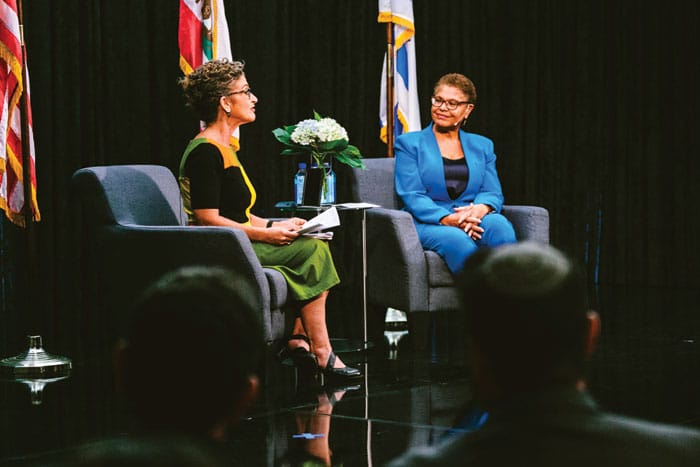
During a recent community forum, Los Angeles mayoral candidates Karen Bass and Rick Caruso highlighted their approaches to combating antisemitism and the city’s homelessness crisis. They also spoke about how they’d approach leading the country’s second-largest city if elected.
Appearing during an Oct. 26 event organized by the Jewish Federation of Greater Los Angeles, Anti-Defamation League, and American Jewish Committee, the two also shared how the Jewish community has impacted the trajectory of their careers.
“It was the Jewish parents that got me involved in politics,” Bass said, speaking of her time enrolled at Alexander Hamilton High School, which had a significant population of Jewish students. “My friend’s parents were Holocaust survivors. So, I remember the first time I saw a tattoo and what that meant. It was a very powerful experience that shaped me.”
“But I also remember during the Civil Rights movement, the alliance between the African-American and Jewish communities,” she said. “So, I grew up making a commitment at a very young age that I wanted to spend my life fighting for justice and that is how I spent my life.”
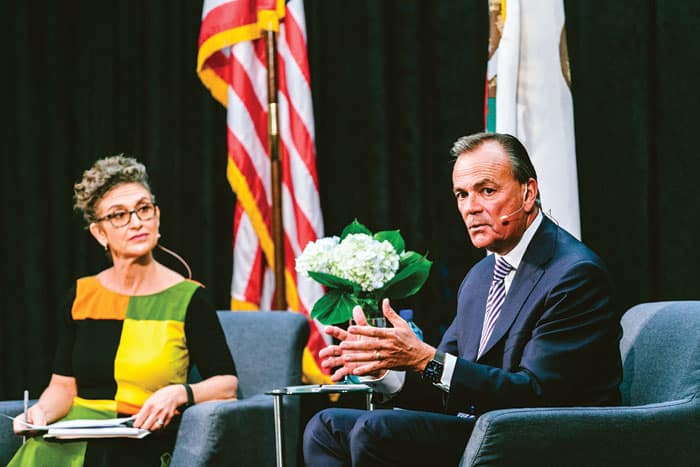
Spectrum news anchor Alex Cohen with Rick Caruso. Photo by Kathy Deninno
Caruso said the Jewish community played an important role in his respective businesses. When he developed the Grove shopping mall, for instance, he sought input from the neighborhood’s Orthodox leaders.
“On a very personal level, I wouldn’t have the success in my life that I’ve had without the Jewish community,” he said.
The virtual forum was held less than two weeks before the Nov. 8 election. Lasting nearly 90 minutes, the program was livestreamed from the headquarters of the Jewish Federation before a small crowd and featured Bass and Caruso in separate conversations with Spectrum News Anchor Alex Cohen. Neither candidate was in the room for the other’s discussion.
Bass, 69, a Democratic Congresswoman, represents a district that includes Pico-Robertson, Cheviot Hills and Baldwin Hills. If she were elected mayor, she would draw on nearly two decades of public service when facing issues including homelessness, crime and housing affordability.
“I think that it is inhumane to allow people to die on the streets,” she told Spectrum’s Cohen. “The fact that homelessness has exploded the way it has is the reason why I decided not to run for Congress again.”
Caruso, 63, is a successful shopping mall developer who has managed to stay competitive in this race despite never holding public office.
The businessman’s candidacy is his first attempt at elected office – and would be his last, he said.
“I feel very fortunate that I can run for mayor,” he said. “The greatest advantage I have is I am beholden to nobody. People will criticize and say, ‘Maybe you are spending too much money.’ That’s not the issue in my opinion. The issue is, every day I am going to be able to wake up, go to my office in City Hall and not worry about a political career I don’t want. This will be my one and only election, I promise you. My one and only candidacy.”
Caruso said his success in business has proven he can handle seemingly insurmountable challenges, including homelessness and the rise in crime.
“I’m somebody that is solution-oriented, and I want to bring that attitude to the homeless population,” he said.
Both candidates denounced the rise in antisemitism and shared how they’d combat it… The two also shared how the Jewish community has impacted the trajectory of their careers.
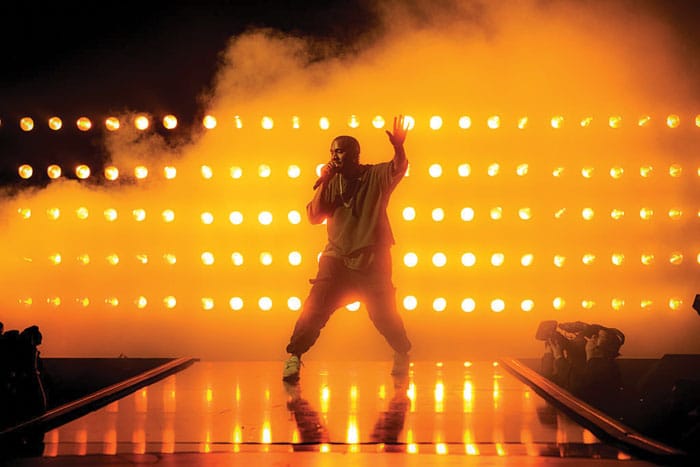
Both candidates denounced the rise in antisemitism and shared how they’d combat it. They called out widely criticized remarks from rapper Kanye West, whose antisemitic comments in recent social media posts and interviews have inspired anti-Jewish incidents around the country.
“I have devoted my life to fighting for social and economic justice and part of that fight means always fighting against antisemitism and recognizing what is happening right now in our country, as we’ve been experiencing this for a few years now,” Bass said. “And I believe that the only way that we deal with it is by coming together and being very, very aggressive.”
Caruso, meanwhile, focused on crimes targeting the local observant community, saying, “We have to have more officers visible in the Orthodox neighborhoods while giving a safe passage to worship.”
At the start of the evening, Jewish Federation of Los Angeles CEO and President Rabbi Noah Farkas, one of a handful of Federation leaders in attendance, encouraged everyone watching over Zoom to exercise their civic duty and vote.
“Jewish Angelenos inhabit nearly every corner of this city. We, a diverse, Jewish community, are deeply vested in the outcome of this election.”– Rabbi Noah Farkas
“Jewish Angelenos inhabit nearly every corner of this city,” Farkas said. “We, a diverse, Jewish community, are deeply vested in the outcome of this election.”
In the weeks since news of megastar Kanye West’s antisemitism has dominated the headlines, I’ve learned a number of lessons.
First, I’ve been reminded that wealth doesn’t guarantee health. According to Forbes, West’s deal with German apparel giant Adidas was worth $1.4 billion, rendering his former net worth before Adidas dropped him at $2 billion. Like many, I believe that West suffers from mental health challenges. But how is it possible that someone with billions (or hundreds of millions) of dollars still can’t access adequate mental health care? No, wealth does not guarantee health, whether mental or physical; sometimes, it’s up to an individual’s own choices.
But there’s something else: Wealth is also not a guarantee of an enlightened mind. Bigotry, it seems, doesn’t discriminate based on class. And sometimes, the wealthier the person, the more he or she believes in the myth of immunity. Case in point: Before Adidas cut ties with West last week, he declared the following on Revolt TV’s “Drink Champs” podcast: “The thing about me and Adidas is I can literally say antisemitic s— and they can’t drop me. I can say antisemitic things and Adidas can’t drop me. Now what?”
Worse, it was reported last week that West, who is one of the most successful artists of all time, reportedly wanted to name his album “Ye” after Adolf Hitler. A former West executive told CNN that the rapper “would praise Hitler by saying how incredible it was that he was able to accumulate so much power and would talk about all the great things he and the Nazi Party achieved for the German people.”
There you have it. A musical powerhouse who, as of two weeks ago, had a net worth of $2 billion, wanted to name an album after Hitler. You can’t put a dollar value on the virtues of wisdom and tolerance.
There you have it. A musical powerhouse who, as of two weeks ago, had a net worth of $2 billion, wanted to name an album after Hitler. You can’t put a dollar value on the virtues of wisdom and tolerance.
But in the past few weeks, I’ve also learned a lot about the virtues of sacrifice. MRC Entertainment, which has made a completed — yes, a completeddocumentary about West — announced that it’s shelving the film. In an amazing statement that’s truly refreshing in its candor and bravery (especially for Hollywood), the company’s two CEOs and co-founders, as well as its CBO, wrote,
“Kanye is a producer and sampler of music. Last week he sampled and remixed a classic tune that has charted for over 3000 years – the lie that Jews are evil and conspire to control the world for their own gain. This song was performed acapella in the time of the Pharaohs, Babylon and Rome, went acoustic with The Spanish Inquisition and Russia’s Pale of Settlement, and Hitler took the song electric. Kanye has now helped mainstream it in the modern era.”
Incidentally, in the statement, the heads of the film and television studio also identify themselves as “a Jew, a Muslim and a Christian,” and demand a balanced dialogue about Israel and the Palestinians. It’s not hard to imagine that the staff at MRC had worked tirelessly on the documentary. Perhaps this was the project that would have catapulted them into stardom in documentary filmmaking and guaranteed future success of their other films. And still, they shelved the project. Did I mention that the film cost $2 million to make and MRC hoped to generate distribution revenues of up to $10 million?
What a sacrifice on the part of MRC. But ironically, by not releasing the film, the company has still gained fame because it has made headlines worldwide, and its statement set a gold standard for unapologetic repudiation of Jew hatred. And while I’m grateful to Adidas for finally dropping West, its recent statement, on the other hand, made sure to note that the company would lose $246 million in net income in 2022 by cutting ties with the rapper. If that sounds like a lot, last year, Adidas earned over $24 billion.
I don’t know what awaits West in the coming weeks and months. Nearly everyone has cut financial ties with him, including T.J. Maxx, which dropped his Yeezy clothing line (he’s used names such as “Yeezus” for his highly-acclaimed sixth studio album and has legally changed his name to “Ye”). I’d never vouch for an antisemite, but still, it would be jarring to have every single door closed in your face in the course of a week.
And there’s a huge catch-22 to all of this: West has lost nearly all of his business ties because, among other hateful messages, he essentially told his 31 million Twitter followers that Jews control the world. Now that he’s persona non grata (I wouldn’t use the term, “canceled,” in his case), there are millions who now will believe that Jews actually do control the world because no one will work with West anymore. What a catch-22 indeed.
Perhaps the hardest lesson I’ve learned in the past few weeks is this: When you’re a Jew, you’re damned if you do and damned if you don’t.
But perhaps the hardest lesson I’ve learned in the past few weeks is this: When you’re a Jew, you’re damned if you do and damned if you don’t. On October 29, CNN ran a story with this headline: “Kanye West’s Antisemitism Did What His Anti-Blackness Did Not. And Some People Have a Problem with That.” The author wrote, “It seemed to take West offending the Jewish community before his empire, which includes music, fashion and tennis shoes, began to crumble.” You can imagine the barrage of tweets from many others who’ve voiced the same grievance. Yes, West should have been dropped years ago, but these arguments are poison against Jews.
Last week, West entered the Los Angeles corporate offices of Skechers “unannounced and uninvited,” according to the company, and was escorted off the premises after engaging in “unauthorized filming.” I don’t know where he’ll turn up next. But I know one thing: If Kanye West has a nervous breakdown, it’ll be blamed on the Jews. If he assaults someone or someone assaults him, it’ll be blamed on the Jews. And if he hurts himself, it’ll be blamed on the Jews. The fact that his business associates didn’t drop him earlier is certainly being blamed on the Jews. As author Damon Young said in the CNN story mentioned above, this “must mean that anti-Blackness didn’t move the needle, but antisemitism did.” G-d help us with such arguments. I can almost see the torch-bearing mobs as they approach us worldwide.
At this point, I could make a joke that if West hurt himself (I hope he won’t), all hell would break loose if the world believed that Jews killed Yeezus. But everything I’ve mentioned above is extremely heavy, sobering and yes, dangerous. It’s a lot to take in, particularly for those of us who live in Los Angeles, where a group of well-known antisemites recently made Nazi salutes and hung a huge banner over the 405 freeway that read, “Kanye is right.” You know antisemitism poisons everyone when white supremacists convene to support a Black antisemite.
As for Jews, we must double down in two ways: First, by emitting even more Jewish pride, especially with our children at home and on social media. And second, we must step up our Jewish actions, whether performing a mitzvah with extra joy and gratitude, giving a little extra to tzedakah, or learning a few lines of Torah each week.
In fact, in last week’s Torah portion, we learned that Noah and his family survived a cataclysmic flood by essentially staying together. Perhaps it feels as though we’re struggling to stay afloat in a different kind of flood today — a flood of social media-amplified antisemitism that leaves us feeling angry and helpless. But I believe that we can hold on to one another as Jews. And ironically, it’s Kanye West who has proven to be one of the greatest unintentional unifiers of Jews in recent memory.
Tabby Refael is an award-winning LA-based writer, speaker and civic action activist. Follow her on Twitter @TabbyRefael.