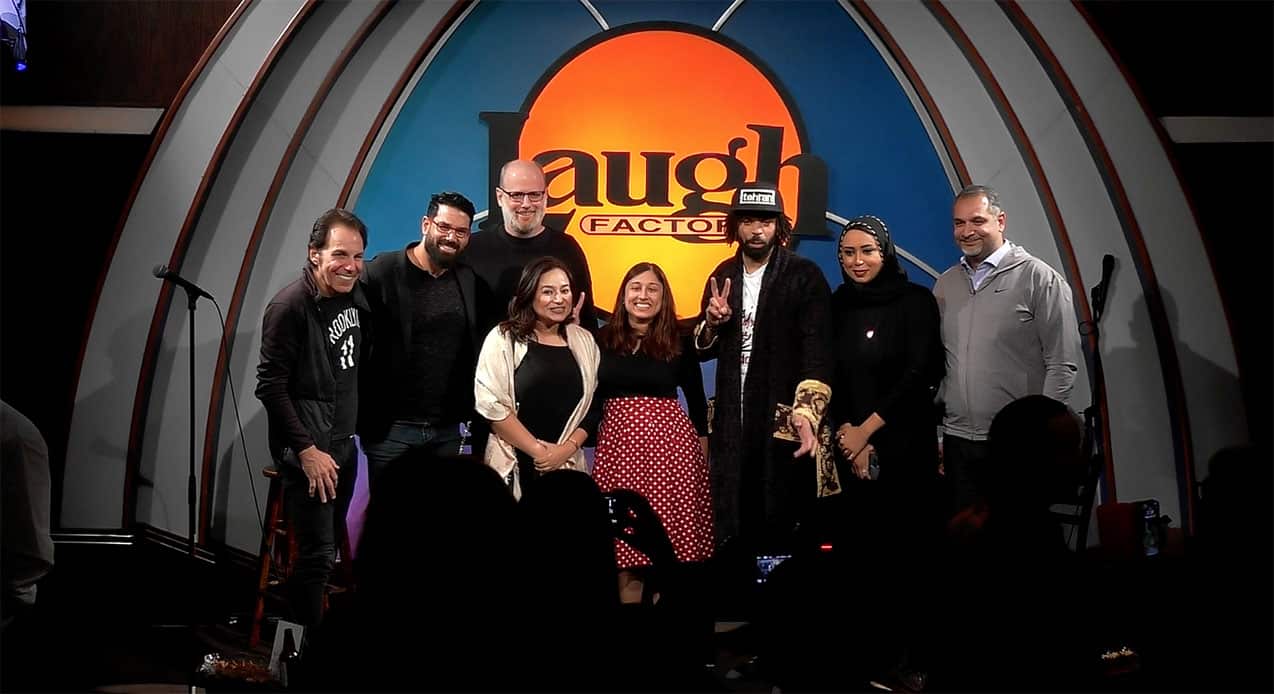
A Black Iranian, a Pakistani Muslim, and a Brooklyn Jew walk into a comedy club.
No, that’s not the setup for a joke. Rather, it was the lineup on Monday night at the Laugh Factory for the “Comedy for Peace” event in honor of Sharaka, a global interfaith organization dedicated to achieving peace in the Middle East. The event was part of a Sharaka speaking tour in partnership with the Consulates General of Israel to Los Angeles and Atlanta, and was sponsored by the Adam and Gila Milstein Family Foundation.
Founded three years ago by Israeli comedian Erik Angel, “Comedy for Peace” advertises a show where Muslim and Jewish stand-up comedians perform side-by-side in a “no politics, just laughs” night of humor. And for the crowd on hand Monday, the comedians delivered laughs from start to finish, including during a brief Q&A after the performances.
Throughout the show, comedians on the bill regularly promoted unity and stressed the importance of laughing as a form of understanding. “Jews and Arabs are family,” mused Angel, a recent immigrant to New York. “Fights over land, heritage, real estate. What is more family than that?”
Comedian Tehran Von Gasri, a Black Iranian with Mizrahi Jewish heritage, effortlessly opened the show with punchline after punchline about his Birthright trip, his Bar Mitzvah, and hosting a show sponsored by the Israeli Consulate.
“That’s why they have extra security,” Von Grasi said. “When I walked in, I searched myself.”
Zara Khan, a Los Angeles based Pakstani Muslim comedian and mental health advocate, talked about arranged marriage, dating as a Muslim woman, and coping with mental illness. Setting up a joke, Khan said she thinks mental illness is a lot like marijuana, before delivering the punchline: “It’s something you used to hide, and now everyone has it.”
Riffing off the classic trope about overbearing mothers—something she said both Arabs and Jews can relate to—Khan quipped during the post-show Q&A about how she started her career as an engineer, then became a therapist, before moving into stand-up comedy. “The bar is just going lower and lower,” she cracked.
Steve Marshall, a Jewish-American comedian, actor and writer based in New York, closed the show with big laughs without hardly even taking the stage. Marshall spent the majority of his nearly 20-minute microphone-free routine weaving throughout the crowd and interacting with audience members at their tables.
“It’s amazing that I’m a Jewish man making Jewish women happy,” he joked as the crowd erupted.
Marshall also had attendees in stitches over pre-planned musings about anxiety, babies on airplanes, and how his Jewish family would withhold taxes from his allowance. Responding to those wondering how much his parents would give him, Marshall asked, “Take home or gross?”
Before exiting the stage, Marshall re-emphasized the evening’s theme of unity and urged those in attendance to not make assumptions about others.
The night concluded with a Q&A moderated by Bahrain-based Fatema Alharbi, who serves as Sharaka’s Gulf Affairs Director.
“After the Abraham Accords were signed, the past two years seemed like a dream to me,” she said ahead of showtime.
Overall, Alharbi sees the considerable impact that the peace treaty has had, not just at a governmental level, but at a human level as well.
“[The signing of the Abraham Accords] is changing people’s lives in the region and helping bring people together no matter their religion and beliefs,” she said. “This is the reality we want to share with the world about the new Middle East.”
Sharaka, which means “partnership” in Arabic, started operations in 2020, shortly after the Abraham Accords, a landmark set of diplomatic agreements between the UAE, Bahrian and Israel, were signed on the White House lawn.
“As a Moroccan-Muslim woman, I live in a society that always promoted tolerance, coexistence values and interfaith respect,” said Ibtissame Ezzaoui, the youngest Parliament member in Morocco’s history and also a member of Sharaka’s delegation. “I want to share this model and help build strong people-to-people relations across the region.”
Both Alharbia and Ezzaoui, along with the rest of the delegation, are optimistic about a new era of relations in the Middle East and hope for a constructive, prosperous, and sustainable common future leading to a lasting peace.
In addition to attending the evening’s Comedy for Peace event, Sharaka members visited the Museum of Tolerance and spoke at the Pacific Council on Global Affairs.