fbpx

October 25, 2022

What a Waste!

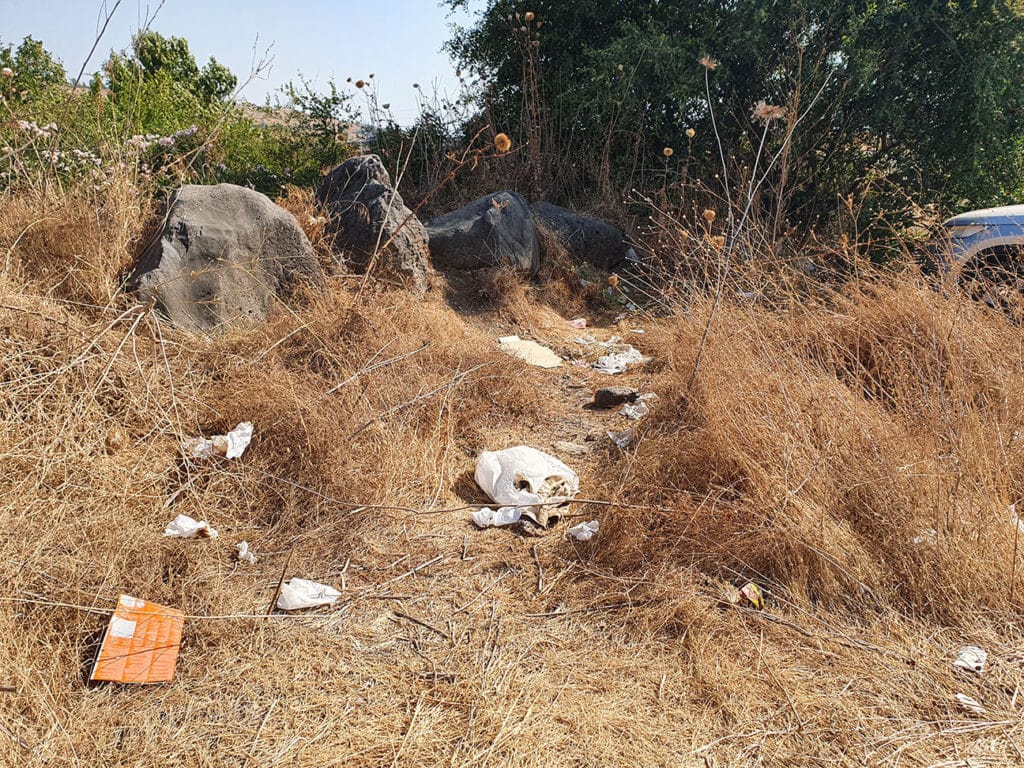
Not many activities are as relaxing as a trip or a picnic in nature, among trees and flowers, away from the noise, the crowds, and the pollution. Similarly, there aren’t many things as annoying as finding a faded soda can between the bushes, a plastic bottle in the stream, cigarette butts thrown everywhere, used COVID masks, or filthy toilet paper on the sides of the road; such sights are unfortunately very common in nature in Israel.

If you find yourself both nodding in agreement and disgusted with the people who litter in nature, and even if you think of yourself as an ally of the environment, who takes care to keep it clean, a new study about littering in nature in Israel – presented at the 50th Annual Conference for Science and the Environment – shows that there is a good chance that you also litter in nature, and are just not aware of that (at best).

For purposes of the research from Haifa University – conducted with support from the JNF (Jewish National Fund, HaKeren HaKayemet LeYisrael), and conducted by Naama Lev, a Ph.D. student at the department for management of natural and environmental resources, and a researcher at the center for education towards sustainability at the Kibbutzim College – teams of surveyors would sit at picnic areas at JNF parks (from April through November 2021), documenting over 2,200 visitors and 411 incidents of littering. Additionally, the visitors who littered were handed 627 questionnaires about their level of content from the picnic areas. The anonymous questionnaires asked the visitors for their demographics, their position about littering in nature, the frequency at which they have littered in nature (if at all), and their opinion on garbage collection on site.

This study is the third in a series of studies, and their results are to become Lev’s doctoral thesis (advised by Prof. Ofira Ayalon, of the Department of Natural Resources and Environmental Management, and Dr. Maya Negev of the School of Public Health – both at the Haifa University). The results of this study uncover unawareness even of the act of littering, as well as other surprising conclusions – such as the fact that neither increasing the number of trashcans nor placing them next to the picnic areas prevents visitors from littering.

How people believe they behave

Lev says that she chose the subject of her research to create a true change. “I have worked at the SPNI (The Society for the Protection of Nature in Israel, HaHevra LeHaganat HaTeva) for years, and I’m an avid hiker. It would always make me sick to see people littering, or go away while leaving garbage behind,” she says. “I would go up to people and ask them why they do it. When I began my studies for a Ph.D., I wanted that my research would have meaning outside of Academia.”

Besides being unaesthetic, littering in nature is a dangerous phenomenon that causes wide ecological harm: wild animals might eat either pieces of plastic that smell like food, wipes, or plastic bags, and it is not rare for animals to get a bowel obstruction, or even to die. Soda cans might injure animals who try to chew on them or trap smaller animals in them. Organic waste, such as leftover food, also poses ecological dangers – species feeding on it (for example, wild boars or golden jackals) could reproduce to an extent that threatens other species.

In the first of the three studies, Lev examined the public conception of littering in nature. 401 participants, a representative sample of the Israeli public, who visited a nature reserve or a park at least once in 2020, answered a questionnaire about littering in nature. According to the study, many assume that some types of waste are less harmful and therefore they could throw them: toilet paper, wipes, organic waste, and cigarette butts. The results of the research show that though 98.5% of the people who answered the questionnaire view with great importance the cleanliness of the site they visit, 45% of them stated that they had littered at least once in the past year. Interestingly, but not surprisingly, the respondents said that in contrast to their littering, which was either absent-minded or because there wasn’t any trashcan around them, others (so they claim) litter because “they enjoy the act of littering”. Some Israelis have such low opinions about their compatriots…

In the second study (conducted with the help of the NAKI association and the SPNI), Lev interviewed people who are in charge of operating, cleaning, and enforcement in nature reserves. She talked to 50 office holders in environmental organizations (SPNI, JNF, and so on) and discovered dissatisfaction with the standards by which the sites are operated and with the level of information and education towards keeping nature unpolluted. She also found that many prefer to focus on the symptoms – namely the level of pollution at the sites – and not the actual problem, which is littering. According to Lev, that is one of the reasons the problem persists.

How people actually behave

The third study, revealed here for the first time, was about what actually happens in reserves and parks, including real-time documentation of people littering and handing them questionnaires. With funding from the JNF, Lev trained teams of surveyors, who hid at various picnic areas, watched some 2,200 visitors, and documented 411 cases of littering. 627 questionnaires were filled in, collecting other information, such as demographics and positions regarding waste. “We went to talk to people whom we saw littering,” explained Lev, “and we said we were conducting a satisfaction survey and were interested in their opinion. Hidden between other questions in the survey, there were also questions about littering.”

In the study, garbage disposal was split into three categories: one category was intentional littering – throwing garbage on the ground, leaving it behind, or hiding it (42% of the observed cases). Another category was improper disposal: throwing garbage into the trash and missing (and not picking it up afterward), putting garbage in a bag and leaving the bag outside of the trash, or failing to pick up garbage blown in the wind (41% of the cases). The third and final category was proper disposal: putting garbage into a closed trashcan or taking it out of the park (17% of the cases).

Additionally, the study examined three groups of factors that were found to be significant in littering. One group consists of environmental factors: the overall level of pollution at the site, whether the trashcans seemed well maintained or not, where they were positioned, etc. A second group consists of personal factors: how the person littering viewed nature as important and how responsible they felt for the cleanliness of the site. The third group is situation-related factors: who was with the person who littered, the type of garbage thrown away, and some types of behavior that might be linked with littering – the research found a positive correlation between littering and either smoking cigarettes and hookahs, having a barbeque (Mangal) at the picnic, or using disposables and plastic bags.

Kings of denial

According to the study, about 40% of the visitors who were found intentionally littering answered that they never litter in nature. “It might mean,” says Lev, “that people don’t think of themselves as littering or are ashamed of admitting it. Additionally, I was surprised by the fact that many people claim to love nature and to believe that littering is wrong and that it is the responsibility of visitors to keep nature unpolluted – yet still litter,” adds Lev. This result might mean that even when wanting to avoid harming nature, people don’t know enough about the proper disposal of garbage to do so.

Another surprising result of the study is that placing trashcans next to visitors did not help in reducing the number of people littering. “There are picnic areas with small trashcans next to the tables (Asphatonim). We discovered that the closer the trashcan was to the tables, the less satisfied were the visitors. One of our recommendations is to place big trashcans or dumpsters at a reasonable distance away from the tables since people are willing to walk even 200 meters to a dumpster to throw away the garbage.”

According to Lev, one conclusion from the results of the study is that there are no magic cures against littering in nature, and the “littering type” can’t be clearly characterized; polluters come from a variety of ages, genders, social groups, and religions. “It’s hard to point to one characteristic which might explain the phenomenon all on its own; the results show quite the opposite – the causes for this behavior are multiple, and therefore actions in several directions must be taken: education and information are necessary, but so are better facilities and enforcement.

Do you want to make sure that your behavior does not put nature at harm? Lev gives a few rules of thumb: “most importantly – do not leave waste behind in any way besides in the designated closed containers. A waste bag shouldn’t be left tied to a tree or even next to the container if it’s full. Rather, you should take the garbage with you – that includes organic waste; animals don’t need to be fed. Even small pieces of waste – seed shells, cigarette butts, bottle caps, etc. – can be found in large quantities in nature, and pollute it. Generally, you should avoid using disposables (which are 20% of the total amount of littered waste), and notice that they don’t blow away in the wind.

One last rule, which is very important: “it should be clear that even when you have bowel movements,” emphasizes Lev, “nothing should be left behind, and that includes toilet paper and everything that goes with it – they should be put in a bag and thrown to the trash.”

This article was prepared by ZAVIT – The News Agency of the Israeli Society of Ecology and Environmental Sciences

What a Waste! Read More »

Wedding Chuppah

Summer Romance Turn into Fall Proposals

When the leaves change color and it starts to get chilly, those of us in the romance travel and wedding planning industry can almost feel the anticipation in the air! Approximately 40% of marriage proposals will happen between Thanksgiving and Valentine’s Day, with the most popular days being Christmas Eve, New Years Eve and Valentine’s Day. December is particularly popular for those “surprise” engagement getaways that we are often asked to help plan during the winter holiday season, when family and friends gather for those special celebrations.

However, unless the couple has a favorite place they both love, choosing a wedding destination and venue can be a daunting task as there is so much to consider! How do you choose a venue if one loves the beach and the other is more of a city person? Same with choosing activities. What about the legalities of the country where you will get married or the vendors you would need? Do you buy your wedding attire where you are getting married, or take it with you? How many guests should you invite, and should you remain in the same area for the honeymoon! So many details to think about and that is what your travel advisor will help you with. Once you have decided on a venue, there are amazing professional planners on site who will give you great advise and support you throughout your event and stay. As far as destinations are concerned, these three popped up most often when I did research in my singles groups and FYI, these destinations are LGBTQ friendly.

The Maldives – photo credit Daniel Santiago Diaz www.koveli.com

Planning a destination wedding is always a challenge and we work with a professional and knowledgeable management company at the Maldives, who is familiar with and have worked with the properties we suggest for our clients. They assists travel advisors and their clients with destinations weddings to the Maldives and offer more than 135 resorts in the Maldives at all price points. If you are a travel advisor reading this article and want to contact Daniel, let me know and I will give you their direct contact info. Definitely recommended!

Grand Resort Lagonissi – Greece. Photo credit Mania Spanou.

Mania Spanou at the Grand Resort Lagonissi in Greece and her very professional team, are highly recommended by Vivian Chambers of the Muse Collection and it is easy to see why. This resort and wedding venue is just breathtaking. An added value for me as I book Jewish Weddings and events, is the fact that this resort adheres to strict kosher standards. We will be doing a follow up article about the Kosher events at this stunning destination soon.

Sprinkled with stardust, weddings, events and celebrations taking place at the Grand Resort Lagonissi will be engraved in the heart of all guests for the years to come. Secluded amidst colorful gardens, on the Cliffside overlooking the bay, on a yacht-like sea view setting or right on the dazzling seafront, wedding venues offered at the Grand Resort Lagonissi evoke a sense of grandeur and refined elegance, perfect for a one-of-a-kind celebration, event, wedding and honeymoon for up to 1200 guests on the Athenian Riviera. Newlyweds are welcome to take advantage of the exclusive wedding packages available and leave everything to the hands of the professional experts who will plan the wedding of their dreams down to the last detail. Mania Spanou is the contact person and you can reach her here.  For the couple that needs something other than soaking up the sun and being pampered at this 5 star luxury resort, the Athenian Riviera offers an abundance of sightseeing attractions, cultural venues, shopping districts and opportunities for daily excursions.

Kilindi Zanzibar – Photo Credit Elewana Collection.

Zanzibar was the first island I ever traveled to as a kid with my family, and I clearly remember being utterly mesmerized by the incredibly white sand. The island is famous for its mix of exotic beaches, famous spice plantations, history and diverse culture. The locals are welcoming, laid back and thanks to the picture-perfect beaches, sunny weather and rich culture, Zanzibar is considered a popular tourist destination. The sea life of Zanzibar is bountiful and diverse. Guests can enjoy day boat trips, scuba diving and snorkeling and get a glimpse of the dolphins, stunningly and copious amounts of beautifully colored fish and vivid corals that thrive in Zanzibar’s clear waters.

Located on the north-west coast of Zanzibar, and adjacent to the clear turquoise waters of the Indian Ocean, sits the extraordinary and gorgeous Kilindi. This beautiful luxurious boutique hotel was originally designed for Benny Andersson, one of the members of the pop group ABBA. Kilindi has achieved the perfect combination of Scandinavian minimalism and dramatic architectural overtones of Middle Eastern heritage, yet still with a back-to-nature ambiance. The suites all show off the spectacular views of the ocean and allows the gentle breeze to cool the guests on those hot summer days and balmy nights.

Each stunning villa has a private plunge pool with water features and a waterfall, and a bathroom adjoined by an open fronted walkway offers a revitalizing rainfall shower. Each villa also has a vantage point over the breath-taking views of the kaleidoscopic Indian ocean and bay traversed by traditional dhows. Dining options include romantic dinners on the beach, by the pool, among the gardens and room service. Kilindi’s delectable cuisine uses the freshest seafood caught that day, and an organic garden provides fresh crisp ingredients.

For the adventurous couple, there is always the option to hop over to Tanzania or Kenia for a safari honeymoon after spending some time on the glorious Kilindi in Zanzibar.

Thank you for spending time with me and follow for more info about jaw dropping destinations and fabulous adventures! Then contact me to book those unforgettable experiences. Also please contact me HERE should you have any questions about booking your destination wedding or honeymoon. I wrote an article a few years back about gorgeous wedding destinations in Israel and you can find that article HERE.

Summer Romance Turn into Fall Proposals Read More »

Young People Who Spend Time in Israel Feel Stronger Ties Toward Judaism, Study Finds

At Shabbat tables across the country, many are asking: among younger Americans, is Jewish identity facing a recession?

A recent poll from Pew Research found that more than half of Jewish Americans between the ages of 18 and 29 say that they do not feel a strong connection to Israel. 

In her youth, Charlene Green would have likely said the same thing. 

“I was disconnected from my Jewish roots and felt something was missing from my life,” she said. 

That changed when Green signed up for an immersive volunteer program in Israel with Masa Israel Journey, an organization that facilitates long-term study abroad programs in Israel for young Jewish adults from around the world. Today, nearly 15 years after her trip, Green works as a Jewish nonprofit professional at the Jewish Federations of North America. 

“When I moved back to the United States, I knew I wanted to keep nurturing the part of my Jewish soul that blossomed in Israel,” she said. “This led me to find fulfilling employment building Jewish community in North America, sharing the passion and love of Judaism I discovered in Israel. I 100% attribute my lifelong work as a Jewish nonprofit professional to my Masa program.” 

Last month, Masa released the findings of a study conducted by Impact:NPO that aggregated the personal attitudes and professional outcomes of thousands of its participants from 2009-2019, finding that Jewish individuals who spent a significant amount of time — defined as roughly four months or more — in Israel during their youth feel more connected as adults to the country and to Judaism. 

The results, Masa CEO Ofer Gutman said, provide a quantitative explanation of a phenomenon that Masa has long understood. 

“This study provides valuable data to support a conclusion that we have long understood: long-term immersive programs in Israel guide young Jewish adults to forge deep, lasting ties to the Jewish state, their Jewish identity, and the Jewish people,” said Gutman. “Even more exciting is that young Jews who have been unengaged from Jewish life before their long-term program, return to their homes with a desire not only to engage with their local Jewish communities but to meaningfully contribute.”

“Even more exciting is that young Jews who have been unengaged from Jewish life before their long-term program, return to their homes with a desire not only to engage with their local Jewish communities but to meaningfully contribute.”
– MASA CEO Ofer Gutman

The study divided American Jews between the ages of 20 and 45 into three groups: those that had spent more than four months living in Israel; those that had spent short periods of time in Israel; and those that had never been to Israel. 

The report’s findings on the impact of long-term experiences in Israel on American Jewish identity was significant, the report claims. For example, eight-in-10 former long-term program participants surveyed in the inquiry said that being Jewish was an important part of their life, and 62% said they feel a strong connection to Jews in other parts of the world.
The report also highlighted the implications of experiences in Israel on the continuity of Jewish life and tradition. It found that nearly half of long-term program participants regularly donate to Jewish causes, and two-thirds participate in Jewish communal life. When it comes to parenting, 92% of long-term participants said they plan to raise their children in the Jewish community — more than 30 percentage points higher than those who had not spent significant time in Israel. 
Masa said that in sharing the results of the survey, it sought to control for an important, confounding variable: Jewish affiliation and participation prior to coming to Israel. Masa alumni of Jewish Studies programs often begin their programs with deep connections to Jewish life, given their participation in early-age Jewish experiences such as summer camps, religious services, Jewish day schools and/or yeshiva programs. To ensure an even analysis of differences between surveyed groups, responses from Masa alumni of Jewish Studies were excluded from the report.
One group surveyed included Masa alumni that largely consists of millennials motivated to live in Israel to advance their careers. Nearly half of these individuals did not participate in formative Jewish experiences like summer camp, bar or bat mitzvahs, or day school as children, according to Masa. 

Yet after spending time in Israel, the majority of this group felt strongly that being Jewish is an important part of their identity and indicated that they feel connected to the Israeli people, according to the study. 

Gutman sees these findings as a great benefit to the Jewish people. 

“Looking ahead, we now have concrete evidence of the transformative effect long-term programs in Israel has on young Jewish adults. Israel gains devoted advocates, Jewish communities gain engaged members, and collectively, the Jewish world gains leaders committed to cultivating a strong Jewish future,” said Gutman.

Young People Who Spend Time in Israel Feel Stronger Ties Toward Judaism, Study Finds Read More »

World Series Jews

Two Jews will be in the World Series that begins this Friday—the Houston Astros’ superstar third baseman Alex Bregman and the Philadelphia Phillies’ little-known back-up catcher Garrett Stubbs.

Bregman has had an exceptional post-season performance so far, hitting .333 with two homers and seven RBIs, helping the Astros defeat the New York Yankees in four straight games to win the American League pennant. His three-run homer home run in the second game was all the Astros needed to beat the Yankees 3-2.

During the season, Stubbs backed up J.T. Realmuto, perhaps the best catcher in the majors, and played only sporadically. But when he had a chance to play, he did well, hitting .264 with five homers and 16 RBIs in 106 at bats in 46 games: his best performance in his four major league seasons. The Phillies, who went 87-75 and finished third in the NL East during the regular season, improbably scratched their way into the World Series, so even with his limited playing time, Stubbs made some important contributions, including a three-run walk-off homer to beat the Marlins in June. Stubbs hasn’t played yet in this year’s post-season games, but he may be needed as a pinch-hitter or catcher, particularly if the best-of-seven series lasts more than five games, or if Realmuto is injured.

Last year, a record four Jewish baseball players played in the World Series between the Atlanta Braves and the Astros. Pitcher Max Fried and outfielder Joc Pederson took the field for the Atlanta Braves. Bregman and Stubbs, who played for the Astros last year before being traded to the Phillies for this season, were on the Houston roster. Stubbs replaced catcher Martin Maldonado in the ninth inning but didn’t get a chance at bat.

In the second inning of game six, which clinched the series for the Braves, Bregman came to the plate against Fried. It was the first time in World Series history that two Jews faced each other.  On Fried’s second pitch, Bregman lofted a foul ball that was caught by Braves’ right fielder Pederson, making it a Jewish trifecta on one play.

Stubbs and Bregman are among the 173 Jews who have played in the majors since 1901, the year considered the start of what is now known as Major League Baseball. (This represents about one percent of all major league players.) This season, 13 Jews donned big league uniforms: Richard Bleier, Noah Davis, Scott Effross, Jake Fishman, Dean Kremer, Eli Morgan, Kevin Pillar, Rowdy Tellez and Jack Weiss, in addition to Bregman, Fried, Pederson and Stubbs. Over the past decade, an average of 14 Jews have played on major league teams each year. That is more than in any decade since 1901.

During the first two-thirds of the 20th century, most Jewish major leaguers were the children of immigrants who learned to play in city playgrounds and parks. Many of today’s Jewish ballplayers are the offspring of mixed marriages.

Stubbs, born in 1993 in San Diego to a Jewish mother and a Catholic father, was raised Jewish. He attended Hebrew school every Wednesday from age eight to 13 and celebrated his bar mitzvah at Temple Solel, a Reform congregation in Cardiff-by-the-Sea, a San Diego suburb.  He played baseball at Torrey Pines High and was twice selected to the All-California Interscholastic Federation team.

After high school Stubbs went to the University of Southern California, where he was an outstanding hitter and catcher for the Trojans. He was eligible for the major league draft after his junior year, but chose to return to USC for his senior year, batting .346, winning the 2015 Johnny Bench Award as the best catcher in college baseball,and earning a spot on the All-American team by both Baseball America and Rawlings.  He graduated with a degree in policy, planning and development.

The Astros picked Stubbs in the eighth round of the 2015 MLB draft. After three years in the minors, the Astros brought him up to the big leagues on his 26th birthday, May 26, 2019. He made his major league debut two days later, slugging a double in his first at-bat and contributing an RBI single his next at-bat. Despite that auspicious start, Stubbs appeared in only 51 games in three seasons with the Astros, mostly as a catcher but also as an outfielder and pinch-runner. He  was traded to the Phillies last November. Now he’ll be playing for the Phillies against his former Astros teammates.

Bregman was born in 1994 and raised in Albuquerque, New Mexico. His father grew up Jewish and his mother was born Catholic but converted to Judaism. In his bar mitzvah speech at Congregation Albert, a Reform temple, Bregman, then 5’4”, said: “I want to be a professional athlete who plays for the love of the game, never quits trying to give my best, and is a good role model for all of the kids who look up to baseball players.”

In 2009, during his freshman year at Albuquerque Academy, Bregman led his team to the state high school championship. As a junior, he hit .678, was named first team All-State, and led the 18-and-under U.S. National Team to a gold medal at the International Baseball Federation World Championship. He missed most of his senior year due to an injury to his right hand. He was drafted by the Boston Red Sox but chose to attend Louisiana State University, where he studied sports administration. He was voted 2013 National Freshman of the Year by Baseball America and won the Brooks Wallace Award as the country’s best college shortstop. He was a two-time All-American and in his junior year led LSU to the College World Series. His LSU roommate was Aaron Nola, now a pitcher for the Phillies. The two friends might face each other in the World Series.

In 2015, at the end of his junior year, the Astros made him the second pick in the first round of the baseball draft, and he signed to play pro ball. He was the highest drafted Jewish player since Ron Blomberg was drafted first in 1967. In 2016, USA Today named Bregman the Minor League Player of the Year. That July, he was called up to the majors.

Bregman has spent his entire seven-year career with the Astros, playing second base, shortstop and third base. In 2017 he was the youngest member of the USA team that won the World Baseball Classic goal medal. That year, the Astros won the World Series. In 2018 Bregman not only made the All-Star team but was also named the game’s Most Valuable Player after hitting a go-ahead home run in the 10th inning. He led the AL in doubles with 51. The following year he made the All-Star team again, led the NL in walks (119), received the AL’s Silver Slugger Award as the best offensive third baseman, and was runner-up for the AL MVP award. In his career so far he’s averaged 28 home runs and 99 RBIs per season while hitting .277. He had a sub-par season this year, batting just .259, but still swatted 23 homers and had 93 RBIs.

Both Bregman and Stubbs have younger brothers who excelled at baseball. Like his brother, Anthony (A.J.) Bregman starred at Albuquerque Academy. He was selected by the Astros in the 35th round of the 2018 draft. He chose instead to attend the University of New Mexico, played one season for the Lobos, but ended his baseball career without playing in the minors. C.J. Stubbs followed his brother to USC and was drafted by the Astros in the tenth round of the 2019 MLB draft. He’s played in the Astros’ minor league system since then. With former minor league teammates playing with the Astros, and his brother Garrett on the Phillies roster, C.J. might be torn over which team to root for in the upcoming World Series.


Peter Dreier is the E.P. Clapp Distinguished Professor of Politics at Occidental College and coauthor of two recently-published books “Baseball Rebels: The Players, People, and Social Movements That Shook Up the Game and Changed America” and “Major League Rebels: Baseball Battles Over Workers’ Rights and American Empire.”   

World Series Jews Read More »

The Divide and Conquer Strategy of Far Left Antisemitism

Whether deemed communists or capitalists, foreigners or gentrifiers, Jews often seem to serve as scapegoats for societal ills. As a result, the age-old question of how to fight antisemitism must continually adapt to recognize antisemitism in its current form. Often disguised as the pursuit of moral justice via causes such as pro-Israel censorship for the sake of Palestinian rights, the idea of the “white supremacist Jewish elite” as the true logic driving antisemitism extends far beyond the Israel-Palestine conflict.

Given the far left’s distrust of power, the age-old trope of the “powerful Jew” has emerged stronger than ever in the framing of Ashkenazi Jews as a hyper-privileged Jewish subset, perhaps even a catalyst for what some might view as deserved Judeophobia. But due to the left’s reputation for supporting social justice on topics like the Israel-Palestine conflict, far left anti-Israel sentiment that spills over into suspicion of overall Jewish power often goes unnoticed or ignored. In the case of a Google executive who tweeted about Jews having an “insatiable appetite for war”—not Israelis, but Jews—14 years passed before the employee faced any consequences. This incident is an example of the left’s preference for Muslim and non-Jewish Middle Eastern groups over Jewish groups, who are seen as connected to whiteness and power. And given the rising anti-colonial sentiment throughout the world, it’s no surprise that Jews, perceived as white colonizers in progressive circles, have become a target.

This connection of Ashkenazi Jews with Eurocentrism and whiteness invalidates their minority status in the view of many progressives, thus paving the way for antisemites to claim they don’t hate all Jews, only those “privileged white Jews” who control funding of American schools and disenfranchise minorities of color while occupying the non-white underdog in the Middle East via Israel. Indeed, the belief that Ashkenazi Jews have always been white has also increased, with social media influencers claiming an alleged prioritization of the Shoah due to the “whiteness” of Jewish victims. Such a claim conveniently ignores Nazi ideology, which viewed Jews as a distinct and inferior race as well as the historical classification of Jews in Europe as both Palestinian and Oriental.

Moreover, this simplistic “white oppressor versus non-white oppressed” binary fails to define whether a ‘”white Jew” refers to a member of the Ashkenazi majority in the United States, having the ability to visibly present as European, or having recent diaspora sojourn in Central and Eastern Europe. Unfortunately, this murky classification of whiteness has also caught on within the Jewish community thanks to some Jews feeling marginalized by both Ashkenormativity and white presenting Jews.

The idea that European lineage grants automatic privileged status above those who came from elsewhere in the world is being capitalized on by groups such as Arabs. Whereas Arabs and other non-Jewish MENA groups eventually achieved “white” status on the United States census, many are now fighting to reverse this label once again in order to maintain a minority status, given their non-European origins, pride as a unique ethnic group, and anti-Arab/Muslim discrimination in the West.

Despite the American emphasis on race, ethnicity also matters. Whether for Arabs or Jews, identifying as a non-white ethnic group does not mean that members of these groups who pass as white do not also enjoy privilege. Given both Middle Eastern origins (no matter how long ago for Ashkenazim) and the fact that Jews experience some of the highest hate crime rates of any group in the United States despite our relatively small population size, Jews should also insist on a non-white ethnic minority status.

We can hardly expect to succeed in thwarting antisemitism when our own community struggles with diaspora infighting. Healing the rift begins with uniting the Jewish community as an ethnoreligious rather than purely religious group. We can and should respect diaspora history without letting such discrepancies define our unique, shared identity as Jews. Only when we come together to recognize antisemitic divide and conquer strategies can we address anti-Jewish bigotry in all its forms.


Sarah Katz is an author, UC Berkeley alumna in Middle Eastern Studies, and cyber security analyst. 

The Divide and Conquer Strategy of Far Left Antisemitism Read More »

Gambling on Health in California

Voters considering Propositions 26 and 27, California’s gambling initiatives, should think again if they believe they’re getting all they need to know from the Secretary of State’s official voters’ guide. It’s bad enough that voters endure a biased bombardment of advertising from monied special interests. It’s even worse that they can’t depend on the State to supply critical information on the substantial health impact of California initiatives.

If you review the guide’s twelve pages on the two initiatives you’ll see assessments of their possible impact on state revenues, law enforcement and local governments. Never once does the guide or its pro and con commentaries consider the major group most affected: California’s gamblers. The initiatives would allocate a small proportion of anticipated revenue to social programs for problem gamblers. But do these programs really help those with gambling addiction? Do they effectively address any of the adverse financial, social or health effects of gambling? You won’t find a comment. Will greater access to gambling increase the number of Californians struggling with gambling addiction? The State doesn’t seem to think that’s important enough to consider.

One reason that gamblers may be off the Secretary of State’s radar is that they are a stealth population. Although research suggests that about 500,000 Californians are problem gamblers, they are out of the public eye, both collectively and individually. Many hide their financial tracks leaving their families completely unaware of the issue. With alcohol addiction, in contrast, families can notice leftover bottles, altered behavior and tell-tale alcohol breath. Doctors also have trouble identifying problem gamblers. We don’t screen for gambling addiction and, also unlike alcoholism, gambling addiction lacks characteristic laboratory findings.

Research also suggests that having a casino within 50 miles doubles the prevalence of the condition. The highest risk individuals are those suffering from substance abuse and mental illnesses such as depression and bipolar affective disorder. We should ask ourselves if these individuals would be likely to resist the temptation of a constant on-line “casino in your pocket,” as proposed by Prop 27. Many would likely suffer de-stabilization of their family life as well as their physical and mental health.

We should ask ourselves if these individuals would be likely to resist the temptation of a constant on-line “casino in your pocket,” as proposed by Prop 27.

I have only one patient with a known history of gambling addiction. JR, 65, has abstained for many years since getting help from Gamblers Anonymous. Still, he vividly remembers the rush of winning and the intoxicating power of “chasing that high.” He also remembers the secrecy and the path of broken trust as his family’s finances were strained and relationships damaged. JR’s problem centered around slots and electronic poker, not the sports betting currently on the ballot. But he recognizes that the gamblers’ rush affects different people in different ways. He sees sports betting as a gamblers’ “gateway drug.” He also worries about the reliability of the measures to prevent minors from using on-line gambling. Not surprisingly, this key issue was also not adequately addressed by the state’s ballot guide.

Despite the experience of a gambling nightmare, JR appreciates the flip side of the coin. Those who bet responsibly on sports using disposable income want convenient, legal options. They might ask why others’ addiction problems should interfere with their choices for the “pursuit of happiness.”

Striking a balance between the libertarian pursuit of individual freedom and the social benefit of reducing risk to the community is just one issue posed by the gambling propositions. Voters will also need to consider the potential benefits of the anticipated increase in tax revenue. Some will also view these initiatives as a test of the legitimacy of the special interest tactic of allocating a cut of the profit to socially popular programs, like aid to the homeless, to attract support.

Sorting out all these complexities would challenge any voter. But how can we expect citizens to make appropriately informed choices when the State reneges on its obligation to fully inform them? The initiative process should not be a game of chance in which voters choose now and learn about undisclosed health consequences later. Rather than rolling the dice on these initiatives California’s voters should oppose both and send a message to the Secretary of State and the initiative industry that they won’t approve ballot measures that neglect adequate consideration of public health.


Daniel Stone is Regional Medical Director of Cedars-Sinai Valley Network and a practicing internist and geriatrician with Cedars Sinai Medical Group. The views expressed in this column do not necessarily reflect those of Cedars-Sinai.

Gambling on Health in California Read More »

How Democrats can Prepare and Survive the Coming November 8th Apocalypse

On election night in 2010, I was sitting in a Washington D.C. hotel with fellow Obama staffers musing about what was theoretically the end of the Obama presidency. Just two years earlier, with great excitement and fanfare, a new president had come to town, with hope, change and opportunity written everywhere.  Just two years later—what a difference two years can make. And now we stand in what is likely a worse situation, just two years into another Democratic administration on the precipice of what will likely be a very bad night for Democrats. It seems that Democrats have not learned their lesson. What is that lesson? Take a page out of the Republican playbook, play the long game, and stay focused, with a clear, simple and positive message for Americans.

We should be prepared for the worst, and hope for a split decision. Unfortunately, I think we should also plan for the worst and on November 9 begin looking to the future and building the types of coalitions and support that have driven so many successful ideologic moments in history.

We must face the prospects of likely losing both houses of congress, splitting statehouses, and losing some key down ballot races that are critical such as Secretary of State.

There is no time for the same old hand wringing and calls for a change. We need to take action. I believe in the 12-step program, but in this case it’s four simple steps.

  • It’s time for a leadership change. On November 9th, Nancy Pelosi, Steny Hoyer and the entire leadership of the house, and Senate—Chuck Schumer and Dick Durbin included—need to call it quits. We love the work you have done, you guided us through some difficult times, but it’s time for a new generation of leadership. In its place, we need a mix of centrists, progressives and new Democrats that represent the new south, the old west and the emerging mid-west.
  • Be in it for the long game. Focus on taking back the state houses and gaining control of the local narrative in states that make a difference. Look to organize in states that have traditionally been red and are now moving purple. Reclaim local and state issues that are important to everyone: crime, community, education and global excellence.
  • Support the middle class. After Obama we lost the independent-minded middle class and blue-collar voters who care about bread and butter issues and believe that we can work hard and make a living and that the government does have a place in our lives—to help us through the tough times.
  • Take back from the Republicans the issues of fairness, safety, educational excellence and international leadership and stay on message.

Democrats hate to stay on message. Too often they can’t help themselves and they veer off into uncharted territory, creating long, tangled narratives that opponents easily turn against them. Take the issues of defunding the police, critical race theory, and even inflation. In each case the Democrats could have easily claimed the high ground. Democrats have long been stalwart supporters of sensible, ethical policing. In fact, some of the nation’s top Democrats were once police officers or military personnel. And since 1909 Democrats have supported the best of education, and supported the need for a robust public education system. So how is it that they are now the destroyers of educational equity and excellence? Does anyone remember trickle down economics, the Bush deficits? For decades Democrats have talked about balanced budgets and economic stimulus when it made sense as well as creating economic prosperity. So how is it we are losing the battle on saving the middle class? The answer is because we just cannot stay on message.

But rather than stand defeated, Democrats and moderate Republicans need to demonstrate true leadership.

Yes, it will be a difficult couple weeks after the November 8th election, and yes, Republicans will give back committee assignments to Marjorie Taylor Green and strip AOC and others of their committees, start investigations into Hunter Biden, bring up impeachment, kill the voting rights act, and try to shut down the government over fiscal matters. But rather than stand defeated, Democrats and moderate Republicans need to demonstrate true leadership. In times like these I refer back to great speeches that held great promise, in a time when Democrats and Republicans worked together and collaborated on important legislation on healthcare, social security and education.  Such a speech came from Ted Kennedy’s concession speech at the 1980 Democratic National Convention. He captured the mood of the moment, as a country struggling with high inflation, and discontent needed a vision for the future. He stated:

There will be setbacks and sacrifices in the years ahead; but I am convinced that we as a people are ready to give something back to our country in return for all it has given to us.  It is surely correct that we cannot solve problems by throwing money at them, but it is also correct that we dare not throw out our national problems onto a scrap heap of inattention and indifference. The poor may be out of political fashion, but they are not without human needs. The middle class may be angry, but they have not lost the dream that all Americans can advance together. For all those whose cares have been our concern, the work goes on, the cause endures, the hope still lives, and the dream shall never die.

We must not just as Democrats or Republicans work to reclaim our heritage as stewards of American idealism, pushing back on the continued rise of divisive and hateful rhetoric. We can build toward a greater future if we take the necessary steps to reassert our understanding and compassion for the human spirit.


Seth Jacobson is the founder and principal of JCI Worldwide, a Los Angeles-based communications and research firm. He spent several years in the Carter and Clinton administrations in positions focused on economic development, foreign policy, and media relations. He is a frequent lecturer on policy and public affairs at Pepperdine University and UCLA.

How Democrats can Prepare and Survive the Coming November 8th Apocalypse Read More »

Guess What? There’s a Silver Lining to the Kanye West Hatefest

First, let’s get something out of the way. When an international superstar with a huge following like Kanye West does something bad—like, say, spew poison about Jews—it’s no longer just about him. It’s about his millions of followers and the Jew haters who have been awoken and empowered by a superstar.

Kanye can tell us he’s not a Jew hater but even if that were true, it doesn’t really matter. What matters is that he used his global influence to spread dangerous antisemitic tropes about Jews. This is why the campaign to condemn and isolate him has been so heated—people understand the devastating impact of hate speech when it comes from celebrities and social influencers.

But in all of this bad news, there is still a silver lining that must be noted.

Imagine being in Germany in 1935, and a famous German musician decides to rant publicly against Jews, just as Kanye has done 87 years later in the United States. Can you even fathom the possibility that the German celebrity would be condemned and ostracized the way Kanye is being condemned and ostracized today?

Not a chance.

Within a week or two of his vile rants, Kanye has been dropped by his Hollywood agents (CAA), Adidas, Balenciaga, Foot Locker, Gap, Vogue, Universal Music and MRC, a film company that was about to release a documentary on his life. And that’s only the beginning.

When an ugly banner was unfurled in L.A. in support of West, the leader of the free world (President Biden) released a statement that “we need to call out antisemitism everywhere it rears its ugly head. These actions in LA are disgusting and should be condemned.”

So, as Jews bemoan the rise in antisemitism, it’s important that we don’t take for granted the widespread condemnations of this hatred. The flip side of Jew hatred is the support Jews are receiving across the country.

This is the kind of support our ancestors could only dream of.

Guess What? There’s a Silver Lining to the Kanye West Hatefest Read More »

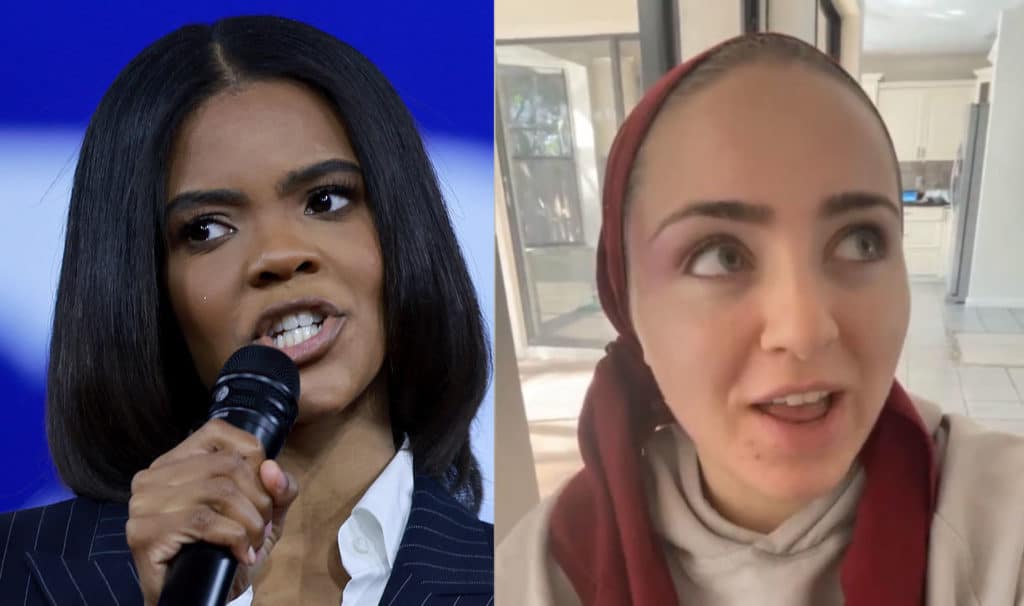
Kanye West Ally Candace Owens Claims She’s Being Attacked by Rochel Leah Boteach on Twitter

On Tuesday, Oct. 25, Rochel Leah (Boteach) Taktuk, 24, an Orthodox Jewish Instagram influencer and daughter of Rabbi Shmuley Boteach posted a quick story that said: “@realcandaceowens @kanyewest Don’t mess with the Jews.”

Rochel Leah was happy; Adidas had canceled their contract with West after he made a slew of antisemitic remarks. There were going to be consequences for the rapper’s egregious behavior.

“I finally felt like we were winning,” she told the Journal.

After posting the story, she focused her attention on celebrating her second anniversary with her husband. But then, she started to receive a huge amount of hateful messages and death threats on her Instagram.

“Hitler should have finished the job,” one person wrote.

“You hate Black people,” another person said.

It turns out that Candace Owens, a conservative commentator at The Daily Wire, had blasted out a screenshot of Rochel Leah’s story to her 3.1 million Twitter followers. Owens wrote: “I have been fielding threats for two weeks straight. How is it possible that any person is allow to openly message ‘don’t mess with the Jews’ to me? Rochel Leah is just one of many who have been openly threatening me and many other black podcasters. Why is this okay?”

Rochel Leah’s face and Instagram username, @thethirstysouls, appeared on the post. In just seven hours, Owens’ post received more than 1,600 comments, 5,000 likes and 1,200 retweets. According to Rochel Leah, Owens also privately messaged her.

“She wrote to me ‘Do you mean this as a threat? ‘Don’t mess with the Jews?’ You have absolutely NO RIGHT to threaten me,’” Rochel Leah said. “It’s so crazy how Candace can enable Kanye, who has been threatening the Jewish people for two weeks.”

Now, Rochel Leah is fearing for her safety.

“Some of the messages say, ‘Send me your address, and we’ll send you a gift for your anniversary,’” she said. “They say they’re coming after my husband and I.”

The Instagrammer is also frustrated with Owens; before the past two weeks, she was a fan, and paid The Daily Wire to hear the commentator talk about women’s issues.

“I didn’t always agree with Candace politically, but I thought she spoke up for what was right,” she said. “I was personally let down. I was sure she was going to say Kanye is making a mistake after he went full-blown antisemite. But she defended him and enabled him. Every time he makes a mistake, she gives him the confidence to keep going.”

“I didn’t always agree with Candace politically, but I thought she spoke up for what was right. I was personally let down.”
-Rochel Leah Boteach

Owens has sported a necklace that reads “Ima” (mom) in Hebrew during her appearances on “Tucker Carlson Tonight.” In 2019, she got in trouble for saying, “If Hitler just wanted to make Germany great and have things run well — OK, fine.”

“I have no fear of Candace,” Rochel Leah said. “The real fear I have is of God. Am I making a chillul Hashem (desecration of God)? That’s my main fear. I know for a fact that I’m doing the right thing. And my husband, who is the most moral human being I’ve ever met, stands behind me 100%.”

Rochel Leah also said that many people are taking her side during this stressful time.

“I hope the whole world sees you cannot get away with being a Jew hater anymore,” she said. “For thousands of years, Jews were killed. Our blood was spilled. No one cared. But now, Candace is scrambling. Candace thought she could be antisemitic. Kanye did too. You come for us, and we will come back and defend ourselves in every way we can.”

Kanye West Ally Candace Owens Claims She’s Being Attacked by Rochel Leah Boteach on Twitter Read More »

Jewish Revenge in Small-Town Britain

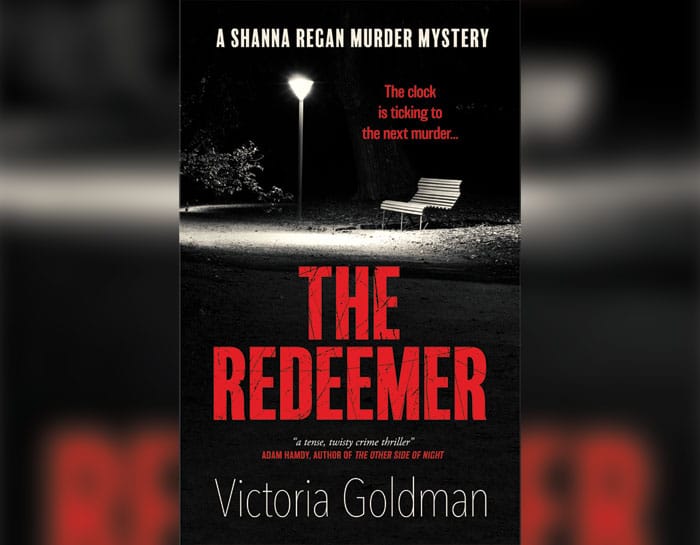
Faye Kellerman, behold your British counterpart! Violence, elusive clues, a gaggle of potential suspects, forgotten crimes, and a countdown until the next murder are mixed together with a healthy dose of Jewish education in a new, tightly wrought crime thriller, “The Redeemer,” by debut novelist Victoria Goldman. 

Victoria Goldman

If you like murder mysteries — sitting on the edge of your seat, not knowing what will happen next, but also comforted by the knowledge that the protagonist is sure to live and the bad guys will be caught — you’ll love “The Redeemer.” As in every good mystery novel, the author makes readers care about her protagonist before she puts her in all sorts of dangerous situations. In this case, the protagonist is Shanna Regan, a journalist. Shanna is considerate and thorough in her investigations; she’s also feisty, headstrong and worldly. Shanna works at a small-town local magazine in Hertfordshire, one of the home counties, as they’re called, in the south of England. Before she arrived in Hillsbury (a fictional town), she traveled the globe, spending time in Afghanistan, Iraq, Indonesia, India and Morocco. Among the novel’s mysteries is the question of what drove Shanna from her exciting career of freelance journalism to working at a dull lifestyle magazine in the middle of nowhere.

Perhaps the bigger mystery surrounding the heroine, however, is her interest in Judaism. What motivates Shanna to intercede on behalf of a visibly Jewish woman being harassed by antisemitic teenagers in the park? Why does she, a gentile, go to the synagogue when the congregants are holding their Hanukkah party? Or to the Jewish cemetery, when unknown mourners are holding a funeral? Moreover, why does Shanna’s mind keep replaying a memory of a girl in her school being bullied for being Jewish? What’s it to her? Over the course of “The Redeemer,” it becomes clear that the unsolved murders are not all that are motivating Shanna to be drawn into the Jewish world of Hillsbury.

As her involvement in the town’s crimes deepens, so too does her understanding of Jewish religious traditions and knowledge of Jewish history.

Raised in Ireland where she attended Catholic school, Shanna knows little about Judaism at the start of the novel, even needing to ask a local resident to identify for her the strange talisman she sees appearing on the frames of Jewish doorways. But as her involvement in the town’s crimes deepens, so too does her understanding of Jewish religious traditions and knowledge of Jewish history. Significantly, readers can learn alongside Shanna, just as readers have learned for decades alongside Los Angeles’s police lieutenant Peter Decker in Faye Kellerman’s bestselling Decker-Lazarus series (Decker and Shanna share something else in common, but I won’t spoil the fun!).

If I have one small complaint against the book, it’s that certain elements reinforce the idea that everything Jewish goes back to the Holocaust. Britain has its own long history of antisemitism, far older than the 20th century, and I would be keen to see a contemporary British novel that makes a usable past of the Norwich blood libel (the first such libel), or the crusades, or the 13th-century British expulsion of the Jews. Yet my quibble is small, since “The Redeemer” invokes the Holocaust in a novel manner, calling to mind the way that Canadian writer Ausma Zehanat Khan wove the tragedy of the Srebrenica massacre and the desire for vengeance into her debut crime novel, “The Unquiet Dead.” Moreover, I should stress, the Holocaust is not the focus of this book, and Goldman does an admirable job of illuminating present-day antisemitism in Britain. In the Afterword, Goldman poignantly notes that “All of the anti-Jewish (antisemitic) incidents in ‘The Redeemer’ are based on real-life events that took place in the UK while [she] was writing the book in 2018 and 2019.”

And as it happens, the Holocaust (or more precisely, post-Holocaust) history that Goldman weaves into her story couldn’t be more timely. It is also the subject of a new film called “Plan A,” based on a true story and starring Michael Aloni of “Shtisel” fame, which is being released this month.

On the whole, “The Redeemer” is a riveting read; I consumed it in two days, dying (sorry, sorry) to find out “whodunnit”! Goldman received an honorable mention for “The Redeemer” in the Capital Crime/DHH Literary Agency New Voices Award 2019, and it’s not hard to see why. She’s clearly talented. 

Happily, the book is labeled “A Shanna Regan Murder Mystery,” suggesting there are many more to come. It feels like a bit of a bold claim for a first novel, but I’m pleased to see it. Frankly, I’m ready for the next instalment!


Karen E. H. Skinazi, Ph.D, is Associate Professor of Literature and Culture and the director of Liberal Arts at the University of Bristol (UK) and the author of Women of Valor: Orthodox Jewish Troll Fighters, Crime Writers, and Rock Stars in Contemporary Literature and Culture.

Jewish Revenge in Small-Town Britain Read More »