fbpx

September 14, 2022

Westside JCC to Open “The Hive,” a New Infant Care Center

After years of planning, interrupted by a global pandemic, Westside JCC’s Early Childhood Center has announced the opening of a state-of-the-art infant care center for children six weeks to two years of age. The Infant Care Center — affectionately named “The Hive” — will meet the needs of young Jewish families who need safe, reliable, education-focused infant care and will be the only licensed Jewish center-based infant care program in the mid-city area. 

“As a Jewish Community Center, our main goal is to build connections between people and create community,” WJCC Executive Director Brian Greene said. “Young families, as they enroll their children in the Infant Care Center, will build deep connections to each other and to Jewish communal life through robust family programming.”


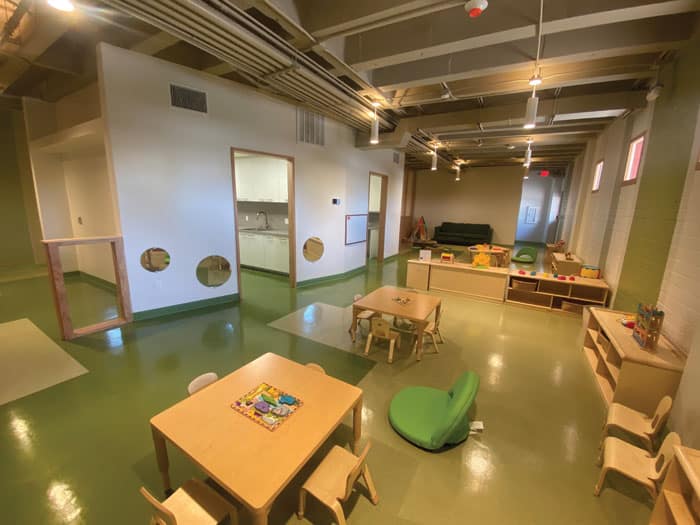
Going well beyond typical daycare, The Hive facilities include a dedicated crib room, environmentally friendly materials and on-site security. Courtesy of Westside JCC

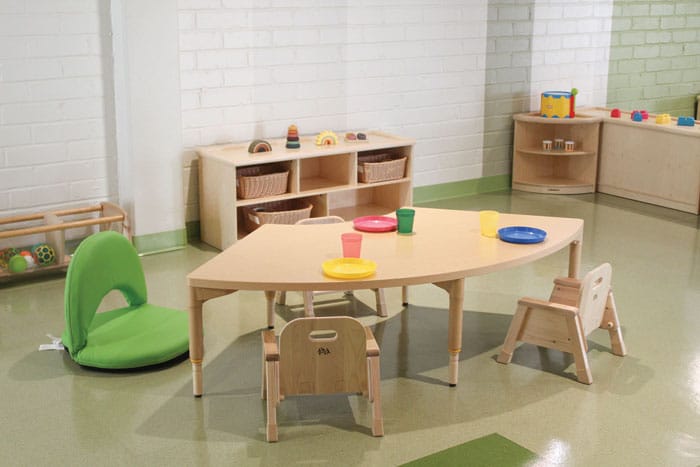
Going well beyond typical daycare, The Hive – expected to open this fall as a newly completed expansion to the Westside JCC’s Early Childhood Center – will offer a 3:1 infant-to-teacher ratio, highly qualified teachers and child development experts, a dedicated crib room and natural, environmentally friendly materials for the children.

“By expanding the preschool to meet the needs of families with infants, the opening of The Hive is a powerful example of individuals, board members, foundations, and institutions coming together to support Westside JCC in response to a true community need,” Westside JCC Board Vice President and Campaign Chair Amanda Johns Perez said.

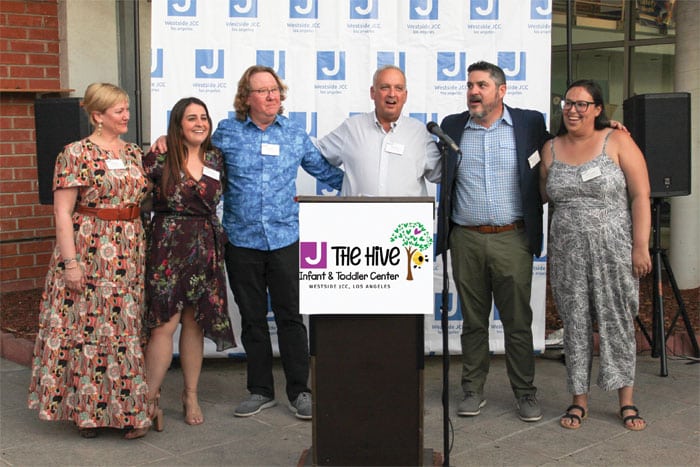
On Aug. 31, Perez was one of many donors, community members and Jewish communal leaders who gathered for a milestone event celebrating the new infant center. Additional participants of the dedication ceremony included Westside JCC’s Board President Steve Wallock, Jewish Federation of Greater Los Angeles CEO and President Rabbi Noah Farkas, JCC Association of North America Board Chair David Wax and Westside JCC Early Childhood Director Lauren Friedman. 

Delivering remarks about the Westside JCC’s impact and legacy, Wallock said he welcomed the addition of an infant care center to Westside JCC’s already-robust programming.

Westside JCC’s state-of-the-art infant care center is scheduled to open in the fall. Courtesy of Westside JCC

“The Hive will provide working families with trusted childcare in a Jewish, education-focused setting,” the JCC board president said. “It will create yet another opportunity at our JCC for families to form connections with each other and the Jewish community.” 

Since 1954, Westside JCC has served as a thriving hub for Jewish life, engaging and educating thousands of babies, children, teens, and seniors from across the religious spectrum and socioeconomic and geographical boundaries of Los Angeles. 

Located on a 120,000 square foot campus in the heart of mid-city Los Angeles – on Olympic Boulevard, just east of Fairfax – the Westside JCC serves the community by offering stimulating and innovative educational, cultural and recreational programs fostering a strong connection to Israel and Jewish life. 

Over the years, it has also served as a temporary home for a number of synagogues, schools and Jewish organizations, including IKAR, Progressive Jewish Alliance and Shalhevet High School. It has long served as an inclusive meeting space for diverse Jewish populations, from the observant to the unaffiliated.

Westside JCC to Open “The Hive,” a New Infant Care Center Read More »

Rosh Hashanah Sephardic-Style

When my family moved from Morocco to America, my mother managed to keep all the old traditions alive through the years. Rosh Hashanah for my mother meant lots of baking. She made honey cookies, sponge cakes and the most exquisite date and almond cigars. Unfortunately, these cigars are one of the lost recipes because I never paid attention when she made them. They were not made with the typical phyllo dough or Moroccan brik (egg roll style) sheets. She would mix her own dough, stuff with soft dates and ground almonds, roll into cigars, fry the cigars and in a final act of decadence, dip them in a honey syrup. The delicious memory lives on.My tireless Maman would peel and chop thick-skinned quince and stand over the hot stove, until she had the sweetest, prettiest pink quince jam for the Rosh Hashanah Seder table.

As for the rest of the simanim, (leeks, spinach, gourds etc) she would boil them in a soup and drizzle honey on them. Yuck! We weren’t quite as fond of that. (She would also make a flavorful soup with beef bones and all of the vegetables that make up the simanim.) There would be a table filled with bowls of Moroccan salads, along with her standout, perfectly seasoned, creamy chicken liver pâté (chopped liver). The main course would be couscous, with lamb and chicken, vegetables and stewed fruits, representing happiness and abundance, prosperity and blessing.

I have no idea how she made all this and ran her own business.

Rosh Hashanah meant wearing a new dress to synagogue. My mother would call it Estrenar (in Spanish it means to wear something new.) We attended services at Sephardic Temple Tiffereth Israel and we sat in the Moroccan section with Racquel Bensimon and her family in front of us. Behind us would sit the Sephardic Education Center’s very own Rabbi Daniel Bouskila, his sisters, Sylvie and Orly, his father Nessim from Marrakesh (the head tailor in the wardrobe department for Aaron Spelling Productions) and his mother Alice from Oran, Algeria. 

During breaks in the service, we would have so much fun telling funny stories in French and just laugh and laugh. 

After a long day of prayer, we would come home and eat tortilla de pattata and lots of salads. We never took a nap on Rosh Hashanah, so that we would have a productive year and not be sleeping all year.

Growing up, I was always by my mother’s side in the kitchen, learning tricks and tips. She always set a beautiful table and I follow her example, always setting a table with fine linens and cloth napkins, my finest chinaware, my silver and my crystal. Fresh flowers and candelabra with lit candles. I do as my mother did, I take it all out and use it. What should we save it for, if not these occasions!?!

Pour your love into everything you make because your family and guests will taste it with every bite. Food memories are the most special and awaken so much emotion in our hearts.

—Rachel

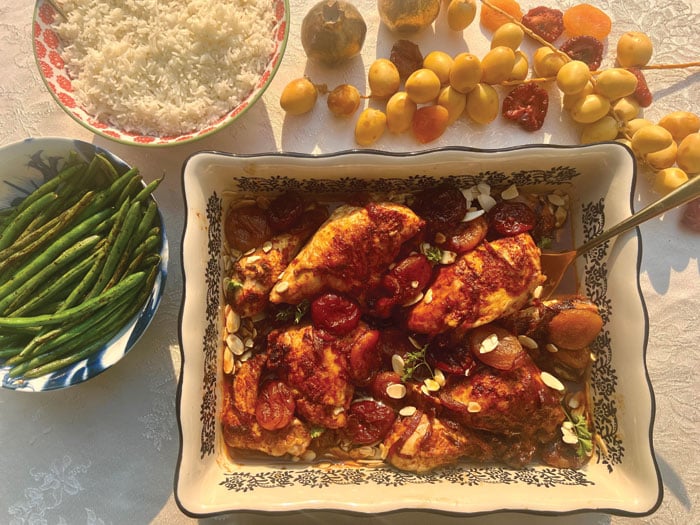
Djaje Bi Mishmash
Chicken with dried fruits

About five years ago, Alan and I traveled to Panama to have a romantic getaway for the other New Year. We loved it so much and felt so guilty for not bringing our children (they had school that week), we brought them to Panama two years later. 

Panama is a tiny nation filled with stark contrasts and incredible wonders. Panama City, which nestles the Pacific Ocean, is filled with Manhattan-style skyscrapers and jungle vegetation. You can spend the day with the man-made ingenuity and wonder of the Panama Canal. You can feed the wild and cheeky capuchin and tamarin monkeys on Monkey Island. You can take a catamaran to the Pearl Islands and laze on the most stunning white sand beaches. You can drive from the Pacific Ocean, and a mere 45 minutes later, find yourself at the Atlantic Ocean, where you will see old Spanish fortresses and stunning, colorful tropical fish in the warm blue sea. 

Of course, when you’re Jewish it’s all about the food. And in Panama City you are in luck. The Jewish community emigrated there from Syria starting in the 1820s and is an integral part of the country’s political, finance, construction, tourism and textile sectors. Put it this way, when you enter the exhibit adjacent to the Panama Canal, you can kiss the mezuzot on the doors and eat empanadas at the strictly kosher Coffee Bean. 

For a city that boasts a Jewish population of 15,000, the selection and quality of the kosher restaurants is astounding. And the two kosher supermarkets are both the size of a small town, with countless options. As a Sephardic Spice Girl, I was intrigued by all the spices and other exotic ingredients available. You could just feel the incredible traditional Syrian cooking coming out of those high rise kitchens. Inspired, I brought home “kubbah” spices and packages of tamarind. We returned to Los Angeles and made lots of delicious lach’majin, ground beef flavored with with tamarind on a flatbread (Trader Joe’s pizza dough works fabulously for this recipe).

Tamarind is the sweet and tart secret ingredient of the Syrian kitchen. When Rachel found this fabulous recipe for chicken with dried apricots in the Syrian/Mexican cookbook “Sefre Dayme,” I was all in. 

We adapted the recipe by adding red onions and dried plums and subbing silan for the honey. The chicken was perfectly sweet and sour, moist and tender.

—Sharon 

3 to 4 pounds chicken, cut into 10 pieces
1 large red onion
¼ cup olive oil
2 cups orange juice
½ cup tamarind paste
1/3 cup silan (date syrup)
1 teaspoon paprika
Salt to taste
½ teaspoon white pepper
½ cup dried apricots
½ cup dried plums
1/2 cup water
1/3 cup toasted peeled slivered or whole
almonds, for garnish

  • Preheat oven to 350°F.
  • In a medium bowl, whisk tamarind paste, orange juice, silan (date syrup), paprika, salt and pepper, then set aside.
  • In an oven safe skillet, warm the oil over medium low heat and sauté the onions until golden, about 8 minutes.
  • Add the chicken pieces skin side down and sauté for 3 minutes, then flip the pieces.
  • Add the dried fruits, tamarind sauce and water to the skillet.
  • Cover with foil and bake for one hour. Uncover and bake for an additional 15 minutes.
  • Remove from oven and transfer to a serving platter, then add the toasted almonds.
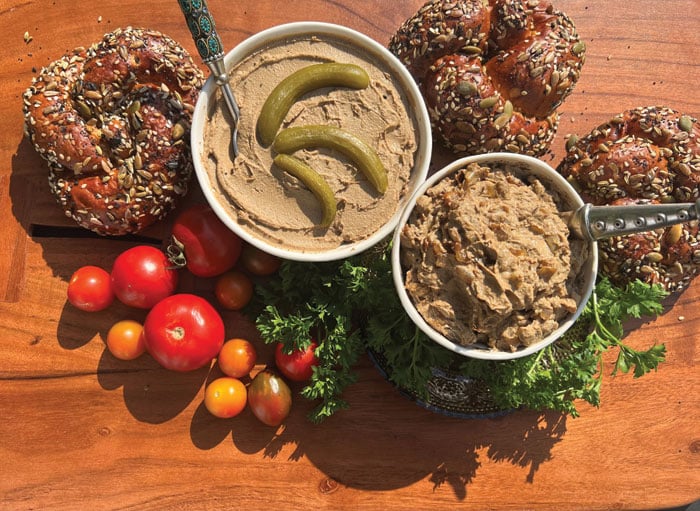
Chicken Liver/Pate au Foie

CHICKEN LIVER / PATE AU FOIE

I’ve been eating pate au foie all my life. My mother’s pate was legendary, melt in your mouth heaven.  As a I child I got excited knowing it was on the table. I don’t ever recall a holiday without it. I started making it when I got married. My husband asked me to add caramelized onions, chopped parsley and hardboiled egg, so it became “chopped liver.” 

Nowadays I only make it several times a year, but always for Passover and Rosh Hashanah. Of course, my kids won’t touch it. What is it about being born in America that makes them dislike liver? Regardless, you will always find it on my table.

—Rachel

3 pounds chicken liver
1 tablespoon kosher salt
3 medium onions, thinly sliced
¼ cup extra virgin olive oil
1 stick (8 tablespoons) Miyokos Vegan Butter, or margarine or schmaltz
2 medium carrots, peeled and sliced
4 large bay leaves
1 cup chicken broth or water
¼ cup cognac or white wine
Juice of one lemon
2 teaspoons white pepper
Salt to taste

  • Drain all visible blood from the chicken livers, then place on a baking sheet lined with foil or parchment paper.
  • Sprinkle with 1 tablespoon kosher salt, making sure each chicken liver is salted.
  • Place in broiler for 5 minutes. Remove from oven and drain all juices.
  • In a large pan, sauté onion in olive oil until it becomes soft and slightly golden, about 10 minutes.
  • Add the vegan butter, carrots, bay leaf, chicken broth, white pepper, livers and cognac or white wine.
  • Reduce heat, cover and allow to simmer until liver is soft and juices are reduced and thick, about 20 minutes.
  • Remove the bay leaves.
  • Remove from heat and let cool 10 minutes.
  • Pour into a food processor and whip for 3 minutes or until very smooth. Pulse if a chunky texture is preferred.
  • Add lemon juice and process a few more seconds.
  • Taste and adjust salt or pepper.
  • Refrigerate overnight, or freeze in a well-sealed container.

For Chopped Liver
Add caramelized onion, finely chopped parsley and chopped hard boiled egg.

Pecan Knafe

Pecan Knafe

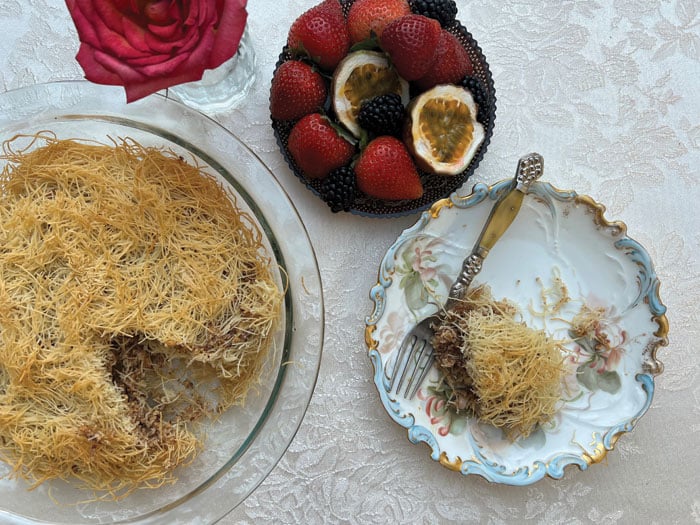
Along with wonderful memories and precious photos, Neil and I returned from our summer trip to Istanbul with a love for Knafeh. Knafeh is a popular Middle Eastern dessert made with thin, crunchy filaments of shredded Phyllo pastry called kataifi. It is typically layered with cheese and nuts and soaked in a sweet orange blossom or rosewater scented syrup.

Along with wonderful memories and precious photos, Neil and I returned from our summer trip to Istanbul with a love for Knafeh.

I was inspired to make knafeh and film it for an Instagram reel and we had an incredible response. Estrella, my daughter-in-law, told me that her Syrian Jewish family makes a pareve verision of knafeh. Her mother Denisse, originally from Guadalajara but now living in Miami, makes her version of Knafeh with pecans every Rosh Hashanah.

Intrigued, I turned to my trusty Syrian cookbook, “Sefra Dayme”.

(In the 1980’s, my husband Neil led many memorable Hamsa summer trips for the Sephardic Educational Center. Among the many teen participants from Mexico City was Elias Harari. Years later when his son came to Los Angeles to study at USC, we had the pleasure of hosting him at our home on many Shabbats. When Elias and his lovely wife Rebecca Uziel came to visit us for the first time, she brought me this beautiful cookbook.)

“Sefra Dayme: Cien anos de cocina Judeo-Damasquina en Mexico” (One hundred years of the Jewish Damascene kitchen in Mexico) was written in Spanish by Amelia Romano de Salame. It is a love letter filled with traditional recipes that originated with the Jewish community of Damascus, Syria.

The inside flap of the book wishes the reader “May you always have a table of abundance, blessed food, a table filled with joy.”

So I asked Estrella’s grandmother Telly to explain what Sefra Dayme literally means. Do they as a Syrian family use this expression? She sent me a WhatsApp message explaining how to use this saying.

As a guest at someone’s home for dinner, after enjoying the food, you will compliment the hostess by saying “Sefra Dayme,” everything was delicious. She will respond “Awafi,” may it be good for you. (In Spanish, buen provecho. In French, bon apetit. In Hebrew, b’te’avon.)

Anyway, this recipe for Knafeh with its layers of crispy thin filaments of pastry, pecans and orange blossom syrup is just heavenly — honeyed, crunchy and nutty.

A perfect dessert for a sweet Rosh Hashanah.

– Rachel

Miel Arabe (Arabic Honey Syrup)
1/2 cup water
1 cup sugar
½ lemon, juiced
1 teaspoon ground cinnamon (optional)
1 tablespoon orange blossom water (or rosewater)

  • In a small saucepan, bring water to a boil over medium heat. Add sugar and stir until sugar has melted.
  • Add lemon juice, cinnamon and orange blossom water and stir well.
  • Set aside to cool for at least one hour, so that the syrup thickens.

1 16 ounce package of Kataifi pastry
8 ounces vegan butter, melted
1 cup of sugar
2 cups chopped pecans
1 teaspoon ground cinnamon
1 cup Arabic honey syrup

  • Preheat oven 350°F.
  • In a large bowl, separate kataifi strands so that they are loose and fluffy. Add melted vegan butter and mix well. Set aside.
  • In a separate bowl, mix the sugar, ground pecans and cinnamon.
  • Place half the pastry into a greased baking pan or glass pie dish. Sprinkle nut mixture evenly over the pastry. Cover with the remaining strands of pastry.
  • Bake for 40 minutes or until pastry appears golden and crunchy. Remove from oven drizzle with Arabic honey syrup.

Notes:
Miyoko’s Creamery Butter is our favorite vegan butter.
Any nuts you love will work in this recipe: almonds, walnuts, pistachios.
All spices and flavored waters are optional.


Sharon Gomperts and Rachel Emquies Sheff have been friends since high school. The Sephardic Spice Girls project has grown from their collaboration on events for the Sephardic Educational Center in Jerusalem. Follow them on Instagram @sephardicspicegirls and on Facebook at Sephardic Spice SEC Food. Website sephardicspicegirls.com/full-recipes

Rosh Hashanah Sephardic-Style Read More »

Rabbis of LA | Rabbi Judy Greenfeld: Providing Inspiration Beyond the Walls of a Synagogue

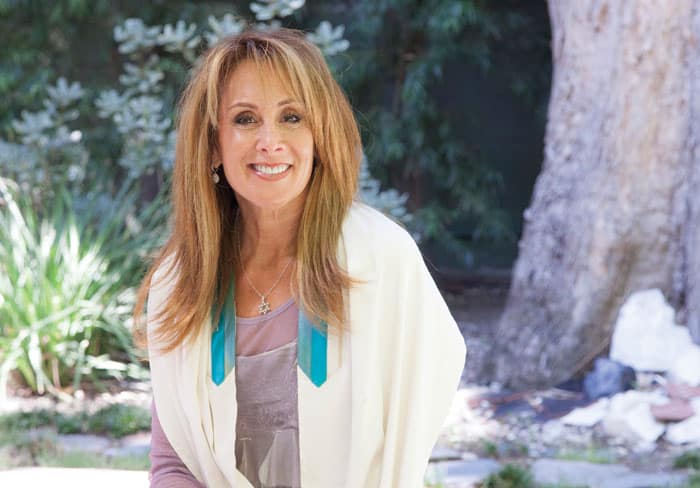
Rabbi/Cantor Judy Greenfeld has always been a spiritual visionary. 

In 2005, she founded Nachshon Minyan, an unaffiliated minyan without walls. Services are held in different indoor and outdoor locations as well as livestreamed for members at home.

“I wanted to be what the big synagogues couldn’t offer, which was a more inclusive and flexible way to enter into Judaism,” she said. “I wanted this kind of Judaism, so I made a pact with God: If 10 people keep showing up, I’ll keep doing this. Ten kept showing up, and more came, every year.” 

Greenfeld’s spiritual journey began when she was a child growing up in a Conservative Jewish home in Cleveland, Ohio. She went to Hebrew school four days a week, all the way through high school, and lived in a lively Jewish community. Her father was the vice president of the Zionist Organization of America.

“There was a strong pride around being Jewish in my home,” she said. 

She had no desire to become a rabbi and cantor, but events that unfolded in her life that led to her wanting to connect more with her faith. 

When she was 16, her father was murdered in Cleveland. Her parents went downtown to see a show, and three teenagers held them up at gunpoint; one of them shot and killed her father.

“My world turned upside down, and I was very angry at God,” she said. “How could God have let this happen when we were this nice family growing up in suburbia? How could this have happened?”

For years, Greenfeld explored other religions for solace. 

“I looked into Buddhism and different types of spirituality at the time,” she said. “I searched everywhere, especially in yoga, meditation and psychology. Then, I remember sitting in a meditation class, and they asked me to find my Christ consciousness. I said, ‘Oh my gosh, I don’t have that.’ I needed to find out about what Judaism had to say about tragedy and look for the beauty in my religion.” 

At first, Greenfeld didn’t understand how rabbis and cantors could be so immersed in prayer. This curiosity kicked off her journey to becoming part of the rabbinate herself.

“How could they be so engaged in services for four hours? What kind of spirituality did they tune into? Because I’d like to know about it.”

“I needed to know what was so exciting to rabbis and cantors that I wasn’t understanding,” she said. “How could they be so engaged in services for four hours? What kind of spirituality did they tune into? Because I’d like to know about it.”

When Greenfeld was 40 years old and married with two children, she decided it was time to seek out the answers and connect with her Jewish heritage on a deeper level. In 2004, she became ordained as a cantor at Academy for Jewish Religion, California.

“I loved to sing and I knew all the prayers,” she said.

For eight years, Greenfeld worked as the second invested cantor at Temple Emanuel in Beverly Hills in the New Emanuel minyan, an alternative minyan there. While she enjoyed her work, what she really wanted to do was start her own minyan – which is how Nachshon came about. 

“Judaism was built without walls under the idea of the mishkan,” she said. “My congregants want an immersion that isn’t just brick and mortar. I felt very motivated to provide that.”

After 11 years of running Nachshon as a cantor, in 2016, she decided to go back to AJRCA and become a rabbi, too. Today, Greenfeld understands what all those cantors and rabbis were so excited about. Judaism not only provides her with a meaningful connection to God, her community and herself, but it also helps her process the misfortune she’s experienced in life.

“Torah is my complete inspiration,” she said. “I went through a tragedy at 16 and I got divorced in 2014, which felt like a tragedy unto itself. Learning Torah and committing myself to my Jewish lifestyle and community make me get up in the morning. It’s really in my heart to be giving and sharing. I love being part of this Jewish continuity and lineage.”

Fast Takes with Judy Greenfeld

Jewish Journal: What is your favorite Jewish food?
Judy Greenfeld: Kasha varnishkes. And also matzo ball soup.

JJ: What career would you have if you weren’t a rabbi?

JG: Nothing. Being a rabbi and cantor is who I really am. 

JJ: What yoga position do you like the best?

JG: It’s the hardest one for me to do, but I love the tree. When I do the tree position to stabilize myself, it’s so primal. My body is the trunk of that tree, and I root myself so deeply in the earth. I can feel the life force. 

Rabbis of LA | Rabbi Judy Greenfeld: Providing Inspiration Beyond the Walls of a Synagogue Read More »

Table for Five: Ki Tavo

One verse, five voices. Edited by Salvador Litvak, the Accidental Talmudist

Look down from Your holy dwelling, from the heavens, and bless Your people Israel, and the ground which You have given to us, as You swore to our forefathers, a land flowing with milk and honey.

– Deut. 26:15


Dini Coopersmith
Teacher, Trip Director, reconnectiontrips.com

This request to look down upon us is made right after we have given maaser ani, which is charity to the poor. We ask Hashem that in return for giving of our produce and money to the Levites, the downtrodden and the poor, He keep to His “end of the deal” and fulfill the promise to give us the abundance of the Land flowing with milk and honey. 

The Hebrew word for “Look down” is “hashkifa“. According to the Sages, this word always has negative connotations (“Hashem looked down upon Sodom”) except for this instance, to teach us that charity has the power to turn anger into mercy. 

It seems that God reflects our behavior and treats us in the same way we treat others. There is a phrase taken from Psalms, “God is your shadow”. When we show other people kindness and bring goodness and light into the world through our actions and character, God responds measure for measure and sends abundance and blessing our way. 

The wording of the midrash, “turns anger into mercy” reminded me of the idea that when the shofar blows, we are shaken into returning to God, and then He in turn “gets off the chair of Judgment and moves to the chair of mercy”. 

As we enter the High Holy Days and reflect on ways in which we can improve, let’s start with treating others with kindness and compassion and merit to receive an abundantly compassionate sweet new year. 


Ben Elterman
Screenwriter, Essayist, Speechwriter at Mitzvahspeeches.com

The phrase “You swore to our forefathers a land flowing with milk and honey,” is a little odd. You would think by “forefathers” it is referring to Abraham, Isaac, and Jacob, whom God originally promised the land of Israel. However, there’s no mention of the milk and honey anywhere in the book of Genesis. That phrase doesn’t show up until Moses is speaking to God at the burning bush in Exodus 3:8. 

The Ramban suggests that the term “forefathers” actually refers to the generation that left Egypt and not the original big three. Why would Hashem not tell Abraham, Isaac, and Jacob about this special and delicious detail of the land? 

I believe the Torah is giving us a brilliant idea about the rewards of work. The generation that left Egypt had firsthand experience of how being without a homeland can be catastrophic. They literally spilled blood, sweat, and tears during their exile. But it’s only from that effort and sacrifice that one can truly enjoy an achievement. Abraham, Isaac, and Jacob could have dreamed about the miracles and marvels of the land of Israel. But without going through the crucible of Egyptian slavery, they couldn’t possibly fathom the sweetness of the reward found in that land. 


Rabbi David Eliezrie
President, Rabbinical Council of Orange County

Judaism is a two-way street between the Creator and his creations. Once Jews have followed the commandment of tithing, they request that G-d shower them with blessings. But more lingers here. What a Jew is really saying is, “I have served you passionately, even doing beyond the actual letter of the law. In return you should act with me beyond my expectations.” 

This goes to the core of how we approach a mitzvah. It can be done with rote, “Oh I must attend High Holy Day service because grandma would be disappointed if I don’t.” The proper approach is to reach deep into ourselves and foster an excitement of doing a Mitzvah. “Wow, this year begins a whole new cycle. I have a new opportunity to reconnect with Hashem.” 

Rabbi Yosef Ber Soloveitchik would recall his childhood teacher who before Rosh Hashanah declared with excitement, “we are going to the coronation of G-d”. That Jews every year on Rosh Hashanah announce to the world that Hashem is the creator and true sovereign of the world. 

You can’t just show up on Rosh Hashanah expecting the rabbi’s sermon to be what makes or breaks the holiday. You have to do some spiritual lifting in advance. We must set aside time to foster the spiritual side of life. To study Torah, to inspire ourselves and others, and prepare ourselves for Rosh Hashanah. 


Yael W. Mashbaum
Interim Middle School Director, Sinai Akiba Academy

Parashat Ki Tavo prepares the nation to enter the Land of Israel. 

The Israelite farmer is handed a series of speeches to recite upon delivery of his first fruits and his tithe. These prescribed words are written in first person, so that any Israelite farmer can memorize the script and recite it correctly. 

And then, BAM! 

A stark contrast is the verse on the table which is written in the plural. The individual Israelite asks God to look down from heaven and bless the people and the soil given to us. We read this verse in Elul, as we prepare for Rosh Hashanah and Yom Kippur, when God is described in anthropomorphic terms as the King sitting on a throne throughout the machzor. We read this verse in Elul when we turn to plural language regarding our sins even when we speak individually to God about our hopes and dreams for the year. 

In the final book of the Torah, Moshe exudes anxiety that the Israelites will not keep the Covenant, and his retelling the mitzvot is an effort to remind the nation how to survive and thrive long after his leadership. The juxtaposition of this verse in which God is asked for a communal blessing with the many that come before, teaches us that each Jews’ practice of Torah and mitzvot, contributes to our communal commitment to the Covenant. 

May we each follow the individual prescriptions so that we attain the communal blessings. Shanah tovah.


Denise Berger
Freelance writer

This passage might be the only place in the Torah where we tell G-d what to do, rather than ask. The location of the pasuk gives an understanding about what’s really going on here. 

The parsha begins with an overview of our settlement of Israel, reminding us that G-d has given it as our inheritance. We are to bring the first fruits to the Kohen, declaring that because of Hashem’s promise we are in the land. We then direct our words to Hashem, recalling the origins of His promise, starting with Yakov and Lavan and continuing through to the arrival in Israel. We are told to worship and rejoice, and we’re reminded how to treat the vulnerable. Finally, we are to point out to G-d how well we have fulfilled His requests. And then we tell Him to bless us. 

If we’re able to fulfill everything on that list, we are already amazingly blessed. But human nature is such that when things go well, we consider the facts of our daily lives to be the natural order rather than a divine gift. Right at our peak of being impressed with ourselves, the Torah harnesses that arrogance to align our hearts to Hashem. There is no condemnation of boldness or entitlement or lack of humility. Instead, those very traits are embraced and channelled in a way that reconnects us to a recognition of what it means to be blessed. 

Table for Five: Ki Tavo Read More »

Ein Kerem

This poem is a tribute to the Israeli poet Yehuda Amichai, who died on September 22, 2000, in the Hadassah Hospital that overlooks the village of Ein Kerem, located in a valley outside of Jerusalem.

The lines in italics are direct quotes taken from his poem “In This Valley.”

Ein Kerem

After In This Valley, by Yehuda Amichai

The road winds down into the valley
a valley like there are many here
carved out by many waters in endless years
with sudden breezes and instant stillness
valleys I have seen in the poems of Yehuda Amichai
poems that give words to speechlessness
that honor what was and was not
the in-betweens
like a breeze passing through the valley without being destined for it

The day is hot
From the hills, I hear voices of men, machines wrecking
To my right, a building stretches into the void
over pines and umber soil
like his name
a pledge to choose life
despite the abyss between heaven and earth

There are loves that must die in their place and their time
He died in the building on the crest to my left
At Miriam’s spring, naked children yell and splash water
in exhilaration, like only young children can
or truly happy people
I enter the garden alone, a sudden breeze
turns stillness into bouncing shadows
cools the sweat on my temples, my scorched words

In this valley, I want to sing of loves that last forever
I want to leave the wrecked buildings of my life behind


Julia Knobloch is a poet and rabbinical student, currently studying at the Fuchsberg Center in Jerusalem. 

Ein Kerem Read More »

AJU’s Decision to Sell its Bel Air Campus is a Loss with an Upside

These are the most difficult columns to write, because I’m torn between two sentiments. On the one hand, I don’t want to feed communal anger; but on the other, I don’t want to dismiss it either.

I’m referring to American Jewish University (AJU)’s decision to sell its Bel Air campus to an international education organization. Since AJU announced in February its intention to sell, one of the hot topics of conversation in our community has been, “Will they keep it in Jewish hands?”

Well, it won’t stay in Jewish hands. That decision has been made. From what I hear, they came close to selling the campus to Milken Community School, which is located nearby and needed more space to accommodate growth, but the sides couldn’t reach an agreement. Negotiations went back and forth for several months. In the end, AJU went with another, presumably higher, offer.

Had the sale to Milken gone through, this column would have turned from the hardest one to write to the easiest. Everyone loves a happy ending!

No such luck this time.

This lack of a happy ending makes me sad on two fronts. One, the hard feelings among people who opposed the sale will guarantee that some Shabbat and Holiday table conversations will be dominated by those hard feelings. I totally get that. That’s the reality of Jewish communal life. When people are upset, they want to share it with others, whether it’s on Rosh Hashana night or on a regular Monday night.

But the second, more important reason for my sadness is that not enough attention will be paid to what I believe is the essential question coming out of the sale:

What will AJU do with the money?

Losing “Jewish real estate” is more tolerable if the tradeoff is that the community would gain something greater.

In other words, can AJU take its new funds and accomplish something over the next 20 years where we can look back and be grateful for what they’ve given the community?

The past two years give us a clue. Since the onset of the pandemic, AJU has reinvented itself as a global resource of Jewish learning. It created an online conversation platform, Maven, that has hosted prominent speakers from around the world. It also relaunched its business program as the online School of Enterprise Management and Social Impact, training MBA students to become purpose-driven leaders.

This reinvention won’t please everyone. Many of us are emotionally attached to the old AJU and the communal events and programs we attended for many years. But that model was no longer sustainable, either for a college or for communal events. Especially in this lingering COVID era, it’s tough enough to get Jews to show up for anything, let alone schlep in 405 traffic to get there.

Don’t get me wrong: Getting Jews to show up in person will be a huge priority in the post-COVID Jewish world. But that also means having locations that are more easily accessible than a mountaintop.

Put simply, from what I can gather, AJU looked at a radically changing world and its human assets and decided that its best bet was to become, among other things, a global force in online Jewish learning.

AJU’s challenge will be finding the right balance between its global online presence and its in-person communal presence. It still owns the 2,700-acre Brandeis Bardin Campus in Simi Valley, which hosts the annual Camp Alonim summer program; it will need to figure out what else to offer the local community. To help sort this out, it has established a working committee to oversee the process and plan for the future.

Here’s the intriguing question: If AJU indeed finds the right balance between its global and local presence, and L.A. becomes home to a popular, world-class online learning institution in the Jewish world, will that be a net win for our community?

Also, can Brandeis Bardin become a premier destination for Jewish retreats? And will AJU use its new capital to surprise us with some creative local initiatives, including a new location with original programming?

I get that some people would prefer not to dwell on such questions right now, because they’re still upset over the sale. I don’t want to dismiss those sentiments or even downplay them.

All I’m saying is this: for better or for worse, the decision has been made. What’s the best way to now move forward? Yes, it’s OK to grieve the loss of Jewish real estate and at the same time bemoan why it had to happen.

But while we do that, it’s also OK to wish AJU well on its new journey, give them some space to see what they will do, and, yes, even hope for a happy ending.

Shana tova.

AJU’s Decision to Sell its Bel Air Campus is a Loss with an Upside Read More »

Moroccan Muslims Are Reviving Jewish Heritage in Former Jewish Neighborhoods

To read more articles from The Media Line, click here.

Moroccans now living in the mellahs – historic urban neighborhoods in Moroccan cities that were once thriving Jewish quarters – do not know anything about the people who lived there before them. These neighborhoods later became small, mostly poor ghettos, with little to no connection to Jews today. 

But a new program might change this. “Rebuilding Our Homes” is a multi-year US Agency for International Development-supported New Partnership Initiative of the American Sephardi Federation and Mimouna Association. It aims to revive the prosperous Jewish life in the historic urban areas in Fez, Essaouira and Rabat, by teaching their current residents about local history, and helping to make them part of the rich heritage of the place. 

“We make the residents of these neighborhoods take part in preserving the place by letting them document and upload photos of old Jewish houses to our archive, and teaching them Hebrew,” Jason Guberman, executive director of the American Sephardi Federation, told The Media Line.

Guberman is one of the founders of the three-year project, which still has another 18 months to go.

 “We wanted to establish a connection between youth and grownups in these neighborhoods and their own history – as well as to the rich Jewish heritage surrounding them,” he explained. 

This is the reason for another workshop that has become part of the project: Judaica and traditional Jewish art. 

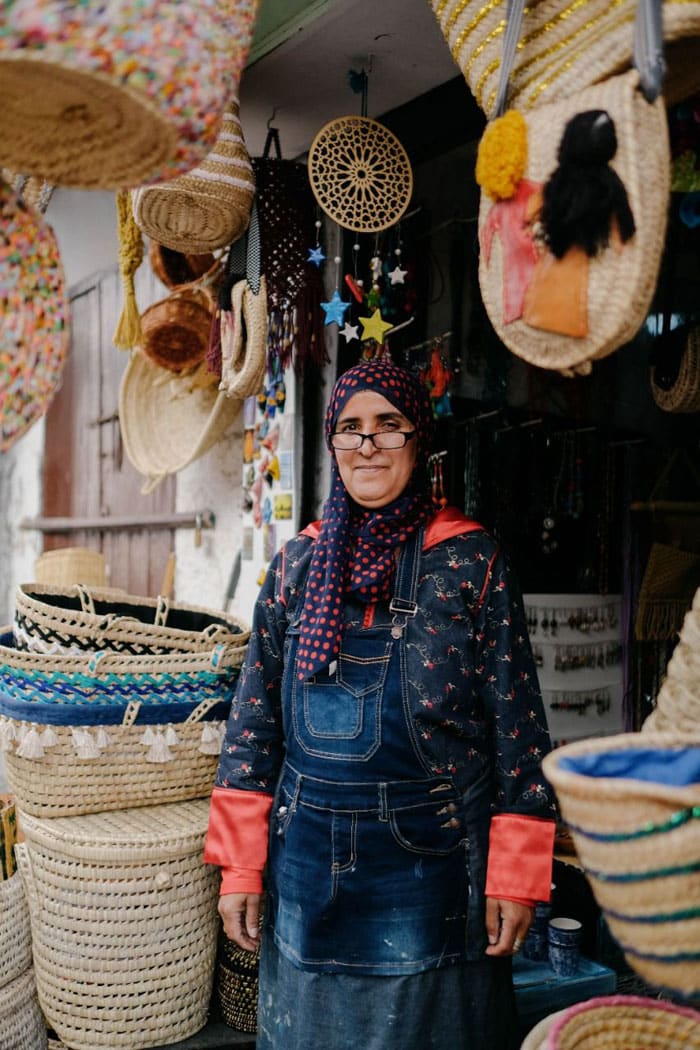
Today, many of the residents of the mellahs make a living from creating Jewish artifacts and selling them to tourists. Mezuzas, Shabbat candlesticks and other traditional pieces of Judaica made by Muslims are filling the shops in the narrow alleys. 

“I took a course in traditional Jewish industry, and how to mix it with local Moroccan art,” Hicham Essaidi, one of the artisans taking part in the project, told The Media Line. “We learned about what tools Jews use for their holidays, what’s important in religion and many other nuances.” 

The course, he explains, was presented as part of a cooperation of the Mimouna Association, the American Sephardi Federation, USAID and the Mohammad V Foundation. 

Essaidi said he is excited to meet the expected tourists to the neighborhood and expressed his hope that many Israelis will come to Morocco.

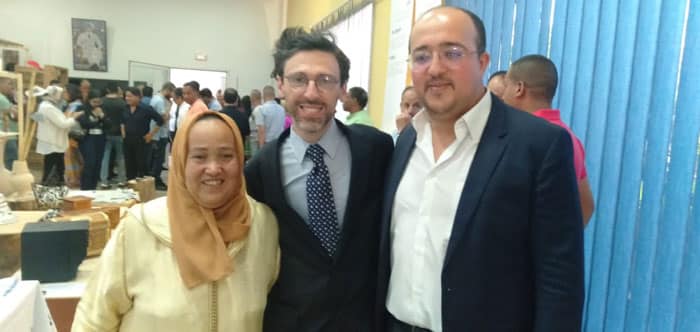
From right, El Mehdi Boudra, founder/president Mimouna Association; Jason Guberman, executive director, American Sephardi Federation; and Moroccan artist Amina Yabis at the Rebuilding Our Homes exhibit opening at the Mohammed V Foundation in Fez (Courtesy)

“We had to teach people not only the art, but also go deep into the meaning of each artifact,” El Mehdi Boudra, president of the Morocco-based Mimouna Association, told the Media Line. “These artifacts will be sold to Jewish and Israeli tourists, which we expect in big quantities starting next year,” he added. 

Some 200,000 Israeli tourists are expected to visit Morocco next year. Israel and Morocco agreed to normalize relations in December 2020 as part of the Abraham Accords. 

“There were only four Hebrew-speaking tour guides in the kingdom before we started the project. Now there are 200, and many more want to learn Hebrew. People are waiting for Jews to come visit, and they are looking forward to interacting with them,” Boudra said. 

As to his own connection to Judaism, Boudra has a surprising answer. 

A Moroccan Muslim woman displays her wares in the mellah. (Courtesy/Hicham Essaidi)

“I’m a proud Muslim. Ethnically I’m Arab and Amazigh. But culturally I’m Moroccan, which means Jewish as well,” he said. “Morocco was home to the biggest Jewish community in the Muslim world for centuries. Judaism is an integral part of our culture as Moroccans, and we should take pride in that.” 

Prior to the massive immigration of Moroccan Jews to Israel in the 1960s, there were nearly 250,000 Jews living in the kingdom, in several different cities. 

“My mom came from Casablanca, where Jews and Muslims lived side by side, so I always heard stories about the Jewish community, without knowing them personally. The younger generation living in the mellahs, however, knows almost nothing about the rich Jewish heritage our country has,” said Boudra, whose association is one of several partners supporting the project.

Boudra said that the general public has a positive opinion about the Jews who lived in the mellahs. 

“We surveyed what people here thought about Jews before we started the project, and discovered 85% of the population has a positive opinion about them,” he said. “That’s a high support rate, which was important for us to initiate the program.”

 “We also tested what people think of the Abraham Accords and found out that about 93% of people are supportive of (Jews), mainly for economic reasons. It’s a good reason, but we wanted to encourage a connection to Jews and Israel that is deeper than just money. The two peoples were close, and could be as close once again,” he explained.

Rebuilding Our Homes, including the courses and workshops the program offers to locals, is expected to carry on for another year and a half. Boudra says it should be more than enough. 

“Our goal was to give people the tools to develop their neighborhoods and make them welcoming for Jewish tourists, because the economic prosperity shouldn’t stay only at the high-class resorts and hotels,” he said. “But now it’s up to them. We hope the people living in the mellahs take these tools and go forward with them, making this a success story. And we are optimistic,” he said. “People are already starting to open kosher Moroccan restaurants and show more enthusiasm about Judaism. We hope this continues.”

Moroccan Muslims Are Reviving Jewish Heritage in Former Jewish Neighborhoods Read More »

Pat’s Dairy Restaurant Reopens After Three Decades

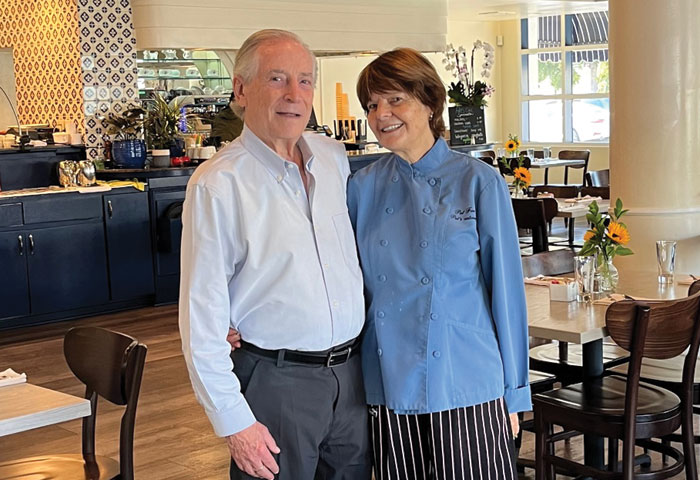
Thirty-five years ago, Pat’s opened up in Pico-Robertson. At the time, it was one of two kosher restaurants in the neighborhood – the other was Pico Kosher Deli, which is now closed. At first, Pat’s served dairy food, but after two years, they switched over to meat. 

“That was the best thing we could have done,” said Errol Fine, who owns the restaurant with his wife, Pat. “In those days, you really couldn’t find a fine dining kosher restaurant.”

Now, after three decades, the Fines have re-opened Pat’s Café, the original milchig restaurant, but with a modern twist. It’s in the old location on Pico Boulevard where Pat’s, the fleishig restaurant, used to be before the pandemic. The meat restaurant is across the street at The Mark, an outdoor space. 

“We thought we couldn’t let our location go, so we maintained it and opened it again,” said Errol.  

Pat’s Café is serving breakfast and lunch food like French toast, a Caesar salad with salmon, a roasted vegetable sandwich, pastas, ice blended drinks, huevos rancheros and a poke bowl. Pat came up with the menu, just as she did for the meat restaurant.

“Since I am strictly kosher, I can’t really go out and eat, so I’ve got my ear glued to the ground. I try to tweak things and create them on my own.” – Pat Fine 

“I’m always researching new food trends,” said Pat. “Since I am strictly kosher, I can’t really go out and eat, so I’ve got my ear glued to the ground. I try to tweak things and create them on my own.” 

Pat and Errol came to the United States from South Africa in 1976, when Errol got a job as an accountant in Los Angeles. At the same time, Pat had been a pharmacist, but decided to be a stay-at-home mom, as they had three young sons. 

“We saw that in the long term, it would be good for our family to leave South Africa because there was an opportunity here,” said Errol. “We knew we needed to take it.”

After arriving in L.A., Pat started catering events out of their kitchen in Santa Monica, where they lived at the time. One day, Errol’s cousin had a bar mitzvah, and they asked Pat to help make the food. 

“Everybody loved what she made,” said Errol. “She was self-taught and has always had a great desire to do well in the kitchen.” 

At first, Errol and Pat opened Elite Cuisine, a casual dining kosher restaurant, first in Pico-Robertson, then La Brea. Once a fine dining space at 9233 W Pico Blvd. opened up, they decided they’d give it a go. 

Pat and Errol have been trendsetters from the start, tapping into what’s happening in the world of non-kosher dining and making kosher versions of the same dishes. When they first opened the dairy restaurant three decades ago, a very important rabbi came in, and they served him gourmet-style ravioli.

“He nearly freaked out and said, ‘What’s this?’” said Pat. “I said it was ravioli. He had never heard of such a thing. Later, he called us and said, ‘What’s the ravioli of the day?’ It was hilarious. In those days, people used to call it mac and cheese. We brought new types of food to the Jewish world.”

When dining at the new Pat’s Café, customers may recognize the waiters from the meat restaurant – that’s because many members of the staff have been with them since they started in the ‘80s. 

“I’m very much a kitchen person and care about my staff tremendously,” said Pat. “I’m in the trenches with them all the time and work side by side with them. We learn to respect each other and work together. They appreciate it. They’re like our family.” 

Both Pat and Errol, who have been together for 50 years, believe their respective partner is responsible for the success of their restaurants. 

“I have a very patient husband,” said Pat. “He’s kind to everyone. He is the heart and soul of the business.”

Errol echoed a similar sentiment about his wife. “If somebody were to say to me, ‘Who deserves the credit?’ I would say unquestionably and undoubtedly, it’s Pat,” he said. 

The two have juggled being married, having children, working in a restaurant and weathering the pandemic with grace. 

“Having a restaurant is not an easy undertaking,” said Errol. “It’s got to be in your blood.” 

Reflecting on the earlier days, when they were parenting their little boys while working more than full-time, Errol said they had to take it day by day.

“Thank Hashem it worked out,” he said. “We get a lot of joy from our children. We’re very proud of them.” 

The Fines, who are longtime members of Beth Jacob Congregation, now have nine grandchildren – seven boys and two “princesses,” as Errol calls them. They have built quite a life together since they met in South Africa at a pharmacy where Pat was working. When Errol saw her coming down the stairs, he was immediately smitten. He called her and asked her on a date, and they fell in love. 

Looking to the future, Errol and Pat plan to stay hands-on with both of their businesses. And when they do finally decide to retire, they hope their legacy lives on.

“I’d like to make sure that the business has a long life, but not necessarily with me around,” said Pat. “I hope the employees will continue in our footsteps. In the meantime, we’ll work as long as we possibly can.”


To find out more, visit Patsrestaurantandcatering.com or Instagram.com/patscafela

Pat’s Dairy Restaurant Reopens After Three Decades Read More »

Carrying Life In The Shadow of Death

My belly is big. And as I write this and gaze down at my rotund mid-section, I realize it is, in fact, huge. Sometimes when I’m going about my day, my brain actually forgets that I am pregnant, and I walk around like “a normal person,” thinking non-pregnancy thoughts and doing non-pregnancy related things. That is, until I pass someone who nods at me in support, or with anticipatory awareness, or with admiration. 

The one place I never forget that I am pregnant is Cedars-Sinai, the hospital where I’ve spent 400 hours working toward my Clinical Pastoral Education for rabbinical school. At first, when being pregnant was a secret known only to my partner and my body, it was easy to hide being pregnant from the ailing patients I served. But as I grew conspicuously rounder, it became impossible for my pregnancy not to take center stage as I entered a patient’s room. I quickly mastered the art of acknowledging my baby bump and then gently maneuvering the conversation back to focus on the patient and their life. Sometimes it worked. But many times, it didn’t. 

Those interactions often would begin with my asking the patient a question such as “how is your spirit today?” And when the patient rerouted the conversation to pregnancy and parenting, I hesitated to steer the ship back toward my original question. Not because I wanted to avoid talking to patients about their troubles — because that’s part of chaplaincy. And not because I’d rather discuss childbirth or conception or reproduction or virility. Instead, it was because of another reason entirely.

It has been nothing short of miraculous to see patients who are recovering from major surgeries or illnesses, or who are in the throes of pain — and sometimes even confronting imminent death — uplifted at the sight of my pregnant belly. 

It has been nothing short of miraculous to see patients who are recovering from major surgeries or illnesses, or who are in the throes of pain — and sometimes even confronting imminent death — uplifted at the sight of my pregnant belly. It somehow serves for them as a momentary respite from their suffering. 

“I loved my pregnancies,” one chemo patient told me, and then proceeded to detail the births of all five of her children.

“Becoming a father was the best thing that ever happened to me,” whispered an 89-year-old man struggling with pain. His face momentarily relaxed as he recalled his treasured parenting experiences. 

“Oh, it was such a hard time in my life,” explained a middle-aged man who hadn’t been able to keep food down for four days. “So many things I would have done differently as a parent.” He talked to me for an hour about how he would’ve spent more time with his children. Not once in that hour did he dwell on his illness and impending surgery. 

I quickly learned that my baby and my ever-growing bump offered a sort of reflective mirror to my patients. They could gaze into that mirror and immediately be reminded of their own life experiences of birth (be it the birth of a child or an idea or a business). That mirror offered a portal for ruminating on parenting, family dynamics, triumphs, mistakes made, and lessons learned. These conversations were intoxicating and soulfully nourishing for both the patient and myself. The conversations also were holy, with each word creating a new world for both the patient and me, as our morning liturgy reminds us, “Baruch She’amar V’hayah Ha’Olam, Blessed is the one who spoke and the world came to be.”  

I am told that when the time comes to birth my baby, I will also be giving birth to myself, that is, a new version of me: a mother. Like my baby, the future me is someone I have not yet met. I can’t help but notice that with each belly-focused conversation my patients and I share together, they too birth themselves again — meeting alternate versions of themselves and revisiting meaningful and sometimes difficult moments in their lives. They explore new understandings of who they were, who they are, and who they may become. 

But my pregnancy didn’t always make my Clinical Pastoral Education experiences easily manageable. On the contrary: Cedars-Sinai, like all hospitals, helps restore health and life, but it is also a place where life sometimes ends. The moments I found myself most wanting to conceal my pregnant body were during times of death. The feeling of comforting a crying family member of the departed, of reciting the final viduy prayer, or of acting as a temporary shomeret for a body were made more overwhelming by the little one who seemed to be constantly dancing and celebrating inside me. My baby clearly wasn’t getting the memo. It made me feel as if I weren’t honoring the dead. 

“Shhhh, little one,” I’d mentally implore. Didn’t he feel the heaviness in the hospital room? Didn’t he sense the airlessness in the space? Didn’t he perceive the aura of sorrow and grief that engulfed the room and clung to the bedsheets of the departed soul?

But the baby’s dancing didn’t stop. I remember hoping no one would notice the life-filled ripples flowing across my belly as a white sheet was drawn over the body of a 45-year-old man who had just closed his eyes for the last time. This uncomfortable dichotomy, with its juxtaposition of death and life, deeply pained me. 

Little did I realize, in such discordant moments, just how much my brilliant baby was teaching me, as he continued growing, dancing, and swimming in the primordial waters of the womb. 

This semester, I took a class called “Illness and Healing in Hebrew Literature” taught by Rabbi Wendy Zierler at Hebrew Union College. As if living through two + years of a pandemic wasn’t enough, my slightly sadistic self thought that it might be enlightening to dive into the study of other health blights that rocked our histories: Black Plague, Tuberculosis, Cholera … I was thirsty to learn about it all and study the ancient relationship between people, highly contagious diseases, and the impact it has on communities. One of the novels we read in this class was “The Year of Wonders” by Geraldine Brooks. The book tells the story of the small Derbyshire village of Eyam in England that, when beset by the plague in 1666, quarantines itself in an attempt to prevent the disease from infecting the village. It didn’t work. The village is quickly consumed by death and the village’s priest struggles to keep up with the spiritual needs of the dying and the community at large. Perhaps most striking in this sorrowful story was the recurring theme of life comingling with death and destruction. 

I empathized with the main character, Anna Frith. Like Job, she had lost everything to the plague: her husband, her almost-fiancé, her young children, her neighbors, and her friends. Yet somehow, she found herself in the position of continually bringing life into the world as she became a midwife — with some births occurring a mere arm’s length from a plagued body. The quarantined town needed a midwife (and nurse), and Frith answered the call despite her lack of prior midwifery and health care experience. Time and time again, Frith muddies the waters between life and death, showing us that they need not be mutually exclusive. In fact, Frith teaches us that simply by virtue of the fact that life continues, even in the darkest of circumstances, it is a testament to the powerful, resilient human condition, declaring “and in that season of death, we celebrated life.”  

Through exploring Cholera, Tuberculosis, Polio, AIDS, and other pandemics, I continued returning to this same theme. It seemed that no matter the strife, the disease, the communal grief, life continued to be celebrated in unique ways. Death and disease could not extinguish the basic human need for joy and celebrating life. And as people who are now living through the COVID-19 pandemic, we can relate to this firsthand. Even in the depths of the heartache of the pandemic, with millions of lives lost, many of us still sought to celebrate life. We found creative ways, in large part through technology, to hold birthday parties, weddings, brit milah ceremonies, B’nai Mitzvahs, graduations, and more. But even during our celebrating, many of us couldn’t help but ask ourselves: Is it really appropriate to celebrate amidst all this pain and death in our world? Shouldn’t life be put “on hold” under such circumstances?  

Life and death seem diametrically opposed, in concept and in fact. Yet, they have more in common than we at first may admit. Ecclesiastes 11:5 reads, “As you do not know how the spirit comes to the bones in the womb of a woman with child, so you do not know the work of God who makes everything.” Both birth and death are passages to an unknown world, for which all the preparations in the world cannot fully ready us. In both spheres, we may try to latch onto whatever seems within our control, but we know in our hearts that control is simply an illusion. 

Throughout my service as a chaplain intern, I felt I needed to control the boundary between life and death. I felt I needed to conceal my pregnancy in cases of illness or death because, in a room filled with dire illness or impending death, the life growing within me seemed irreconcilable with the anguish unfolding in the room. My pregnancy might cause the patient’s discomfort or even make them feel unheard or unseen by me. But then, I am reminded of a famous teaching from Masechet Ketubot that was discussed in my Illness and Literature class in the context of a depiction of a plague wedding: “If a funeral procession and a wedding procession meet at an intersection, the wedding procession goes first.”  

Why does Jewish law insist that the wedding celebration takes priority over the funeral at an intersection? What does this teach us about the benefit of seeing and appreciating life during mourning and vice versa?  Judaism reminds us not to conceal the celebration of life amidst death. Allowing joy to collide with our mourning might offer us a meaningful way to understand that the grief of death must give way to life. And as we soon gather to usher in 5783, we are reminded of this intermingling through our Days of Awe. Even as we celebrate something as sweet as the start to a new year, we know that Rosh Hashanah is inextricably linked to Yom Kippur. The elation of one holiday is tied to the solemnity and weight of the next. We know that new beginnings and “Who Shall Live,” the opening of the gates, must connect to “and Who Shall Die” the closing of the gates. Life and death exist together in dissonant harmony within the same breath of Unetaneh Tokef in our high holiday liturgy, making the chaggim and our collective experience all the more powerful.

Similarly, Masechet Ketubot teaches us that both processions hold value, and perhaps by allowing the wedding processional to advance through the intersection first, the mourners might be reminded of the love and hope that still exists in their future. That when sorrow and disconsolation seem to pervade and color everything the darkest hues, we must not forget that life continues and still can offer us blessings. Life and death need not be separated or hidden away from each other. Rather, they can and must take notice of and ennoble the other.  

I often felt I was standing at that very intersection during my time as a chaplain intern. These two processionals came to a head when I entered the room of one particular hospice patient. The patient was in a coma. The family, knowing their loved one only had hours left, was already mourning. The room felt dark and heavy. And right on cue, my baby began moving: I felt the need to conceal my dancing, bulging belly. The visit contained all the normal components of a regular chaplaincy visit: there was comforting, validating, acknowledging, and tender moments where the family reflected on the patient’s life. But just as I stood up to make my way toward the door and thought the intersection traffic light was about to change, the patient’s adult daughter tapped me on the shoulder. 

“May I?” she asked, hovering her hand over my belly. 

I nodded.  

And as we stood there in silence, she placed one hand on my dancing belly and the other on the hand of her dying mother. In my entire pregnancy, I never had felt so connected to life as in that very moment of death. The daughter then removed her hand from my belly, and squeezed her mother’s hand even more tightly. 

“I think she knows,” the daughter said of her mother. 

I did not need to ask what it was that the daughter thought her mother knew. The answer was clear as the light of dawn. 

“Thank you for coming to us,” the daughter continued. “You brought life into this room.” 

And as I walked out of the room, across the intersection of life and death, I stood a little taller. Allowing my belly to fully expand in all its discordant, defiant joy, I whispered a prayer of gratitude for my unborn son: “Baruch atah Adonai, Eloheinu melech haolam, shekacha lo be’olamo, We praise You, Eternal God, Sovereign of the universe, that such wonders as these are in Your world.” My unborn son had taught me my first lesson in chaplaincy and motherhood. He taught me the importance of carrying life in the shadow of death.


Anna Calamaro is a 5th year rabbinical student at Hebrew Union College in Los Angeles who currently serves as the Rabbinic Intern for Congregation Hakafa in the Chicago suburbs.

Carrying Life In The Shadow of Death Read More »

After Innovating Around COVID, Or Ami Keeps the Creativity Alive for the New Year

For the last several years, Congregation Or Ami in Calabasas has gone out of its way to bring connection to their community in these challenging — and, until recently, mostly virtual — times. 

“When COVID first hit, we had a lot of people in our community that we were not able to connect with,” Or Ami Vice President Susie Gruber told the Journal. “They were scared, they had medical issues, they were experiencing life-changing events. Everybody knew that the synagogue was open to them, [but] because of COVID, that physical structure wasn’t there for people.”

A few months into the pandemic, Gruber and others from the synagogue started delivering Shabbat candles and a note to members’ homes.

“I’d ring the doorbell with my Or Ami mask on, and people were just so overwhelmed and touched that our community was reaching out to them, not on the telephone and not by email, but in person. It was so impactful for so many people to really feel the connections.”

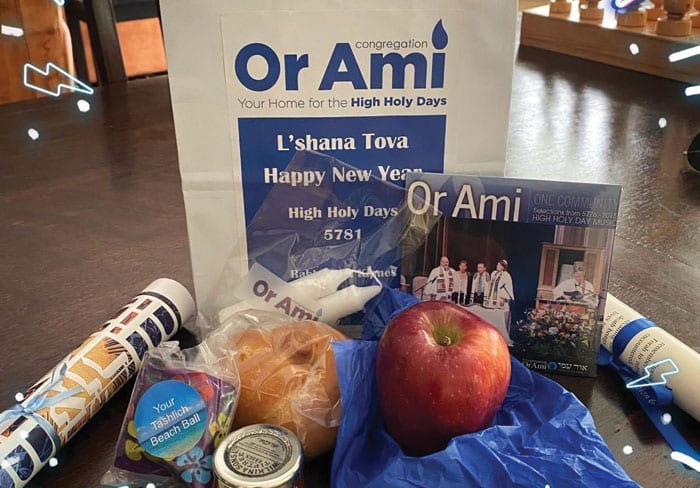
When the High Holy Days were coming back in 2020, Gruber wanted to find an innovative way to bring people together. So she founded Or Ami’s High Holy Essentials Gift Bag project.

“We wanted the community to share the joy of Rosh Hashanah … and to be grateful that we still have each other, even though we couldn’t physically touch each other,” she said. 

Rather than deliver these care packages to their members’ homes, they decided to have people come to them. They hosted a festive drive-thru in the parking lot.

“We had our song leaders dressed up in costume, we had car games, we had gifts, we had clergy there and people felt safe,” Gruber said. “They stayed in their cars. We stayed at a distance.” 

It was such a huge success, they did it for Hanukkah, Purim and Passover, and so on over the next two years.

“We just kept recreating and re-innovating and just building upon [it],” Gruber said.

Now, with the High Holy Days approaching, and a return to in-person High Holy Day services, Or Ami decided to keep the gift bag tradition alive. 

Over the next week or so, they will be mailing out holiday essential packages to 500 members of their close and extended community. The purpose? To help get the new year off to a meaningful start.

“If you walk into the High Holy Days services, whether in person or online, you will have a meaningful, powerful, musical experience.”
– Or Ami Rabbi Paul Kipnes

“If you walk into the High Holy Days services, whether in-person or online, you will have a meaningful, powerful, musical experience,” Or Ami Rabbi Paul Kipnes told the Journal. “If you prepare, it will be deeper and more transformational for you.These gift bags help people begin the process.”

This years’ holiday essential packages include a loving note from the rabbis, a honey jar, a Shana Tova apple corer and an Artful Shiviti by artist Isaac Brynjegard-Bialik to put up on the eastern wall of the home and create a sacred space. There’s also a High Holy Days supplement available online with all the prayers, songs and exercises for preparing the home. 

“The idea is we touch people when they come to us, but we also have to touch them spiritually and holiday-wise wherever they are,” Kipnes said.

According to the rabbi, preparing for the High Holy Days is like going to the gym or taking practice runs before you do the marathon. 

“The more you do, the more prepared you are, the better the experience will be,” he said. “The more people think and reflect on the High Holy Days, the better prepared they are to have the experience lift them up and change them.”

In addition to congregants, bags are sent to college students and young adults (18-25) away from home. They are also sent to people who have moved away and stayed in touch and Ori Ami neighbors (distance partners) throughout the United States, including people in New York, Hawaii, Arizona, Texas and other parts of California.

“The purpose [of the bags] originally was lifting people’s spirits, letting everyone know how much we miss seeing them and how much we want to still celebrate together,” Gruber said. “We wanted to bring some joy into people’s lives and to their families, and to [let them] know that their synagogue is here for them, always.”

This year, Or Ami looks forward to seeing about 65% of their congregation in person for High Holy Day services at Fred Kavli Theatre at the Bank of America Performing Arts Center in Thousand Oaks. They will also have a significant worldwide, online audience; Or Ami has been live streaming their services for about a decade. 

In anticipation, Kipnes said he is overjoyed, overwhelmed and excited. 

“I’m nervous about preaching to and inspiring two crowds simultaneously: those in the sanctuary and those streaming from all over the world,” he said. “I miss people. I’m so excited that so many of us are going to be back.”

Gruber said there’s familiarity in being back in person with her clergy and community during the High Holy Days. 

“It just provides so much comfort,” she said. “It makes the happy times even happier and helps us on Yom Kippur get through some of the rough times. With our community, doing things online, whether by Zoom or livestream, it doesn’t replace being together. It doesn’t replace the physical contact, and I think the world needs it.”

After Innovating Around COVID, Or Ami Keeps the Creativity Alive for the New Year Read More »