fbpx

June 2, 2022

Lawmakers voice support for housing development in heart of Pico Robertson for people with disabilities

A growing number of state lawmakers has voiced strong support for a new, supportive housing development for people with disabilities in Los Angeles’ Pico Robertson neighborhood.

In late May, Sen. Henry Stern (D-Los Angeles), with support from Sen. Sydney Kamlager (D-Los Angeles), Sen. Ben Allen (D – Santa Monica), Assemblymember Luz Rivas (D-San Fernando Valley), and Assemblymember Isaac Bryan (D-Los Angeles), submitted a request to the California Senate Budget and Fiscal Review Committee to include funds in the upcoming California state budget to support the development of The Village, a 64-unit apartment community designed to serve individuals living with intellectual and developmental disabilities. Developed by Cornerstone Housing for Adults with Disabilities, The Village is set to break ground this fall on Pico Blvd. and will include eight units for low-income affordable housing.

Stern’s request will be considered by the budget committee later this month.

“The Village is the kind of inclusive, affordable, community-based housing we need more of in LA,” said Stern. “With ETTA’s partnership, I am working to ensure California supports housing like this as a tangible, livable form of justice we must pursue.”

The $55 million development is set to include what Cornerstone terms, “wrap-around services,” which include housing, transportation, job services, life skills, day programs, summer and recreational activities and case management. ETTA, a nonprofit organization that has been serving adults with special needs and their families in Los Angeles for nearly three decades, will be offered as one of the on-site service providers for residents.

“The Village will transform an old, commercial property, located in the Pico-Robertson neighborhood, into a residential and retail site,” said Dr. Michael Held, executive director of ETTA and Cornerstone Housing. “The Village will empower residents who have intellectual and developmental differences to live active, independent, and enriched lives.”

California Assemblymember Richard Bloom (D-Santa Monica) also publicly voiced his support for the Village. Bloom has a long personal history with one of The Village’s service providers, ETTA, which was co-founded by his parents, Aaron and Rickey Bloom.

“My personal connection to ETTA runs deep: my mom and dad were personal friends of Etta Israel and her developmentally disabled son, Lazar – whose passing inspired Etta to leave her modest estate to provide help to individuals like Lazar,” said Bloom. “As her executors, [my] mom and dad fulfilled Etta’s wishes by co-founding the non-profit when she passed.”

“Years later, ETTA is now a leading innovative organization serving the needs of individuals with developmental disabilities. When it comes to solving our housing crisis, especially for society’s most vulnerable, we must think big and outside the box,” said Bloom.

He added that the Cornerstone project, “has my full support and I look forward to seeing its funding included in this year’s final budget.”

Cornerstone recognized that the number of Americans with intellectual and developmental disabilities enter adulthood was increasing year after year, creating a vital need for supportive housing and wraparound services.

This growing problem was only exacerbated by the COVID-19 pandemic. Restrictions on access to caregivers and medical services, combined with changing family dynamics amid physical distancing, led many people with disabilities to experience a loss of community. Research found that those with disabilities were at greater risk of experiencing depression and anxiety during the pandemic.

This challenge—building communities for people with disabilities to increase connection and thwart loneliness—extends well beyond the pandemic. Many people with disabilities are reliant upon their family for care. The Social Security Administration’s Disability Determination Services found that only 16 percent of people with disabilities live on their own, and only 35 percent have access to employment. Amid these challenges, many face an outsize risk of homelessness.

Cornerstone said that The Village is meant to be more than just a place to live. It is envisioned as a community hub for Angelenos with disabilities—as well as a proof of concept for developing new housing options for underserved populations in a region with limited housing supply.

 “We believe The Village can serve as a pilot project, creating a new model for people with disabilities —and a blueprint to unite them with their communities—that can be replicated nationwide,” said Held.

Sen. Bob Herzberg (D-Van Nuys), Senate Majority Leader Emeritus, also voiced his enthusiasm for what he described as the Village’s pioneering approach to addressing the region’s housing challenges.

“I love innovative projects like this,” said Hertzberg. “Where else but California would policy leaders embrace a forward-thinking plan to help the developmentally disabled be near friends and family yet live independently? All at a cost they can afford, plus be near shopping and transportation. Talk about revolutionary.”
Lawmakers voice support for housing development in heart of Pico Robertson for people with disabilities Read More »

My Levite Agenda – A poem for Parsha Bamidbar

They shall keep his charge and the charge of
the entire community before the Tent of Meeting,
to perform the service of the Mishkan.
–Numbers 3:7

I was born of Cohens and take the
responsibilities of the Levites seriously.
Though, it wasn’t always this way.

My first time at Temple I wanted
nothing to do with it. Nine years old
and this was my way.

We moved across the country and
Temple got in the way of Boy Scouts.
This didn’t help Temple’s cause.

Later that year Temple sent me to camp
and there was a pretty girl there and,
well, things started to change.

I decided I would go back and
before I knew it I was furthering
Temple’s cause which, as it turned out

was my cause too. Choose a good life.
Do unto others. More than occasionally
have a little nosh. There was so much to love.

Soon I picked up a guitar and Temple
was sending me paychecks. I was happy
to keep the lights on at home, but soon

realized it was my job to turn the lights
out at Temple when I was done with the room.
And my job to make sure the stranger

felt welcome when they first walked
through the doors, and my job to
pay attention and take care.

It didn’t say any of that on the piece of paper
I signed when I showed up, but my job
description comes from the oldest text.

All the details are there, passed down
from my mother, and her parents, and
their parents, and so on

all the way back to the mountain
when my ancestors were first told
to perform this service.

I don’t have Cohen on my
business card. But I let my actions
do the telling.


God Wrestler: a poem for every Torah Portion by Rick LupertLos Angeles poet Rick Lupert created the Poetry Super Highway (an online publication and resource for poets), and hosted the Cobalt Cafe weekly poetry reading for almost 21 years. He’s authored 25 collections of poetry, including “God Wrestler: A Poem for Every Torah Portion“, “I’m a Jew, Are You” (Jewish themed poems) and “Feeding Holy Cats” (Poetry written while a staff member on the first Birthright Israel trip), and most recently “The Tokyo-Van Nuys Express” (Poems written in Japan – Ain’t Got No Press, August 2020) and edited the anthologies “Ekphrastia Gone Wild”, “A Poet’s Haggadah”, and “The Night Goes on All Night.” He writes the daily web comic “Cat and Banana” with fellow Los Angeles poet Brendan Constantine. He’s widely published and reads his poetry wherever they let him.
My Levite Agenda – A poem for Parsha Bamidbar Read More »

NYC City Council to Investigate Antisemitism Allegations at CUNY

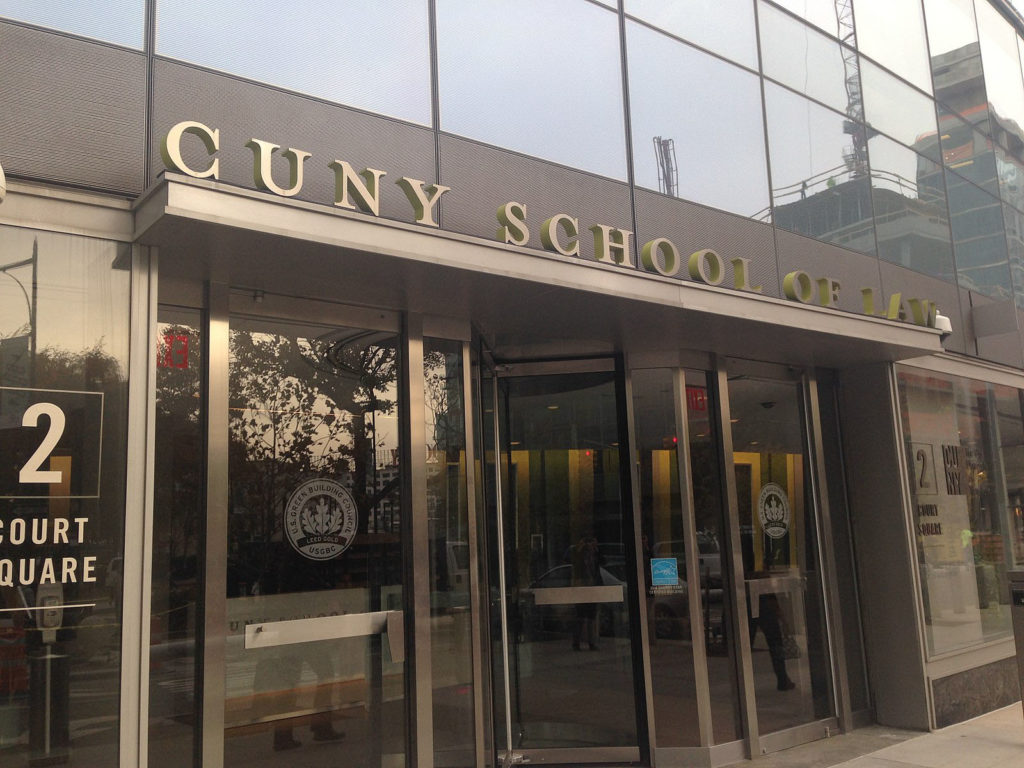
The New York City Council announced on May 31 that they will be investigating allegations of antisemitism at the City University of New York (CUNY) schools.

The New York Post reported that the city council’s Higher Education Committee will holding a hearing on June 8 about antisemitism at college campuses; the Post claimed to have sources telling them that the decision from CUNY Law faculty to back a resolution endorsing the Boycott, Divestment and Sanctions (BDS) movement was what prompted the city council to hold the hearing.

“The embracement and normalization of BDS by both CUNY students and faculty has fostered an extremely hostile campus environment that has resulted in the more blatant forms of antisemitism that are becoming all too common in our city,” City Councilman Eric Dinowitz, a Democrat who heads the committee and the Jewish Caucus in the city council, told the Post. “It is crucial for the Council to ensure that our CUNY system, a national model for higher education, does not descend into the singling out of the only Jewish state in the world, and in turn, ostracize our Jewish students and residents.”

City Councilwoman Inna Vernikov, a Republican who serves as the city council’s Minority Whip, tweeted: “Antisemitism will no longer go unchecked at @CUNY. Not on my watch. Defund antisemitism. Expose the antisemites. I am just getting started here. And now, I hope this probe/hearing leads to real action and not just headlines.” Vernikov had recently announced that she is revoking $50,000 from CUNY over the BDS resolution vote.

Students and Faculty for Equality at CUNY (S.A.F.E. CUNY) said in a statement to the Journal, “S.A.F.E. CUNY is extremely grateful to Council Members Dinowitz and Vernikov for their courageous efforts to shine light on what has been a very dark time for Jewish students and faculty members at CUNY. It is truly sad that this unprecedented probe has become necessary. But after Chancellor [Felix] Matos-Rodriguez first repeatedly refused to address even fully investigated and [Equal Employment Opportunity Commission]-substantiated antisemitism at the university and then issued a bizarre statement that CUNY Law School faculty’s discriminatory and blatantly illegal adoption of BDS policy was somehow ‘political,’ this sad reality has become a necessity. 

“We have called for Chancellor Matos-Rodriguez to step down for defending policies that violate city, state and federal discrimination laws as well as New York State Executive Order No. 157,” they added. Executive Order No. 157 is the state’s anti-BDS law.

A CUNY spokesperson said in a statement to the Journal, “As the Chancellor said earlier this week, reiterating statements that he made in July and December 2021, CUNY is home to a great many organizations that represent students, faculty and staff. However, these organizations speak for themselves and their opinions do not represent the views of University or the CUNY community as a whole. We hope that our elected officials base decisions about public fund allocation on the needs of the community and on the efficiency of agencies entrusted in managing those funds for the public good.”

NYC City Council to Investigate Antisemitism Allegations at CUNY Read More »

Jewish-Italian Comedian Gianmarco Soresi Finding His Own Voice

In just six years in comedy, Gianmarco Soresi has made quite the impact.

The young comic has appeared alongside Billy Crystal and Tiffany Haddish in the movie “Here Today,” been featured on Comedy Central and Netflix, amassed over 26 million likes on TikTok and has a special on Amazon Prime. Now, the New York City-based comedian is making his way to the West Coast, playing at the Brea Improv on June 5. 

The Jewish-Italian Soresi is enjoying his career, thus far, because of the feedback he receives for his work.

“I like stand-up comedy because as an insecure, indecisive creature, I need constant feedback to know that I am on the right track.” 

“I like stand-up comedy because as an insecure, indecisive creature, I need constant feedback to know that I am on the right track,” he said. “If I wrote books, I’m sure my friends would be very exhausted by me sending them every new sentence [and] asking, ‘Is this good?’ But with stand-up, I get to do that in a way. I don’t have to ask directly ‘Is this funny?’ The laugh lets me know.”

After taking a comedy class at Carolines on Broadway during college, Soresi entered the world of show business as an actor. Then, he decided he wanted to try getting up on stage and doing stand-up. That evolved into funny videos on TikTok that have gone viral, stints as the spokesman for both General Electric and Baby Bottle Pop and the movie with Crystal and Haddish.

“Working with Billy Crystal and Tiffany Haddish was very cool, and that movie is a big hit on airplanes,” he told the Journal. “Every time I’m sitting next to someone watching it, I’m sure to stare at them until they realize I’m the guy doing a Jeff Goldblum impression in one of the scenes.”

Soresi, whose Twitter bio says he is a “stand-up comic/child of divorce,” grew up without much connection to his Judaism. 

“But I did the Birthright trip, got a speed bar mitzvah at the Western Wall and I’m now dating a woman who grew up in a Chabad community, so I’m learning a lot more,” he said. 

The creator of a sketch series called “Matza Pizza,” Soresi makes it a point to talk about his Jewish background in his comedy, “whether it’s the kvetching or the somewhat cynical point of view,” he said. “Sometimes I’ll even say onstage that I’m Jewish and the audience will laugh as if to say, ‘Yeah buddy … we knew that already.’”

One joke that he tells to see how many Jews are in the audience, or how familiar an audience is with Jewish culture, is “I went on a date with a Mormon woman and she asked if I go to ‘Jewish church’ and I said ‘Sweetheart, they’re called delis.’” 

“That joke did not work great in Oklahoma City,” he said. 

Even though Soresi’s name sounds very Italian, the comedian’s father “really exaggerated the amount of Italian I am, so much so that I’m hesitant to find out the actual percentage with a DNA test,” he said. “We watched ‘The Godfather’ like it was a home movie, I ate ravioli for every meal in middle school and if my dad and I ever get into an argument he’s quick to say, ‘Don’t ever go against the family!’” 

The Brea Improv is just one of many stops on Soresi’s upcoming tour. He’s also heading to San Diego, Oxnard and San Francisco while he’s in California. Getting on stage as much as possible is his goal. 

“I’d like to be able to tour comfortably to sold out — or close to sold out — shows where I get to do long sets, build and fine-tune my material and start releasing it on an annual basis, whether through a traditional platform or on my own,” he said. “Whether I become some modicum of famous is not fully in my control but getting good at my craft is, so I’m trying to focus on that.”

He continued, “Please come see me so I can be famous. I was lying before. That’s all I really want!”  

You can purchase tickets for Gianmarco Soresi’s show on Ticketweb.com.

Jewish-Italian Comedian Gianmarco Soresi Finding His Own Voice Read More »

Celebrating Shavuot: Say Cheesecake

No matter how you celebrate Shavuot, there’s bound to be cheesecake involved. 

The holiday, which occurs this year from sundown on June 4 through nightfall on June 6, marks seven weeks after the Passover exodus and commemorates the wheat harvest in Israel. Celebrations include festive meals, all-night Torah study and eating dairy.

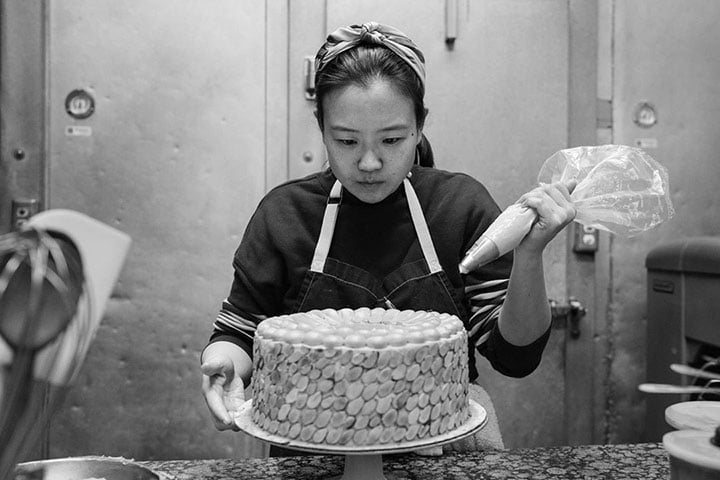
“I like to celebrate Shavuot by going on a long hike and reconnecting with nature,” Cecily Feng told the Journal. Feng is a Los Angeles-based pastry chef and owner of Little Sparrow, a Chinese dumpling pop-up. “Being a convert myself, I also honor Ruth by reading about her life.”

Cecily Feng. Photo by Marshall Birnbaum

The holiday is a favorite of Feng’s because it celebrates the wonderful spring produce and gives a reason to make delicious dairy recipes. And, since Feng’s birthday is the last week of May, it sometimes coincides with Shavuot.

“During the quarantine, my cousin-in-law Debra dropped off a homemade berry cheesecake at my door,” Feng said. “Some might think there’s no reason to cook for a chef, but it’s actually a treat when someone cooks for you.”

Feng’s favorite type of cheesecake is a Basque cheesecake, as they are crust-less and ultra-creamy.

“It makes a smaller 6-inch cheesecake, which is plenty for two to four people, as it is so rich.” – Cecily Feng

“I have so many reasons why I love this recipe,” Feng said. “It makes a smaller 6-inch cheesecake, which is plenty for two to four people, as it is so rich. On top of that, you make it all in a food processor and the cream cheese does not need to be at room temp. The only downside is you must make it the night before.”

Cecily Feng’s Basque Cheesecake

You will need: 6-inch cake pan, food processor and sheet tray

Ingredients:
2 (8oz) blocks Philadelphia brand cream cheese
3/4 cup granulated sugar
5 large egg yolks
1/2 tsp Kosher salt
1/2 cup crème fraiche or sour cream
Zest & juice of 2 limes (optional)

Instructions:
1. Do this first! Preheat oven to 475°F with the rack in the bottom third. Set it to normal bake setting, not convection.
2. Spray the cake pan with non-stick coating such as Pam and arrange two sheets of 8″x16″ parchment like a plus sign to line the pan. You will need to press and fold the parchment so it lays flat. The parchment should extend up the sides of the pan. Spray the parchment and put the cake pan on a sheet tray.
3. In a food processor, add the cream cheese, sugar, yolks and salt, and blend until smooth. Be sure to scrape the sides as needed. Add the crème fraiche or sour cream, optional lime zest and juice, and pulse until smooth again.
4. Pour all the batter into the prepared pan and tap the pan on the sheet tray to release any air bubbles.
5. Bake for 20 to 25 minutes, or until the top is dark brown and the center is still very jiggly like a wave. Cool on a rack until the cheesecake is at room temp then refrigerate overnight, uncovered.
6. To serve, lift the parchment to slide the parchment and cheesecake out of the cake pan. Basque cheesecake is often served in the parchment. Just pull it down the sides and cut into slices with a sharp knife. The center of the cheesecake should be very creamy like a soft brie.

Follow @cecilycooks and @littlesparrow on Instagram for more from Chef Feng.


Yael Friedman, owner of Kitch’N Giggles

“I love making Basque Cheesecake,” Yael Friedman, founder of Kitch’N Giggles, told the Journal. “You don’t need to worry about a water bath, or keeping a consistent oven temperature to avoid cracks. I also love serving it because it’s a chance to introduce people to something new, and a little bit surprising.”

To Friedman, Shavuot means two things: “Being inspired by the vast depth of knowledge and wisdom that is in the Torah and getting to eat dairy desserts. I was a pastry chef for a long time, so I am very passionate about butter and cream.” 

Friedman and her family celebrate Shavuot by learning Torah together on Shavuot night and with an annual Shavuot brunch the next day. Her favorite Shavuot memory is from 2020, because it was a memorable time with so much uncertainty and confusion.

“With the kids all home from school, we wanted to figure out a way to create a festive, happy experience for them,” she said. “We got some art supplies and made our own Har Sinai that we decorated in honor of receiving the Torah. We hung it up so we could feel like we were at Har Sinai ourselves.”

Friedman, who started Kitch’N Giggles to teach healthy cooking to young children, loves creating food traditions around the holidays. 

“It’s important to focus on the process, instead of the product,” Friedman said. “Even if the idea of getting your kids involved seems daunting, Shavuot is the perfect time to find a fun kitchen project to jump start the holiday spirit.”

Yael Friedman’s Tips on Making Cheesecake with Your Kids

1. Cheesecake is a wonderful dessert to make with kids. If you’re using a graham cracker crust, you can have your kids break the crackers up in a Ziploc bag and then squish it in their hands to make the crumbs. It’s also a great way to work out some of that pre-chag stress.

2. Always make sure your cream cheese is at room temperature.

3. Also, your eggs need to be at room temp. Your kids can help warm up cold eggs by giving them a “bath” in some warm water.

4. Kids make excellent egg crackers. Set them up for success by giving them a small container to crack into. That way, you can easily pick out any broken shell pieces before they get mixed into your cheesecake.

5. Cheesecake lets you get creative. A plain cheesecake is just a blank canvas for your child to decorate with fruit, caramel sauce or sprinkles. Even a store-bought cheesecake can benefit from some creative plating.

For more inspiration on cooking with your kids, follow @Kitchngiggles on Facebook and Instagram.

Celebrating Shavuot: Say Cheesecake Read More »

Summertime and the Grilling is Easy

The shift in the weather is imperceptible. The day starts cool and grey but warms up a little more quickly and by noon the sun is shimmering and golden. The palm trees stand sentinel, patiently waving their green fronds, silhouetted against a brilliant blue sky. It’s just another perfect June day in the City of Angels. 

The seasons might not be as clearly defined in Los Angeles, but we know when summer has arrived. For us, the surest signal is all the wonderful produce that suddenly appears at the market. We love it all—especially the juicy dark red cherries, the soft blushing apricots and the plethora of white and yellow flesh peaches. (We are also suckers for the stunning peonies that show up at Trader Joe’s.)

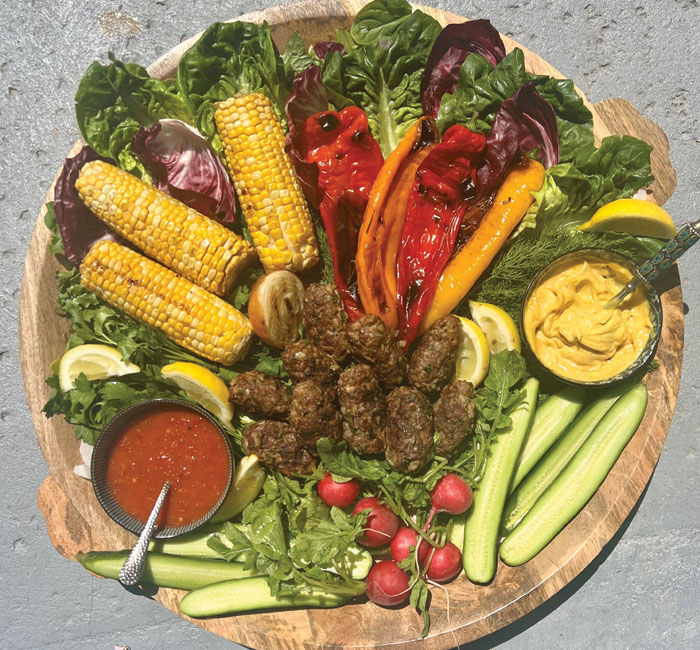
The warmer weather and longer days put us in the mood for outdoor dining. This week we made easy, exotically spiced grilled kefta kabob served with spicy harissa and amba aioli and sides of grilled peppers and corn on the cob. 

Kebab originated in the medieval kitchens of Persia and Anatolia. It is a staple in the cuisines of the Middle East and North Africa. Traditionally made with ground lamb, each region added their unique combination of spices. Our more modern recipe calls for ground beef along with the finely minced onion and fresh chopped Italian parsley that keep the kebab moist. 

Whenever my grandmother would make shefta, the Iraqi version of kebab, she always seemed to have a twinkle in her eye and a smile on her face. It’s a happy meal. 

—Sharon

When Neil and I bought our first home, the first improvement we made was to build a permanent Sukkah. The second was to buy a barbecue. Our entire family celebrated every special occasion with a barbecue. There were Father’s Day barbecues, summer barbecues, midweek barbecues and birthday barbecues. Any excuse for a barbecue. 

For many, many years, I never actually touched the barbecue. I would marinate the meat and chicken and fish. I would prepare the vegetables for grilling. And I would wait for Neil to come home from work. One day I got tired of waiting and decided what is the worst that could happen? I admit that there were a few mishaps along the way, like some burnt steak and undercooked chicken.

Food just tastes better off a real fire. It’s my favorite way to get a meal on the table. 

Slowly but surely, I’ve become the barbecue master. Food just tastes better off a real fire. It’s my favorite way to get a meal on the table. 

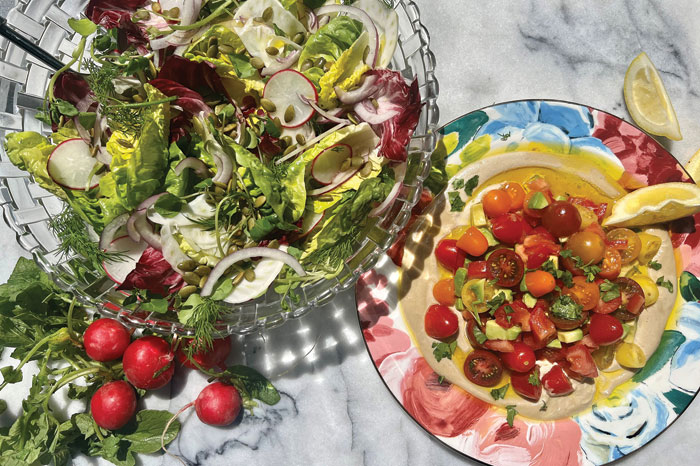
We love to grill Kefta on skewers. The meat ends up so tender and juicy. Of course, no middle eastern meal is complete without some grains and some salads. We dreamed up a green salad made with gem lettuce, fresh dill and bitter peppery radicchio. We added crunch and texture with finely shaved fennel, radishes and pepitas (pumpkin seeds), with a light dressing of fresh lemon juice, extra virgin olive, Himalayan salt and freshly cracked black pepper. The contrast of sweetly acidic heirloom cherry tomatoes and nutty tahini makes our tomato tahina salad a must for your al fresco dining. 

—Rachel

Photo by Alexandra Gomperts

Kafta Kebab

1 lb ground beef
1 onion, finely chopped
1 cup finely chopped Italian parsley
2 tablespoons olive oil
1 teaspoon salt
1/2 teaspoon turmeric
1/2 teaspoon paprika
1/2 teaspoon ground allspice
1/2 teaspoon ground cinnamon
1/2 teaspoon ground cumin
1/2 teaspoon garlic powder
Freshly ground black pepper

  • Combine all the ingredients in a large bowl and mix well.
  • Cover and let the meat rest in the refrigerator for one hour.
  • Heat the grill. Lightly oil a baking tray.
  • Form the meat mixture into a 3 inch long oval, then place on the tray.
  • Grill on high heat for 3-5 minutes until nicely browned on all sides.

Tomato Tahina Salad

½ cup tahini paste
¼ cup fresh lemon juice
6 tablespoons water, plus more as needed
1 small garlic clove, grated
½ teaspoon sea salt

In a medium bowl, mix all the ingredients with a whisk. Slowly add more water until the Tahina is a thick and creamy consistency. Set aside.

2 Roma tomatoes, diced
1 cup heirloom cherry tomatoes,
cut in half
1 ripe avocado, diced
1 lemon, juiced
1 tablespoon finely chopped Italian
parsley
2 tablespoons extra virgin olive oil
1/2 teaspoon kosher salt

  • Mix all the ingredients in a bowl, then set aside.
  • On a large flat plate, pour the tahina around the edges to create a thick ring.
  • Place the tomato salad over the tahina in the center of the plate.


Sharon Gomperts and Rachel Emquies Sheff have been friends since high school. The Sephardic Spice Girls project has grown from their collaboration on events for the Sephardic Educational Center in Jerusalem. Follow them on Instagram @sephardicspicegirls and on Facebook at Sephardic Spice SEC Food. Website sephardicspicegirls.com/full-recipes

Summertime and the Grilling is Easy Read More »

Let Us Eat Cheesecake

The Jewish people have been patiently counting the Omer for the past seven weeks. And now it’s time for their reward—cheesecake!

This week we commemorate the beautiful holiday of Shavuot, Z’man Matan Torateinu (Giving of the Torah). We learn Torah all night and indulge in deliciously dairy meals.

This recipe for cheesecake is decadently rich, smooth and creamy and most importantly, it’s absolutely foolproof. 

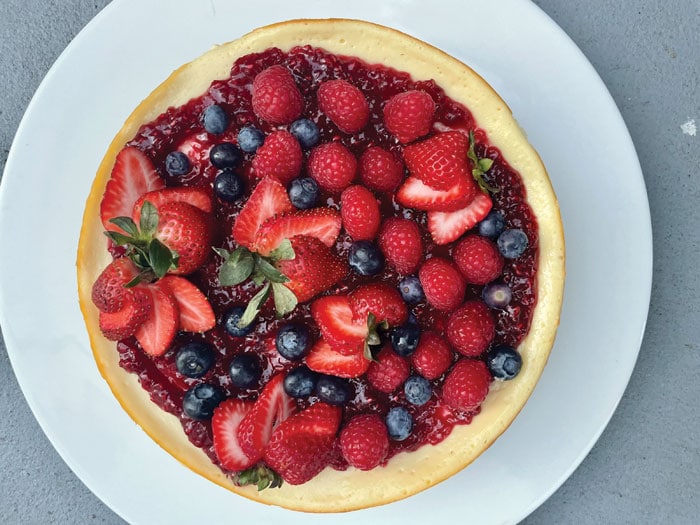
This recipe for cheesecake is decadently rich, smooth and creamy and most importantly, it’s absolutely foolproof. One of the best things about making cheesecake is getting creative with the toppings. We’ve topped our cheesecakes with lots of different indulgent ingredients, including Oreo cookies, a Bourbon caramel sauce, chocolate and pecans, mango and coconut…..the list goes on. But this year we are going with this exquisite, show stopping berry cheesecake.

Chag Sameach!

Berry Cheesecake

Crust
2 cups Graham cracker crumbs
1 stick butter, melted
1/3 cup sugar

  • Preheat oven to 325°F.
  • Grease a 9-inch springform pan.
  • Combine cracker crumbs, melted butter and sugar until they’re the texture of sand.
  • Press mixture into the bottom of the cake pan and about 1 inch up the sides.
  • Bake for 10 minutes, until lightly browned.

Cheesecake mixture
4 8oz packages of cream cheese, at room
temperature
3 tablespoons plain flour
1/4 teaspoon salt
1 cup sugar
1 cup sour cream
1 tablespoon vanilla extract
3 large eggs, at room temperature

  • Preheat oven to 300°F.
  • Using a standing mixer or electric beater, combine the cream cheese, flour and salt until very smooth and fluffy.
  • Add the sugar, sour cream and vanilla. Beat until well blended.
  • Add eggs, one at a time, beating well after each addition.
  • Pour batter into cake tin
  • Bake for 60 to 70 minutes, until the center jiggles slightly when shaken.
  • Let cool to room temperature. Cover and refrigerate overnight.

Berry Garnish
1/2 cup raspberry jam
1 cup raspberries, washed and dried
1 cup blueberries, washed and dried
6 strawberries, washed, dried and cut in thirds, with stems.

  • Spread jam over the cheesecake.
  • Arrange berries on top of the jam.
  • Refrigerate cake until serving.

Sharon Gomperts and Rachel Emquies Sheff have been friends since high school. The Sephardic Spice Girls project has grown from their collaboration on events for the Sephardic Educational Center in Jerusalem. Follow them on Instagram @sephardicspicegirls and on Facebook at Sephardic Spice SEC Food. Website sephardicspicegirls.com/full-recipes

Let Us Eat Cheesecake Read More »

Southern Africa – Safaris, Sun Soaked Beaches and Fine Wine.

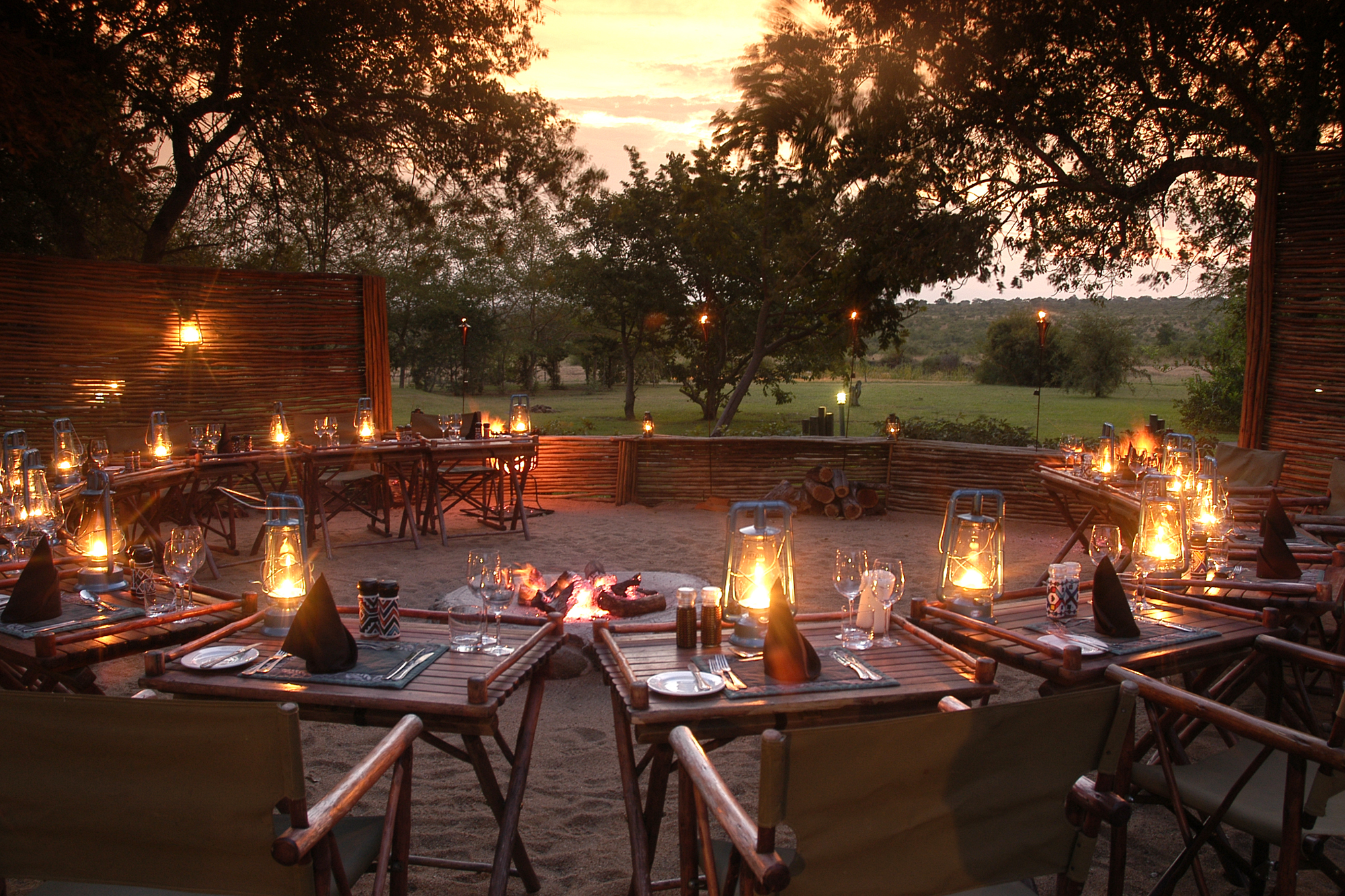
If an African Safari is not on your bucket list, it should be! Not only are there nine Countries in Africa that have amazing Safari adventures, but within those Countries there are several types of accommodations and adventures to choose from. Each one breathtaking and exciting in it’s own way.  Whether you want to participate in a lot of activities or spend your days relaxing on the deck of your lodge and watch the wildlife from your pool, (or both), there is something for everyone. There are lodges where kids of all ages are welcome, others don’t allow kids under 6yo. Some lodges are for adults only and those who specialize in romance travel. Keep reading for more details. 

This post, as well as others that I have linked to below, will give you a general out line and information about the destination and what to expect. As you read the articles, consider your vision for the trip you are planning, your priorities, your travel companions and your travel dates and make notes. These will help you with the planning process. This particular article is about safaris in Southern Africa. If you are also considering East Africa, you can take a look at that post HERE and the post with a quick comparison of all areas, is located HERE.

Southern Africa, the southernmost region of the African continent, comprises of amongst others, Botswana, Mozambique, Namibia, South Africa, Zambia, and Zimbabwe. Each magnificent in its own right and quite different.

Zambia.

Zimbabwe.

If you are into painting and conservation, you will love the Wild Horizons Elephant Sanctuary who teamed up with Art of Africa to create an eco-conscious and unique elephant experience. This adventure is brought to life by the artistic strokes of your fingertips while surrounded by the African bush. Learn how these beautiful and gentle giants came to be adopted by this organization, followed by a delicious lunch.

Both Zambia and Zimbabwe safaris can include one of the world’s most intriguing destinations; the Victoria Falls. This means that whichever of these two countries you choose for your safari destination, you will be able to include the Victoria falls in your itinerary. Zimbabwe offers a large variety of scenery and has one of the African continent’s finest concentrations of wildlife, and a perfect climate with an average of 7 hours of sunshine daily throughout the year. As the country with the most UNESCO World Heritage Sites in Southern Africa, Zimbabwe’s hundreds of San Rock paintings and ancient ruins from the Iron Age, satisfies the most avid history buffs. You can enjoy incredible views from the infamous Knife-edge Bridge or walk through the Rain Forest that grows within the billowing spray. With so much to offer, Zimbabwe safaris are a popular choice with visitors to Africa.

Botswana.

This Country is a safari paradise with several options that highlight the unique destinations in “Old Africa’s Last Refuge.” These can include dry game drives, canoeing wet safaris or walking safaris. With a small human population, including some of the last remaining Bushmen, Botswana is truly a ‘wild’ safari destination. The channels of the Okavango Delta lie in north-western Botswana, which has been called a safari wonderland where you can experience a water and land based safari. Located in the north of Botswana, you will find Chobe, which is the country’s third-largest game reserve. It not far from the border to Zimbabwe and a water taxi ride away from Zambia.

To make the most of your time in Botswana, you could charter a private flight to take you between remote destinations. Imagine your safari kicking off with a bush pilot maneuvering the light aircraft over the vast Botswana wilderness at an altitude that allows for aerial game viewing! There is so much to experience, that we recommend guests spend at least two or three nights at distinctly different Botswana camps; each unique in design and personality and offer a variety of activities. “Water” camps specialize in wildlife activities aboard boats and mekoros (canoes) and the walking safaris are also hugely popular. The “land” camps are geared to the pursuit of the big 5 on open 4×4 vehicles which allows you to get so close to the wildlife that you can leave your zoom lenses behind!

Namibia.

This is a land of enduring tribes, timeless tradition, wild and ghostly coastlines littered with shipwrecks, fantastic geography, and abundant wildlife. Namibia boasts one of the greatest wildlife populations in the world including some truly unique and many rare species. In the Etosha National Park, huge herds of springbok, gemsbok, zebra, and blue wildebeest, as well as smaller numbers of red hartebeest, lion, cheetah, and leopard, gather at waterholes where they are easily spotted against the stark white background of immense salt pans. You can travel from the endless, rippling sands and towering dunes of Sossusvlei to the dolphin-filled waters at Swakopmund and Walvis Bay. Then through the stark plains of Damaraland and onto the Etosha Pan. Etosha, meaning ‘Great White Place’, is made of a large mineral pan, where the animals have adapted to this wild and arid landscape. This is a truly unique African experience and not to be missed.

South Africa.

There is truly no other experience that compares to a safari in the African Bush. You will leave something behind when you go, and you will yearn for Africa until you return. Whatever your safari preference; whether lazing at the pool, spotting the animals on a game drive, camping out in the wild under the stars, or enjoying the world renown South African wines with delicious authentic South African food… it will be an unforgettable experience.

Accommodation.

The lodges we recommend are & Beyond Ngala and Phinda, Singita, Thornybush, Ulusaba by Virgin, Amakhala Woodbury Tented Camp, Londolozi, Sabi Sabi, and Tswalu Kalahari Reserve. These are high end luxe lodges, but there are many other budget friendly camps that are absolutely wonderful, where you can experience the life changing adventure that is an African Safari. Here are a few: Kwafubesi Tented Safari Camp, Amakhala Woodbury Tented Camp, Kwa Maritane Bush Lodge and many more. There are some lodges that cater to kosher travelers. Contact me HERE for more info. 

Much More to South Africa than Safaris

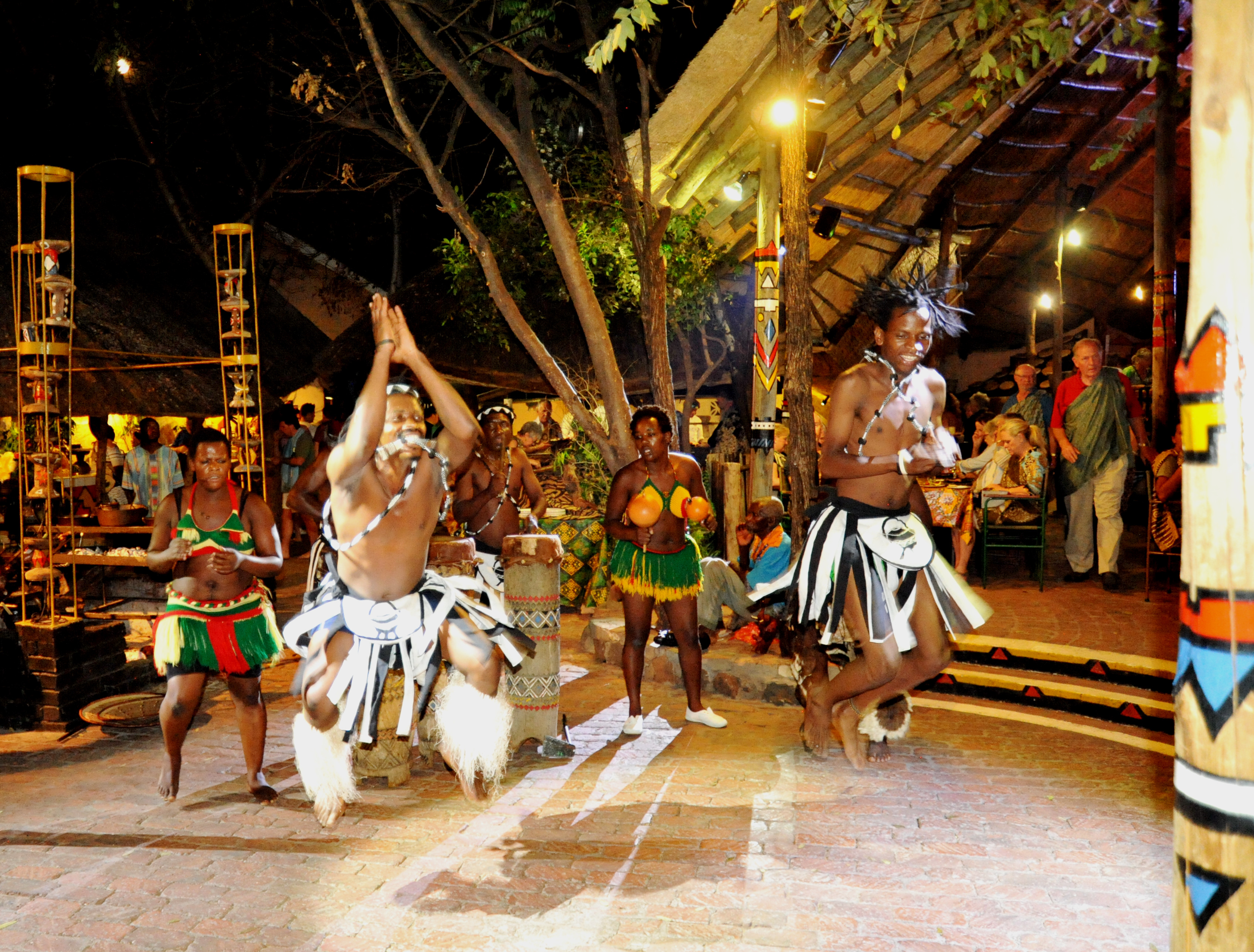
South Africa has so much to offer! Aside from going on Safari and tracking the Big 5, while you are there, do an add-on to your trip and discover the charms and jaw dropping vistas of Cape Town, hike the iconic Table Mountain, swim with the penguins or great white sharks. Discover the world renowned wines of Stellenbosch or experience a Cultural tour in Johannesburg. There is truly something for everyone.

The most important aspect of planning your trip is a professional and reliable travel designer and DMC and there are two companies I work with in Africa that I put my complete trust in to fulfill every detail of a client’s trip without fail. Meet Bernard of Nziza Hospitality and Sandra Lee of Ruby Travel. Both have many years of experience in the travel industry and will provide you with a once in a lifetime opportunity to experience Africa at its best. These two professionals are true gems in the industry and will work with you to create an unforgettable experience.
 

Keep following our posts for info on Travel, Fine Wine Tours, Safari Weddings, Domestic Travel, Road Trips, Exotic Island Getaways, Wedding and Honeymoon Destinations and much more. Contact us HERE if you have any questions.  Thank you for spending time with me today. See you again soon. 

Warmly; Dahlia.

Southern Africa – Safaris, Sun Soaked Beaches and Fine Wine. Read More »

Milk Tongue

Only Jews who are at least
trilingual, knowing not just their milk tongue, their native land’s vernacular,
but two tongues of the not-Near East,
biblical Hebrew and talmudic Aramaic, as tabernacular

for them as was the tabernacle
they built while in the wilderness with booths, recalled by Jews on Tabernacles,
the waste land wanderers’ ramshackle
accommodations’ roofless rooms they lived in when they shed their slavish shackles,

were zoomed with Moses to learn what
God said on Sinai using Hebrew words the prophet would explain
since most of them could surely not
translate God’s holy words into their milk language, felt profane.

On the Festival of Weeks,
called Shavuot, Jews eat meatless food that’s milky, though it’s more prosaic
than meaty food, because God speaks
to them on Sinai in a tongue that’s churned into their mother’s milk, Mosaic.

My “Rashi-rationale” for  cheese-
cake eating on the Feast of Weeks is verse sixteen, Psalm sixty-eight,
recalling how all Jews said “Please,”
when offered tablets on a cheesy mountain on that sweet, hot date.

In “The Babel Within,” Gavin Francis, in the NYR 5/26/22, reviewing Memory Speaks: On Losing and Reclaiming Language and Self by Julie Sedivy writes:

Language is “a reliable badge of the gradations of belonging,” Sedivy writes, a timeless tool used by our hypersocial species to decide who is and isn’t to be trusted—something she underlines with a quote from the book of Judges:

“Are you an Ephraimite?” If he said, “No,” then they would say to him, “Say now, ‘Shibboleth.’” But he said, “Sibboleth,” for he could not pronounce it correctly. Then they seized him and slew him at the fords of the Jordan.
Ps. 68:16 may be the source of the custom to eat cheesecake on Shavuot:

טז  הַר-אֱלֹהִים הַר-בָּשָׁן:    הַר גַּבְנֻנִּים, הַר-בָּשָׁן.  A mountain of God is the mountain of Bashan; a mountain of peaks is the mountain of Bashan.

גַּבְנֻנִּים not only means “peaks” but also may mean “cheeses,” as was first suggested by the great kabbalist, Rabbi Shimshon of Ostropoli, who died tragically together with three hundred of his followers during the Khmelnytsky Uprising in 1648.

Job 10:10 states:

י  הֲלֹא כֶחָלָב, תַּתִּיכֵנִי;    וְכַגְּבִנָּה, תַּקְפִּיאֵנִי. 10 Hast Thou not poured me out as milk, and curdled me like cheese?

The word תַּקְפִּיאֵנִי, you curdled me, perhaps inspired the story told in BShabbat 88a about how the Israelites received the Torah on Mount Sinai:

״וַיִּתְיַצְּבוּ בְּתַחְתִּית הָהָר״, אָמַר רַב אַבְדִּימִי בַּר חָמָא בַּר חַסָּא: מְלַמֵּד שֶׁכָּפָה הַקָּדוֹשׁ בָּרוּךְ הוּא עֲלֵיהֶם אֶת הָהָר כְּגִיגִית, וְאָמַר לָהֶם: אִם אַתֶּם מְקַבְּלִים הַתּוֹרָה מוּטָב, וְאִם לָאו — שָׁם תְּהֵא קְבוּרַתְכֶם The Torah says, “And Moses brought forth the people out of the camp to meet God; and they stood at the lowermost part of the mount” (Exodus 19:17). Rabbi Avdimi bar Ḥama bar Ḥasa said: the Jewish people actually stood beneath the mountain, and the verse teaches that the Holy One, Blessed be He, overturned the mountain above the Jews like a tub, and said to them: If you accept the Torah, excellent, and if not, there will be your burial.

The word שֶׁכָּפָה which means “He overturned,” perhaps alludes to תַּקְפִּיאֵנִי, you curdled me, in Job 10:10, whose word וְכַגְּבִנָּה, like cheese, recalls הַר גַּבְנֻנִּים, the cheesy mountain, in Psalm 68:16.


Gershon Hepner is a poet who has written over 25,000 poems on subjects ranging from music to literature, politics to Torah. He grew up in England and moved to Los Angeles in 1976. Using his varied interests and experiences, he has authored dozens of papers in medical and academic journals, and authored “Legal Friction: Law, Narrative, and Identity Politics in Biblical Israel.” He can be reached at gershonhepner@gmail.com.

Milk Tongue Read More »

A Bisl Torah – Receiving

The Gottman Institute, an organization dedicated to the repairing and rebuilding of relationships, is known for “Love Maps.” Through a couple’s journey, each partner is encouraged to engage in a love map. A love map identifies the priorities, interests, dreams, and aspirations of each partner. How well did you know each other at the start of the relationship? How well do you know each other now? And a love map, while seemingly designed for couples, can be applied to other relationships. How well do we know the people in our lives? And do we put in the work to understand how they have transformed, who they are today?

The philosopher, Martin Buber shares a story about the rabbi of Kotzk. The rabbi is asked, “Why is Shavuot called ‘the time the Torah was given’ rather than the time we received the Torah?” The rabbi answered, “The giving took place on one day, but the receiving takes place at all times.”

We think we know each other. But spending time together does not mean understanding. Living in the same space or praying in the same shul does not mean we have insight into each other’s fears, passions, motivations, and worries.

We are meant to “receive” the Torah every day—finding daily connection and developing a genuine relationship with our Creator. And likewise, we are meant to receive each other. Knowing that we have all changed since the first day of meeting. Since the first day of giving. And when we choose to receive each other, actively working to learn the nuances of each other’s soul, that is where I believe, holiness resides.

Shabbat Shalom and Chag Sameach


Rabbi Nicole Guzik is a rabbi at Sinai Temple. She can be reached at her Facebook page at Rabbi Nicole Guzik or on Instagram @rabbiguzik. For more writings, visit Rabbi Guzik’s blog section from Sinai Temple’s website.

A Bisl Torah – Receiving Read More »