fbpx

June 2, 2022

A Moment in Time: Right on Cue

Dear all,

It’s been a busy few weeks for our family. With Ron’s State Controller Campaign in full swing, and with my balancing multiple life transitions at Temple Akiba (not to mention the raising of our wonderful children), we rarely get a chance for date night.

But earlier this week, in the middle of everything, we went out for a walk and happened upon a pool table. Ron said, “Let’s play.” But I hesitated, noting that we really didn’t have all that much time. Ron insisted.

As I held the cue in my hand, it dawned on me. There are a million things we both need to accomplish. But right on cue, destiny presented us with a reason to spend extra time with one another.

Yes – I did think of the Music Man and the Trouble in River City! And yes, I confirmed that I am a lousy pool player. But creating a moment in time to be with my beloved…. That surpasses all else.

What opportunity will present itself to you this week?

With love and Shalom,

Rabbi Zach Shapiro

A Moment in Time: Right on Cue Read More »

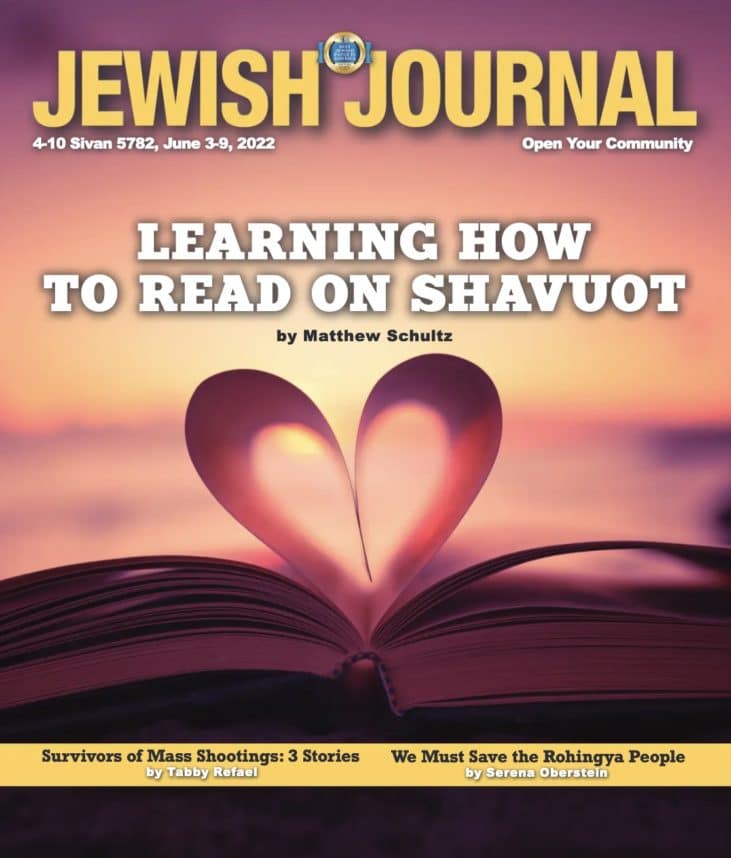
Print Issue: Learning How to Read on Shavuot | June 03, 2022

CLICK HERE FOR FULLSCREEN VERSION

Print Issue: Learning How to Read on Shavuot | June 03, 2022 Read More »

News Anchor Alex Cohen on Working at an Atypical Local TV News Network

Spectrum News One is not a typical television news network. It’s a relative newcomer to the daily cable news scene in Southern California, having only launched in November of 2018. 

Unlike a vast majority of local television news programming, Spectrum News steers away from the car chases, armed robberies and other sensationalized stories. When reporter Alex Cohen was offered the chance to be the first anchor of their nighty show, “Inside the Issues,” she thought of Spectrum News as a “unicorn” in the business.

“I was like, what you’re describing couldn’t possibly exist — a place that was television news, but wasn’t going to do car crashes, wasn’t going to do ‘if it bleeds, it leads,’” Cohen told the Journal. “It was dedicated to bringing uplifting stories and was hyper-locally focused. And they kept saying, ‘We really believe in this, we feel like there’s a market for this. And if you build it, they will come.’” 

Cohen reports on politics on “Inside the Issues,” which feels like a hyperlocal version of “Meet the Press.” She’s not one for antagonizing politicians or fishing for “gotcha” sound bites. She reports with a curiosity and integrity that eludes so many contemporary political “discourse” shows. 

“One of my favorite experiences was having the chance to talk with Dr. Anthony Fauci during the height of the COVID pandemic,” Cohen said. “It was a deep honor to be able to ask questions on behalf of our audience to one of the most respected voices of medicine in the nation.”

Spectrum News allots more time for human interest stories than other local broadcasts, often reporting on lesser-known people throughout LA. doing generous deeds or overcoming hardship. “Some of my most memorable conversations have been with people who are sharing stories from their heart,” Cohen said. “One such interview was when I traveled to the home of the Orfanos family, whose son was killed during the mass shooting at the Borderline Grill. Despite all that they had just endured, they opened their home to me, shared their pain and their memories and we even managed to have some laughs together. I will always be deeply moved by their dignity and humanity.”

Cohen said that Spectrum’s general attitude towards news is “The world is hard enough, let’s be kind and good to each other.” It’s a supportive workplace that produces character-driven news, rather than quick stories with little depth. 

“I say Spectrum is kind of like the public radio version of television, because I think it respects the intelligence of the viewer,” Cohen said. 

Cohen’s earliest news memories were watching Walter Cronkite on TV at home in the San Fernando Valley. Her parents were both raised in Conservative Jewish households, but raised their family with what Cohen calls “a more eclectic religious upbringing.” Although these days she identifies as “Jew-ish,” Cohen sees a straight line between the fundamentals of Judaism and her outlook as a journalist.

“I think that the basic tenets of Judaism about how you approach the world and do right in the world, I think that’s what journalism is all about.” – Alex Cohen

“I think that the basic tenets of Judaism about how you approach the world and do right in the world, I think that’s what journalism is all about,” Cohen said. “So in that way, I kind of look at that as my ‘practice,’ for lack of a better word.” 

Although she has been a nightly fixture for Southern California viewers for over three years, she’s a newcomer to reporting the news in front of the camera. At the time of her hiring, Cohen had been working in public radio for nearly two decades. 

Her first news awakening came when she started listening to NPR in college at Brown University. But the most impactful news moments for her came in the years soon after graduating. She had been living in Portland, Oregon in January 1994 when the Northridge earthquake struck. Her family was still living in Studio City and their home sustained some damage. Cohen felt more than ever how important news was in helping and connecting local communities.

The next watershed moment in Cohen’s pivot to a news career happened when she was teaching English in Japan in October of 1995. People in the United States were glued to their TVs and radios, awaiting the conclusion of the O.J. Simpson trial.

“Being cut off from the news as the O.J. verdict was happening and being in this tiny little village in Japan, and definitely being so far away from Los Angeles while these major news events were happening, I was like, ‘Oh my God, all this stuff is happening and I don’t know what’s going on.’” 

It was now clear: Cohen had to go into the news business. 

“I wanted to help people in whatever way that I could and I always wanted to be learning,” she said. “I never wanted to just feel like, ‘Okay, I have this job and now this is the one thing that I do.’ I feel that way to this day.”

After completing a master’s degree in journalism at UC-Berkeley, Cohen worked at NPR headquarters in Washington, D.C. before moving back to the Bay Area. In 2003, Cohen moved back to LA and experienced what she refers to as her “Armageddon year.” There were non-stop wildfires statewide, the U.S. invasion of Iraq and Arnold Schwarzenegger’s victory in the gubernatorial recall election — all of which Cohen covered for radio. 

During this time, she discovered the sport of roller derby, joining a league called the L.A. Derby Dolls. Cohen’s name on the team was Axles of Evil. She retired in 2008 and wrote a book about the experience titled, “Down and Derby: The Insider’s Guide to Roller Derby.”

Between roller derby seasons, Cohen got her first guest-hosting gig at American Public Media. She went on to host “All Things Considered” and “Take Two” at KPCC, as well as “Day to Day,” the first NPR program to be based out of California.

Three months before her first interview with Spectrum, Cohen gave birth to her second child. She didn’t have childcare that day, so she brought her three-month-old son to the interview. She immediately liked the leadership and accepted the offer to do her first on-camera hosting job.

She was given the position of anchor and host of the nightly show, “Inside the Issues.” Cohen would have conversations with many prominent figures in California policymaking, eventually interviewing almost every U.S. House Member from LA. 

Only 16 months after becoming a primetime face on Spectrum News, the pandemic hit. Cohen would have to report to a nightly audience from her home in Atwater Village, with her husband and two children around. 

“I feel most comfortable in the studio,” she said. “That’s always where I’m happiest. One of the things that was hardest about the pandemic in doing the show from my house is that I had no crew and I was running the prompter and running lights and doing everything by myself.” 

Although she was doing exciting things, like conducting remote interviews with Dr. Anthony Fauci from her garage, Cohen found anchoring television from her home to be both depressing and isolating. These days, she’s grateful to be back in the studio, having face-to-face pitch meetings and assistance with the production process. 

“[The Spectrum News leadership] places an incredible amount of trust in me to explore the ideas and the issues that I’m passionate about and that I feel like people don’t necessarily see elsewhere,” she said. “That’s just a real blessing as a journalist to be able to do that. It’s just a privilege that I get paid to know what’s happening and help people understand it.”

News Anchor Alex Cohen on Working at an Atypical Local TV News Network Read More »

Woman at Center of Pico-Robertson Attack Urging Safety on Shavuot

Last week, an urgent message quickly spread throughout Pico-Robertson WhatsApp groups. Sarah Zulauf, a local resident, grandmother and small business owner, wrote that she was walking home from a Lag B’Omer event when three men with a taser jumped and attempted to rob her just one block from her home.
“They threw me down, pulling my jacket off,” the message said. “I am guessing they thought I had money in the pockets of my jacket since I was not carrying a purse.”

Zulauf screamed “Hatzolah!” as loud as she could. Neighbors came out to help, and the three men ran away. 

Now, with Shavuot approaching, Zulauf said she was sending out a message to urge the community to practice safety over the holiday. 

“I would like to take my experience and please G-d possibly prevent others from a similar experience or worse, chas v’shalom.”

In an interview with the Journal, Zulauf, who owns the food company Sarah’s Organic Gourmet, said that usually she asks someone to walk her home or to her car.

“I wasn’t careful,” she said. “I forgot to ask someone. I live three blocks away and I kind of figured I would be alright.” 

Observant Jews like Zulauf don’t use transportation on Shabbat and certain holidays, including Shavuot. Shavuot is when Jews stay up all night learning Torah, which means they’re walking around their neighborhoods when it’s still dark outside as they go from class to class.

On Shavuot and beyond, Zulauf hopes that rabbis and other community leaders emphasize the importance of safety on their event advertising.

“We should always include lines like, ‘Please make sure you have a safe way back to your car or your home and, if needed, we have a buddy system.’”
– Sarah Zulauf

“We should always include lines like, ‘Please make sure you have a safe way back to your car or your home and, if needed, we have a buddy system,’” she said. “That has to be included.”

Another way people can protect themselves is to carry around pepper spray when they’re out and about, according to Rabbi Yossi Eilfort, founder of the Magen Am, a nonprofit that provides security in local Jewish neighborhoods. He also said it’s important to walk with other people. 

“If you walk in groups and have pepper spray, without making promises I can’t keep, I can say with near certainty you’ll be fine.”

Eilfort, who currently patrols the La Brea-Hancock Park Jewish community with his team, said having security and being aware of danger is what keeps the Jewish community safer than other surrounding neighborhoods.

“We do what we need to do as Orthodox Jews to live in peace,” he said. “We are living our lives in a security-conscious way.”

The rabbi also pointed out that it was smart for Zulauf to scream.

“Screaming and running away are huge deterrents,” he said. “People don’t generally like to get caught. You can scream and run and make it hard for them to get you.”

Eilfort recommended that when walking home to stay on the main streets or a block away from the main streets. They are better lit and, in general, the more people around, the safer you will be. For those who are interested in additional protection, Magen Am holds free safe-defense classes for the community.

Though Zulauf is shaken up, she’s also comforted by the fact that her neighbors were there for her, and Hatzolah as well as officers from the Beverly Hills Police Department and the Los Angeles Police Department showed up. To her knowledge, the police have not yet caught her attackers. But the car she described ran a red light nearby minutes after the incident.

“The police told me they were trying to get the license plate number,” she said. 

Learning from her experience, Zulauf is always going to walk with at least one person and carry pepper spray from now on.

“We have to step it up a little bit, even with everything we’re already doing,” she said. “My hope is that we will become even more diligent than we already are.”

Woman at Center of Pico-Robertson Attack Urging Safety on Shavuot Read More »

Antisemitism: Back in Vogue?

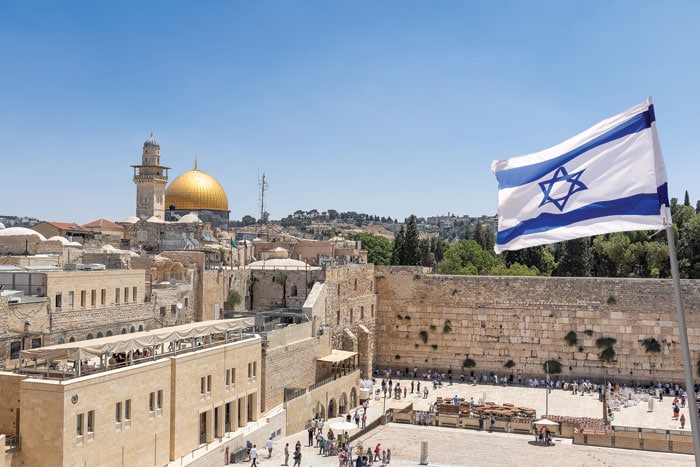
As a student journalist and a voting American, I like to start my day by perusing various news outlets. Lately, my morning readings have begun to weigh heavily on me. Tragedy and hate populate my inbox. Our country is on the precipice of a recession; 21 lives were devastatingly snuffed out in Uvalde, Texas; and antisemitism has become all too fashionable, especially among the educated elites. On Thursday, my morning began with a profile on Greg Raths, a Republican who has thrown his hat into the ring to represent California’s 40th Congressional District.

Trotting our age-old antisemitic tropes about Jews buying political influence, Raths declared that the “The Jewish community is very well organized in the United States and they control a lot of politicians.” To emphasize his distance from the Jews, he assured listeners at the Orange County Islamic Foundation candidate forum that “the Jewish community has never given me one dime, so I’m not beholden to them at all.”

Raths is not only in favor of slashing aid to Israel. He has also vocally advocated for arming the Palestinian Authority (PA) with funding — funding that it uses to make payments to imprisoned terrorists and the surviving families of suicide bombers. The PA allocates approximately 300 million dollars annually to the endeavor. Because that’s exactly what a free democratic republic founded on toleration should champion: funneling money to so-called martyrs for senseless acts of murder. The PA not only provides monetary rewards for acts of unspeakable violence but also employs members of Hamas, a US-designated terrorist organization, among its highest ranks, according to the U.S. Department of the Treasury. Thankfully, when confronted by the Journal, Raths issued an apology.

Having just witnessed a surge in public anti-Israel sentiments at Princeton with the recent Boycott, Divestment, and Sanctions (BDS) aligned referendum, I am overwhelmed by how commonplace and acceptable antisemitism has become in this country, particularly among the well-educated. 

Nevertheless, as an American and a Jew, I am appalled, but unfortunately not too surprised, by Raths’ rhetoric, which is just a continuation of the anti-Israel sentiment that has become so fashionable in today’s political climate. Having just witnessed a surge in public anti-Israel sentiments at Princeton with the recent Boycott, Divestment, and Sanctions (BDS) aligned referendum, I am overwhelmed by how commonplace and acceptable antisemitism has become in this country, particularly among the well-educated. 

Reporting for the Princeton Tory, the university’s journal for conservative thought, I attended an event thrown in support of the referendum by the Princeton Committee on Palestine (PCP), a pro-Palestinian student group whose President authored the BDS-aligned referendum. At the event, an invited guest speaker declared “From the River to the Sea,” an explicit call for the erasure of the Jewish State of Israel and a slogan routinely used by Hamas and other terrorist organizations. In addition, groundless assertions like “Zionism is Racism” and blood libels against Israel charging it with carrying out “ethnic cleansing” were casually bandied about without the slightest regard for the truth.

Just weeks before that, PCP protested an Israel internship fair outside of the University’s Center for Jewish Life. And this is far from the first time that PCP has been embroiled in antisemitic controversy. In 2019, the group sponsored an event featuring Norman Finkelstein, a known antisemite who has referred to Israel as a “satanic state,” at which Finkelstein called a Jewish Princeton student a “concentration camp guard” for his service in the Israeli Defense Forces. In 2021, PCP brought yet another antisemitic voice into Princeton’s hallowed halls: Lamis Deek. Deek has expressed support for Hamas terrorists and drawn comparisons between Israel and Nazi Germany.

As Americans and Jews, we cannot passively stand for this, whether out of fear for personal safety or potential “erasure” by self-anointed arbiters of the Web; events of the last century have taught us what the lethal consequences of complacency are. 

As Americans and Jews, we cannot passively stand for this, whether out of fear for personal safety or potential “erasure” by self-anointed arbiters of the Web; events of the last century have taught us what the lethal consequences of complacency are. Antisemitism must not be permitted to become so commonplace and unchecked in this country that politicians can spew hatred and falsehood with no repercussions or accountability. When a nation becomes unlivable for some, it will eventually become intolerable for all.

Alexandra Orbuch is a Freshman at Princeton University from Los Angeles, California hoping to study Politics. On campus, she writes for The Princeton Tory, the university’s journal for conservative thought, and the Princeton Legal Journal, the university’s undergraduate law review.

Antisemitism: Back in Vogue? Read More »

The Great Return Theory

“Zionism is racism” is indeed a pernicious lie. Propagation of this lie has led to both random and organized violence against Jewish people and the marginalization of Jewish people in their respective nations, from the Soviet Union to Great Britain. Should the claim that Zionism is akin to racism, white nationalism, and Nazism penetrate mainstream American circles, it would spell a crisis for our community. Hatred against us would become justifiable, isolation from progressive movements would become encouraged, and our very status as protected citizens in the United States would become imperiled. We crossed into dangerous territory this week when journalist Peter Beinart and foreign policy advisor to Senator Bernie Sanders Matt Duss, two highly respected liberal commentators, publicly compared “The Great Replacement Theory” to opposition to the “right of return.” In doing so, they continue the legacy of the “Zionism is racism” libel and therefore deliberately contribute to antisemitism in the United States and around the world.
Anti-Zionism, not Zionism, is akin to white nationalism by its very definition, crafted explicitly with the desire to punch down at minorities and subjugate them once again.

The Great Replacement Theory, or GRT, is back in the news this month after a deranged shooter killed ten Black Americans in a parking lot in Buffalo. Like the shooters at Pittsburgh’s Tree of Life Synagogue and Chabad of Poway, the Buffalo assailant ascribed to a conspiratorial worldview that claims that an elite cabal of Jews are manipulating demographics in the United States — breeding out the white people and opening the borders to people of color to take their place. The theory is based on ideas of racial supremacy and ethnic hierarchy. 

The “right of return” is a common policy initiative pushed by anti-Israel advocates. Its foundation lies in the 1948 War of Independence between the nascent State of Israel and surrounding Arab nations, which declared war on the Jewish people and swore to their annihilation. In the midst of battle, 750,000 Palestinians either fled or were expelled from their homes in Israel, along with upwards of 800,000 Jews from Muslim countries. Those who champion “the right of return” claim that the Palestinian refugees of 1948 and their descendants, who number close to seven million people worldwide, have a “right” enshrined in international law to return to the property inside of Israel’s borders. Not only is “return” not a right enshrined anywhere in international law, but Jews worldwide are strongly opposed to this idea, considering the resettlement of millions of Palestinians inside of Israel would render the Jewish people once again a minority in the region, would compromise their means of self-defense, and would turn Israel into Palestine from the river to the sea. This is the goal of the “right of return,” regardless of the language used to disguise it as justice or human rights.

After the Buffalo shooting, the Anti-Defamation League took to Twitter to condemn “The Great Replacement Theory” for the hateful venom it is. Beinart responded: “the Anti-Defamation League denounces in America the principles it advocates in Israel,” referring to the ADL’s strong opposition to white nationalist ideas in addition to their support for a Jewish state in the Middle East. Duss then tweeted: “In the Israeli-Palestinian context, ‘great replacement theory’ is expressed as opposition to the Palestinian right of return, which treats Palestinians as a ‘demographic threat.’” An irresistible narrative then developed in left-wing corners. It claimed that Zionism, by way of its intention to maintain a Jewish majority in Israel, is no different than the ideology that animated the antisemite who slaughtered innocents in Buffalo, and therefore that Jews around the world who support the existence of Israel are no different than the Nazis who have at many points tried to kill them.

Antisemitism has always been a politics of inversion.

Antisemitism has always been a politics of inversion. The alt-right and radical Islamists both revel in the delight of accusing the Jews of doing to others that which has been done to them. That Beinart and Duss would join this crusade is shameful. As I see it, their argument reinforces an abject lie, and it is of paramount importance that it is addressed as such. 

White nationalism and Zionism could not be more distinct. White nationalists view all white people as just that, a nation deserving of their own self-determination, which they define as an exclusively white society that upholds “white” culture and values. It bears repeating that white people are not a nation. White people are not a peoplehood with a common history, language, culture, or attachment to a piece of land. The separation of “whites” from all other human beings is constructed purely on the pseudo-science of race, external characteristics, and a power dynamic of genetic supremacy that they themselves have imposed. 

Zionism, on the other hand, is a liberation movement, seeking to grant sovereignty to an independent people. The Jewish people fall under every political definition of a nation, sharing our own history, language, culture and attachment to land. We encompass a vast array of races and ethnicities under the umbrella of the term “Jewish.” The founders of Zionism indeed called for a Jewish and democratic state, where equality for minorities was to be enshrined as explicitly as protection of Jewish values. Additionally, Jewish people are a perpetual minority who have collectively been made to bear the consequences of white supremacy and other forms of hatred that successfully exploited our lack of a state. The right of self-determination for independent nations is indeed universal. No left-wing commentator would ever accuse the Kurds, the Palestinians, or the Uighurs of ethnic supremacy in their demand for political independence. However, they recognize Zionism, the Jewish form of this demand, as immediately evil. This reveals a pathological bias as well as a distinct set of double standards against Jewish people. 

Anti-Zionism, the ideology Beinart and Duss have seemingly espoused, the ideology at the core of “the right of return,” is closer to white nationalism than Zionism. Anti-Zionism rejects the concept of coexistence in the Middle East. It rejects that Jews have equal rights with non-Jews, and it rejects that the Jewish people are their own nation with the rights to defend themselves and to decide their own fate. This is not to say that racism does not exist in Israel. And this is definitely not to say that racists don’t hold any power in Israel. But it is to say that Anti-Zionism, not Zionism, is akin to white nationalism by its very definition, crafted explicitly with the desire to punch down at minorities and subjugate them once again. Zionism is an affirmative, the right of the Jewish people to a country, whereas anti-Zionism is a negation, the denial of this right. 

It is therefore incumbent upon us to recognize when demands to eliminate Israel are wrapped in manipulating words. Just as white nationalists twist their true intentions by claiming they’re only concerned with immigration, with crime, or with “western civilization,” anti-Zionists are hell-bent on describing their cause as liberation, peace and freedom. The ramifications of both ideologies lead to disaster for the Jewish people. I therefore propose that we Jews begin to address calls for the “right of return” as the “Great Return Theory,” for they share the same goals and the same strategies to reach these goals as those who propagate white nationalist conspiracies.


Blake Flayton is New Media Director and columnist for the Jewish Journal.

The Great Return Theory Read More »

Rabbi Sarah Hronsky: The Inclusive Leader

When Rabbi Sarah Hronsky was 15 and growing up in St. Louis, Missouri, she learned about tikkun olam and inclusivity from her rabbi, Rabbi Lynn Koshner. No matter who needed help, Koshner was there for them.

“We scouted out homeless people in abandoned train cars and fed them once a week,” said Hronsky, who is the senior rabbi at Temple Beth Hillel in Valley Village. “She showed me how to do acts of loving-kindness outside of the doors of the temple.”

The temple was small – everyone contributed and everyone participated. Hronsky’s parents served on the board and eventually she did, too. 

“My mom and I mowed the temple yard and stacked the furniture so it could function,” she said. “I participated in the youth group.”

Hronsky’s love for synagogue life – along with Koshner’s influence – made her want to pursue the rabbinate. 

“[Koshner] opened my eyes,” she said. “The previous rabbi taught me about Jewish study and how to lein Torah and read prayer. That was beautiful. Rabbi Koshner showed what it meant to be part of the larger Jewish community and serve folks who are in the ‘othered’ category.”

As a rabbinical student at Hebrew Union College-Jewish Institute of Religion, one of the focuses of Hronsky’s studies was how the Jewish tradition saw people with disabilities. 

“For me, Judaism was about accessibility for everyone, and almost 20 years ago, there wasn’t a lot of knowledge about how to be inclusive of people who are differently abled,” she said. “Judaism may put you on the outside and not allow you to fully participate in the community. I wanted to study the origins of the stigma behind disabilities and make Judaism inclusive.”

At Temple Beth Hillel, where she’s been since 2003, she makes sure that everybody, no matter what their abilities, background or connection to Judaism are, can participate. For instance, every child has a bar or bat mitzvah based on their needs. 

“Some kids will learn a little Torah, and some will learn a lot,” Hronsky said. “Some will read a lot of Hebrew, some won’t. Everyone is able to have a bar or bat mitzvah.”

Throughout the pandemic, Hronsky and her staff reached out congregants to ensure they were able to see the services. Mainly, they were helping senior citizens who didn’t know how to log onto services online.

“We were training them on how to install programs on their computer so they could access services,” she said. “We also did Zoom classes to reach people and create a holy space in their house.”

Recently, Hronsky and her congregation have also strengthened their relationships with Jews of color and clergy members of different faiths. 

“We spent a year deeply committing to learning, reading books and having guest lecturers,” she said. “We see what’s happening in the world around us and how we can make a change and be part of this healing process.”

Hronsky learned about inclusivity and the value of caring for all different types of people from one of the Torah’s core teachings.

“We need to embrace each other as holy and truly treat one another in a way we wish to be treated.” 

“I really want to live by the holiness code: love your neighbor and your stranger like yourself,” she said. “We need to embrace each other as holy and truly treat one another in a way we wish to be treated. Whether they are our neighbor or different from us, everyone should be treated with dignity.” 

For Hronsky, this means that anybody who walks through the doors at Temple Beth Hillel is going to feel at home.

“One of our folks who knocked on the door spent the last couple of years studying and converting,” she said. “They were called up to the Torah just a week ago for an adult b’nai mitzvah. Our congregation was so excited to show up and support this individual on their journey.”

This is exactly what Hronsky envisioned when she first become involved in her childhood temple. Today, she’s proud she’s passed on inclusivity to her own congregation.

“We pride ourselves on being warm, welcoming and inclusive,” she said. “We’re embracing people for who they are.”

Fast Takes with Sarah Hronsky

Jewish Journal: What’s your favorite Shavuot food?

Sarah Hronsky: Cheese blintzes.

JJ: What would you be if you weren’t a rabbi? 

SH: Probably a veterinarian. I kind of love all the gross medical stuff, and animals are lovely. And they don’t talk back.

JJ: What do you like to do with your family when you have some time off work?

SH: We love to do family traditions. Ride the ferris wheel in Santa Monica. Host meals. We might be at Disneyland or go hiking.

JJ: What’s your perfect Shabbat look like?

SH: A big, fun, festive service where kids can play, parents participate and there is eating and prayer and music. 

Rabbi Sarah Hronsky: The Inclusive Leader Read More »

Learning How to Read on Shavuot

Starting With Aleph

When Akiva was forty years old, he had not yet learned a thing. 

So goes the origin story of the great Rabbi Akiva, recounted in the “Avot D’Rabbi Natan,” a collection of Jewish aggadot, or legends, from the latter half of the first millennium. 

One day, according to the tale, Akiva was looking into a well. Perplexed by what he saw, he asked his companions how the stone inside the well had become smooth. They answered that water had carved the stone. With a hint of mocking, they added that Akiva would have known this had he read the Book of Job, wherein it is written that “water wears away stone; [and] torrents wash away earth” (Job 14:19). 

Akiva paid no mind to the condescension of his fellows, but rather continued to stare into the well — transfixed. He reasoned: “If water, which is soft, can carve stone, which is hard; how much more so could the words of Torah, which are as strong as steel, carve my heart, which is but flesh and blood.” 

Without delay, he went off to study Torah. He joined his young son at the children’s schoolhouse. He sat at the feet of the teachers and took a slate in his hands. 

They taught him the letter aleph and he learned it. 

They taught him the letter bet and he learned it. 

Eventually he reached tav, the final letter of the alphabet, and from here, he began to read the book of Leviticus, and on and on until he had read the entire Torah. 

There are many messages that one can take from this story. One of them is this: To study Torah, one must first learn how to read. 

Standing at Sinai

In Rabbi Akiva’s story there is an echo of another story — a story both ancient and archetypal, as fundamental to the Jewish people’s shared identity and fate as the story of the exodus from Egypt.

In this great story, we swap out Akiva at the feet of his teachers for the Israelites at the foot of Mount Sinai on the day they received the Torah — the day when the people became the people of the Book. 

Shavuot, discussed in the Torah as an agricultural festival connected to the barley harvest, became associated with the Sinai revelation in the rabbinic era. In our own era, however, Shavuot is often overlooked. It is far less observed than Pesach or Hanukkah, and Jews who fast on Yom Kippur are unlikely to attend a Tikkun Leil Shavuot event, at which people gather to study Torah late into the night and potentially until the break of dawn.

Shavuot simply doesn’t speak to many of us, and this is because we don’t understand its language. 

Shavuot simply doesn’t speak to many of us, and this is because we don’t understand its language.

The Torah remains our greatest inheritance and our heaviest piece of baggage—simultaneously an elixir of life and an elixir of death (BT Yoma 72b) depending on the spirit in which it is imbibed. Coming to the Torah, we may find it impenetrable. We are put off by the Hebrew and the profusion of commentaries on each and every verse makes getting started seem like an impossible task. 
We may find it primitive. Its morals are strange to us and it contains much that seems so contrary to our modern sensibilities. 

We may find it bewildering. There are spinning, flaming swords wielded by cherubim. Fire and brimstone rains from the sky. Seeking spiritual peace or inspiration, we may wish to look elsewhere. 

Whatever it may be, we are estranged. Like Akiva, we are lacking the one skill that would open up the entire Torah for us. We haven’t yet learned how to read. 

Learning How to Read

In April, when I learned that my former professor, Ilja Wachs, had passed away, I rushed to my closet to grab a box of mementos that I keep on the top shelf. I hauled it over to my desk and began rifling about until I found what I was looking for — a photo we had taken on the final day of the semester, sitting out on the stone steps of Andrews House. Ilja would have been in his late seventies then. I was twenty.

Ilja occupied a somewhat mythical role at Sarah Lawrence College. His seminar, Studies in the Nineteenth-Century Novel, was as celebrated as he was, and though I knew little about him and had equally little interest in nineteenth-century novels, I took it on faith that one should — at the very least — make an attempt to get into the much-ballyhooed seminar. To my great surprise, I got in. 

In the years before I studied with him, I would sometimes see Ilja through the window of his office as I walked past. Through the glass, he looked to me like an old man — a tweedy academic with a wisp of white hair that was always pointing in a different direction like a weathervane. 

Face-to-face, he gave a different impression — one of vigor and joy. Much of this came from his voice, which was sonorous and benevolent, capable of commanding any space in which he held court.  

In a way, this shift in my perception of Ilja mapped onto a parallel shift in my perception of nineteenth-century novels. If, before Ilja’s class, I had been inclined to see these novels as stodgy, stilted, and forbidding; afterward, I came to see them as vivid renderings of the human experience, brimming with wisdom, beauty, and vitality. 

When it came time for our class to conduct independent studies, I chose to read “Daniel Deronda” by George Eliot. Over the course of the next couple of months, Ilja and I would meet weekly in his office to discuss the book together. It was here that we began to know one another as individuals, and it was here that our greatest differences were articulated.

I was just beginning to delve deeper into my Judaism. Ilja was a principled and passionate atheist. On the topic of Jewish identity, we stood on opposite sides of a great historic divide. Ilja revealed to me that he was a Holocaust survivor, separated at age six from his parents and left alone for an entire year in his family’s Vienna apartment, looked in on by a housekeeper and unsure of when or if he would see his family again. 

There is a great deal more to this story, but this was all that Ilja told me at the time. The rest I have learned only since his passing — a story of reunions and separations, narrow escapes and foiled plans, heartache and courage. 

After this experience, Ilja never forgave. He was finished with religion, and now he wouldn’t so much as attend a seder. Nevertheless, we came together each week over the Kabbalistic musings and proto-Zionist themes of “Daniel Deronda.” 

More than any one corpus of literature, what Ilja taught was the craft of reading well, and though he may have balked at this application of his teachings, I believe that what Ilja knew about reading could be helpful to those Jews who find themselves estranged from the Book of Books.

On this Shavuot, it is to these Jews that this essay is addressed, though it is to Ilja that it is dedicated. 

The Actual and the Ideal

When approaching the Torah, we confront a gap between an actuality and an unrealized ideal.  The actuality is the text in front of us. The unrealized ideal is all those notions of what scripture ought to be — or could be. In the gap between the two, there is often disappointment. 

After all, the Torah is supposed to be the literal word of God, or at least our best human attempt at creating a home for God within language. 

We speak of it in the most vaunted terms. We call the Torah a tree of life. We are told that those who hold fast to it are happy and that its ways are ways of pleasantness and all its paths are paths of peace. In mystical literature, it is taught that the Torah is the very blueprint of creation and the Mishna tells us to “turn it and turn it for everything is in it.” 

When we open it up, however, this is what we find: There are stories with an often confounding moral logic. There are laws — a great many of which have to do with animal sacrifices and ritual impurity. There are skin afflictions and oozing members, liver protuberances turned into smoke on the altar, and fornicators impaled on a rod. In summation, much of it is boring, some of it is offensive, and a significant portion of it is unseemly.

A similar gap between the actual and the ideal is found in nineteenth-century literature. As Ilja said in a 2010 lecture, though nineteenth-century novels take place within history, with all the attendant “societal constraints that delimit and distort the self,” they nonetheless strive toward transcendence, “struggling to suggest new human possibilities — harmonies and reconciliations of opposites that are in effect utopian in the sense that they cannot be fully realized in the moment of history in which they are written — or in our moment of history.” 

This is precisely how we should approach the gap between the actual and the ideal in the Torah. 

Take, for instance, this verse from Parashat Ki Teitzei in Deuteronomy: “If, along the road, you chance upon a bird’s nest, in any tree or on the ground, with fledglings or eggs and the mother sitting over the fledglings or on the eggs, do not take the mother together with her young. Let the mother go, and take only the young, in order that you may fare well and have a long life” (Deuteronomy 22:6-7).

In this passage, God’s justice and compassion are extended even to the birds — but not completely. The law concerns itself with the mother bird, but not with her young, and only to a certain extent. Her pain is mitigated, not eliminated. The traveler’s appetite is checked, but not forbidden. 

The law thus seems to fall short, but in its limitations, the negative space of an unseen ideal is articulated.

Instead of a doctrinaire precept, there is the suggestion of narrative, replete with what Ilja called “sensuous concreteness.” We see a traveler upon the road. He “chances upon” a bird’s nest and, with the voice of God in his ears, the scope of his moral vision (and ours) expands. Within the limits of the actual, he reaches for utopia.

Meeting the Torah On Its Own Terms

The Torah is more than the sum of its genres. 

Though it contains elements of history and epic, philosophy and verse — it is neither history nor epic, neither philosophy nor verse. As the great thinker Yeshayahu Leibowitz put it, “as a means of moral education, perhaps Sophocles’ “Antigone” or Kant’s “Metaphysics of Morals” are superior; as philosophy, Plato and once again Kant are more important; as poetry, perhaps Sophocles or Shakespeare are better; as history, certainly Thucydides is more interesting and more profound.”

Only when considered “as the words of the living God” does the Torah become “incomparable to Sophocles and Shakespeare, Plato and Kant, Thucydides or any other human creation.” 

A similar idea is found in the Zohar, phrased in a more mystical idiom: “Woe to the person who thinks that Torah comes simply to tell stories and speak of earthly matters. If that were so, even in our times we could make a Torah, and we could do a much better job of it … Rather, all the words of the Torah are sublime matters and deep secrets.” 

In other words, we must meet the Torah on its own terms. 

This was how Ilja met each and every novel that he read.

As the author Brian Morton once said of his time studying with Ilja, “He had nothing to say about literary craft. He had nothing to say about the handling of dialogue or the use of the third-person point of view. It took me a while to see that Ilja was going after things of much greater consequence than that.” 

Indeed, he had no interest in those courses on offer at Sarah Lawrence that read literature through some explicitly ideological, political or theoretical lens. This was too narrow an approach, one that failed to take each novel seriously as a unique human expression and a world within itself. 

As the Jewish philosopher Martin Buber might put it, he didn’t see literature as an “it” to be categorized, compared and dissected, but rather a Thou — an infinitely complex subject with which to enter into relationship. 

The Biblical Gestalt

The narrator is usually an unobtrusive figure in a book — ever present but somehow unseen, striving to keep up the appearance of objectivity. Not so for the narrator of George Eliot’s “Middlemarch,” who watches over her characters with tenderness and concern and often departs from the plot to rhapsodize about the human condition. 

“And certainly,” begins the narrator in one such moment, “the mistakes that we male and female mortals make when we have our own way might fairly raise some wonder that we are so fond of it.”

These interludes are some of the most enjoyable parts of the novel — far more entertaining, to be sure, than the interminable descriptions of local political goings on. For this reason, Ilja had once endeavored to publish them as a collection. He went through the entire text, finding and gathering Eliot’s best sayings. What he discovered, however, was that the finished product was unsatisfying. 

“I realized,” he told us, “that the narrator can’t be separated from the characters and the plot.” 

A similar temptation exists with the Torah. There are certain passages, certain chapters, and certain portions that we would — if we could — raise up as somehow more important than the rest. To do so, however, would be folly. 

A story is related in the introduction to the work “Ein Yaakov” in which the sages hold a sort of contest to see who can identify the most important passage in the Torah. 

Ben Zoma suggests the Shema, “Hear, O Israel, the LORD is our God, the LORD is one” (Deuteronomy 6:4).

Ben Nanas suggests: “Love your fellow as yourself” (Leviticus 19:18).

Then Shimon Ben Pazzi suggests: “The first lamb you shall sacrifice in the morning and the second lamb you shall sacrifice in the evening” (Numbers 28:4). 

At this, Rav Ploni rises and declares Shimon Ben Pazzi the winner of the contest.

The Torah is more than its greatest hits. Its wisdom can only be apprehended by those who are willing to delve into its less quotable and more challenging material.  

The meaning of this koan-like story is anything but clear, but one takeaway might be this: The Torah is more than its greatest hits. Its wisdom can only be apprehended by those who are willing to delve into its less quotable and more challenging material. 

As was taught by Maimonides, the great philosopher and legal codifier of the 11th century, the Torah is entirely holy, and there is therefore no difference in holiness between the passage “I the Lord am your God” (Exodus 20:2) and the passage “and Timna was a concubine” (Genesis 36:12). 

To believe in the holiness of “and Timna was a concubine” is an act of faith. To realize it with the heart, however, is an act of commitment — a matter of sitting with the text, along with the commentaries — until the significance of the passage becomes clear. 

As it says in the Midrash collection “Tanna d’Vei Eliyahu,” “the Torah was given as wheat or flax in order to have flour or garments produced from them.” Put another way, the Torah demands our participation, our contribution, and our effort. 

Reading for Reading’s Sake

We live in a culture that prizes ambition and goal-oriented activity, and we inevitably bring these postures into our relationship with reading. We read to have read, or to be well-read, or to acquire some specific knowledge. 

Such an attitude was anathema to Ilja. Reading was, for him, a pleasure first. Indeed, it was one of life’s greatest pleasures. To read for the sake of something else missed the point entirely. 

In the books we studied, we savored all that was tender, humorous and thrilling. We lingered over the scenes that captured life at its richest and most sensual, such as the time-bending tempest in “David Copperfield” (“a dread disturbance of the laws of nature”) or the joyful and bizarre “sperm squeezing” scene in “Moby Dick” (“I squeezed that sperm till a strange sort of insanity came over me”) or the mystic mowing chapter from “Anna Karenina” (“He thought of nothing, wished for nothing … He heard nothing but the swish of the scythes.”).

We must come to Torah not to take from it, but to spend time with it.

Torah, too, must be read lishma — for its own sake. We must come to Torah not to take from it, but to spend time with it. For this reason, we pray each day that God make the Torah “sweet” in our mouths. 

When God grants this prayer, we will find much in the Torah that is tender, humorous and thrilling. We will hear Sarah’s laughter. We will be awed by the strangeness of Jacob’s visions. We will fear for Joseph in the pit. We will be moved to find Ruth curled up at the feet of Boaz. We will be charmed by Rahab and her apartment in the wall of Jericho. 

Certain passages will seem to wink at us. Certain images will linger in our minds. Certain laws will move us to tears from the sheer force of their moral vision. 

Transcending Solitude

When the seminar ended, Ilja gave us a piece of advice as a parting gift: “Join a book club.” Reading, he believed, is something that we do together. 

As James Atlas — a member of Ilja’s own fabled book club — wrote in a 2014 New York Times essay, “To read a book is to burst the confines of one’s consciousness and enter another world. What happens when you read a book in the company of others? You enter its world together.” He added, “In the end, book groups are about community.”

So is Torah. 

The Talmud puts it this way: “Why are matters of Torah compared to fire? … To tell you: Just as fire does not ignite in a lone stick of wood but in a pile of kindling, so too, matters of Torah are not retained and understood properly by a lone scholar” (BT Taanit 7a).

Judaism, in its own way, is a book club. 

photovs/Getty Images

We tend to meet on Saturdays in synagogues. We read our book aloud and discuss it with one another. Interpretations are offered. Connections with contemporary issues are drawn. Like at any good book club, wine is poured and a meal is served.

We are a diffuse group, spread across the globe. Our membership includes the living and the dead. Rashi sits beside us, along with Ramban, Ibn Ezra, the Tosafists, and the Hasidic masters. 

We are a diffuse group, spread across the globe. Our membership includes the living and the dead. Rashi sits beside us, along with Ramban, Ibn Ezra, the Tosafists, and the Hasidic masters. 

In the Beit Midrash, these voices from the past call out to us from the margins. They become as real as anyone else who reads beside us — living presences who bring us into the text’s hidden architecture, revealing to us the subterranean chambers that lie beneath a verse or the skylight bringing light into a word. 

Beginner’s Mind

Rabbi Akiva never really moved on from aleph. Though he became the greatest sage of his day, a master of Torah, he never lost his concern with the letters themselves — the building blocks of all that can be known and expressed. 

Indeed, he was even concerned with the so-called “jots and tittles” of the Torah’s calligraphy. As one aggada has it, when Moses ascended to heaven, he saw God busy writing decorative crowns on the letters of the Torah. Moses asked the reason for this, and God replied that he was doing it for Rabbi Akiva, who would someday derive great meaning from even these little markings. 

As we get older, we tend to stop seeing letters. Indeed, we even stop seeing words. We fail to notice their shape. We ignore the way the look of a word — its texture and size and font — affects the way we understand it. 

To return to such things is to cultivate what the Zen tradition calls “beginner’s mind.” 

As Zen teacher Shunryu Suzuki puts it, “In the beginner’s mind there are many possibilities, but in the expert’s there are few.”

Rabbi Akiva never lost his beginner’s mind. Neither did Ilja, who read “Anna Karenina” every year for some four decades and never stopped delighting in it or seeing it with fresh eyes.  Learning to read well, then, is a matter of forgetting — a matter of returning to our beginner’s mind. 

On Shavuot, we have a rare chance to do just this — a chance to return to the start, when we stood at the foot of Mount Sinai and began learning how to read. As taught by Rabbi Menachem Mendel of Rimanov, when God spoke at Sinai, the Israelites did not hear a word nor a whole commandment, but rather one letter alone, the first letter of the decalogue, which is also the first letter of the Hebrew alphabet.

First an aleph. Then everything else.


Matthew Schultz is the author of the essay collection “What Came Before” (2020). He is a rabbinical student at Hebrew College in Newton, Massachusetts.

Learning How to Read on Shavuot Read More »

Table for Five: Shavuot Edition

One verse, five voices. Edited by Salvador Litvak, the Accidental Talmudist

May the Lord reward your deeds, and may your reward be full from the Lord God of Israel, under Whose wings you have come to take shelter.

-Ruth 2:12


Aliza Lipkin
Writer and educator, Maaleh Adumim, Israel

In Megillat Ruth we read how Naomi suffers the death of her husband and two sons in Moav. Upon hearing that the famine in Israel ended, she returns, destitute, to her homeland with Ruth, her daughter-in-law, who refuses to leave her side. Ruth decides to find them sustenance by going out to glean in the fields. She haps upon Boaz’s field where she gleans all day. When Boaz arrives and learns her story he gives her special treatment and blesses her saying, “May the Lord reward your deeds, and may your reward be full from the Lord God of Israel, under Whose wings you have come to take shelter.” 

His blessing appears to have been accepted and fulfilled by God, for in Psalm 91, compiled by Ruth’s great-grandson David Hamelech these exact words are found, “With His wing, He will cover you, and under His wings, you will take shelter” 

This concept resonated deeply with King David because it was firmly implanted in his very being by Ruth. Her full devotion is witnessed by her words to Naomi “ wherever you go, I will go, and wherever you lodge, I will lodge; your people shall be my people and your God my God.” 

This all-embracing devotion of Ruth was rewarded by having King David as a great-grandson. His faith and devotion to God were so heartfelt and compelling that his words have been an unparalleled source of prayer and solace until this day, connecting us to His wings of shelter. 


Marcus J Freed
Actor, Writer & Jewish Educator, marcusjfreed.com @marcusjfreed

Quentin Tarantino’s lockdown experience was a surprise to many people. Having married an Israeli woman, he embraced being stuck in Israel during the early COVID era and enjoyed time with their daughter who calls him ‘Abba’. The iconic filmmaker who brought us the violent imagery of “Reservoir Dogs” became deeply connected to the land of our forefathers. 

The Book of Ruth recounts Boaz’s blessing to Ruth, who followed her calling despite a painful personal history. The blessing is beautiful – “May the Lord reward your deeds” – but the history of rewards for righteous people is a complex history. 

Many tzaddikim suffered greatly, experiencing the apparent opposite of rewards. Rabban Shimon Ben Gamliel was beheaded, Rabbi Yishmael’s face was removed, Rabbi Akiva was raked with iron combs, and Rabbi Haninah ben Teradion was burned alive. 

It sounds like a bloody Tarantino movie, full of action, violence and unexpected plot twists. Where, then, is the reward for the righteous? 

We can retranslate the verse as “May the Lord complete and fulfil your actions”. The word for ‘complete’ is a derivation of ‘Shalom’, and can be read as a blessing to achieve a sense of peace and completeness in everything you do. 

The word for ‘deeds’ can also be read as your purpose, or soul’s calling. On Shavuot we receive the word of God, which happens at every moment. You listen for your personal calling, to use your unique gifts and fulfil them in the world. May you be blessed with the strength to complete your mission.


Rabbi Gershon Schusterman
Businessman, Mashpia

Shavuot, the 3,334th anniversary of our receiving the Torah at Mt. Sinai, commemorates the cataclysmic event when heaven and earth met and God spoke the Ten Commandments to our predecessors. This changed the world forever. 

For the descendants of Abraham, this was their conversion to Judaism. They became a holy nation, bound by their allegiance to their Creator and His commandments. They became a family, bound by their responsibility and allegiance to each other. 

On Shavuot, we read the Book of Ruth, for Ruth was the quintessential proselyte. Born a Moabite princess, she married a Jew and, when widowed, abandoned her lofty status to accompany her mother-in-law, Naomi, to Israel, living in poverty, modestly gleaning barley stalks left behind by the harvesters. Her dedication to Judaism is expressed in her pledge to Naomi: “Where you go, I will go; where you lodge, I will lodge; your people are my people, and your God is my God; where you die I will die and there I will be buried.” (Ruth 1:17) God noticed. He orchestrated that Ruth find favor in the eyes of Boaz, a venerable judge and leader, whom she later married and they became the forbears of the royal family of King David. 

Every Shavout we take inspiration from Ruth. We renew our vows to eschew the superficiality of wealth and status and to rather find shelter under the wings of the God of Israel and meaning in a life filled with His Torah and its commandments. 


Cantor Michelle Bider Stone
Shalom Hartman Institute of North America

There are many hypotheses about why the book of Ruth is read on Shavuot, but I’m struck by a lesser known theory that the rabbis connected Shavuot and Ruth to show the indivisibility of the written and oral Torah. On Shavuot, we celebrate the giving of the Torah at Mt. Sinai, including both written Torah and the centuries long practice of its interpretation. So, how does the book of Ruth represent the oral Torah? 

According to Deuteronomy, Israelites are not allowed to marry or even interact with Moabites. Ruth, the protagonist of the megillah, comes from Moab, yet she is able to marry an Israelite and join Israelite society, a reinterpretation of Torah for its time and circumstance. This verse is said by Boaz, who marries Ruth and welcomes her into the Israelite people. 

The Sefat Emet, the 19th century Hasidic work, explains that Boaz represents the Oral Torah on Shavuot because of his courageous reinterpretation of Deuteronomy that allows him to marry Ruth the Moabite. Boaz exemplifies the importance of the interpretative tradition that allows for our intergenerational dialogue so vital to learning and living Torah. Ours is a multivocal tradition that values the voices of the past and present. We, the Jews of the present, are integral to that long-standing interpretive tradition, and reading the story of Ruth on Shavuot expresses our commitment to it. 

This weekend, as we again stand at Sinai to receive the Torah, let us remember to add our voices to the chain.


Rabbi Avraham Greenstein
AJRCA Professor of Hebrew

This verse contains the biblical version of an idiom (i.e. that of taking shelter under the wings of the Divine) that has become a conventional, yet evocative, way to describe the process of becoming a Jew by choice. It is worth noting that built into this image of taking shelter is an implication of vulnerability and of a need for protection. That is, in fact, the case for Ruth who arrives widowed from Moab, with no means and no friend but her despondent and equally dispossessed mother-in-law. Boaz recognizes the precariousness of Ruth’s position, and he admires her sacrifice as well as her loyalty to Naomi and to the God Ruth has newly committed herself to. 

Boaz notes in the previous verse that Ruth has left her family and her homeland in preference for an unknown future with a nation heretofore unknown to her. This journey from the familiar to the uncertain and into the hands of the Divine is an echo of the patriarch Abraham’s journey by God’s command to leave his homeland for a promised land and an auspicious destiny. Ruth certifies her membership in the tradition of Israel with her Abraham-like trust in the God of Israel and her acts of kindness. 

On this holiday of Shavuot that celebrates our receipt of the Torah, Ruth reminds us that the first step to receiving the Torah is that of facing the uncertainty of life and trusting in the Divine love and untold amazement we have yet to discover. 

Table for Five: Shavuot Edition Read More »