fbpx

May 18, 2022

Israel Set to Hold Its First NFT Auction as Local Artists Embrace New Technology

To read more articles from the Media Line, click here.

The first auction of NFT works in Israel will be held this month, as many artists and collectors embrace the emerging technology.

The May 30 auction, hosted by the Herzliya-based Tiroche Auction House, is dedicated to contemporary art and will be held in collaboration with prominent art galleries from across the country.

NFTs, or non-fungible tokens, are one-of-a-kind blockchain-based digital assets – videos, animations, images, videos or songs – that can be bought, traded or sold. Though the market for them remains speculative, owners of NFTs claim unique ownership rights over the digital tokens that they have purchased.

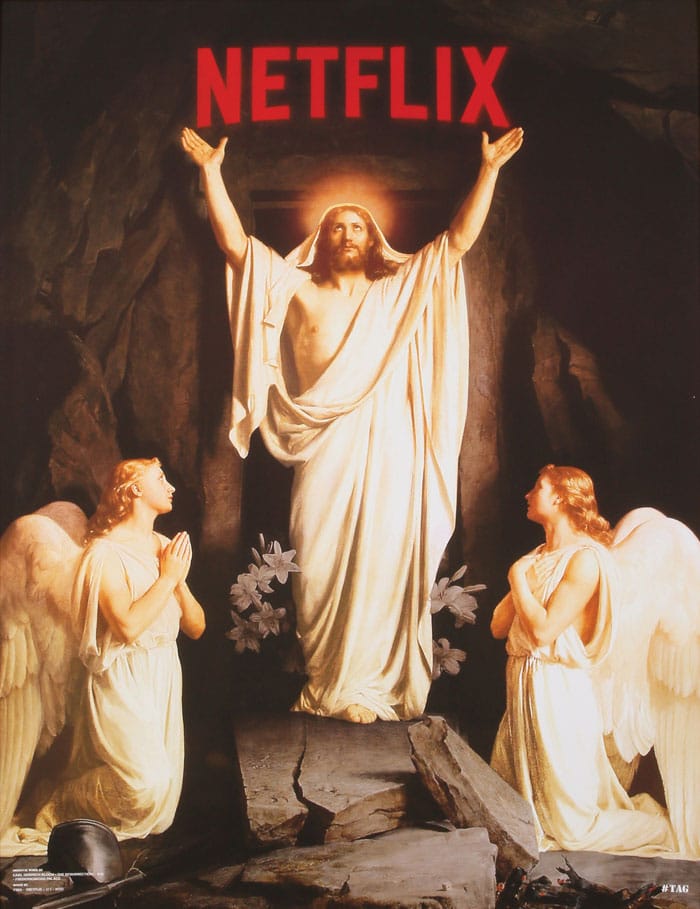
A screenshot of a video NFT work titled “Netflix” by artist #TAG (Ruben Karapetyan), which will be at the May 30 auction. (Courtesy)

Similar to cryptocurrencies such as Bitcoin, NFTs reside as data on a blockchain – a secure digital public ledger – but their value is set by the highest bidder. Artists wishing to sell their work as NFTs must first register with a marketplace, then create digital tokens on a blockchain and list them for auction.

According to Amitai Hazan Tiroche, managing director of Tiroche Auction own the company, the May 30 event represents not only Israel’s first NFT auction, but also its first auction geared entirely toward contemporary art.

“It’s a kind of retrospective exhibition of the most established and respected artists in the contemporary art industry,” he told The Media Line.

In all, 120 works – both NFTs and traditional pieces – will go under the hammer. The NFTs are by pioneers in the industry: Koketit, Shirley Shor, #TAG, and Moran Victoria Sabbag. In addition, dozens of non-NFT artworks also will be auctioned off, including by Zoya Cherkassky, Sigalit Landau, Michal Rovner, Jeff Koons, Yayoi Kusama, Adi Nes and Ron Arad.

Those wishing to purchase NFTs in the auction will be able to do so by paying with cryptocurrency or shekels and dollars.

Last year, digital artist Mike Winkelmann – better known as Beeple – sold an NFT piece for a record-breaking $69 million at a Christie’s auction.

Since then, a growing number of artists and high-tech professionals have begun working in the NFT industry and collectors are showing an interest in purchasing their works as an investment.

A screen capture of artist Shirley Shor’s NFT video work “Strange Days” (2018-2022). Sound by Dror Rada. (Courtesy)

“Everyone can see an NFT, everyone can use it but only one person is the legal owner of this token,” Hazan Tiroche explained. “It’s almost like buying the certificate [of authenticity]. Once you buy an NFT, you can only enjoy it in your digital wallet.”

Since the concept of digital ownership may be difficult for some collectors to understand, Tiroche Auction House also will provide an electronic screen displaying the video art of the NFT purchased. The screen can then be hung on the buyer’s wall.

Some have criticized the sudden popularity of NFTs and warned that the industry is a bubble or even a scam. Others have argued that copyright claims are unenforceable since digital images can easily be seen and shared for free.

As the owner of Israel’s largest auction house, where does Hazan Tiroche see the whole NFT trend heading?

“There’s so much noise and so many people doing NFTs that it’s difficult to focus on those 1% of very talented and successful creators,” he said. “I do think that NFTs are the future. Facebook decided to change their name to Meta because the next world is going to be in the ‘Metaverse’ and people will wear glasses and go with their avatars to digital malls and buy digital real estate. Maybe we can’t understand it today, just like people in 1996 didn’t understand the internet.”

The term metaverse initially was coined by author Neal Stephenson in his 1992 science-fiction novel “Snow Crash.” It refers to an immersive virtual reality world, branded by Meta CEO Mark Zuckerberg as “the future of the internet.” Such a platform will rely on virtual reality, or VR, and augmented reality, or AR, headsets to transport users to a three-dimensional, virtual space.

Shirley Shor, an Israeli new media artist, is among the pioneers in the NFT arena whose work will be sold at the upcoming Tiroche auction. Her video and sound installation, “Strange Days” (2018-2022), explores the relationship of the human body to machines, and how the two have begun to merge as technology rapidly develops.

Shor has worked as a digital artist for the last 25 years.

“When the NFT arrived, it was supernatural,” Shor told The Media Line. “It was another platform to execute some of my work.”

Like Hazan Tiroche, she believes that the potential for NFTs is huge and that humanity is on the cusp of a new – and virtual – era.

“When someone would ask what the internet was 30 years ago, we didn’t really know what it was,” Shor related. “The internet as a concept is going to change.”

More and more artists are selling their work as NFTs because the technology has enabled creators to make a decent living without the need for an intermediary like an agent or art gallery, she said. In fact, NFT data company Nonfungible.com reported that over $17 billion in NFT trades were made in 2021, up from $82 million a year earlier.

Shor believes that NFTs will evolve and eventually become part of serious art collections that people will display on their virtual properties in the metaverse.

“Right now, it’s all very chaotic; we’re all making history in real time,” she said. “Traditional art collectors are aware that the NFT is here to stay so they will need to get used to it.”

Israel Set to Hold Its First NFT Auction as Local Artists Embrace New Technology Read More »

Fail is a Four-Letter Word

Failure is all the rage. You can’t get through an instant of scrolling on LinkedIn or other social media sites without someone extolling failure’s many virtues. But what’s so exceptional about tragic failure, organ failure, bank failure, moral failure, market failure, repeated failure, and miserable failure? I know you think I’m missing the point and that rebounding from failure is what it’s all about. You want me to understand that failure is part of life; we need to accept failure, move on, and try, try again. Yes, I agree with this notion in principle, but I take formal umbrage with the word failure as it’s used in this context. Look more closely with me. The Oxford Languages dictionary defines failure as “a lack of success” and “an unsuccessful person, enterprise, or thing.” But what does this mean, a lack of success? Well, the word lack is defined as “the state of being without” or “deficient in.” Taken this way, failure means that when we don’t get the job, don’t meet the quota, don’t score the touchdown, don’t get the second date, we are without success and have achieved little or nothing. Failure is not some abstract concept; someone must ostensibly accomplish the failure, and that someone is apparently you. Moreover, synonyms for failure are rife with Debbie Downers such as: defeat, fiasco, wreck, washout, screwup, loser, and the catchy but disparaging term cock-up. Seriously, this is complete claptrap. When we don’t accomplish what we initially set out to do, it does not mean that we failed. Rather than telling ourselves that we failed, we can simply tell ourselves, “It didn’t work out as planned” or “It missed the mark” or “The results were not as expected.” Yes, there are maybe four or five more words to get through, but not one of them leaves us feeling like a loser. Additionally, fear of failure leads to risk aversion. But if we only feared “missing the mark,” it’s likely we’d take more chances and more risks—which leads to more innovation and creativity.

When we don’t accomplish what we initially set out to do, it does not mean that we failed. 

Famous, influential, and highly accomplished people the world over have chummed up to failure: Oprah Winfrey said, “Failure is another steppingstone to greatness.” J.K. Rowling said, “It is impossible to live without failing at something unless you live so cautiously that you might as well not have lived at all, in which case you have failed by default.” And Thomas Edison said, “Many of life’s failures are people who did not realize how close they were to success when they gave up.”

The excellent, underlying message throughout is keep trying. But let’s examine this last often-quoted statement. Thomas Edison speaks from experience. It seems like he never gave up on anything and enjoyed tremendous acclaim and success. He was one of the greatest and most prolific inventors of all time and acquired a record number of 1,093 patents, many profoundly and positively impacting people’s lives the world over. His creative genius was behind the invention of the phonograph, the incandescent light bulb, and one of the earliest motion picture cameras. But he was also often described as moody, socially maladroit, and so tireless that he would lock himself away in his lab for immeasurable hours. Edmund Morris, author of the biography, “Edison,” once compared Edison to electricity itself – an invisible force. But not everyone aspires to be a Thomas Edison. I’ve never invented a thing, and my lifetime accomplishments don’t stack up against even one of Edison’s, but I also don’t believe that “Many of life’s failures are people…[who] gave up.” Who knows why someone gives up? Perhaps they want to try something entirely different, or have personal or mental health problems, or they don’t care about material success. Not everyone hungers for achievement or equates it with success.

Reproaching ourselves for falling short obscures the deeper meaning of life experiences and reduces them to a pass/fail scorecard.

How do we even know that something is a failure? Why do we only judge the immediate outcome rather than believe it may be a blessing in disguise setting us up for something better, something more wonderful that we can’t yet envisage. It might seem like a failure when we lose the promotion or the awesome date, but if not for these losses, the next good thing (the dream job, dream partner) might never have happened. Each experience (good, bad, and everything in between) shapes us and makes us who we are. Reproaching ourselves for falling short obscures the deeper meaning of life experiences and reduces them to a pass/fail scorecard. Whenever I ask my Chabad rabbi, “How are you?” the answer is always “Baruch Hashem,” which basically means “Thank God.” In other words, thank God for everything good and seemingly not good because everything has a purpose, even if it is not revealed to us now. Our happiness, equilibrium, and sense of success should not be at the sway of a given moment to moment event, and our mood should not be a servant to circumstance.

As we move through life, we must remind ourselves that nothing we do is a failure, and we are certainly not failures. Each of us is doing the best we can at any given moment. That’s not to say we can’t do better in the future, but that is to say that we did not fail.


Dr. Beverly Wertheimer, DMin, MSW is an associate child and adolescent therapist, adjunct professor of psychology at Pepperdine University, and CEO of BeWorthy life coaching. She is a former TV broadcast journalist at ABC and NBC affiliates, Entertainment Tonight, and CNN Turner Entertainment.

Fail is a Four-Letter Word Read More »

Alleged Buffalo Shooter Identified Himself As Antisemite in Manifesto: “I wish all JEWS to HELL!”

The suspect behind the May 14 shooting at a Tops supermarket in Buffalo, NY reportedly identified as a white supremacist and antisemite in his manifesto, stating he wished that “all Jews” went “to hell.”

The shooting resulted in 10 dead. The suspect, identified as 18-year-old Payton S. Gendron, is currently in custody and is on suicide watch, according to CNN. He is pleading not guilty.

Journalist Tom Elliot tweeted out passages from the shooter’s purported 180-page manifesto that was posted online; in the manifesto, the shooter asked a series of questions to himself and then answered them. The suspected shooter wrote that he chose the supermarket because it was in an area with “the highest black population percentage … and isn’t that far away” and because the state’s “heavy gun laws” assured him that “any legally armed civilian was limited to 10 round magazines or firearms.” The suspect also proudly called himself a fascist, white supremacist, racist and antisemite, stating: “I wish all JEWS to hell! Go back to hell where you came from demon! But in reality, a Jew with confined to Judea where he can’t spread his people or beliefs is of no concern to me. It’s important to note that with proper connection to the [I]nternet, that is impossible.”

The alleged shooter rejected the label of being politically conservative, calling the philosophy “corporatism in disguise.” On being called “right wing,” “left wing” or “socialist,” he simply wrote, “Depending on the definition” to all of them. “On the political compass I fall in the mild-moderate authoritarian left category, and I would prefer to be called a populist,” he wrote, later adding that he wouldn’t mind being called “an ethno-nationalist eco-fascist national socialist.”

The suspected shooter wrote that he became radicalized after “browsing 4chan,” a forum of anonymous Internet users, during the “extreme boredom” of the COVID-19 lockdowns. The shooter went down a rabbit hole from 4chan and into websites like the neo-Nazi website Daily Stormer. According to the Anti-Defamation League, the alleged shooter believed in “Great Replacement Theory” that whites would be replaced by immigrants of colors and that Jews are behind such efforts.

Additionally, CNN reported that the alleged shooter “was inspired by the 2019 mass killing at two mosques in Christchurch, New Zealand, in which the gunman similarly wrote a lengthy document and livestreamed the attack.” The Buffalo shooting was livestreamed on the streaming platform Twitch; the streaming platform eventually took it down but not before it proliferated to various other social media platforms.

The suspect had also visited the store back in March to plan the attack, and in 2021, he made a murder-suicide threat while he was at high school and was placed briefly in a facility for a “mental health evaluation,” per CNN.

Alleged Buffalo Shooter Identified Himself As Antisemite in Manifesto: “I wish all JEWS to HELL!” Read More »

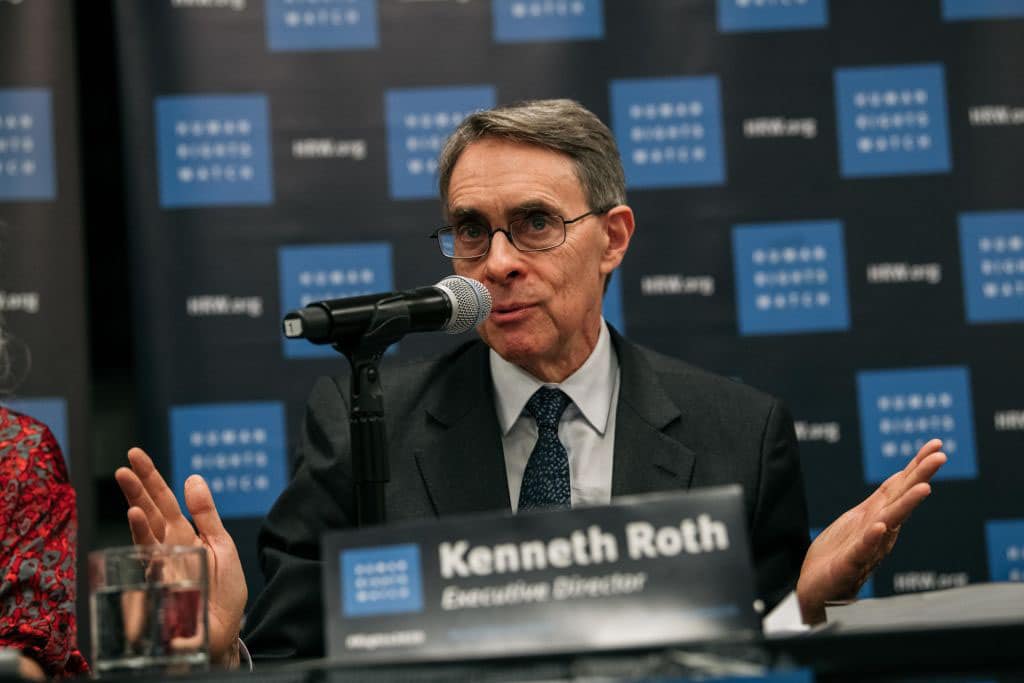
After Ken Roth, Can Human Rights Watch Be Repaired?

The head of Human Rights Watch (HRW), Ken Roth, recently announced that, after 29 years, he will be leaving the organization. For nearly three decades he led HRW far from its founding principles, based on the Universal Declaration of Human Rights adopted in the shadow of the Holocaust. Instead, the group is often considered to be a political organization with a highly selective agenda and an obsession with Israel. Restoring their lost credibility, if this can be done, will require a major effort taking many years. 

HRW, originally called Helsinki Watch, was founded in 1978 as an independent organization to monitor and report on rights violations in closed societies, particularly the Soviet Union, China and other dictatorships. The NGO quickly gained influence as a credible source, and eventually became the US-based counterpart to London’s Amnesty International.

Since the end of the Cold War in 1989, Roth transformed HRW into a champion of “the global left” that blames the democratic West and capitalism for the world’s problems.

 Since the end of the Cold War in 1989, Roth transformed HRW into a champion of “the global left” and the post-colonialist ideology that blames the democratic West and capitalism for the world’s problems, while absolving the “victims” of human rights responsibilities. After joining this political movement, HRW was embraced in the UN and by similar-minded academics and political influencers.   

 The short, pro-forma criticisms of dictatorships continued, but Roth and HRW got attention and funding by condemning American-led conflicts with terror regimes in Afghanistan and Iraq, citing highly distorted versions of international law and human rights. Among other absurdities, Roth was very vocal in attacking the Obama Administration’s decision to kill Osama Bin Laden, asserting that the arch terrorist should have been arrested and tried. 

Roth also showed a strong animus towards Israel, repeatedly joining the shrill voices demanding an end to American support and repeating false accusations of “war crimes” and “crimes against humanity.”  HRW, in concert with Amnesty International and Palestinian groups, was central in reviving the Soviet-led effort to equate Zionism with South African apartheid. In 2001, HRW was among the leaders of the blatantly antisemitic NGO Forum of the UN Durban conference, ostensibly called to celebrate the end of South African apartheid. In responding to critics, including from within HRW, he declared that “Israeli racist practices are an appropriate topic.” 

To support this agenda, Roth filled HRW’s Middle East and North Africa division with people who joined in disproportionately attacking Israel, with only token publications on Syria, Libya, Iran and other authoritarian regimes. Roth lobbied the UN Human Rights Council to create one-sided “investigations,” and pressed the International Criminal Court to adopt invented versions of international law to use against Israel, including a fictitious version of apartheid. He used the term “primitive” in the context of Jewish religion and tradition (2006), and blamed Jews for antisemitism. HRW’s April 2021 “report” claiming that Israel had “crossed the line into apartheid” is a reiteration of this 20-year campaign. 

These activities were noted by Robert Bernstein, the founder of HRW, and although he had retired, was strongly opposed to the direction that Roth was taking the organization, specifically in demonizing Israel. (Full disclosure: I discussed these issues in meetings with Bernstein beginning in 2004.) In 2009, Bernstein took the unprecedented and painful step of denouncing HRW in a New York Times column and in a series of speeches, and many of HRW’s donors ended their support.

However, Roth is a very skilled fundraiser, and after getting $100 million from George Soros, he added other secret donors, such as a Saudi billionaire whose 2012 “contribution” (the existence of which was denied for many years) was only revealed in 2020. 

Finding a qualified successor devoted to universal human rights who is not inherently hostile to the West and to Israel, and will not sell out to corrupt donors, is a major challenge. If successful, the difficult process of repairing the damage and restoring the credibility and universality of human rights principles envisioned by HRW’s founders can begin.


Gerald M. Steinberg heads NGO Monitor and is emeritus professor of political science at Bar Ilan University.

After Ken Roth, Can Human Rights Watch Be Repaired? Read More »

Double Standard Against Jews

A controversy erupted in the White House earlier this year when it was reported that Vice President Kamala Harris’ newly-hired communications director, Jamal Simmons, had posted statements on social media several years earlier that were offensive to undocumented immigrants. After criticism from progressive and Latino activists about his decade-old tweets, Simmons offered a tepid apology and met with members of the Congressional Hispanic Caucus to explain his thinking on immigration-related policy. The tempest blew over quickly because Simmons made it clear that he was a strong supporter of immigration reform and that his online comments did not reflect his true beliefs.

Contrast Simmons’ situation with that of Karine Jean-Pierre, the new White House press secretary, who authored an article for Newsweek magazine a few years back in which she attacked the American Israel Public Affairs Committee (AIPAC) for what she calls “severely racist, Islamophobic rhetoric.” In the article, she accused Israel of potentially committing war crimes in its attacks on Gaza, and charged AIPAC with “trafficking in anti-Muslim and anti-Arab rhetoric while lifting up Islamophobic voices and attitudes.”

Denigration of the Jewish state and its people is more commonly accepted than equally bigoted attacks on other marginalized targets.

When Jean-Pierre assumed her new role as chief presidential spokesperson this week, there was no similar outcry such as that which Simmons had faced. Nor has she explained or apologized for her condemnations of both Israel and its primary advocacy group.  Joe Biden is not an anti-Zionist or an antisemite, not in the least, any more than Kamala Harris is anti-immigrant. But the very different responses to their advisors’ transgressions is yet another reminder that denigration of the Jewish state and its people is more commonly accepted than equally bigoted attacks on other marginalized targets.

In the days after last weekend’s racist massacre in Buffalo, New York, we don’t need a reminder that anti-Jewish hatred thrives on both extreme ends of the political spectrum. The deranged gunman who cited abhorrent “replacement theory” as his motivation for killing ten people is a direct ideological descendant of the ultra-conservatives who caused such mayhem in Poway, Pittsburgh and Charlottesville. Nor is this column an attempt to equate Jean-Pierre’s noxious statements with much uglier acts of violence, bloodshed and murder.

But just as the new White House spokesperson accuses AIPAC of fomenting violence with language that she finds objectionable, her brand of anti-Zionist bias provides false comfort to those who engage in violence against Israel and Jews. Issue-based differences are an entirely legitimate and necessary part of political debate. But the vilification of an entire people has no place in the public square, and those who engage in such behavior should not be speaking on behalf of the leader of the free world. (Jean-Pierre’s defenders can argue that her disparagement of Israel is based on legitimate policy difference, but the fact that Simmons’ postings represented an opposing belief on U.S. immigration policy did not protect him from either criticism or from the need to apologize.)

In her Newsweek piece, Jean-Pierre applauded the fact that none of the 2020 Democratic presidential candidates spoke at AIPAC’s annual policy conference, and praised them because they “recognized that AIPAC is nothing more than a partisan lobbying group that has … failed to uphold progressive values.”  But both House Speaker Nancy Pelosi and Senate Democratic Leader Chuck Schumer did address the group that year, and candidates Amy Klobuchar, Kirsten Gillibrand – and current Vice President Harris – met privately with AIPAC members who were attending the conference. 

The party’s internal divide over Israel is growing – in a recent Associated Press poll, 51 percent of Democratic respondents said that the U.S. is not sufficiently supportive of the Palestinians – and Jean-Pierre’s thinking represents a growing sentiment among progressive voters.  However, it does not reflect the beliefs of the Biden Administration, and the White House needs to make it clear that her past statements are unacceptable to Biden. Or she could apologize as Simmons did. But it is impossible to imagine either outcome actually happening. 

The challenge for Republicans to eradicate the replacement theorists from their ranks is just as daunting – and just as unlikely. And so our two-front partisan war will continue unabated.


Dan Schnur is a Professor at the University of California – Berkeley, USC and Pepperdine. Join Dan for his weekly webinar “Politics in the Time of Coronavirus” (www.lawac.org) on Tuesdays at 5 PM.

Double Standard Against Jews Read More »

Who Killed Shireen Abu Akleh?

An innocent woman is killed by a bullet. That’s a tragedy. She was not supposed to be killed; she takes no part in the fighting; she is there to do her job, and then pays with her life. A tragedy. The woman is a journalist. The personal tragedy becomes a PR problem. The woman has an American passport. The personal tragedy turned PR problem is now a political headache. Thus, rather than mourn the unnecessary loss of life, one must suddenly take sides. Shireen Abu Akleh, the Al Jazeera journalist who was killed while covering an Israeli incursion in Jenin, was not supposed to die. Her death is a tragedy. The story of her post-death is a farce.

If a Palestinian shooter, or an Israeli soldier, aimed at her with an intent to kill her, then it matters. But in all other cases, it doesn’t. Her death was a tragedy—and an accident.

Who killed Shireen Abu Akleh? Let me make a suggestion: It doesn’t much matter. Not unless you think, and can prove, that someone killed her deliberately. If a Palestinian shooter, or an Israeli soldier, aimed at her with an intent to kill her, then it matters. But in all other cases, and the likely scenario of Abu Akleh’s death is one of those many other cases – it doesn’t. She was killed by accident. She was at the wrong place at the wrong time. She stood between two groups of people shooting at one another. One of them did not see her, or did not aim his weapon well, or did not understand who she is, or got nervous. 

It might have been a Palestinian. It might have been an Israeli. The world is going to pay close attention to any hint suggesting it was one or the other. So, repeating myself, let me suggest: Don’t pay much attention to these hints, accusations, investigations. They will not change what we already know: Shireen Abu Akleh was not supposed to die. Her death was a tragedy — and an accident.

The rest is mere PR and politics – and the tendency of the media to be more interested in the killing of media personalities than the killing of other people. Had Abu Akleh been a dressmaker, or a baker, or an electrician, her death would not be less tragic. Had Abu Akleh been killed in an exchange of fire between policemen and car thieves, her death would not be less tragic. Had Abu Akleh been killed in Tel Aviv rather than Jenin, her death would not be less tragic. But in all three cases, her death would not have gotten even a fraction of the attention it has gotten around the world. An innocent person dies is a tragedy – a celebrity dying in a politically charged situation is a circus. 

You might say: well, that’s the whole point – the politically charged situation, that’s why who killed her matters. If that’s what you think let’s think about it together. First, let’s say she was mistakenly killed by a Palestinian shooter. Does this diminish the argument of Palestinians against living under Israeli occupation? I don’t think it does. 

Now let’s say she was mistakenly killed by an Israeli soldier. Does this diminish the argument of Israelis for staying in Judea and Samaria and keeping the current system of far-from-perfect occupation? I don’t think it does. 

There are good reasons to oppose Israel’s policies, there are good reasons to support Israel’s policies – and Shireen Abu Akleh’s tragedy does not add one iota of weight to either of those, no matter which side mistakenly killed her. 

Thus, everything we witnessed following her death was no more than a juvenile game. Assigning blame to Israel is not going to change anything; neither is deflecting blame. But let’s be serious: Does the US change its defense policies if one of its soldiers mistakenly kills an innocent bystander during a military operation? Does America’s enemy fighters halt their attacks if they mistakenly killed a bystander they did not intend to kill? If the answer is no, then I’m not quite sure why the US feels the need to be “highly troubled” by this incident, or demand a thorough investigation of the circumstances in which Abu Akleh was killed. If the answer is no, then I’m not quite sure why who killed Shireen Abu Akleh matters.

Something I wrote in Hebrew

The price of housing in Israel is soaring and the government seems incapable of fixing the problem. Here’s what I wrote: “The surge in apartment prices requires a complex approach to a problem for which there are only long-term solutions. It cannot be addressed by short-term governments, for two reasons. First, long-term solutions require long-term planning that is not subject to the changing whims of ministers who come and go. The second is that long-term solutions do not pay off politically, and therefore are not a priority for a government whose term in office is short, and who will have to compete in new elections tomorrow morning. And of course, that does not mean that the leaders do not want to do the right thing. That does not mean they do not want to solve the problem of housing prices. They do. But politics has its own dynamics…”

A week’s numbers

The current coalition lost its majority in the Knesset, so what would the public want to happen now? A majority would replace it, either by having new election or by forming a Netanyahu-led government.

A reader’s response:

Jessica Gold writes: “The new Israeli government promised to fix the situation near the Western Wall, but I don’t see them changing anything. I am highly disappointed.”


Shmuel Rosner is senior political editor. For more analysis of Israeli and international politics, visit Rosner’s Domain at jewishjournal.com/rosnersdomain.

Who Killed Shireen Abu Akleh? Read More »

Global Accessibility Awareness Day is May 19. Is Your Business Website Accessible?

Global Accessibility Awareness Day (GAAD) in many ways highlights what being Jewish is about: Making the world a better, more inclusive place. 

“I cannot think of a better way to practice my yiddishkeit than doing good work in accessibility,” GAAD co-founder Joe Devon told the Journal. 

GAAD, which is celebrated on the third Thursday of May, is a day of awareness about the need to make digital products accessible to people with disabilities.

A serial entrepreneur, Devon is also co-founder and CEO of the Los Angeles-based Diamond digital agency, as well as chair of the GAAD Foundation. Devon solves technology challenges for major organizations, and frequently takes the stage to influence developers and corporations to build their digital products with inclusive designs. He also participates in Jewish events with the American Jewish Congress and looks at GAAD as his form of tikkun olam. 

Devon grew up in an Orthodox home in Montreal and “was lucky enough to have been brought up by wonderful, loving parents who taught me well,” he said.

“My dad was a genius,” he continued. “My dad could quote the meforshim by heart, but then would also pull out one of his many seforim and make us see it for ourselves to be sure there was no misquote.”

The inspiration for GAAD came from Devon’s father. This was more than a decade ago; Devon was a backend developer for AmericanIdol.com, and doing work that was seen by millions of people. Meanwhile, his father, who sardonically called himself a survivor of the “Universities of Auschwitz and Dachau,” struggled with banking. 

Devon’s father’s eyesight and hearing started to suffer as he reached his 80s, and, according to Devon, using access paratransit to go to the bank physically took all day, and might entail waiting hours in the sun with no bathroom.The web should have been the solution, but the bank’s website was inaccessible.

“I believed that developers and designers were making their websites and apps inaccessible out of ignorance, not malice.” – Joe Devon

Devon was so upset he wrote a blog post proposing a Global Accessibility Awareness Day. “I believed that developers and designers were making their websites and apps inaccessible out of ignorance, not malice,” he said. “And I posited that growing awareness would improve the situation.”

GAAD took off that first year with 16 cities running events. By year two, there was a tweet a minute on the #GAAD hashtag, and by year three, the bank whose inaccessible website inspired the day wrote to GAAD. They knew their accessibility was bad and they were running an internal event to improve things. 

“I never announced their name publicly and to this day they have no idea they were the inspiration,” Devon said. 

Other notable GAAD celebrations included a Stevie Wonder concert on the Apple Campus, Microsoft releasing the Xbox adaptive controller for People with Disabilities and the big tech companies started changing their homepages in honor of the day.

GAAD is a community-driven event, so anyone can participate. Public events are listed online at accessibility.day. Devon said they’ve recently listed about 200 public events around the world and they estimate that there are at least 200 events in private companies that don’t get publicized. Plus, Apple typically runs accessibility sessions in every one of their over 500 stores globally for the whole week. 

For individuals who want to acknowledge GAAD on May 19, they can try surfing their employer’s website with the mouse disabled, write a blog post or tweet to influencers to talk about the day. For businesses, celebrating GAAD depends on where they are in their accessibility journey. 

“If [a business is] further along, they may want to make a public event to share what they are doing and talk about how becoming more accessible is good for business,” Devon said. “For others earlier in their journey, an internal event is more appropriate to get the product people, the designers and developers more engaged on the importance of designing products accessibly.”

This year, GAAD is running an event with Jenny Lay-Flurrie, the chief accessibility officer of Microsoft, and former Congressman Tony Coelho (D—Los Banos), the architect of the Americans with Disabilities Act, for an update on Digital Accessibility and the Law.

“What GAAD has taught me is that one person can make a difference,” Devon said. “I’d even say there’s a formula for it. Have a vision, build a community around it, share it with the world and add a bit of luck. I only wish my dad could have seen more of what GAAD turned into.”

Global Accessibility Awareness Day is May 19. Is Your Business Website Accessible? Read More »

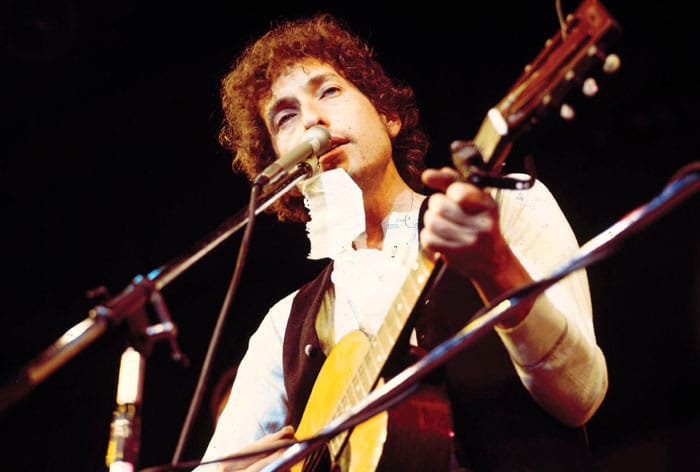
Bob Dylan’s Bohemian Zionism

This week, we celebrate the 81st birthday of Robert Allen Zimmerman, one of America’s most celebrated singer-songwriters. Many American Jews know that Zimmerman went on to change his name to Bob Dylan in a bid for palatability among mainstream American audiences, and perhaps many of us are conditioned to resent this — to view it as an act of internalized antisemitism or need for assimilation. I can’t argue with this critique, though I will say that Dylan was hardly alone in this, as American Jews changed their surnames by the thousands in the twentieth century for both professional and social concerns. Like it or not, that is our story in this country. It also wouldn’t be entirely fair to say that Dylan abandoned his Jewishness either, especially if we consider a less popular albeit prominent recording of his from 1983: “Neighborhood Bully.” 

 “Neighborhood Bully” is about “just one man,” whose enemies say he’s “on their land.” The neighborhood bully “just lives to survive, he’s criticized and condemned for being alive, he’s not supposed to fight back, he’s supposed to have thick skin, he’s supposed to lay down and die when his door is kicked in.” Dylan continues: “Well, he knocked out a lynch mob, he was criticized, old women condemned him, said he should apologize. Then he destroyed a bomb factory, nobody was glad. The bombs were meant for him. He was supposed to feel bad.” He concludes: “Every empire that’s enslaved him is gone. Egypt and Rome, even the great Babylon. He’s made a garden of paradise in the desert sand. In bed with nobody, under no one’s command.”

Clearly, “Neighborhood Bully” is a Zionist anthem. Every line waxes poetically on the Jewish-Israeli experience, blurring the lines between how one perceives the Jewish people as a unit and how one views Israel as a state.

 Clearly, “Neighborhood Bully” is a Zionist anthem. Every line, the vast majority of which I cannot include in this column, waxes poetically on the Jewish-Israeli experience, blurring the lines between how one perceives the Jewish people as a unit and how one views Israel as a state. Written during the Israel-Lebanon War, the piece was seen as a lightning rod of support for Israel from the American Jewish community, at a time when even the Israeli people were increasingly critical of their own government. But over time, the tune has faded away, lost from the memories of even the most die-hard Dylan fans, and Google has even been accused of censoring it. 

We of course all know the words to songs such as “Blowin’ In The Wind,” “The Times They Are A-Changin,” and “Like a Rolling Stone.” These songs take us back to the 1960s, the era of civil rights, social justice and universal ideals. Indeed, Dylan has been immortalized as one of the original authority-questioners, whose promise of “your sons and your daughters are beyond your command” launched a new wave of bohemian, liberal culture in America. Unfortunately, it just so happens that the current bohemian, liberal culture in America sees their values and the values of a Jewish sovereign homeland as incompatible, which perhaps is the reason “Neighborhood Bully” speaks to me continually but fails to leave a lasting impression on Dylan’s legacy. 

At a time when advocacy for Jewish self-determination is perceived to be conservative at best and reactionary at worst, when the spokespeople for Israel come bearing suitcases of money, dressed in suits and ties, and crowned with two-dollar haircuts, it is refreshing to listen to a four-minute case for Israel that instead comes with a three-chord guitar riff from a pioneer of speaking truth to power. I have written at length about the need for the Jewish community to inject a spirit of rebelliousness back into Zionism if it is truly our hope to successfully combat the ever-trendy and ever-“edginess” of anti-Zionism. So far, this plea has fallen on deaf ears. In listening to “Neighborhood Bully,” I realize that we cannot trust this effort to be led by those already in power and making decisions on behalf of American Jewry and Israel. No, the new wave of advocacy on behalf of Israel must be ushered in by Dylan archetypes: young, ambitious and looking to shake power structures.

I can envision a renaissance in young pro-Israel circles, where art, music, literature, cafe culture and hesitation to accept authority are once again embraced. 

 If Max Nordau was able to coin the term “muscular Judaism,” as a method of fashioning the Zionist pioneers into his idealized framework, and if A.D. Gordon was able to tether connection to the physical land of Israel to the need for a Jewish state, it shouldn’t be too far-fetched to introduce a “bohemian Zionism” in a bid to strengthen the Jewish people. I can envision a renaissance in young pro-Israel circles, where art, music, literature, cafe culture and hesitation to accept authority are once again embraced. I like to explain to young people that Zionism did not begin or even shift into motion with the convening of distinguished delegates to Theodor Herzl’s Basel conference in 1897. Rather, it began with anxious Jews spending hours upon hours in smoky living room salons, outside the harsh eye of the Jewish establishment, reciting poetry in Yiddish and Hebrew and inviting the most impressive Jewish intellectuals of the day to contribute to the discussion. What is stopping us from igniting this again?

One of the most impactful lines of “Neighborhood Bully” is “He took the crumbs of the world and he turned it into wealth, took sickness and disease and he turned it into health. He’s the neighborhood bully.” In hearing these lines, I worry the Jewish community has lost sight of the wonders we have to offer in service to defending that which we already have. Our nation is defined by what we create, “wealth” and “health,” but also a rich culture that demands to be expressed and interpreted. Why should the anti-Zionist Jews have a monopoly over the universal energy of Dylan and the beatnik generation? It was the beatnik generation’s struggle for freedom and their independent spirit that should inspire us as well, to advocate for the existence and strength of the world’s only Jewish state.


Blake Flayton is New Media Director and columnist for the Jewish Journal.

Bob Dylan’s Bohemian Zionism Read More »

Rethinking the Jewish Communal Enterprise

We are living through an extraordinary moment of Jewish communal realignment; everything is in play. These shifting waters are significant and profound, impacting all sectors of our community. External elements, involving generational behaviors, cultural motifs, and technological innovations, are being simultaneously unleashed. The impulses here are global, yet most of the outcomes we experience are being locally driven. This survey article seeks to incorporate earlier work reflective of these core issues, while referencing new data and identifying emerging trends.

Contemporary change theory seeks to explain such transformational patterns. What we are learning is that when institutions are simultaneously overwhelmed by internal challenges and external realities, the change process is no longer systematized. Disruptive change alters the ability of organizations to effectively manage the process. At times, institutions lead from behind, seeking to regain coherence, while on other occasions they operate ahead of the change curve, resetting the stage in an attempt to be proactive.

Extrapolating this theoretical notion to the broader communal system allows us to examine the outcomes we are experiencing within the American Jewish marketplace. This state of disruption is contributing to a fundamental operational realignment. Within the Jewish ecosystem, we are simultaneously encountering the re-engineering of legacy institutions, the emergence of new organizations and startup programs, and the intervention of social media platforms and alternative delivery systems, all designed to be reactive to the changing dimensions of Jewish life.

The causes associated with this rapid, disruptive change environment are essential to understand within the context of the Jewish communal sector:

The national discussion and debate around diversity and inclusion, encompassing sexual orientation, racism, cancel culture and more is profoundly reshaping Jewish life, institutional practice and communal policy.

• In this third decade of the 21st century, generational and demographic behaviors are driving the scope and pace of change. The national discussion and debate around diversity and inclusion, encompassing sexual orientation, racism, cancel culture, and more is profoundly reshaping Jewish life, institutional practice and communal policy.

• The economic order is undergoing a significant recalibration. The impact of inflation, the shifting character of work, transformative financial resources, new entrepreneurial business models, the rise of social media and e-commerce, among other forces, are contributing to the reshaping institutional performance and practice.

American Jewish assimilation is being reframed. Social mores and cultural norms are altering how Jews understand and embrace their Jewish identity in the context of their Americanism. 

• American Jewish assimilation is being reframed. Social mores and cultural norms are altering how Jews understand and embrace their Jewish identity in the context of their Americanism. Contemporary antisemitism and the disruptive state of American politics must be seen as transformative factors. 

• The decline of trust in established institutions and the loss of confidence in key leaders, evident in the civic culture, represents a phenomenon also present within the religious sector, as symbolized by the rise of the “Religious Nones,” further minimizing the impact and credibility of our communal and religious infrastructures.

• The idea of community and the value of the collective have been replaced by an overarching attention to individualism. The primacy of the sovereign self remains a core challenge.

• The impact of technology is rapidly and radically transforming communal behavior as we monitor the rise of virtual Judaism.

Each of these trend lines is contributing to the reshaping of the 21st-century American Jewish community. Introduced below are a number of particular characteristics that serve to describe the “state” of the Jewish communal order:

Increasingly, Jewish seekers are turning to websites and learning platforms studying Jewish texts, experimenting with spirituality, and framing new forms of Jewish cultural expression.

Personalized, Privatized Judaism: This age is distinctively marked by the blossoming of personalized expressions that define the character and content of how Judaism is being reconstructed. The primacy of the individual is now driving Jewish economic and lifestyle choices, but it is also contributing to a distinctive set of religious expressions and cultural choices, as Jewish pride and curiosity are driving this inquiry. This focus on individualism correlates with the broader cultural emphasis on the primacy of self. Increasingly, Jewish seekers are turning to websites and learning platforms studying Jewish texts, experimenting with spirituality, and framing new forms of Jewish cultural expression. Diversity and choice are redefining the Jewish marketplace with much of this new energy being delivered virtually.  

The Rise of Entrepreneurial Judaism: A major economic shift is now underway, as we monitor the rise and growth of various forms of for-profit Jewish initiatives. We are seeing new economic models taking hold. The historic disconnect between the for-profit sector and the Jewish institutional marketplace is beginning to erode, as we note the rise of entrepreneurial Jewish business models. The creation of programs, services and products delivered through a business format will fundamentally reshape how we understand and define the communal enterprise. Even as some parts of this sector opt for a for-profit incentive model, much of the existing nonprofit market space is being impacted by platform branding, social media advertising, and the introduction of e-commerce offerings. The delivery of American Judaism to consumers is fundamentally changing!

Virtual Judaism: One of the primary outcomes of this new emergent communal model has been the growing impact of on-line Jewish cultural and religious offerings. This revolution encompasses all aspects of learning and praying, just as it is reshaping patterns of engagement and connection. The phenomenon of the virtual national synagogue with its global membership  represents a post-COVID reality.

The New Voices: Increasingly one finds multiple influencers who are seizing this moment, operating through independent leadership pods across the Jewish ecosystem.

As the community transitions, the idea of a holistic, integrated communal model has given way to this new constellation of distributed power. The traditional organizing principles are being challenged and, in some instances, discarded; among these are the concept of membership, the idea of affiliation, and loyalty to denomination and agency. Emergent boutique models are being introduced framed around alternative organizing principles and delivery models.

The continuous internal institutional wars over policy and personalities add to the state of division and discord that today defines the communal order. The external political environment represents another contributing factor to the unraveling of the idea and value of a single integrated Jewish community; in its place we are seeing the framing of multiple Jewish communal responses around such core ideas as Israel, managing the fight against antisemitism and anti-Israel expression, and giving space to the emergence of differing and competing political and cultural perspectives.

We will not be able to fully appreciate for years the structural, social and cultural effects of the pandemic on our community. External influences have and will continue to profoundly drive communal behaviors. 

Impact Studies:  We will not be able to fully appreciate for years the structural, social and cultural effects of the pandemic on our community. External influences have and will continue to profoundly drive communal behaviors. Elsewhere, this writer and others have addressed the broader social and structural impact of COVID on the communal landscape. We only need reference the 2008 economic crisis to appreciate such external markers.

One critical outcome involves the mental health and physical wellness of our constituencies. No longer dismissed as individual considerations, these issues occupy the attention and responsiveness of a consortium of religious and social service organizations. In this new moment, the welfare of the individual has become a defining and essential priority. 

Emergent Conservative Voices: In the midst of these predominantly liberal Jewish expressions of activism, one finds a series of countervailing forces, including the rise of a vibrant, triumphal American Jewish Orthodoxy, the burgeoning of a vigorous Jewish conservative cultural and literary presence, and a growing conservative political focus, challenging the community’s traditional liberal anchor.

Shared Threats: Even as communal interests are increasingly minimized, there remains a shared concern in connection with institutional and personal security. The presence of antisemitism and anti-Israel activism has been one of the few unifying factors in driving a collective response. We might consider how such external threats transform identity and engagement.

Geography Matters: Beyond the great workplace resignation, we are in the midst of a great population transfer. We see a significant population shift under way, with pockets of middle-class families and singles opting out of our large traditional population centers. This phenomenon is also present among Jewish households. This exodus will likely produce new Jewish urban centers of influence, among them communities in the South, Southwest, and Northwest. 

The Bottom Line: At one moment we are experiencing the blossoming of vibrant innovation, while documenting parts of the communal order moving through difficult transitions. We are experiencing the graying of America’s legacy Jewish institutions, just as we observe the presence of a new creative robustness as personalized, individuated Jewish initiatives emerge to fill the market space, led by a mix of generational actors and innovative organizing models. This new presence is comprised of broad set of single-issue institutional expressions, with particular attention directed to specific sectors of our community, among these operational voices are activists giving specific attention to the broader social issues of race and ethnicity, sexual orientation, and generational preferences.

The continuous rise of new Jewish institutional models reminds us of the creative energies present within our community, and the growing focus to serve niche markets remains a powerful option. Since the mid-1980s, Jews have been reinventing the communal marketspace, constructing along the way an institutional and cultural revolution. Experimentation is a primary marker in understanding the contemporary Jewish marketplace. What we are identifying is a series of energy pockets, the spaces where transformation is fully unfolding. The state of the community is marked by these shades of unevenness, pockets of innovation offset by institutional paralysis and dysfunctionality.

The revolution is upon us. We are facing a set of unknown and complex challenges that will fundamentally redefine our institutions and recalibrate our community as we move forward. 

In this condition of chaos and change, as we transition by generation, as we encounter shifting institutional models and absorb the waves of cultural and social influences, the Jewish communal enterprise is experiencing a major reset. The outcomes here remain uncertain, just as we identify in some sectors a renaissance of engagement and activism. The revolution is upon us. We are facing a set of unknown and complex challenges that will fundamentally redefine our institutions and recalibrate our community as we move forward.


Steven Windmueller, Ph.D. is Emeritus Professor of Jewish Communal Studies and Interim Director of the Zelikow School of Jewish Nonprofit Management, Jack H. Skirball Campus, HUC-JIR, Los Angeles.

Rethinking the Jewish Communal Enterprise Read More »