fbpx

April 8, 2022

What Was Behind AJU’s Decision to Sell its Familian Campus

American Jewish University recently announced that we are selling our Familian Campus in Bel Air. This has prompted many questions from the community:  Are we going out of business? Are we moving to an online-only model? Are we also going to sell the 2,600 acres we own at our Brandeis Bardin Campus in the Simi Valley? The answer to all these questions is absolutely not.

We are seeking to sell the Familian Campus because we no longer believe that holding twenty-two acres in Bel Air is necessarily the best way to support our critical mission of promoting Jewish journeys, and strengthening the Jewish life of individuals, organizations, and our community.

The challenges and opportunities facing the Jewish communities of North America are multi-faceted: synagogues are struggling to attract members; Jewish literacy and understanding is declining dramatically; many in the next generation have an increasingly strained and complicated relationship with Israel; with more than 50 percent of American Jews intermarrying, Jewish families look different than they ever have; waves of immigrants from the Middle East and the former Soviet Union have added new life and dimensions to our communities, which have long been centered in an Ashkenazi worldview. We believe that building a highly flexible organization that can respond nimbly to trends across the Jewish landscape is vital.

I have heard from many of you that this decision has raised complicated feelings associated with memories of spending time of our Familian Campus. For many of us, Judaism is strongly linked to structure that we visited and memories of an institution we joined or frequented. For better or for worse, this is not the Judaism of our children and our grandchildren. Today, our community’s most successful efforts involve experiences and relationships. In order to succeed, Jewish organizations must meet people where they are (literally), be nimble, and accessible.

Today, our community’s most successful efforts involve experiences and relationships. In order to succeed, Jewish organizations must meet people where they are (literally), be nimble, and accessible.

Just in the last two years, we have seen many examples where AJU has responded to evolving opportunities in a bold manner to make a significant communal impact:

  • Our School for Jewish Education and Leadership, addressing an important gap in the professionalization of Jewish teachers, has started both bachelor completion and master’s degrees in Jewish early childhood education. These are offered nationwide online and have both synchronous (where everyone is online together) and asynchronous (where students access the course material when convenient) components. As a result, enrollment has tripled in just four years as teachers are hungry for education that will allow them to educate young Jewish students, and not incidentally their families, in developmentally appropriate and research-based methods. The implications for these young families, and the Jewish institutions they will enter, are profound.
  • The Miller Introduction to Judaism cemented its position as the foremost program in the world engaging newcomers to Judaism through learning. The program, via in-person and zoom classes, now has more students enrolled directly than at any time in its thirty years. The online students come from dozens of different countries while our in-person classes are taught at local synagogues. Our curriculum is now offered in 175 Jewish institutions across North America.
  • The Maven digital platform has registered over 100,000 users for more than two hundred programs since the start of the pandemic that have imparted Jewish wisdom and spirituality across the world. Maven is now developing partnerships with dozens of Jewish institutions across the country to provide best-in-class digital content for their constituencies.
  • On April 10th and 11th, AJU will co-sponsor with the Herzl Institute and ANU—the Museum of the Jewish People a major conference in Jerusalem and Tel Aviv on the worldwide phenomena of potentially millions of people, often due to discoveries through genetic testing, learning that they have one or more ancestors who are Jewish and therefore are seeking greater affinity with Jews and Israel. These new populations have the potential to provide important new support for Jews and for the Jewish state at a time when antisemitism is increasing worldwide.

All these initiatives, as well as AJU’s other ongoing programs, go to the heart of Jewish challenges—how to bring young families into Jewish learning (and thus often into synagogues), how to extend Jewish learning into adulthood, how to address those at the margins of Jewish life, and how to increase support for the Jews and Israel while combatting antisemitism. They reflect AJU’s ability to pivot and our absolute determination to provide solutions to Jewish problems rather than simply be part of the chorus proclaiming doom.

After many months of thoughtful deliberation and consideration of our options, the board of directors made the bold decision to sell the Familian campus to unlock the value of that asset so that we could continue with our mission and make meaningful changes to our programs. It became clear that continuing to operate in Bel Air with the attendant cost to operate was not fiscally responsible.

At our Brandeis Bardin Campus, our much-loved and regularly sold-out Camp Alonim and the long-standing Brandeis Collegiate Institute are tied to the land, and we will continue to hold and invest in that wonderful property.

Selling Familian does not mean that we will be entirely online. We are simply going to find a physical space that suits our current needs. We may stay in Bel Air in a reduced footprint. We may also move. AJU already has a long history of offering in-person classes (including the Miller Introduction to Judaism Program and Hebrew) at other physical locations across the city, a practice we will continue.

Families move and companies relocate all the time in response to opportunity. AJU is taking a bold step because that is what is required to address the problems that the Jewish community faces. Our track record demonstrates that the return on our new initiatives is very high, and we look forward to using all of our resources in service of the Jewish community in Los Angeles and across the country.


Jeffrey Herbst is President of American Jewish University.

What Was Behind AJU’s Decision to Sell its Familian Campus Read More »

No, Secretary Blinken, Palestinian Terror is Not “Senseless”

How many times have we heard Western voices call terror acts “senseless”? We heard it again this week after a Palestinian terrorist murdered three Israelis and injured several others on trendy Dizengoff Street in Tel Aviv.

After saying that “Americans are, once again, grieving with the Israeli people in the wake of another deadly terrorist attack,” Secretary of State Tony Blinken added that the U.S. “stands resolutely in the face of senseless terrorism and violence.”

But is the violence really senseless, Mr Blinken?

It may be for you, but it’s not for the terrorists.  They think their terror has a purpose. If you despise Jews and think they don’t belong in the Middle East, killing them gives you purpose. If it makes you sick to see Jews you hate having fun in a cool city like Tel Aviv, killing them gives you purpose.

And if you fall for the propaganda from your corrupt leaders that Jews will soon take over your holy Temple Mount in Jerusalem, killing Jews is anything but senseless.

Since the birth of Israel 74 years ago, virtually every act of violence against the Jewish state has been connected to an overarching belief among Palestinians that Jews don’t belong in this region, regardless of any legitimate claims of a Jewish connection to the land.

In spreading the propaganda of Jews as foreigners and land thieves, Palestinian leaders know that nothing fires up the masses like Jerusalem, Israel’s biblical heartbeat.

“We welcome every drop of blood spilled in Jerusalem. This is pure blood, clean blood, blood on its way to Allah. With the help of Allah, every martyr will be in heaven, and every wounded will get his reward.”

Those fighting words were uttered on Sept. 26, 2015 by Palestinian Authority President Mahmoud Abbas, whom many consider Israel’s “peace partner.”

Two weeks later, on Oct. 1, Palestinian terrorists murdered an Israeli couple, Eitam and Naama Henkin, in cold blood in front of their four children, who ranged from 9 years old to 4 months.

Did these terrorists think their murders were senseless? I doubt it.

The fundamental problem with characterizing terror as senseless is that it lets you off the hook. By depersonalizing the violence, by ignoring its root, you turn it into a terrible but generic crime where everyone is treated the same.

The fundamental problem with characterizing terror as senseless is that it lets you off the hook.

But Palestinian terror against Israelis is no generic crime. It is intentional violence rooted in a deep, singular hatred. This truth may make sophisticated diplomats like Secretary Blinken uncomfortable, but that won’t make it go away. Until Western leaders have the courage to connect Palestinian terror to the anti-Jewish and anti-Zionist propaganda that emanates from every nook and cranny of Palestinian society, peace and reconciliation will remain delusional pipe dreams.

If the U.S. is serious, in other words, about “standing resolutely” against Palestinian terror, it will have to connect the dots of terror and Jew-hatred.

Until then, we’ll be left with empty reactions like, “This has to stop!” That tweet came from U.S. Ambassador to Israel Tom Nides, who added after the Tel Aviv attacks that he was “horrified to see another cowardly terror attack on innocent civilians.”

I can assure you, Mr Nides, that the large crowds in Gaza and the West Bank who celebrated the Tel Aviv attacks did not consider the terrorist a coward, and they certainly didn’t see the murders as “senseless.”

It is the treating of intentional terror as senseless that is really senseless.

No, Secretary Blinken, Palestinian Terror is Not “Senseless” Read More »

Palestinian Terrorist Behind Tel Aviv Shooting Killed

The Palestinian terrorist who committed the shooting on Tel Aviv’s Dizengoff Street on April 7 was killed by the Israeli authorities several hours after the terror attack, The Times of Israel reported.

The terrorist, identified as 28-year-old Ra’ad Hazem, hailed from Jenin and was the son of a retired senior officer in the Palestinian Authority (PA) security forces. Hazem was found hiding in a Jaffa mosque and opened fire on Israeli officers pursuing him. Hazem is not believed to have been affiliated with any terror groups and reportedly entered Israel illegally through a gap in the security barrier separating Israel and the Palestinian territory in the West Bank. Hazem’s father and uncle both lauded the terror attack, with his father telling a crowd, “Your eyes will see the victory soon. You will see change. You will achieve your freedom… God, liberate the Al-Aqsa Mosque from the desecration of the occupiers.”

Three people have died from the Tel Aviv terror attack so far. They have been identified as Barak Lufan, 35, Eytam Magini, 27, and Tomer Morad, 27.  Lufan is a former Olympian and left behind a wife and three children. Magini and Morad were childhood friends; Magini, who worked for the Israeli tech firm Wix, had recently gotten engaged. Morad was about to start a new job.

PA President Mahmoud Abbas said in a statement, “The killing of Palestinian and Israeli civilians only leads to a further deterioration of the situation, as we are all striving for stability, especially during the holy month of Ramadan and the upcoming Christian and Jewish holidays.” The Israeli government is lobbying the Biden administration to pressure Abbas to end the PA’s payments to terrorists and their families, known as the “pay-to-slay” policy.

Bahrain’s foreign ministry issued a condemnation of the terror attack and gave their condolences to the families of the victims. “We reiterate the Kingdom of Bahrain’s position that opposes all forms of terrorism and violence no matter the motives and the justifications,” they said.

Israeli Prime Minister Naftali Bennett issued his condolences to the families of the victims in a series of tweets and acknowledged that Israel is “in a difficult and challenging period.” “It may be prolonged,” he added. “The Second Intifada lasted several years but in the end we won.”

Palestinian Terrorist Behind Tel Aviv Shooting Killed Read More »

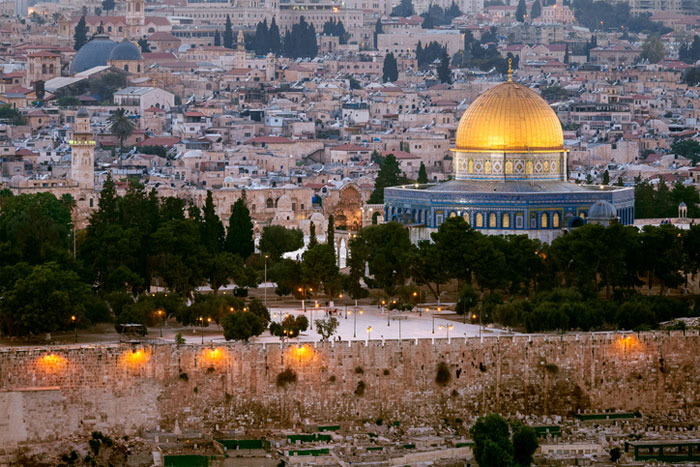
Mountain of Holiness

Whether the capital of Ukraine should be called Kiev or Kyiv
is more immediate and maybe just as murky
as whether “Turkikiye” should be the name of Turkey;
or whether Bangkok, Thailand’s royal capital, should now receive

parentheses, preceded by the longest capital that’s in the Guinness
Book of Records — are dilemmas that I think far less
important than the name to give a very holy mess
that in Jerusalem now troubles pious people more than it does sinners.

Its most ancient name appears in Genesis and is Moriah,
the place where God told Abraham to save his son,
His ostensible command-to-kill undone;
no holiness than saving human lives is higher.

Ralbag, a great rabbi, claims that God’s original, unclear intention
was just that Abraham show Isaac how to offer
a sacrifice—of sacrifices a great scoffer
when they involve a victim of the tribe to which we all belong, called “Menschen.”

It’s where the Jewish Temple used to be, though many Muslims may deny it,
and a mosque and an Islamic Dome stand too.
Exactly what the mountain should be called I do
believe is not Al Aqsa, as most Muslims claim, but Har HaBayit,

“The Mountain of the House,” the Temple Solomon constructed after David
paid for the precious land. Destroyed
by Babylon, its memory has been enjoyed
for ages since the House of Holiness was not forever lost, and we must save it.

In “(Bangkok): A Push for Parentheses Miffs Thais (Who Have Bigger Problems),” NYT, 4/2/22, Hannah Beech writes about a debate in Thailand over whether the capital should be known internationally as “Bangkok,” after the old riverside settlement where she lives, or “Krung Thep Maha Nakhon.”

Meir Soloveichik suggests, in Episode #230 of his Bible 365 series, “The Search for the Temple: Text: Psalms 131-32,” that the reason Deuteronomy does not identify Jerusalem as the site of the central shrine that Moses instructs the Israelites to build, is that it wishes the site to be discovered by a process of seeking. He quotes Rabbi Joseph Soloveichik, ‘the Rov’, who said that knowledge of God must be “ecstatic and perceptional,” discovered not just by our sense of sight and sound, but by our sense of the sacred. The Rov points out that Deuteronomy does not identify Jerusalem as the site of God’s central shrine and that this echoes God who does not tell Abraham In Gen. 12:1 to go to the land of Canaan. Instead, He tells him to go אֶל-הָאָרֶץ, אֲשֶׁר אַרְאֶךָּ, “to the land that I will show you.”

Gershon Hepner is a poet who has written over 25,000 poems on subjects ranging from music to literature, politics to Torah. He grew up in England and moved to Los Angeles in 1976. Using his varied interests and experiences, he has authored dozens of papers in medical and academic journals, and authored “Legal Friction: Law, Narrative, and Identity Politics in Biblical Israel.” He can be reached at gershonhepner@gmail.com.

Mountain of Holiness Read More »

Vibrant Children’s Picture Book Explores Passover in 1950s Iran

It finally happened. I finally found a Jewish children’s picture book that depicts dark-haired and dark-skinned Middle Eastern-looking townspeople, rather than bakers, merchants and passerby who all look like Tevye the Milkman. 

Don’t believe me? The baker wears a bright red fez and has a big handlebar mustache.

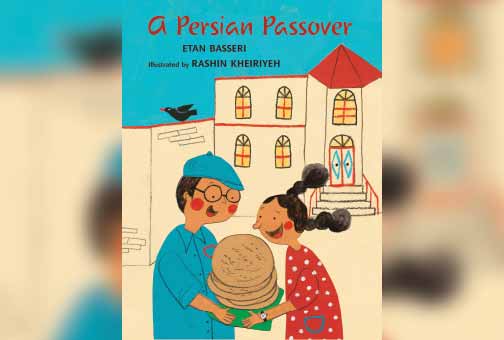
The book is titled, “A Persian Passover” (Kalaniot Books, 2022) and is written by Etan Basseri, a Seattle-based Senior Product Manager at Microsoft, and illustrated by internationally-acclaimed artist Rashin Kheiriyeh. 

“I felt there was a gap in Jewish children’s literature, especially with stories that portrayed the old country as the Pale of Settlement,” Basseri told the Journal. “But we know that Jews come from many places, and each ‘old country’ has a rich history and culture that can help young people build their own unique sense of Jewish identity.”

Basseri’s father, who left Iran in 1969 to pursue higher education in the United States, raised him and his American-born siblings with a love and appreciation for Persian culture. His father met his mother, who is Ashkenazi, as college students in the San Francisco Bay Area.  

“Growing up, I had many cousins and a few Persian friends. But the biggest Persian influence was my dad,” Basseri said. “His passion is the arts: food, music, poetry. He would set you up with a Khoresht-e Loobia Sabz (Persian green bean stew), a hot cup of tea, blast some music from [pop singer] Morteza on his tape player and read you some Hafez.” Basseri’s father also showed the children the charming 1995 Iranian film, “The White Balloon.”  

“That film gave me a small sense of contemporary life in Iran, which was important because I have never visited. The film was also the inspiration for my book,” Basseri said. 

“A Persian Passover” tells the story of a little boy named Ezra and his sister, Roza, who help their family prepare for Passover in 1950s Iran by doing what thousands of Persian Jews have done for centuries: bringing flour to the local synagogue to be baked into matzah in a communal wood-burning oven. But when a crisis occurs with the matzah, the siblings learn the sacred importance of community, kind neighbors and even kinder hospitality. Ezra and Roza were inspired by Basseri’s own young son and daughter.

“A Persian Passover” is Basseri’s first venture as an author. A coherent, beautiful and easy-to-read children’s book, it is sorely needed in the Jewish “kid lit” space. “I learned by doing,” admits Basseri. “I tried to emulate one of my favorite children’s authors, William Steig (“Shrek,” “CDB”), and I started with a basic plot outline, then wrote a draft and shared it with my wife, Sonya, who teaches kindergarten.” Basseri also received guidance about the historical accuracy of the story from his cousin, Dr. Jaleh Pirnazar, a well-known scholar who has been teaching at the Department of Near Eastern Studies at UC Berkeley since 1980.

Etan Basseri

One of the most striking aspects of “A Persian Passover” are the deliciously vibrant and colorful illustrations by award-winning artist Rashin Kheiriyeh, who was born and raised in Iran. Based in Washington, D.C., Kheiriyeh received a Ph.D in illustration and an MFA in graphic design from Alzahra University in Tehran, and has published over eighty books. She has also created illustrations for The New York Times and was named a 2017 Maurice Sendak Fellow. Kheiriyeh has lived in the U.S. since 2011.

“It has been a long time that I wanted to create a picture book about an Iranian-Jewish family and I am so glad that I got this chance to introduce some parts of Persian culture in this book,” said Kheiriyeh. “I have noticed that so many people in the U.S. don’t know that we have Jewish populations in Iran who lived happily there for many years.”

Basseri believes Kheiriyeh’s talent and unique background elevate the book. “Rashin is an incredible artist, period. She used mixed media to create a collage effect, and this gives the book a rich, tactile sense that brings it to life in a very unique way,” said Basseri. “As someone who grew up in Iran, she was able to bring a level of authenticity and richness that others would not have been able to do. Many of the details, including the Jewish content, are based on archival photography from midcentury Iran.”

Basseri and Kheiriyeh met through Lili Rosenstreich, publisher at Kalaniot Books. The Pennsylvania-based publishing company emphasizes a “rich mosaic of Jewish culture,” according to Rosenstreich. In Fall 2022, Kalaniot will release a children’s Sukkot book titled, “The Very Best Sukkah: A Story from Uganda”, by Shoshana Nambil. The book focuses on the Abayudaya Jewish community in eastern Uganda. 

“Although I grew up with predominantly Ashkenazi Jewish traditions, I have an uncle who was born in Iran,” said Rosenstreich. “I was struck by the beautiful and varied Mizrahi customs that he brought to our celebrations — especially at Passover.”

“A Persian Passover” marked one of the first times I’ve read a children’s Jewish book in which I actually saw myself. 

“A Persian Passover” marked one of the first times I’ve read a Jewish children’s book in which I actually saw myself. In addition to the Persian-looking characters and the distinctly Persian architecture of various spaces, Kheiriyeh also drew signs written in Persian on the walls and alleyways of the fictional town; Ezra and Roya’s family even sits on a large Persian rug and enjoys the Passover seder on the floor, just as I recall from my childhood in Iran. The book also includes a glossary, a short description about the history of Persian Jewry, and a recipe for halleq (Persian spiced charoset). 

The book marked one of the few instances that I read a Passover children’s book to my young kids and they gleefully cried, “We do that, too!” For our family, that’s an invaluable experience. 

“I hope that the loving relationship between Ezra and Roza is a model for siblings, and that the hospitality they show to their neighbor is a positive example for how we all can welcome others into our homes. That’s what community is all about,” said Basseri. 

Basseri grew up in a traditional home and attended Jewish day school, Jewish day camp and overnight camp. He has served on the boards of Jewish Family Service of Greater Seattle and Sephardic Bikur Holim Congregation. 

“Persian Jews celebrate Passover in many of the same ways as the rest of the Jewish community, with a few interesting differences. You don’t have to be Persian to enjoy some of those traditions, either.” 

Basseri is currently working on another children’s picture book that will be “set in the Sephardic old country.” In addition to his work demands, family commitments and writing pursuits, this year, as with every year, Basseri is responsible for a particularly vital aspect of the Persian Passover seder: He’s the one in charge of the charoset.

For more information on “A Persian Passover,” visit kalaniotbooks.com/books/

Vibrant Children’s Picture Book Explores Passover in 1950s Iran Read More »

A Paratrooper Poet Walks into a Painting Class

There is a lush nature preserve in Gush Etzion called “Oz VeGaon” that was created in 2014 in reaction to the murder, by Palestinian terrorists, of the three boys Gil-ad Shaer, Eyal Yifrach and Naftali Fraenkel. The name of the reserve, in Hebrew, is an acronym created from the boys’ names.

Oz VeGaon has become a vibrant tourist attraction that includes a playground, picnic and camping area, gazebos, a library with historical volumes on Zionism, and is a center for courses, lectures, performances, agricultural camps for youth, and family simchas. It has been visited by many Israeli and foreign dignitaries.

And hosts a wonderful painting class taught by artist Avital Sharansky, wife of the renowned former Prisoner of Zion, Natan Sharansky.

I have the pleasure of being in that class.

And one day, a paratrooper walked in.

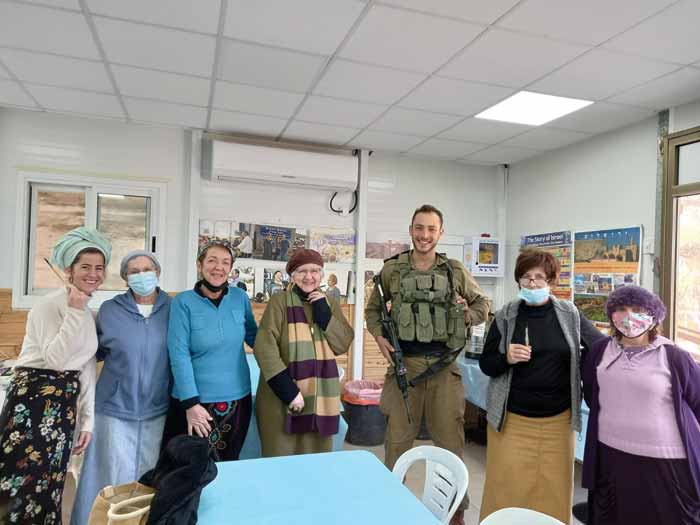
He was on reserve duty and his assignment was guarding the nature preserve. He smiled, asked us if everything was okay, we said yes, and Avital invited him to paint with us.

“Thanks,” he said, “but I don’t paint, I write poetry, mostly in English.”

As both a poet and a teacher of poetry, my ears perked up.

“Please read us something you’ve written,” I asked.

And so it came to be that Staff Sergeant Daniel Bard, in full battle gear, pulled out his phone and read us this:

Open the doors

Open the doors of your heart

So love can flow from it with each beat

Widen your stride open your feet

For life moves forward there is no retreat

Open your eyes so they can see

The wonder and beauty of the world

For if they are closed how could it be

The glorious ability to take in all that lies before thee

The planet is so very vast

Look hence forth for changed cannot be made the past

The sea of time rages on our bodies must sail upon it with a fortuitous mind to be the sturdy mast

As we crash and curl upon and beneath the waves

We wrestle with society for to it we do not wish to be slaves

And in our thoughts we find ourselves often in crisis

When left to the realm of man and its own designed devices

But no I shall not be ever bound by chains

For I shall step lively through the time that for me remains

I relish joy and wonder for my heart has indeed known pains

Nature’s balance is manipulated by man

Yet I connect to what has been left by the natural order of life’s plan

And through city streets I may folly and fall

Yet I can never refuse the wilderness’ call

Upon stream and star my ship does ride

For by mankind the natural order is often defied

Yet lost as our race may be

I shall let the radiant beauty of each setting sun be the eternal guide for me.

We were deeply moved by his poem, and I asked him, “Where did you learn to write poetry like that?” He told me that his father bought him the book One Hundred and One Famous Poems, and maybe that influenced his style.

Daniel’s story

Daniel grew up in Chevy Chase Maryland, near Silver Spring, to parents Marcela Kogan and Mitchell Bard. His mother is a freelance writer, and his father has a PhD in political science and runs a non-profit called the “American Israeli Cooperative Enterprise (AICE).” Mr. Bard is also a writer, and he operates and founded the Jewish Virtual Library, an educational website.

“I made aliya with a group of like-minded individuals, who came to serve in the IDF, in December, 2017, after doing a gap year through Masa, during which time I lived in Tel Aviv and volunteered at a school and at an animal shelter, and lived in Jerusalem and volunteered with Magen David Adom.

“During my time in Israel, I noticed the soldiers and how they were young adults such as myself, and when seeing a soldier in Hebron and looking into his eyes, I understood the only difference between us was that he was a Jew born in Israel and I was a Jew born in America.

“I understood and I felt it was my duty as well to come and serve in the IDF and protect the land of Israel.

“I had a counselor on my program who had been a paratrooper and when I told him I wanted to be a paratrooper like him, he said, ‘No way, you are like a noodle, the army will break you.’ I responded ‘No no, I’m like a cooked noodle, I bend I don’t break.’

“As often is the case, the strongest motivational factor to do something is when somebody tells you that you can’t do it.

“When I finished my gap year in Israel and returned to my home in Maryland, I awoke in my bed that I had slept in for twenty years, and didn’t feel at home. Then I knew that I must make aliya.

“I landed in Israel on December 27, 2017, and began living with my ‘garin’ (aliya group) in Raanana in the Absorption Center. In March, 2018, I was drafted into the paratrooper brigade after having passed the ‘gibush’ (a pre-IDF training orientation to determine if potential recruits are right for a particular unit).

“I was a Lone Soldier, and having a much lower Hebrew level than my comrades, it was often a struggle, especially during the combat medics course. I pushed my commanders to send me to it during basic training, but with high motivation and the desire to succeed, I returned to my unit a proficient medic for my team.

“After being released in July, 2020, I went to work in agriculture, picking fruit in the Golan Heights. In October of 2021 I moved to Moshav Paran in the Arava (the desert valley that extends from the Dead Sea to Eilat, along Israel’s border with Jordan) and took a job managing a pepper farm, which is what I am doing currently.”

How he began to write

“I think ever since I was little, I have liked poetry and been drawn to it, and believe that the ability to make anything poetic or see it in a poetic light allows a person to turn even the most basic and bland elements or occurrences into something epic, grand and beautiful.”

He says that now he would like to take a long trip, as do many Israelis after the army, and to travel to the east or to South America, in search of adventure, “To a destination that is so far away and hard to get to that by the time I reach it, I will have been so satisfied deeply by the journey, that reaching the destination is not as important. As I set out to wander, I expect that the world will take me to places beyond the fathomable.

“And one day I’ll return to Israel and perhaps continue in agriculture or open a camping business of some kind.”

Daniel put his thoughts about being a paratrooper into poetry.

A Paratrooper’s Creed 

It is with honor

It is with love

It with pride and with a smile

that those who may call themselves brave

Battle the evil and the hate

that burdens the beauty

of wonderous life

This land is sacred

For it is earth it is home

to many who share its fruits

When dawn breaks the day

we shall stand strong

Our will unbreakable

When terror tides to trouble the innocent

We shall shield it

with a heart that beats for love and for freedom

We shall strike

with a sword driven by a prideful soul

The land of Israel and her people

will not be trod upon

by any who may be consumed by hate

We shall extinguish the flames of destruction

By the strength of love

In the grimace of malicious snares

We shall stand

We shall smile

And sing AM ISRAEL HAI

We shall stand beside her people

in the rains of the hills of Jerusalem

We shall stand upon her mountains

in the freezing winds of the Golan

We shall stand beneath the scorching suns

of her deserts in the Negev

We shall stand and we shall fight

with pride and joyous determination

in desire for love and peace

We shall fight

for the freedom to live in peace

We shall fight

so that we need not fear

We shall stand

in the ominous shadow of animosity,

through the horrid hails of hate

Through the terrible thunders of terror

We shall stand through darkness

yet we shall not be overcome by it

For in our hearts

is love for life

In our souls is a beacon of light

that cannot be relinquished

even through the blackest of night

We are the lochamim [warriors] of the land of Israel

We shall stand for love of our life

We shall stand for love of our land

So that one day…

As we all do,

One day when we fall upon it

It shall be to Rest In Peace

He may have come to Israel as a Lone Soldier, but now that he’s here, Daniel is not alone anymore.


Toby Klein Greenwald is an award-winning journalist, artistic director of Raise Your Spirits Theatre and the editor-in-chief of WholeFamily.com.

A Paratrooper Poet Walks into a Painting Class Read More »

“American Birthright” Documentary Asks, “Should I Marry Jewish?”

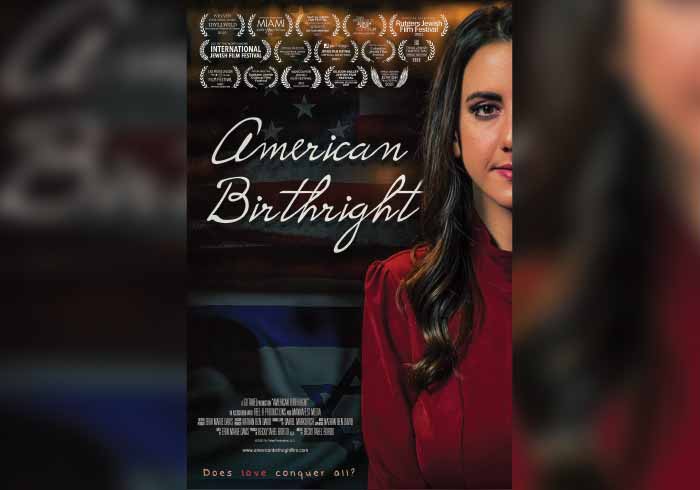
“American Birthright” is a documentary about having difficult conversations. 

The writer and director, Becky Tahel, made her movie to find the answer to two questions: “Should I marry Jewish?” and “Why be Jewish?”

The inspiration behind the documentary came to Tahel when her younger sister Gal became engaged to a non-Jew. Gal and her fiancé Justin agreed to raise their future children Jewish, but also celebrate Christmas and Easter. Their family and community all had varying feelings ranging from joy to disappointment, including Tahel. Both sisters were born in Israel and raised in Philadelphia.

It was all very confusing to Tahel, then 29 years old and an unmarried actress in Los Angeles.  

She had been auditioning for film and television roles of Jewish women, including the titular character in “The Marvelous Mrs. Maisel.” She landed a leading role in a commercial for the dating app JDate. 

But there was something eating her up inside: The sister of the woman on a commercial for a Jewish dating app was getting married to a non-Jew. Tahel knew it would, at the very least, be intriguing to explore.

“My sister and I bumped heads a lot, and I was bumped by her decision [to marry a non-Jew],” Tahel said. “I was worried about her. I wanted to make sure that she understood what she was doing, but I didn’t even understand what she was doing. And I realized that I was the one who needed more education. And isn’t that just life? The things that bump us, we need to explore and hold space for, and we need to stop freaking out about.”

In “American Birthright,” Tahel initially set out to interview family members and rabbis from all different streams of Judaism to learn their perspective on how important individual Jews are in keeping Judaism alive for generations to come. 

One religious scholar pointed out that Christianity and Islam are not significantly affected by intermarriage—both religions have around 2 billion followers each. But with only 15 million Jews in the world, many see intermarriage as a statistical threat. 

A 2020 Pew survey showed that 47% of married Jews outside the Orthodox community are married to a non-Jew. This is compared to 18% of Jews who got married before 1980 who did not have a Jewish spouse. 

“I just want to be a Jew that celebrates Hanukkah, and enjoys the cultural stuff, and goes to summer camp, and goes to Israel every so often,” Tahel told Orthodox Rabbi Benzion Klatzko, the founder of Shabbat.com. “I don’t want to do all those other things. There [are] too many rules. Am I not Jewish?” 

“Oh no, you‘re Jewish” Klatzko assured her. “Education is the beginning of connection. If we don’t understand what Judaism is trying to do, then there’s no way it can speak to us. It becomes OCD practices: that we stand, we sit, we eat, we drink — and that can’t overcome love. It can’t and it won’t.” 

As Tahel looked deeper inside herself, she didn’t fully understand what she loved about being Jewish. She didn’t know how she felt about Torah. She craved more education about Judaism to understand more about herself and her place in it. So she traveled to Jerusalem to study, read, research, debate and reflect at Neve Yerushalayim, one of the oldest all-female seminaries in the world.

“I put Hollywood on hold and booked a  four-month sabbatical — enrolling in a women’s Orthodox seminary to hopefully find the answers to all my burning questions”– Becky Tahel

“I put Hollywood on hold and booked a four-month sabbatical — enrolling in a women’s Orthodox seminary to hopefully find the answers to all my burning questions,” Tahel said in the film. 

There, Tahel explored ancestral healing and intergenerational guilt in Judaism. She determined just how important Judaism really was to her.

“I thought you’re either a cultural Jew or a religious Jew,” she said. “And I didn’t know there were shades of gray. That sort of flavor that I was able to find for myself was the super-inspiring piece. And I hoped that I could bring that into the journey and have people be really excited and inspired to just ask questions. We’re all walking around life, not asking the deeper questions. We don’t want to deal with it.” 

In “American Birthright,” Tahel fights through awkwardness, piousness and certainty. In the end, she presents her findings on her inner faith and identity.

The film received numerous awards on the festival circuit in 2021. Even with its limited release so far, many viewers have reached out to Tahel to share just how much the film impacted them. 

The film received numerous awards on the festival circuit in 2021. Even with its limited release so far, many viewers have reached out to Tahel to share just how much the film impacted them. 

“People are opening up to me about their own Jewish journeys,” she told the Journal. “I get less of the interfaith thing and I get more of the Jewish identity pieces of, ‘Wow, this has just made me really think about why I am Jewish,’ or from the non-Jewish audience, ‘I am what I am.’” 

Tahel also does high school and college workshops with the film. She spent many months of the pandemic driving across the country, living out of a recreational vehicle. 

Without proselytizing one viewpoint over another in the film, Tahel presents her own visible change in “American Birthright.” 

“I felt responsible that my people who came before me led me up to be able to have access to this beautiful experience and this tradition,” she said. “Not everyone has to feel that sort of call, but I think there’s a beauty to that.” 

“American Birthright” will be screening May 25th at 7:30 p.m. at the Laemmle Royal (11523 Santa Monica Blvd., Los Angeles). Tickets: https://www.americanbirthrightfilm.com/screenings

“American Birthright” Documentary Asks, “Should I Marry Jewish?” Read More »