fbpx

March 31, 2022

“Prayer for the French Republic”: A Message for American Jews

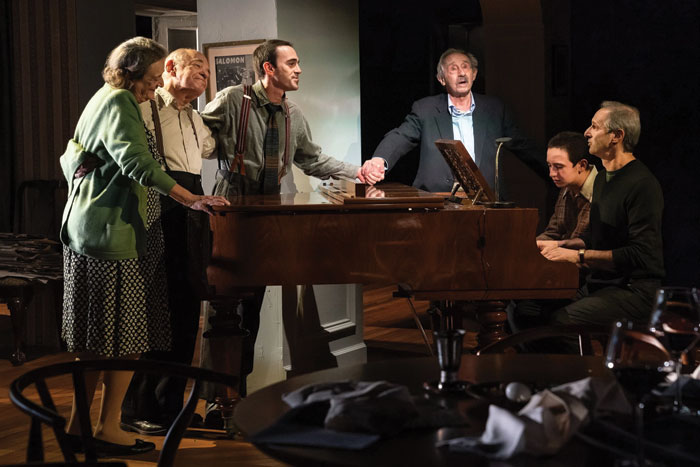
“Prayer for the French Republic” is a very Zionist play. Set in Paris in both 2016 and 1945, the production, which opened off-Broadway in February, follows the Salomons—a Jewish family forced to navigate different breeds of European antisemitism throughout the decades. They eventually come to the conclusion that after the Charlie Hebdo attack, the Sarah Halimi murder, and the possibility of a President Marine Le Pen, there is no choice but to move to Israel. Playwright Joshua Harmon captures the psychological toll that accompanies the realization that one’s home country is no longer safe. It’s an epiphany made all the more painful given that France was the first nation to emancipate its Jews and that the Jewish community still recites the prayer for the French Republic in synagogue as an expression of loyalty and citizenship. The line that closes the final act, “it’s the suitcase or the coffin,” punctuates the feeling of desperation the Salomon family and generations of Jews before them have grappled with in leaving everything behind.

The line that closes the final act, “it’s the suitcase or the coffin,” punctuates the feeling of desperation the Salomon family and generations of Jews before them have grappled with in leaving everything behind. 

The head of the Salomon family is Charles, married to Marcelle. Charles resembles a typical American Jewish father, though his ancestry traces back to Algeria. Marcelle is the classic archetype of a New York-born Jewish mother, emotional and charismatic, as seen in scenes when dirty wine glasses in the living room boil over into full-blown family confrontations. Their children are Elodie, an opinionated but immature young woman, and Daniel, a newly observant Orthodox Jew who is brutalized on the streets of Paris while wearing a yarmulke. Patrick is Marcelle’s brother, intensely secular and disdainful of his family’s convictions, regarding Judaism as something archaic and unnecessary. This attitude is originally shared by Molly, a left-wing American cousin of the Salomons who is studying abroad in France. 

“Prayer for the French Republic” is successful at highlighting the tension between those who take their Jewish identity seriously and those who have been conditioned not to do so. Harmon portrays both Patrick and Molly as out of touch, uneducated, and even as malicious forces for the Salomons, who are greatly influenced by maintaing their son’s continued safety and their family’s sacrifices in generations prior. We root for the Salomons to make it to Israel not only because it would encapsulate a climax of the Jewish story, but also because the move would rebel against the assimilationist, anti-Zionist forces keeping them back. 

But the play is anything but subtle, to its own detriment. Rather than incorporating the important themes of antisemitism and national liberation into the subtext of the work, the dialogue reads as opinion pieces in Jewish newspapers, drowning audiences in long monologues on the intricacies of the Israeli-Palestinian conflict and soliloquies on the question: “Why do they hate us?” It’s hard to believe such conversations were meant to resemble believable family discussions. Harmon’s points are presented to audiences in a somewhat academic manner rather than with natural dramatic prose. It’s more likely that this play was written to educate American audiences, perhaps too blatantly and obviously, on the plight of their fellow Jews overseas. Perhaps this is why the Salomons walk and talk like Americans, rather than French Jews who have been wrestling with these problems for years. 

Only in the last few years have American Jews emerged from the comfortable sense that antisemitism was something of the past, or only the domain of the far-right. By this metric alone, I’m sure many theatre-goers, both Jewish and non-Jewish, were deeply moved by “Prayer for the French Republic,” but to those attuned to the politics of the Jewish community, to those aware that antisemitism can indeed come from both the right and the left, “Prayer” fails to offer anything new or artistically notable. 

Perhaps Harmon was aware of this discrepancy, and perhaps this contributed to the characterization of Patrick and Molly. Harmon may be trying to warn us that the winds of change will not just affect the Jews over there, and implicitly asks us: “Which character do you want to be, which Jew do you want to be?” This is certainly an ambitious approach in making a broader argument about the role of modern Jewry, and yet, realistic execution remains of paramount importance when dealing with such pressing subject matter.

“Prayer for the French Republic” remains a deeply Zionist play. For this I am grateful, considering Broadway is currently wading through an era of preachy social justice, where political ideas being propagated in the theatre are just as expected as the intermission. 

Still, “Prayer for the French Republic” remains a deeply Zionist play. For this I am grateful, considering Broadway is currently wading through an era of preachy social justice, where political ideas being propagated in the theatre are just as expected as the intermission. If “Prayer” is not able to transcend the preachiness, at least it is authentically Jewish. It represents the Jewish story as a particular phenomenon rather than a universalist message against racism. Through the Salomon family’s petty arguments and internalization of threatening political winds, each act strings together fragments of Jewish history with contemporary anxieties. It is crucial that Jews continue to make such a stand in the arts. It is crucial that we make the case for our perspective, with all the baggage behind it. The success of “Prayer for the French Republic,” both commercial and critical, should tell us that these stories deserve to be told, and that the public hasn’t yet been dissuaded from listening.


Blake Flayton is New Media Director and columnist at the Jewish Journal.

“Prayer for the French Republic”: A Message for American Jews Read More »

A Changed Turkey Can Be a Benefit to All

Change is happening fast in Turkey, and countries from Europe to the Middle East and the US are taking note.

On the brink of international isolation not so long ago, we have seen President Recep Tayyip Erdogan usher in a far-reaching geopolitical recalibration in recent months, including several actions that have required real leadership at a time when the world is crying out for partnership and peacemaking.

Across the Black Sea, the Turkish government has provided critical defensive assistance to Ukraine. At the same time, Erdogan has presented himself as a critical mediator between Moscow and Kyiv, leading the international effort to secure a ceasefire.

With neighboring Armenia, a new opportunity now beckons to normalize a relationship that has been almost nonexistent for a century, with reopened borders and mutually beneficial trade ties. Erdogan also visited Abu Dhabi last month to patch up ties with the UAE. At the directive of the president, Turkish Foreign Minister Mevlut Cavusoglu in January met with Bahrain’s Crown Prince Salman bin Hamad Al-Khalifa in Manama. He is also scheduled to visit Israel in the first week of April.

It was a breakthrough when Israeli President Isaac Herzog visited Ankara last month — the most senior Israeli to travel to Turkey in 14 years.

For the last several months, I have been directly involved in diplomatic efforts to shore up another bilateral relationship that is critical for regional security: That between Turkey and Israel. The backchannel talks helped lead to a significant breakthrough, as Israeli President Isaac Herzog visited Ankara last month — the most senior Israeli to travel to Turkey in 14 years.

The renewal of this relationship was no small feat. Relations tumbled dramatically in 2010 amid the fallout of the Gaza flotilla raid. Eight years later, riots broke out in Turkey after the US recognized Jerusalem as the capital of Israel. And the Israelis have chafed for years over Turkish support for the militant Hamas group.

The many differences between the two countries, particularly over the Israeli-Palestinian conflict, will not be solved overnight or through one meeting, but the images of Erdogan welcoming Herzog with open arms undoubtedly sent a signal of hope in a part of the world that needs unity, not division, and security collaboration, not confrontation.

The path to rapprochement was long and winding, stretching all the way to New York and Washington. In the US, I worked closely with Turkish Ambassador Murat Mercan to orchestrate the steps taken by each side, including phone calls between the heads of state and proposed confidence-building measures for each side. At a time when many in the US, including some Jewish leaders, were questioning Washington’s decades-long alliance with Turkey, we discussed how a new Turkish approach toward Israel could be beneficial to all sides.

The summit must not be a one-off. Based on my conversations with the two presidents last week, I feel confident that this new Turkish approach could pay dividends far and wide. As US Ambassador to Turkey Jeff Flake told me, the new direction in Turkey’s foreign policy has been acknowledged and appreciated in Washington.

Even at home, Erdogan has embarked on important reforms and demonstrated congruence between Turkey’s internal affairs and its outward commitments. He is widely reported to have curtailed the influence of the Muslim Brotherhood and made it clear that his party is with the Turkish people in their respect for both Islamic and secular traditions.

In recent months, the president has clearly charted Turkey on a new course that can help solidify its standing as an invaluable force for stability. With the government now embarking on this new, pragmatic foreign policy, we may be able to reconstruct a regional architecture that has been so sorely lacking.

While the future is unknown, we should today credit Turkey for the many steps it is taking to inject hope in places where it has been hard to find. These new bonds of friendship are fragile and must be cultivated by all parties. We all should do all we can to look past our own perceptions of the wrongdoings of the past and explore how we can join together in the quest for greater peace and stability.


Rabbi Marc Schneier is president of the Foundation for Ethnic Understanding and a noted adviser to many Gulf states.

A Changed Turkey Can Be a Benefit to All Read More »

Satirical Semite: A Republican-Democrat Love Story

My friend Jonny 8-Vax is in trouble. He avoided getting COVID due to his eight vaccines, but succumbed to something far worse. Jonny fell in love with a Democrat.

After a contact-high from visiting the Ronald Reagan Presidential Library in Simi Valley, and an endorphin rush from attending a Trump rally in Texas, he accidentally left his echo chamber and met a gorgeous Texan blonde who resembled Ivanka Trump and introduced herself as @chelsearodham. Jonny was seduced by her red lipstick, which was painted over her face with #MAGA written on both cheeks. She admitted to being a liberal Jewish actress from West Hollywood researching a role for “Hillary: The Musical” at the forthcoming Hollywood Fringe Festival. Jonny loved the red paint but ignored the red flag. They bonded during a Young Republicans talent show where he dressed as Elvis and sang “The Real King Lives in Mar-a-Largo.”

It’s complicated. He’s in favor of vaccines but against mandates, while she’s in favor of vaccines and supports mandates. Some couples get matching tattoos, but on their second date they got matching booster shots.

Some couples get matching tattoos, but on their second date they got matching booster shots.

“The thing is,” said Chelsea, “I’m fed up with only having the choice to vote for old white men. I want diversity.” “You’ve got Kamala,” he replied. “Which is more important, someone’s gender and the color of their skin, or someone who will be an incredible leader to run America?” Jonny then offered her another vaccine with a vax card that stated “TDS, Dose 1.” “What’s TDS?” she asked. “Trump Derangement Syndrome!” he said. “You are now protected against the liberal virus. There has been a high infection rate in Los Angeles.”

She slapped him, put on an “I’m still with her” button, and flew home to Austin, Texas. Jonny then visited the Reagan Presidential Library’s gift shop, bought 200 vintage “Reagan Bush ‘84” campaign bumper stickers, and spent the night sticking them on cars around West Hollywood. 

Heartbroken, Chelsea tore up a photo they’d taken at the rally alongside a Trump cutout, with the inscription “I’m with him.” 

In search of a new girlfriend, Jonny headed to the “free state of Florida” where the strongman Republican governor Ron DeSantis had told high school students “you do not have to wear those masks. I mean, please take them off…we’ve gotta stop with this COVID theater. So if you want to wear it, fine, but this is ridiculous.” These were the words of a dictator who imposes dictates upon young minds by insisting they have free choice. As Chelsea once said, “he’s basically Putin.”

Jonny wanted to edit a loving video montage to send her but is still awaiting the delivery of his new Macbook Pro, which will take three months to arrive since Apple’s manufacturing plant is in China, and there is both a supply chain slowdown and a silicon shortage. 

Nevertheless, Jonny was still heartbroken for Chelsea, traveled to Florida, and drowned his sorrows at a bar near Mar-a-Lago. Unfortunately, since central Florida is a land of golf courses and hip replacements, the only available drinking spot was at the Boca Raton JCC, which contained 300 Jewish grandmothers playing Mah-Jong. On the upside, he left with the telephone numbers of their 300 granddaughters. 

Jonny’s next stop was Shabbat in Miami with the hope of sitting next to Jared in shul and meeting Ivanka at the kiddush table. His heart leapt when he saw the ultimate Jewish blonde facing in the other direction, and he said “Shabbat Shalom!” but when she turned around, he saw that it was Chelsea. “Shabbat Shalom, cowboy. I thought you’d never find me.” They hugged, kissed and got thrown out of shul for immodest behavior. 

They danced salsa at a bar in Miami beach, did “Scarface” impressions, and booked tickets for a romantic getaway to Toronto to show solidarity with Canadian truckers. One thing they can agree on is that right now, everyone dislikes Justin Trudeau. This could be the beginning of a beautiful relationship.


Marcus J Freed is an actor, filmmaker and Jewish educator. www.marcusjfreed.com and on social @marcusjfreed.

Satirical Semite: A Republican-Democrat Love Story Read More »

An Apology—Then and Now

I recently came across a letter of apology sent to me in 1982, when I was a 21-year-old senior at UC Berkeley, sent to me by a slightly older grad student named Todd. Reading it again for the first time in many years, I was astonished at the difference between how heated political arguments were handled then versus now. I’m sharing the story hoping that people will see that it’s possible to engage in passionate arguments while still remaining civil, with no need to try to silence opponents.    

Our blowout began after a Bay Area newspaper published a letter to the editor that I had written in response to a cover story by a secular Jew who wrote about what his Jewish identity meant to him. His article upset me greatly. To my mind, he wrote about his religious exploration in a way that trivialized our sacred religious values and instead, elevated leftist social agendas and politics that he traced to Jewish roots. (Familiar story, right?) My letter was harsh, and I signed it as the editor of Ha’Etgar, UC Berkeley’s Jewish quarterly newspaper.  

Todd saw my letter. Then he saw red. He also wrote a letter to the editor, ostensibly about the original article but targeted almost entirely on ridiculing me and my arguments. He belittled me by name numerous times, including an opening salvo where he referred to me in my role as editor of Ha’Etgar as a “little toy gun,” in contrast to the “big Jewish institutional guns” that he derided. Yeah, that stung. 

Todd and I had only a passing acquaintanceship through Berkeley’s Jewish student community. We had never had a real conversation, let alone an argument. I was apoplectic when I saw Todd’s letter, shocked at how personal his attacks were. I called him and said I wanted to meet in person to discuss the matter. We sat on the grass on a little slope in front of the Hearst Mining Building, which I suppose was appropriate because my mood was explosive. I ripped into him for having attacked me so personally in print, while he defended himself and defended points made in the original article. My ego was too bruised and I was too young and headstrong to have been willing to give any ground, though Todd had made some valid points. Among other things, he was right that my calling the writer a “self-hating” Jew was completely inexcusable. 

We resolved nothing, and I walked away from the meeting only partly mollified for having vented my anger at the right address. My reading of the situation was that Todd remained totally unmoved by my anger and hurt, but I was wrong. A week later, I received the letter from him, neatly typed on two pages. It began:

Dear Judy, 

This is an extremely difficult letter for me to write. I felt very sad as you walked away after our meeting last week. I could feel your hurt and knew the time had come for a personal apology. But you had been so stubborn, as I had been (steadfast? intransigent?) that an apology seemed a sign of weakness at that moment. . . 

His letter was thoughtful, proof that he had tried to understand my viewpoints, while maintaining that the tone of my letter had been “misguided and sometimes vicious . . . I hasten to add that I’m sure many of the flaws could be found in my letter. . .”

Thank you, Todd, wherever you are, for the graciousness and generosity in your letter, for not reporting me to the student government to get me booted from my editorship or trying to “cancel” me.

Thank you, Todd, wherever you are, for the graciousness and generosity in your letter, for not reporting me to the student government to get me booted from my editorship or trying to “cancel” me in whatever ways were available in those primitive days before social media became such an easily weaponized tool of destruction. Thank you for signing off with the words, “I hope there is no need for us to avoid or run away from each other—I am perfectly capable of respecting someone personally while disagreeing with them politically.”   

Dialogue, time, perspective, apologies. Perhaps this can become an old-but-new recipe for conflict resolution.


Judy Gruen’s most recent book is The Skeptic and the Rabbi: Falling in Love with Faith. 

An Apology—Then and Now Read More »

How a Man Ages a Woman

“I feel like I was duped,” a close friend confided recently. “Everything I was told about marriage was wrong: You don’t stay in love; you stop giving each other the benefit of the doubt; and there is no wine and candles on ‘mikvah night.’” She paused and added, “Look at me. I’m still young, but being married made me old.” 

In the weeks that passed, I looked — really looked at couples around me, whether young mothers changing diapers while their husbands scrolled Instagram or older women who seemed to have dragged their uncommunicative husbands to dinner at a kabob joint, just to get out of the house for an hour. I didn’t know about their lives. The only thing I know to be sure is that if you look and listen very closely, you begin to understand how a man can age a woman — physically and emotionally. 

These days, my social circles mostly consist of two types of women: those who have been married for many decades and would rather spend time with their dog than their husband, and those who have been married for less than a decade, have young children, and would rather spend time with their coffee than their husbands (and sometimes, their kids). Yes, men — even good men with good intentions — can slowly deplete women like no one else.

Please note that I am not a Licensed Marriage and Family therapist, but I’ve spent most of my life watching high-conflict marriages around me. The following was written with male-female marriages in mind, particularly those with young children. There are many ways that even a good man can age a woman:

He grows inured to her pain.

When my friend first hurt her back in an injury, her husband was incredibly sympathetic and attentive. But over the years, as she struggled with chronic pain and was seldom able to respond to a simple “How are you?” without referring to her back, he grew increasingly inured to her pain. It’s understandable, and it also happens with emotional pain.Another friend who’s struggled with depression since she was a young child found that her husband held loving space for her mental health struggles early in their marriage. But after a year or so, he, too, grew inured to her emotional pain, despite how hard she tried to “keep it together” for the sake of their shalom bayit (“peace in the home”). Like women, men are human. But it’s extremely painful for a woman to subdue her pain because she fears her husband has, sadly, grown desensitized to her suffering. 

He implies that she’s a bottomless pit of need without ever saying a word. 

Taking care of a home and children, especially while working, is indescribably taxing. But you know what’s worse? Living with a man who, even through a simple sigh, signals to a woman that she’s depleting him by asking for too much, too often. As one friend said, “If I could ask anyone else but my husband, I would. I wish I didn’t even have to ask him for help.”

When it comes to taking his family’s side, he’s on autopilot.

Couples get married to create a new “us.” For many women, especially new wives, there are fewer things more shocking than quickly learning that in your new marriage, that “us” is your husband and his family. And on the other side, there’s you. Just you and your Long Island Iced Tea. 

He helps around the house. 

Yes, you read that correctly. I love and appreciate men. But as a woman from a traditional Middle Eastern (Iranian) family, it’s taken me three decades to unlearn something: In America, we need to stop asking men to “help” out around the house.

Why do we expect men to “help” around the house, as though they’re an auxiliary or additional person in the home, rather than an actual occupant? A husband isn’t a metaphorical Airbnb guest who happens to live with us.

If you live alone, do you refer to washing dishes as “helping out”? Of course not. You’re washing dishes because you live there. So why do we expect men to “help” around the house, as though they’re an auxiliary or additional person in the home, rather than an actual occupant? A husband isn’t a metaphorical Airbnb guest who happens to live with us. If I rented out a room in my home to an
Airbnb customer and found him in my kitchen, sweeping the floor, I would be surprised and grateful. But when I find my husband sweeping the floor, I smile and resume cleaning the table. We’re both assuming responsibility for the space we occupy with two small children. 

Today, nearly all women work, and I harbor deep resentment for the childhood message I received from traditional family members: Don’t bother a man with housework requests because he works all day. It’s not only disturbing and cruel to women; it’s not even rooted in reality. Men work. Women work. Of course, there are some women, most of them mothers with very young children, who can stay home with their little ones while their husbands work. But guess what? What those women do is work. 

And if you spend 12 hours a day cleaning up after a child, you can’t be expected to spend the rest of your day cleaning up after a grown man. There are few things less sexy to a woman than incessantly picking up a man’s socks from the floor or putting away his cereal bowl in the sink after breakfast, and such small tasks weigh down a woman for one simple reason: Rather than feeling that she has a reliable partner with whom to tackle life, she’s constantly reminded that everything — even the socks — fall on her shoulders. 

The same reasoning applies to taking care of children. Just as a man isn’t “helping” with cleaning the home where he lives, a father isn’t “babysitting” when he spends time with his own children. In the past few years, I’ve heard a ubiquitous lamentation by many friends: Their husband defensively claims he’s watching the kids because he’s with them, but he’s glued to his phone. “I’m here,” one father kept repeating to his wife when she asked him to play with their toddler. He was there, but he was checking emails. His wife finally gave up, ended her Zoom work meeting early, and sat down to actively play with their child. 

I don’t know why so many men live — truly live — their home lives in such a half-mannered way (I had another hyphenated word in mind that begins with “half,” but I steer clear of expletives in the Journal). I can’t imagine a lovestruck father who holds his newborn infant in his arms, looks down at that perfect, cherubic face and thinks, “I will be part of your life from the comfort of the couch.” For a mother, not feeling that she can rely on her husband to fulfill at least some of her children’s needs is the most painful burden of all. It ages her physically, mentally and spiritually.

We marry so we can learn how to give. And in case you think I’m bashing husbands and fanning the flames of marital resentment, here’s a sneak peek of next week’s column: “How a Woman Tears Down a Man.”


Tabby Refael is a Los Angeles-based writer, speaker, and civic action activist. Follow her on Twitter @RefaelTabby

How a Man Ages a Woman Read More »

Five Rules to Nurture Communal Harmony

It seems as if every week, I get another call about another communal dispute. Sometimes it’s a synagogue, sometimes it’s a school, sometimes it’s an organization. Some disputes have revolved around COVID protocols, others around politics and ideology, still others around the limits of tolerance. The problem is not the disagreements—those have been an integral part of the Jewish story since our very birth as a people.

The problem is when the disagreements turn into ugly and divisive fights. At that point, it is the division itself that becomes the main story.

The problem is not the disagreements— those have been an integral part of the Jewish story since our very birth as a people. The problem is when the disagreements turn into ugly and divisive fights. At that point, it is the division itself that becomes the main story.

Is any disagreement worth tearing us apart?

Ask yourself: If a disagreement is not worth tearing apart your own family, why should it be worth tearing apart a community?

The physical isolation forced by the pandemic has surely made things worse. When you don’t meet people face to face, it’s a lot easier to throw venom at them. Digital screens, whether on social media or WhatApp groups or email, have made it easier to forget the social graces that nurture empathy and dignity.

If you have an interest in reducing the level of rancor in our communities and reinjecting empathy and dignity, I’d like to suggest five simple “rules” that might help us get there. And if your community is already swimming in harmony, look at them as an ounce of prevention.

Rule #1: If you give yourself the benefit of the doubt, give the other person the same treatment. So many fights break out because one side assumes the other side doesn’t mean well. You’re less likely to fight if you accept that the other person has their heart in the right place, just as you do.

Rule #2: If you hate being attacked in public, don’t do it with others. Nobody likes to be humiliated in public. But here’s the thing many people forget: When you go after someone on a Whatsapp group or on social media, that is exactly what you’re doing. However strongly you feel about an issue, the proper thing to do is to reach out privately, just as you’d like to be treated.

Rule #3: Consider the possibility that you don’t have all the information. I’ve noticed that everyone has one thing in common: We’re certain that we’re right. We also assume that we have all the information we need to arrive at that level of certainty. But chances are, we don’t. Very few people do. Before jumping into a confrontation, let’s be humble and try to seek out more information.

Rule #4: If you don’t get your way, don’t go into meltdown. For some inexplicable reason, many people feel that they must always get their way. So we fight and fight until we get our way. And if we don’t, a social volcano erupts, tearing apart communities. If we can’t make peace with the simple reality that we won’t always get our way, we are dooming our communities. Not every issue is life or death. There’s nothing wrong about “agreeing to disagree” and, if we feel strongly enough, moving to other options. It’s only wrong when we do it with anger and spite.

Gossip tastes great, but so does greasy potato chips. It’s easy to sit around Shabbat tables and talk about the latest communal rumble… It’s harder, but more rewarding, to talk about things that will inspire those around you and spread a little joy.  

Rule #5: When you’re around other people, serve up joy, not junk food. Gossip tastes great, but so does greasy potato chips. It’s easy to sit around Shabbat tables and talk about the latest communal rumble, or the latest gossip, or the latest thing that drives you nuts. It’s harder, but more rewarding, to talk about things that will inspire those around you and spread joy. The good news is that if you do, you’ll feel a lot better and you won’t end up with indigestion.

I said these rules were simple, but I didn’t say they were easy. Many go against human nature. As a start, maybe we can all try them for a week and see if they’re worth the effort.

At the very least, our families and communities will thank us.

Five Rules to Nurture Communal Harmony Read More »

Local Business Owner on Being Jewish in Ukraine and Coming to America

Ukraine-born Jewish business owner Yael Lichaa was dumbfounded when she learned that Russia had invaded her homeland.

“It didn’t make sense,” the owner of the Robertson Art Zone (RAZ) told the Journal. “[It’s] hard to believe. How could there be a war? We just came out from COVID. Seems to me people should appreciate life and their health now more than ever.”

Lichaa, who opened RAZ three years ago, believes “children will become enriched by exploring cultural art from around the globe, including Ukraine and Russia,” she said. “Each person has something unique to contribute to the world.” 

Three weeks into the war, Lichaa painted both flags of Ukraine and Russia on her cheeks and placed a peace sign on her forehead. She wore a dress with the map of the world and a headdress of authentic weaving she brought from her native Ukraine. 

Lichaa was 16 years old in 1990 when she, her brother, her dentist father and engineer mother fled their hometown of Kyiv for the United States during the reign of Mikhail Gorbachev. 

“When my father (Lev Burda) came back from a visit to the U.S., he told our family, ‘We better get out right now,’” she said. With no regrets, the Burdas left.

Lichaa, especially, had no regrets. She had begun studying medicine and recalled  a scene that has not faded from her memory. “When I was riding the bus [to class], I would see miserable people. Every day. It was very sad. Nobody ever smiled.”

While Gorbachev may be remembered as softer and more reasonable than his Soviet predecessors, Lichaa knew first-hand how difficult it was to be Jewish in that region. 

“I did not know I was Jewish until I was 15,” she said. 

Her mother, Zoya, was “ashamed” to be a Jew, and her father kept the secret. Her mother was annoyed when her grandparents spoke Yiddish. However, she recanted her rejection two years before she died, even accompanying her daughter to the Kabbalah Center.

When she was 48 years old, Lichaa began writing her autobiography. “Since I was a little girl, I dreamed about doing creative work,” she said. “Kindergarten and school were boring—too much talking, learning unnecessary topics and classes.”

After reading a biography of Marie Curie’s accomplishments as a young woman, she continued, “I wanted to do something that would find a cure for the world.” Working in a Philadelphia doctor’s office after her family settled there, Lichaa was disappointed to see the doctor give shots for the pain, rather than the cause.

She navigated from pre-med to the arts.

But one day, while Lichaa was working on a sculpture of a man, it hit her: Why create what already has been created?” she said. “I understood that it was tangible, easy to be destroyed. I wanted to build something that can stay in the world forever.”

Working on an art project in the early ‘90s, she came across a Tree of Life symbol rooted in Kabbalistic studies.

“After I screamed to God to help me find what it is I have to do [with my life], my best friend’s mother told me a Kabbalah center opened five minutes from my home.”

When Lichaa walked in, a lifetime commitment was formed. Today, she is a regular at the Kabbalah Center on Robertson Boulevard.

“[It’s] hard to believe. How could there be a war? We just came out from COVID.” – Yael Lichaa

None of that could have happened if her cousin Vika, 16, who had emigrated from Kyiv to New York in the 1970s, had not returned for a visit to Ukraine in 1989. Vika, who was writing a school paper on Lenin, asked if she could sit in on Lichaa’s class. Fearing that Lichaa’s cousin would be a negative political influence, the school refused to grant permission. 

Walking home after school that day, a boy called out to Lichaa, “What are you doing here? Go to Israel!”

Lichaa was puzzled. “I had no friends there. Why should I go?” she said. 

Since her parents never had disclosed their Jewishness, Lichaa knew nothing of Shabbat or Jewish holidays.

“That was the day I started asking questions,” she said. “What exactly does it mean to be Jewish? Why don’t people like Jews?”

Reflecting on her past, Lichaa said it’s easy “to appreciate the good times, but appreciating the hard times leads to spiritual growth and [the] manifestation of dreams.”

Local Business Owner on Being Jewish in Ukraine and Coming to America Read More »

Rabbi Sarah Bassin: Finding Common Ground Through Interfaith Relations

Rabbi Sarah Bassin is part of a mixed family. Her mom is a Jew by choice, so growing up in Kansas City, Bassin frequently interacted with her non-Jewish relatives.  

“I thought interfaith families were super normative,” she said. “I had no exposure to the Orthodox community. I didn’t know people still kept kosher. It wasn’t until I went to college on the East Coast that I came into contact with traditional Jews.”

The earlier part of her life guides much of her work today. Bassin, who decided she wanted to become a rabbi after her bat mitzvah to “make the world a better place,” now does interfaith work in her community and around the globe.

For eight years, from 2014 until this past March 21, she served as associate rabbi at Temple Emanuel of Beverly Hills. There, she supported interfaith families, teaching them about Judaism while acknowledging the value of other religions as well.

“I call myself a fundamentalist pluralist. I firmly believe that every religious tradition has something of incredible beauty to offer the world. We just have our own language of expressing it.”

“I call myself a fundamentalist pluralist,” she said. “I firmly believe that every religious tradition has something of incredible beauty to offer the world. We just have our own language of expressing it.”

Temple Emanuel offers Introduction to Judaism classes, which are filled with students approaching Judaism from different perspectives. 

“There are always a couple of partners who are clearly skeptics and say, ‘I’m doing this because I love my partner, but I don’t really want to be here,’” said Bassin. “But because of how we intentionally value their voice, what they are bringing to the conversation and their identity and background, almost inevitably, at the end they are so happy they went through the class together.”

While some people may not want to encourage dialogue among Jews and people from other faiths, Bassin does. She sees the boundaries of the community as porous, and believes that we have always been informed by interactions with those around us.

“I see interfaith engagement and interfaith families as assets to the Jewish community, not as threats” she said. “For too long, they have been framed only in terms of a demographic detriment. There is a self-fulfilling prophecy that when you treat people like statistics, that’s what they become.”

In addition to working with interfaith families, Bassin participates in social justice initiatives. She was the founding executive director of NewGround: A Muslim-Jewish Partnership for Change, which Governor Jerry Brown of California named as the state’s faith-based organization of the year in 2013. She’s traveled with leadershiop delegations to Iran, Qatar, France, England and Germany and connected civil leaders with one another.

“There is a real value in understanding cultures not only through their governments, but also through making direct connections to people,” she said. “It’s worthwhile to have avenues beyond official government conversation.”  

At Temple Emanuel, Bassin had been part of an effort to resettle the Afghan refugees, a cause that is closest to Bassin’s heart. A few years ago, she had a back unit, and she housed a mother and child who were seeking asylum from Mexico, where the drug cartel had kidnapped the child. The child was eventually released and rescued, but the family was still traumatized.  

“I watched [the mom] try to navigate the immigration system and not know where her husband was because he was in a detention center,” Bassin said. “Seeing that experience firsthand made this the issue I care the most about. I could not believe we were still in a state where the people who were experiencing pain and trauma and seeking safety, security and a better life couldn’t get help.”  

To further her work with the refugee population, Bassin is now moving into her role at HIAS, a Jewish nonprofit organization that offers humanitarian assistance and aid to refugees. There, she will serve as the inaugural director of clergy and congregations and continue her justice work.

“For me, Temple Emanuel has been an amazing place to work, and justice has always been my main passion as a rabbi,” she said. “Especially at this particular moment, where there are more than two million Ukrainian refugees, I get to step into this position with HIAS. I really feel the importance and weight of it.”

Fast Takes With Sarah Bassin

Jewish Journal: What’s your favorite Jewish food?

Sarah Bassin: Rugelach. I wish I made it myself. My favorite Jewish cake to make is Passover cheesecake with a macaroon crust.

JJ: What’s the best place you’ve traveled to?

SB: Berlin. The architecture is a juxtaposition of the old and the new. The way that city grapples with its history and wears it on its sleeve is just so powerful. 

JJ: What’s your favorite thing to do with your family? 

SB: I have a toddler who is under two and a newborn, so the most exciting thing we do together is go to the park.

JJ: If you weren’t a rabbi, what would you be? 

SB: Either a cake decorator or a home renovation flipper. I love HGTV. 

Rabbi Sarah Bassin: Finding Common Ground Through Interfaith Relations Read More »

From Vienna, With Love: A Hazelnut and Chocolate Cake Too Good To Passover

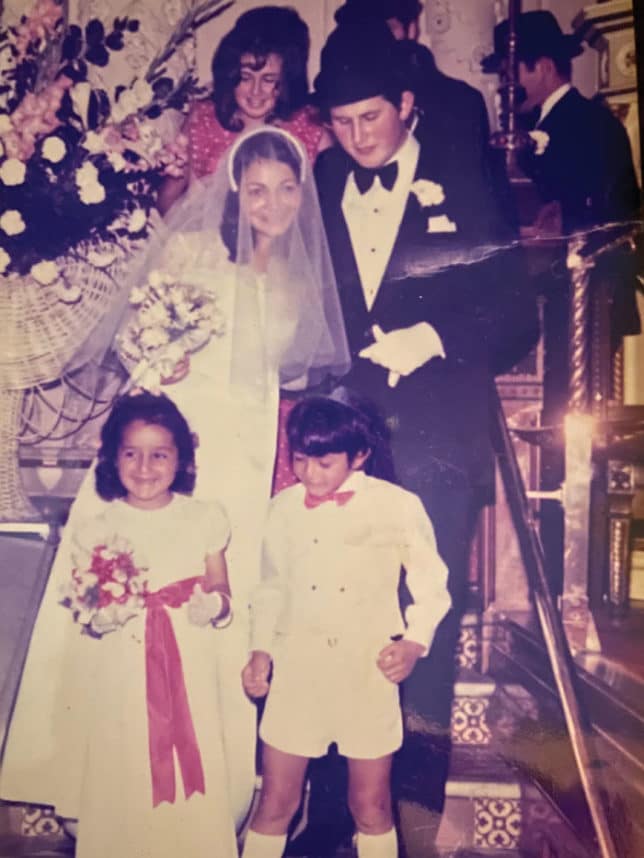
Sharon as the flower girl

Being the flower girl at the wedding of my mother’s younger sister Rebecca to Anthony was probably the most exciting night of my five-year-old life. I wore a long white dress with a fuchsia velvet sash, white mesh gloves and pink rosebuds in my hair.

While my family were immigrants from Baghdad via Israel, my new uncle Anthony came from what seemed to me a very Australian family. His maternal great grandmother Julie Gran, descended from Sephardic Jews who emigrated to Australia in 1883, and was the epitome of refinement. Her daughter Judy, Anthony’s mother, had sparkling brown eyes, a wonderful smile and a lovely manner about her. She married Dennis Clifford, an Ashkenazi Jew from London. He emigrated to Sydney after the Second World War and went into the schmatta business. He was larger than life. A very, very successful manufacturer of ladies dresses, he amassed the world’s largest collection of Royal Doulton, fine china plates and vases that were hand painted by artisans all over England.

My grandparents would invite the Clifford family for Friday night dinners and Jewish holidays. My grandfather would make the kiddush over the wine in his deep voice, we’d say the blessing over the challah and then my grandmother would serve her incredible feasts. Her menus would include dishes like potato kubbah, okra stew with semolina kubbah, platters of roasted saffron and turmeric chicken, tomato-infused rice studded with almonds, sultanas and caramelized onions, and lots of different salads.

After dinner, Anthony’s younger brother Roger would bring out his acoustic guitar and the whole mishpacha (family) would sing for hours. Several years after Anthony and Rebecca married, Roger married Susie.

Recently, Susie wrote to me: “Your grandmother Nana Aziza reminds me so much of my grandmother Omama Irma. They were both natural cooks and always happiest when they were feeding family and guests. I doubt they ever looked at recipe books — it was all in their magic hands.

Your grandmother’s table was always laden with irresistible Middle Eastern delights. It was always exciting to be invited to your grandparents home because the atmosphere was incredible and the food was amazing!”

Susie’s Family

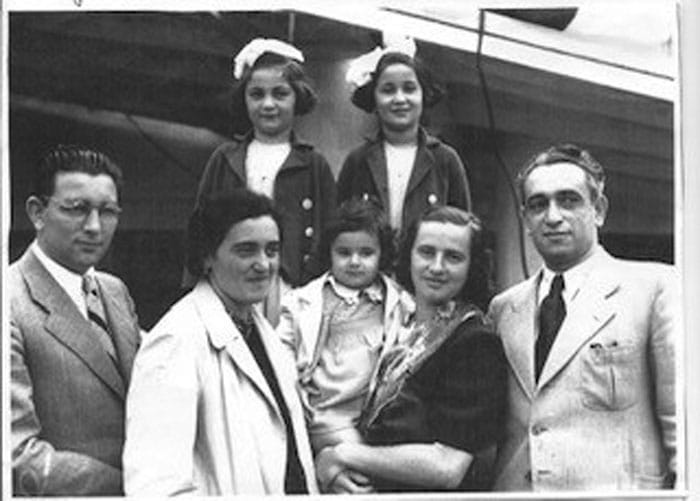
Susie’s Omama Irma was born in Skycov, part of the Austro-Hungarian Empire, in 1908. After her marriage to Layosh (Ludwig) Wohlstein, they moved to Vienna, the flourishing center of Jewish life and culture. They lived there happily until the German Anschluss and rising tide of Nazi antisemitism forced them to flee. Miraculously, Irma, Layosh, their two daughters Trudy and Lilli, her brother and his family were able to secure passage on a boat from Genoa to Sydney, Australia.

As refugees on the first ship allowed to dock in Sydney, their landing was featured on the front page of the Sydney Morning Herald, the venerated broadsheet newspaper. Before the war broke out, Irma and Layosh capitalized on their own good fortune and sponsored family members and many friends for immigration to Australia.

An intuitive cook and baker, Irma loved to feed family and friends. Using recipes she’d learned in Skycov and Vienna,, she quickly gained a reputation for her wonderful food and delicious cakes and desserts.

An intuitive cook and baker, Irma loved to feed family and friends. Using recipes she’d learned in Skycov and Vienna, she quickly gained a reputation for her wonderful food and delicious cakes and desserts.

On those wonderful Friday nights at my grandparents home, Susie would bring Omama Irma’s delicious Chocolate and Hazelnut Cake to be served alongside my aunt Rebecca’s incredible pavlova (recipe is on our website SephardicSpiceGirls.com).

I have been making a flourless chocolate torte for a very long time. Whenever I’m invited for a meal and I ask the hostess what she’d like me to bring, the answer is usually “Chocolate Torte, please!”

Rachel says she still has the piece of paper with the recipe I wrote out for her over ten years ago. It’s still her go-to dessert. A sure crowd pleaser. But to accommodate the health needs of her parents, she has modified my recipe by using only the semisweet chocolate chips and omitting all the sugar. She says that the results are just as moist and delicious.

It’s a really good cake, but Omama Irma’s decadently rich dessert has been seared in my memory for years. So I reached out to Susie and she generously shared the amazing recipe. (I tweaked it a tiny bit.) We’re not sure if it’s the crushed hazelnuts, the coffee or the chocolate ganache that make it better than anything you’ve ever tasted. But it’s that good!

Pesach or not, this recipe is not to be passed over.

Chocolate and Hazelnut Cake

7 eggs, separated
1 cup sugar, divided in half
1 3/4 cups ground hazelnuts
8 ounces dark chocolate, chopped
1 cup water
2 tablespoons instant coffee granules
1/2 cup avocado or safflower oil
1 teaspoon vanilla
1/2 teaspoon kosher salt

Chocolate Glaze
4 ounces dark chocolate, chopped
1 tablespoon sugar
1 teaspoon oil
1/4 cup water

Garnish
1/2 cup roasted hazelnuts
Fresh berries, washed and dried

  • Preheat the oven to 350°F. Line the base and sides of a 10 inch springform cake pan with parchment paper.
  • In a clean, dry bowl, use an electric mixer to whisk the egg whites until fluffy. Gradually add 1/2 cup of sugar and continue beating until stiff peaks form. Set aside.
  • In a medium saucepan, combine the ground hazelnuts, 1/2 cup sugar, chocolate, water and coffee granules. Cook over medium low heat, stirring constantly until the chocolate has melted and the mixture is smooth.
  • Remove from heat and add the oil, stirring well.
  • Pour the mixture into a large mixing bowl and allow to cool slightly. Add the egg yolks, vanilla and salt, beating well to combine.
  • Gently fold the egg whites into the chocolate mixture.
  • Pour batter into the prepared tin and bake for 40 minutes. Remove from oven, undo the latch on the cake tin and allow cake to cool completely.
  • To make the glaze, place the chocolate, sugar, oil and water in a small saucepan and warm over low heat, stirring occasionally until it is a smooth and shiny glaze.
  • Place the cake on a serving plate and spread the chocolate glaze over the top, allowing it to drip down the sides of the cake.
  • Scatter hazelnuts around the edge of the cake and garnish with fresh berries.

Sharon Gomperts and Rachel Emquies Sheff have been friends since high school. The Sephardic Spice Girls project has grown from their collaboration on events for the Sephardic Educational Center in Jerusalem. Upcoming events include a Sharsheret Passover Cooking Webinar. Follow them on Instagram @sephardicspicegirls and on Facebook at Sephardic Spice SEC Food. Website sephardicspicegirls.com/full-recipes

From Vienna, With Love: A Hazelnut and Chocolate Cake Too Good To Passover Read More »