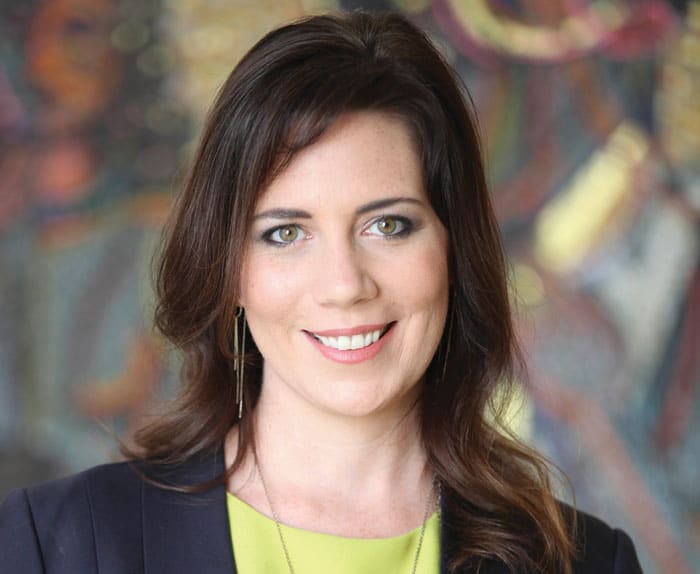
Rabbi Sarah Bassin is part of a mixed family. Her mom is a Jew by choice, so growing up in Kansas City, Bassin frequently interacted with her non-Jewish relatives.
“I thought interfaith families were super normative,” she said. “I had no exposure to the Orthodox community. I didn’t know people still kept kosher. It wasn’t until I went to college on the East Coast that I came into contact with traditional Jews.”
The earlier part of her life guides much of her work today. Bassin, who decided she wanted to become a rabbi after her bat mitzvah to “make the world a better place,” now does interfaith work in her community and around the globe.
For eight years, from 2014 until this past March 21, she served as associate rabbi at Temple Emanuel of Beverly Hills. There, she supported interfaith families, teaching them about Judaism while acknowledging the value of other religions as well.
“I call myself a fundamentalist pluralist. I firmly believe that every religious tradition has something of incredible beauty to offer the world. We just have our own language of expressing it.”
“I call myself a fundamentalist pluralist,” she said. “I firmly believe that every religious tradition has something of incredible beauty to offer the world. We just have our own language of expressing it.”
Temple Emanuel offers Introduction to Judaism classes, which are filled with students approaching Judaism from different perspectives.
“There are always a couple of partners who are clearly skeptics and say, ‘I’m doing this because I love my partner, but I don’t really want to be here,’” said Bassin. “But because of how we intentionally value their voice, what they are bringing to the conversation and their identity and background, almost inevitably, at the end they are so happy they went through the class together.”
While some people may not want to encourage dialogue among Jews and people from other faiths, Bassin does. She sees the boundaries of the community as porous, and believes that we have always been informed by interactions with those around us.
“I see interfaith engagement and interfaith families as assets to the Jewish community, not as threats” she said. “For too long, they have been framed only in terms of a demographic detriment. There is a self-fulfilling prophecy that when you treat people like statistics, that’s what they become.”
In addition to working with interfaith families, Bassin participates in social justice initiatives. She was the founding executive director of NewGround: A Muslim-Jewish Partnership for Change, which Governor Jerry Brown of California named as the state’s faith-based organization of the year in 2013. She’s traveled with leadershiop delegations to Iran, Qatar, France, England and Germany and connected civil leaders with one another.
“There is a real value in understanding cultures not only through their governments, but also through making direct connections to people,” she said. “It’s worthwhile to have avenues beyond official government conversation.”
At Temple Emanuel, Bassin had been part of an effort to resettle the Afghan refugees, a cause that is closest to Bassin’s heart. A few years ago, she had a back unit, and she housed a mother and child who were seeking asylum from Mexico, where the drug cartel had kidnapped the child. The child was eventually released and rescued, but the family was still traumatized.
“I watched [the mom] try to navigate the immigration system and not know where her husband was because he was in a detention center,” Bassin said. “Seeing that experience firsthand made this the issue I care the most about. I could not believe we were still in a state where the people who were experiencing pain and trauma and seeking safety, security and a better life couldn’t get help.”
To further her work with the refugee population, Bassin is now moving into her role at HIAS, a Jewish nonprofit organization that offers humanitarian assistance and aid to refugees. There, she will serve as the inaugural director of clergy and congregations and continue her justice work.
“For me, Temple Emanuel has been an amazing place to work, and justice has always been my main passion as a rabbi,” she said. “Especially at this particular moment, where there are more than two million Ukrainian refugees, I get to step into this position with HIAS. I really feel the importance and weight of it.”
Fast Takes With Sarah Bassin
Jewish Journal: What’s your favorite Jewish food?
Sarah Bassin: Rugelach. I wish I made it myself. My favorite Jewish cake to make is Passover cheesecake with a macaroon crust.
JJ: What’s the best place you’ve traveled to?
SB: Berlin. The architecture is a juxtaposition of the old and the new. The way that city grapples with its history and wears it on its sleeve is just so powerful.
JJ: What’s your favorite thing to do with your family?
SB: I have a toddler who is under two and a newborn, so the most exciting thing we do together is go to the park.
JJ: If you weren’t a rabbi, what would you be?
SB: Either a cake decorator or a home renovation flipper. I love HGTV.