Avivah Zornberg: The book of Leviticus
Follow Shmuel Rosner on Twitter.
Avivah Zornberg: The book of Leviticus Read More »
Follow Shmuel Rosner on Twitter.
Avivah Zornberg: The book of Leviticus Read More »
(JTA) — Mark Asher Goodman is beginning to imagine finishing paying off roughly $85,000 in student debt he incurred while training to become a rabbi — nearly two decades after he was ordained.
So when his rabbinical school, the Ziegler School of Rabbinic Studies, announced last week that it was slashing tuition by nearly 80%, he was briefly envious. Then he was filled with relief that future students at the Conservative seminary, part of Los Angeles’ American Jewish University, won’t have the experience he did.
“I was a day school teacher and rabbi for 12 years, and I made far less than pulpit rabbis,” Goodman, who now leads one synagogue in Erie, Pennsylvania, and works at another in Pittsburgh, told the Jewish Telegraphic Agency. “To force graduates into irrational financial choices due to their loan situations, in any field, is unfair.”
Ziegler’s new tuition is $7,000 a year, down from $31,342 this year. The change makes the school just 20% the price of the Conservative movement’s larger and older rabbinical school, the Jewish Theological Seminary in New York City.
Slashing tuition could seem counterintuitive for a school that is in so much financial distress — since 2018 it has shuttered its undergraduate program, sought renters for its space and, last month, announced that it would sell its 35-acre campus.
But American Jewish University administrators are betting that Ziegler’s new list price will draw more students, reversing a trend of declining enrollment that has contributed to the school’s financial crisis. Just four students enrolled at Ziegler this year; the school ordained only two new rabbis in 2021.
They also say they want to be on the leading edge of a movement to make rabbinical school accessible to a larger and more diverse set of potential Jewish leaders. Training to become a rabbi typically requires five years of courses and fieldwork, such as synagogue internships, making the path burdensome and in many cases impossible for people who do not have family wealth.
Reducing tuition, Ziegler’s dean, Rabbi Bradley Shavit Artson, told the Jewish Telegraphic Agency, “opens up the rabbinate to a much broader pool.”
Artson said donations — rather than, say, anticipated revenue from the campus sale — were making possible the new tuition, which applies to current students in addition to future ones. Additional funds will cover tuition completely while students study in Israel during their third year, according to the details of the new tuition plan.
He declined to name the people who had given to support the initiative, saying only that AJU possesses an “extraordinary circle of philanthropists and community leaders who understand that a literate, wise and compassionate rabbinate holds the key to energizing and strengthening the Jewish future.”
It is unclear how much of a difference Ziegler’s new price will make to individual students, considering that many were receiving substantial financial aid before.
But the flashy price tag may make it more appealing for aspiring rabbis in the Conservative movement. At JTS, the movement’s flagship seminary, this year’s tuition is over $36,000 — although few if any students there pay full price.
The price war comes in the context of declining overall interest in the rabbinate and in declining affiliation by American Jews with Conservative synagogues.

The Ziegler School of Rabbinic Studies is running Facebook ads to announce its new, lower tuition. (Screenshot)
Competition between the two schools for students who want to become Conservative rabbis “produces constant incentives to improve and to compete,” Artson said. He added, “The challenge is in the context of that healthy competition to realize we’re not actually competing.”
A JTS spokesperson said that school would continue to offer “substantial tuition assistance, stipends, fellowships and internship opportunities” to make rabbinical school affordable for students who enroll.
“We are delighted to hear about all initiatives that assist students in pursuing a career in the rabbinate,” the spokesperson said.
There’s evidence that tuition incentives could have the intended effect — but also that increasing enrollment may not be a panacea for the woes facing a rabbinical school or its movement. When Hebrew Union College in Cincinnati offered tuition incentives to make attendance there relatively inexpensive compared to the Reform movement’s campuses in New York and Los Angeles, students chose Cincinnati more often.
But when the incentives ended, the campus again became the last choice for Reform rabbinical students. Now, the school is seeking to stop training rabbinical students in Cincinnati entirely.
Ziegler and American Jewish University, too, face an uncertain future. The Bel-Air campus where Ziegler has been housed since it opened in 1996 is up for sale, and while the university is retaining a different parcel of land, where it has housed a camp, it’s not clear where future rabbinical students will go to class after next year, though administrators are emphasizing that learning will take place in person.
“There will be a physical space, and it will be holy,” Artson told JTA.
Three rabbinical students deferred enrollment last year to this fall, the school said, but how many additional students will enroll at Ziegler is unclear.
“Time will tell if that move will counteract the uncertainty that comes with the planned sale of the AJU’s Familian Campus,” Goodman said about the tuition reduction. “But in the long run, making rabbinic school more affordable is a net positive move for the Jewish people.”

One of 2 Conservative Rabbinical Schools in the US Is Slashing Tuition — by Nearly 80% Read More »
I am a baby boomer. The generation of the Cold War. On command, we elementary school kids would drop and curl up under our wooden desks, wanting to believe that this act would protect us from the dreaded atomic bomb that Russia – the Soviet Union – might drop on us at any moment.
As a child, the words Russia, Reds, Iron Curtain, Soviet Union swirled around me like a nightmare you can only feel but not describe. I wanted my life to go back to a time when I didn’t know about bombs.
Russia remained the enemy until the Iron Curtain started coming down in 1989. By then I was living and teaching in Israel and I was excited to welcome the new immigrants from the former Soviet Union, many of whom became my high school students.
Two years later, Israel was attacked with Scud missiles during the Gulf War. Now I was running drills for my own students on how to use their gas masks. As in the 50s, I’m sure my students knew deep down that this would not protect them.
With such positive connections to the new Russia, even I came out from under my protective wooden school desk to visit the country of my former sworn enemy. In 2009, my husband and I attended an exclusive wedding in a restaurant in the capital of the former Soviet Union. I remember the euphoria, the inner joy I felt as we were able to roam around Red Square in the country I had so feared. The people were free, and we were free to go where we wanted, to speak Hebrew or English without fear of secret police. This was one of those moments that validates hope for better times.
Instead of monsters, I found haute couture, nightclubs, couples and families shopping in stores I couldn’t afford, children playing in parks, everyone photographing themselves with the Kremlin in the background.
True, the Iron Curtain had come down over twenty years before, but for me to be casually strolling the streets of Moscow, this was a miracle. Those drop drills had instilled in me an irrational fear of Mother Russia. I could never have imagined a world where I’d be touring the den of my nightmares. Instead of monsters, I found haute couture, nightclubs, couples and families shopping in stores I couldn’t afford, children playing in parks, everyone photographing themselves with the Kremlin in the background. The heavy gray and drab uniform styles we had seen in movies had been replaced by three-inch spike heels, tight dresses and short skirts. There was laughter. And American franchises like McDonald’s.
I never patronize McDonald’s in any country. But on this trip, I was desperate for some cool air and a rest room. It was Moscow’s hottest summer in a century and wildfires were burning around the city adding to the heat and feelings of suffocation. There is little air conditioning in Russia because there is usually no need for it. I ignored my aversion to McDonald’s and followed my husband through the door and found relief and French fries.
Here we are today, 2022. The Cold War of my childhood has become a real war. The atomic bomb we feared has become the threat of nuclear weapons. Neither drop drills nor gas mask training can help the people of the Ukraine or the next victims of Russian aggression. The Russia we applauded when the walls came down and borders opened has now tragically returned to its terrifying, bullying ways under Vladimir Putin.
Russia is closed to outgoing and incoming flights. McDonald’s is closed “temporarily” according to a Google map of Moscow. It leaves out the reason, but we know it is the sanctions imposed by international companies aimed at punishing Putin for his brutal war against the Ukraine. I wish it were so easy to stop a war.
The frightening memories of my childhood are sharpened as the free world circles back to fearing Russia and Putin’s threat to use nuclear weapons to achieve his goals. It’s a vicious circle that I hope will end one day soon, but only on the upswing.
Galia Miller Sprung, who moved to Israel in 1970 to become a pioneer farmer, is a retired high school teacher, writer and editor.
Parents are tasked with feeding their children on a daily basis. It’s usually a mundane responsibility and just one of the many things they do throughout the day. They don’t have a second thought about it.
But what if a child is medically unable to eat? What does a parent do then? For Debi Lewis, she was consumed by the struggle to feed her daughter, Sammi, for the first nine years of her life. From birth, Sammi had problems with swallowing, and the label “failure to thrive” was placed on her medical charts.
Today, Lewis is the author of a new book, “Kitchen Medicine: How I Fed My Daughter Out of Failure to Thrive,” about her issues with trying to feed Sammi. Each chapter is named for a different type of food the author explores – like chickpea soup, matzo and fat-free cream cheese and pickles – and how it affected Sammi and Lewis’ entire family.
“I don’t know what it was during all those years that kept me from turning on food, from hating it and resenting it, but instead of never wanting to look at the stove again, I kept returning, curious and seeking joy and wonder.” – Debi Lewis
“There was medicine, of course, and there were surgeries and doctor’s appointments and therapies and consultations, but more than anything else, there was food — rules and structure and complicated diets, restrictions and extra calories, so many changes I can mark those years by food-related phases,” Lewis writes. “I don’t know what it was during all those years that kept me from turning on food, from hating it and resenting it, but instead of never wanting to look at the stove again, I kept returning, curious and seeking joy and wonder.”
From the time Sammi was born, she was in and out of doctors’ offices. According to Lewis, her daughter was diagnosed with laryngomalacia as a newborn, then gastro-esophageal reflux and a double aortic arch. At age four, she was diagnosed with eosinophilic esophagitis, a chronic, lifelong condition where the esophagus becomes inflamed and will not properly contract. It causes difficulty swallowing.
Sammi’s doctors suggested Lewis and her husband try different types of food to help their daughter. Throughout all this, Lewis felt alone.
“There is nothing for parents of children like Sammi, who are in a liminal, confusing medical purgatory of ‘failure to thrive’ with other confounding diagnoses,” she said. “There were parents with similar stories — a local friend whose daughter had celiac disease, a friend far away whose son had laryngomalacia — but there were no hospital support groups for us.”
Though Lewis was stressed out by the situation, there were many moments of triumph when she learned to love cooking and feeding her family. She writes how she never cooked until she got married. Then, she began making recipes from cookbooks for her first child as well as her husband, and continued exploring different food options for Sammi.
“I learned that our attitudes about food and feeding have to be grounded in some kind of deeper goal in order for them not to take over our inner life to a debilitating degree,” she said. “When I was able to step back and find joy and creativity in food, it made handling the constantly changing dietary restrictions much easier. It’s like what Mary Poppins says: ‘In every job that must be done, there is an element of fun. Find the fun and snap! The job’s a game!’”
While it wasn’t always so easy to channel her inner Mary Poppins, she was able to keep her ultimate goal in mind, which was to not destroy her daughter’s relationship with food. “Remembering that helped me find better language than ‘forbidden’ or ‘bad’ when it came to foods that she couldn’t eat, and helped me figure out how to course correct when I’d slipped in my own language,” she said.
Through various medications, therapies, surgeries and food, Sammi eventually learned how to eat. Today, she is 16 years old and loves the traditional Ashkenazi foods her mother makes, like matzo ball soup and challah. “When she was little, she claimed to like challah but didn’t actually eat much of it [because] I think it was hard for her to swallow,” said Lewis. “Now, when we make two loaves for Shabbos, she can finish almost a third of a loaf at Friday night dinner.”
Like other Jewish mothers, Lewis has a spiritual relationship with cooking, and that transforms her kitchen into a sanctuary. “I think this is true of many parents and grandparents who find the connection between feeding and love to be especially strong,” she said. “Treating food as a gift and taking into account the needs of the people around you makes cooking for them the real blessing that it is.”
Lewis hopes that when parents dealing with similar issues read her book, they’ll know that others went through the same thing. “For the parent of the next child whose pediatrician clucks his tongue and says ‘Still failure-to-thrive, dad, you’ve gotta get more calories in this kid,’ I want there to be a story they can hold in their hands that makes them feel less alone,” she said.
In “Kitchen Medicine,” she also strives to show how much of a miracle the food we eat is, and how we can have a positive experience with it.
“The sense of reverence I experienced when Sammi’s body healed was not terribly different from the reverence I feel when I pull a tomato off the vine from a plant I grew myself or the amazement I feel when my yeast proofs and the challah dough rises,” she said. “It’s amazing to be a human being whose body functions, and it’s incredible that the food we need just grows out of the dirt. Throughout every struggle, I always felt a sense of wonder at the things we could achieve with help or hard work. I hope that others who read this find some measure of appreciation for the sacred nature of everyday life.”
You can purchase “Kitchen Medicine” online at DebiLewis.com/kitchen-medicine.
“Kitchen Medicine” Tells the Story of a Child’s Struggle to Eat Read More »
“Dwell on the beauty of life. Watch the stars and see yourself running with them.”
— Marcus Aurelius
“Have you ever walked late at night through a forest when you are first in love?”
— Conrad Veidt
I have always loved the night. I’ve always found it wonderful. When most people have pajama-ed up and are tightly tucked in, I’m out roaming in the shimmer of the evening. When the sun quits, my heart starts ticking. For jazz artists and comics, the night is king. That’s when we hear the music. That’s when our souls start to dance. The night is what we live for.
I am a nightclub comic. Many of the people I work with I’ve never seen during the yellow hours. Occasionally I’ll be asked to do a show during the daytime. Day shows always seem wrong. Empty of heart. Just a money grab. Even strip clubs are open for the lunch crowd. But never comedy clubs.
I love the sound of rain as it pings off the roof of a car on a dark street. I love staring out the window of a beat-up cab with busted shocks and under-inflated tires as it zips me across Central Park at 3 am. The night is when the big cities or small drab towns all come alive in the shadow of the moon and stars. I, too, come alive in those shadows.
From ages 20 to 30, I mostly woke up after the strike of noon, dying for the night to take a bow. Growing up, I remember hearing my father saying, “I can’t sit in that rush hour traffic anymore. I have to find a better way.” He never did find that better way. Most taxi drivers will tell you they would rather drive at night when there is less traffic but don’t because they are afraid of being robbed. Murderers, thieves, whores, drunks, dopers, short-order cooks, people trying to forget their jobs by burning through their paychecks, people cleaning bank safes and office buildings, runaways, broken hearts looking for an answer, new lovers hopeful they can finally stop looking … those are a few of the types that comics share the night with.
The night is when romance gets its charge. Is there such a thing as romance during the day? Lovers like to hide in the corners of dim-lit booths. Can Dylan Thomas be fully understood before it gets dark?
The night is what many love songs are written about. After a harsh breakup, put on Sinatra’s “Only the Lonely” album at 1 am. Good luck trying to make it to daybreak.
I’m in a profession that allows you to tell your loved ones you have no idea when you will be home, but you promise to kiss them on your return.
During my school years, they never suggested any type of night work. Comics don’t punch clocks; we punch lines. I’m in a profession that allows you to tell your loved ones you have no idea when you will be home, but you promise to kiss them on your return. A profession that while you’re working, you’re allowed to booze with the opposite sex. But the night plays tricks. It can get you thinking, “This is the one” when you already have the one. And lead you to never to go home and plant that kiss you promised them. It’s rare, but occasionally two hearts do meet on a barstool. But rarely if ever without a sad story attached.
I’m in a profession that if you don’t have somewhat of a poet’s soul and if you don’t mind not sleeping with the one you love and if you don’t mind rarely having a homecooked meal and if you don’t mind working every holiday while the rest of the world is off and if you don’t need to own sunglasses unless you’re on drugs and if you don’t mind traveling alone in towns you have never been to and will probably never go back to and if you don’t mind having the stars and moon as your umbrella and if you don’t mind being lonely much of the time and if you think you can be funny in a room of complete strangers under bright hot lights, then the night is where you belong.
And that’s where you might find me.
Mark Schiff is a comedian, actor and writer, and host of the ‘You Don’t Know Schiff’ podcast.
In the Heat of the Night Read More »
You shall eat it in a holy place…
-Leviticus 10:13
I’m not going to waste your time telling you the joke
about the summary of all Jewish holidays.
(Okay, maybe just parenthetically, in the unlikely event
you don’t know it: They tried to kill us. They failed. Let’s eat.)
Every sentence of this section
of this Torah portion is about eating.
We are instructed to eat.
We are instructed what to eat.
We are instructed how to eat.
We are instructed where to eat.
Nothing is left to question.
If one of the great mysteries of your life
has been where and how to eat
the Breast of Waving, then this is your moment.
(Also if you didn’t know there was a
breast of waving, and for that matter
a thigh of raising, I’m only too happy
to share this information.)
Everything Jewish begins with, ends with
or is composed of eating.
Even the times we are not supposed to eat
culminate with eating.
We can’t get away from it. (Nor do we want to!)
I may take a break from writing this to have a snack.
Okay, I’m back. I hope you’re not hungry.
You should really eat something.
You’re starting to look a little thin.
Are you wearing enough sweaters
And for heaven’s sake, write down
all the details of the recipe.
You don’t want your descendants screwing it up
with interpretation.
You should eat.
You should eat right now.
Los Angeles poet Rick Lupert created the Poetry Super Highway (an online publication and resource for poets), and hosted the Cobalt Cafe weekly poetry reading for almost 21 years. He’s authored 25 collections of poetry, including “God Wrestler: A Poem for Every Torah Portion“, “I’m a Jew, Are You” (Jewish themed poems) and “Feeding Holy Cats” (Poetry written while a staff member on the first Birthright Israel trip), and most recently “The Tokyo-Van Nuys Express” (Poems written in Japan – Ain’t Got No Press, August 2020) and edited the anthologies “Ekphrastia Gone Wild”, “A Poet’s Haggadah”, and “The Night Goes on All Night.” He writes the daily web comic “Cat and Banana” with fellow Los Angeles poet Brendan Constantine. He’s widely published and reads his poetry wherever they let him.
You Should Eat (As if you didn’t know that) – A poem for Parsha Shemini Read More »
For approximately a decade, throughout the 1990s and early 2000s, I was a member of the Israel section of Amnesty International. During this period, I was also a member of the board of directors, and in 1998-1999, I was its chair. There, I met good people who devoted their energy, money and time to helping people they did not know, and all of this on a purely voluntary basis.
Currently, I am not a member of the organization, and I do not know most of the members at the Israeli section. Most of the officials of the international movement who were active at the beginning of the millennium have been replaced by others. It goes without saying that I do not pretend to represent the organization or speak for it.
Amnesty was founded in 1961 following an article published in The Observer titled, “The Forgotten Prisoners.” In its infancy, one of the organization’s major focuses was “prisoners of conscience”: people who were imprisoned for exercising their basic human rights in a non-violent way, and without calling for the use of violence. At that time, it was relatively easy to find prisoners of conscience: It was just a matter of locating a person in the Communist Bloc or in a European or Latin American dictatorship who was imprisoned or who had vanished as a result of such activity.
In the late 1980s and 1990s, as these regimes were gradually disappearing, distinct prisoners of conscience became rarer. More human rights organizations, which fought for the same pool of activists and donors as Amnesty International, entered the arena. In addition, the spotlight turned to ethnic conflicts like the one that erupted in Yugoslavia, following CNN and similar parties that broadcasted live from all over the world. These conflicts involved widespread and severe human rights violations, but investigating them required staff members with different skill sets than the ones used to aid prisoners of conscience.
These developments made the organization’s investigations of events that took place months and sometimes years before publication, irrelevant, and pressure mounted to publish current reports. However, producing quick and accurate research requires many qualified experts, access to warzones and to classified materials, as well as the ability to interview combatants in real time, and more. The organization did not possess the manpower and financial resources that enable such investigations, and to the best of my knowledge it does not have them today, rendering its reports far less professional. These phenomena were further exacerbated during the second decade of the 21st century, when social networks became an influential factor in the organization’s agenda and modus operandi.
The organization did not possess the manpower and financial resources that enable such investigations, and to the best of my knowledge it does not have them today, rendering its reports far less professional.
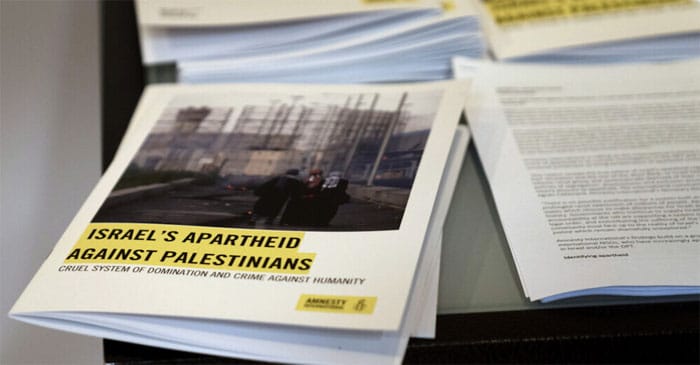
A recently published Amnesty International report declared that Israel practices a policy of apartheid against the Palestinians, both in Israel and the Palestinian Authority. In my view, this is a ridiculous claim, but since this is a case of a detailed report by a prestigious organization, cries of antisemitism will clearly not be helpful here. Readers around the world would rather believe an organization that is considered reliable and neutral and not the Israeli Ministry of Foreign Affairs.
I wish to address the report itself, particularly at the methodological level.
Amnesty International’s reports are written anonymously. There is no way to know who authored the report, how many researchers were involved in its preparation, what their professional experience is and so on. In addition, when examining the sources on which the current report is based, a disturbing picture emerges. The report contains about 1,600 footnotes, the majority of which refer to past reports and policy papers by Amnesty International, B’Tselem, Adalah, HaMoked, Ir Amim, Bimkom, Al-Haq, and additional far-Left Israeli organizations, as well as reports by the UN Human Rights Council and similar international bodies. When these are the sources for “research” that purports to examine the State of Israel’s attitude toward its Arab population from 1948 to the present, it is clear that the result will be biased and one-sided. While I am not familiar with all the legal experts quoted in the report, if one relies on people like John Dugard, who is known for his critical attitude toward Israel, it is clear that the views of people like him will lead any reasonable person to similar conclusions. Furthermore, despite the fact that the report claims to confirm the theory that Israel, since its inception, has aspired to discriminate against Arabs on racial grounds, the number of sources concerning Israel’s first fifty years is negligible compared to those concerning recent decades.
Amnesty International prides itself on the organization’s high level of research and its neutrality. This report is an extreme example of how baseless that claim is.
Amnesty International prides itself on the organization’s high level of research and its neutrality. This report is an extreme example of how baseless that claim is. If one writes a report based almost entirely on all one-sided sources, does not bother to engage with civil society organizations that hold a different perspective, and does not turn to mainstream academics and legal experts, then he is conducting biased and negligent research with the main purpose of smearing Israel and harming its international status. His aim is not to promote human rights. Anyone who seeks to have a dialogue with Israel and improve its human rights situation should not label it an apartheid state, which by definition makes it illegitimate.
Dr. Michael Ehrlich, Department of Middle Eastern Studies Bar-Ilan University, Israel
Behind the Scenes of Amnesty International’s Report on Israel Read More »
United Nations Special Rapporteur Michael Lynk released a report on March 24 accusing Israel of being an apartheid state.
The report, according to The Times of Israel (TOI), alleged that Israel is providing “one racial-national-ethnic group with substantial rights, benefits and privileges while intentionally subjecting another group to live behind walls, checkpoints and under a permanent military rule” in the “occupied Palestinian territory.” Additionally, Lynk claimed that Israel is fragmenting the Gaza Strip, West Bank and East Jerusalem from each other to divide the Palestinians and that the Jewish state is “warehousing” Palestinians in Gaza. TOI also noted that Palestinian terror groups like Hamas and Islamic Jihad are omitted from Lynk’s report.
Israeli Ambassador to the United Nations in Geneva Meirav Eilon Shahar accused Lynk of promulgating “baseless and outrageous libels previously published by NGOs that share the same goal as the author of this report: to delegitimize and criminalize the State of Israel for what it is: the Nation State of the Jewish People, with equal rights for all its citizens, irrespective of religion, race or sex.”
Jewish groups also lambasted the report.
“AJC strongly rejects the biased findings of the UN Special Rapporteur’s libelous report on Israel,” the American Jewish Committee (AJC) tweeted. “Israel is a pluralistic democracy that ensures equal rights to all of its citizens. Bolstering [Amnesty International]’s baseless allegations does nothing to advance the cause of peace.” Amnesty had released a report in February that also accused Israel of apartheid, although The Jerusalem Post noted that Lynk’s report “will be posted on the UN’s internet and written into the [UN Human Rights Council] record.”
AJC strongly rejects the biased findings of the UN Special Rapporteur's libelous report on Israel.
Israel is a pluralistic democracy that ensures equal rights to all of its citizens.
Bolstering @Amnesty's baseless allegations does nothing to advance the cause of peace. https://t.co/Hy02MXg1Zg
— American Jewish Committee (@AJCGlobal) March 24, 2022
International Legal Forum CEO Arsen Ostrovsky similarly said in a statement, “The word ‘apartheid’ is mentioned over 100 times in this 18-page report, yet the words ‘Palestinian terror’ not once. Indeed, the Special Rapporteur, who went out of his way to defend Palestinian violence, in fact relied on evidence submitted by PFLP-affiliated terror groups Al-Haq and Addameer. Ultimately, like the reports that preceded it, including by Amnesty International and Human Rights Watch, this one too is a malicious manipulation of international law, divorced from reality and a gross distortion of truth, which deserves to be placed in the dustbin of antisemitic history.” Ostrovsky added that the report was released the “same day as four Israelis were murdered in a brutal terror attack in Beersheba, or as Russia is waging a devastating war against Ukraine in the greatest humanitarian crisis in recent memory, is indicative of the UN Human Rights Council’s perverse sense of priorities, in continuing to single out Israel for opprobrium and relentless obsession, over focusing on actual pressing human rights abuses around the world.”
NGO Monitor argued that Lynk’s report uses rhetoric “designed to portray Israel as greedy and cartoonishly wicked.” “The reader is told that Israeli measures to prevent the smuggling of weapons and military materiel into Gaza constitute a ‘medieval military blockade,’ and that Israel is a ‘covetous alien power’ that must ‘abandon the fever-dream of settler-colonialism and recognize the freedom of the indigenous people.’” Regarding Lynk’s “medieval military blockade” accusation, NGO Monitor argued that “Lynk ignores the terrorist organizations ruling and operating in Gaza, and the two decades of increasing rocket fire that they have directed at Israeli population centers – clear war crimes. No honest assessment of Israeli policy can whitewash the threat that Gaza-based terror groups like Hamas and Islamic Jihad pose to Israeli citizens.”
Additionally, NGO Monitor argued that Lynk’s claim that a “prolonged occupation” of the West Bank is illegal under international law is false and that Lynk is following the trend of anti-Israel activists in attempting to redefine “occupation” into “apartheid.” NGO Monitor also noted that the difference in how the Israeli government treats Israelis and Palestinians isn’t based on race or ethnicity but on ‘citizens and non-citizens,’” “Israel’s Arab citizens enjoy greater freedom of movement in the West Bank than Israeli Jews, entering PA-controlled Area A to study, shop, purchase real estate, and for recreation,” the watchdog group added. “By contrast, Israeli law does not permit Israeli Jews to enter these areas, but this to protect their security rather than to segregate them on racial grounds.”
UN Rapporteur Issues Report Accusing Israel of Apartheid Read More »
Rabbi Jeffrey K. Salkin, the rabbi at Temple Israel in West Palm Beach, Florida, recently shared an article about the future of religious leadership. In gleaning insight from the Megillah, he explains that clergy burnout (across faiths and denominations) can be avoided if one remembers to “center yourself on your goals, your ideals and your passions.”
He offers that at the end of the Megillah, Mordecai is described as a leader “popular with the multitude of his brethren.” Meaning, Mordecai wasn’t actually liked by everyone. Astonishingly, when you remember that Mordecai is considered one of the heroes of the story, intimately involved in saving the Jewish people from utter demise, this may be hard to believe. But Salkin uses this very example as an important lesson: you will never be liked by everyone. And the greatest of leaders must understand that to be everything to everyone is to virtually stand for nothing.
And so, the question that each person must answer: what do you stand for? Parents often teach their children to stop following the crowd. But the lesson falls short when we forget to distill what it is that’s worth championing. Whether you are a leader in an organization or leader of your family, what are the values that define your life? And is your life reflective of those values?
Life should not be a popularity contest. But the ongoing shaping of one’s character to meet one’s priorities…that is a pursuit that holds promise. When I think about the person I want to be and the leader I aspire to become, the words of Micah 6:8 bolster my spirit: And what the Lord requires of you: Only to do justice, and to love goodness, and to walk humbly with God.
We can’t be everything for everyone. But if we hold by that which sustains our soul, we will be more than enough.
Shabbat Shalom
Rabbi Nicole Guzik is a rabbi at Sinai Temple. She can be reached at her Facebook page at Rabbi Nicole Guzik or on Instagram @rabbiguzik. For more writings, visit Rabbi Guzik’s blog section from Sinai Temple’s website.
A Bisl Torah – More Than Enough Read More »
Dear all,
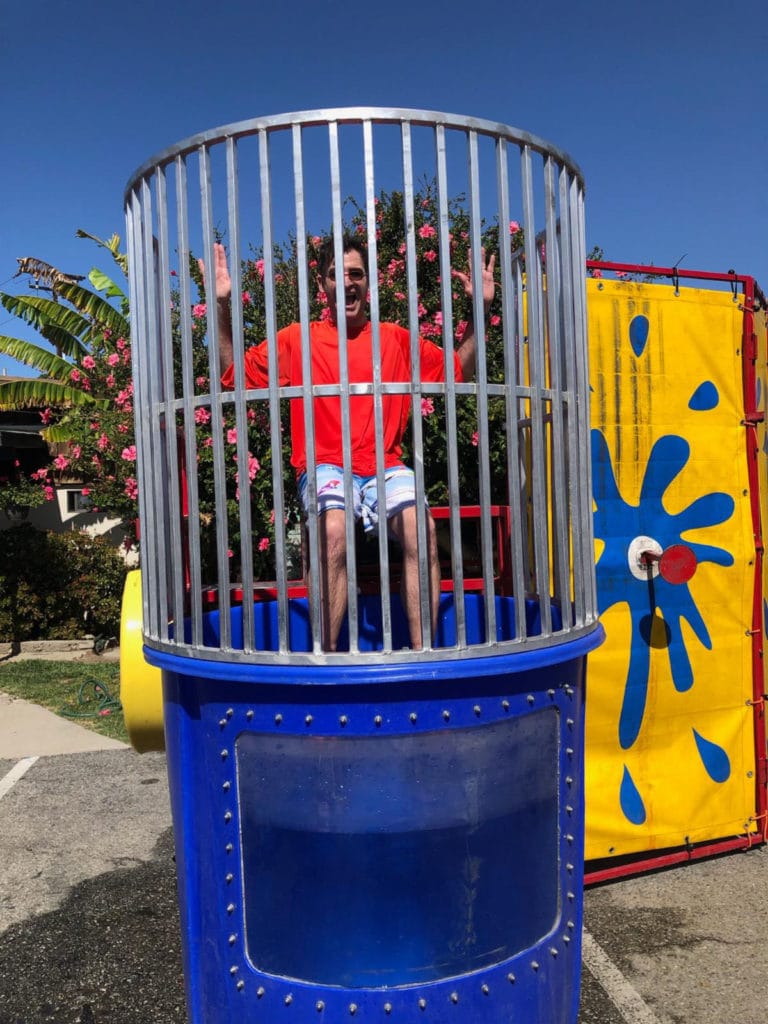
Last weekend I found myself perched above a bucket of cold water as members of the community attempted to “Dunk the Rabbi” during our Purim Carnival. Yes, people lined up to seize the opportunity! We all had a great time.
But as I sat there above the bucket, contemplating my fate, it dawned on me:
”What is on my bucket list?”
Where do I want to visit?
Who do I want to meet?
What adventure is calling my name?
What value do I want to uphold?
What organization should I support more generously?
And … When am I going to start crossing things off the “to do” list – and accomplish them?!
We each have our own bucket list. This is the moment in time to dive in!
Rabbi Zach Shapiro
Moment in Time: What’s on Your Bucket List? Read More »